Hua Chenyu: The Life Story Behind China's Wild Star
In this post
- A Boy From Shiyan Who Heard Music Differently
- Super Boy and the Audition Nobody Forgot
- Albums, Aliens, and a Sound All His Own
- Love, Family, and Life in the Spotlight
- The Mars Concerts and the Fans Who Call Themselves Martians
- What Hua Chenyu Leaves Behind
- The Voice as an Instrument and the Training Behind the Wildness
- The Fans Who Travel and the Nights They Remember
- My Take:
Hua Chenyu is the most unpredictable singer in Chinese pop. One minute he is whispering, the next he is screaming, and a moment later he is singing a note so high and so long that the audience gasps. His concerts feel less like a normal pop show and more like a storm: lights, smoke, strange sounds, and a singer who gives everything he has to the stage. Some people find him strange. Many more find him thrilling, and they follow him with a loyalty that few Chinese singers can match.
He came to fame in 2013, when he won the singing contest Super Boy. From the very first audition, it was clear that he was not like the other contestants. He did not sing safe, pretty songs. He sang with a wild energy that seemed to come from somewhere deep inside, and the judges did not know what to make of him at first. By the end of the contest, they knew. He was the winner, and a new kind of Chinese pop star had arrived.
This is the story of a boy from Hubei who heard music differently from everyone around him, and who turned that difference into one of the most remarkable careers in Chinese entertainment.
A Boy From Shiyan Who Heard Music Differently
Hua Chenyu was born on 7 February 1990 in Shiyan, a city in Hubei province in central China. Shiyan is not a famous city, and Hua Chenyu’s childhood was not a famous one. He grew up in an ordinary family, and like many children, he went to school, played with friends, and listened to music on the radio. But from an early age, there was something different about the way he heard sound. He was drawn to strange noises, to high notes, and to music that other people found odd.
As a child, he is reported to have spent long hours alone with music, listening and experimenting. He was not a loud child in the usual sense, but his inner world was loud with sound. He learned to play instruments, and he began to think about music not as a set of rules to follow, but as a place to explore. A normal song has a clear tune and a steady beat. Hua Chenyu was interested in what happens when you break those rules, when you let a voice rise, fall, and twist in unexpected ways.
His parents’ marriage ended when he was young, and he grew up largely with his father. That is a hard start for any child, and it may help to explain the intensity in his music. A child who has lived through a family breaking apart often feels things deeply, and music can become the place where those feelings go. Hua Chenyu’s singing has always had that quality: it sounds like a person letting out feelings that have been held in for a long time.
At school, he was not the kind of student who fitted easily into every class, but music was the place where he belonged. He studied at the Wuhan Conservatory of Music, one of the respected music schools in China, and there he learned the formal side of his craft: how to sing properly, how to understand harmony, and how to shape a performance. The training gave him control over his wild voice, and that control is what makes his performances work. He is not just shouting. He is a trained singer choosing to push his voice to its limits.
Super Boy and the Audition Nobody Forgot
In 2013, Hua Chenyu entered Super Boy, the televised singing contest that had launched many Chinese stars. His audition was unforgettable. He sang a song called “Why Nobody Fights”, and he performed it in a way that no one had seen before. His voice moved from a whisper to a cry, his body moved with the music, and the judges watched with a mix of surprise and delight. It was not a safe performance. It was a strange, brave performance, and it made him famous overnight.
Week after week, he kept surprising the audience. Other contestants chose well-known songs and sang them well. Hua Chenyu chose difficult songs, and he sang them in his own way, often changing the arrangement so that it sounded like no one else’s version. He took risks that could have ended his run in the contest, and the risks paid off. The audience voted for him in large numbers, and the judges, who had been unsure at first, became his champions.
He won Super Boy in 2013, and the win changed his life completely. He went from a music student in Wuhan to one of the most talked-about young singers in China. Record companies wanted to sign him, television shows wanted him as a guest, and fans began to follow his every move. For a young man who had spent his childhood hearing music differently, it was a dream come true, but it was also the start of a life lived in public, with all the pressure that brings.
The years after the contest were busy. He released his first album, Quasimodo’s Gift, in 2014, and it showed the world what kind of artist he wanted to be. The album was not a collection of safe pop songs. It was strange, bold, and full of his own ideas. Some listeners loved it at once. Others needed time to understand it. But no one could say it sounded like anyone else, and that was the point.
Albums, Aliens, and a Sound All His Own
Hua Chenyu’s albums tell the story of an artist who refuses to repeat himself. After Quasimodo’s Gift came Aliens in 2015, an album that pushed his sound even further into strange and dramatic territory. Then came H in 2017, and New World in 2020, each one different from the last, each one full of songs that only he could have made. He writes about loneliness, about the world, about love, and about the feeling of being different, and he does it in a musical language that mixes pop, rock, and something entirely his own.
His voice is his most famous tool. He can sing very high, very low, very soft, and very loud, and he can move between those extremes in a single phrase. Trained singers admire his control, and ordinary listeners are simply amazed by what they hear. A Hua Chenyu song is not background music. It demands attention, and it rewards it, because there is always something unexpected waiting in the next line.
He is also known for his concerts, which he calls Mars Concerts. The name comes from his fans, who call themselves Martians, as if they come from another planet, just like him. His concerts are large, loud, and full of visual spectacle: huge stages, dramatic lights, and performances that feel like theatre as much as music. Fans travel from across China to see him, and they sing along to every word. For many of them, a Mars Concert is not just a show. It is a gathering of people who feel different, and who have found a singer who understands that feeling.
He has also worked as a mentor and judge on singing shows, where his advice is often direct and honest. He tells young singers to be themselves, to take risks, and to trust their own ears. That advice comes from his own life. He took risks on Super Boy, and those risks made his career. He wants the next generation to have the same courage.
Love, Family, and Life in the Spotlight
Hua Chenyu’s private life has been closely watched, and in January 2021 he and the singer Zhang Bichen shared the news that they had a daughter together. They said that they were raising their child together while not being married, and the announcement drew a great deal of public attention. It was a personal matter, and both singers asked for privacy for their child. The news showed a different side of Hua Chenyu: not the wild performer, but a young father trying to protect his family from the noise of fame.
Fame has brought him both great love from fans and great pressure. He is one of the most popular singers in China, and that popularity means that everything he does is watched and discussed. A new song, a new look, a new concert: all of it becomes news. He has handled this attention in his own way, by focusing on his music and by keeping much of his private life out of view. He does not court scandal, and he does not turn his personal life into a show.
There have been difficult moments, as there are for every star of his size. Rumours and criticism are part of life at the top of Chinese pop, and Hua Chenyu has faced his share. He has mostly answered by working: by releasing new music, by performing, and by letting his concerts speak for him. His fans have stayed loyal through these times, and their loyalty is one of the strongest in Chinese entertainment. They call themselves Martians, and they defend their singer with a passion that is famous in itself.
His health and his energy are also part of the story. His performances are physically demanding, and he gives everything on stage. Fans worry about him when he works too hard, and he has spoken about the need to rest and to look after himself. A career built on wild energy needs care, and he has learned, over the years, how to balance the storm on stage with quiet time away from it.
The Mars Concerts and the Fans Who Call Themselves Martians
The Mars Concerts are the heart of Hua Chenyu’s career, and they are unlike any other concerts in China. The name began as a joke among his fans, who felt that their singer was so strange that he must come from Mars. Hua Chenyu took the joke and made it his own, and now the Mars Concert is a brand, a gathering, and a promise all at once. When he announces a Mars Concert, tickets sell fast, and fans travel from every part of China to be there.
What makes these concerts special is the feeling in the room. The audience is not just watching a star. They are part of a community of people who feel different in their own lives, and who have found a place where that difference is celebrated. They wear red, they wave lights, and they sing every word, including the hardest notes, as if they are singing them for themselves. For many fans, the concert is the best night of their year.
Hua Chenyu gives everything at these shows. He sings for hours, he moves across the stage, and he pours his whole energy into the performance. There is no holding back, and there is no safe, easy set list. He sings the strange songs, the hard songs, and the songs that only his true fans know by heart. That honesty is why the concerts matter so much. He does not perform for the cameras. He performs for the people in the room, and they know it.
The concerts have also grown over the years, from smaller halls to huge stadiums, and they have become one of the biggest live events in Chinese pop. Other singers have large concerts too, but few have a fan community as close and as devoted as the Martians. That community is Hua Chenyu’s greatest achievement, because it was built not on a single hit, but on years of strange, brave music that spoke to people who felt like outsiders.
What Hua Chenyu Leaves Behind
Hua Chenyu is still in the middle of his career, and it is too early to write a final judgement. But some things are already clear. He changed what a Chinese pop star could be. Before him, the path was narrow: sing pretty songs, look perfect, and do not frighten anyone. He broke that path. He sang strange songs, he looked different, and he made a career out of being himself. That opened a door for other unusual singers, and Chinese pop is wider and more interesting because of it.
His influence is also a lesson about courage. He could have won Super Boy and then played it safe, releasing easy songs and becoming a normal idol. He did not. He chose the harder road, and he kept choosing it, album after album. That choice cost him some easy success, but it gave him something better: a career that is truly his own, and fans who love him for who he is, not for who he pretends to be.
For young singers, his story says something simple and hard: trust your own ears. If you hear music differently, do not hide it. Learn your craft, so that your strangeness has skill behind it, and then take the risk of showing it to the world. Not everyone will understand, but the people who do will follow you for years. That is the lesson of Hua Chenyu’s life, and it is a lesson that goes far beyond music.
The Voice as an Instrument and the Training Behind the Wildness
Many people hear Hua Chenyu and think he is simply wild, a singer who screams and jumps and lets his feelings take over. That is only half the story. Behind the wildness is years of formal training, and a voice that has been shaped with great care. He studied at the Wuhan Conservatory of Music, and there he learned how the voice works: how to breathe, how to support a note, and how to move from a whisper to a cry without hurting himself. A singer who tries to do what he does without that training would damage his voice very quickly. Hua Chenyu has been doing it for more than a decade, and his voice is still strong, because he knows what he is doing.
His range is one of the widest in Chinese pop. He can sing very low, in a voice that sounds almost like a whisper, and he can sing very high, in notes that seem to come from another world. He can also move between those extremes in a single phrase, which is one of the hardest things a singer can do. It takes control, it takes breath, and it takes confidence. When he does it on stage, the audience gasps, because it sounds impossible, but it is not impossible. It is the result of practice, and of a singer who understands his instrument deeply.
He also uses his voice in ways that other singers do not. He will add a cry, a laugh, a breath, or a strange sound to a song, and those sounds become part of the music. Some listeners find that strange, and some find it thrilling, but no one can say it is careless. Every sound he makes is a choice, and it is a choice that comes from a musician who hears the voice as an instrument, not just as a way to carry words. That is a rare way to think about singing, and it is the reason his music sounds like no one else’s.
His training also shows in the way he writes songs. He does not just write a simple tune and repeat it. He builds songs with changes, with surprises, and with moments that catch the listener off guard. A Hua Chenyu song can start quietly, build to a storm, and then fall back to a whisper, all in a few minutes. That structure takes skill, and it takes a composer who understands how music works. He is not just a singer. He is a musician, and his songs are built like small pieces of theatre.
He has also learned how to protect his voice. A singer who performs as intensely as he does must rest, must warm up properly, and must know when to stop. He has spoken about the need to look after himself, and about the balance between giving everything on stage and saving something for the next show. That balance is hard to find, and it is one of the reasons his career has lasted. A wild singer who does not care for his voice will soon have no voice. Hua Chenyu has cared for his, and it is still there, strong and strange, after more than a decade.
His influence on other singers is also worth noting. Young performers who hear him realise that a voice can do more than sing a pretty tune. It can cry, it can shout, it can whisper, and it can become many voices at once. That freedom has encouraged a new generation of Chinese singers to experiment, to take risks, and to trust their own ears. Not all of them will succeed, but the ones who do will owe something to Hua Chenyu, who showed them that a strange voice can fill a stadium.
The Fans Who Travel and the Nights They Remember
Hua Chenyu’s fans are different from the fans of most pop stars, because they do not just follow him. They travel for him, they wait for him, and they build their year around his concerts. When a Mars Concert is announced, fans from every part of China book trains and planes, arrange time off work, and make the journey to be in the room. That kind of devotion is rare, and it is built on something deeper than a hit song. It is built on the feeling that this singer understands what it means to feel different, and that his concerts are a place where different people belong.
The fans call themselves Martians, and they wear red, wave lights, and sing every word, including the hardest notes, as if they are singing them for themselves. For many of them, the concert is not just a show. It is the best night of their year, a night when they can be strange, loud, and free, without anyone judging them. That freedom is a gift, and Hua Chenyu gives it to them by being strange himself, openly and without apology.
The community around him is also a source of friendship. Fans meet each other at concerts, they form groups online, and they support each other through hard times. A young person who feels alone at school or at work can find friends among the Martians, because they share a love of the same singer and the same feeling of being different. That community is one of the most valuable things Hua Chenyu has created, even if it is not a song or an album. It is a place where people belong, and it lasts long after the concert ends.
He knows how much his fans give, and he gives back by performing for hours, by singing the strange songs that only his true fans know, and by treating the concert as a shared experience rather than a one-way show. That respect is the reason his fans stay loyal, year after year, even when his music changes and his style grows stranger. They do not follow him because he is safe. They follow him because he is honest, and because his concerts are the one place where they feel fully themselves. He has also worked with other musicians and producers, and those collaborations have added new colours to his sound. A singer who works alone can become narrow, but a singer who listens to other artists learns new ideas, and Hua Chenyu has always been open to that learning. He has invited other voices into his concerts, and he has shared his stage with younger performers, giving them a chance to be heard by his large audience. That generosity is a sign of confidence, because a star who is afraid of being overshadowed would never share his stage. He shares it gladly, and his fans love him for it.
My Take:
I will be honest: Hua Chenyu is the singer in this group who puzzles me the most, and that is why I find him the most interesting. I do not always understand his music on the first listen. Sometimes it sounds strange, sometimes it sounds too loud, and sometimes I wonder what he is trying to say. But then I listen again, and I hear the skill underneath the strangeness, and I realise that the strangeness is not an accident. It is a choice, made by a man who hears music differently and refuses to pretend otherwise. I respect that choice, even when I do not fully share his taste.
What I admire most is his courage. Winning Super Boy gave him a safe path. He could have become a normal idol, singing sweet songs and smiling for the cameras, and he would have been rich and famous. Instead, he chose to be strange. He chose hard songs, wild performances, and a sound that many people did not understand at first. That takes a kind of bravery that is easy to praise and hard to practise. Most of us, given a safe path and a wild path, choose the safe one. He chose the wild one, and he kept choosing it for more than a decade. I think that is remarkable.
I also think about his childhood, and about growing up with a family that had broken apart. I do not want to claim too much, because his private pain is his own, but I think it is fair to say that a child who has lived through that kind of loss often feels things more deeply than other children. His singing sounds like that to me: like a person who has held a lot inside and is finally letting it out. When he screams on stage, I do not hear showing off. I hear release. And when he whispers, I hear the quiet side of the same feeling. That range is what makes him worth listening to, even for people who do not love every song.
The Mars Concerts fascinate me, because they are about more than music. They are about belonging. His fans call themselves Martians, which is a funny name, but it is also a serious one. It says: we feel different, we feel like we come from another planet, and here, in this stadium, we belong. I think many young people in China feel that way, even if they do not say it. They feel strange at school, strange at work, strange in their own families. A singer who tells them that strangeness is a good thing is giving them a gift. I am glad that gift exists, and I am glad it fills stadiums.
I do have worries about him, and I want to say them plainly. His performances are so intense that they must take a heavy toll on his body and his mind. A man cannot scream for hours, night after night, without paying a price. I hope he rests, I hope he looks after his health, and I hope the people around him protect him from working too hard. The music business is good at using up a wild talent and then moving on. I would hate to see that happen to him. His fans love him, but love from a crowd is not the same as rest, and I hope he knows the difference.
His family news, the daughter he shares with Zhang Bichen, also makes me think. Two singers, a child, and a public that wants to know everything: that is a hard situation. I respect the way they asked for privacy, and I hope the child grows up with as much quiet as possible. Fame is a strange gift to give a child, and it is not one the child chose. I think Hua Chenyu understands that, and I hope he keeps protecting his daughter from the noise, even as his own life stays loud.
As a mentor on television, I think he has done something valuable. He tells young singers to be themselves, and he means it, because he lived it. That advice is easy to give and hard to follow, and a young singer who hears it from a man who won Super Boy by being strange is more likely to believe it. I hope the next generation listens, because Chinese pop needs more singers who sound like themselves and fewer who sound like everyone else.
If I could speak to a young reader who feels strange and different, I would point to Hua Chenyu and say this: your difference is not a problem to hide. It is the most valuable thing you have, if you learn your craft and have the courage to show it. He learned to sing properly, he studied music, and then he used that training to be wild. The training came first, and the wildness came second. That order matters. You cannot break the rules well until you know them, and he knows them.
In the end, I come back to one idea: Hua Chenyu is a reminder that pop music does not have to be safe. It can be strange, loud, sad, and beautiful all at once, and it can still fill a stadium. Long after the safe songs of his time are forgotten, people will remember the night they saw a man from Mars leap across a stage and sing a note that seemed impossible. That is a fine memory to leave behind, and I think he has earned it. I also want to think about the word “strange”, because it follows Hua Chenyu everywhere, and I think it is worth asking what it really means. When people call him strange, they often mean that he does not fit their idea of a pop star. He does not sing pretty songs, he does not smile in the expected way, and he does not behave like other idols. But strange is not the same as wrong. A strange singer is a singer who hears something different, and who has the courage to share it. I think the world needs more strange singers, not fewer, because they are the ones who push music forward. The safe singers keep music comfortable. The strange ones make it grow.
His albums also deserve more attention, because they are not just collections of songs. Each one is a world of its own, with a different mood and a different sound. Quasimodo’s Gift was dark and dramatic, Aliens was wilder and more experimental, H was more personal, and New World was broader and more hopeful. That willingness to change is rare. Many stars find one sound that works and repeat it for twenty years. Hua Chenyu refuses to repeat himself, and that refusal costs him some easy success, but it gives him something better: a body of work that is truly his own, and that will be studied by young musicians for years to come.
I sometimes think about his fans, the Martians, and about what it means to belong to a community like that. A fan community can be a wonderful thing, because it gives people a place where they feel accepted. But it can also be a closed world, where the fans defend their star against all criticism, and where no one is allowed to say that a song is not good. I hope the Martians can love him and also be honest with him, because a star who is only ever praised will stop growing. The best fans are the ones who love you enough to tell you the truth, and I hope Hua Chenyu has fans like that around him.
His role as a mentor also makes me think about the next generation. When he tells a young singer to be herself, he is not giving empty advice. He is telling her to do what he did, and that is a powerful message. But I also know that being yourself is not easy when the whole industry wants you to be someone else. A young singer who follows his advice will face the same risks he faced, and she will need the same courage. I hope he tells them that too: that being yourself is brave, and that bravery has a cost, but that it is worth paying.
If I could ask him one question, it would be about the quiet moments. After the concert ends, after the lights go out and the crowd goes home, what does he think about? Does he feel proud, or tired, or lonely? I think the answer would be honest, and I think it would help a lot of people understand that fame is not a constant high. It is a series of moments, some loud and some quiet, and the quiet ones are often the hardest. A singer who gives everything on stage must find a way to live quietly off it, and I hope Hua Chenyu has found that way.
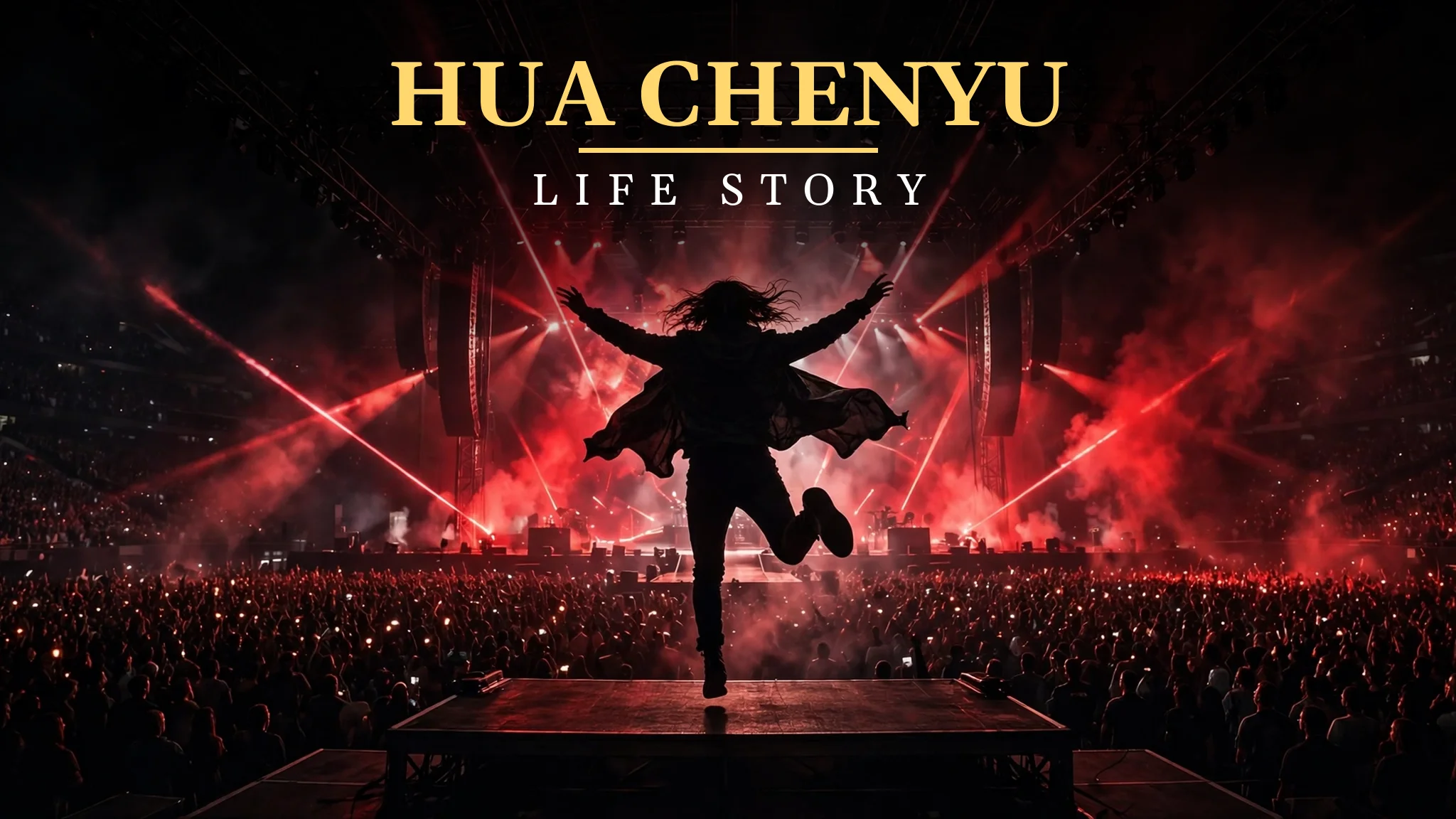
In the end, I come back to the leap on the stage, the silhouette in red light, arms wide, caught in mid-air. That image is the heart of his story: a man who jumps, not knowing exactly where he will land, but trusting that his voice and his training will carry him. Long after the safe songs of his time are forgotten, people will remember that leap, and they will remember the night they saw a man from Mars sing a note that seemed impossible. That is a fine memory to leave behind, and I think he has earned it. I also want to think about his fans, the Martians, because they are a community that tells me something important about the world today. Many young people feel different, and they feel alone in that difference. They feel strange at school, strange at work, and strange in their own families. Hua Chenyu’s concerts give them a place where that strangeness is not a problem but a badge of honour. They wear red, they sing the hard notes, and they belong. I think that belonging is one of the most valuable things a singer can give, and it is the reason his fans travel so far to see him. A concert that makes you feel at home in your own skin is worth more than any hit song.
I also think about the price of that devotion, for the fans and for him. A fan who travels across China, spends her savings, and waits for hours to see a concert is giving a great deal, and a star who receives that devotion carries a great responsibility. I hope Hua Chenyu knows how much his fans give, and I hope he treats that gift with care. And I hope his fans remember that their lives matter too, and that a concert is a wonderful night, but it is not a whole life. The best fan communities are the ones that lift people up in their daily lives, not just on concert nights, and I hope the Martians do that for each other.
If I could speak to a young person who feels strange and alone, I would point to Hua Chenyu and say this: your difference is not a problem to hide. It is the most valuable thing you have, if you learn your craft and have the courage to show it. He learned to sing properly, he studied music, and then he used that training to be wild. The training came first, and the wildness came second. That order matters. You cannot break the rules well until you know them, and he knows them. Learn first, then be brave, and the people who understand you will find you.
In the end, I think of him as a reminder that pop music does not have to be safe. It can be strange, loud, sad, and beautiful all at once, and it can still fill a stadium with people who feel at home. Long after the safe songs of his time are forgotten, people will remember the night they saw a man leap across a stage and sing a note that seemed impossible, and they will remember that they were not alone in feeling different. That is a fine legacy, and I hope he keeps building it. One more thought about Hua Chenyu: his music asks something of the listener that most pop does not ask. It asks you to pay attention, to sit with a strange sound, and to let it grow on you. That is not how most people listen to music today, where a song has ten seconds to catch your ear or it is skipped. Hua Chenyu’s songs reward patience, and they punish haste. I think that is a valuable lesson in itself. Some things in life, like a good song or a good friendship, take time to understand, and the people who give them that time are rewarded. His fans have given him that time, and they have been rewarded with a body of work that is unlike anything else in Chinese pop. One more thought about Hua Chenyu: his music asks something of the listener that most pop does not ask. It asks you to pay attention, to sit with a strange sound, and to let it grow on you. That is not how most people listen to music today, where a song has ten seconds to catch your ear or it is skipped. Hua Chenyu’s songs reward patience, and they punish haste. I think that is a valuable lesson in itself, and it is one that applies far beyond music. Some things in life, like a good song or a good friendship, take time to understand, and the people who give them that time are rewarded with something deeper than a quick thrill.
Frequently Asked Questions
When was Hua Chenyu born?
Hua Chenyu was born on 7 February 1990 in Shiyan, Hubei province, in central China. He grew up in an ordinary family and later studied at the Wuhan Conservatory of Music. His training there gave him the vocal control behind his wild and dramatic performances.
How did Hua Chenyu become famous?
He became famous by winning the singing contest Super Boy in 2013. His audition, in which he sang “Why Nobody Fights” in a strange and powerful way, made him known overnight. He kept taking risks through the contest, and the audience voted him the winner.
What are Hua Chenyu’s Mars Concerts?
Mars Concerts are his large live shows, named after his fans, who call themselves Martians. The concerts are known for dramatic staging, long sets, and a strong sense of community among fans who feel different in their own lives. Tickets sell fast, and fans travel from across China to attend them.
What albums has Hua Chenyu released?
His albums include Quasimodo’s Gift from 2014, Aliens from 2015, H from 2017, and New World from 2020. Each album sounds different from the last, and they show his wish to keep growing rather than repeating one safe style. His songs mix pop and rock with his own dramatic vocal style.
Does Hua Chenyu have a child?
Yes, in January 2021 he and the singer Zhang Bichen shared the news that they had a daughter together. They said they were raising their child together while not being married, and they asked for privacy for their daughter. The announcement drew wide public attention in China.
Why is Hua Chenyu called a wild star?
He is called wild because of his unpredictable singing, which moves from whispers to screams and very high notes, and because of his intense stage performances. He does not follow the safe path of a normal pop idol, and his concerts feel more like a storm than a quiet show. Fans love that daring style.


