Hugh Grant: The Life Story Behind the Romantic Star
In this post
- An Oxford Education and an Accidental Actor
- Four Weddings and Overnight Stardom
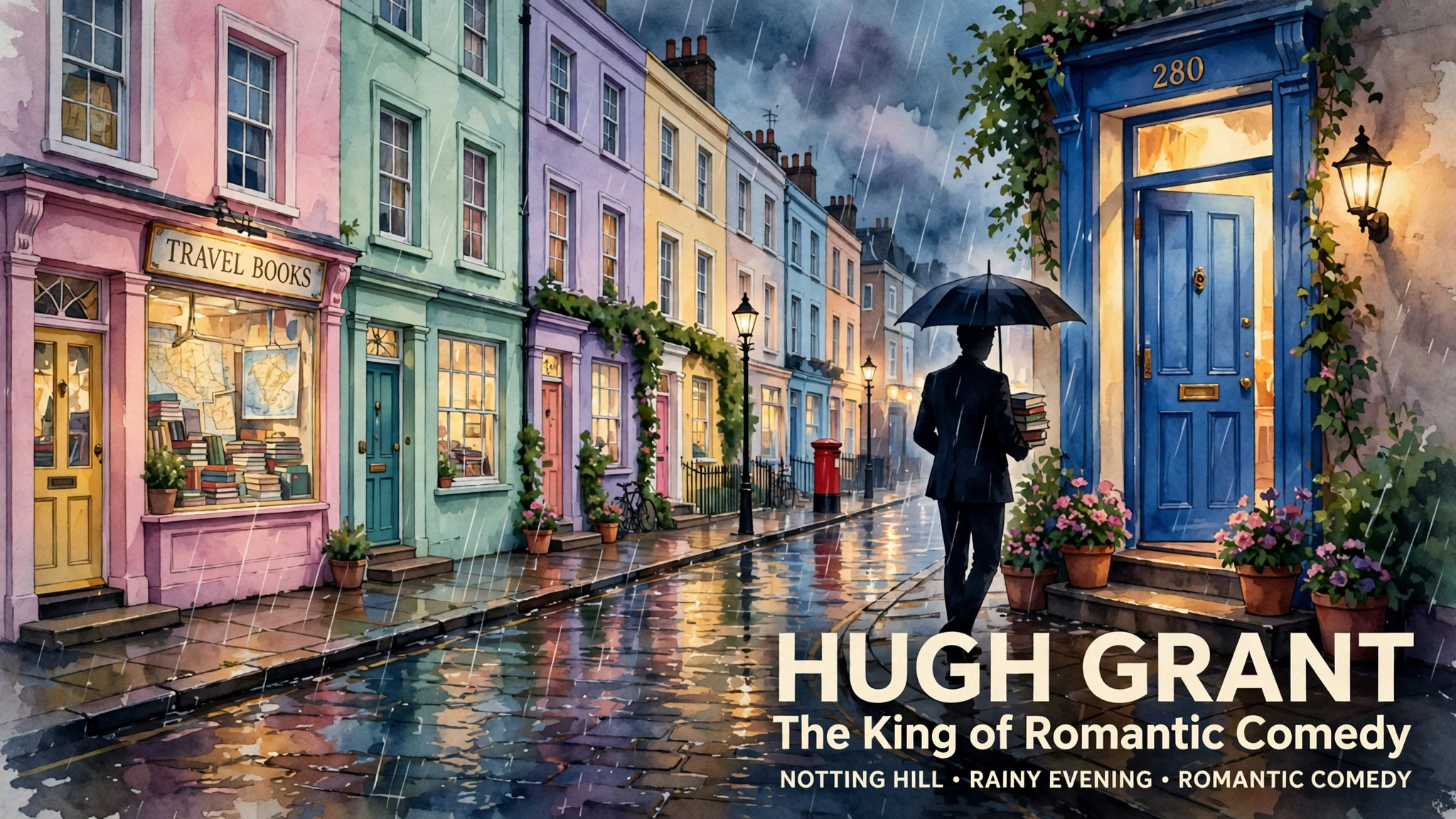
- Notting Hill, Bridget Jones, and the King of Romance
- About a Boy, Scandal, and the Difficult Years
- A Very English Scandal and the Brilliant Second Act
- Press Reform, Campaigning, and the Man Behind the Wit
- What Hugh Grant Proves About Reinvention
- My Take:
Hugh Grant is the actor who defined the romantic comedy for a generation, and he did it by playing charming, stammering, self-deprecating Englishmen who somehow always got the girl. When “Four Weddings and a Funeral” arrived in 1994, Grant became a star overnight, and his performance as Charles, a witty, commitment-phobic Londoner, made him the most famous romantic lead in the world. Then came “Notting Hill”, “Bridget Jones’s Diary”, and “Love Actually”, films that became classics and that made Grant synonymous with romance, with London, and with a particular kind of English charm. Behind the rom-com image, though, there is a much more interesting story, of an Oxford graduate who fell into acting, who became famous almost by accident, who struggled with the fame, and who then reinvented himself in middle age as one of the finest character actors in Britain. His story is about charm, about wit, and about a man who learned that the best roles come when you stop trying to be charming.
Long before the fame, there was simply a child in Hammersmith, London, learning, watching, and dreaming. His father, James, was an artist and carpet salesman, and his mother, Finvola, was a teacher, and he grew up in a cultured household in London. He has an older brother, James, and he has spoken about how his parents encouraged his love of books and theatre. He attended Latymer Upper School in London, and he later studied English literature at New College, Oxford, where he performed in student theatre and discovered his love of acting. Those early years explain more of the later career than most people realise.
This is that journey told properly, beginning to end: the home, the hustle, the break with Four Weddings and a Funeral, the peak years, the setbacks, and the legacy still being written today.
An Oxford Education and an Accidental Actor
Hugh Grant was born in Hammersmith, London, in 1960, the son of an artist father and a teacher mother, and he grew up in a household where books and ideas mattered. He attended Latymer Upper School, and he was a bright, witty boy, more interested in reading than in sport. He won a scholarship to New College, Oxford, where he studied English literature, and he performed in student theatre, including with the Oxford University Dramatic Society. He did not plan to become an actor, and he has said that he fell into it almost by accident, through a student film and through the encouragement of friends. After Oxford, he worked in various jobs, including as a tutor and as a writer, while taking small acting roles. He appeared in the film “Privileged” in 1982, a student production, and in “Maurice” in 1987, a Merchant Ivory drama that gave him his first critical attention. Oxford gave him his education, his wit, and his love of language, and those qualities would define his performances for decades to come.
In 1979, New College, Oxford gave Hugh Grant a challenge that looked modest in Hammersmith, London and proved demanding for Hugh Grant inside. He studied English literature at Oxford, performing in student theatre and discovering his love of acting. New College, Oxford stands as a reminder from 1979 that the best moments for Hugh Grant often come from saying yes to the difficult job. Such work builds trust for Hugh Grant, and trust is the currency of New College, Oxford that never goes out of fashion in Hammersmith, London.
Around 1982, Privileged put Hugh Grant in front of a new audience in Hammersmith, London, and the response mattered to Hugh Grant. His first film role came in a student production, showing his early talent on screen. For audiences in Hammersmith, London, Privileged became the piece they mention first when they explain why they admire Hugh Grant. Not many manage that kind of shift and keep the audience with them, yet Hugh Grant did it in Privileged by staying truthful.
By 1987, Maurice had arrived, and Hugh Grant knew the work in Hammersmith, London would be judged on its own terms, not on Hugh Grant’s past. His performance in the Merchant Ivory drama gave him his first critical attention. Maurice is the kind of job that makes the next opportunity easier for Hugh Grant to win, because the evidence from 1987 is right there. Not many manage that kind of shift and keep the audience with them, yet Hugh Grant did it in Maurice by staying truthful.
New College, Oxford proved that the foundations of Hugh Grant were solid in Hammersmith, London, and solid foundations are what let a career survive the hard years.
Four Weddings and Overnight Stardom
In 1994, Hugh Grant starred in “Four Weddings and a Funeral”, Richard Curtis’s romantic comedy about a group of friends navigating love and weddings, and the film made him a star overnight. He played Charles, a charming, witty, commitment-phobic Londoner, and his performance was funny, warm, and utterly engaging. The film became a huge commercial success, the highest-grossing British film of its time, and it won Grant a Golden Globe Award and a BAFTA. He became the most famous romantic lead in the world, and his stammering, self-deprecating style became his trademark. He has spoken about how sudden the fame was, and about how unprepared he felt for it. He had been a jobbing actor, and suddenly he was a star, recognised everywhere, and offered every romantic lead in Hollywood. “Four Weddings” was more than a hit, it was a phenomenon, and it defined Grant’s career for the next decade, for better and for worse.
With Four Weddings and a Funeral in 1994, Hugh Grant stepped into new territory, and Hugh Grant felt the risk in Hammersmith, London from the very first day. The film made him a star overnight, and it became the highest-grossing British film of its time. The result of Four Weddings and a Funeral spoke for itself in Hammersmith, London, and it gave Hugh Grant a stronger footing for everything after 1994. It is one more reason the story of Hugh Grant reads as earned in Hammersmith, London rather than handed over after Four Weddings and a Funeral.
With Golden Globe win in 1995, Hugh Grant stepped into new territory, and Hugh Grant felt the risk in Hammersmith, London from the very first day. He won Best Actor for Four Weddings, a major recognition of his breakthrough. It also proved how much Hugh Grant had grown in craft, confidence, and control of Golden Globe win since 1995. The lesson of Golden Globe win is simple for Hugh Grant: do the hard job well in Hammersmith, London, and the next door opens by itself.
In 1995, BAFTA win gave Hugh Grant a challenge that looked modest in Hammersmith, London and proved demanding for Hugh Grant inside. He also won the BAFTA, confirming his status as Britain’s brightest new star. What people in Hammersmith, London remembered afterwards was the feeling of BAFTA win, not the noise around Hugh Grant. The quiet discipline of Hugh Grant behind BAFTA win is easy to miss in Hammersmith, London, and it is the most important part.
Four Weddings and a Funeral proved that the foundations of Hugh Grant were solid in Hammersmith, London, and solid foundations are what let a career survive the hard years.
Notting Hill, Bridget Jones, and the King of Romance
After “Four Weddings”, Grant became the king of romantic comedy, starring in a run of films that became classics. “Notting Hill” in 1999, in which he played a bookshop owner who falls in love with a movie star played by Julia Roberts, became one of the most loved romantic films of all time. “Bridget Jones’s Diary” in 2001, in which he played the charming, unreliable Daniel Cleaver, became another huge hit, and he returned for the sequel in 2004. “Love Actually” in 2003, in which he played the Prime Minister, became a Christmas classic, watched by millions every year. The films made Grant synonymous with romance, with London, and with a particular kind of English charm. He was everywhere, and his image, the floppy hair, the stammer, the self-deprecating wit, became iconic. Yet the success also brought pressure, because he was typecast, and it was not clear whether audiences would accept him in any other kind of role. The romantic years were the peak of his fame, and they made him one of the biggest stars in the world.
The story of Notting Hill in 1999 starts with Hugh Grant taking a gamble in Hammersmith, London that many around Hugh Grant would have avoided. His bookshop owner opposite Julia Roberts became one of the most loved romantic films ever made. Seen from today, Notting Hill marks a point where the career of Hugh Grant quietly changed direction in 1999. It is one more reason the story of Hugh Grant reads as earned in Hammersmith, London rather than handed over after Notting Hill.
Bridget Jones’s Diary in 2001 found Hugh Grant ready for a bigger stage, even if Hammersmith, London was not sure yet about Hugh Grant. He played Daniel Cleaver, the charming rogue, in the hit adaptation of Helen Fielding’s novel. The response to Bridget Jones’s Diary showed that Hugh Grant could carry a big moment in Hammersmith, London without forcing it. It is a useful reminder that the career of Hugh Grant was built as much in the small jobs as in the famous ones like Bridget Jones’s Diary.
Love Actually landed in 2003, and for Hugh Grant it was less a reward in Hammersmith, London than a fresh responsibility for Hugh Grant. His Prime Minister became a Christmas classic, watched by millions every year. Looking back from Hammersmith, London, it is easy to see why Love Actually stayed in the mind of Hugh Grant’s audience long after 2003. It also explains why the phone kept ringing for Hugh Grant after Love Actually, because dependable talent is genuinely rare in Hammersmith, London.
The step of Notting Hill counts for Hugh Grant because it connected the early promise to the later success in Hammersmith, London, and without it the story would have a gap.
About a Boy, Scandal, and the Difficult Years
Grant’s career in the 2000s included some of his finest work, including “About a Boy” in 2002, in which he played a selfish man who learns to care for a young boy, a performance that showed a more mature, more emotional side of his talent. Yet the decade also brought difficulties, including a highly publicised scandal in 1995, when he was arrested in Los Angeles, an event that threatened his career. He handled it with honesty and humour, appearing on television to apologise, and his career survived, yet the experience left its mark. He has spoken about how the fame and the scrutiny affected him, and about how he came to dislike the parts of celebrity culture that had nothing to do with acting. He also became a father later in life, and he has spoken about how his children changed his priorities. The difficult years were a period of reflection, of learning what mattered, and of deciding what kind of actor he wanted to be. They were the prelude to one of the great reinventions in British cinema.
In 2002, Hugh Grant said yes to About a Boy, and that yes in Hammersmith, London carried more weight for Hugh Grant than anyone expected. His performance showed a more mature side, as a selfish man learning to care for a boy. What lasted from About a Boy was not the headline but the craft of Hugh Grant, and craft is what keeps a career alive in Hammersmith, London. The lesson of About a Boy is simple for Hugh Grant: do the hard job well in Hammersmith, London, and the next door opens by itself.
Public scandal came in 1995, and it turned into a proving ground for Hugh Grant, a test Hugh Grant faced in Hammersmith, London with everything to prove. His arrest in Los Angeles threatened his career, yet his honest apology helped him survive it. The response to Public scandal showed that Hugh Grant could carry a big moment in Hammersmith, London without forcing it. It is one more reason the story of Hugh Grant reads as earned in Hammersmith, London rather than handed over after Public scandal.
The story of Fatherhood in 2011 starts with Hugh Grant taking a gamble in Hammersmith, London that many around Hugh Grant would have avoided. He became a father, and he has spoken about how his children changed his life and priorities. Fatherhood rewards a second look, because the care Hugh Grant put into it in 2011 only becomes clear over time. The attention to detail in Fatherhood is what lifts the good work of Hugh Grant into work people in Hammersmith, London remember.
About a Boy mattered for Hugh Grant because it showed growth in public in Hammersmith, London, and growth in public takes more courage than growth in private.
A Very English Scandal and the Brilliant Second Act
In 2018, Grant starred in “A Very English Scandal”, the BBC drama about the politician Jeremy Thorpe, and the performance marked the beginning of a brilliant second act. He played Thorpe with a mix of charm, menace, and vulnerability, and he won a BAFTA Award for his performance. It was a revelation, because audiences who had only seen him as a romantic lead now saw him as a serious, versatile actor. He followed it with “The Undoing” in 2020, an HBO drama in which he played a husband accused of murder, and with “Paddington 2” in 2017, in which he played the villain, Phoenix Buchanan, a performance that was funny, camp, and delightful. He also appeared in “Florence Foster Jenkins” in 2016, opposite Meryl Streep, and in “Wonka” in 2023, as an Oompa-Loompa. The second act has been a triumph, because it showed that Grant was always a better actor than his romantic image suggested, and that he had been waiting for the right roles to prove it. He is now regarded as one of the finest character actors in Britain.
2018 paired Hugh Grant with A Very English Scandal, a project in Hammersmith, London that needed patience, nerve, and long hours from Hugh Grant. His performance as Jeremy Thorpe won him a BAFTA, marking a brilliant reinvention. The job mattered because A Very English Scandal stretched what people in Hammersmith, London believed Hugh Grant could take on next. A Very English Scandal shows how much of the success of Hugh Grant is preparation meeting a moment that finally arrives in Hammersmith, London.
In 2017, Paddington 2 became a test of whether Hugh Grant could grow in Hammersmith, London without losing what made Hugh Grant interesting. He played the villain Phoenix Buchanan, a funny and delightful performance that charmed audiences. For audiences in Hammersmith, London, Paddington 2 became the piece they mention first when they explain why they admire Hugh Grant. The lesson of Paddington 2 is simple for Hugh Grant: do the hard job well in Hammersmith, London, and the next door opens by itself.
For Hugh Grant, The Undoing in 2020 was the moment to show Hammersmith, London that the earlier success of Hugh Grant was no accident. His role in the HBO drama showed his range in dark, serious television. The project added a new colour to the career of Hugh Grant, and that colour from The Undoing has never quite faded in Hammersmith, London. The attention to detail in The Undoing is what lifts the good work of Hugh Grant into work people in Hammersmith, London remember.
What A Very English Scandal gave the career of Hugh Grant was range rather than noise, and range is what keeps a performer working for years in Hammersmith, London.
Press Reform, Campaigning, and the Man Behind the Wit
Grant has also become known for his campaigning, most notably on press reform, after his phone was hacked by tabloid newspapers. He became a leading voice in the campaign for a free and accountable press, giving evidence to the Leveson Inquiry and founding the group Hacked Off. He has spoken passionately about the need for privacy, about the damage done by intrusive journalism, and about the importance of a press that is both free and responsible. His campaigning has made him a controversial figure in some quarters, yet it has also earned him respect for his courage and his persistence. He has also been active in politics, supporting causes he believes in, and using his platform to speak about issues that matter to him. His life beyond acting is as considered as his work on screen, and it shows a man who thinks deeply about the world, and who is willing to stand up for what he believes. The wit that made him famous is still there, but it is now matched by a seriousness of purpose.
In 2011, Phone hacking campaign opened a new chapter for Hugh Grant, and Hugh Grant walked into it in Hammersmith, London without looking back. He became a leading voice for press reform after his phone was hacked by tabloids. Phone hacking campaign is the kind of job that makes the next opportunity easier for Hugh Grant to win, because the evidence from 2011 is right there. The attention to detail in Phone hacking campaign is what lifts the good work of Hugh Grant into work people in Hammersmith, London remember.
In 2012, Hugh Grant said yes to Leveson Inquiry, and that yes in Hammersmith, London carried more weight for Hugh Grant than anyone expected. He gave evidence about press intrusion, becoming a prominent campaigner for accountability. In the wider arc of the life of Hugh Grant, Leveson Inquiry stands as evidence from 2012 that the progress was real, not lucky. The steadiness behind Leveson Inquiry is the part of Hugh Grant that does not show up in headlines from 2012.
Hacked Off came in 2011, and it turned into a proving ground for Hugh Grant, a test Hugh Grant faced in Hammersmith, London with everything to prove. He helped found the campaign group, showing his commitment to a free and responsible press. Hacked Off showed a performer in Hammersmith, London willing to be judged on the work itself, which is a brave choice for Hugh Grant. It is one more reason the story of Hugh Grant reads as earned in Hammersmith, London rather than handed over after Hacked Off.
Looking back, Phone hacking campaign was one of the steps that made later triumphs possible for Hugh Grant, because it proved the base in Hammersmith, London was strong.
What Hugh Grant Proves About Reinvention
Grant’s legacy is the proof that reinvention is possible at any age, and that a great actor can be more than his image. He began as an Oxford graduate who fell into acting, became the king of romantic comedy, and then, in middle age, became one of the finest character actors in Britain. He showed that charm can be a trap, and that the best work comes when you stop trying to be charming and start trying to be truthful. His influence can be seen in the many actors who followed his path, and in the way romantic comedy is now understood. He has also shown that fame can be used for good, through his campaigning on press reform, and that a star can be both funny and serious. Young actors look at his career and see a lesson, be patient, be brave, and never let an image define you. The boy from Hammersmith who loved books became the most famous romantic lead in the world, and then he became something even better, a great actor, and his story is far from over.
The story of Romantic comedy legacy in 1994 starts with Hugh Grant taking a gamble in Hammersmith, London that many around Hugh Grant would have avoided. His Four Weddings defined the genre for a generation, and his style became iconic. The work of Hugh Grant in Romantic comedy legacy landed because Hugh Grant treated it seriously in 1994, and seriousness is something audiences in Hammersmith, London can feel. Such work builds trust for Hugh Grant, and trust is the currency of Romantic comedy legacy that never goes out of fashion in Hammersmith, London.
With Second act triumph in 2018, Hugh Grant stepped into new territory, and Hugh Grant felt the risk in Hammersmith, London from the very first day. His reinvention as a character actor showed that great careers can have more than one peak. Second act triumph confirmed something the closest watchers in Hammersmith, London already knew, that the talent of Hugh Grant had depth behind it. Such work builds trust for Hugh Grant, and trust is the currency of Second act triumph that never goes out of fashion in Hammersmith, London.
In 2012, Hugh Grant said yes to Campaigning legacy, and that yes in Hammersmith, London carried more weight for Hugh Grant than anyone expected. His press reform work has made him a respected voice beyond acting. For Hugh Grant, Campaigning legacy was proof that the long hours and the early sacrifices in Hammersmith, London had not been wasted. It also explains why the phone kept ringing for Hugh Grant after Campaigning legacy, because dependable talent is genuinely rare in Hammersmith, London.
The value of Romantic comedy legacy for Hugh Grant shows up in what followed in Hammersmith, London, in the confidence of the choices and the quality of the work after 1994.
My Take:
Hugh Grant is the actor I think about when someone says that a career is finished. He was the biggest romantic comedy star in the world in the 1990s, then he became a joke, then he became a character actor, and now, in his sixties, he is giving the best performances of his life. That arc is so unusual that it deserves to be studied. Most actors who peak early spend the rest of their lives trying to get back to the peak. Grant did something stranger and braver. He walked away from the peak, he let people laugh at him, and he rebuilt himself as a completely different kind of actor. The result is a second career that is more interesting than the first, and it is the reason I think his story matters beyond the films themselves.
I keep coming back to Four Weddings and a Funeral from 1994, because it is the film that made him, and because it is also the film that trapped him. He played Charles, a charming, stammering Englishman who cannot commit to anyone, and he played him so well that the whole world decided that was who he was. The film earned more than 240 million dollars, it won him a BAFTA and a Golden Globe, and it made him the most famous British actor alive. But the success had a cost. Every role he was offered after that was a version of Charles: the charming Englishman, the stammer, the floppy hair, the self-deprecating joke. He played that man in Nine Months, in Sense and Sensibility, in Notting Hill, in Bridget Jones’s Diary, in Love Actually, and in Two Weeks Notice. He was very good at it, and audiences loved it, but he was also, by his own admission, bored. He has said that he found the romantic comedy years repetitive, and that he felt like a man doing the same trick again and again. That boredom is important, because it explains what came next.
Notting Hill in 1999 is the film I would show to anyone who wants to understand why he was so loved. He plays William Thacker, a bookshop owner in London who falls in love with Anna Scott, a famous American actress played by Julia Roberts. The film is a fairy tale, and Grant plays it with a lightness that makes the fairy tale believable. There is a scene in which he tells Anna that he is just a man standing in front of a girl, asking her to love him, and the line has become one of the most quoted in romantic cinema. What makes it work is not the writing. It is Grant’s delivery, the way he makes vulnerability look easy and charm look effortless. He was the best in the world at that particular thing, and for a few years, that particular thing was what the world wanted most. But the world changes, and the thing it wants changes with it, and Grant was smart enough to see that coming before most people did.
The scandal in 1995 is the part of his story that everyone remembers, and I want to write about it plainly. He was arrested in Los Angeles with a sex worker named Divine Brown, and the story was on the front page of every newspaper in the world. His girlfriend at the time, Elizabeth Hurley, stood by him publicly, and he apologised on television, but the damage was enormous. He has spoken about it since with a mixture of shame and honesty, saying that he was unhappy, that he was behaving badly, and that the arrest was the consequence of choices he had made. I do not think the scandal ruined his career, because he went on to make Notting Hill and Bridget Jones after it, and audiences forgave him. But I think it changed him. It taught him that fame was fragile, that the public could turn on him in a day, and that the charming image he had built was not a protection. He became more guarded, more sceptical of the press, and more aware of how quickly a reputation can be destroyed. That awareness would shape the second half of his life in ways he could not have predicted.
About a Boy in 2002 is the film that showed the first cracks in the romantic comedy image. He played Will Freeman, a rich, selfish man who lives off the royalties of a Christmas song his father wrote and who pretends to have a child to meet single mothers. The character is not likeable, and Grant played him without softening the edges. The film was based on Nick Hornby’s novel, and it was directed by Chris Weitz and Paul Weitz, and it gave Grant a role that asked him to be funny and unpleasant at the same time. He was very good in it, and the film was a success, but it was also a sign. He was getting older, the romantic lead roles were going to younger men, and the industry did not know what to do with a charming Englishman in his forties. He made a few more romantic comedies, including Music and Lyrics in 2007, and then he stopped. He has said that he simply stopped getting offered the roles, and that he did not mind, because he was tired of them. What he did not know was that the best work of his life was still ahead of him.
The reinvention began, slowly, with Florence Foster Jenkins in 2016, in which he played the husband of Meryl Streep’s tone-deaf opera singer, and it became unmistakable with Paddington 2 in 2017. He played Phoenix Buchanan, a vain, washed-up actor who steals a pop-up book and frames a bear for the crime, and he was magnificent. The performance was funny, theatrical, and completely committed, and critics who had dismissed Grant for years wrote that he had stolen the film from a computer-generated bear. He had. Buchanan is a villain, but he is a villain who believes he is the hero, and Grant played him with a relish that suggested he was enjoying himself for the first time in years. The film was a huge critical success, and it proved something important: Grant was not only a romantic lead. He was a character actor who had been trapped in a leading man’s career, and once he was free of that trap, he could do anything.
A Very English Scandal in 2018 was the performance that made the reinvention complete. He played Jeremy Thorpe, the Liberal Party leader who was tried and acquitted of conspiracy to murder his former lover, and he played him as a man of charm, ambition, and deep moral corruption. The series was written by Russell T Davies, and it gave Grant a role that required him to be funny, frightening, and pathetic in the same scene. He was nominated for a BAFTA, and he should have won. The performance was a revelation, because it showed a Grant that audiences had never seen: a man who could be dark, who could be cruel, and who could make you understand a person you despised. It was the opposite of Charles from Four Weddings. It was a man who used charm as a weapon, and Grant, who had spent twenty years being charming on screen, knew exactly how that weapon worked. He had lived inside charm for so long that he understood its dangers better than anyone.
His work since then has been consistently brave. He played a shady private investigator in The Gentlemen in 2019, a wealthy husband accused of murder in The Undoing in 2020, a villain in Dungeons and Dragons in 2023, an Oompa Loompa in Wonka in 2023, and a terrifying religious fanatic in Heretic in 2024, a horror film in which he played a man who traps two young missionaries in his house and tests their faith. Heretic was the most surprising of all, because it asked him to be genuinely frightening, and he was. Critics wrote that it was the best performance of his career, and I agree. He plays the character with a calm, reasonable manner that makes the horror worse, because he sounds like a man having a polite conversation while doing something monstrous. It is a long way from Notting Hill, and that distance is the measure of how far he has travelled as an actor.
The press campaigning is the part of his life that I respect most, even though it has nothing to do with acting. After years of being pursued by tabloid newspapers, after his phone was hacked and his private life was splashed across front pages, Grant became one of the leading campaigners for press reform in Britain. He worked with Hacked Off, the campaign group, he gave evidence to the Leveson Inquiry into press standards, and he sued newspapers that had hacked his phone. He has said that the experience taught him how powerless ordinary people are against a press that can print anything and apologise later, and he has used his fame and his money to fight for people who do not have either. That is a serious commitment, and it has cost him. Newspapers that he criticised have attacked him in return, and the fight has gone on for more than a decade. But he has not stopped, and I admire that. It is easy to be brave on screen. It is harder to be brave in a courtroom, against institutions that can afford better lawyers than you can.
His personal life is quieter now than it was in the 1990s. He married Anna Eberstein, a Swedish television producer, in 2018, and they have three children together. He also has two children with Tinglan Hong, a former partner, making five children in total. He has spoken about fatherhood with a mixture of humour and seriousness, saying that having children late in life changed him, and that he is more settled now than he has ever been. He lives in London, he is known for being witty and grumpy in interviews, and he has a reputation for saying exactly what he thinks, whether or not it is diplomatic. That bluntness is part of his charm now, in a way it was not when he was younger. He is no longer trying to be liked. He is trying to be honest, and audiences respond to honesty more than they respond to charm.
I think about his Oxford education sometimes, because it is part of the story that people forget. He studied English literature at New College, Oxford, and he was a good student. He acted in student productions, and he appeared in his first film, Privileged, in 1982, while he was still at university. The education shows in his performances, in the precision of his language and the intelligence of his choices, but it also shows in his interviews, where he is articulate, funny, and often self-deprecating about his own work. He has said that he does not think of himself as a great actor, and that he is surprised by the praise he has received for his recent work. That modesty is either genuine or very well performed, and I suspect it is genuine. He spent years being told he was a lightweight, and he believed it, and the belief shaped the way he worked. The recent praise has surprised him because he had stopped expecting it.
If I were recommending where to start with him, I would start with Paddington 2, because it is the most fun, and because it shows you the new Hugh Grant in full. Then I would watch A Very English Scandal, and see how dark he can be. Then I would watch Heretic, and see how frightening he can be. Then, and only then, I would go back to Four Weddings and Notting Hill, and see the young man who started it all. Watching them in that order changes what you see. The romantic comedies stop looking like the whole story, and start looking like the first chapter of a much longer, much stranger book. That book is still being written, and I am more interested in the next chapter than I was in the first.
The thing I will remember longest about Hugh Grant is the refusal to be finished. The industry finished him, or thought it had. The romantic comedies stopped coming, the leading roles went to younger men, and the press wrote him off as a relic of the 1990s. He answered by becoming a better actor than he had ever been, by taking roles that scared him, and by doing work that no one expected from him. That is not a comeback. A comeback is a return to what you were before. Grant did not return. He became something new, and the new thing is better than the old one. If there is a lesson in his story for anyone reading this, it is that being typecast is not a life sentence, and that the work you do after people stop watching can be the best work of your life. He proved it, and he proved it in public, in films that anyone can watch. I think that is worth remembering the next time someone tells you that your best years are behind you.
There is one more thing I want to say, about the way he talks about his own career, because it is funny and it is honest in a way that most actors are not. He has said that he never wanted to be an actor, that he fell into it, and that he finds most of his own films embarrassing to watch. He has said that he took the romantic comedy roles for the money, and that he is not proud of all of them. That kind of honesty is rare, and it is refreshing, because most actors pretend that every role was a passion project. Grant does not pretend. He says what he thinks, he laughs at himself, and he moves on to the next thing. That attitude is part of why his second career has worked. He is not precious about his image, and he is not afraid to look foolish. He played an Oompa Loompa. He played a villain in a children’s film. He played a horror villain who talks about religion for two hours. None of those roles would have been possible for a man who was protecting his image. Grant stopped protecting his image years ago, and the freedom that followed is visible in every performance since.
Frequently Asked Questions
How did Hugh Grant become famous?
He became a star overnight with Four Weddings and a Funeral in 1994, after years of small roles.
What is Hugh Grant’s most famous film?
Four Weddings and a Funeral is his most famous breakthrough, though Notting Hill and Love Actually are also classics.
Did Hugh Grant win a BAFTA?
Yes. He won BAFTAs for Four Weddings and a Funeral and for A Very English Scandal.
Is Hugh Grant in Paddington 2?
Yes. He plays the villain Phoenix Buchanan in Paddington 2, a performance that was widely praised.
What is Hugh Grant doing now?
He continues to act in films and television, including recent work in Wonka and The Regime, alongside his campaigning.
Did Hugh Grant campaign on press reform?
Yes. He became a leading campaigner for press reform after his phone was hacked, giving evidence to the Leveson Inquiry.


