Ilse DeLange: The Life Story Behind the Dutch Country Singer
In this post
Ilse DeLange is a Dutch singer who brought American country music to the Netherlands and made it her own. She was born in Almelo, in the east of the Netherlands, and she grew up singing country songs, dreaming of Nashville, and working hard to become a professional singer. Her debut album, World of Hurt, was a success in 1998, and she went on to release many albums, to perform in large concerts, and to represent the Netherlands at Eurovision in 2014 as part of The Common Linnets, finishing second with Calm After the Storm. Her story is about a woman who loved a kind of music that was not popular in her own country, and who built a career on that love anyway.
She was born on 13 May 1977 in Almelo, a city in the province of Overijssel. She grew up in a family that loved music, and she sang from an early age. She was drawn to country music, to the stories it told, and to the warmth of its melodies. Country was not a common choice for a Dutch singer, but DeLange did not care. She loved it, and she was determined to sing it, even if it meant travelling to America to learn how it was done.
What makes her story worth telling is the way she stayed true to a style that many people told her would not work in the Netherlands. She proved them wrong, and she built a long and successful career on country music, on honest songwriting, and on a warm and clear voice that audiences love. She is a singer who followed her heart, and her heart led her to Nashville and back again, to Eurovision, and to a place as one of the most loved singers in Dutch music.
A Childhood in Almelo
Ilse DeLange was born on 13 May 1977 in Almelo, a city in the eastern Netherlands, in the province of Overijssel. Almelo was a practical and hard working city, known for its industry and its trade, and life there was calm and orderly. She grew up in a family that loved music, and she was encouraged to sing and to play from an early age. It was a good place to grow up, and it gave her a sense of home that she has carried with her ever since.
As a child, she was drawn to music in all its forms, but she was especially drawn to country music. She listened to American country singers on the radio and on records, and she loved the stories their songs told: stories about love, about loss, about home, and about the simple things in life. She sang along to those songs, and she began to dream of singing them herself, on a stage, in front of an audience. That dream stayed with her, and it shaped the direction of her life.
Her school years were shaped by her love of singing. She took part in school performances, she sang in local events, and she began to think about music as a career rather than just a hobby. She was a good student, but her heart was always in music, and she knew that she wanted to spend her life singing. She was a determined child, and she practised her singing with care, learning how to control her voice and how to make it sound warm and clear.
The city of Almelo gave her a Dutch sense of practicality. Life there was not glamorous, and it did not encourage showing off. It encouraged hard work, honesty, and a respect for others. Those values stayed with her, and they appear in her music, which is honest, hard working, and respectful of the audience. She has never tried to impress people with tricks. She has tried to tell the truth, and that is a quality that audiences recognise and respect.
Discovering Country Music
DeLange’s love of country music was unusual for a Dutch teenager. Country was an American style, and it was not widely popular in the Netherlands in the 1980s and 1990s. But she did not care about fashion. She loved the music, and she was determined to sing it. She listened to country singers, she learned their songs by heart, and she tried to understand what made country music so powerful. It was the stories, she decided, and the honesty of the lyrics, and the way a simple melody could carry a deep feeling.
She began to perform country songs in local venues, singing with bands and on her own. She was young, but her voice was already strong and warm, and audiences noticed her immediately. She was not trying to copy American singers. She was trying to sing country music in her own way, as a Dutch woman who loved the style and who understood its heart. That approach made her stand out, because she was not a copy. She was an original.
She also began to write her own songs, in English, because country music is sung in English. Writing in a second language is hard, but DeLange worked at it, and she learned how to write lyrics that were simple, clear, and honest. Her songs were about love, about home, and about the feelings that everyone knows, and they were sung in a voice that made them feel real.
The years of discovering country music were a time of learning and of growth. She was building her voice, building her repertoire, and building her confidence. She was also learning about the music business, and about how hard it was for a Dutch country singer to be taken seriously. She did not let that stop her. She kept singing, kept writing, and kept believing that her music would find its audience.
World of Hurt and a Debut Success
In 1998, DeLange released her debut album, World of Hurt, and it became a success in the Netherlands. The album was a country album, recorded with care and with a clear sense of what she wanted to achieve. It showed that a Dutch singer could make a country album that was as good as an American one, and it earned her praise from critics and from audiences. The title track and other songs from the album were played on the radio, and she began to build a following.
World of Hurt was important because it proved that her choice of country music was the right one. Many people had told her that country would not work in the Netherlands, but the album’s success showed that they were wrong. Audiences loved her voice, they loved the songs, and they loved the honesty of her performance. She was no longer a young singer with a dream. She was a professional artist with a successful album, and she was ready for the next step.
After the debut, she travelled to Nashville, Tennessee, the home of country music, to record and to learn. Nashville was a revelation for her, because it was a city where country music was taken seriously, where songwriters worked every day, and where the best musicians in the world played on every street. She learned a great deal there, and she brought that knowledge back to the Netherlands with her. She recorded albums in Nashville, she worked with American songwriters, and she built a bridge between Dutch music and American country.
The debut years were busy, but they were also exciting. She was touring, she was recording, and she was living the life she had dreamed of as a child in Almelo. She had proven that a Dutch country singer could succeed, and she had done it by staying true to the music she loved. That is a remarkable achievement, and it is the foundation of her long career.
Albums, Tours, and a Country Career
After World of Hurt, DeLange released a series of successful albums, including Livin’ on Love, Clean Up, and The Great Escape. Each album showed a different side of her music, but they all shared the same core: warm country songs, honest lyrics, and a clear and beautiful voice. She had hits with songs such as I’m Not So Tough, and she became known as one of the most consistent singers in Dutch music.
Her concerts were warm and welcoming, and her fans were loyal and enthusiastic. She performed in theatres and in large venues in the Netherlands, and she built a reputation as a live performer who gave everything on stage. She did not put on a big show with lights and dancers. She sang, she talked to her audience, and she created a feeling of closeness that made her concerts special. That warmth became one of the hallmarks of her career.
She also worked with other musicians, and she wrote songs for other artists. She was not just a singer. She was a songwriter, a performer, and a creative force in Dutch music. Her albums were praised by critics, and they sold well in the Netherlands, where she had a large and loyal following. She was a star, but she was also a working musician who took her craft seriously.
The years after her debut were a time of steady work and steady success. She did not have one huge international hit, but she had many successful albums, and she built a career that lasted. She toured, she recorded, and she kept in touch with her fans, who followed her from album to album. That loyalty is a sign of a singer who has earned her audience’s trust, and DeLange earned it by being honest and by working hard.
The Common Linnets and Eurovision
In 2014, DeLange formed The Common Linnets with the singer Waylon, and they represented the Netherlands at the Eurovision Song Contest in Copenhagen, Denmark, with the song Calm After the Storm. The song was a quiet country ballad, very different from the loud pop songs that usually do well at Eurovision, and it became a huge success. The Common Linnets finished second, which was the best result for the Netherlands in many years, and the song became a hit across Europe.
Calm After the Storm was a perfect song for DeLange. It was a country song, it was sung with warmth and honesty, and it showed her voice at its best. She sang it with Waylon, and their harmonies were beautiful. The performance was simple and elegant, with no big staging or tricks, and it stood out because of its quality. Audiences across Europe loved it, and it brought DeLange to the attention of a wider audience than she had ever had before.
The Eurovision success was important for the Netherlands as well as for DeLange. Dutch entries had struggled in Eurovision for many years, and the second place finish showed that a serious, high quality song could do well in the contest. The Common Linnets’ success, following Anouk’s ninth place the year before, marked the start of a new era for the Netherlands at Eurovision, and DeLange is often credited with helping to start it.
After Eurovision, The Common Linnets released an album, and DeLange continued to work as a solo artist as well. She had proven that she could succeed on the biggest stage in European music, and she had done it with a country song, on her own terms. That is a remarkable achievement, and it is one that her fans remember with pride. It showed that country music, sung with honesty, could win the hearts of millions of people.
Later Years, The Voice, and Today
In later years, DeLange has continued to record and to perform, releasing new albums that show her voice is still warm and her songwriting is still honest. She has also worked as a coach on The Voice of Holland, the Dutch version of the television singing competition, where she helped young singers to develop their talent. Her work on the show showed a different side of her: a mentor who was kind, honest, and supportive, and who wanted her singers to be themselves.
She has also built a life away from the stage. She lives in the Netherlands, and she has spoken in interviews about the importance of family, of home, and of staying grounded. She is known as a friendly and down to earth person, and she is liked by her colleagues and by her fans for that reason. She is a singer who works hard, but who also values her private life and who tries to balance the two.
Today, Ilse DeLange is seen as one of the most loved singers in the Netherlands. She has sold many records, she has performed in front of huge audiences, and she has built a career that has lasted for more than twenty-five years. She is respected by other musicians for her voice and her songwriting, and she is loved by her fans for her warmth and her honesty.
Her story is still being written. She is still recording, still performing, and still choosing new projects that interest her. She has come a long way from Almelo, from a young girl who loved country music to a singer who represented her country at Eurovision, and she has done it by working hard, by singing with warmth, and by staying true to herself. That is a story worth telling, and it is one that will continue for many years to come.
Nashville and Learning Country
Ilse DeLange’s trips to Nashville, Tennessee, were a turning point in her career, because Nashville is the home of country music, and it is a place where the style is taken seriously as an art form. When she first travelled there, she was a Dutch singer who loved country, but she had learned it mostly from records and from the radio. In Nashville, she met songwriters who wrote country songs every day, musicians who had played on hundreds of records, and producers who understood the sound from the inside. She learned from all of them, and she brought that knowledge back to the Netherlands with her.
Nashville taught her about songwriting in a particular way. In Nashville, songwriters work in pairs or in small groups, sitting in a room with a guitar and a notebook, and trying to write a song that tells a true story in three minutes. DeLange learned that discipline, and she began to write songs that were tighter, clearer, and more honest than before. She learned that a good country song does not need many words. It needs the right words, in the right order, sung with feeling. That lesson stayed with her, and it appears in all her later albums.
She also learned about the sound of country music in Nashville, about the instruments, the harmonies, and the way a band works together to create a warm and full sound. She recorded albums there, working with American musicians who had played with the biggest names in country, and she absorbed their skill and their professionalism. Those recordings gave her albums a quality that Dutch country albums had rarely had before, and they helped her to build a reputation as a serious country artist, not just a Dutch singer who liked the style.
Her Nashville experience also gave her confidence. She had gone to the home of country music, she had worked with its best people, and she had proven that she belonged there. That confidence showed in her later work, because she sang with more assurance, she wrote with more clarity, and she performed with more ease. She was no longer a young singer trying to prove herself. She was a country artist who had learned her craft at its source, and who was ready to share it with audiences in Europe and beyond.
The Warmth of a Live Concert
Ilse DeLange’s concerts are known for their warmth, and that warmth is one of the reasons her fans have stayed loyal to her for so long. She does not put on a big show with dancers and special effects. She stands on stage with her band, she sings, and she talks to her audience as if they were friends in her living room. That closeness is rare in a large venue, and it is a skill that comes from years of performing and from a genuine love of her audience. Fans who have seen her live often say that it felt like a personal experience, even in a hall full of thousands of people.
Her voice is at its best live, because it is a warm and clear voice that fills a room without needing to be loud. She sings country songs with a tenderness that makes the audience feel the story behind each lyric, and she moves between upbeat songs and quiet ballads with ease. She also tells stories between songs, about where they came from, about Nashville, and about her own life, and those stories make the concert feel like a conversation rather than a performance. That is a special gift, and it is one that few singers possess.
She has performed in theatres, in concert halls, and at festivals across the Netherlands and in other countries, and she has built a reputation as a live performer who never disappoints. Her fans know that when they buy a ticket to see her, they will hear good music, sung with honesty, and they will leave feeling happier than when they arrived. That trust is the foundation of her long career, and it is one that she has earned through more than twenty-five years of consistent and caring performances.
Country Music in the Netherlands
Ilse DeLange’s career changed the way Dutch audiences thought about country music, because she proved that a Dutch singer could make country records that were as good as those made in Nashville. Before her debut, country was seen as a foreign style, something that belonged to America and had little to do with Dutch life. DeLange showed that the themes of country music, love, loss, home, and hope, were universal, and that they could be sung by a Dutch woman in a way that felt true to her own experience. Her success opened a door for other Dutch country singers, and it helped to create a small but loyal country audience in the Netherlands that had not existed before.
Her albums also showed that country music could be commercially successful in the Netherlands. World of Hurt and her later records sold well, they were played on the radio, and they earned her a large and faithful following. That commercial success gave her the freedom to keep making the music she loved, to travel to Nashville, and to represent her country at Eurovision with a country song. It was a remarkable achievement, and it is one that will be remembered as a turning point for Dutch country music.
My Take:
When I think about Ilse DeLange, I think about warmth. Not a loud or showy warmth, but a quiet warmth that makes you feel comfortable when you hear her sing. Her voice is clear, it is gentle, and it is full of feeling, and it makes a country song feel like a conversation with a friend. That is a rare gift, and it is the reason her fans have stayed loyal to her for more than twenty-five years. A singer who makes you feel at home is a singer you will keep listening to, and DeLange does that.
I admire the way she followed her love of country music, even when many people told her it would not work in the Netherlands. Country was an American style, and it was not popular in Dutch pop. But DeLange loved it, and she was determined to sing it anyway. That takes courage, because it means going against fashion and trusting your own taste. She trusted it, and she was right. Her debut album World of Hurt proved that Dutch audiences would love country music if it was sung well, and her long career has proved it again and again. I respect that courage, because it shows a person who cares more about the music than about being fashionable.
What I find most moving about her story is her Eurovision performance with The Common Linnets. Calm After the Storm is a quiet song, and Eurovision is a loud contest. Most singers try to be as big and as flashy as possible. DeLange and Waylon were quiet, and they stood out because of it. They sang a country ballad with beautiful harmonies, and they finished second, which was a wonderful result for the Netherlands. I think that performance showed the power of simplicity. A good song, sung well, does not need tricks. It just needs honesty, and DeLange has honesty in abundance.
I also think about her trip to Nashville, and I find it very inspiring. She went to the home of country music to learn, to record, and to understand the style she loved. She did not just copy American country. She learned it, and she brought it back to the Netherlands in her own way. That is a sign of a serious artist, one who wants to understand her craft deeply, not just to imitate it. She built a bridge between Dutch music and American country, and that bridge has helped many other Dutch singers who love country music.
If I have a sadness about her story, it is that she is not as well known outside the Netherlands as she should be. Her voice is world class, and her songs deserve a wider audience. But she has always been a Dutch singer first, and she has not chased international fame in the way that some other artists have. That is her choice, and I respect it, but I also think it is a shame, because people in other countries would love her music if they heard it. I hope that Eurovision helped some of them to discover her, and that more will find her in the years to come.
I also respect the way she has worked as a coach on The Voice of Holland. She could have been a harsh judge, or she could have been a distant star. Instead, she was kind, honest, and supportive, and she helped young singers to find their own voices. That is generous work, and it shows that she cares about the next generation of Dutch singers. A star who helps others is a better star than one who only thinks about herself, and DeLange has shown that she is willing to help.
Another thing I notice is her longevity. She has been famous for more than twenty-five years, and she is still recording and performing. That is not an accident. It is the result of hard work, of a warm voice, and of a decision to keep going even when the music business changed. She did not give up when country became less popular, or when the charts moved on. She kept making the music she believed in, and her fans kept listening. That is a lesson for anyone who wants a long career: do not depend on one moment of success. Build something that lasts, and keep working at it.
When I compare DeLange with other singers of her generation, what stands out is her consistency. She has never made a bad album, and she has never tried to be someone she is not. She has sung country music, she has sung it well, and she has done it for more than twenty-five years. That consistency is rare, and it is valuable, because it means that an audience can trust her. When you buy an Ilse DeLange album, you know that you will hear good songs, sung with warmth and honesty. That trust is the foundation of her long career.
For a young singer reading this, I think the lesson is to follow the music you love, even if it is not fashionable. DeLange loved country music, and she built a career on it, even though many people told her it would not work. A young singer who follows her example will not always be popular, but they will be true to themselves, and that truth will eventually find an audience. Talent matters, but honesty matters just as much, and DeLange has both.
In the end, I think Ilse DeLange teaches us that a warm voice and an honest heart can build a long and happy career, and that a singer who follows her love of music can go from a small city in the Netherlands to the biggest stage in Europe. She has sung country music, she has represented her country, and she has earned the love of millions of fans. I admire her for it, and I look forward to hearing what she sings next, because I believe that her best work may still be ahead of her.
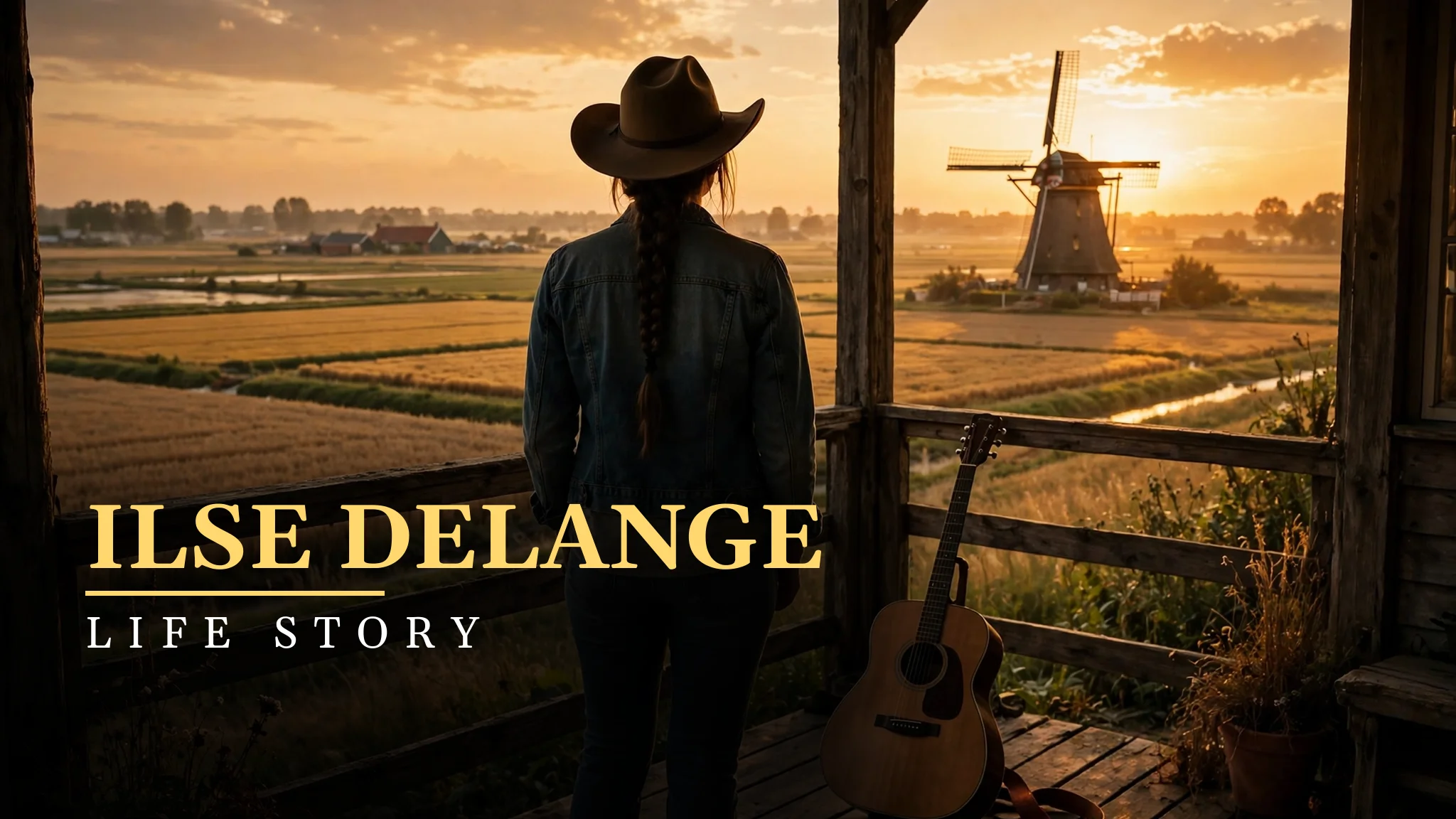
One more thought stays with me, and it is about the windmill in her image and the Dutch landscape she comes from. She grew up in a country of windmills, of fields, and of wide skies, and she carries that Dutch sense of home with her wherever she goes. It is a quiet home, not a loud one, and it is the same kind of home that appears in her songs. I think that is a lovely connection, and it is one that makes her story feel complete.
I also think about the windmill in her image, and about what it says about her career. A windmill is a Dutch symbol, a reminder of home, and it stands in a field of golden light, with a guitar leaning nearby. DeLange’s career is like that image: it is Dutch at its roots, it is warm and golden, and it combines the old and the new, a traditional Dutch landscape with an American guitar. She has brought those two worlds together, and she has done it with grace. That is a beautiful achievement, and it is one that I will remember when I think about her.
Another thing I admire is her work as a mentor on The Voice of Holland, because it shows a different side of her from the singer on stage. As a coach, she was kind, patient, and honest, and she helped young singers to find their own voices rather than to copy hers. That is generous work, and it shows that she cares about the next generation of Dutch singers. A star who helps others is a better star than one who only thinks about herself, and DeLange has shown that she is willing to help. Her students will carry her lessons with them, and that is a legacy that goes beyond her own records.
I also think about the song Calm After the Storm, and about why it worked so well at Eurovision. It is a quiet song, about a difficult time passing and a new calm arriving, and it was sung with a simplicity that stood out in a contest full of loud and flashy performances. DeLange and Waylon did not try to impress the audience with tricks. They sang a beautiful song, with beautiful harmonies, and they trusted the audience to listen. That trust was rewarded with second place, and it showed that a good song, sung well, can succeed even in the loudest contest in Europe. I think that is a valuable lesson for any singer.
There is also a question about what country music means in the Netherlands, and DeLange’s career answers it. Country music is often seen as an American style, but DeLange has shown that its themes, love, loss, home, and hope, are universal, and that they can be sung by a Dutch woman in a way that feels true to her own life. She did not try to pretend to be American. She sang country as a Dutch woman who loved the style, and that honesty made her music feel real. That is a lesson for any artist who loves a style from another country: do not copy it. Learn it, understand it, and then make it your own.
I think about her future too, and about what she might sing next. She is in her forties, and her voice is still warm and clear. She could sing about getting older, about family, about home, and about the world as she sees it now. Those are rich subjects, and DeLange has the experience and the honesty to sing about them well. I hope that she will keep recording, because her voice is still needed, and because her fans are still listening. A warm voice like hers does not age. It grows deeper and richer, and I believe her best songs may still be ahead of her.
Finally, I want to say something about the simple pleasure of her music, because it is easy to overlook a singer who is not loud or controversial. DeLange’s music is not about shock or about fame. It is about the simple pleasure of a good song, sung well, with warmth and honesty. That pleasure is real, and it is one that millions of people have enjoyed for more than twenty-five years. In a world that is often loud and harsh, a warm and honest voice is a gift, and DeLange has given that gift to her audience again and again. I am grateful for it, and I hope she will keep giving it for many years to come.
I also think about the acoustic guitar in her image, and about what it represents. An acoustic guitar is a simple instrument, with no electricity, no effects, and no hiding place. A singer who plays it must be honest, because every note is heard clearly. DeLange’s music is like that guitar: simple, honest, and clear. She does not hide behind production tricks. She sings a good song, with a good voice, and she trusts that it will be enough. That trust is a sign of confidence, and it is one of the reasons her music feels so warm and so real.
Another thing I admire is her consistency as a songwriter. She has released many albums over more than twenty-five years, and each one has been made with care. She does not rush an album, and she does not release songs she does not believe in. That patience is rare in a music business that wants new product constantly, and it is one of the reasons her albums are so good. A listener who buys an Ilse DeLange album knows that every song on it has been chosen with care, and that trust is valuable.
There is also a thought about the Netherlands and country music, and about DeLange’s role in bringing the two together. Before her, country was seen as a foreign style, something that belonged to America and had no place in Dutch music. After her, Dutch audiences understood that country music could speak to their own lives, in their own country, and that a Dutch singer could make it her own. That is a significant cultural achievement, and it is one that goes beyond her own career. She opened a door, and other Dutch country singers have walked through it since.
Frequently Asked Questions
Where was Ilse DeLange born and what kind of music does she sing?
Ilse DeLange was born on 13 May 1977 in Almelo, Netherlands, and she sings country music, inspired by American country singers, with a warm and clear voice.
What was Ilse DeLange’s debut album?
Her debut album was World of Hurt from 1998, a country album that became a success in the Netherlands and proved that a Dutch country singer could find a large audience.
What is The Common Linnets?
The Common Linnets is the duo DeLange formed with Waylon, which represented the Netherlands at Eurovision in 2014 with Calm After the Storm, finishing second and becoming a hit across Europe.
Did Ilse DeLange go to Nashville?
Yes, she travelled to Nashville, Tennessee, the home of country music, to record and to learn, working with American songwriters and musicians and building a bridge between Dutch and American country.
Was Ilse DeLange a coach on The Voice of Holland?
Yes, she worked as a coach on The Voice of Holland, helping young singers to develop their talent and encouraging them to be themselves rather than to copy others.
What songs is Ilse DeLange known for?
She is known for songs such as I’m Not So Tough, Calm After the Storm with The Common Linnets, and many other country songs from her albums including The Great Escape.
Is Ilse DeLange still performing today?
Yes, she continues to record and perform, releasing new albums and playing concerts, and she remains one of the most loved singers in the Netherlands.


