Indochine: The Life Story Behind France's Enduring Rock Band
In this post
- Paris in 1981 and the Birth of a Band
- The 1980s: Hits, Fame, and a Young Crowd
- The Hard 1990s and the Loss of Stephane
- Paradize and the Great Comeback
- Stadiums, New Albums, and a Band That Keeps Growing
- The Sound, the Words, and the Live Show
- Legacy of a Band That Refused to Stop
- The Fans Who Grew Up With the Band
- My Take:
Indochine is the rare French rock band that never really went away. For more than forty years, the group has filled concert halls, changed its sound, lost members, and found new crowds, yet the name on the poster has stayed the same. At the centre of that long run stands Nicola Sirkis, the singer and songwriter who formed the band in Paris in 1981 and kept it alive through every change that followed. His voice, his words, and his sense of theatre turned a small new-wave group into one of the biggest live acts in French music.
The band began in a time when French rock was trying to find its own voice. Many groups copied English and American bands, but Indochine mixed cold electronic sounds with French lyrics, romantic images, and a strong visual style. Their first hit, L’Aventurier, sounded like an adventure story set to music, and young listeners in France took it as their own. The song did not just climb the charts. It gave the band an identity, a world of heroes, deserts, and faraway places that fans could step into every time the music played.
What followed was not a straight climb. Indochine knew huge success in the 1980s, then quieter years, then a painful loss, then a comeback that surprised even people who had followed the band for years. The story is about more than hit songs. It is about a singer who refused to stop, a band that learned to play stadiums when many of its rivals had faded, and a crowd that grew up with the music and then brought its own children to the shows. That is why Indochine still matters in France, long after the first wave of new-wave bands has gone.
What is striking about Indochine, when you step back from the hit songs and the stadium lights, is how French the band has stayed through every change in fashion. The group never tried to become an English or American rock band with French words pasted on top. It built its own world, with French lyrics, French images, and a French sense of romance and drama, and it trusted that world to be enough. That trust has been rewarded again and again, because audiences in France and in other French-speaking places recognised something of themselves in the songs, in the stories of adventure and longing, and in the voice of a singer who sang as if he meant every word.
Paris in 1981 and the Birth of a Band
Nicola Sirkis was born in France in 1959, and he grew up with a twin brother, Stephane, who would later join him in the band. Paris in the late 1970s and early 1980s was full of new music, new clothes, and new ideas, and the two brothers were part of that restless mood. Nicola was drawn to words, images, and the idea of building a world around songs, not just writing a tune and hoping it would sell. He wanted a band that looked different, sounded different, and spoke French in a way that felt modern and bold.
In 1981, Nicola formed Indochine with Dominique Nicolas, a guitarist whose playing gave the early songs their sharp, bright edge. The name came from French Indochina, a place tied to history, adventure, and faraway stories, and it suited the romantic pictures in Nicola’s lyrics. The band’s first steps were small, like those of most young groups. They rehearsed, they played small venues, and they tried to find a sound that belonged to them. The early music mixed guitars with keyboards, and the songs were short, direct, and full of pictures that listeners could see in their minds.
The breakthrough came quickly. In 1982, the band released its first album, L’Aventurier, and the title song became a hit in France. The song told of a hero on a journey, and its driving rhythm made it perfect for radio and for dancing. Young fans loved the mix of adventure and romance, and they loved the way Nicola sang, with a voice that was clear, urgent, and full of feeling. The album opened doors, and suddenly Indochine was no longer a small Paris band. It was a name that people knew, and a group that promoters wanted to book.
Those early years set a pattern that would follow the band for decades. Nicola wrote songs that worked as stories, the band dressed the music in strong images, and the live shows grew more theatrical with each tour. The group was not trying to be a quiet band that stood still on stage. It wanted the concert to feel like a journey, with lights, smoke, and a crowd that sang every word. That ambition, present from the very start, helps explain why Indochine later became a stadium band while so many of its early rivals stayed small.
The 1980s: Hits, Fame, and a Young Crowd
The middle of the 1980s was Indochine’s first great period of success. After L’Aventurier, the band released more albums and more singles that found a wide audience in France and in other French-speaking places. Songs such as 3e sexe, Canary Bay, and Tes yeux noirs became part of the sound of the decade for many young listeners. The music was danceable and romantic at the same time, and the lyrics spoke of love, desire, and the need to be free. For teenagers in France, Indochine was not just a band on the radio. It was a group that seemed to understand them.
The band’s image mattered as much as its sound. Nicola Sirkis had a strong sense of style, and the group used posters, covers, and stage design to build a world that fans wanted to enter. The concerts grew larger, and the crowds grew louder. Indochine played to packed halls, and the fans sang along to every chorus. In a country where rock music often lived in the shadow of English and American stars, the band proved that a French group could fill big rooms with songs in French and with a sound that was fully its own.
Success also brought pressure. A band that rises fast must keep writing songs, keep touring, and keep finding new ideas while the public watches closely. Indochine kept working, and the albums of the late 1980s showed a group trying to grow without losing the energy that made it famous. Some songs were darker, some were more direct, and the band’s sound began to change as new members came and went. The core of the group, however, stayed the same: Nicola’s voice and words, and a belief that a concert should feel like an event, not just a list of songs played in order.
By the end of the decade, Indochine had become a fixture of French pop culture. The band had survived the fast rise, the tours, and the demands of fame, and it had built a fan base that would stay loyal for years. Many bands from the same period faded when the fashion changed, but Indochine had something more than fashion. It had songs that people remembered, a singer who knew how to hold a stage, and a crowd that felt the music belonged to them. That bond would matter greatly in the harder years that followed.
The Hard 1990s and the Loss of Stephane
The 1990s were harder for Indochine. Musical fashion changed, new styles took over the radio, and the band’s sound no longer felt as new as it had in 1982. The group kept making albums and touring, but the crowds were smaller, and the press paid less attention. For a band that had once filled large halls, the quieter years were a test. Nicola Sirkis had to decide whether to stop, to change direction, or to keep going and trust that the songs would find their audience again.
During this period, the band’s line-up changed, and the music moved in different directions. Some albums were more guitar-driven, others more electronic, and the group searched for a sound that felt honest in a new decade. The work was not easy, and the results were mixed, but the band never stopped completely. Nicola continued to write, to record, and to play live, and a core group of fans stayed with him. They were not casual listeners who had come for one hit. They were people who had grown up with the band and who still believed in it.
Then came a loss that changed everything. Stephane Sirkis, Nicola’s twin brother and a key member of the band, died in 1999. He had been part of Indochine’s story from the start, and his death was a deep personal blow for Nicola as well as a shock for the fans. The band had already been through hard years, and now it faced grief. Many people would have understood if Nicola had decided to end the group at that point. Instead, after a period of mourning, he chose to continue, and the decision gave the next chapter of the band’s life a sense of purpose that went beyond charts and sales.
The late 1990s therefore stand as a turning point. Indochine was no longer the young band of the early 1980s, and it was no longer the chart-topping group of the middle of that decade. It was a band that had survived change, loss, and falling fashion, and that survival gave Nicola a new kind of strength. When the comeback came, it did not feel like a trick or a revival of old hits. It felt like the return of a band that had earned its place by refusing to quit.
Paradize and the Great Comeback
In 2002, Indochine released Paradize, an album that changed the band’s fortunes in a dramatic way. The record was darker, harder, and more modern than much of the group’s earlier work, and it connected with a new generation of listeners as well as with old fans. The single J’ai demande a la lune became a huge hit, and suddenly Indochine was back on the radio, back in the press, and back in large venues. The comeback was not a small return. It was a full revival, and it showed that the band could speak to a new decade without pretending to be young again.
The success of Paradize opened a new phase in the band’s live career. Indochine began to play bigger shows, with larger stages, stronger lights, and a crowd that now included both people who had loved the band in the 1980s and younger fans who had found it through the new album. The concerts became famous for their scale and their energy. Nicola Sirkis, now a veteran performer, knew how to hold a huge room, and the band’s set lists mixed old hits with new songs in a way that made the whole night feel like one long story.
The years after Paradize brought more albums, more tours, and more proof that the comeback was real. Alice and June followed, and the band continued to fill arenas across France and Belgium. The music stayed melodic and direct, but it also kept a darker edge, and the lyrics continued to deal with love, loss, and the search for meaning. Indochine was no longer chasing fashion. It was making the music it wanted to make, and the audience had grown large enough to support that freedom.
For Nicola, the comeback must have felt like a second life. He had kept the band alive through the quiet years, through grief, and through doubt, and now the reward was a crowd that was bigger than ever. The story of Paradize is often told as a music business success, but it is also a human story. It is the story of a singer who kept working when few people were watching, and who was ready when the moment came to be heard again.
Stadiums, New Albums, and a Band That Keeps Growing
In the 2010s, Indochine reached a scale that few French rock bands have ever reached. The album Black City Parade, released in 2013, was another success, and the tour that followed took the band to huge venues. Then came 13, released in 2017, which brought more hit songs and more sold-out shows. The band’s concerts became events that fans planned months ahead, with long set lists, big screens, and a stage design that filled the whole arena. The crowd sang every word, and the shows often lasted for hours.
In 2022, the band played the Stade de France, the largest stadium in France, and the scale of that night showed how far Indochine had come from its small Paris beginnings. A band that had started in 1981, in a small rehearsal room, was now playing to tens of thousands of people in a single night. The achievement was not just about size. It was about loyalty. The fans had stayed, the songs had lasted, and the band had kept its promise to give the audience a night to remember.
The group’s later albums also showed that Nicola Sirkis still had new ideas. The band worked with new sounds, new producers, and new visual styles, but the heart of the music stayed the same. The songs were still about people, feelings, and the world around them, and the live shows were still built around the bond between the band and the crowd. Indochine did not become a nostalgia act that only played old hits. It kept making new music, and the new music kept finding listeners.
This long run has made Indochine a special case in French music. Most bands have one great period and then fade. Indochine has had at least two great periods, separated by hard years, and it has kept going long after both. The band’s story shows that a group can grow old without growing dull, and that a singer who stays true to his songs can find a new audience in every decade.
The Sound, the Words, and the Live Show
Indochine’s sound has always mixed melody with energy. The early records used keyboards and guitars in a bright, new-wave style, while the later records added harder guitars, deeper bass, and a more modern production. Through all the changes, two things have stayed constant. The first is the melody. Indochine writes tunes that people can hum after one hearing, and that simple strength has kept the songs alive on radio and in concert halls. The second is the voice. Nicola Sirkis sings with a clear, emotional tone that makes even a simple line feel urgent.
The words matter just as much as the music. Nicola writes in French, and his lyrics are full of images, names, and places that give the songs a sense of story. He has written about love, about cities, about journeys, and about the pain of losing someone. The lyrics are not always easy, and they do not always explain themselves in a simple way, but that is part of their power. Listeners can find their own meaning in them, and they can return to the same song years later and hear something new.
The live show is where all of this comes together. Indochine concerts are known for their scale, their lights, and their long set lists, but the real secret is the crowd. The band’s fans know the words, they sing along, and they create a wall of sound that fills the arena. Nicola talks to the crowd, he thanks them, and he treats the concert as a shared night, not as a performance delivered from a distance. That bond is the reason the band can fill stadiums. It is not just the songs. It is the feeling that everyone in the room is part of the same story.
Over the years, the band has also used its platform to speak about issues that matter to its members, and to support causes that its fans care about. The group has never been a quiet band that hides from the world. It has used its size and its voice to say something, and that honesty has strengthened the trust between the band and its audience.
Legacy of a Band That Refused to Stop
Indochine’s legacy is simple to state and hard to earn. The band is one of the most successful French rock groups of all time, with a career that spans more than four decades, a catalogue of songs that spans generations, and a live following that few French acts can match. The group proved that French-language rock could fill stadiums, that a band could survive a fall in fashion, and that a comeback could be bigger than the first success. Those are not small achievements in a music world that often moves on fast.
The legacy also belongs to Nicola Sirkis in a personal way. He formed the band, he wrote the songs, he survived the loss of his brother, and he kept the group going when it would have been easier to stop. His persistence is the thread that runs through the whole story. Without it, Indochine would be a memory from the 1980s, a band that people mention when they talk about old hits. With it, the band is a living group, still making records, still playing to huge crowds, and still finding new listeners.
For younger French bands, Indochine offers a clear lesson. A career is not made in one year, and it is not lost in one bad year either. It is made by writing songs that matter, by treating the audience with respect, and by keeping going when the fashion changes. The band’s story is not a fairy tale. It has hard chapters, sad chapters, and quiet chapters. But the final chapter, at least for now, is a loud one, with a stadium full of people singing along, and that is a fitting image for a band that refused to stop.
The Fans Who Grew Up With the Band
Indochine’s fans are not like the fans of a band that has one hit and then disappears. They are people who have followed the group for decades, who bought the first records on vinyl, who taped songs from the radio, who went to concerts as teenagers and who now bring their own children to the same shows. That kind of loyalty cannot be bought with advertising or with a single hit song. It is earned over time, through songs that stay with people, through concerts that feel like shared nights, and through a singer who treats the audience as partners, not as customers.
The crowd at an Indochine concert is a mix of ages, and that mix is one of the most remarkable things about the band. Older fans stand next to younger fans, parents stand next to their teenage children, and everyone sings the same words, from L’Aventurier to the songs from the latest album. That shared singing creates a feeling of community that is rare in modern music, where audiences are often divided by age, by taste, and by the platforms they use. At an Indochine show, those divisions disappear for a few hours, and the crowd becomes one voice.
That loyalty was tested in the hard years, when the band was no longer on the radio every day and when the venues were smaller. The fans who stayed were not casual listeners. They were people who believed in the band, who bought the records, who went to the shows, and who kept the name alive when the press had moved on. When the comeback came with Paradize, those fans were ready, and they brought new listeners with them, because they had never stopped talking about the band, never stopped playing the songs, and never stopped believing that Indochine would return.
The band has repaid that loyalty by giving the fans long shows, by playing old songs alongside new ones, and by treating each concert as an event rather than a routine. Nicola Sirkis talks to the crowd, he thanks them, and he makes the night feel personal, even in a stadium full of tens of thousands of people. That personal touch, in a very large room, is a skill that few performers have, and it is one of the reasons the fans keep coming back, year after year, tour after tour.
In the end, the fans are as much a part of Indochine’s story as the band itself. Without them, there would be no stadiums, no comebacks, and no forty-year career. With them, the band has a life that goes beyond any single album or any single tour. The songs belong to the people who sing them, and that is why Indochine still matters, long after the first wave of new-wave bands has faded from memory.
My Take:
When I think about Indochine, the first thing I feel is respect for staying power. Most bands I know have one good run and then they fade, and I have seen that happen again and again. A group has a hit, the crowd moves on, and the band either breaks up or keeps playing smaller and smaller rooms until nobody comes. Indochine did the opposite. It had a hit, it had a fall, it had a loss that would have ended most groups, and then it came back bigger than before. That is not luck. That is work, and it is the kind of work I admire because it is quiet, patient, and hard to see from the outside.
I admire Nicola Sirkis because he kept the band alive when there was no clear reward for doing so. In the 1990s, the charts had moved on, the press had moved on, and many people would have said the story was over. He kept writing, he kept touring, and he kept believing in the songs. I think that takes a special kind of faith. It is easy to believe in yourself when everyone is cheering. It is much harder to believe in yourself when the rooms are smaller and the phones have stopped ringing. Nicola did that, and I think that is the most important part of his story. The stadium shows are the reward, but the quiet years are the proof.
I also think about what it must have felt like to lose Stephane. He was not just a band member. He was Nicola’s twin brother, someone who had been there from the very start, someone who shared the early dreams and the early struggles. Losing a brother is a pain that does not go away, and I do not want to pretend that music can fix it. What I respect is that Nicola did not turn that pain into a sad ending. He mourned, he kept going, and he made new music that carried the memory of his brother without turning the band into a memorial. That balance is hard to keep. It would be easy to stop, and it would be easy to keep going in a cold way. He found a way to keep going with feeling, and I think the fans sensed that.
The comeback with Paradize is the part of the story that gives me hope. I have seen many people give up too early, in music and in life, because they think their best years are behind them. Indochine shows that a second chance is possible, but only if you are ready for it. Nicola was ready because he had kept working, kept writing, and kept the band alive. When J’ai demande a la lune found its audience, the band did not have to start from nothing. It had songs, it had a live show, and it had fans who were waiting. That is a lesson I want to remember. You cannot control when the moment comes, but you can control whether you are ready when it does.
I love the idea that Indochine sings in French and fills stadiums with French songs. In a world where so much music is in English, and where many artists feel they must sing in English to be heard, Indochine proved that your own language can be enough. The songs are not translations. They are French songs, with French images and French feelings, and the crowd sings them in French, word for word, in a stadium full of people. That matters to me because it says that you do not have to copy someone else to succeed. You can be yourself, in your own words, and still reach a huge audience. That is a brave choice, and it is one that has paid off for more than forty years.
The live shows also teach me something about loyalty. A concert is not just a band playing songs. It is a meeting between people who have shared the same music for years. When I picture an Indochine stadium show, I do not just see lights and a big stage. I see parents who loved the band in the 1980s standing next to their children, who found the band through a new album. I see people who have been to many shows, who know every word, and who have made the band part of their own lives. That kind of loyalty cannot be bought with advertising. It is earned, show by show, year by year, and Indochine has earned it.
If I am honest, there are parts of the story that make me sad as well. The 1990s were a hard time for the band, and I can imagine how lonely it must have felt to play smaller rooms after playing big ones. Fame is a strange thing. It lifts you up fast, and it can drop you just as fast, and the drop hurts more because you remember the height. Nicola lived through that drop, and he did not become bitter. He kept going, and that is what I respect most. Many people in his place would have blamed the audience, blamed the radio, or blamed the times. He blamed no one. He just kept working.
I also think about the pressure of leading a band for so long. When you are the singer and the songwriter, every decision falls on you. You choose the songs, you choose the sound, you choose when to tour, and you carry the name. That is a heavy weight, and it is one that Nicola has carried for more than forty years. I admire that he has carried it without turning the band into a one-man show. The other musicians matter, the live band matters, and the fans matter. He has kept the group feeling like a group, even though everyone knows who leads it. That is a skill, and it is not a small one.
Another thing I take from this story is the value of a long view. In music, people often talk about the next single, the next chart, the next tour, as if each one decides everything. Indochine’s story shows that a career is longer than any single moment. A bad year does not end a career. A good year does not guarantee the next one. What matters is the work you do over time, the songs you write, and the way you treat the people who listen. Nicola understood that, and he built a career that lasted because he thought in decades, not in weeks.
I think about young bands in France today, and I hope they look at Indochine and learn the right lesson. The lesson is not to copy the sound or the image. The lesson is to write songs that mean something to you, to play live with honesty, and to keep going when the fashion changes. The music business will always chase the new thing, and the new thing will always change. A band that only chases fashion will be left behind when the fashion moves on. A band that builds its own world, as Indochine did, can keep that world alive for a long time.
The death of Stephane also reminds me that success and loss often live side by side. Indochine has had huge nights, huge crowds, and huge applause, and it has also had grief, doubt, and quiet years. That mix is what makes the story feel real. If it were only success, it would feel like a fairy tale, and I would not believe it. Because it has loss in it, I believe it, and I feel the success more deeply. The stadium nights mean more because I know what came before them.
I also respect the way Indochine has kept making new music. It would be easy, after a comeback, to play only the old hits and to live off the past. Many bands do that, and the crowds still come, but the band slowly becomes a museum. Indochine did not do that. It kept releasing albums, kept trying new sounds, and kept giving the fans new songs to learn. That is a sign of a living band, not a band that is only looking back. I think the fans respect that, and I think it is one of the reasons the crowds keep coming.
When I look at the whole story, from Paris in 1981 to the Stade de France in 2022, I see a band that grew up with its audience. The fans who were teenagers in the 1980s are now adults, and many of them bring their own children to the shows. The music has become part of family life, part of memory, and part of French culture in a way that few bands achieve. That is a rare thing, and it is worth celebrating. Indochine is not just a band with hit songs. It is a band that has been part of people’s lives for more than forty years.
In the end, what I take from Indochine is simple. Keep going. Write the songs you believe in. Treat the audience with respect. Do not quit when the fashion changes, and do not stop making new music when the old songs still work. If you do those things, you may not have a hit every year, but you may have something better: a career that lasts, a crowd that stays, and a story that is worth telling. Indochine has all three, and that is why I think the band will still be remembered long after the lights go down on the last stadium show.
I think about the fans a lot when I think about Indochine, because a band is nothing without the people who listen, and Indochine has fans who have stayed for forty years, which is a rare and beautiful thing. I picture a teenager in the 1980s, buying L’Aventurier on vinyl, playing it again and again, and then, thirty years later, standing in a stadium with their own child, singing the same song, word for word. That image moves me, because it shows that music can be a thread through a life, connecting a young person to the adult they become, and connecting a parent to a child through a shared song.
I also think about what it means to sing in French in a world where so much popular music is in English. Indochine never apologised for singing in French, never tried to translate its songs, and never pretended to be something it was not. That honesty is a kind of courage, and it has paid off, because the band’s French lyrics are part of its identity, part of what makes it different, and part of what its fans love. I respect that choice, because it says that your own language, your own culture, and your own stories are enough, and you do not need to copy someone else to be heard.
Another thought that stays with me is about the long view. In music, as in life, people often want quick success, a hit song, a big tour, and then they think the work is done. Indochine shows that a career is longer than a hit, longer than a tour, and longer than a decade. It is made by writing songs that matter, by playing shows that respect the audience, and by keeping going when the fashion changes. That long view is hard to keep, because it requires patience, and patience is not fashionable, but it is the only way to build something that lasts.
I think about Nicola Sirkis as a leader, too, and about the weight of leading a band for more than forty years. He has carried the name, he has written the songs, he has made the decisions, and he has done it through loss, through change, and through doubt. That is a heavy weight, and I admire the way he has carried it without becoming bitter, without blaming others, and without giving up. Leadership is often talked about as if it were about being loud or being in charge. In Nicola’s case, it has been about staying, about working, and about believing in the songs when few others did.
I also reflect on the idea of a second chance, because Indochine’s comeback with Paradize is one of the great second chances in French music. Many bands never get a second chance, and many people never get one either. The band got one because it was ready, because it had kept working, and because it had kept the songs alive. That readiness matters. You cannot control when a second chance comes, but you can control whether you are ready for it, and Indochine was ready, because Nicola had never stopped.
There is a sadness in the story, too, in the loss of Stephane, and I do not want to move past it quickly. Losing a twin brother is a loss that does not heal, and I think the band’s later success is more meaningful because of that loss, not less. The stadium shows, the new albums, the crowds singing along, all of it happens with the knowledge that Stephane is not there, and that knowledge gives the music a depth, a gravity, that it would not have otherwise. I think the fans feel that, too, even if they do not say it.
I think about young bands today, and what they can learn from Indochine. The lesson is not to copy the sound, or the image, or the songs. The lesson is to build your own world, to write songs that mean something to you, to treat your audience with respect, and to keep going when the fashion changes. The music business will always chase the new thing, and the new thing will always change. A band that builds its own world can keep that world alive for a long time, and that is a better goal than a single hit.
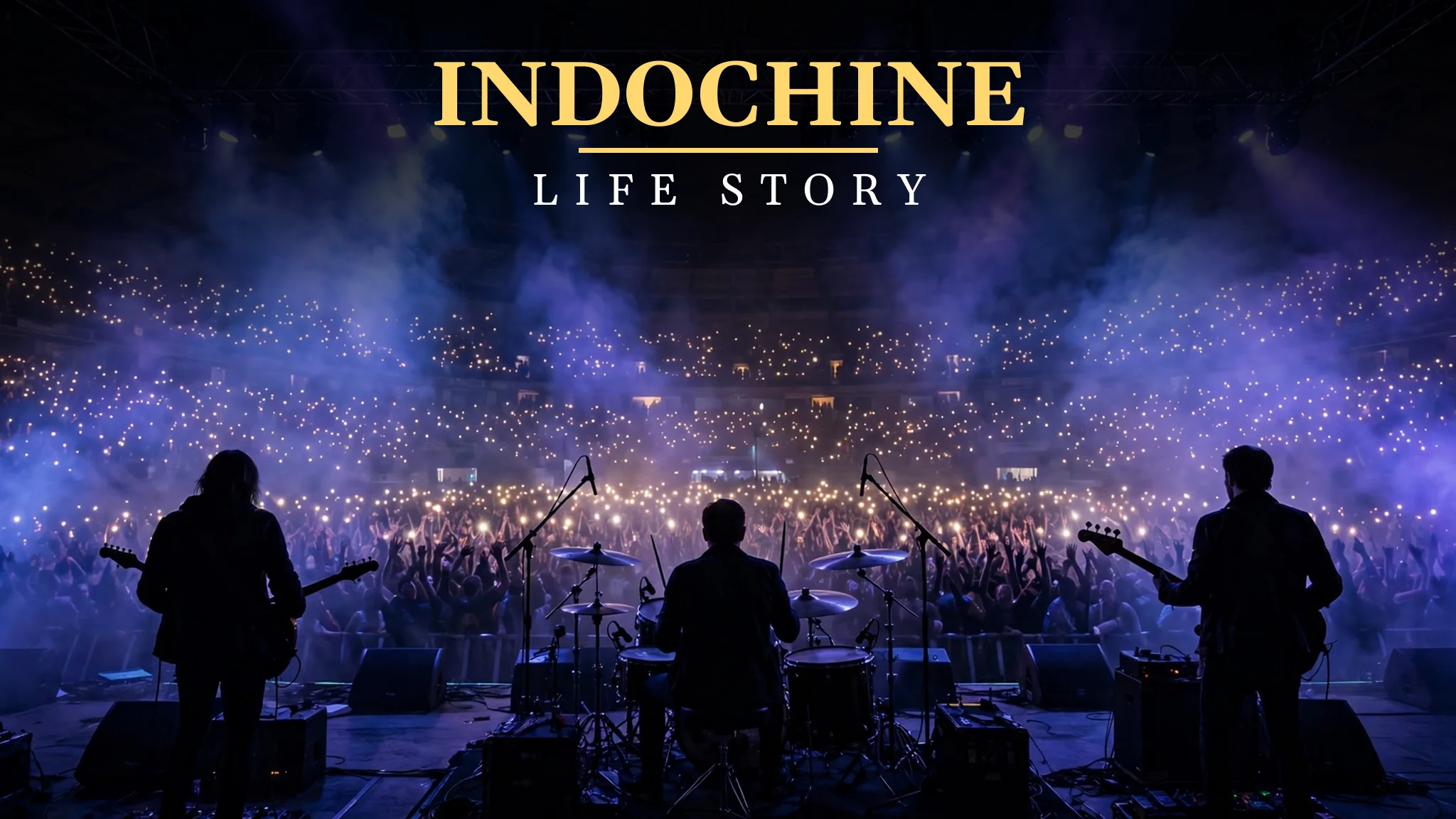
Finally, I think about the stadium, the lights, the smoke, and the thousands of small lights in the crowd, and I think that image is a fitting end to this story. A band that started in a small room in Paris, with a singer and a guitarist, now plays to tens of thousands of people who know every word. That journey, from a rehearsal room to a stadium, is not a fairy tale. It is the result of work, of loyalty, of loss, and of a refusal to stop, and that is why I think Indochine’s story is worth telling, and worth remembering.
Frequently Asked Questions
When was Indochine formed and who started the band?
Indochine was formed in Paris in 1981 by singer Nicola Sirkis and guitarist Dominique Nicolas. Nicola has remained the band’s leader and main songwriter through every change in the line-up since then.
What was Indochine’s first big hit?
The band’s first big hit was L’Aventurier, the title song of its first album, released in 1982. The song became a hit in France and gave the young band its first wide audience.
Which Indochine songs are the most famous?
Famous Indochine songs include L’Aventurier, 3e sexe, Canary Bay, Tes yeux noirs, and the comeback hit J’ai demande a la lune from the album Paradize. The band’s live shows also feature many songs from its later albums.
What happened to Stephane Sirkis?
Stephane Sirkis, Nicola’s twin brother and a member of Indochine, died in 1999. His death was a deep loss for the band, and Nicola chose to continue the group after a period of mourning.
How did Indochine make a comeback?
Indochine made a major comeback with the album Paradize in 2002. The record and its hit single J’ai demande a la lune brought the band back to the charts and to large venues, and later albums kept that success going.
Has Indochine played in stadiums?
Yes, Indochine has played in very large venues, including the Stade de France in 2022. The band is known for long, large-scale arena and stadium shows with strong lights and a crowd that sings along.


