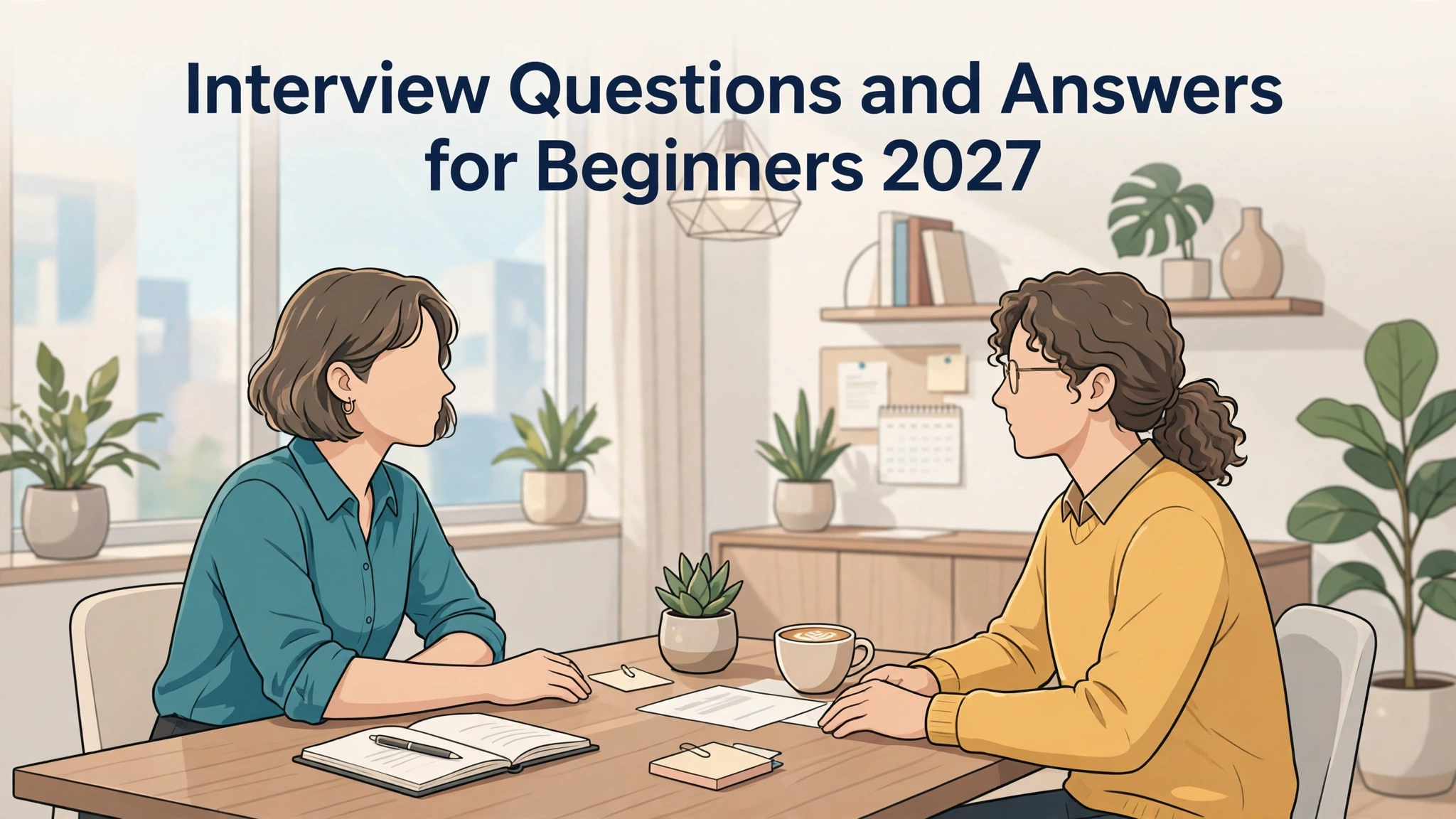
Interview Questions and Answers for Beginners 2027
In this post
A job interview can feel intimidating for a beginner, especially when it is the first time sitting across from a hiring manager and trying to prove suitability in a short conversation. The good news is that interviews are far more predictable than they feel. Most interviews ask a small set of common questions, test the same qualities in different ways, and reward preparation, honesty, and clear examples far more than perfect wording. This guide explains the most common beginner interview questions, how to structure strong answers, what interviewers are really asking, and how to handle tricky questions about experience, weaknesses, and salary without panic or exaggeration.
The first thing beginners should understand is the purpose of an interview. It is not an exam with one correct answer, and it is not a performance where confidence alone wins. It is a conversation to test fit: can this person do the job, will they work well with the team, and are they likely to stay and grow? Every question, even a casual one, relates to one of those tests. A candidate who keeps that purpose in mind will answer more naturally, because they will focus on showing capability, reliability, and genuine interest, rather than trying to guess a magic phrase.
The second thing is preparation. Beginners often prepare by memorizing answers word for word, then freeze when a question is phrased differently. A better method is to prepare stories, not scripts. Gather four or five real examples from study, work, volunteering, or projects that show problem-solving, teamwork, learning, reliability, and initiative. Then practise telling each story briefly, with a beginning, an action, and a result. Those stories can answer many different questions, because interviewers care more about evidence than about rehearsed perfection. Preparation should also include researching the employer, the role, and the industry, so answers can connect personal strengths to the employer’s actual needs.
The third thing is honesty. Beginners sometimes feel pressure to invent experience or hide weaknesses, but interviewers are skilled at spotting vague or inconsistent answers. Honest answers, framed positively, build far more trust. A beginner can say they are new to a tool but have learned similar tools quickly, or that they lack direct experience but have completed relevant projects and are eager to learn. That honesty, combined with evidence of learning ability, is often more convincing than a confident claim that collapses under follow-up questions. Interviews reward candidates who can be trusted, and trust starts with truthful answers.
Tell Me About Yourself and Other Opening Questions
Tell me about yourself is the most common opening question, and it is not an invitation to recite a life story. Interviewers want a short professional summary that connects past experience to the role. A strong structure has three parts: present, past, and future. Present means who you are now, in one sentence, such as a recent graduate in business studies or a customer service assistant. Past means one or two relevant experiences or skills that prepared you for this role. Future means why this role is the next logical step and what you hope to contribute. The whole answer should last about one minute, not five, and should end by inviting the interviewer into the role discussion.
An example structure, using invented example details, shows how this works. A candidate might say they are currently working part-time in retail while completing a marketing course, that retail taught them customer communication and handling busy periods, that their course projects taught them social media planning and basic analytics, and that they are now seeking a junior marketing role where they can apply those skills to real campaigns. That answer is short, relevant, and forward-looking. It does not list every job or hobby. It selects the evidence that matters for this role and leaves room for follow-up questions.
Other opening questions include why do you want this job, why should we hire you, and what do you know about our company. These all test preparation and genuine interest. A strong answer to why this job connects the role’s duties to the candidate’s skills and interests, rather than focusing only on salary, location, or convenience, even if those matter privately. A strong answer to why hire you summarizes two or three strengths with brief evidence, not a list of adjectives. A strong answer about the company shows specific research: what the company does, who its customers are, recent news or values that genuinely interest the candidate, and how the role fits into that picture. Generic praise, such as saying a company is great, proves nothing. Specific knowledge proves preparation.
Strengths, Weaknesses, and Behavioural Questions
Strengths questions are easier when the candidate chooses strengths that match the job and supports each with a brief example. Instead of saying I am hardworking, a candidate might say they are organized, explaining how they managed coursework, part-time work, and a volunteer schedule by planning weekly and meeting deadlines. Instead of saying I am a team player, they might describe a group project where they coordinated tasks and helped resolve a disagreement. The strength matters less than the evidence. Interviewers remember stories. They forget adjectives.
Weaknesses questions frighten beginners, but they are really a test of self-awareness and growth. The worst answers are fake weaknesses disguised as strengths, such as I work too hard, or claiming no weaknesses at all, both of which sound evasive. A better answer names a real, non-critical weakness, explains what is being done to improve it, and shows progress. For example, a candidate might say they used to feel nervous presenting, so they joined opportunities to present in class and practised with small groups, and now feel more confident, while still preparing thoroughly. That answer is honest, specific, and shows learning. Avoid naming a weakness central to the job, such as poor attention to detail for a data role, unless you can show strong, credible improvement.
Behavioural questions ask for examples of past behaviour, often starting with tell me about a time when. Common topics include handling a difficult customer, working in a team, solving a problem, meeting a deadline, or learning something new. The STAR method helps structure these answers: Situation, Task, Action, Result. Situation sets the scene briefly. Task states what needed doing. Action explains what the candidate personally did, using I rather than we, so their contribution is clear. Result states the outcome honestly, including what was learned if the outcome was imperfect. Beginners without work experience can use examples from study, volunteering, sports, or personal projects, because interviewers value the behaviour demonstrated, not only the setting.
Experience, Education, and Tricky Questions
Beginners often worry about questions on lack of experience, such as why should we hire someone with no experience, or what makes you suitable without direct experience. The honest answer reframes the question: experience is not only paid work. Relevant coursework, projects, internships, volunteering, part-time jobs, and personal learning all build skills. A candidate should connect those experiences directly to the role’s needs. For example, a candidate for a customer service role can draw on retail, volunteering, or any role involving helping people under pressure. A candidate for a technical role can draw on course projects, personal builds, or online learning with portfolio evidence. The key is to show transferable skills, not to apologize for being a beginner.
Questions about gaps, job changes, or academic results should be answered briefly, honestly, and forward-looking. A gap due to study, caregiving, illness, or job searching can be stated simply, followed by what was learned or how the candidate is ready now. There is no need for long personal detail, and interviewers should not press for private information beyond what is relevant. If a question feels inappropriate or discriminatory, candidates in many countries have rights, and they can politely redirect to job-relevant strengths. Knowing local employment rights before an interview helps beginners respond calmly rather than feeling trapped.
Tricky questions also include where do you see yourself in five years, why did you leave your last job, and what salary do you expect. For future plans, give an honest, role-relevant answer: growing skills in this field, taking on more responsibility, and contributing to the team, rather than a vague dream unrelated to the job. For leaving a job, stay positive and factual, focusing on seeking growth, new challenges, or a better fit, without criticizing a former employer at length. Negativity about past employers worries interviewers, because they wonder what the candidate will say about them later. For salary, research typical ranges for the role and region before the interview, and if pressed early, give a researched range or ask about the budgeted range, while expressing flexibility for the right opportunity. Beginners should not accept a salary far below market rate out of fear, but they should also understand that entry-level roles pay entry-level rates, and growth comes with experience.
Questions to Ask, Body Language, and Follow-Up
An interview is also a chance for the candidate to assess the employer, and interviewers expect questions at the end. Asking no questions can suggest low interest, while asking thoughtful questions shows engagement. Good questions include what does success look like in the first months, how is training and support provided for beginners, what does a typical day involve, and how does the team work together. Avoid asking only about salary, holidays, or perks in the first interview, unless the interviewer raises them, because that can suggest the candidate cares only about benefits. Save detailed contract questions for later stages, when an offer is discussed.
Body language and presentation support answers without replacing them. Arrive on time, dress appropriately for the workplace, greet interviewers politely, and maintain natural eye contact. Sit comfortably, avoid fidgeting excessively, and listen fully before answering rather than interrupting. For video interviews, test camera, microphone, and internet beforehand, choose a quiet, tidy background, look at the camera when speaking, and keep notes nearby without reading answers word for word. Technical preparation for video interviews is part of professionalism, and a candidate who handles a minor glitch calmly impresses more than one who panics.
After the interview, a short thank-you message is good practice where culturally appropriate. Thank the interviewer for their time, restate brief enthusiasm for the role, and mention one point from the conversation that reinforced interest. Keep it short and professional, and send it promptly, usually within a day. If no response arrives by the stated timeline, a polite follow-up asking about the decision timeline is reasonable. If rejected, asking for brief feedback, where offered, can help future interviews. Rejection is normal for beginners, and it is not a verdict on worth. Each interview, including unsuccessful ones, builds experience that makes the next interview easier.
Video Interviews and Assessment Tasks
Video interviews are now standard for many first-stage interviews, and they require technical preparation as well as content preparation. Test the platform, camera, microphone, speakers, and internet connection well before the interview, and have a backup plan, such as a phone hotspot or a second device, in case of failure. Choose a quiet room with a tidy, neutral background, good lighting on the face, and no interruptions. Inform housemates or family of the interview time, silence notifications, and close unnecessary applications. A candidate who joins calmly, with working audio and video, already signals professionalism before answering a question.
During a video interview, look at the camera when speaking, rather than at your own image, so eye contact feels natural to the interviewer. Speak slightly more slowly than usual, because video can compress speech and make fast talk harder to follow. Use notes sparingly: a short list of stories and questions is helpful, but reading answers word for word sounds flat and is usually obvious. If the connection freezes or audio drops, stay calm, state the problem plainly, and ask to repeat the question. Interviewers understand technical problems, and handling one gracefully can actually impress them more than a flawless connection.
Assessment tasks, such as written exercises, practical tests, or short presentations, are increasingly used alongside interviews, especially for roles involving writing, analysis, design, or technical skill. Prepare by practising similar tasks under time limits, reading instructions carefully, and showing working or reasoning where relevant, not just final answers. If a task is take-home, submit it on time, in the requested format, and with a brief note explaining assumptions made. If a task is live, think aloud where appropriate, so assessors can see problem-solving even if the final answer is imperfect. Honesty about limitations during a task, combined with a clear approach, usually scores better than a polished-looking answer that cannot be explained.
Handling Rejection and Improving Next Time
Rejection is a normal part of job searching, especially for beginners competing for entry-level roles with many applicants. A single rejection rarely means the candidate was poor. It often means another candidate matched a specific need more closely, had a particular skill, or was available sooner. Beginners should avoid personalizing each rejection and instead treat applications as a numbers game with learning built in: apply thoughtfully, interview well, and review what could improve after each stage. Keeping a simple record of applications, interview questions asked, and answers given helps spot patterns, such as a question that repeatedly causes difficulty, which can then be practised.
Feedback, where offered, is valuable and should be requested politely after a rejection. A short message thanking the interviewer and asking for one or two areas to improve is reasonable, and some employers will respond helpfully. Not all employers give feedback, often due to time or policy, and silence should not be taken as hostility. Where feedback is given, act on it specifically: if presentation skills were noted, practise presentations; if technical knowledge was thin, study that area before the next interview. Generic feedback, such as keep trying, is less useful, but it still confirms that persistence, not a single interview, is the path forward.
Confidence grows with practice, and practice can be created deliberately. Mock interviews with a friend, mentor, or career adviser, using real job descriptions and common questions, reveal habits such as rambling, vague answers, or nervous filler words. Recording a mock interview, with permission, and watching it back can be uncomfortable but highly instructive, because candidates often do not realize how often they say um, how long their answers run, or how little eye contact they make. Each mock interview makes the real interview feel less unfamiliar, and familiarity reduces anxiety more reliably than motivational advice alone.
My Take:
My opinion on interviews is that beginners overestimate how much interviewers expect perfection and underestimate how much they value clarity and honesty. Interviewers meet many candidates who sound polished but say nothing specific. A beginner who speaks plainly, gives a real example, and admits what they are still learning stands out precisely because they sound like a real person rather than a rehearsed script. I think the best interview preparation is not memorizing answers. It is knowing your own stories well enough to tell them naturally, even when a question surprises you.
I also believe the STAR method is useful but often misused. Candidates who force every answer into a rigid formula sound mechanical, and interviewers stop listening. I think STAR should be a mental checklist, not a script: set the scene quickly, say what you personally did, and state what happened. If the result was imperfect, saying what you learned is stronger than inventing a perfect ending. Interviewers respect candidates who can reflect on mistakes, because workplaces need people who learn, not people who pretend they never fail.
On weaknesses, my view is that honesty is the only strategy that survives follow-up questions. A fake weakness, such as perfectionism, invites a follow-up that exposes it. A real weakness with a credible improvement plan invites respect. I would advise beginners to choose a weakness they have genuinely worked on, practise explaining the improvement briefly, and then move on confidently. Dwelling on weaknesses, apologizing repeatedly, or choosing a weakness central to the job all undermine an otherwise strong interview. The goal is self-awareness, not self-punishment.
I am sceptical of interview advice that tells beginners to always appear confident, even when they do not feel it. Nervousness is normal, especially in a first interview, and most interviewers expect it. What matters is not hiding nerves completely, but managing them enough to communicate clearly: pausing before answering, speaking slowly, and asking for clarification when a question is unclear. Asking a question to be repeated is not weakness. It is good communication, and it prevents answering the wrong question confidently. I think beginners should give themselves permission to pause. A short silence before a thoughtful answer is better than a rushed answer to the wrong question.
Finally, I believe interviews should be treated as two-way conversations, not auditions for approval. A beginner who asks thoughtful questions, listens to answers, and notices whether the workplace feels supportive is making a better decision than a beginner who accepts any offer out of desperation. Not every job is a good job, and a poor fit harms both sides. I would encourage beginners to prepare questions about training, support, and daily work, and to trust their instincts about the team they meet. Getting a job matters, but getting a job where you can learn, be supported, and grow matters more, especially at the start of a career.
On video interviews, my view is that technical preparation is now part of interview preparation, not a separate IT task. A candidate who tests their setup, chooses a quiet room, and handles a glitch calmly shows the same reliability employers want on the job. I think beginners should do a full mock video call with a friend before any real video interview, checking lighting, sound, background, and eye contact. That one rehearsal prevents most technical embarrassments and frees the candidate to focus on answers rather than worrying about whether they can be heard.
I also believe rejection should be treated as data, not as a verdict. A beginner who records interview questions, reviews answers, and practises weak areas will improve faster than a beginner who either blames employers or blames themselves after each rejection. I would keep a simple interview log and review it after every interview, noting one thing that went well and one thing to improve. That habit turns even unsuccessful interviews into progress, and progress, over several interviews, is what eventually produces an offer. Job searching is a skill, and like any skill, it improves with deliberate practice.
A final thought is that mock interviews are the most underused preparation tool for beginners. Most beginners prepare alone, reading answers silently, and then discover in a real interview that speaking answers aloud feels completely different. I would practise aloud, with another person if possible, and record at least one mock session to watch back. It is uncomfortable, but it reveals rambling, filler words, and vague answers that silent reading hides. A candidate who has already heard themselves answer tell me about yourself three times will answer it calmly the fourth time, when it counts.
One more view I hold is that preparation should include the employer’s perspective, not only the candidate’s answers. Before an interview, I would ask what problem this role solves for the team, what a good first month looks like, and what worries the hiring manager might have about a beginner. Answering those questions in advance shapes every response, because the candidate can show how their strengths address the team’s actual needs rather than reciting generic qualities. That employer-centred preparation is what separates a good interview from a merely rehearsed one.
I also believe beginners should practise handling silence. Many candidates rush to fill pauses, adding rambling detail that weakens a good answer, because silence feels like failure in an interview. In reality, a brief pause before answering, or a calm moment after finishing an answer, signals thoughtfulness and confidence. I would practise pausing deliberately in mock interviews: finish an answer, stop, and wait for the next question without apologizing or adding filler. That discipline is small, but interviewers notice it, because it shows a candidate who is comfortable, controlled, and able to communicate under pressure.
Finally, I would tell any beginner facing a first interview to trust preparation over perfection. Know your stories, research the employer, prepare thoughtful questions, and then speak plainly and honestly on the day. You will not answer every question perfectly, and you do not need to. Interviewers are looking for a capable, reliable person they would enjoy working with, and a beginner who shows evidence, self-awareness, and genuine interest already looks like that person, even without years of experience.
Frequently Asked Questions
How should a beginner answer tell me about yourself?
Use a short present, past, future structure: who you are now, one or two relevant experiences or skills, and why this role is the next step. Keep it to about one minute, focus on relevance to the job, and avoid reciting your full life history or CV.
What is a good answer to what is your biggest weakness?
Name a real, non-critical weakness, explain what you are doing to improve it, and show progress with a brief example. Avoid fake weaknesses such as working too hard, claiming no weaknesses, or naming a weakness central to the role without credible improvement.
How do I answer interview questions with no work experience?
Use examples from study, volunteering, projects, sports, or personal learning that demonstrate transferable skills such as teamwork, problem-solving, reliability, or communication. Interviewers value the behaviour shown, not only whether the example came from paid work.
What questions should I ask at the end of an interview?
Ask about success in the first months, training and support for beginners, a typical day, and how the team works together. Thoughtful questions show genuine interest. Save detailed salary and contract questions for later stages unless the interviewer raises them first.
How should I answer the salary question as a beginner?
Research typical salary ranges for the role and region beforehand. If asked early, you can give a researched range or ask about the budgeted range, while expressing flexibility for the right opportunity. Avoid accepting far below market rate out of fear, but understand entry-level roles pay entry-level rates.
What should I do after an interview?
Send a short, professional thank-you message within a day, restating enthusiasm and one point from the conversation. If no reply arrives by the stated timeline, follow up politely about the decision. If rejected, ask for feedback where offered, and treat each interview as experience for the next one.