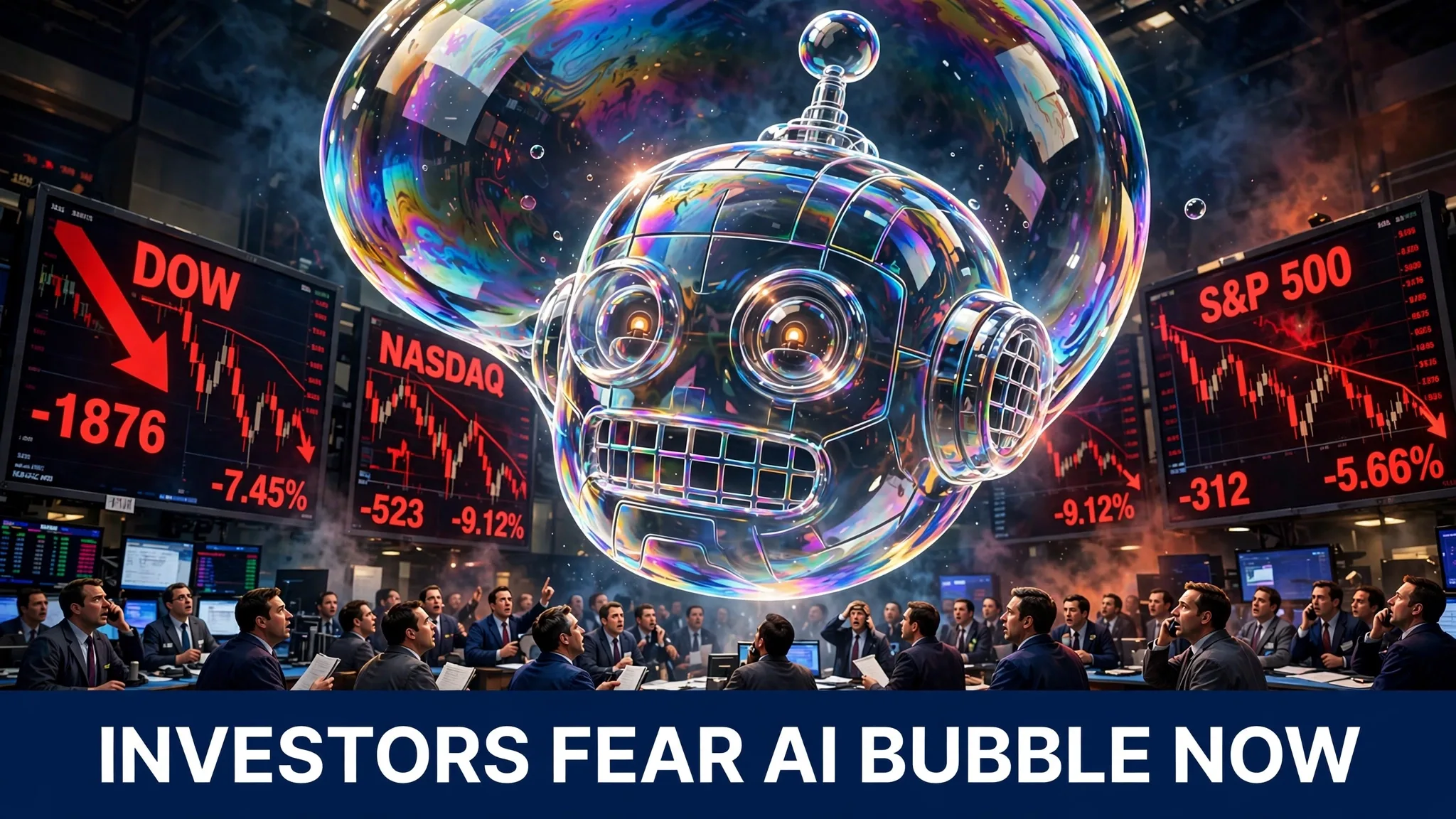
Investors Fear AI Bubble Now
In this post
The Morning the Screens Turned Red
Every trading day on Wall Street begins with a bell. It rings, the screens light up, and thousands of people start buying and selling pieces of companies. Some days the numbers climb calmly, like a slow walk uphill. Other days they drop like a stone down a well.
This was a stone day.
By the time the dust settled, the Nasdaq — the famous index packed with technology companies — had fallen 2.6% in a tech sell-off. To understand why one number like that can make headlines around the world, you have to walk through the day slowly, bell by bell. Because this was not really a story about computers or chips. It was a story about a question, one that has been whispered for months and finally got shouted out loud: has the great artificial intelligence boom become a bubble?
What Is a Bubble, in Plain Words?
Forget the finance textbooks for a moment. Imagine a street where everyone suddenly decides that one special type of stone is precious. On Monday, a stone costs ten rupees. On Tuesday, your neighbour sells his for fifty, because everyone wants one. By Friday, people are paying five hundred, not because the stone changed, but because everyone believes someone else will pay even more tomorrow.
Then one morning, a buyer pauses. He looks at the stone in his hand and thinks: it is still just a stone. He offers less. Suddenly everyone wants to sell at the same time, and nobody wants to buy. The price does not slide — it pops.
That is a bubble. Prices rise far above what something is truly worth, carried up by excitement and belief, and then the belief cracks.
So when investors worry about an “AI bubble,” they are asking a simple question. Tech companies are spending truly enormous amounts of money on artificial intelligence — on data centres, chips, power, and people. The spending is real. The excitement is real. But are the future profits being promised real enough to justify today’s prices? That single doubt sat at the centre of this whole trading day.
The Seven Giants Holding Up the Market
To follow the next part of the day, you need to meet a famous group. On Wall Street, traders talk about the “Magnificent Seven” — a nickname borrowed from an old cowboy film — for the small group of giant technology stocks that have become so large and so powerful that they drag the entire market up or down with them.
For years, these giants were the engine of the stock market’s rise. When they climbed, the indexes climbed. Pension funds, savings plans, and ordinary investors all benefited, often without even knowing the names of the companies inside their funds.
But an engine that powerful creates a quiet risk. If so much of the market’s success rests on just a handful of companies, then a bad day for those few becomes a bad day for almost everybody. And that is exactly the fear that walked onto the trading floor this morning: what if the prices of these giants have climbed too high, too fast, on the promise of AI money that has not arrived yet?
The Slide: How the Day Went Wrong
Once the opening bell rang, technology shares started slipping. Selling invites more selling — when prices fall, some investors sell because they are scared, others sell because their systems are programmed to, and the red numbers spread from screen to screen.
The fall in the Nasdaq, down 2.6%, told the story in one figure. This was not one company disappointing the market with one bad report. It was the whole technology corner of the market stepping backwards together, as the debate over whether AI spending has become a bubble flared up again, louder than before.
And Wall Street does not trade in a sealed room. News travels at the speed of light, and fear travels with it.
The Fear Crosses the Ocean
While Americans watched their screens, traders across Asia were watching theirs. Asian equities followed Wall Street lower, the same worry wearing different clothes in different time zones. A question asked in New York at breakfast was being asked in Tokyo and Hong Kong by their morning too: have we all paid too much for the AI dream?
This is one of the strange truths of modern money. Markets on opposite sides of the planet are tied together like boats on the same lake. When a big wave rocks one, every boat feels it. A worker in Asia who never bought an American share can still wake up to a smaller retirement fund, simply because his fund owns pieces of the same falling market.
The Scramble for Safety
Here is where the day gets interesting, because fear does not only sell. Fear also buys — it buys safety.
As shares fell, money ran toward the calm corners of the financial world. Japanese government bonds rallied, and the yen — Japan’s currency — strengthened. Traders call this a “flight to safety,” and it is a classic pattern, as old as markets themselves. When the storm rises, sailors head for the harbour. Government bonds from a stable country and a trusted currency are the harbour.
Think of it like weather in a village. When dark clouds gather, people do not stop living — they move their goods under a roof. Investors did not abandon the market forever; they shifted their money toward things that feel solid while the argument about AI prices rages on.
Watching both moves on the same day — shares down, safe havens up — tells you the market’s mood more honestly than any speech could.
The Pension Fund That Made Everyone Look Up
Every market day has one moment that people remember afterwards. This day’s moment came from California.
CalPERS, California’s giant pension fund, has sharply cut its holdings in the Magnificent Seven. If you have never heard of CalPERS, here is why it matters: a pension fund is not a gambler’s pocket money. It is the collected retirement savings of huge numbers of ordinary workers — teachers, firefighters, office staff — people who worked for decades and trusted this fund to guard the money they will live on when they are old.
Funds like this move slowly and carefully, like ocean liners. They do not chase fashions, and they do not panic. So when an allocator of that size trims its position in the very group of stocks that has driven the market’s returns, people pay attention. CalPERS pointed to doubts over lofty valuations — prices it sees as stretched too high — and soaring spending, the river of money the tech giants are pouring into AI.
Honestly, one fund’s move proves nothing about the trend on its own. Big funds adjust their holdings for many reasons, and a trim is not an escape. CalPERS did not declare the giants worthless; it reduced how much it holds. Still, when the most careful sailor on the lake quietly moves some cargo below deck, the other sailors notice. That is why this single decision became the day’s loudest signal.
In my view, this is the part of the story that deserves the most attention — not the falling numbers, but the fact that the guardians of ordinary people’s savings are the ones asking the hard questions first.
Why This Matters Far Beyond Wall Street
You might wonder why a trading day in America deserves your time if you have never bought a share. The answer is that the modern savings system ties nearly everyone to these markets, whether they chose it or not.
Retirement funds buy indexes. Indexes are dominated by the giant tech stocks. So when the giants wobble, the savings of millions of people wobble with them — quietly, invisibly, in accounts most people check once a year. The AI spending debate is therefore not just an argument among traders. It reaches into the future income of teachers, nurses, drivers, and shop workers on several continents.
There is another side too. If the AI boom truly has inflated a bubble, the spending itself is shaping real life right now: data centres rising, electricity demand growing, jobs created and jobs changed. A bubble in prices does not mean the technology is fake. Railways were real, and railway shares still crashed in their early days. The internet was real, and internet shares still crashed before the internet conquered the world. A technology can change everything and still be priced too high for a while. Both things can be true at once, and honest investors have to hold both ideas in their heads on days like this one.
The Closing Bell
Eventually, the closing bell rang, the way it always does. The screens froze on their final numbers. The Nasdaq’s 2.6% fall was written into the record books, Asia had echoed it, the yen and Japanese bonds had absorbed the nervous money, and CalPERS’ decision had given the whole day its meaning.
Nothing was settled. That is the thing nobody tells you about markets: the bell ends the trading, not the argument. Tomorrow the same question will be asked again — is this a bubble, or is this just a deep breath in a long climb? The giants will report their earnings, the spending figures will come out, and millions of people will judge again.
What this day proved is smaller, and more solid: the question can no longer be ignored, because even the biggest, most careful pools of money in the world are now asking it in the open. On Wall Street, that is how every big story begins — not with an answer, but with a doubt too loud to whisper.
Frequently Asked Questions
What happened on Wall Street on this day?
Technology shares sold off sharply, and the Nasdaq index fell 2.6%. The fall was driven by a renewed debate over whether the enormous spending on artificial intelligence has pushed tech stock prices into bubble territory.
What does “AI bubble” actually mean?
It means prices may have risen far above what the companies can realistically earn in the near future, carried there by excitement rather than results. If belief in those future profits cracks, prices can fall very fast, just as a soap bubble pops rather than slowly leaking air.
Who are the Magnificent Seven?
It is a nickname for the small group of giant technology stocks that have grown so large they drive the performance of the whole market. Because indexes and pension funds hold them heavily, their rise lifted everyone’s savings — and their falls hurt in the same wide way.
What did CalPERS do, and why does it matter?
CalPERS, California’s giant pension fund, sharply cut its holdings in the Magnificent Seven, citing doubts over lofty valuations and soaring spending. It matters because pension funds guard the retirement savings of ordinary workers and move very cautiously, so their decisions are watched as serious signals — though one fund’s move alone does not prove a trend.
What is a “flight to safety”?
It is what investors do when fear rises: they move money out of risky assets like shares and into calm ones. On this day, Japanese government bonds and the yen rallied as money sought safety, a classic pattern during market storms.
Does this fall mean the AI boom is over?
No. One day’s fall settles nothing, and even the day itself carried no such proof. It shows that doubt about AI prices is now being voiced by some of the most careful investors in the world. The technology may still transform daily life; the open question is only whether today’s prices already assume too much of that future.
Sources
- Daily Brief, 23 October 2026 (compiled from major news wires) — https://michaelbrunger.com/briefs/2026-10-23/