Iqbaal Ramadhan: The Life Story Behind Indonesia's Teen Star
In this post
- A Child Singer in Coboy Junior
- Dilan and a Motorbike That Became Famous
- Bumi Manusia and a Serious Novel
- Study in Australia and a Pause
- Returning as an Adult Actor
- A Star Who Grew Up With His Audience
- What Growing Up in Public Teaches
- Music After the Boy Band
- A Young Man in Melbourne
- Milea, New York and a Wider World
- My Take:
Iqbaal Ramadhan is a star who grew up in front of Indonesia, and that is not a figure of speech. He was a child singer, then a teenage idol, then a film star, then a student in Australia, then an adult actor, and millions of Indonesians watched each of those stages happen. They watched him sing in a boy band, they watched him ride a motorbike as Dilan, they watched him leave for university, and they watched him come back. That shared history is why his name still brings a smile to so many faces. He is not only a star. He is a memory of growing up.
He was born on 28 December 1999 in Surabaya, Indonesia, as Iqbaal Dhiafakhri Ramadhan. Surabaya is Indonesia’s second largest city, a busy port city in East Java, and a boy growing up there learns to be practical, direct, and hardworking. Iqbaal carried those qualities with him when he moved to Jakarta as a child, and they stayed with him through fame. He was not a child who was pushed into show business by accident. He was a child with a clear talent for singing and performing, and his family supported him as he learned to use it.
What makes his story different from many child stars is that he did not stay a child star. He grew, he changed, and he made choices that showed he was thinking about his future. He left a successful boy band, he went to study abroad, and he returned to acting as an adult, with a new kind of role and a new kind of seriousness. That is a rare path, and it is one that takes courage, because leaving a successful group is always a risk. Iqbaal took that risk, and it worked.
A Child Singer in Coboy Junior
Iqbaal Ramadhan’s first fame came as a singer, not as an actor. In 2011, when he was eleven years old, he became a member of Coboy Junior, a boy band for young singers, which later became known as CJR. The group sang pop songs for young audiences, they performed on television, and they became very popular with children and teenagers across Indonesia. Iqbaal was one of the main voices in the group, and he was known for his clear singing, his bright smile, and his natural way on stage.
Being in a boy band as a child is a strange life. You sing, you dance, you travel, you meet fans, and you do it all while you are still going to school. Iqbaal did it, and he did it well, for several years. The group released songs, performed in concerts, and appeared in films and television, and Iqbaal became a familiar face to millions of young Indonesians. For many of them, he was the first pop star they ever loved, and that first love is hard to forget.
In 2014, when he was fourteen, Iqbaal left Coboy Junior. The decision was widely discussed at the time, because the group was still popular, and leaving a popular group is never easy. He left because he wanted to focus on his studies and on his own path, and because he was growing up and his voice, his interests, and his life were changing. It was a brave choice for a teenager, and it showed a maturity that many adults do not have. He was willing to give up a sure thing for a future he could not yet see.
The years after Coboy Junior were quieter, and that quiet was important. He studied, he grew taller, his voice changed, and he thought about what he wanted to do next. He did not rush back into fame. He waited, he learned, and when he returned, he returned as a different kind of star: not a child singer, but a young actor, ready for a role that would change his life.
Dilan and a Motorbike That Became Famous
In 2018, Iqbaal Ramadhan appeared in Dilan 1990, a film based on a popular novel by Pidi Baiq, about a high school boy named Dilan in Bandung in 1990, who falls in love with a girl named Milea. Iqbaal played Dilan, a boy who rides a motorbike, who is clever, funny, and a little bit naughty, and who wins Milea’s heart with his words and his charm. The film became a huge hit, one of the most successful Indonesian films of its year, and it made Iqbaal a star all over again, this time as an actor.
Dilan is a character that many Indonesian teenagers love, because he is not a perfect hero. He is a boy who fights, who jokes, who writes letters, and who loves in a way that feels real. Iqbaal played him with a lightness and a confidence that fitted the character perfectly. He rode the motorbike, he wore the school uniform, he spoke the lines, and audiences believed him. For many viewers, Iqbaal became Dilan, and Dilan became Iqbaal, and the two names are still linked today.
A sequel followed, Dilan 1991, in 2019, and then Milea: Suara dari Dilan, in 2020, in which the story was told from Dilan’s point of view. The three films together became a phenomenon, watched by millions, quoted by fans, and loved by a generation. Iqbaal was at the centre of that phenomenon, and he handled it with a calm that many people admired. He did not act as if he was above his fans. He thanked them, he worked hard, and he kept his private life mostly private.
The Dilan films also showed that Iqbaal could carry a film. He was not only a singer who acted. He was an actor who could hold the screen for two hours, make audiences laugh, make them feel, and make them come back for the next film. That is a rare skill, and it is one that directors noticed. After Dilan, he was offered more serious roles, and he took them, because he wanted to grow beyond the schoolboy on a motorbike.
Bumi Manusia and a Serious Novel
In 2019, Iqbaal appeared in Bumi Manusia, which means This Earth of Mankind, a film based on a famous novel by Pramoedya Ananta Toer, one of Indonesia’s greatest writers. He played Minke, a young Javanese man in the Dutch colonial period, who falls in love with a woman named Annelies and who faces a world of racism, injustice, and change. It was a very different role from Dilan. It was serious, historical, and literary, and it asked Iqbaal to play a young man who thinks, writes, and fights for his dignity in a colonial world.
Playing Minke was a great honour and a great risk. Pramoedya’s novel is taught in schools and loved by readers, and Minke is a character that many Indonesians know well. Iqbaal had to show Minke as a clever, brave, and thoughtful young man, not as a simple romantic lead. He had to wear period clothes, speak in a different way, and live in a different time, and he had to do it while audiences compared him to the Minke they had imagined while reading. He did it with a seriousness that surprised people who only knew him as Dilan.
The film was a commercial success, and it was praised for bringing a classic novel to the screen. For Iqbaal, it was proof that he could do more than teen romance. He could do history, literature, and serious drama, and he could do it well. He was no longer only the boy from Dilan. He was also Minke, a young man from a classic novel, and those two roles together gave him a wider range than most young actors have.
Bumi Manusia also showed his interest in Indonesian history and literature. He was not only an actor who took any role. He was an actor who chose a role from a great book, and who treated it with respect. That choice tells a great deal about his values. He wanted to be part of Indonesian culture, not only Indonesian entertainment, and Bumi Manusia gave him that chance.
Study in Australia and a Pause
After the Dilan films and Bumi Manusia, Iqbaal made another brave choice: he went to study in Australia. He enrolled at Monash University in Melbourne, where he studied communications and media, and he lived as a student, far from the fame and the cameras of Jakarta. It was a pause in his acting career, and it was a pause he chose, not one that was forced on him. He wanted to learn, to live abroad, and to grow up away from the spotlight, and he did it.
Studying abroad is a different kind of life from being a film star. A student must attend classes, write assignments, cook for himself, and live in a new city, and Iqbaal did all of those things. He was recognised by Indonesian students in Melbourne, and he was friendly with them, but he was also a normal student, living a normal student life. That normality is valuable for an actor, because it gives you new experiences to draw on, and it gives you time to think about who you are when you are not performing.
His time in Australia also gave him a wider view of the world. He saw a different country, a different culture, and a different way of life, and he brought that view back to Indonesia when he returned. He spoke about his studies in interviews, and he spoke with a thoughtfulness that showed the experience had changed him. He was no longer only a teenage star. He was a young man who had studied, travelled, and thought, and that depth showed in his later work.
The pause also showed his fans that he was serious about learning. Many young stars promise to study later, and later never comes. Iqbaal studied, and he studied abroad, and he did it while he was at the height of his fame. That is a message that many young Indonesians heard clearly: fame is not a reason to stop learning. Learning is a reason to be proud, even when you are already famous.
Returning as an Adult Actor
When Iqbaal returned to Indonesia after his studies, he returned as an adult actor, with a new kind of role in mind. He appeared in films that were more serious, more varied, and more grown up than Dilan, and he showed that he was willing to take on characters who were not simply charming schoolboys. He worked in dramas, in films about modern life, and in projects that asked him to be quieter, darker, and more thoughtful than before. That change was not easy, because audiences still loved Dilan, and they wanted him to stay Dilan forever. But Iqbaal knew that staying Dilan forever would mean not growing, and he chose growth.
His return also included work in music, in public life, and in projects that connected him with young Indonesians who had grown up with him. Those fans were now adults too, and they were ready for adult films, adult stories, and adult conversations. Iqbaal grew with them, and that shared growth created a bond that is hard to break. A star who grows up with his audience will often keep that audience for life, because the audience feels as if they grew up together.
He has also become known for his calm, thoughtful way of speaking in interviews. He does not shout, he does not boast, and he does not try to be the centre of attention. He speaks clearly, he listens, and he answers with thought. That calm is rare in a young star, and it is one of the reasons people respect him. He seems to know who he is, and he does not need to prove it every day. That confidence comes from having been famous as a child, having left fame to study, and having returned on his own terms.
His adult work is still developing, and that is part of its interest. He is in his mid-twenties, with a past that is already remarkable, and a future that is still open. He could become a leading man in serious dramas, a director, a producer, or a public figure who speaks about education and youth. Whatever he chooses, he has already shown that he can choose well, because he has chosen well before: leaving Coboy Junior, playing Dilan, playing Minke, and going to study in Australia were all good choices, and they all led him to where he is now.
A Star Who Grew Up With His Audience
Today, Iqbaal Ramadhan stands as an example of a child star who grew up well. He was famous at eleven, he was famous at eighteen, he was famous at twenty, and he is still famous in his mid-twenties, but he is famous in a different way now. He is no longer a child singer or a teenage idol. He is a young adult actor, with a degree, with experience, and with a clear sense of who he is. That transformation is rare, and it is worth celebrating, because many child stars do not make it.
His story also shows how Indonesian entertainment has changed. When he started, in 2011, boy bands were popular, and television was the main way to be famous. By 2018, films based on novels were the main way, and by 2020, streaming and social media had changed everything again. Iqbaal lived through all of those changes, and he adapted to each one, without losing himself. He sang, he acted, he studied, and he came back, and each time he was a little different, and a little stronger.
For young Indonesians, Iqbaal is a useful example. He shows that you can be famous young, you can leave fame to study, and you can return stronger. You do not have to choose between fame and learning. You can have both, if you are willing to work for both, one step at a time. You do not have to stay the person you were at eleven. You can grow, you can change, and you can become someone new, and your fans will grow with you if you let them.
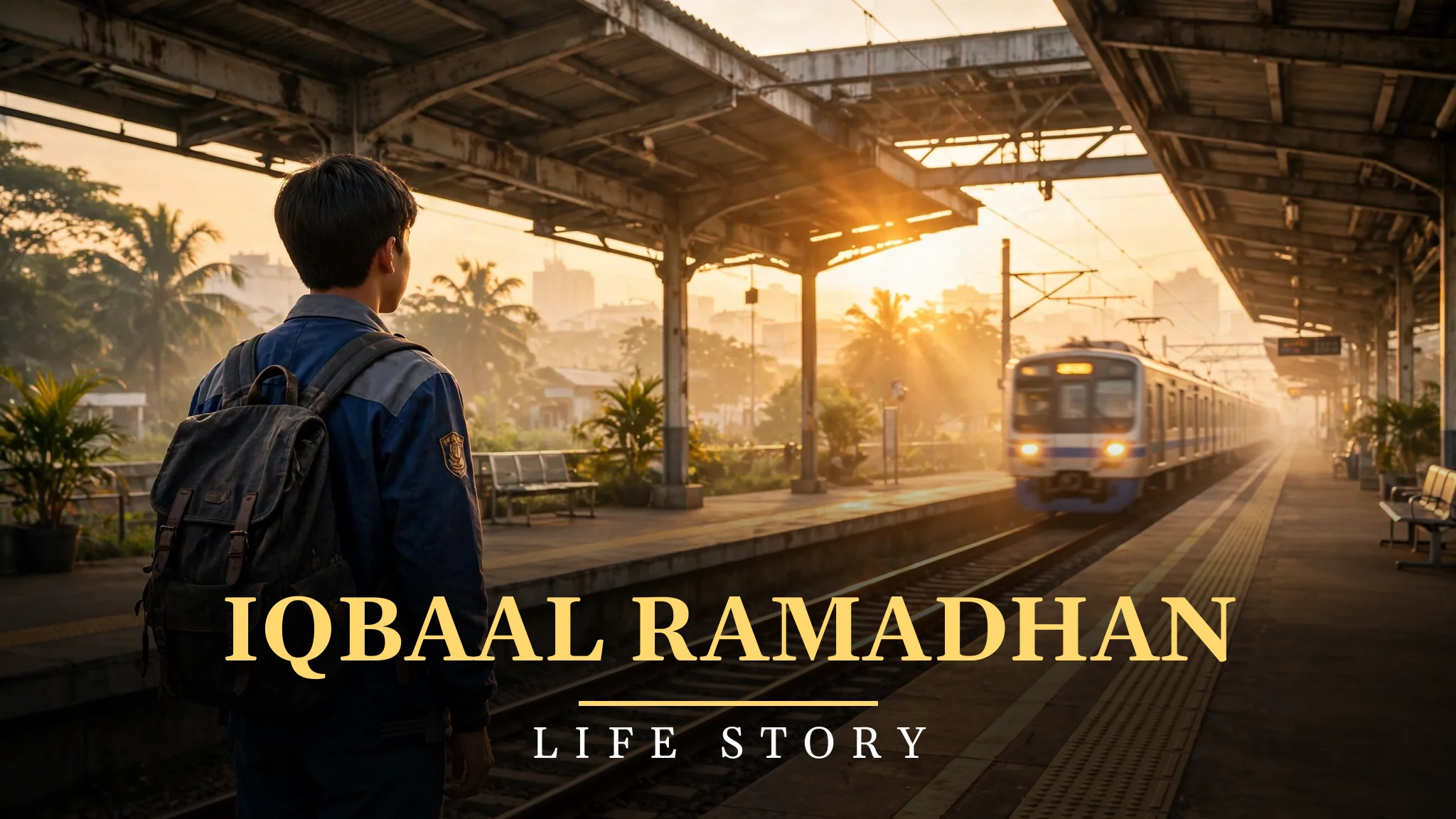
In the end, the image that stays is simple: a young man with a backpack, standing on a platform, watching a train arrive, ready to go somewhere new. That is Iqbaal Ramadhan. He has always been ready to go somewhere new, whether it was from Surabaya to Jakarta, from a boy band to a film set, from Jakarta to Melbourne, or from Dilan to Minke. He is still going, and his audience is still watching, and still waiting to see where he will go next.
What Growing Up in Public Teaches
Iqbaal Ramadhan’s journey teaches a clear lesson: growing up in public is hard, but it can be done well, if you have a family that supports you, if you are willing to learn, and if you are brave enough to pause. He paused twice: once when he left Coboy Junior, and once when he went to study in Australia. Both pauses could have ended his career, but both made it stronger, because they gave him time to grow. A pause is not a failure. It can be a preparation, and Iqbaal’s pauses were preparations for a longer, better career.
His journey also teaches that a star can change. He was a child singer, a teenage idol, a romantic lead, and a serious actor, and each of those was a different person, and each was true. A person who can change is a person who can live, and Iqbaal has lived many lives already, in his short career. That is a hopeful message for any young person who feels trapped by who they were. You can change. You can grow. You can become someone new, and the world will accept you, if you do it honestly.
Music After the Boy Band
After leaving Coboy Junior, Iqbaal Ramadhan did not stop making music. He sang solo, he wrote songs, and he performed in a style that was different from the boy band: quieter, more personal, and more grown up. A boy band sings songs that are written for a group, with a bright, pop sound. A solo singer sings songs that are his own, with a sound that reflects who he is. Iqbaal’s solo music reflected a young man who was growing up, who was thinking, and who was finding his own voice, literally and figuratively.
His solo work included songs that were gentle and thoughtful, and performances that showed a different side of him: not a child singer in a group, but a young adult with a guitar, a voice, and a story to tell. That change is hard, because fans of a boy band often want the group to stay together forever, and they can be slow to accept a solo singer. Iqbaal handled that change with patience, and he let his solo music speak for itself, without trying to force it. He sang, he performed, and he let audiences decide, and many of them decided to follow him.
Music also gave him a way to express feelings that acting could not. An actor speaks words that someone else wrote. A singer writes his own words, and sings them in his own voice, and that is a more personal act. Iqbaal’s songs, in his solo work, showed a young man who was thinking about love, about growing up, and about the future, and who was willing to share those thoughts with his audience. That willingness is a sign of maturity, and it is one of the reasons his fans stayed loyal, even after he left the group.
His music after Coboy Junior also connected him with a new audience, including older listeners who liked a quieter, more thoughtful sound. That wider audience is valuable, because it gives a singer a second home, beyond the teenage fans. An artist who has both a young audience and an older audience can have a longer, richer career, and Iqbaal was building both, with his films and with his music, at the same time.
A Young Man in Melbourne
Iqbaal Ramadhan’s time as a student in Melbourne gave him something that no film role could give: a normal life, away from fame. He lived in a student flat, he cooked for himself, he took the tram to university, and he studied with classmates who did not know him as Dilan. That normality is valuable for an actor, because it gives you new experiences to draw on, and it gives you time to think about who you are when you are not performing. He used that time well, and he returned to Indonesia with a wider view of the world, and a clearer sense of what he wanted to do next.
He also learned how another country lives, how its people think, and how its culture is different from Indonesia’s, and that learning made him a more thoughtful person. A young man who has lived abroad can see his own country more clearly, with its strengths and its problems, and Iqbaal spoke about Indonesia with that clearer view when he returned. He did not come back as a different person. He came back as the same person, with more to say, and with a deeper understanding of the world.
Milea, New York and a Wider World
After Dilan, Iqbaal returned to the story with Milea: Suara dari Dilan, a film told from Milea’s side, which let audiences see the same love story through different eyes. Playing Dilan again, a few years older and a few years wiser, asked him to show how a young man changes when he is loved and when he loses love. The film did well, and it confirmed that Dilan was not a single lucky hit. It was a character that audiences wanted to live with for longer, and Iqbaal was the actor they wanted to live with him.
In 2021 he took a different kind of step, with Ali and Ratu Ratu Queens, a film made for Netflix and shot in New York. Iqbaal played Ali, a young man who travels to New York to find his mother, and who meets a group of Indonesian women, the “queens” of the title, who help him find his way. The film was warm, funny, and sad in turns, and it showed Iqbaal in a new setting, far from Bandung, acting in English and Indonesian, in a city that never stops. Working abroad, with a different crew and a different pace, tested him as an actor, and he came through it with a performance that many viewers loved.
In 2024 he appeared in The Architecture of Love, a romance filmed in New York with Putri Marino, in which he played a writer trying to start again after loss. The film was quieter than Dilan, and more adult, and it asked Iqbaal to play a man rather than a boy, a person carrying grief rather than first love. That shift matters, because it shows an actor growing up with his audience. The teenagers who loved Dilan are now adults, and Iqbaal is giving them stories about adult life: about loss, about work, about starting again. That is how a child star becomes an adult actor, not by one big jump, but by choosing roles that grow as he grows.
My Take:
I have a soft spot for Iqbaal Ramadhan, and I will tell you why at the start: he grew up in front of me, in the sense that I watched his story unfold over many years, from a child singer to Dilan to Minke to a student in Australia. That is a long time to watch someone grow, and it creates a feeling that is hard to describe. It is not only admiration. It is a kind of affection, the affection you feel for a person you have watched become an adult. I feel that affection for Iqbaal, and I think many Indonesians feel it too.
What I like first is Coboy Junior, because it is such a happy memory for so many people. A boy band for children, with bright songs and bright smiles, is a simple pleasure, and Iqbaal was at its centre. He was eleven, he sang well, and he looked happy, and that happiness was infectious. I think about those early years with kindness, because they were innocent, and innocence is a rare thing in show business. He was a child, he was singing, and he was loved, and that is a good start to a life, even if it is a strange one.
Leaving Coboy Junior at fourteen is the decision I respect most in his early life. It would have been easy to stay. The group was popular, the money was good, and the fame was comfortable. He left, because he wanted to study and to grow, and that takes a courage that many adults do not have. A fourteen-year-old who can say no to fame is a fourteen-year-old who knows himself, and Iqbaal knew himself. I wonder how many adults could do what he did at fourteen. Not many. He did it, and he did it quietly, without a fuss, and that quiet courage is something I admire.
Dilan is the role that made him a star again, and I understand why. Dilan is a boy who rides a motorbike, who writes letters, who jokes, and who loves in a way that feels real. Iqbaal played him with a lightness that made the film feel like a summer afternoon: warm, bright, and a little bit sad at the end. I have watched Dilan, and I have seen why teenagers love it. It is not a perfect film, but it is an honest film about first love, and Iqbaal is honest in it. He does not try to be a hero. He tries to be a boy, and he succeeds.
Bumi Manusia is the film that made me take him seriously as an actor, not only as a star. Playing Minke is a hard job. Minke is a character from a great novel, a young man who thinks, writes, and fights for his dignity in a colonial world. Iqbaal played him with a seriousness that surprised me, because I had only known him as Dilan, light and funny. Here he was serious and thoughtful, and he carried the film well. That change shows that he is not only a teen idol. He is an actor who can do history, literature, and drama, and who is willing to learn.
Studying in Australia is the choice I talk about most when I tell his story to others, because it is the choice that proves he values learning. He was at the height of his fame, after Dilan and Bumi Manusia, and he left to study communications at Monash University in Melbourne. That is not a small decision. It means leaving money, fame, and comfort behind, to sit in a classroom, to write assignments, and to live as a normal student. I respect that decision more than I can say, because it shows that he does not see fame as the end of life. He sees it as one part of life, and learning as another part, and he wants both.
I also think about Surabaya, because I think where you grow up shapes how you work. Surabaya is a practical city, a port city, a city where people work hard and speak directly. Iqbaal carries that practicality with him. He does not seem to waste time on drama. He works, he studies, he returns, and he works again. That is a Surabaya way of living, and I like it. It is steady, it is honest, and it lasts longer than a flashy way of living.
If I am honest, I do not know Iqbaal as a person, and I should not pretend that I do. I do not know what he is like at home, or what he worries about, or what he hopes for. But I can see his public choices, and they show a pattern: he chooses growth, he chooses learning, and he chooses to return stronger. That pattern is enough for me to respect him. I do not need gossip to respect an artist. I need only to watch the work, and the work is there, in songs, in films, and in a degree from Australia.
One lesson I take from his story is about pausing. He paused twice, and both pauses made him stronger. A pause is not a failure. It is a time to learn, to grow, and to prepare for the next step. Young people today are told never to pause, to keep posting, to keep working, to keep being seen. Iqbaal’s story says something different. It says: pause, study, grow, and then return. That is a wise message, and it is one I wish more young stars would hear.
Another lesson is about changing. He was a child singer, a teenage idol, a romantic lead, and a serious actor, and each of those was a different person. He did not stay the person he was at eleven. He grew, he changed, and he became someone new, and his fans grew with him. That is a hopeful message for any young person who feels trapped by who they were. You can change. You can grow. You can become someone new, and the world will accept you, if you do it honestly.
When I think about his future, I feel hopeful rather than worried. He is in his mid-twenties, he has a degree, he has experience, and he has a clear sense of who he is. He could become a leading man in serious dramas, he could direct, he could produce, or he could speak about education and youth. Whatever he chooses, I think he will choose it well, because he has chosen well before. I hope he keeps choosing well, and I hope he keeps growing, because Indonesian cinema is better with him in it.
In the end, my feeling about Iqbaal Ramadhan is warm and affectionate. I started by seeing a child singer in a boy band, and I ended by seeing a young adult actor who has played Dilan and Minke, who has studied in Australia, and who has grown up in public with grace. That is a good story, and it is a story that is still being written. I look forward to its next chapter, and I think many Indonesians do too.
I also think about his solo music, because it is the part of his story that is easiest to miss. After Coboy Junior, he could have stopped singing altogether, and focused only on acting, and no one would have blamed him. He did not stop. He sang solo, he wrote songs, and he performed in a quieter, more personal style, and that music showed a young man who was growing up, who was thinking, and who was finding his own voice. That is a brave thing to do, because a solo singer has nowhere to hide. In a group, you can hide behind others. Alone, you are on your own, and your voice is all you have. Iqbaal sang alone, and his voice was enough.
There is a feeling I have about Iqbaal that is hard to put into words, and I will try anyway: he feels like a friend who grew up with me, even though I have never met him. That feeling comes from watching him grow, from a child singer to Dilan to Minke to a student in Australia, over many years. It is a feeling that many Indonesians share, because they watched him grow too, and they feel as if they know him. That is a special kind of fame, a fame that is based on shared growth, not only on a single hit, and it is a fame that lasts, because it is built on time, not only on talent.
I also think about Surabaya again, because I keep coming back to it. Surabaya is a practical city, a port city, a city where people work hard and speak directly, and Iqbaal carries that practicality with him. He does not waste time on drama. He works, he studies, he returns, and he works again. That is a Surabaya way of living, and I like it. It is steady, it is honest, and it lasts longer than a flashy way of living. In a world full of noise, a steady, practical person is a relief, and Iqbaal is that person.
If I could give one piece of advice to a young person who admires Iqbaal, it would be this: do not be afraid to pause. He paused twice, once when he left Coboy Junior, and once when he went to study in Australia, and both pauses made him stronger. A pause is not a failure. It is a time to learn, to grow, and to prepare for the next step. Young people today are told never to pause, to keep posting, to keep working, to keep being seen. Iqbaal’s story says something different. It says: pause, study, grow, and then return. That is a wise message, and it is one I wish more young stars would hear.
Finally, I want to say that I am looking forward to his next chapter, because he is still young, he is still learning, and he has already shown that he can surprise us. He could become a leading man in serious dramas, he could direct, he could produce, or he could sing again, in a new style, with a new voice. Whatever he chooses, I think he will choose it well, because he has chosen well before. I hope he keeps choosing well, and I hope he keeps growing, because Indonesian cinema and music are better with him in them.
I also think about the way Iqbaal is seen by his fans, because his story is not only about films and songs. It is about a boy who grew up in front of millions of people, and who grew up well, despite the pressure, and that is a rare thing. Many child stars do not grow up well. They burn out, they get tired, or they get lost, and Iqbaal did not. He grew, he learned, he studied, and he returned, stronger each time. That is a credit to his family, to his own character, and to a way of living that is steady, patient, and honest. I hope young people who become famous early look at him and see that it can be done, if you are willing to learn, to pause, and to grow.
There is another thought that stays with me about him: he is a young man who has lived in more than one country, and who has brought a wider view back to Indonesia. He studied in Melbourne, he lived as a student, he cooked for himself, and he learned how another country lives, and he brought that learning home. That wider view is valuable, because it stops a person from thinking that their own country is the only way to live. Iqbaal saw another way, and he came home with a clearer view of Indonesia, its strengths and its problems, and that clarity shows in the way he speaks, in interviews, with a thoughtfulness that many young stars do not have.
I also wonder about the music he has not yet made, because I think his solo music is a part of his story that is still developing. He sang in a boy band, he sang solo, and he acted, and each of those was a different kind of music, a different kind of performance. What will he sing next? I do not know, and I do not want to guess, but I think he has the voice, the experience, and the thoughtfulness to sing something new, something that reflects the man he has become, not only the boy he was. I hope he does, because his voice is a gift, and it should not be silenced by acting alone.
Finally, I want to say that Iqbaal’s story gives me hope for child stars everywhere. He was famous at eleven, he was famous at eighteen, he was famous at twenty, and he is still famous in his mid-twenties, but he is famous in a different way now. He is no longer a child singer or a teenage idol. He is a young adult actor, with a degree, with experience, and with a clear sense of who he is. That transformation is rare, and it is worth celebrating, because it shows that a child star can grow up well, if they have support, if they are willing to learn, and if they are brave enough to pause.
I also think about Dilan, because it is hard to explain to someone who did not live through it how big that film was. Teenagers quoted the lines, wore the clothes, rode motorbikes like Dilan, and talked about Milea as if she were a real person. That kind of fame can swallow a young actor, because the public wants him to stay Dilan forever. Iqbaal did not stay Dilan forever. He went to Australia, he studied, he played Minke in Bumi Manusia, he played Ali in New York, and he came back as a different kind of actor. That is the hardest move in a young career: to leave the role that made you famous, and to trust that the audience will follow you to the next one. Many cannot make that move. Iqbaal did.
Bumi Manusia is the role I respect most in his career, because it asked him to carry a great Indonesian novel on his shoulders. Minke is a young man in colonial Java who dreams of freedom and education, and the novel by Pramoedya Ananta Toer is one of the most loved books in Indonesia. Playing Minke is a great honour and a great risk, because readers already have Minke in their minds, and they will judge any actor against that image. Iqbaal played him with a seriousness that showed he understood the weight of the book. He was no longer a teen idol. He was an actor trusted with a national story, and that trust is a sign of how far he had come.
His time in Melbourne is another part of his story that I admire, because it is the part that looks least like fame. He lived as a student, he cooked for himself, he took buses, he wrote essays, and he was, for a while, an ordinary young man in a foreign city. That ordinary life is exactly what a child star needs, because fame can make a person forget how ordinary life works. Iqbaal remembered, and he came home with a degree and a wider view of the world. A degree does not make an actor better on its own, but the life behind the degree does: the patience, the discipline, the days when no one is watching. Those days build character, and character shows on screen.
If a child star asked me what to copy from Iqbaal, I would say this: pause when you need to, and learn something that has nothing to do with fame. Go to school, learn a language, live in another country, cook your own food, and let yourself be ordinary for a while. Fame will wait, or it will not, and either way you will be a stronger person. Iqbaal paused, he learned, and he returned better, and that is a lesson for any young person who becomes famous early: your education is not a break from your career. It is a part of your career, and it will carry you further than fame alone.
Frequently Asked Questions
When was Iqbaal Ramadhan born?
Iqbaal Ramadhan was born on 28 December 1999 in Surabaya, Indonesia. He became famous as a child singer in Coboy Junior before becoming a film actor as a teenager.
What was Coboy Junior?
Coboy Junior, later known as CJR, was a boy band for young singers formed in 2011, in which Iqbaal was one of the main voices. The group was very popular with children and teenagers in Indonesia, and Iqbaal left the group in 2014 to focus on his studies.
What role made Iqbaal Ramadhan famous as an actor?
He became famous as an actor through Dilan 1990 in 2018, in which he played Dilan, a high school boy in Bandung in 1990 who falls in love with Milea. Sequels followed in 2019 and 2020, and the films became a phenomenon in Indonesia.
Did Iqbaal Ramadhan act in Bumi Manusia?
Yes, he played Minke in Bumi Manusia in 2019, a film based on a famous novel by Pramoedya Ananta Toer. Minke is a young Javanese man in the Dutch colonial period who faces racism and injustice, a much more serious role than Dilan.
Did Iqbaal Ramadhan study abroad?
Yes, after his early film success he went to study at Monash University in Melbourne, Australia, where he studied communications and media. He lived as a student there before returning to Indonesia to continue his acting career.
What is Iqbaal Ramadhan doing now?
He is in his mid-twenties and remains an active actor in Indonesian film, with adult roles that are more serious and varied than his early teen work. His fans continue to follow his next projects, and his earlier films, especially Dilan, are still widely watched.


