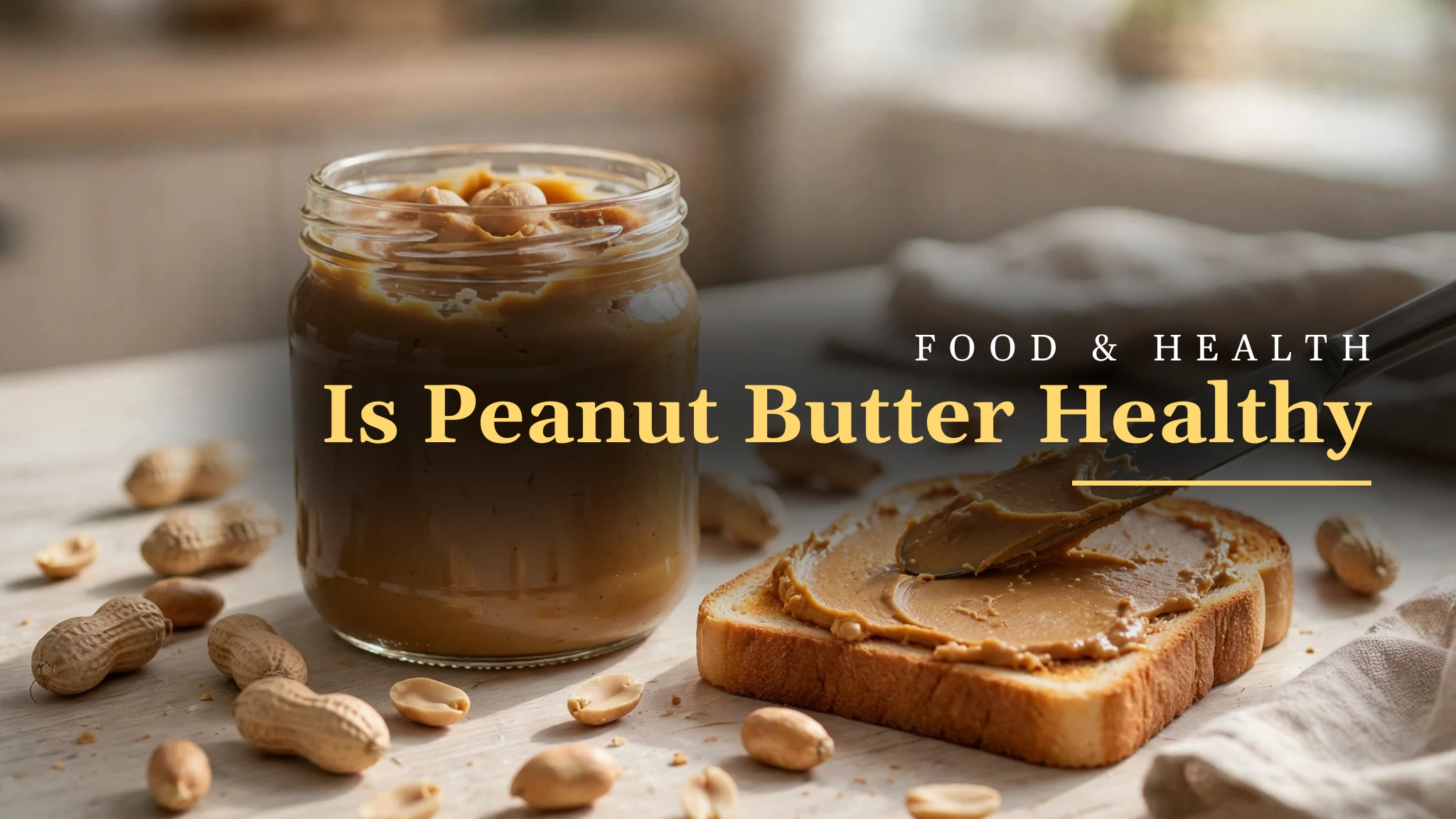
Is Peanut Butter Healthy
In this post
Peanut butter sits in a strange place in most kitchens. Some people treat it as a health food, something full of protein that keeps them strong. Others treat it as a treat, something sweet and heavy that belongs on the same shelf as chocolate spread. Both views have a little truth in them, which is why the question is so hard to answer with a single yes or no. The honest answer is that peanut butter can be a genuinely good food, but only when you know what is inside the jar and how much you are eating. A spoonful of the right kind, eaten in the right way, is very different from several thick spoonfuls of a sweetened kind eaten straight from the jar.
At its best, peanut butter is simply ground peanuts. Peanuts themselves are a useful food. They give you protein, which helps your body build and repair muscle. They give you healthy fats, the kind that help you feel full and that your body uses for energy over a longer time than sugar does. They give you fibre, which slows digestion and helps your stomach feel settled. They also give you vitamin E, magnesium, and a small amount of other minerals your body uses every day. When you spread that on bread or eat it with a banana or an apple, you turn a light snack into something that actually keeps you going for a few hours. That is the reason athletes, workers, students and parents have relied on it for so long. It is cheap, it needs no cooking, it lasts for weeks in a cupboard, and a small amount goes a long way.
The problem starts with what gets added. Many jars on shop shelves are not just peanuts. They also contain added sugar, added salt, and extra oils that make the spread smoother and sweeter and help it stay soft for longer. A little of that is not a disaster, but it changes the food. Sugar adds calories without adding anything your body needs. Extra oil adds more fat on top of the fat already in the peanuts. Salt, in a small amount, is fine for most people, but some jars contain far more than you would expect from a savoury spread. So two jars that look almost the same on the shelf can be quite different foods once you read the label. That label is the real answer to the question in the title. Peanut butter made mostly of peanuts is healthy in normal amounts. Peanut butter that is mostly sugar and oil is a sweet spread, and it should be treated like one.
Portion size is the second half of the answer. Peanut butter is rich, which means a small amount carries a lot of energy. Two tablespoons, which is roughly the amount that fits comfortably on one slice of bread, gives you about 190 calories, around 8 grams of protein, about 16 grams of fat, and about 2 grams of fibre. That is a useful, filling amount. But it is very easy to eat twice that without noticing, especially if you are spreading it thickly or eating it with a spoon while standing in the kitchen. Four tablespoons is close to 400 calories, which is about the same as a small meal, and if you eat that on top of a full breakfast or lunch, the extra energy adds up over days and weeks. None of this makes peanut butter a bad food. It simply makes it a food that rewards a little care. A thin spread, a measured spoon, a jar that is mostly peanuts — those three small choices are what turn peanut butter from a heavy habit into a healthy one.
What Peanut Butter Is Actually Made Of
A peanut is not a nut in the strict sense. It grows underground, and it belongs to the same family as beans and lentils. That family link matters, because it explains why peanuts give you more protein than most true nuts do. When peanuts are roasted and ground, their own natural oil is released, and that oil is what turns dry ground peanuts into a smooth, creamy paste. A good jar needs nothing else. Peanuts, and perhaps a pinch of salt, are enough. The texture comes from the peanuts themselves, and the flavour comes from roasting, not from added sweetness.
Once you understand that, the label becomes easy to read. Turn the jar over and look at the ingredients list. If it says peanuts, and perhaps salt, you are holding a simple food. If the list is long, with sugar, molasses, honey, palm oil, or hydrogenated vegetable oil near the top, you are holding a different product. The word order on a label tells you how much of each thing is inside. Ingredients are listed from the largest amount to the smallest, so if sugar appears second, there is a lot of sugar in that jar. If peanuts are first and sugar is near the end, the amount is small. This one habit, reading the first three ingredients, tells you more about a jar than any claim on the front of the label.
The fat in peanuts deserves a clear explanation, because fat is often misunderstood. Not all fat behaves the same way in your body. The fat in peanuts is mostly unsaturated fat, which is the kind found in olive oil, nuts, seeds and fish. In general, unsaturated fat is the kind that fits well into a varied diet, while a diet very high in saturated fat, the kind found in large amounts of butter, fatty meat and many fried foods, is linked with poorer heart health over time. Peanut butter also contains a small amount of saturated fat, because almost every fatty food contains a mix, but the larger share is unsaturated. That is one reason peanut butter has a better reputation than many other spreads. It is not fat-free, and it is not meant to be. Its fat is part of what makes it filling and useful, as long as the amount stays sensible.
There is also protein to consider. Two tablespoons of peanut butter give you about 8 grams of protein, which is similar to one egg. That is a meaningful amount from a spread, and it is why peanut butter works so well as part of breakfast. Protein slows down how quickly you feel hungry again, and it helps your body repair itself after work or exercise. Peanut butter is not a complete protein on its own, which means it does not give you every building block your body needs in the ideal balance, but when you eat it with bread, oats, or other grains, the combination covers more of what you need. That is why peanut butter on wholemeal toast is a better meal than peanut butter eaten alone. The bread and the peanuts support each other, and together they keep you full for much longer than either one would alone.
Natural Peanut Butter and Sweetened Peanut Butter
Walk down a supermarket aisle and you will see two kinds of peanut butter sitting side by side. One kind is smooth, sweet, and always soft, even straight from the shelf. The other kind is often firmer, sometimes with a layer of oil on top, and it tastes more plain, more like roasted peanuts and less like a sweet treat. The first kind usually contains added sugar and extra oils. The second kind, often sold as natural or no added sugar, usually contains only peanuts and salt. The difference in taste is real, and the difference in nutrition is real too.
Natural peanut butter has one habit that surprises people the first time they open it. The oil rises to the top and sits in a golden layer above the paste. That is normal, and it is a good sign. It means no extra ingredient has been added to stop the oil from separating. You simply stir the jar well the first time, keep it in a cool place, and the texture stays even after that. Some people store the jar upside down, so the oil moves through the paste slowly. Others keep it in the fridge after opening, which makes it firmer and easier to spread thinly. Either way works. The oil on top is not a fault. It is proof that the jar is simple.
Sweetened peanut butter is easier to spread and easier to like at first taste, because sugar makes almost any food taste better straight away. But that sweetness has a cost. A sweetened jar can contain several grams of added sugar in every two tablespoons, and if you eat peanut butter daily, that sugar adds up across a week. It also trains your taste to expect sweetness from a food that does not need it. Many people who switch to natural peanut butter find the first week strange, because the spread tastes plain and a little salty. Then, after a week or two, their taste changes, and the natural version starts to taste rich and satisfying on its own. That change is worth waiting for, because it means you are eating peanuts, not sugar with a peanut flavour.
Price is another difference, and it is worth being honest about. Natural peanut butter often costs a little more than the sweetened kind, because it contains more peanuts and fewer cheap fillers. But the gap is usually small, and a jar lasts for weeks, so the extra cost per serving is tiny. If the natural jar is too expensive for your budget, a regular jar with a short ingredients list and a small amount of sugar is still a reasonable choice. The worst choice is the jar with a long list of added sugars and oils, eaten thickly and often. The best choice is not a perfect jar. It is the simplest jar you can afford, eaten in a sensible amount.
Protein, Fat and Why Peanut Butter Keeps You Full
Hunger is not only about an empty stomach. It is about how quickly food leaves your stomach, how steady your energy stays, and how soon your body starts asking for more. Peanut butter scores well on all three, because it brings protein, fat and fibre together in one food. Protein tells your body that you have eaten something substantial. Fat slows digestion, so the food stays with you longer. Fibre adds bulk and slows the whole process further. Together, they explain why a slice of toast with peanut butter keeps you full until lunch, while a slice of toast with jam, which is mostly sugar, can leave you hungry again within the hour.
This is why peanut butter is so popular as a snack before work or school. A labourer who eats peanut butter on bread in the morning has energy that lasts through the first hours of physical work. A student who eats it before class can concentrate without the distraction of hunger. An older person who finds large meals difficult can eat a small amount of peanut butter and still get useful protein and energy from a few bites. None of these people need a large amount. Two tablespoons, spread thinly across two slices of bread, is enough to make a real difference to how the morning feels.
It is also why peanut butter works well with fruit. A banana with a spoon of peanut butter is one of the simplest balanced snacks there is. The banana gives you quick energy, potassium and fibre. The peanut butter gives you protein and fat, which slow the banana down and keep you full longer. An apple sliced and dipped in peanut butter works the same way. The fruit gives you freshness, water and fibre. The peanut butter gives you staying power. These combinations are better than either food alone, and they need no cooking, no recipe, and no special skill. That simplicity is a large part of peanut butter’s value in real life.
There is a limit, though, and it is important to name it. Feeling full is useful, but it can also mislead you. Because peanut butter is so rich, it is easy to eat far more than you need while still feeling as if you have eaten only a little. A spoonful straight from the jar, then another spoonful while you wait for the toast, then a thick spread on top — that is three servings before you have sat down. The food has not changed. The amount has. If you find yourself doing this often, the fix is simple and does not need willpower. Use a tablespoon to measure, spread it thinly, and put the jar away before you start eating. When the jar is out of sight, the second spoonful is a choice, not a habit.
Peanut Butter and Weight: Heavy or Helpful
The question of weight is where peanut butter causes the most confusion. Some people avoid it completely because they think it will make them gain weight. Others eat large amounts of it because they have heard it is a health food and assume that means they can eat as much as they like. Both views miss the middle, which is where the truth sits. Peanut butter is high in energy, so eating a lot of it every day, on top of everything else you eat, can lead to weight gain over time. But eating a sensible amount, as part of a varied diet, does not make you gain weight on its own, and it can even help you eat less overall, because it keeps you full and stops you reaching for biscuits or crisps later.
Think of it in terms of swaps rather than additions. If you replace a sweet biscuit in the afternoon with an apple and a spoon of peanut butter, you are eating a similar number of calories, but you are getting protein, fibre and healthy fat instead of mostly sugar and refined flour. You will feel fuller, and you are less likely to want another snack an hour later. If you add peanut butter on top of the biscuit, without removing anything, you are simply adding calories, and over weeks that will show. The food is the same in both cases. The difference is whether it replaces something less useful or sits on top of everything else.
For people who are trying to gain weight, or who struggle to eat enough because their appetite is small, peanut butter can be genuinely helpful. It packs a lot of energy into a small volume, so a person who finds a large meal difficult can get useful calories from a few spoonfuls. This is one reason it is often used for children who need extra energy, for older people whose appetite has fallen, and for workers doing heavy physical labour who burn a lot of energy during the day. In those cases, a thicker spread and a second spoonful are not a problem. They are the point. The amount should match the person’s needs, not a fixed rule from a label.
For people who are trying to lose weight, the advice is different but not harsh. You do not need to give up peanut butter. You need to measure it. One tablespoon instead of two, spread thinly, still gives you the taste and a good share of the protein and fat, for about half the calories. Pair it with foods that are high in water and fibre, like apple slices, celery, or wholemeal bread, so the snack feels large even though the peanut butter itself is small. And watch the sweetened kinds, because the added sugar makes it harder to feel satisfied and easier to keep eating. A small amount of the simple kind, eaten slowly and with other foods, fits well into a weight-conscious diet. A large amount of the sweet kind, eaten alone and quickly, does not.
Peanut Allergy: The One Serious Warning
There is one part of peanut butter that has nothing to do with calories or sugar, and it matters more than all the rest: allergy. Peanuts are one of the most common causes of food allergy, and for a person with a peanut allergy, even a small amount can cause a serious reaction. The signs can range from an itchy mouth or a rash to swelling of the lips or throat and trouble breathing, and a severe reaction needs urgent medical help. This is not a matter of taste or habit. It is a medical fact, and it is why peanut butter should never be given to someone who has been told they are allergic to peanuts, and why it should never be offered to a small child without first checking with the child’s parents.
The allergy is also why labels matter in a second way. Peanut butter is not the only food that contains peanuts. Peanuts turn up in sauces, biscuits, cereal bars, Asian dishes, and foods made in factories that also handle peanuts. A person with an allergy learns to read every label, and the people around them learn to ask before sharing food. In schools, this is why some classrooms ask parents not to send peanut butter sandwiches. It can feel like an overreaction if your own family has no allergy, but for the allergic child it is a real safety rule, and it costs nothing to respect it. A different sandwich filling on one day a week is a small price for another child’s safety.
If you have never had a reaction to peanuts, a daily spoon of peanut butter is not something to fear. Allergies usually show themselves early, and most adults who have eaten peanuts all their lives without a problem will not suddenly develop one, though a new allergy in adulthood is possible and any sudden reaction should be checked by a health professional. The point is not to worry people who are fine. The point is to remember that the same food that is a healthy snack for one person can be dangerous for another, and that the difference deserves respect. Good food habits include paying attention to the people you share food with, not just to your own plate.
For parents, the question of when a child can try peanut butter is one to raise with a health professional, because guidance on this has changed over the years and it depends on the child’s history. What has not changed is the practical rule that a young child should never be given whole peanuts, because they are a choking risk. Smooth peanut butter, spread thinly, is different from whole nuts, and that distinction matters. Beyond that, the sensible approach is simple: ask, check, and do not assume. Peanut butter is a good food, but it is a food that demands a little extra care around other people, and that care is part of eating well.
Peanut Butter in Everyday Meals
Peanut butter earns its place in the kitchen because it fits into so many meals without any cooking. At breakfast, it turns plain toast into something that keeps you full until lunch. Spread it thinly on wholemeal bread, add slices of banana or apple, and you have a breakfast that takes two minutes and costs very little. Stirred into warm porridge, it melts into the oats and makes the bowl richer and more filling, which suits people who find plain porridge too light. Mixed into yoghurt with a little honey, it becomes a thick, sweet snack that feels like a treat but carries real protein with it.
At lunch, peanut butter works in sandwiches that travel well. A peanut butter sandwich does not need a fridge for a few hours, it does not spill, and it still tastes good by midday, which is why it has been a packed-lunch favourite for generations. It also works as a dip. Apple slices, celery sticks, carrot sticks and even plain crackers all taste better with a spoon of peanut butter beside them, and the combination of fresh crunch and rich spread is more satisfying than either food alone. For a worker with a lunchbox or a child with a school bag, that kind of snack is practical in a way that a salad or a hot meal simply is not.
In cooking, peanut butter has a quieter role. A spoon stirred into a noodle dish or a vegetable stir-fry gives the sauce body and a gentle nutty flavour. Blended with a little warm water, soy sauce and lemon juice, it becomes a simple sauce for rice or vegetables. Added to a smoothie with banana and milk, it makes the drink thicker and more filling, so it works as a light meal rather than just a drink. None of these uses needs a recipe book or special skill. They are small habits that turn a jar in the cupboard into a useful ingredient rather than just a spread.
Storage is simple, and it is worth getting right. An opened jar of natural peanut butter keeps best in a cool cupboard or in the fridge, and it will last for weeks. The oil on top is normal, as explained earlier, and a good stir the first time solves it. A sweetened jar lasts even longer because of the added ingredients, but it should still be kept cool and the lid kept clean so the spread does not dry out. A jar that smells stale or tastes sharp has gone past its best, and it should be thrown away. These are small kitchen habits, but they mean the jar you buy actually gets used instead of sitting half-empty at the back of the shelf.
My Take:
If you ask me whether peanut butter is healthy, my honest answer is yes, with two conditions that I will not soften: buy the simple jar, and watch the amount. I say that because peanut butter is one of the few foods where the difference between a good choice and a poor one sits entirely in your own hands. Nobody forces you to buy the sweetest jar, and nobody forces you to spread it an inch thick. The jar you pick and the spoon you use decide almost everything, and that is good news, because it means you do not need a new diet or a special plan. You need a label you can read and a portion you can measure, and the rest takes care of itself.
I think the jar matters more than most people realise, and I want to be plain about why. A jar that is only peanuts and a pinch of salt is a food your body understands: protein, fibre, and mostly the kind of fat that fits well into a varied diet. A jar that is full of added sugar and extra oil is a different product wearing the same name, and it behaves like a sweet spread, not a health food. I have no problem with sweet spreads. I have a problem with a sweet spread pretending to be something it is not. When I stand in a shop and pick up a jar, I turn it over and read the first three ingredients, and that takes five seconds. Five seconds is all it takes to know whether you are buying peanuts or buying sugar with a peanut flavour, and I think that is a habit worth teaching to anyone who eats peanut butter regularly.
The portion is the second condition, and I think it is the harder one, because peanut butter does not feel like a rich food when you are eating it. It feels like a light spread, something you can add freely, and that feeling is misleading. Two tablespoons carry about as much energy as a small meal, and four tablespoons carry as much as a large one, yet both amounts look small on a slice of bread. I have seen people eat three servings before they sit down, one spoon from the jar, one thick spread, one more for luck, and then wonder why their weight is creeping up. The food did not betray them. The amount did. My own rule is simple: I measure with a tablespoon, I spread it thinly, and I put the jar away before I eat. It sounds fussy, and it is, but it works, because a jar that is out of sight cannot be dipped into without thinking.
I also think peanut butter deserves credit for being one of the cheapest useful foods in the shop, and that matters more than any vitamin chart. A jar lasts for weeks, it needs no cooking, no fridge for a day or two, and no skill to prepare, and a small amount gives a child energy for school, a worker energy for the first hours of labour, and an older person protein from a few bites when a large meal feels like too much. In a world where healthy eating is often sold as something expensive, peanut butter is a quiet argument against that idea. It is not a superfood, and it does not need to be. It is a plain food that does a useful job at a low price, and I think we should say that plainly instead of dressing it up with big claims.
There is a point about children that I feel strongly about, because peanut butter is one of the best snacks a parent can give a child, and also one of the easiest to get wrong. Spread thinly on wholemeal bread with banana slices, it keeps a child full until dinner, and it teaches them that a snack can be both sweet and nourishing. Given thickly on white bread with jam and a sweet drink, it becomes part of a sugary meal that leaves them hungry again within the hour. The jar is the same. The meal around it is what changes. I would tell any parent to keep the peanut butter and change the company it keeps: wholemeal bread instead of white, fruit instead of jam, water instead of a sweet drink. Small swaps, repeated every day, shape a child’s taste far more than any single lecture about healthy eating.
I want to say something honest about weight, because this is where peanut butter gets the most unfair treatment. Some people avoid it completely, as if one spoon would ruin their diet, and others eat it by the jarful because they have heard it is a health food. Both are wrong, and both miss the simple middle. Peanut butter is rich, so a lot of it every day, added on top of everything else, will add weight over time. But a measured amount, eaten instead of something less useful, can actually help you eat less, because it keeps you full and stops the biscuit habit in the afternoon. I do not believe in banning foods that are useful. I believe in measuring them. A tablespoon of the simple kind, eaten slowly with an apple, is a sensible snack. Four tablespoons of the sweet kind, eaten standing in the kitchen, is not. The difference is not the food. It is the hand that holds the spoon.
The allergy question is one I take seriously, and I think everyone who eats peanut butter should too. For most of us, peanuts are a safe, everyday food. For a person with a peanut allergy, they can be dangerous, and that difference is not a small detail. I think it is a basic part of eating well to ask before sharing food, to read labels when cooking for others, and to respect a classroom rule that keeps peanut butter out of lunchboxes for a day. It costs nothing, and it protects a child who cannot protect themselves. A food can be both healthy and dangerous, depending on who is eating it, and holding both of those facts at once is part of being honest about food.
I also think we should be honest about what peanut butter cannot do, because the claims around it have grown too big. It will not build muscle on its own, though its protein helps your body repair itself after work or exercise, and exercise is what builds strength. It will not keep you full all day on its own, though a sensible amount with bread and fruit will carry you to lunch. It is not a complete protein by itself, though with bread or oats it covers far more of what your body needs. I prefer this honest version, because when people expect a miracle from a jar and do not get one, they stop trusting good advice altogether. Peanut butter is a good food, and that is enough. It does not need to be a medicine as well.
There is another reason I like peanut butter, and it is about real life rather than nutrition charts. Healthy food often fails because it needs time, money or skill, and many people have little of any of those. Peanut butter needs none of them. You open the jar, you spread it, you eat. A labourer can carry a sandwich made in the morning and eat it at midday without a kitchen. A student can make breakfast in two minutes before class. A mother can feed a child a useful snack without turning on the stove. That ease is not a small thing. It is the reason peanut butter has lasted for generations while fancier health foods have come and gone. The foods that survive in real kitchens are the ones that fit into real days, and peanut butter fits better than almost anything else on the shelf.
I think the taste question deserves an honest word too. Many people try natural peanut butter once, find it plain, and go back to the sweet kind, and I understand that, because sugar makes almost any food taste better at first bite. But taste is a habit, not a fixed fact. Give the natural jar a week or two, and your taste changes. The plain version starts to taste rich, roasted and satisfying, and the sweet version starts to taste like what it is: sugar with a peanut flavour. I have seen this change happen, and I think it is worth waiting for, because it means your taste is learning to like the food itself instead of the sweetness added to it. If the natural jar costs a little more, I think the extra cost is small when a jar lasts for weeks, and a regular jar with a short list and a little sugar is still a reasonable choice if the natural one is out of reach. The worst choice is not a slightly expensive jar. It is the cheapest jar with the longest list of added sugars and oils, eaten thickly and often.
My view on the smooth versus crunchy question is simple: it does not matter much, and people should stop worrying about it. The difference is texture, not nutrition. Smooth spreads more thinly, which can help with portion control, and crunchy gives a little more to chew, which can make a snack feel more satisfying. Either one is fine, and the choice should come down to what you enjoy, because a food you enjoy is a food you will keep eating in a sensible way. The same goes for the question of when to eat it. Morning, afternoon, evening, it matters far less than the jar and the amount. A spoon in the morning with breakfast gives you energy for the first hours of the day. A spoon in the afternoon with an apple stops the biscuit habit. A spoon in the evening is fine too, as long as the amount stays small. Do not overthink the timing. Think about the jar, think about the spoon, and let the rest be easy.
So here is my final view, in plain words. Peanut butter is healthy when the jar is mostly peanuts and the portion is measured. Two tablespoons on wholemeal bread, with fruit beside it, is a genuinely good meal for most people. A thick spread of the sweetened kind, eaten straight from the jar on top of everything else, is a heavy habit, and it should be treated as one. The difference between those two pictures is not a diet plan or a special product. It is a label read for five seconds and a tablespoon used instead of a guess. That is the whole method, and I think it is a method anyone can follow.
If a friend asked me whether they should keep peanut butter in the house, I would say yes, and I would tell them to buy the simplest jar they can afford, keep a tablespoon in the drawer next to it, and spread it thinly on wholemeal bread with banana or apple. I would tell them to put the jar away before they eat, so the second spoonful is a choice rather than a habit. I would tell them not to give it to anyone with a peanut allergy, and to ask before sharing food with children whose parents they do not know. And I would tell them not to expect it to do more than it can. It will not build muscle, cure tiredness, or fix a poor diet on its own. What it will do is give them protein, fibre and steady energy at a low price, with no cooking and no fuss, and that is a useful thing to have in any kitchen.
One last thought: the best foods are the ones you barely have to think about, and peanut butter is exactly that kind of food once you have made two small decisions, the jar and the amount. You do not need willpower to eat it well. You need a label, a spoon, and a little honesty about how much you are actually eating. Over months and years, those small, easy choices add up to more than any short diet or expensive product ever will. That is the real lesson of peanut butter, and it is a lesson worth keeping.
I also want to say something about the habit of eating straight from the jar, because I think it is the single habit that does the most damage to an otherwise good food. Eating from the jar feels harmless, almost like tasting rather than eating, but a spoonful is a spoonful wherever you eat it, and two or three tasting spoonfuls add up to a small meal before you have even sat down. I am not saying you should never taste what you are spreading. I am saying that tasting should have a limit, and the simplest limit is to put the peanut butter on the bread first, put the jar away, and then eat at the table like a meal rather than a snack stolen from the shelf. Food eaten at a table, with attention, is almost always eaten in a smaller amount than food eaten standing in the kitchen, and that is true for peanut butter more than for almost anything else, because it is so easy to take one more spoon without noticing. If you can change only one habit around peanut butter, change that one, and the jar will last longer, your weight will be steadier, and the food itself will still taste just as good.
Frequently Asked Questions
Is peanut butter healthy for most people?
Yes, for most people, peanut butter made mostly of peanuts is a healthy food in normal amounts. It gives you protein, fibre, and mostly unsaturated fat, and it keeps you full for a few hours. The answer changes when the jar is full of added sugar and extra oils, or when the portion is very large, because then you are eating a sweet, rich spread rather than a simple food.
How much peanut butter should I eat in a day?
Two tablespoons a day is a sensible amount for most adults, which is roughly the amount that fits on one or two slices of bread. That gives you about 190 calories and around 8 grams of protein. One tablespoon is a better choice if you are watching your weight. The key is to measure with a tablespoon rather than guessing, because it is very easy to eat twice as much as you think.
Is natural peanut butter better than regular peanut butter?
Natural peanut butter, made only from peanuts and perhaps a pinch of salt, is usually the better choice, because it has no added sugar and no extra oils. Regular peanut butter is often sweeter and smoother, but it can contain several grams of added sugar in every serving. If the natural jar is too expensive, a regular jar with a short ingredients list and a small amount of sugar is still a reasonable choice.
Can peanut butter help with weight loss?
It can help, but only in a measured amount. Peanut butter keeps you full, so a small amount with fruit or wholemeal bread can stop you reaching for biscuits or crisps later in the day. But it is high in energy, so eating large amounts on top of everything else will add weight over time. The trick is to use it as a replacement for a less useful snack, not as an extra on top of one.
Is peanut butter good for children?
Peanut butter spread thinly on wholemeal bread, with banana or apple, is a good snack for most children, because it gives them protein and steady energy. Whole peanuts should never be given to a young child, because they are a choking risk. And peanut butter should never be given to a child with a peanut allergy, so always check with the child’s parents first.
What should I look for on a peanut butter label?
Look at the ingredients list, which is ordered from the largest amount to the smallest. A good jar lists peanuts first, and perhaps salt second, with little or nothing else. If sugar, molasses, honey, palm oil, or hydrogenated vegetable oil appear near the top of the list, the jar contains a lot of those ingredients. Reading the first three ingredients tells you more than any claim on the front of the label.
Sources
This article is general information only. It is not medical advice and it does not diagnose, treat, or cure anything. For personal concerns, speak to a qualified health professional.


