Ismael Lo: The Life Story Behind Senegal's Gentle Star
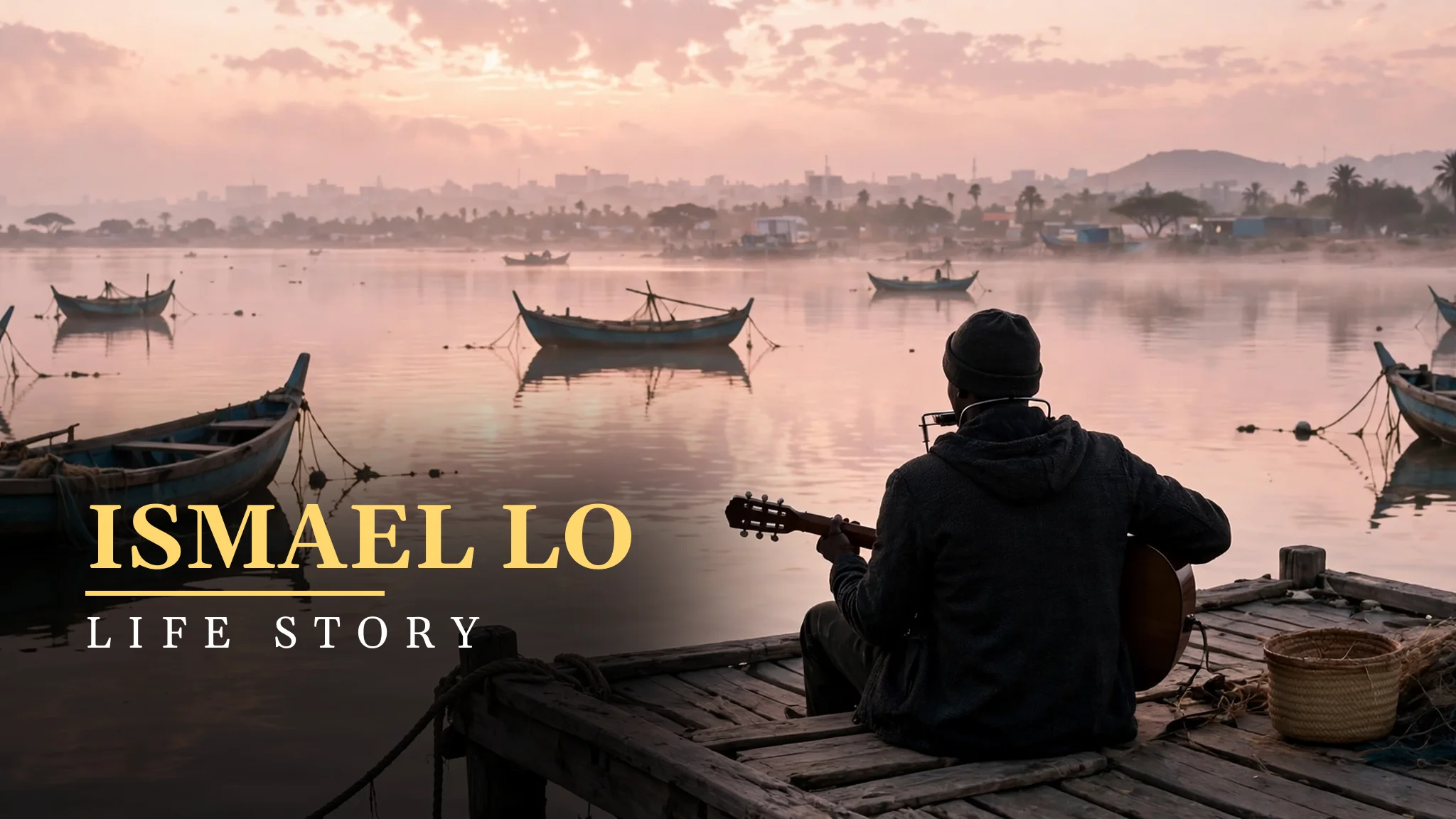
In this post
Ismael Lo is a singer who makes quiet music in a loud world. He plays the guitar, he plays the harmonica, and he sings in a soft, gentle voice that makes listeners lean in and pay attention. He was born in Niger in 1956, and he grew up in Senegal, where he became one of the most loved singers in West Africa. His best-known song, “Tajabone”, is a slow, beautiful melody that has been heard around the world, in films, on radio, and in concert halls. It is a song that seems to hold the whole feeling of a West African evening, calm, warm, and full of memory.
He is not a singer who shouts or who tries to fill a stadium with noise. He is a singer who sits with his guitar, who plays a simple melody, and who lets the song do its work. That simplicity is his strength. It makes his music feel personal, like a conversation with a friend, and it has won him fans in Senegal, in France, and in many other countries. He has been singing for more than forty years, and his voice has not lost its gentleness or its power.
His story is the story of a man who was born in one country, raised in another, and who made music that belongs to both. He sang with the great band Super Diamono, he went solo, and he built a career that crossed borders without ever losing its roots. This is the story of that gentle star, of his guitar, his harmonica, and his songs.
Born in Niger, Raised in Senegal
Ismael Lo was born on 30 August 1956 in Dogondoutchi, a town in Niger, in West Africa. His family was from Senegal, and when he was still young, they moved to Senegal, where he grew up. That move shaped his life. He was born in one country and raised in another, and he learned to belong to both. He spoke the languages of the region, he heard the music of Senegal, and he became a Senegalese singer, even though his birthplace was Niger. That double belonging is part of who he is, and it is part of his music.
He grew up in a family where music was present, and he began to sing and play as a boy. He was drawn to the guitar, an instrument that suited his gentle style. He learned to play it by listening and by practising, and he began to write his own songs. He also learned the harmonica, a small instrument that he could carry with him and play alongside his guitar. The combination of guitar and harmonica became his signature, a sound that is easy to recognise and that gives his music a soft, wistful feeling.
As a young man in Senegal, he listened to the music of the time, to the mbalax of Dakar, to the soul music of America, and to the traditional songs of West Africa. He loved them all, but he was drawn to a quieter sound. He did not want to make loud dance music. He wanted to make songs that people could listen to closely, songs about love, about life, and about the feeling of being far from home. That choice set him apart from many singers of his generation, and it became the foundation of his career.
He went to school in Senegal, and he began to perform as a teenager, singing at small gatherings and at school events. People noticed his voice. It was soft, it was clear, and it had a warmth that made listeners feel at ease. He was not a loud singer, but he was a singer who could hold a room with a whisper. That ability is rare, and it is one that he has kept for his whole career. He learned early that a quiet song can be more powerful than a loud one, if it is sung with truth.
Super Diamono and the Dakar Scene
In the late 1970s, Ismael Lo joined Super Diamono, one of the most important bands in Senegal. Super Diamono, also known as Super Diamono de Dakar, was a group that played a mix of mbalax, soul, and Latin music, and it was known for its strong singers and its tight sound. Ismael joined as a guitarist and singer, and he learned a great deal from the experience. He played night after night in Dakar, he learned how to perform with a band, and he learned how to write songs that would work for a large audience.
The band was a training ground for many of the best musicians in Senegal, and Ismael was part of that world. He played with talented singers and players, and he absorbed the energy of Dakar’s music scene. The city in those years was full of bands, clubs, and dancers, and the music was alive. Ismael was in the middle of it, but he was also different. While other singers shouted and danced, he played his guitar quietly and sang with a soft voice. That difference made him stand out, and it helped him to find his own path.
During his time with Super Diamono, he began to write songs that showed his own style. He wrote about love, about the sea, about the life of ordinary people in Senegal. His songs were not about fame or fortune. They were about the small, true things in life, and they were sung with a simplicity that made them feel honest. The band’s audiences responded to that honesty, and Ismael began to build a reputation as a songwriter as well as a singer.
After several years with Super Diamono, he decided to go solo. It was a big step, from being part of a band to standing alone on a stage with only a guitar and a harmonica. But he was ready. He had learned his craft, he had written his own songs, and he knew what kind of singer he wanted to be. He left the band with the respect of his colleagues, and he began a solo career that would take him far beyond Senegal. It was the right decision, and it would lead to the songs that made him famous around the world.
Tajabone and a Song That Travelled the World
Ismael Lo’s most famous song is “Tajabone”, and it is a song that has travelled further than he could ever have imagined. It is a slow, gentle melody, sung in Wolof, with a guitar and a harmonica that weave around his voice. The song speaks of a beautiful woman, of love, and of the feeling of longing, and it is sung with a tenderness that makes it unforgettable. When listeners first hear it, they often say that it feels like a song they have known for a long time, even if they have never heard it before. That is the mark of a great melody.
“Tajabone” became famous in Senegal in the early 1990s, and then it travelled to France, to Europe, and to the rest of the world. It was used in films, most famously in the Spanish film All About My Mother, directed by Pedro Almodóvar, where it played over a scene and gave the film a moment of deep beauty. Audiences who had never heard Senegalese music before heard “Tajabone” in that film, and they wanted to know who had sung it. That film alone introduced Ismael Lo to millions of listeners.
The song’s success was not about a big marketing campaign. It was about the music itself. A simple melody, a soft voice, and a feeling that was true. People heard it, and they loved it, and they shared it with others. It became one of the most loved African songs of its time, and it remains Ismael’s signature work. He has sung it thousands of times, in concerts around the world, and it still moves audiences. That is a rare thing for a song, to stay fresh after so many years, and it is a sign of how beautiful it is.
After “Tajabone”, Ismael’s career grew. He recorded albums, he toured Europe and America, and he became known as one of the great voices of West African music. He did not change his style to please new audiences. He stayed with the guitar and harmonica that had always defined him, and he let his soft delivery speak for itself.
Iso, Dibi Dibi Rek, and the Solo Albums
In 1994, Ismael Lo released the album Iso, and it became one of his most important works. The album included “Dibi Dibi Rek”, a song that became a hit in Senegal and in France, and it showed a singer at the peak of his powers. The songs on Iso were a mix of gentle ballads and more rhythmic numbers, all sung with his characteristic warmth. The album was praised by critics, and it sold well in Europe, where listeners were discovering African music in greater numbers. It confirmed Ismael as a major artist, not just a one-song singer.
“Dibi Dibi Rek” was a different kind of song from “Tajabone”. It was faster, more danceable, and it showed that Ismael could make people move as well as make them listen. The song’s title is in Wolof, and it speaks of a joyful, carefree feeling. It became a favourite at concerts, where audiences would dance and sing along. That balance, between the slow and the fast, between listening and dancing, is part of what makes Ismael’s concerts so enjoyable. He can move an audience from tears to joy in the space of a single song.
He continued to record albums in the years that followed, each one showing a different side of his music. Some were more acoustic, with just guitar and voice. Some were more produced, with a full band. But all of them were centred on his voice and his guitar, and all of them were sung with the same gentleness. He worked with musicians from Senegal, from France, and from other countries, and he built a sound that was truly international without losing its Senegalese heart.
His solo career also took him to festivals around the world, where he performed for audiences who had come to hear African music. He played in Paris, in London, in New York, and in many other cities, and he was welcomed with warmth wherever he went. He did not need a big show. He would walk on stage with his guitar, sit down, and sing. The audience would listen in silence, and then they would applaud with a feeling that was more than just appreciation. It was love, for a singer who had given them a beautiful song and a quiet evening of music.
A Guitar, a Harmonica, and a Quiet Stage
Ismael Lo’s stage is a quiet place, and that is deliberate. He does not use loud lights, big dancers, or a huge band. He uses a guitar, a harmonica, and his voice. He sits, he plays, and he sings. That simplicity is his art. It allows the audience to hear every note, every word, and every breath. It creates a feeling of closeness, as if he is singing to each person in the room individually. That closeness is rare in modern music, and it is why his concerts are so loved.
The guitar is his main instrument, and he plays it with a gentle touch. He does not strum hard. He picks the strings softly, and he lets the melody speak. The harmonica is his second voice, a small instrument that he holds to his mouth while he plays the guitar. It adds a wistful, almost lonely sound to his music, a sound that fits the feeling of his songs. Together, the guitar and the harmonica create a world that is simple and beautiful, a world where a single melody can carry a whole story.
His concerts are often described as peaceful, and that is a good word for them. People leave his shows feeling calm, feeling moved, and feeling as if they have heard something true. He does not try to excite the audience with noise. He tries to touch them with beauty, and he succeeds. That is a different kind of success from filling a stadium, but it is no less real. A quiet concert that moves people deeply is as valuable as a loud one that makes them dance, and Ismael has built his career on that quiet power.
He has also taught younger musicians, showing them that a singer does not need a big production to be heard. He shows them that a guitar, a voice, and a true song are enough. That lesson is important in a world where many young artists think they need expensive equipment and a large team to succeed. Ismael proves that simplicity can be a strength, and that a song sung with honesty can travel further than a song sung with noise.
Jammu Africa and Songs With a Message
Ismael Lo’s music is not only about love. It is also about Africa, about its people, and about its future. His song “Jammu Africa”, which means “Africa, hold on” or “Africa, be strong”, is a plea for the continent to stay true to itself, to remember its values, and to face the future with courage. It is a song that many Africans know and love, because it speaks to a feeling that is shared across the continent: a love for Africa, and a hope that it can overcome its problems.
He has also sung about the environment, about the sea, and about the lives of fishermen and farmers in Senegal. His songs are rooted in the daily life of West Africa, in the work of ordinary people, and in the beauty of the land. He does not sing about abstract ideas. He sings about the things he has seen, the people he has known, and the places he has lived. That concreteness makes his songs feel real, and it makes them speak to listeners who have lived similar lives.
His music has been used in films, in documentaries, and in campaigns for Africa, and it has helped to shape how the world sees Senegalese music. He is not a loud activist, but he is a singer who cares about his home, and his songs carry that care. He sings about Africa with love, not with anger, and that love is more persuasive than any speech. A song about Africa, sung with warmth, can do more to change minds than a hundred articles. Ismael understands that, and he uses his music with that understanding.
He has also worked with other African musicians, and he has been part of a community of artists who share his values. He believes that African music should be heard in the world, and that it should be heard on its own terms, in its own languages, with its own instruments. He has spent his career making that happen, one song at a time, one concert at a time. That work is quiet, but it is important, and it has helped to open doors for other Senegalese singers.
A Gentle Star Who Is Still Singing
Today, Ismael Lo is still performing, still recording, and still travelling with his guitar and his harmonica. He is in his late sixties, and his voice is still soft, still warm, and still full of the feeling that has always defined it. His concerts are still quiet, still beautiful, and still loved by audiences who come to hear a singer who does not shout, but who sings the truth. He has not changed his style to fit the times. He has kept it, and the times have come to him.
His legacy is secure. He is regarded as one of the great singers of West Africa, a man who took a simple sound, a guitar and a voice, and made it into a career that has lasted for more than forty years. His songs, especially “Tajabone”, are classics, and they will be sung and played for many years to come. He has shown that a gentle voice can be a strong voice, and that a quiet song can travel further than a loud one.
Younger Senegalese singers look to him as a model, not only for his music but for his life. He shows that a singer can be successful without being loud, that a singer can be famous without losing his humility, and that a singer can sing in his own language and still reach the world. Those are powerful lessons, and they are lessons that will guide new generations of African musicians.
His story is not finished, because he is still singing. But even now, his place is clear. He is the gentle star of Senegal, the singer with the guitar and the harmonica, the man who made “Tajabone” and who gave the world a song of great beauty. That is a legacy to be proud of, and it is one that will last.
The Sea in His Songs
The sea is present in Ismael Lo’s music, even when he is singing about love. He grew up in Senegal, a country with a long coast, and the sea was part of his daily life. Fishermen, boats, and the sound of water are in his songs, not as decoration but as a feeling. The sea is calm in the morning, it is restless in the afternoon, and it is mysterious at night. Ismael’s music has that same range. It can be calm, it can be restless, and it can be mysterious, all in the space of a single song. That is why his music feels so natural, so close to life itself.
He has sung about fishermen, about the work of the sea, and about the people who depend on it. Those songs are not about abstract ideas. They are about real people, real work, and real lives. When he sings about the sea, he sings about the men who go out in boats before dawn, about the women who wait for them, and about the families who live by the water. That concreteness makes his songs feel true, and it makes them speak to listeners who have lived similar lives, whether by the sea in Senegal or by a river or a lake elsewhere.
The sea is also a symbol in his work, a symbol of distance and of longing. A person who looks at the sea thinks of places far away, of people who have left, and of journeys that have not yet been made. Ismael’s songs carry that longing, and they give it a beautiful form. When he plays his guitar and sings about the sea, he is singing about the feeling of being far from home, and about the hope of return. That feeling is universal, and it is why his music travels so well, from Dakar to Paris to the rest of the world.
My Take:
When I hear Ismael Lo sing, I feel like I am sitting by the sea at dawn, listening to a friend play a guitar. His voice is soft, his guitar is gentle, and the whole feeling is calm. I do not need a big show. I do not need loud drums or bright lights. I just need that voice, that guitar, and that melody, and I feel at peace. That is a rare gift for a singer to have, the ability to make a listener feel calm in a world that is always noisy. Ismael has that gift, and he has used it for more than forty years.
What I admire most about him is his gentleness. He does not shout. He does not try to impress you with high notes or fast singing. He sings quietly, and he trusts that you will listen. That trust is a kind of courage. It takes courage to sing softly in a world that rewards loudness, to play a simple guitar when others are using big bands and loud speakers. Ismael has that courage, and it has served him well. His quiet songs have travelled further than many loud ones, because they speak to a part of life that is quiet and true.
I think his story teaches a lesson about simplicity. A guitar, a harmonica, and a voice are enough. You do not need a lot of equipment to make beautiful music. You need a true song, an honest voice, and a willingness to share it. Ismael proves that, night after night, concert after concert. He walks on stage with very little, and he gives the audience a great deal. That is a lesson for any young musician who thinks they need more to succeed. They do not need more. They need truth, and they need patience, and Ismael has both.
The song “Tajabone” moves me every time I hear it, because it is so simple and so beautiful. It is a melody that feels like it has always existed, like a song that was waiting to be found. When Ismael sings it, I feel a kind of longing, a feeling of love and loss that is hard to put into words. That is the power of a great melody. It does not need to explain itself. It just is, and the listener feels it. I think “Tajabone” is one of the most beautiful songs to come out of Africa, and I am grateful that a film helped the world to hear it. Without that film, many people might never have known it existed, and that would have been a great loss.
I also think about his life, born in Niger and raised in Senegal, and how that double belonging shaped his music. He belongs to two countries, and he sings for both. That is a beautiful thing, and it is also a difficult thing. To belong to two places means that you are always a little bit far from home, no matter where you are. Ismael turned that feeling into music. His songs speak of longing, of the sea, of home, and they carry that double belonging in every note. I think listeners who have lived far from home will recognise that feeling, and they will find comfort in his songs.
If I am honest, I sometimes wish his music was better known. He is famous in Senegal and in France, but many people in the rest of the world have never heard his name. That seems unfair to me, because his voice deserves to be heard by everyone. I hope that more people discover him, because they will find a singer who is worth listening to for a lifetime. His albums are not loud or flashy, but they are deep and true, and they grow more beautiful the more you hear them. That is the kind of music that lasts, and it is the kind that I value most.
What I learn from his life is that a quiet voice can be a strong voice. Ismael does not need to shout to be heard. He sings softly, and the world listens. That is a powerful lesson, not only for musicians but for anyone who feels that they need to be loud to be noticed. You do not need to be loud. You need to be true, and you need to be patient. Ismael has been true and patient for more than forty years, and his music is the proof that quiet strength can last longer than loud fame.
I also admire the way he has stayed true to his style. He did not change his sound to fit the latest fashion. He kept playing his guitar, kept playing his harmonica, and kept singing in his gentle way. That consistency is a sign of a real artist, someone who knows who they are and who does not need to chase every new trend. In a music world that changes fast, Ismael’s steadiness feels like a kind of wisdom. He knows what he does well, and he does it, year after year, with the same care.
When I think about his concerts, I imagine a room full of people listening in silence, with their eyes closed, feeling the music. That image stays with me, because it is so different from the image of a loud stadium show. Both kinds of concerts have their place, but Ismael’s kind is special. It is a shared moment of quiet, a time when strangers sit together and listen to a beautiful song. That shared quiet is a kind of community, and it is one that I value deeply. His music creates that community, night after night, and that is a beautiful thing.
In the end, I come back to the simple feeling I have when I hear him sing. I feel calm, I feel moved, and I feel at home, even though I have never been to Senegal. That is the power of his music. It carries me to a place I have never visited, and it makes me feel welcome there. Ismael Lo is a gentle star, a singer with a guitar and a harmonica, and a voice that has touched millions of people. I hope he keeps singing for many years, because the world needs his quiet beauty, now more than ever.
I also want to say something about his harmonica, because it is a small instrument that carries a big feeling. When he plays it, it sounds lonely and beautiful, like a voice from far away. It adds a sadness to his songs that makes them more moving, and it adds a warmth that makes them more human. I think the harmonica is the perfect instrument for him, because it is small, it is portable, and it is honest. It does not try to be grand. It just sings, in its own quiet way, and that is exactly what Ismael does. Together, the guitar, the harmonica, and the voice make a sound that is unlike any other, and it is a sound that I will always love.
I also think about the way his music makes a room feel when he performs. It is not a loud room. It is a quiet room, where people listen closely, where they close their eyes, and where they feel the song. That quiet is a kind of community, a shared moment when strangers sit together and listen to a beautiful melody. I value that kind of community, because it is rare in a world that is always noisy. Ismael creates it with his guitar and his voice, night after night, and that is a beautiful gift to give an audience.
Another thought that stays with me is about his harmonica, and how a small instrument can carry a big feeling. When he plays it, it sounds lonely and beautiful, like a voice from far away. It adds a sadness to his songs that makes them more moving, and it adds a warmth that makes them more human. I think the harmonica is the perfect instrument for him, because it is small, it is portable, and it is honest. It does not try to be grand. It just sings, in its own quiet way, and that is exactly what Ismael does. Together, the guitar, the harmonica, and the voice make a sound that is unlike any other.
I also admire the way he has stayed true to his style for more than forty years. He did not chase the latest fashion. His guitar, his harmonica, and his soft voice have remained at the centre of everything he does, and that steadiness is a sign of a real artist, someone who knows who they are and who does not need to chase every new trend.
When I think about his future, I hope he keeps performing, because his concerts are a rare and beautiful experience. I hope he records more albums, because his voice still has much to say. And I hope young Senegalese singers learn from him, because they have much to learn. They can learn that a quiet song can be powerful, that a simple guitar can carry a whole concert, and that a singer does not need to shout to be heard. Those are lessons that will serve them well, and Ismael is the best teacher they could have.
In the end, I think Ismael Lo matters because he proves that gentleness is a strength. He is a gentle singer, a gentle guitarist, and a gentle man, and his gentleness has carried him around the world. It has won him fans in Senegal, in France, and in many other countries, and it has made his songs classics. That is a powerful lesson, not only for musicians but for anyone who feels that they need to be loud to be noticed. You do not need to be loud. You need to be true, and Ismael has been true for more than forty years.
I also want to say something about the film All About My Mother, because it is how many people first heard “Tajabone”. A film can introduce a song to millions of people, and that film did it beautifully. It placed Ismael’s melody in a moment of deep emotion, and the audience felt it. That is a reminder that music and film can work together, and that a great song can find a new life in a new place. I am grateful to that film for introducing me to Ismael Lo, and I hope that more films use his music, because it deserves to be heard by as many people as possible.
When I listen to him now, I feel calm, I feel moved, and I feel at home, even though I have never been to Senegal. That is the power of his music. It carries me to a place I have never visited, and it makes me feel welcome there. Ismael Lo is a gentle star, and I hope he keeps singing for many years, because the world needs his quiet beauty, now more than ever.
I also think about the way his music is used in films and in documentaries, because it shows how a quiet song can carry a big feeling. When a director chooses “Tajabone” for a film, they are choosing a melody that can say what words cannot. That is a high honour for a song, and it is one that Ismael’s music has earned many times. I hope that more filmmakers use his songs, because they deserve to be heard by as many people as possible, and because they bring a beauty to the screen that is hard to find elsewhere.
Another thought that stays with me is about the young guitarists in Senegal who are learning from Ismael, and how important his example is for them. They see a man who plays a simple guitar, who sings softly, and who has built a career that has lasted for more than forty years. That must give them courage. It tells them that they do not need a big band or a loud show to be heard. All they need is a true song, an honest voice, and a willingness to give it away. Ismael proves that, night after night, and his example is a school for any young musician who wants to understand what music is really about.
In the end, I think Ismael Lo will be remembered as a gentle star, a singer whose quiet voice travelled further than many loud ones. His songs are classics, his guitar is a friend to millions of listeners, and his harmonica is a small voice that carries a big feeling. I am glad he is still singing, and I hope he keeps singing for many years, because the world needs his calm, his beauty, and his truth, now more than ever.
Frequently Asked Questions
When and where was Ismael Lo born?
Ismael Lo was born on 30 August 1956 in Dogondoutchi, Niger. His family was from Senegal, and he grew up in Senegal, where he became a singer.
How did Ismael Lo become known as a singer?
He became known by playing guitar and singing with Super Diamono, one of the great bands of Dakar, in the late 1970s. He later went solo and built his own career with his guitar and harmonica.
What is Ismael Lo’s most famous song?
His most famous song is “Tajabone”, a slow, beautiful melody sung in Wolof. It became known around the world after it was used in the film All About My Mother, directed by Pedro Almodóvar.
What instruments does Ismael Lo play?
He plays the guitar and the harmonica, and those two instruments are the centre of his sound. He often performs alone on stage with just his guitar, his harmonica, and his voice.
What is the song Dibi Dibi Rek about?
“Dibi Dibi Rek” is a joyful, danceable song from his 1994 album Iso. It became a hit in Senegal and France and is one of his best-loved songs, showing a livelier side of his music.
What is Jammu Africa?
“Jammu Africa” is a song by Ismael Lo that calls on Africa to stay strong and true to itself. It is a plea for the continent to remember its values and face the future with courage.
Is Ismael Lo still performing today?
Yes, he is still performing and recording, singing at festivals and concerts around the world. His quiet, gentle concerts remain popular and his voice is still warm and clear.


