Jacques Dutronc: The Life Story Behind France's Coolest Singer-Actor
In this post
Jacques Dutronc is the coolest man in French pop. He sang with a dry voice, he wore a dark suit, and he looked at the world with a raised eyebrow and a small smile, as if he knew a joke that no one else had heard. His songs were clever, funny, and sharp, and they made fun of fashion, of money, and of the people who took themselves too seriously. He was a singer, a guitarist, and later a great film actor, and he did all of it with a calm that made him different from every other star of his time.
He was born in Paris, he grew up in a house full of music, and he became famous in 1966 with a song that laughed at the selfishness of the world. He sang about playboys, about cactuses, about girls, and about Paris waking up at five in the morning, and each song was a small film, with characters, with a joke, and with a truth underneath. He married Françoise Hardy, the soft voice of French pop, and together they became one of the most loved couples in France, even though they were very different.
He later became a serious actor, and he won the César Award for Best Actor for playing the painter Vincent van Gogh, a role that showed a depth no one had expected from a pop singer. He is still alive, still loved, and still remembered as a man who did everything in his own way, with style, with humour, and with a quiet refusal to follow the crowd. This is the story of a Parisian who became a star by being himself.
A Paris Boy with a Guitar
Jacques Dutronc was born in Paris on 17 April 1943, during the Second World War. His father was a manager in a coal company, and his mother was a pianist, so music was in the house from the start. He grew up in a comfortable home, he went to school in Paris, and he learned to play the piano and the guitar. He was a bright boy, but he did not like school, and he preferred to listen to records, to play with friends, and to dream about a life in music.
He heard American rock and roll, he heard French chanson, and he began to play in small bands as a teenager. He was a guitarist first, and he played in a group called El Toro et les Cyclones, where he learned to play on stage, to work with other musicians, and to handle a crowd. He was tall, he was handsome, and he had a calm way of moving that made people look at him. He did not shout, and he did not dance wildly. He stood, he played, and he let the music do the work.
He also worked as a songwriter for other singers, and he learned to write words that were clever and funny. He worked with the writer Jacques Lanzmann, who became his great partner, and together they wrote songs that were full of wit and of observation. They looked at Paris, at its people, at its fashions, and at its follies, and they turned what they saw into songs that made people laugh and think at the same time. That partnership was the start of his career, and it gave him a voice that was entirely his own.
He was not in a hurry to become a star, and he spent years learning his craft, playing guitar, writing songs, and watching the world. He was a quiet young man, but he had a sharp eye, and he noticed the small details of life that other people missed. That eye for detail became the heart of his songwriting, and it is why his songs still feel fresh today, because they are about the real Paris, with its real people, and not about a dream.
Et moi, et moi, et moi and Overnight Fame
In 1966, Jacques Dutronc recorded Et moi, et moi, et moi, a song about a selfish man who thinks only of himself, and it became a huge hit in France. The song was funny, sharp, and full of energy, with a guitar riff that everyone recognised, and it made his name known all over the country. He sang it in a dry voice, with a smile, and the audience laughed, because they recognised the selfish man in the song, and they recognised themselves in him as well. It was a perfect first hit, because it showed his wit, his style, and his cool.
He followed it with Les Playboys in 1966, a song about young men who spend their lives chasing girls and fashion, and with J’aime les filles in 1967, a song about loving girls in all their forms. Each song was a small comedy, with a catchy tune and clever words, and each one made him more famous. He became a star of the yé-yé years, but he was different from other pop stars, because he was older, cooler, and more ironic. He did not sing about innocent love. He sang about the world as it was, with its vanities and its jokes.
He recorded Les Cactus in 1967, a song about people who are prickly and hard to get close to, and L’Opportuniste, a song about a man who takes every chance for himself. His songs were full of characters, and each character was drawn with a few sharp lines, like a cartoon. He was a songwriter who could see people clearly, and who could make them laugh at themselves, and that gift made him one of the most original voices in French pop.
He toured, he appeared on television, and he became a fashion icon, with his dark suits, his sunglasses, and his calm manner. He did not try to be a rock star. He was a Parisian gentleman who happened to sing, and that image made him stand out. He was cool, in the true sense of the word, calm, stylish, and a little distant, and young people in France loved that coolness, because it was different from the loud energy of other stars.
Il est cinq heures, Paris s’éveille
In 1968, Dutronc recorded Il est cinq heures, Paris s’éveille, a song about Paris waking up at five in the morning, with the bakers, the street cleaners, and the early workers starting their day. The song is gentle, poetic, and full of love for the city, and it became one of his most loved songs. It is not a funny song. It is a tender song, and it shows a different side of Dutronc, a man who loved Paris, who knew its streets, and who could write about it with warmth. The song is still played in the morning in Paris, and it is still a favourite of people who love the city.
The song came at a time when France was in turmoil, with student protests and strikes in May 1968, and its calm picture of Paris waking up felt like a moment of peace. Dutronc did not write a political song. He wrote a song about a city, about its people, and about the quiet hours before the noise begins. That choice showed his gift for finding a simple moment and making it into art, and it is why the song has lasted for more than fifty years.
He continued to record in the late 1960s and into the 1970s, and his music grew deeper. He sang Gentleman cambrioleur, a song about a gentleman thief, and he worked with good musicians, making albums that were praised for their wit and their sound. He was not a singer who repeated his hits. He kept writing new songs, with new characters and new jokes, and he kept his audience with him, because they trusted him to surprise them.
He also began to act in films, taking small parts that used his cool manner and his handsome face. He was not a trained actor, but he had a presence on screen that directors liked, because he looked like a real person with a real past. He learned to be still in front of a camera, to let a look do the work, and that stillness later became the heart of his great acting career. He was a singer who was becoming an actor, and the two arts were about to meet in a remarkable way.
Françoise Hardy, Thomas, and a Long Love
In 1967, Jacques Dutronc met Françoise Hardy, the soft-voiced singer who had become famous with Tous les garçons et les filles, and the two of them fell in love. They were very different, he loud and funny, she quiet and thoughtful, but they fitted together in a way that lasted for the rest of their lives. They lived together, they worked together, and they became one of the most loved couples in French music, even though they did not marry until 1981, when their son was already eight years old.
Their son, Thomas Dutronc, was born in 1973, and he grew up in a house full of music. He later became a singer and guitarist himself, and he worked with his parents, carrying on the family tradition. Jacques was a devoted father, and he tried to give Thomas a normal life, even though both of his parents were famous. He took him to school, he played guitar with him, and he kept the home as quiet as he could, away from the noise of show business.
His relationship with Françoise was long and complicated, as long relationships often are. They lived apart for much of their later life, and they had their own homes, but they remained married and they remained close. They spoke with love about each other, and they supported each other’s work. Jacques did not pretend that their life together was perfect. He said that love changes, and that a long love is not the same as a young love, but that it can still be deep and true, and his life with Françoise proved that.
He wrote songs about love in all its forms, about the joy of meeting, about the pain of parting, and about the quiet comfort of a long partnership. His songs were often funny, but underneath the humour there was a tenderness that his fans recognised. He was a man who loved deeply, even if he did not show it in a loud way, and his love for Françoise and for Thomas was the centre of his private life, even when his public life was full of noise.
Van Gogh and a Great Actor Is Born
In the 1970s and 1980s, Dutronc became a serious film actor, and he worked with some of the best directors in France. He acted in films that used his cool manner, his handsome face, and his quiet presence, and he learned to be a real actor, not only a singer trying to act. He took roles that were difficult, and he played them with a restraint that impressed critics, who began to see him as more than a pop star.
In 1991, he played the painter Vincent van Gogh in the film Van Gogh, directed by Maurice Pialat, and his performance was a triumph. He played Van Gogh as a sad, passionate, and difficult man, with a beard, with a tired face, and with a voice that carried the pain of an artist who was not understood. The film was praised, and Dutronc won the César Award for Best Actor, the highest honour for an actor in France. It was a remarkable achievement for a man who had started as a pop singer, and it showed that he had a depth that no one had expected.
He continued to act in films after Van Gogh, taking roles in serious dramas and in comedies, and he showed that he could play many kinds of characters. He was not a singer who acted for fun. He was an actor who had earned his place, and who was respected by directors, by critics, and by other actors. His acting career ran side by side with his singing career, and each one made the other stronger, because both were about telling a story with honesty and with style.
He also recorded new music in the 1990s and 2000s, and he toured when he had the strength, but acting became a larger part of his life. He liked the quiet of a film set, the work with a director, and the chance to become another person for a while. He was a man of many talents, and he used them all, with a calm that made his work look easy, even when it was hard.
Les Vieilles Canailles and the Final Concerts
In 2017, Dutronc joined Johnny Hallyday and Eddy Mitchell, two old friends from the early days of French rock, for a tour called Les Vieilles Canailles, which means the old rascals. The three men had known each other since the 1960s, and they had shared the early years of French rock, and the tour was a celebration of their friendship and their music. They sang together, they joked on stage, and they gave concerts that were filled with emotion, because the audience knew they were seeing three legends together for the last time.
Johnny Hallyday died later that year, and the tour became a farewell to him as well as a celebration of their friendship. Dutronc spoke about Hallyday with love, and he said that he had been a great friend and a great singer. The concerts were a reminder that Dutronc had been part of French music for more than fifty years, and that his place in its history was secure, not only as a singer, but as a friend to other singers.
He has lived in Corsica in his later years, in a quiet home where he can rest, read, and play guitar, away from the noise of Paris. He has had health problems, and he has rarely performed in public, but he is still loved, and his songs are still played. He gave interviews when he had the strength, and he spoke about his life, his family, and his music with a calm that has always been his mark. He is an old man now, but he is still cool, still stylish, and still himself.
His son Thomas has kept the family music alive, and he has worked with his father, carrying on the tradition of French song. Jacques is proud of Thomas, and he has spoken about him with love. He is a father, a husband, a singer, and an actor, and he has lived a life that is full, even if it has been quiet in its later years. He is still a part of France, and his songs are still a part of its life.
Why Dutronc Still Matters
Jacques Dutronc matters because he showed that French pop could be clever, funny, and cool, all at once. He wrote songs that made people laugh, and he also wrote songs that made them think, and he did it with a style that was entirely his own. He did not copy American rock, and he did not copy French chanson. He made a sound that was Parisian, modern, and ironic, and that sound is still heard in French music today, whenever a songwriter takes the time to write a clever lyric.
He also matters because he proved that a singer can become a great actor, and that an actor can keep singing. His César Award for Van Gogh is a rare honour for a pop star, and it shows that talent can cross from one art to another, if the artist is willing to work. He did not become an actor by luck. He worked, he learned, and he earned his place, and that is a lesson for anyone who wants to try a new art later in life.
His love story with Françoise Hardy also matters, because it shows that a long love can survive even when two people are very different, and even when they live apart. They were together for more than fifty years, they had a son, and they stayed married until her death in 2024. That is a rare and beautiful thing, and it is a part of his legacy that goes beyond music, a story of a love that lasted.
The Cool Parisian Who Never Changed
Dutronc never changed his cool manner, even when the world around him changed. He wore dark suits in the 1960s, he wore them in the 1990s, and he still wears them today, because style, for him, is not about fashion. It is about being yourself, and about not following the crowd. He sang with a dry voice, he acted with a quiet presence, and he lived with a calm that made him stand out in a noisy world. That coolness is not a pose. It is who he is, and it is why he is loved.
His songs are still played in France, in cafes, in cars, and in homes, and his voice is still recognised by people who were not born when he started. That is the mark of a true artist. He did not belong to one decade. He belonged to Paris, and Paris still keeps him. The boy who played guitar in a small band became a singer, an actor, and a legend, and he did it by being himself, in his own way, with style, with humour, and with a quiet refusal to follow the crowd.
When a listener today hears Il est cinq heures, Paris s’éveille, they hear a city waking up, and they hear a man who loved that city, and who sang about it with warmth. His songs are still played in the morning in Paris, in cafes where bakers and workers start their day, and in homes where people remember the Paris of their youth, a city that Dutronc knew street by street, and that he loved with a quiet and lasting heart. That is a gift that Dutronc left behind, a song about Paris that will last as long as Paris itself, and a voice that will keep singing, cool and clear, for a long time. His records are still sold, his films are still watched, and his name is still spoken in France whenever a young singer tries to write a clever song, because Dutronc showed that a French song can be funny, stylish, and true at the same time, and that a Parisian who trusts his own taste can change the music of a country without ever raising his voice.
My Take:
When I think about Jacques Dutronc, I think first about coolness. He did not shout, he did not dance wildly, and he did not try to impress anyone. He stood, he sang in a dry voice, and he looked at the world with a small smile, as if he knew a joke that no one else had heard. I admire that, because it takes a special kind of confidence to be cool in a loud world. Most stars try to be louder than the next one, but Dutronc proved that a quiet man can be more powerful than a loud one, if he is clever, if he is stylish, and if he is true to himself. That is a lesson I carry with me.
I admire his songs because they are clever, funny, and sharp, and because they make fun of the world without being cruel. Et moi, et moi, et moi laughs at a selfish man, Les Playboys laughs at young men who chase fashion, and Les Cactus laughs at people who are prickly and hard to love. Each song is a small comedy, but underneath the comedy there is a truth, that people are often selfish, vain, and foolish, and that laughter is a good way to see that truth. I think that is a kind way to teach, to make people laugh at themselves, and then to let them think about what they have laughed at.
What moves me most is his song Il est cinq heures, Paris s’éveille, because it is not funny at all. It is tender, poetic, and full of love for Paris, and it shows a different side of Dutronc, a man who loved his city, who knew its streets, and who could write about it with warmth. The song is about bakers, street cleaners, and early workers, people who wake up before the rest of the city, and it treats them with respect. I think that is a beautiful thing, to write a song about ordinary workers, and to make it one of the most loved songs in France. It shows that Dutronc did not only laugh at the world. He also loved it.
I also think about his love with Françoise Hardy, and about how two very different people stayed together for more than fifty years. He was loud and funny, she was quiet and thoughtful, and yet they fitted together. That is a lesson about love, that it does not need two people to be the same. It needs two people to respect each other, to give each other space, and to stay true, even when life is hard. Their love was not perfect, and they lived apart for much of their later life, but it lasted, and it gave them a son, Thomas, who became a musician himself. That is a real love, and it is worth remembering.
His acting career also impresses me, because it shows that a singer can become a great actor if he is willing to work. He won the César Award for Best Actor for playing Van Gogh, a role that required sadness, passion, and depth, and he played it with a restraint that made the performance feel true. He did not act like a pop star. He acted like an actor, with a quiet presence and a clear mind. I think that is a remarkable achievement, and it is a lesson for anyone who wants to try a new art later in life. You are never too old to learn, and you are never too famous to start again.
I think about his friendship with Johnny Hallyday and Eddy Mitchell, and about the tour Les Vieilles Canailles in 2017, when the three old friends sang together for the last time. That tour was a celebration of friendship, and it was also a farewell, because Hallyday died later that year. Dutronc spoke about Hallyday with love, and he said that he had been a great friend. I think that is a moving story, because it shows that a life in music is not only about hits. It is also about friends, about shared years, and about the people who were there at the start and who are still there at the end.
His cool style also makes me think about fashion, and about how he wore dark suits, sunglasses, and a calm manner for more than fifty years, without ever following a trend. He did not change his style to please fashion, and he did not need to, because his style was his own. I think that is a lesson for anyone who worries about style. You do not need to follow fashion. You need to find what suits you, and to wear it with confidence, and the rest will follow. Dutronc did that, and he became a fashion icon without trying to be one.
I also admire the way he lived in Corsica in his later years, in a quiet home, away from the noise of Paris. He did not chase fame in his old age, and he did not try to be a star forever. He went to a quiet place, he rested, and he played guitar when he wanted to. That is a wise way to age, to know when to step back, and to find peace in a simple life. Many stars cannot do that, because they need applause, but Dutronc did not need it. He had his family, his music, and his home, and that was enough.
There is a sadness in his story too, and it is the sadness of losing Françoise Hardy in 2024, after more than fifty years together. He lost the love of his life, and he had to live with that loss in his old age. I feel for him, because a long love leaves a large hole when it ends, and no amount of fame can fill it. He has spoken little about her death, and I respect his silence, because grief is a private thing, and he has always kept his private life private. That silence is a kind of dignity, and it is typical of the man he has always been.
I think about his son Thomas, and about the way he has carried on the family music, and I realise that Dutronc’s legacy is not only in his own songs. It is also in his son, in the music that Thomas makes, and in the tradition that the family has built together. A father who teaches his son to play guitar, who takes him to school, and who lets him find his own path in music is a good father, and Dutronc was that. His family is a part of his story, and it is a part that deserves to be remembered.
His partnership with Jacques Lanzmann also stays with me, because it shows how important a good partner can be in art. Lanzmann wrote words, Dutronc wrote music, and together they made songs that neither could have made alone. That is a lesson about collaboration, that a great work is often made by two people who trust each other, and who bring different gifts to the same song. Dutronc did not do it alone, and he did not pretend that he did. He worked with a partner, and he gave that partner credit, and that is a generous way to work.
When I hear J’aime les filles today, I hear a song that is playful, warm, and full of the joy of youth, and I understand why it became a hit. It is not a deep song, but it does not need to be deep. It is a song for a sunny day, for a walk in Paris, and for the simple pleasure of looking at the world and loving it. That is a gift, to make a simple song that brings joy, and Dutronc had that gift. He could make a happy song, a funny song, and a tender song, and each one felt true.
I also think about the way he sang about Paris, and about how his songs are a map of the city, with its streets, its cafes, its early mornings, and its late nights. He loved Paris, and he sang about it with a knowledge that only a Parisian can have. That love is in his songs, and it is why Paris still keeps him, and why his name is still spoken whenever French music is discussed. He was not a visitor to Paris. He was a part of it, and the city knows it.
In the end, I think Dutronc teaches us that a cool head and a warm heart can live in the same person. He was cool on stage, but he was warm at home, with his wife, with his son, and with his friends. He was funny in his songs, but he was tender in his love. He was a singer, an actor, and a father, and he did all of those things in his own way, with style, with humour, and with a quiet refusal to follow the crowd. I hope readers listen to his songs, from Et moi, et moi, et moi to Il est cinq heures, and hear the journey in them, from a young guitarist to a great actor to an old man in Corsica who still loves Paris.
I hope young artists learn from him, not only how to write a clever song, but how to live a cool and honest life. He showed that you do not need to shout to be heard, that you do not need to follow fashion to be stylish, and that you do not need to be loud to be loved. You need to be yourself, to work hard, and to trust your own taste, and if you do that, the world will come to you. Dutronc did that, and his songs are still coming to new listeners today.
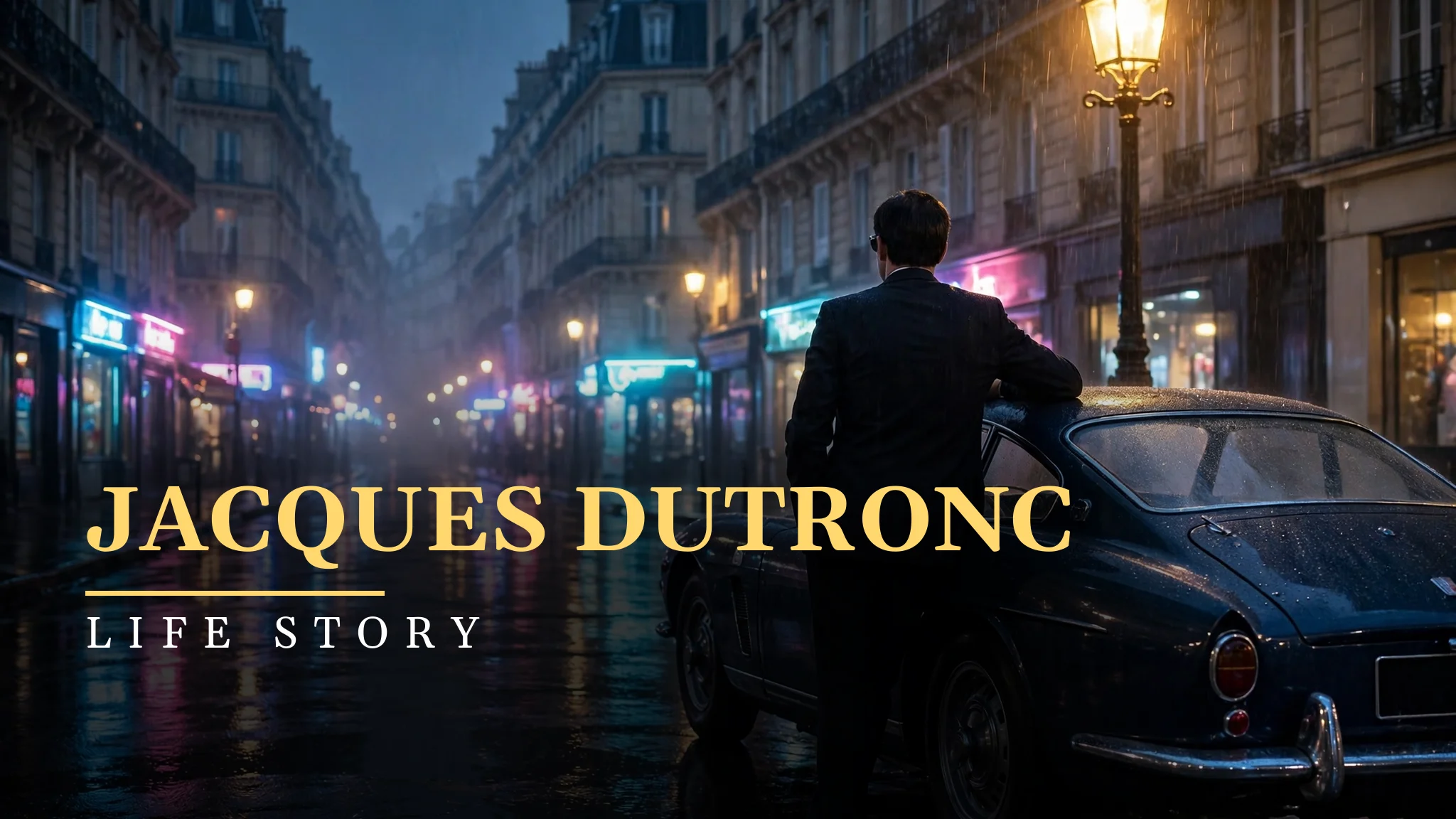
Finally, I think about the image of a man in a dark suit, leaning against a vintage car on a rainy Paris street, with neon lights reflecting on the wet pavement. That image is Dutronc, cool, stylish, and a little distant, but also warm, because the man in the suit loves the city behind him. I hope that image stays with readers, and I hope they remember that a great artist can be cool and kind at the same time, and that a quiet voice can be the strongest voice in the room.
I also think about the way he played guitar, and about how his guitar work was the foundation of his music. He started as a guitarist, and he never lost that love of the instrument, even when he became a singer and an actor. His guitar riffs, especially in Et moi, et moi, et moi, are still recognised by French listeners, and they show that a good riff can carry a song as surely as a good lyric. He was a musician first, and that is why his songs sound so strong, because they were built on music, not only on words.
His films also deserve more attention, because he acted in many films besides Van Gogh, and each one showed a different side of him. He played thieves, lovers, fathers, and quiet men, and he did it with a restraint that made each character feel real. He did not act like a star. He acted like a man, and that is a rare gift in cinema. I wish more people watched his films, because they show a depth that his pop songs only hint at, and they prove that he was a great artist in two arts, not only in one.
Finally, I think Dutronc shows us that a life can be lived at a calm pace, even in show business. He did not rush, he did not chase every trend, and he did not try to be famous every day. He worked when he wanted to, he rested when he needed to, and he kept his private life private. That calm is a lesson for anyone who feels rushed by the world. You do not have to run to be great. You can walk, you can look, and you can sing when you have something to say, and the world will wait for you, as it waited for Dutronc.
Frequently Asked Questions
When was Jacques Dutronc born and is he still alive?
Jacques Dutronc was born in Paris on 17 April 1943, and he is still alive, living in Corsica in his later years. He is one of the great living stars of French pop, and his songs are still played across France.
What is Jacques Dutronc’s most famous song?
His most famous songs include Et moi, et moi, et moi from 1966, Les Playboys, J’aime les filles, and Il est cinq heures, Paris s’éveille from 1968, a tender song about Paris waking up at five in the morning.
Did Jacques Dutronc win an award for acting?
Yes, he won the César Award for Best Actor in 1991 for playing the painter Vincent van Gogh in the film Van Gogh, directed by Maurice Pialat. His performance was praised for its sadness, passion, and restraint.
Who was Jacques Dutronc married to?
He was married to Françoise Hardy, the singer of Tous les garçons et les filles, whom he met in 1967. They married in 1981, and they had a son, Thomas Dutronc, born in 1973, who became a singer and guitarist.
What were the Les Vieilles Canailles concerts like for Jacques Dutronc?
Les Vieilles Canailles was a concert tour in 2017 with Jacques Dutronc, Johnny Hallyday, and Eddy Mitchell, three old friends from the early days of French rock. The concerts were among Hallyday’s last performances, and they celebrated fifty years of friendship and music.
What is Il est cinq heures, Paris s’éveille about?
The song, recorded in 1968, is about Paris waking up at five in the morning, with bakers, street cleaners, and early workers starting their day. It is a tender and poetic love song to the city, and it is still played in the morning in Paris.
Where does Jacques Dutronc live now?
He lives in Corsica in his later years, in a quiet home where he can rest, read, and play guitar, away from the noise of Paris. He rarely performs in public now, but his songs and his films are still loved.


