James Cameron: The Life Story Behind the Titanic Director
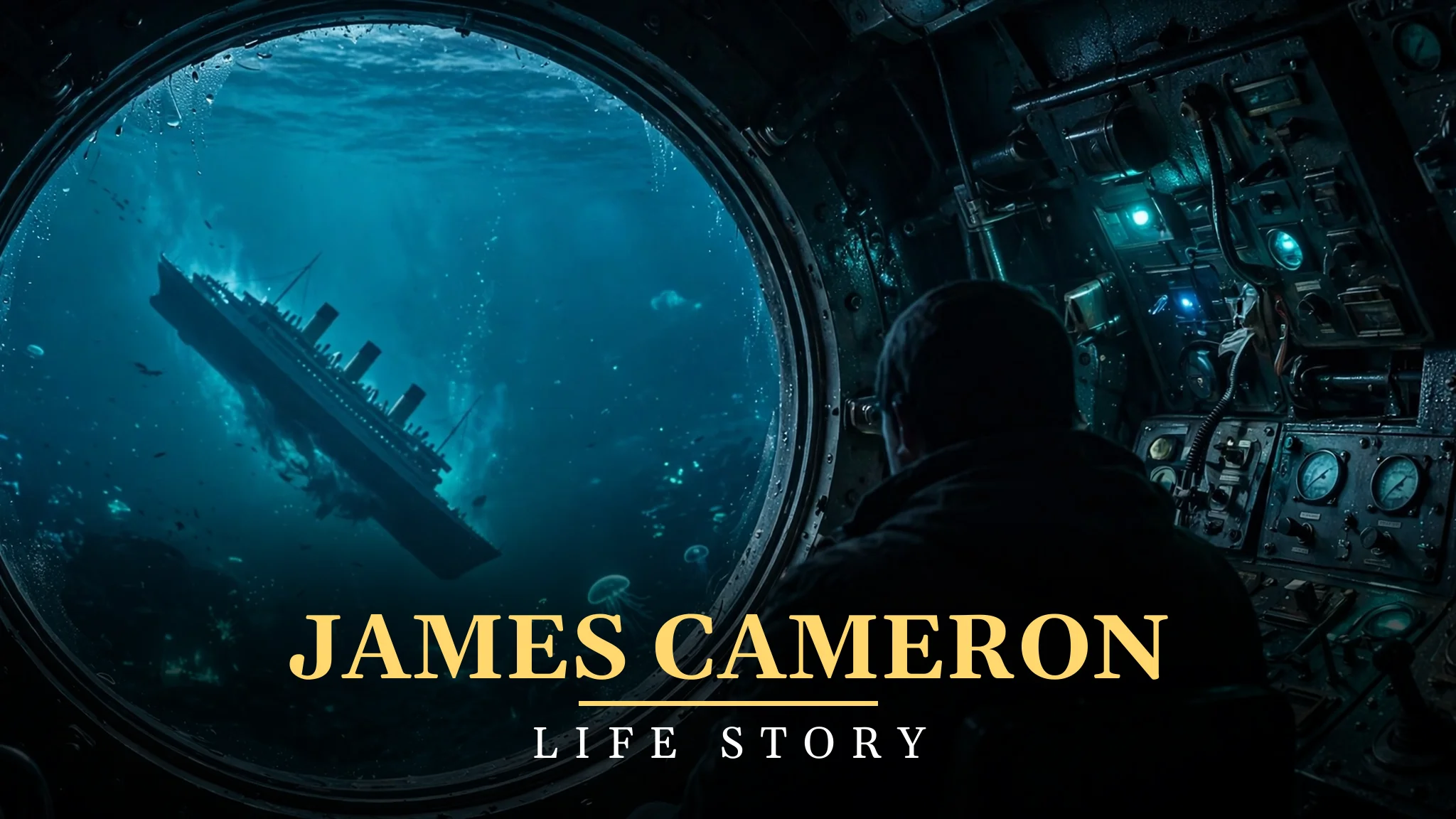
In this post
- A Small Town Boy Who Loved Science Fiction
- California, Truck Driving, and Learning Film the Hard Way
- The Terminator and the Birth of a Blockbuster Director
- Terminator 2, True Lies, and the Biggest Films in the World
- Avatar, New Technology, and the World of Pandora
- The Deep Sea, the Mariana Trench, and a Life of Exploration
- Family, Marriages, and the Man Behind the Films
- The Documentaries, the Ocean, and the Years Between the Big Films
- Alita, Sanctum, and the Films He Helped Others Make
- My Take:
James Cameron is the Canadian director who made the two biggest films in cinema history, and then went down to the deepest place on Earth to see it with his own eyes. Titanic and Avatar each earned more money than any film before them, and both changed the way movies were made. But Cameron is not only a filmmaker. He is an explorer, an inventor, and a man who has always been drawn to the ocean, to machines, and to the edge of what is possible. His life reads like one of his own films: a boy with a big imagination who refused to accept the limits other people placed in front of him.
He was born in a small town in Ontario, grew up near Niagara Falls, and moved to California as a young man with almost nothing. He drove a truck, he painted, he built models, and he taught himself how to make films by watching, reading, and working on the cheapest movies he could find. Then, in a few short years, he made The Terminator, a film that turned a little-known actor named Arnold Schwarzenegger into a star and turned Cameron himself into one of the most sought-after directors in Hollywood.
What makes his story different from other directors is that he never stopped pushing. He pushed cameras, he pushed computers, he pushed budgets, and he pushed himself. He built new technology to film under water, he designed a submarine to dive to the bottom of the ocean, and he spent years building the world of Avatar before he filmed a single scene. This is the story of how a Canadian boy who loved science fiction became the most successful director in the history of film, and how he used that success to explore the real world as well as the imaginary one.
A Small Town Boy Who Loved Science Fiction
James Francis Cameron was born on 16 August 1954 in Kapuskasing, Ontario, a small paper-mill town in northern Canada. His father, Philip Cameron, worked as an electrical engineer, and his mother, Shirley, was an artist and a nurse. The family later moved to Chippawa, near Niagara Falls, where James grew up. The landscape around him was full of water, power, and big machines, and the boy who grew up there learned early how things worked and why they mattered.
As a child, Cameron loved science fiction. He read books, he watched films, and he imagined worlds far from the small town where he lived. He was especially drawn to stories about space, about the deep sea, and about machines that could think. He also loved to draw, and he spent hours sketching strange creatures, spaceships, and underwater worlds. His mother encouraged his art, and his father encouraged his interest in how things were built. The two influences came together in a boy who could both imagine a world and work out how to build it.
School gave him a solid start, but he was not a boy who followed the usual path. He was curious, stubborn, and full of questions. He liked to take things apart to see how they worked, and he liked to build things with his own hands. The town around him was not a place where a boy could easily become a filmmaker, and there were no film studios nearby. But Cameron did not need a studio. He needed a story, a camera, and the will to keep going, and he had all three.
The years in Ontario mattered because they gave him a sense of scale. He grew up near one of the great natural wonders of the world, Niagara Falls, and he learned that nature is powerful and that human beings are small beside it. That feeling runs through all his films, from the ocean in Titanic to the forests of Pandora in Avatar. He has always been drawn to big things: big water, big forests, big machines, and big ideas.
California, Truck Driving, and Learning Film the Hard Way
In 1971, when Cameron was seventeen, his family moved to Brea, California. He went to Sonora High School, and then to Fullerton College, where he studied physics. He later moved to California State University, Fullerton, but he left before finishing his degree. The classroom was not where he learned best. He learned by doing, by reading, and by watching films, and he decided that his education would happen outside the university.
To earn a living, he worked as a truck driver, driving long distances across California. He also worked as a machinist and as a painter. The work was hard, but it gave him time to think, and it gave him money to live on while he dreamed about films. He read books about filmmaking, he studied the work of directors he admired, and he began to write stories of his own. He was not waiting for someone to give him a chance. He was teaching himself the craft, step by step, in his own time.
His first break came when he got work with Roger Corman, the famous low-budget producer, who gave young filmmakers a chance to learn by doing real work. Cameron worked as a production designer, as an art director, and as a special effects man on cheap science fiction films. The budgets were tiny, and the schedules were short, but the work taught him how to solve problems fast, how to build something from almost nothing, and how to get a big effect from a small amount of money. He learned more in those months than many film students learn in years.
In 1981, he directed his first feature film, Piranha II: The Spawning, a low-budget horror film about killer fish. The film was not a success, and Cameron later said he was not happy with how it turned out. But it was a start. He had directed a real film, he had learned what could go wrong on a set, and he had learned that he wanted to make films his own way. The young truck driver from Ontario was now a director, and his next film would change everything.
The Terminator and the Birth of a Blockbuster Director
In 1984, Cameron made The Terminator, a science fiction film about a killer machine sent back in time to kill a young woman named Sarah Connor. The film starred Arnold Schwarzenegger as the Terminator and Linda Hamilton as Sarah Connor. It was made on a modest budget, but it was full of new ideas, strong action, and a story that kept audiences on the edge of their seats. The Terminator became a huge success, and it made both Schwarzenegger and Cameron famous around the world.
The film worked because Cameron understood something simple: a good story needs a clear threat, a strong hero, and a world that feels real. He did not fill the film with expensive effects. He filled it with tension, with chases, and with a machine that would not stop. The line “I’ll be back,” spoken by Schwarzenegger, became one of the most famous lines in film history. The Terminator was not just a hit. It was the start of a series that would run for decades.
Two years later, he made Aliens in 1986, the sequel to Ridley Scott’s Alien. Cameron took the quiet horror of the first film and turned it into a powerful action film, with Sigourney Weaver returning as Ellen Ripley, now leading a team of marines against a nest of alien creatures. The film was a huge success, and it won Academy Awards for its sound and visual effects. It also showed that Cameron could take someone else’s film and make a sequel that was as good as, or even better than, the original.
In 1989, he made The Abyss, a film about a deep-sea oil rig crew who meet a strange life form under the ocean. The film was difficult to make, because much of it was shot under water, and the production was long and hard. The film did not earn as much as his other films, but it was important, because it showed Cameron’s deep love for the ocean, and it led him to develop new technology for filming under water. The Abyss was a step toward Titanic, and toward the deep-sea exploration that would become a central part of his life.
Terminator 2, True Lies, and the Biggest Films in the World
In 1991, Cameron made Terminator 2: Judgment Day, the sequel to The Terminator. The film used new computer technology to create a liquid metal villain, played by Robert Patrick, who could change shape. The effects were unlike anything audiences had seen before, and the film became one of the biggest hits of the year. It won four Academy Awards, including Best Visual Effects, and it proved that Cameron was the master of the modern blockbuster.
In 1994, he made True Lies, an action comedy starring Arnold Schwarzenegger and Jamie Lee Curtis. The film was a success, and it showed that Cameron could make a fun, fast film as well as a serious one. But his mind was already on a much bigger project, a film about a ship that had sunk in 1912, a film that many people in Hollywood thought could never be made.
That film was Titanic, released in 1997. Cameron had been fascinated by the wreck of the Titanic since he was young, and he had dived down to see the real wreck on the ocean floor. He wanted to make a film that told the story of the ship, and the story of two young people, Jack and Rose, played by Leonardo DiCaprio and Kate Winslet, who fall in love on the voyage. The film cost more than any film ever made at the time, and the production was long, difficult, and expensive. Many people said it would fail.
Instead, Titanic became the biggest film in history. It earned more than 1.8 billion dollars in its first release, it won eleven Academy Awards, including Best Picture and Best Director for Cameron, and it stayed in cinemas for months. The song “My Heart Will Go On,” sung by Celine Dion, became one of the best-selling songs of all time. Titanic was not just a film. It was a world event, and it made Cameron the most successful director alive.
Avatar, New Technology, and the World of Pandora
After Titanic, Cameron did not rush into another film. He spent years exploring the ocean, making documentaries about the deep sea, and working on new technology. He was interested in three-dimensional film, in digital cameras, and in the idea of creating a whole world inside a computer. He had an idea for a film about a distant planet called Pandora, where tall blue people called the Na’vi lived in a forest that glowed with light. The film would need technology that did not yet exist, so Cameron waited until the technology caught up with his imagination.
In 2009, he released Avatar. The film told the story of Jake Sully, a former marine played by Sam Worthington, who travels to Pandora and falls in love with Neytiri, played by Zoe Saldana, and with the world she lives in. The film was made with new motion-capture technology, new cameras, and a whole digital world built from scratch. Avatar became the highest-earning film of all time, passing Titanic, and it won three Academy Awards. It changed the film industry, because after Avatar, three-dimensional films and motion-capture became common.
Cameron did not stop there. He spent years making sequels to Avatar, building a whole series of films set on Pandora. Avatar: The Way of Water was released in 2022, and it explored the oceans of Pandora, with new technology for filming under water. The film was another huge success, earning more than two billion dollars. Cameron has said he plans to make more Avatar films, and the world of Pandora has become one of the biggest film worlds ever created.
What makes Avatar important is not only its money. It is the way Cameron used technology to tell a story about nature, about people who live in balance with their world, and about outsiders who come to take what they want. The film is a science fiction adventure, but it is also a warning about what happens when people destroy the natural world. That warning has been part of Cameron’s work since The Abyss, and it runs through all his films about the sea.
The Deep Sea, the Mariana Trench, and a Life of Exploration
Cameron has always been as much an explorer as a filmmaker. He has made more than thirty dives to the wreck of the Titanic, and he has made documentaries about the deep ocean, including Ghosts of the Abyss in 2003 and Aliens of the Deep in 2005. He has worked with scientists and engineers to build new submarines and new cameras that can survive the crushing pressure of the deep sea.
In 2012, he made history by diving alone to the bottom of the Mariana Trench, the deepest place on Earth, in a submarine he helped to design called the Deepsea Challenger. He reached a depth of almost eleven kilometres, deeper than Mount Everest is tall, and he spent hours on the ocean floor, filming and collecting samples. He was the first person to make the dive alone, and only the third person ever to reach the bottom of the trench. The dive was a scientific mission, and it was also a personal dream that Cameron had carried since he was a boy.
The ocean has always been at the centre of his life. He has said that the deep sea is the last great frontier on Earth, a place where no human has been and where strange creatures live in darkness. His films about the sea, from The Abyss to Titanic to Avatar: The Way of Water, all come from that fascination. He is not a director who only imagines worlds. He goes out and sees the real world, and he brings what he sees back into his films.
Cameron has also used his fame to speak about the environment. He has talked about climate change, about the need to protect the oceans, and about the way human beings treat the natural world. He has changed his own life to live more simply, eating a plant-based diet and supporting environmental causes. For him, the message of Avatar is not just a story. It is something he believes, and he has tried to live by it.
Family, Marriages, and the Man Behind the Films
Cameron has been married five times, and his personal life has often been in the news. His first marriage was to Sharon Williams, from 1978 to 1984. He was then married to Gale Anne Hurd, the producer of The Terminator, from 1985 to 1989. His third marriage was to director Kathryn Bigelow, from 1989 to 1991. His fourth marriage was to Linda Hamilton, who played Sarah Connor in the Terminator films, from 1997 to 1999, and they have a daughter together. Since 2000, he has been married to Suzy Amis, an actress who appeared in Titanic, and they have three children together.
He has often said that his work takes over his life, and that making a film like Titanic or Avatar is like going to war. The films take years, they cost hundreds of millions of dollars, and they demand everything from the people who make them. That intensity has been hard on his personal life, and he has spoken honestly about the cost of the work he does. But he has also said that the work is worth it, because it is the work he was born to do.
Cameron lives with his family in New Zealand, where much of the Avatar work is done, and he also spends time in California. He is known for being demanding on set, for working long hours, and for expecting the best from everyone around him. Some people who have worked with him say he is difficult. Others say he is the most prepared director they have ever met, a man who knows every detail of every shot before he arrives on set. Both things may be true, because making films on the scale he works at leaves no room for mistakes.
Today, Cameron is still working, still planning new Avatar films, and still exploring the ocean. He is one of the most successful directors in history, and he is also one of the most driven. His story is not only about money or awards. It is about a boy who loved science fiction and the sea, who taught himself to make films, and who never stopped asking what was possible, whether that meant building a new camera, diving to the bottom of the ocean, or creating a whole new world on a screen.
The Documentaries, the Ocean, and the Years Between the Big Films
Between Titanic and Avatar, Cameron spent years making documentaries about the deep sea, and those years matter as much as his big films. He made Ghosts of the Abyss in 2003, a film that took audiences down to the wreck of the Titanic in three dimensions, showing the ship as it looks today, rusting and quiet on the ocean floor. The film was not a blockbuster. It was a quiet, thoughtful look at a wreck, and at the men and women who died on the ship. It showed Cameron’s respect for history, and his belief that the real wreck deserved to be seen, not only imagined.
He also made Aliens of the Deep in 2005, a film about strange creatures that live in the darkest parts of the ocean, near volcanic vents where no sunlight reaches. The film showed animals that look like they come from another planet, and it reminded audiences that the deep sea is full of life we barely understand. Cameron worked with scientists on the film, and he treated the science with great respect. He was not only a filmmaker. He was an explorer who wanted to share what he had seen with the world.
Those documentary years also gave him time to develop the technology he would need for Avatar. He worked on new cameras, on new ways of filming in three dimensions, and on new ways of capturing an actor’s performance and turning it into a digital character. He was patient, and he was willing to wait until the technology was ready. Many directors would have rushed into the next film. Cameron waited, and the wait made Avatar possible. The years between the big films were not empty years. They were years of learning, of exploring, and of building.
Alita, Sanctum, and the Films He Helped Others Make
Cameron has not only directed his own films. He has also helped other directors to make theirs, as a producer and as a writer. In 2019, he produced Alita: Battle Angel, a science fiction film directed by Robert Rodriguez, about a young cyborg girl who wakes up in a future city with no memory of who she is. Cameron had worked on the story for many years, and he wrote the script with Laeta Kalogridis. He gave the film to Rodriguez to direct, because he was busy with Avatar, but he stayed involved as a producer, helping to shape the world, the characters, and the technology. The film was a success, and it showed that Cameron could help another director to make a film in his own style.
He also produced Sanctum in 2011, a film about cave divers trapped underground, directed by Alister Grierson. The film used three-dimensional cameras that Cameron had helped to develop, and it was shot in real caves and in water tanks. It was a tense, claustrophobic thriller, and it showed Cameron’s love for the underwater world, and his willingness to support a film about exploration and danger. He did not direct it, but his fingerprints were on it, in the cameras, in the water, and in the respect for the real dangers of diving.
These producing roles show another side of Cameron. He is not only a director who wants to control everything. He is also a collaborator, a man who can help another filmmaker to realise a vision, and who can share his technology and his knowledge. He has spent years developing cameras, developing three-dimensional systems, and developing ways of filming under water, and he has shared those tools with other directors. That generosity has helped the whole film industry, and it is part of his legacy. He did not keep his inventions to himself. He used them, and he let others use them too.
My Take:
When I think about James Cameron, the first thing that comes to mind is not Titanic or Avatar. It is the image of a man who refuses to be told that something cannot be done. Most people, when they hear that a film will cost two hundred million dollars, or that a camera does not exist yet, or that no one has ever dived alone to the bottom of the ocean, will step back and choose something smaller. Cameron steps forward. I admire that, because it is easy to dream big and hard to do the work that makes a big dream real. He has done the work, again and again, for more than forty years, and that is why his name means something.
I think his greatest strength is that he is both an artist and an engineer. Most directors are one or the other. They have a vision, and they need other people to build it. Cameron has the vision, and he also understands how the machine works. He knows how a camera works, how a submarine works, how a computer builds a world. That knowledge gives him a freedom that other directors do not have. He does not have to wait for someone to invent the tool he needs. He can help invent it himself. I find that inspiring, because it tells me that learning how things work is not separate from making art. It is part of making art, and the more you understand, the more you can create.
What I love most about his films is the way they make big ideas feel human. Titanic is a film about a ship that sinks, but it is really a film about two young people who fall in love and who come from different worlds. Avatar is a film about a planet full of blue aliens, but it is really a film about a man who learns to see the world through someone else’s eyes. The effects are huge, the worlds are huge, but the heart of each film is small and human. That is why people cry at Titanic, and why they care about Pandora. Cameron never forgets that a film, no matter how big, must be about people, and about what they feel.
I also think about the price he has paid for his ambition. He has been married five times, and he has said himself that his work takes over his life. Making a film like Titanic is not a normal job. It takes years, it takes all your time, and it takes all your energy. That is hard on a family, and it is hard on a marriage. I do not say this to judge him, because I do not know his life from the inside. I say it because I think it is honest to see both sides. The same drive that makes him great also makes his life hard. He has given everything to his films, and the films are extraordinary, but the cost has been real. I think that is a lesson for anyone who wants to do great work: you must decide what you are willing to give, and you must be honest about what you will lose.
There is something I find deeply hopeful in his love for the ocean. Most rich and famous people spend their money on houses, cars, and parties. Cameron spent his money and his time building a submarine and diving to the deepest place on Earth. He did it for science, and he did it because he had dreamed about it since he was a boy. I love that, because it tells me that success does not have to make a person smaller. It can make a person bigger. He used his fame and his money to explore the real world, to learn about the ocean, and to help scientists understand a place no one had seen. That is a good use of success, and it is rare.
I think about the Mariana Trench dive often, because it is the most Cameron thing he has ever done. He designed the submarine, he got inside it alone, and he went down eleven kilometres into darkness, to a place where the pressure could crush a normal vessel like an empty can. He did it because he wanted to see it, and because he wanted to know. Most of us will never do anything like that. But I think the lesson is not about diving. The lesson is about curiosity. Cameron has never stopped being curious, and his curiosity has taken him to places no one else has been, both in film and in the real world. Curiosity is a gift, and he has used it well.
If I have a criticism, it is that some of his films put the spectacle before the story. Avatar is beautiful, and the world of Pandora is one of the most amazing things ever put on a screen, but the story itself is simple, and some people have said they have heard it before. I understand that criticism, and I think there is some truth in it. Cameron is so good at building worlds that the world can sometimes be bigger than the story inside it. But I also think that is a small criticism, because the world itself is the point. He is not only telling a story. He is building a place, and he wants the audience to live in it for a few hours. That is a different kind of filmmaking, and it is fair to judge it on its own terms.
Another thing I notice is how long he takes between films. After Titanic, he waited twelve years before Avatar. After Avatar, he waited thirteen years before The Way of Water. Most directors make a film every two or three years. Cameron takes a decade, because he is building new technology and new worlds. I respect that patience, because it shows that he will not make a film until he can make it the way he wants. But I also think it means we have seen fewer Cameron films than we might have. He has made only a handful of films in forty years, and each one is huge, but I sometimes wonder what he could have made if he had worked faster. I think the answer is that the films would not have been as good, because the time is part of what makes them great.
For a young reader, I think the lesson of Cameron’s life is to learn how things work. He did not become a great director only by having ideas. He became great by learning about cameras, about computers, about submarines, and about the ocean. He drove a truck, he worked as a machinist, he painted, he built models, and every one of those jobs taught him something he later used. I think that is a powerful lesson: no work is wasted if you are paying attention. The truck driver became a director, and the director became an explorer, because he never stopped learning, and he never thought any job was beneath him.
I also think his story teaches something about starting late and starting small. He did not go to film school. He did not have a rich family. He did not get his first real chance until he was thirty, and his first film was a cheap horror movie about killer fish that no one remembers. Many people would have given up after that. He did not. He kept writing, he kept learning, and he kept believing that his next film would be better. That belief, backed by hard work, is what turned a truck driver into the most successful director in history. It is a reminder that where you start does not decide where you finish.
When I look at his whole career, I see a man who has lived more than one life. He has been a truck driver, a painter, a special effects man, a director, an explorer, and a scientist. Most people live one life. Cameron has lived several, and he has lived each one fully. I think that is the real lesson: do not be afraid to change, do not be afraid to learn something new, and do not be afraid to go where no one has been before. Whether that means making a film no one thinks can be made, or diving to a place no one has seen, the spirit is the same. Go, look, learn, and bring back what you found.
In the end, I think James Cameron will be remembered not only for the money his films made, but for the worlds he built and the depths he explored. Titanic and Avatar will be watched for a long time, because they are great films. But the dive to the Mariana Trench, the new cameras, the new technology, and the years he spent exploring the ocean will also be remembered, because they show a man who used his success to learn about the real world. He did not only imagine new worlds. He went out and found the ones that were already here, deep under the sea, waiting to be seen.
I also think about the way Cameron has handled criticism, and I find it interesting. Many people have said that Avatar’s story is simple, that Titanic is sentimental, and that his films are too long. He has heard those criticisms, and he has not changed his approach. He believes in his stories, and he believes that a simple story, told well, can move millions of people. I think he is right. A story does not have to be complicated to be great. It has to be honest, it has to be felt, and it has to be told with care. Cameron tells his stories with care, and that is why they work, even when the story itself is simple.
There is something I keep returning to, and it is the idea that Cameron is a teacher as well as a filmmaker. He has taught the film industry how to make three-dimensional films, how to use motion capture, and how to build a digital world. He has taught scientists about the deep sea, by diving down and bringing back images and samples. He has taught audiences about the ocean, about nature, and about the need to protect the world we live in. That is a lot of teaching for one man, and it shows that his work is not only about entertainment. It is about learning, about sharing what he has learned, and about helping others to see the world more clearly.
I think about the future, and I wonder what Cameron will do next. He has said he plans to make more Avatar films, and the world of Pandora will keep growing. He has also said he wants to keep exploring the ocean, and to keep working on new technology. I am curious to see what he will make, because I think he still has surprises left. He is a man who has never stopped learning, and a man who has never stopped pushing. That is a good place to be, even after forty years, and even after making the two biggest films in history.
I think about Alita: Battle Angel, and I find it interesting that Cameron was willing to give a film he loved to another director. He had worked on the story for years, he had written the script, and he could have directed it himself. Instead, he gave it to Robert Rodriguez, because he was busy with Avatar, and because he trusted Rodriguez to make it well. That is a generous act, and it shows a man who cares more about the story than about his own credit. He wanted Alita to exist, and he was willing to let someone else bring her to life. I respect that, because many directors would never give away a project they loved.
There is something I notice about the way Cameron shares his technology, and I think it matters. He developed new cameras, new three-dimensional systems, and new ways of filming under water, and he shared those tools with other directors. He did not keep his inventions to himself. He used them, and he let others use them too. That generosity has helped the whole film industry, and it is part of his legacy. He is not only a filmmaker. He is an inventor, and an inventor who shares his inventions is a rare and valuable person.
One last thought stays with me, and it is about the ocean. Cameron has spent more time under water than almost any other filmmaker, and he has seen things that few human beings have ever seen. He has dived to the wreck of the Titanic, he has dived to the bottom of the Mariana Trench, and he has filmed creatures that live in darkness, in a world without sunlight. That experience has changed him, and it has changed his films. He knows that the ocean is the last great frontier on Earth, and he has spent his life exploring it. I think that is a beautiful thing, and it is a reminder that the real world is as strange and as wonderful as any world we can imagine.
Frequently Asked Questions
When was James Cameron born and where did he grow up?
James Cameron was born on 16 August 1954 in Kapuskasing, Ontario, Canada, and he grew up near Niagara Falls before his family moved to California when he was seventeen. He studied physics in college but left before finishing, and he taught himself filmmaking while working as a truck driver.
What are James Cameron’s biggest films?
His biggest films are Titanic from 1997 and Avatar from 2009, which each became the highest-earning film of all time. He also directed The Terminator, Aliens, Terminator 2: Judgment Day, True Lies, The Abyss, and Avatar: The Way of Water from 2022.
Did James Cameron really dive to the bottom of the ocean?
Yes, in 2012 he dived alone to the bottom of the Mariana Trench, the deepest place on Earth, in a submarine called the Deepsea Challenger that he helped to design. He reached a depth of almost eleven kilometres, and he was the first person to make the dive alone.
How many Academy Awards did Titanic win?
Titanic won eleven Academy Awards, including Best Picture and Best Director for Cameron, tying the record for the most Oscars won by a single film. Avatar won three Academy Awards, for its art direction, cinematography, and visual effects.
Who is James Cameron married to?
He has been married to Suzy Amis since 2000, and they have three children together. He was married four times before that, including to producer Gale Anne Hurd, director Kathryn Bigelow, and actress Linda Hamilton, who played Sarah Connor in the Terminator films.
What is James Cameron working on now?
He is working on more Avatar sequels, with Avatar: The Way of Water released in 2022 and further films in the series planned. Much of the work is done in New Zealand, where he lives with his family, and he continues to explore the ocean and support environmental causes.


