James Woods: The Life Story Behind Hollywood's Intense Star
In this post
- A Bright Boy From Utah and Rhode Island
- MIT, the Stage, and a Bold Change
- The Onion Field and a Film Career Begins
- Salvador, Ghosts of Mississippi, and Oscar Nominations
- A Sharp Mind, Strong Opinions, and a Public Voice
- The Later Years and a Lasting Mark
- Casino, Contact, Nixon, and the 1990s
- Shark, Voice Work, and Television
- The Virgin Suicides, White House Down, and the Later Films
- My Take:
James Woods is one of the most intense actors Hollywood has ever known. His eyes are sharp, his voice is fast, and his mind seems to work quicker than the people around him. He can play a clever lawyer, a dangerous criminal, a worried father, or a man falling apart, and in each role he brings a fierce energy that makes it hard to look away. He is not a gentle actor. He is a force, and audiences have felt that force for more than fifty years.
He did not start in acting. He started at MIT, one of the best universities in America, where he studied political science and planned a very different life. He gave that up for the stage, and he never looked back. That change, from a bright student to a working actor, shaped everything that followed.
His story runs from Utah and Rhode Island to Broadway, from small film parts to Oscar nominations, from television triumphs to voice work that children know by heart. It is the story of a brilliant, restless man who never did anything halfway, and who paid a price for his honesty along the way.
A Bright Boy From Utah and Rhode Island
James Howard Woods was born on 18 April 1947 in Vernal, Utah. His father was an intelligence officer in the United States Army, and his mother ran a nursery school. The family moved when James was young, and he grew up in Warwick, Rhode Island, where his father died when James was still a boy. Losing his father early changed him. He became serious, driven, and determined to make something of himself, and that drive never left him.
As a schoolboy, he was exceptionally bright. He did well in his studies, and he showed a sharp mind that impressed his teachers. He was not a typical child actor. He did not grow up on a stage. He grew up in classrooms, in books, and in a home where learning mattered. He was the kind of boy who asked hard questions and who did not accept easy answers.
He went to Pilgrim High School in Warwick, where he continued to do well, and he earned a place at the Massachusetts Institute of Technology, known as MIT, one of the most respected universities in the world. At MIT, he studied political science, and he was on his way to a career in government or law. He was a serious student, and his future looked secure. But something else was pulling at him, and it would soon change his life completely.
The early years gave him two things that stayed with him: a sharp mind, and a sense of loss. The sharp mind made him a fast, clever actor, able to learn lines quickly and to understand complex characters. The sense of loss made him serious, and it gave his acting a depth that lighter actors could not match. He was not a man who took life lightly, and his performances showed it.
MIT, the Stage, and a Bold Change
At MIT, Woods began to act in student theatre productions, and he discovered that the stage gave him something his studies did not: a place where his energy and his intelligence could come together in front of a live audience. He was good at it, and he enjoyed it, and he began to think about acting as more than a hobby. It was a difficult thought, because he was at one of the best universities in the world, and leaving it to become an actor seemed like a risk.
In 1969, he left MIT before finishing his degree, and he moved to New York to try to make a living as an actor. It was a bold decision, and many people around him thought he was making a mistake. He had given up a secure future for an uncertain one, and he had no guarantee that it would work. But he believed in his own talent, and he was willing to bet everything on it.
New York was hard, as it is for every young actor. He took small parts on the stage, and he worked in the theatre, where he learned his craft the slow way. He appeared in Broadway productions, and he built a reputation as a serious, focused actor who could handle difficult roles. He was not a pretty leading man. He was a thinking actor, and directors valued him for his mind as much as for his presence.
The MIT years mattered because they gave him a way of thinking that other actors did not have. He could read a script and understand it quickly. He could see the logic of a character, and he could find the weak points in a story. That intelligence made him a strong actor, but it also made him a difficult one, because he was not afraid to say what he thought. That honesty would help him and hurt him throughout his career.
The Onion Field and a Film Career Begins
Woods began to appear in films in the 1970s, taking small parts and building his name. His breakthrough came in 1979, when he played the killer Gregory Powell in The Onion Field, a film based on a true crime story. The role was dark and disturbing, and Woods played it with a chilling intelligence that made audiences uneasy. He showed that he could play a frightening man without shouting, and that his calm, clever manner could be more dangerous than violence.
In the years that followed, he took on a series of strong and unusual roles. He played in Videodrome in 1983, a strange science fiction film by David Cronenberg, where he played a television executive who becomes obsessed with a violent broadcast. The film was odd and disturbing, and Woods played it with a mix of curiosity and fear that made it memorable. He also appeared in Once Upon a Time in America in 1984, Sergio Leone’s epic about gangsters, where he played a complex and troubled character opposite Robert De Niro.
He was becoming known as an actor who took risks. He did not choose easy parts, and he did not play heroes. He played men who were clever, damaged, and dangerous, and he made them feel real. Directors trusted him with the hardest roles, because they knew he would do the work and that he would not back away from a difficult scene.
The early film years were not easy, and he did not become a star overnight. But he built a reputation as one of the most talented actors of his generation, and he earned the respect of the people he worked with. He was a working actor, and he took his craft seriously, even when the films themselves were strange or difficult.
Salvador, Ghosts of Mississippi, and Oscar Nominations
In 1986, Woods starred in Salvador, directed by Oliver Stone, playing Richard Boyle, a journalist who travels to El Salvador during its civil war. The role was the biggest of his career, and it asked him to show a man who is cynical, funny, frightened, and brave all at once. He threw himself into the part, and his performance brought him an Academy Award nomination for Best Actor. It was the first time he had been recognised at that level, and it proved that he could carry a film on his own.
He continued to take strong roles in the years that followed. He played in Cop in 1988, in Immediate Family, and in many other films that showed his range. In 1996, he played Byron De La Beckwith in Ghosts of Mississippi, the story of the trial of the man accused of murdering the civil rights leader Medgar Evers. The role was dark and hateful, and Woods played it with a cold, quiet menace that brought him a second Academy Award nomination, this time for Best Supporting Actor.
He also became famous for his work on television. He won an Emmy Award for Promise in 1986, playing a man who cares for his mentally ill brother, and he won another Emmy for My Name Is Bill W. in 1989, playing the co-founder of Alcoholics Anonymous. These were serious, moving performances, and they showed that he could be tender as well as frightening. Television gave him the space to play complex men over a longer time, and he used it well.
By the 1990s, he was one of the most respected actors in Hollywood. He appeared in Casino in 1995, playing a hustler opposite Robert De Niro and Sharon Stone, and in Contact in 1997, a science fiction film about first contact with alien life. He also voiced Hades, the villain, in Disney’s Hercules in 1997, a role that children around the world came to know and love. His voice was perfect for the part: fast, funny, and full of mischief.
A Sharp Mind, Strong Opinions, and a Public Voice
Woods has always been known for his intelligence, and for his willingness to say what he thinks. He is one of the smartest actors in Hollywood, and he has never hidden that fact. He speaks quickly, he argues forcefully, and he does not back down when people disagree with him. That honesty has won him admirers, and it has also cost him work, because Hollywood is a place where many people prefer actors to stay quiet.
In recent years, he has become well known for his strong political views, which he shares openly on social media. He is outspoken, and his posts have drawn both praise and criticism. Some people admire his courage, and others think he has damaged his own career by speaking so plainly. He has said that he does not care, and that he would rather speak his mind than stay silent for the sake of work. That attitude is consistent with everything else in his life. He has always been a man who says what he thinks.
He is also a serious poker player, and he has played in major tournaments, including the World Series of Poker. He approaches the game the same way he approaches acting: with focus, intelligence, and a willingness to take risks. Poker suits him, because it rewards a sharp mind and a cool head, and Woods has both. He has spoken about the game with the same intensity he brings to his work.
His personal life has been quieter than his public voice. He was married twice, briefly, and he has no children. He has lived a private life away from the spotlight, and he has kept his family matters to himself. He is a man who values his privacy, even when his opinions are very public.
The Later Years and a Lasting Mark
In recent years, Woods has worked less in film, but he has continued to take roles when they interest him. He appeared in the television series Shark in 2006, playing a tough lawyer, and he has done voice work in animation and video games, where his distinctive voice is instantly recognisable. He has also appeared in films such as White House Down in 2013, and he has kept his name known to new audiences.
He has faced difficulties in his later career, including the loss of his home in the Los Angeles fires in early 2025, a loss he spoke about publicly with sadness and honesty. He has also spoken about the changing nature of Hollywood, and about how the industry has become harder for actors who speak their minds. He has not softened his views, and he has not apologised for them. He remains, as he has always been, a man who says what he believes.
His career now spans more than fifty years, from the stage in New York to the biggest films in Hollywood, from Oscar nominations to Emmy wins, from serious drama to children’s animation. Few actors have shown such range, and few have done so with such intensity. He is not a gentle actor, and he is not an easy one, but he is a memorable one, and audiences never forget him once they have seen him.
Today, James Woods stands as one of the most distinctive actors of his time. He is brilliant, he is intense, and he is unafraid. He gave up a safe future at MIT for the uncertain life of an actor, and he built a career that few others could match. He is a reminder that talent, intelligence, and courage can take a person a long way, even when the path is hard.
Casino, Contact, Nixon, and the 1990s
In 1995, Woods played Lester Diamond in Casino, Martin Scorsese’s epic about Las Vegas, a hustler who marries Ginger, played by Sharon Stone, and who becomes entangled in her violent, self-destructive life. The role was small but memorable, and Woods played Lester with a slick, desperate charm that made the character feel real. He was not the star of the film, but he stole every scene he was in, because he understood the character completely. He was a man who lived by his wits, and who lost everything to them.
In the same year, he played H. R. Haldeman in Nixon, Oliver Stone’s film about the president, a role that asked him to play a loyal, intelligent aide who watches his boss fall apart. He played Haldeman with a quiet, professional manner, and he showed that he could play a man of power without shouting. He was a thinking actor, and he brought that thinking to every role.
In 1997, he played Michael Kitz in Contact, a science fiction film about a scientist, played by Jodie Foster, who receives a message from outer space. Kitz is a government official who tries to control the discovery, and Woods played him with a smooth, political intelligence that made the character both reasonable and frightening. He understood that a man in a suit can be as dangerous as a man with a gun, and he played that danger with a calm that made it feel real.
He also appeared in The Virgin Suicides in 1999, playing Mr. Lisbon, the father of five sisters in a quiet suburb, a man who tries to protect his daughters and who fails to understand them. The role was gentle and sad, and it showed a side of Woods that many people had not seen. He could be a father, a man who loves his family and who does not know how to save it. That performance is one of the most moving of his career, and it proves that his range was far wider than the villains he was often asked to play.
Shark, Voice Work, and Television
In 2006, Woods starred in the television series Shark, playing Sebastian Stark, a tough, brilliant lawyer who defends the rich and the guilty, and who later becomes a prosecutor. The role was a perfect fit for him, because Stark is fast-talking, clever, and relentless, and Woods played him with the same speed and intelligence he brings to all his best work. The series ran for two seasons, and it gave him a leading role on television, where he could show his talent week after week.
He has also done a great deal of voice work, and his voice has become famous in its own right. He voiced Hades in Disney’s Hercules, and he returned to the character in the television series, in video games, and in the Kingdom Hearts games, where his fast, funny delivery made the villain one of the most loved characters in the series. He also voiced the Falcon in Stuart Little 2 in 2002, a villain who is charming and dangerous, and he brought the same energy to animation that he brings to live action.
He appeared in the series Ray Donovan in 2013, playing Patrick Sullivan, a man from the past who returns to haunt the family, and he showed that he could still command the screen in his sixties. He has also appeared in many other television projects, and he has kept his name known to new audiences. He is not an actor who faded away. He is an actor who kept working, in films, in television, and in animation, because he loves to work.
His voice is one of the most recognisable in Hollywood. It is fast, sharp, and full of energy, and it can be funny, frightening, or sad, depending on the role. Children know it from Hercules, adults know it from Casino and Salvador, and gamers know it from Kingdom Hearts. That range, across so many different kinds of work, is a sign of how deep his talent is. He is not just a film actor. He is a performer, and he can perform in any medium.
The Virgin Suicides, White House Down, and the Later Films
In 1999, Woods played Mr. Lisbon in The Virgin Suicides, a film by Sofia Coppola about five sisters in a quiet suburb whose lives end in tragedy. Mr. Lisbon is a gentle, confused father who tries to protect his daughters and who fails to understand them, and Woods played him with a sadness and a tenderness that surprised many viewers. It was a quiet, gentle performance, very different from the villains he often played, and it showed that he could be a father, a man who loves his family and who does not know how to save it. The film became a cult favourite, and his performance is one of the reasons why.
In 2005, he played Tommy Athens in Be Cool, a comedy about the music business, opposite John Travolta, and he showed that he could be funny as well as frightening. He played Tommy with a slick, fast-talking charm that made the character feel real, and he stole every scene he was in. He was a working actor, and he took the parts that interested him, whether they were large or small, and he brought the same energy to each one.
In 2011, he played Tom Heddon in Straw Dogs, a thriller about a couple who move to a small town and who face violence from the locals. The role was dark and disturbing, and Woods played Heddon with a cold, menacing manner that made the character feel dangerous. He was in his sixties, and he was still playing men who could frighten an audience with a look, and he did it as well as he ever had. He had not lost any of his intensity, and he had not lost any of his power.
In 2013, he played Martin Walker in White House Down, a big action film about an attack on the White House, playing a Secret Service agent who turns out to be the villain behind the attack. The role was a surprise, and Woods played it with a calm, intelligent menace that made the twist feel real. He was sixty-six years old, and he was still appearing in major Hollywood films, still playing villains that audiences loved to hate, and still bringing his sharp mind to every role. He has worked for more than fifty years, and he shows no sign of losing the fire that made him famous.
My Take:
When I think about James Woods, the first thing I notice is his speed. He talks fast, he thinks fast, and he acts fast. Most actors take their time. Woods does not. He comes at a scene like a man who has already worked out what is going to happen, and who is three steps ahead of everyone else. I find that exciting to watch, because it makes every scene feel alive. You never know what he is going to do next, and that is a rare feeling in a film.
I admire the choice he made at MIT. He was at one of the best universities in the world, studying political science, with a safe future in front of him. He gave it up to become an actor. That takes real courage, because most people would never give up a safe path for an uncertain one. He did it because he believed in himself, and because the stage gave him something that a classroom could not. I think that decision is the heart of his story. He bet on himself, and he won, even though the win did not come quickly or easily.
What I find most interesting is how his intelligence shows in his acting. He does not just learn lines. He understands the logic of a character, and he finds the smartest way to play each scene. When he plays a lawyer, you believe he is a lawyer, because he talks like a man who has read the law and who knows how to use it. When he plays a criminal, you believe he is a criminal, because he thinks like a man who is always looking for an angle. That intelligence is his greatest strength, and it is what makes him different from other intense actors. He is not just angry. He is smart, and his anger has a mind behind it.
Salvador is the film I think about most, because it is the role that showed everything he could do. He plays Richard Boyle, a journalist who goes to El Salvador during a war, and he is funny, cynical, frightened, and brave, sometimes in the same scene. That is a very hard thing to play, because it asks the actor to hold many feelings at once. Woods does it without effort, and his performance earned him an Oscar nomination. I think it is one of the great performances of the 1980s, and it is the film that proves he could carry a whole movie on his own.
I also think about his work in Ghosts of Mississippi, because it shows a darker side of his talent. He plays a man accused of murder, a man full of hate, and he plays him with a cold, quiet menace that is deeply disturbing. It is not an easy role to watch, and it is not an easy role to play, because the character is so unlikeable. But Woods does not soften him. He shows the man as he is, and he lets the audience judge. That honesty takes courage, and it brought him a second Oscar nomination. I respect an actor who is willing to play a character that people will hate, because it means he cares more about the truth than about being liked.
There is something sad in his story too. He has been married twice, briefly, and he has no children. He has lived a private life, and he has often seemed alone in a business that is full of people. I wonder if his intelligence has made him lonely. A man who thinks faster than everyone else can find it hard to connect with people who do not think the same way. His characters are often alone too, men who are clever but isolated, and I think that is not an accident. He understands loneliness, and he brings it to his work.
I admire his television work more than many people do. He won Emmys for Promise and for My Name Is Bill W., and those were serious, moving performances. In Promise, he plays a man who cares for his mentally ill brother, and he shows a tenderness that many people did not expect from him. In My Name Is Bill W., he plays the co-founder of Alcoholics Anonymous, a man who is trying to save himself and others from drink. Those roles show that he is not only intense. He can also be gentle, and he can play a man who is trying to do good. I think those performances are as important as his film work, because they show his full range.
Another thing I notice is his voice work as Hades in Hercules. Children know that voice, and they love it, because it is funny, fast, and full of energy. It is a very different kind of acting from Salvador or The Onion Field, but it uses the same gifts: speed, intelligence, and timing. I love that he could do both. He could play a killer in one film and a cartoon villain in another, and he could make both feel real. That is the mark of a great actor.
If I have a criticism, it is that his outspoken views have sometimes overshadowed his work. He is a man who says what he thinks, and in recent years he has said it loudly on social media. Some people admire that, and some people do not. I understand both sides. On one hand, a person has the right to speak their mind. On the other hand, when an actor becomes known more for their opinions than for their acting, it can hurt their career. I think Woods knows this, and I think he has chosen to speak anyway. That is his choice, and I respect it, but I also wish more people talked about his acting, because his acting is extraordinary.
I also think about the loss of his home in the Los Angeles fires in 2025. He spoke about it publicly, with sadness and with honesty, and it reminded people that even famous actors can lose everything in a moment. I felt for him, because a home is not just a building. It is a place where a person’s life is kept, and losing it is a terrible thing. The way he spoke about it, plainly and without drama, told me a lot about him. He faces hard things directly, and he does not hide from them.
For a young reader, I think the lesson of his life is about betting on yourself. He gave up MIT for acting, and that was a huge risk. He could have failed, and many people who take such a risk do fail. But he believed in his talent, he worked hard, and he kept going even when the work was slow. That is a useful lesson: if you believe in something, and you are willing to work for it, you should take the risk. But you should also know that the risk is real, and that you will have to work very hard to make it pay off.
I also think his story teaches something about intelligence. He is one of the smartest actors in Hollywood, and he uses that intelligence in everything he does, from acting to poker to arguing on social media. Intelligence is a gift, but it is also a responsibility. A smart person can use their mind to help others, or they can use it to win arguments. Woods has done both, and I think his life shows both sides of what a sharp mind can do.
When I look at his whole career, I see a man who never did anything halfway. He was a brilliant student, he was a fearless actor, he was a serious poker player, and he was an outspoken public voice. He gave everything to each thing he did, and he never held back. That is a remarkable way to live, and it is why people still talk about him, even after fifty years.
In the end, I think James Woods matters because he shows that acting can be a battle of minds, not just a display of feeling. He plays men who think, who plan, and who fight with their brains as well as their bodies. That is a different kind of acting, and it is a powerful one. He may not be the easiest actor to love, but he is one of the hardest to forget.
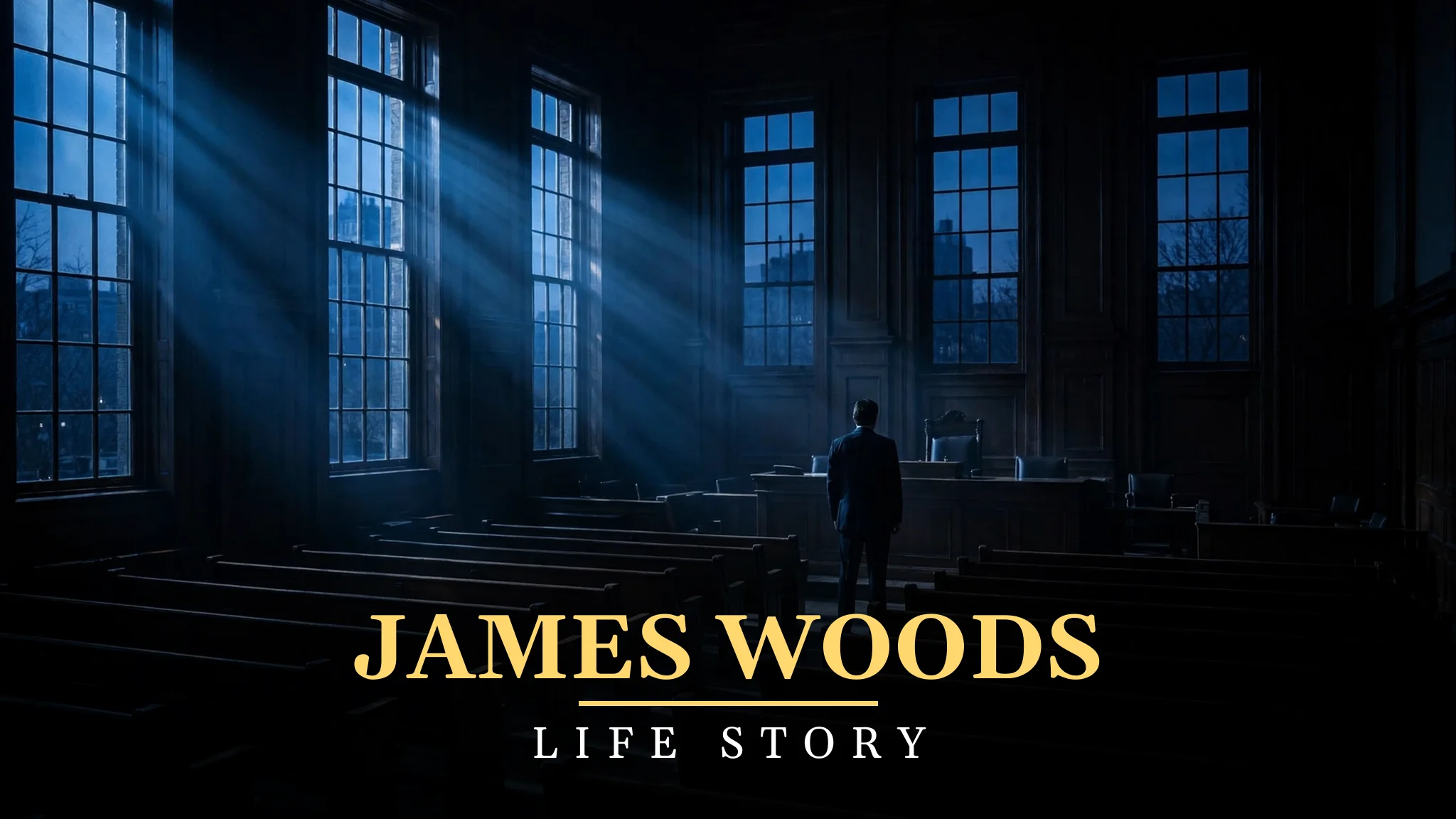
One more thought stays with me. When I picture him, I picture the empty courtroom in the image for this story: one man in a dark suit, standing alone in a cold blue light, with rows of empty benches around him. That is a good picture of his life, because he has always stood alone, arguing his case, with no one to help him. And he has argued it well, for more than fifty years, in a voice that no one else can copy.
I also think about his performance in Casino, because it shows how much he can do in a small role. He plays Lester Diamond, a hustler who marries Ginger, and he plays the part with a slick, desperate charm that makes every scene he is in feel alive. He is not the star of the film, but he steals the film, because he understands the character completely. That is a rare gift. Most actors need a big role to make an impression. Woods can make an impression in a few minutes, because he brings his whole intelligence to every line.
Another thing I notice is his work in Shark, the television series where he played a tough lawyer. The role was perfect for him, because Sebastian Stark is fast-talking, clever, and relentless, and Woods played him with the same speed he brings to everything. It gave him a chance to lead a show, week after week, and he did it well. I think television suited him, because it gave him more time to build a character, and he used that time to show Stark’s intelligence, his humour, and his flaws. It is a performance that deserves to be remembered alongside his films.
I think about his voice work too, because it shows how far his talent reaches. Children know him as Hades in Hercules, gamers know him from Kingdom Hearts, and adults know him from Salvador and Casino. That is an extraordinary range, across films, television, animation, and games. Most actors work in one medium. Woods works in all of them, and he brings the same energy to each one. His voice is fast, sharp, and full of life, and it is one of the most recognisable voices in Hollywood. I love that he could be a cartoon villain and a serious dramatic actor at the same time, and be great at both.
When I think about his intelligence, I think about it as both a gift and a burden. He is one of the smartest actors in Hollywood, and that intelligence makes his acting sharp and precise. But it also makes him restless, and it makes him say what he thinks, even when it costs him work. I respect that honesty, even when I do not agree with everything he says. He is a man who thinks for himself, and who refuses to pretend. That refusal has cost him, but it has also made him who he is, and I would rather watch an honest actor than a careful one.
I also think about The Virgin Suicides, because it shows a gentle side of him that many people forget. He plays Mr. Lisbon, a father who tries to protect his five daughters and who fails to understand them, and he plays the part with a sadness and a tenderness that is deeply moving. It is a quiet performance, very different from the villains he often plays, and it proves that he could be a father, a man who loves his family and who does not know how to save it. I think that role is one of his finest, because it shows his heart, and it shows that his intensity could be soft as well as frightening.
Another thing I notice is White House Down, where he plays a Secret Service agent who turns out to be the villain. He is sixty-six in that film, and he is still playing villains that audiences love to hate, with the same sharp mind he brought to Salvador and Casino. The twist works because Woods plays the character with a calm, intelligent menace, and the audience believes him right up to the moment the truth is revealed. That is a rare gift. Most actors lose their edge as they get older. Woods kept his, and he kept using it, in films, in television, and in animation, because he never stopped working and never stopped caring about the craft.
Frequently Asked Questions
Where was James Woods born and what did he study?
James Woods was born on 18 April 1947 in Vernal, Utah, and he grew up in Warwick, Rhode Island, after his father’s death when he was young. He studied political science at MIT, one of the best universities in America, before leaving in 1969 to become an actor in New York.
Why did James Woods leave MIT?
He left MIT before finishing his degree because he had discovered acting in student theatre and believed the stage was where he belonged. It was a bold risk, giving up a secure future in government or law for the uncertain life of a working actor.
Which film brought James Woods his first Oscar nomination?
He was nominated for Best Actor for Salvador in 1986, playing journalist Richard Boyle during the civil war in El Salvador. The role showed him as funny, cynical, frightened, and brave, and it proved he could carry a whole film on his own.
Did James Woods win an Emmy Award?
Yes, he won Emmy Awards for Promise in 1986, playing a man who cares for his mentally ill brother, and for My Name Is Bill W. in 1989, playing the co-founder of Alcoholics Anonymous. Both were serious, moving television performances.
What cartoon character did James Woods voice?
He voiced Hades, the fast-talking villain, in Disney’s Hercules in 1997, a role that children around the world came to know. His quick, funny delivery was perfect for the part, and he returned to the character in later projects.
Is James Woods a poker player?
Yes, he is a serious poker player and has played in major tournaments, including the World Series of Poker. He approaches the game with the same focus and intelligence he brings to acting, and he has spoken about it often.
What happened to James Woods’s home in 2025?
He lost his home in the Los Angeles fires in early 2025, a loss he spoke about publicly with sadness and honesty. It was a reminder that even famous actors can lose everything in a moment, and he faced it directly rather than hiding from it.


