Jane Wyman: The Life Story Behind Hollywood's Respected Star
In this post
- A Missouri Girl With a New Name
- Small Parts, Hard Work, and a Breakthrough
- Johnny Belinda and an Oscar Without Words
- Magnificent Obsession, Douglas Sirk, and Peak Drama
- Ronald Reagan, Divorce, and Life After
- Falcon Crest and a Television Comeback
- A Long Life, a Vineyard, and a Quiet Farewell
- What Respect Really Means in Hollywood
- My Take:
Jane Wyman was a respected star, and she earned that respect the hard way. She was not a glamorous siren, and she was not a sweet girl next door. She was a tough, talented actress from Missouri who worked her way up from small parts to an Academy Award, and who kept working for more than fifty years, in films and on television. She played a deaf-mute woman in Johnny Belinda, and she won an Oscar for it, without speaking a word for most of the film. That is a remarkable achievement, and it shows what kind of actress she was.
She was also the first wife of Ronald Reagan, who later became President of the United States, and she was the mother of his children. She lived through that marriage, through its end, and through a long life after it, in which she built her own career, on her own terms. She starred in Falcon Crest on television in the 1980s, playing a tough, powerful woman, and she became a star again, to a new generation. She was a woman who kept working, kept learning, and kept going, long after most stars would have stopped.
She died at ninety, after a life that spanned almost the whole twentieth century, from silent films to colour television, from Missouri to Hollywood to a vineyard in California. This is the story of a respected star who earned her place, and who kept it, through talent, hard work, and courage.
A Missouri Girl With a New Name
Jane Wyman was born Sarah Jane Mayfield on 5 January 1917 in St. Joseph, Missouri. Her parents separated when she was young, and she was raised by her mother, and later by foster parents, in a life that was not easy. She was a young girl in Missouri, far from Hollywood, and she dreamed of a life on stage. She was lively, she was pretty, and she liked to perform. She took part in school plays, she sang, and she danced, and she knew that she wanted to act.
As a teenager, she changed her name to Jane Wyman, a name that sounded brighter and more suited to Hollywood, and she began to work as a singer and dancer in clubs and on radio. She was still a young woman, and she was already working hard to make a living as a performer. She moved to California, she looked for work in films, and she began to appear in small parts. She was in her late teens, and she was about to become a film actress, not because she had been handed success, but because she had worked for it, one job at a time.
Her early life in Missouri mattered because it gave her a foundation. She had learned to work hard, to be independent, and to stand up for herself. She had been raised by different people, she had moved around, and she had learned to adapt. Those lessons would help her in Hollywood, where she would need to be tough, to be professional, and to keep going when things were hard. She was not a star who had been raised in luxury. She was a girl from Missouri who had earned her place.
She also learned that a name can be a fresh start. Sarah Jane Mayfield became Jane Wyman, and Jane Wyman became a star. That change was not only about a name. It was about a decision to become someone new, to leave the past behind, and to build a future in Hollywood. That is a brave decision, and it is one that Jane made as a young woman, and that she lived with for the rest of her life.
Small Parts, Hard Work, and a Breakthrough
When Jane Wyman signed with a studio, she was given small parts at first. She appeared in films in the 1930s, and she learned how a film set worked. She learned to hit her mark, to speak her lines clearly, to work with different directors, and to make the most of a short scene. She was pretty, she was talented, and she was professional, but Hollywood had many pretty and talented young women. She needed a role that would show what she could really do, and she had to wait for it, but she kept working, and she kept learning.
She appeared in films like Gold Diggers of 1937, and in other musicals and comedies that gave her a chance to sing and dance, but she was still waiting for a dramatic role. She worked steadily, she earned her living, and she learned her craft. She was a working actress, not a star, and she was patient, but she was also ambitious, and she wanted more. She knew she had talent, and she wanted to show it, but the studio did not always give her the chance. She kept going, because she believed that her time would come.
Her breakthrough came in the 1940s, when she began to get better roles, and when she showed that she could play serious, dramatic women. She appeared in The Yearling in 1946, a film about a boy and a deer in Florida, in which she played the boy’s mother, and she was nominated for an Academy Award for Best Actress for her performance. It was her first Oscar nomination, and it was a well-deserved honour. She had worked for ten years, she had taken small parts, and now she had been recognised as a serious actress. The nomination changed her career, and it gave her more choices, and more respect in Hollywood.
She also married Ronald Reagan in 1940, when both were young actors at Warner Bros. Reagan was a handsome, charming man, and the two of them were a famous couple in Hollywood. They had two children, Maureen and Michael, and a third child, Christine, who died as an infant, a loss that affected them deeply. The marriage lasted until 1949, when they divorced, after nine years. It was a sad end to a young marriage, and it was a loss for both of them, and for their children. Jane was in her early thirties, and she had already faced the end of a marriage, and the loss of a child, and she kept going, with courage.
Johnny Belinda and an Oscar Without Words
In 1948, Jane Wyman starred in Johnny Belinda, a film about a deaf-mute young woman named Belinda McDonald, who lives on a farm in Nova Scotia, and who is raped, becomes pregnant, and learns to communicate through sign language, with the help of a kind doctor, played by Lew Ayres. Jane played Belinda without speaking for most of the film, using her face, her eyes, and her body to tell the story. It was a difficult role, and it was a brave one, because it asked an actress to give up her voice, and to trust her physical acting completely. Jane did it beautifully, and she won the Academy Award for Best Actress for her performance.
The Oscar was a high point in her career, and it was a well-deserved honour. She had worked for more than ten years, she had been nominated before, and now she had won. She was thirty-one years old, and she was a star. The Oscar recognised her talent, and it showed that Hollywood respected her as one of the best actresses of her generation. She was proud of the award, and she should have been. It was a reward for years of hard work, and it was a sign that she had reached the top of her profession.
Johnny Belinda is an important part of her story because it shows her at her best. She was silent, she was strong, and she was deeply moving, and she made audiences believe in Belinda, and in her right to live, to love, and to be a mother. That is a difficult thing to do, and Jane did it without words. She proved that acting is not only about speaking. It is about feeling, about listening, and about letting the audience see a real person. That is a great performance, and it is one that is still remembered today as one of the best in film history.
The film also showed that Jane Wyman was more than a pretty face. She was a serious actress, who could take on a difficult role, and who could give a performance that moved people deeply. She had earned her Oscar, and she had earned her place as a respected star in Hollywood.
Magnificent Obsession, Douglas Sirk, and Peak Drama
After Johnny Belinda, Jane Wyman continued to make films, and she became one of the most popular dramatic actresses in Hollywood. She starred in Magnificent Obsession in 1954, a film directed by Douglas Sirk, in which she played Helen Phillips, a woman who is blinded in an accident, and who is helped by a reckless young man, played by Rock Hudson, who tries to redeem himself. The film was a hit, and it showed that Jane could play a romantic, dramatic heroine, with warmth and with strength. She was versatile, she was skilled, and she was beautiful, and she made each film better by being in it.
She also starred in All That Heaven Allows in 1955, also directed by Douglas Sirk, in which she played Cary Scott, a wealthy widow who falls in love with a younger gardener, played by Rock Hudson. The film is a romantic drama about class, about age, and about love, and Jane played Cary with a quiet, dignified strength that made audiences believe in her. The film is now regarded as a classic, and it is still watched today by people who like romantic, thoughtful films. Jane’s performance in it is one of her best, and it shows her at her most elegant and most moving.
She was nominated for Academy Awards for The Yearling, Johnny Belinda, The Blue Veil in 1951, and Magnificent Obsession, a total of four nominations, with one win. Those nominations show that Hollywood respected her as one of the best actresses of her time, and that she was a serious, talented star, not only a romantic one. She was at the peak of her career, and she was one of the most popular actresses in Hollywood. She had come a long way from Missouri, and she had earned her place.
Her work with Douglas Sirk was particularly important, because Sirk was a director who understood women, and who made films about women’s lives, women’s choices, and women’s feelings. Jane thrived in that world, because she was a thoughtful actress, who understood her characters, and who gave them depth and truth. She was not only a star. She was an artist, and she worked with an artist, to make films that still matter today.
Ronald Reagan, Divorce, and Life After
Jane Wyman’s marriage to Ronald Reagan is a famous part of her story, because Reagan later became President of the United States, from 1981 to 1989. They married in 1940, when both were young actors, and they divorced in 1949, long before Reagan entered politics. Jane rarely spoke about Reagan after the divorce, and she did not use their marriage to gain fame or attention. She kept her private life private, and she focused on her own career, and on raising her children. That is a dignified choice, and it deserves respect.
She was the mother of Maureen Reagan, who became a political activist and writer, and Michael Reagan, who became a radio host and writer, and she loved her children deeply. She tried to give them a normal life, away from the glare of Hollywood, and she did her best to be a good mother, even while she was building her career. The loss of their infant daughter Christine, who died shortly after birth, was a deep pain for both Jane and Ronald, and it affected their marriage. It is a sad part of their story, and it is a reminder that even famous couples face private sorrows.
After the divorce, Jane kept working, and she kept building her career. She did not let the end of her marriage define her, and she did not let Reagan’s later fame overshadow her own work. She was Jane Wyman, a star in her own right, with an Oscar, with four nominations, and with a long career in films. She was proud of that, and she should have been. She had earned her place, and she had done it on her own, through talent and hard work.
She married again, to the film composer Fred Karger, in 1952, and the marriage ended in divorce in 1955, and they remarried in 1961, and divorced again in 1965. She also married a fourth time, but that marriage was brief. She was a woman who loved, and who tried to build a family, even when it was hard. She kept going, and she kept working, and she kept loving her children. That is a quiet kind of strength, and it is a strength that deserves respect.
Falcon Crest and a Television Comeback
In 1981, Jane Wyman began a new chapter in her career, when she starred in Falcon Crest, a television series about a wealthy wine-making family in California’s Napa Valley. She played Angela Channing, the tough, powerful matriarch of the family, a woman who would do anything to protect her vineyard and her family. The show ran for nine seasons, until 1990, and it was one of the most popular programmes on American television. Jane was in her sixties when she started the show, and she became a star again, to a new generation who had never seen her films.
Angela Channing was a perfect role for Jane, because she was tough, smart, and powerful, and she could play a woman who was both loving and ruthless. She was not a sweet, kind mother. She was a matriarch, a businesswoman, and a fighter, and audiences loved her for it. Jane played her with energy and with authority, and she made Angela one of the most memorable characters on television. She was nominated for Golden Globe Awards for her performance, and she won a Golden Globe in 1984. It was a well-deserved honour, and it showed that she was still a great actress, even in her sixties and seventies.
The show gave her a new kind of fame. She was no longer only a film star from the 1940s and 1950s. She was a television star, known to millions of people who watched her every week in their living rooms. She was a part of American family life, and she was welcomed into homes across the country. That is a remarkable achievement, and it is one that she earned through hard work and talent. She had come from films to television, and she had succeeded in both, which is a rare thing.
She worked on Falcon Crest for nine years, and she took her role seriously. She was a professional, and she did her job well, even when she was in her seventies. She was a star, and she knew it, but she was also a worker, and she did her job with skill and with care. The show was the peak of her television career, and it made her one of the most famous women in America, again, after many years.
A Long Life, a Vineyard, and a Quiet Farewell
In her later years, Jane Wyman lived a quieter life. She lived in California, she spent time with her family, and she enjoyed her home. She was a grandmother, and she loved her grandchildren. She looked back on her career with pride, and she knew that her work had mattered. She had been a film star, an Oscar winner, and a television star, and she had done all of those things with talent and with hard work. That is a remarkable career, and it is one that few actresses have matched.
She died on 10 September 2007 in Palm Springs, California, at the age of ninety. She had lived a long life, and she had seen Hollywood change many times. She had been a star for more than fifty years, and she had done it with grace and with professionalism. Her death was mourned by her family, by her friends, and by fans who remembered her films and her television show. She was buried in California, and her life was remembered as a story of talent, hard work, and courage.
Her legacy is tied to Johnny Belinda, to Magnificent Obsession, to All That Heaven Allows, and to Falcon Crest, four very different roles, all played by the same actress, all played with warmth and with truth. She showed that a woman could be a film star, a television star, a wife, and a mother, and that she could do all of those things with grace. Her films and her show are still shown today, and they still give pleasure to people who like honest, powerful acting. She is remembered as one of the most respected stars in Hollywood history, and as a woman who worked hard for every step she took.
What Respect Really Means in Hollywood
Jane Wyman was respected in Hollywood, and that respect was earned, not given. She earned it through hard work, through talent, and through professionalism. She arrived on time, she knew her lines, she worked hard, and she treated everyone on set with respect. Directors liked to work with her, because she was reliable, and because she gave a good performance without making a fuss. She was not a difficult star, and she did not cause problems. She did her job, and she did it well, and that made her valuable to the studios, and to her co-stars.
She also earned respect by taking on difficult roles, like Belinda in Johnny Belinda, a deaf-mute woman who does not speak for most of the film. That is a brave choice, and it is a choice that many actresses would not make, because it is risky. Jane made it, and she won an Oscar for it. That is a sign of a great actress, and it is a sign of a woman who was not afraid to take a risk, to be different, and to trust her talent.
Her life also shows that respect can last. She was respected in the 1940s, she was respected in the 1950s, and she was respected again in the 1980s, when she starred in Falcon Crest. That is a long time to be respected, and it is a rare thing in Hollywood, where stars often fade quickly. Jane did not fade. She kept working, kept learning, and kept earning respect, year after year, decade after decade. That is a legacy worth remembering, and it is a legacy that still matters.
My Take:
When I think about Jane Wyman, I think first about respect, and about how rare true respect is in Hollywood. Respect is not only about fame, or about beauty, or about being popular. It is about being trusted, about being professional, and about doing good work, year after year, without making a fuss. Jane earned that respect, through hard work, through talent, and through a quiet, dignified way of living. She was not a loud star, she was not a showy star, and she did not need to be. She worked, she acted, she raised her children, and she lived her life with grace. That is a beautiful thing, and it is a thing I admire deeply.
I admire her performance in Johnny Belinda most of all. She played a deaf-mute woman, without speaking for most of the film, using only her face, her eyes, and her body to tell the story. That is a remarkable achievement, and it is one that few actresses could match. She had to trust her physical acting completely, and she had to make audiences believe in Belinda, without words. She did it, and she won an Oscar for it. That is a sign of a great actress, and it is a sign of a woman who was brave enough to take a risk, and talented enough to make it work. I think about that performance, and I am amazed by it, because it shows what acting really is, not only speaking, but feeling, listening, and being true.
What makes me sad about her story is the loss of her infant daughter Christine, who died shortly after birth. There is no greater pain for a mother than losing a child, even an infant, and Jane faced that pain with courage, but it must have been devastating. I feel sad for Jane, and for Ronald Reagan, who also lost a daughter, and I feel sad for the family that had to live with that loss. I admire the way Jane kept going, kept working, and kept loving her other children, even after such a loss. That is a quiet kind of strength, and it is a strength that deserves respect.
I also feel sad about the end of her marriage to Ronald Reagan. They were young, they were in love, and they had children, but the marriage ended in divorce after nine years. I do not want to judge either of them, because I do not know what happened inside their marriage. I do know that divorce is painful, especially when there are children, and that it leaves a mark on a family. Jane faced that pain with dignity, and she rarely spoke about Reagan after the divorce. She did not use their marriage to gain fame, and she did not blame him in public. That is a dignified choice, and it tells me a lot about her character. She was a private person, and she kept her private life private, even when the man she had married became President.
I think about her work in All That Heaven Allows, and I admire it too. She played Cary Scott, a wealthy widow who falls in love with a younger gardener, and she played her with a quiet, dignified strength that made audiences believe in her. The film is about class, about age, and about love, and Jane played Cary as a woman who is brave enough to love, even when society tells her not to. That is a powerful message, and it is one that still matters today, when women are still judged for who they love, and for how old they are. Jane’s performance in that film is one of her best, and it shows her at her most elegant and most moving.
I think about her work in Falcon Crest, and I smile when I remember it. She was in her sixties when she started the show, and she played Angela Channing, a tough, powerful matriarch who would do anything to protect her vineyard. She was not a sweet, kind mother. She was a fighter, a businesswoman, and a matriarch, and audiences loved her for it. I think about the older women who watched that show and saw Angela, and who felt that they too could be powerful, and could be respected, even in their sixties and seventies. That is a powerful influence, and it is one that lasts longer than any single episode.
Her long life is the part of her story that makes me feel happy. She lived to be ninety, and she had time to look back on her career, to enjoy her family, to work on Falcon Crest, and to live a full life. She did not die young, like many stars do. She lived a long life, and she had time to make peace with the ups and downs of that life. That is a gift, and I am glad she had it. I think she would have been proud of what she had done, and she had every right to be.
If I could ask her one question, I would ask her how she kept her dignity when Hollywood, and life, were often undignified. She faced a difficult childhood, she faced divorce, she faced the loss of a child, and she faced the pressure of being a star, but she kept her dignity, kept working, and kept loving her family. I think she would say that dignity is a choice, and that professionalism is a choice, and that we can choose to be dignified even when life is hard. That is good advice, and it is advice that comes from a life lived with courage.
In the end, I feel both admiration and sadness when I think about Jane Wyman. Admiration for her respect, her talent, her Oscar, and her long career in films and on television. Sadness for the loss of her daughter, for the end of her marriage, and for a life that, like all lives, had its share of pain. Both feelings are true, and both belong in her story. She was not only a respected star on screen. She was a woman who worked hard, loved her family, and gave powerful, honest performances. That is the Jane Wyman I want to remember.
I also learn from her that respect is earned through work, not through fame. She earned respect by arriving on time, by knowing her lines, by taking difficult roles, and by treating people well. She did not demand respect. She earned it, day after day, year after year. That is a lesson for all of us, because respect is a precious thing, and it is earned through actions, not through words. Jane shows us how to earn it, by being professional, by being kind, and by doing good work.
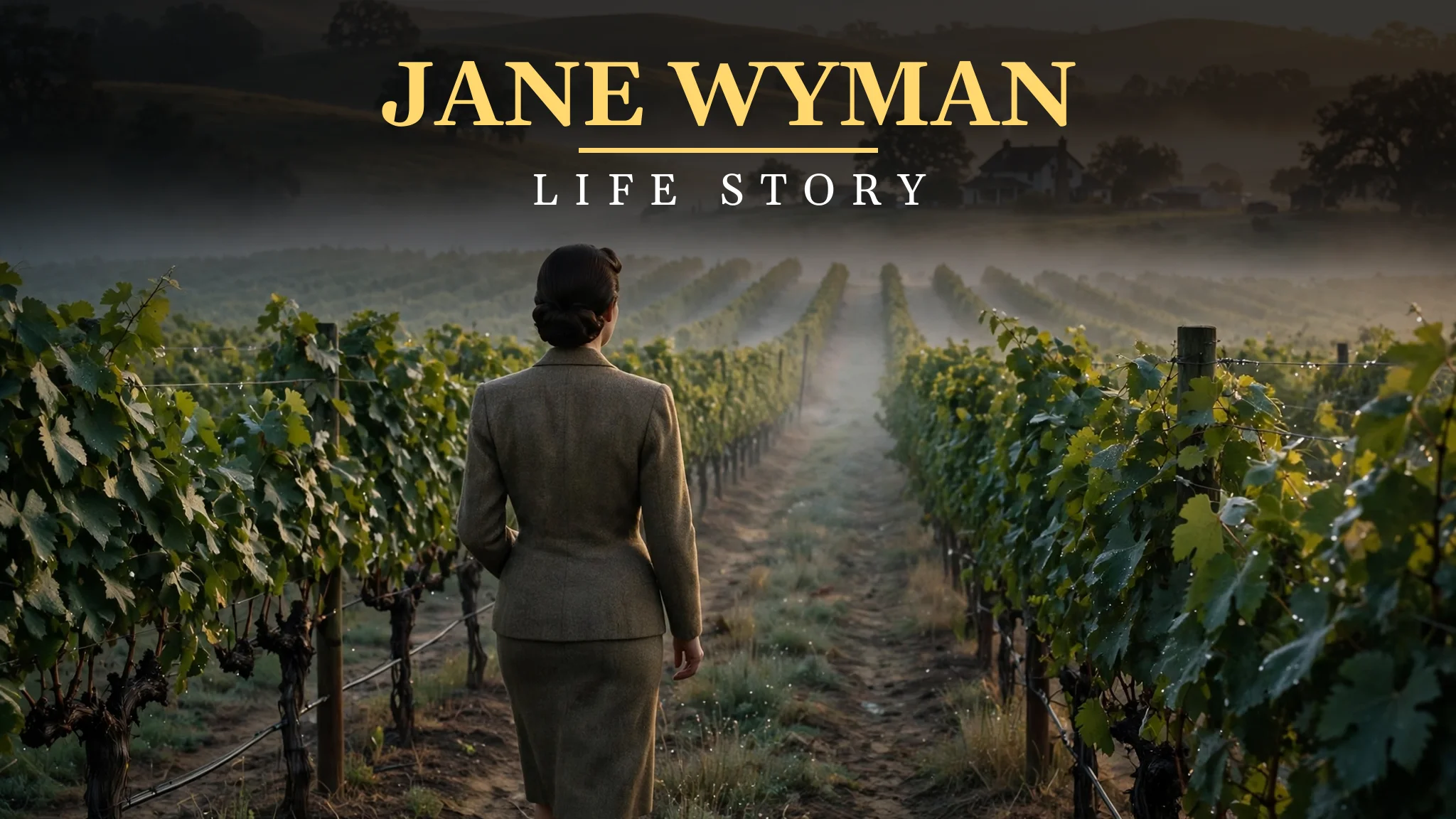
I think her legacy is a good one, and I think it is worth remembering. She showed the world that a girl from Missouri could become a star, that a star could win an Oscar without speaking, and that a woman in her sixties could become a television star again. Her films and her show are still shown today, and they still give pleasure to people who like honest, powerful acting. She gave joy to millions of people, and she did it with grace. That is a life worth celebrating, and it is a life worth telling. When I think of Jane Wyman, I think of a woman in a tweed suit walking through a vineyard at sunrise, strong, dignified, and free, and I smile, because that image is beautiful, and it will last.
I also think about the young people today who come from small towns, and who dream of a bigger life. Jane Wyman proves that it is possible, and that hard work can change a life. She proves that you do not need to be born in Hollywood to become a star. You need to work, to learn, to be professional, and to keep going. That is a message of hope, and it is a message that still matters. I hope that young people who read about Jane Wyman will feel that hope, and will believe in themselves, as she believed in herself.
I keep thinking about the way she played Belinda without speaking, because that performance captures everything I admire about Jane. She used only her face, her eyes, and her body to tell the story, and she made audiences believe in Belinda, and in her right to live, to love, and to be a mother. That is a remarkable achievement, and it is one that few actresses could match. She had to trust her physical acting completely, and she had to make audiences feel what Belinda felt, without words. She did it, and she won an Oscar for it. That is a sign of a great actress, and it is a sign of a woman who was brave enough to take a risk, and talented enough to make it work.
I also think about her work in Falcon Crest, and about how it gave her a second career in her sixties. She played Angela Channing, a tough, powerful matriarch, and she played her with energy and with authority. She was not a sweet, kind mother. She was a fighter, a businesswoman, and a matriarch, and audiences loved her for it. I think about the older women who watched that show and saw Angela, and who felt that they too could be powerful, and could be respected, even in their sixties and seventies. That is a powerful influence, and it is one that lasts longer than any single episode, because it lives in the lives of the women who were inspired by it.
There is another part of her story that stays with me, and it is her dignity after her divorce from Ronald Reagan. She rarely spoke about Reagan after the divorce, and she did not use their marriage to gain fame or attention. She kept her private life private, and she focused on her own career, and on raising her children. That is a dignified choice, and it deserves respect. She was Jane Wyman, a star in her own right, with an Oscar, with four nominations, and with a long career in films. She was proud of that, and she should have been. She had earned her place, and she had done it on her own, through talent and hard work.
I wonder what she would say to a young actress today who comes from a small town, and who dreams of a bigger life. I think she would smile, and she would say, work hard, be professional, be on time, and keep going. I think she would tell that young actress to learn her craft, to take difficult roles, and to treat people with respect. That is good advice, and it is advice that comes from a life lived with respect, talent, and courage.
I also think about the way she played Cary Scott in All That Heaven Allows, because that role shows her at her most elegant and most moving. She played a wealthy widow who falls in love with a younger gardener, and she played her with a quiet, dignified strength that made audiences believe in her. The film is about class, about age, and about love, and Jane played Cary as a woman who is brave enough to love, even when society tells her not to. That is a powerful message, and it is one that still matters today, when women are still judged for who they love, and for how old they are. Jane’s performance in that film is one of her best, and it shows her range as an actress.
Finally, I think about her as a woman who earned respect through work, not through fame, and I find that inspiring. She arrived on time, she knew her lines, she took difficult roles, and she treated people well. She did not demand respect. She earned it, day after day, year after year, in films and on television. That is a lesson for all of us, because respect is a precious thing, and it is earned through actions, not through words. Jane shows us how to earn it, by being professional, by being kind, and by doing good work, and that is a legacy worth remembering.
Frequently Asked Questions
What film won Jane Wyman an Academy Award?
She won the Academy Award for Best Actress for Johnny Belinda in 1948, in which she played Belinda McDonald, a deaf-mute young woman, without speaking for most of the film.
Was Jane Wyman married to Ronald Reagan?
Yes, she was married to Ronald Reagan from 1940 to 1949, and they had two children, Maureen and Michael, and a daughter Christine who died as an infant, long before Reagan became President.
What was Jane Wyman’s role in Falcon Crest?
She played Angela Channing, the tough, powerful matriarch of a wine-making family in California’s Napa Valley, in the television series Falcon Crest from 1981 to 1990, winning a Golden Globe in 1984.
Where was Jane Wyman born?
She was born Sarah Jane Mayfield on 5 January 1917 in St. Joseph, Missouri, where she grew up before changing her name and moving to California to become an actress.
When did Jane Wyman die?
She died on 10 September 2007 in Palm Springs, California, at the age of ninety, after a career in film and television that lasted more than fifty years.
What other films is Jane Wyman known for?
She is known for The Yearling, The Blue Veil, Magnificent Obsession, and All That Heaven Allows, and she was nominated for four Academy Awards in total, winning once for Johnny Belinda.


