Janet Leigh: The Life Story Behind the Psycho Star
In this post
Janet Leigh is remembered for one of the most famous scenes in the history of film. In Psycho, she steps into a shower, and a few minutes later the audience is shocked in a way that no film had shocked them before. The scene made her famous for ever, and it also gave her a problem. People remembered the shower, and they forgot the rest of her work. But Janet Leigh was much more than one scene. She was a talented actress who worked in Hollywood for more than fifty years, who played in westerns, dramas, comedies, and thrillers, and who built a career that was steady, professional, and full of good work.
She was born in a small town in California, and she was discovered by chance, when a famous actress saw her photograph and thought she had the look of a star. She was still a teenager, and she had no training, but she learned quickly, and she worked hard. She made films with some of the best directors of her time, including Alfred Hitchcock and Orson Welles, and she held her own beside them. She was married four times, and her third marriage, to the actor Tony Curtis, gave her two daughters, Kelly and Jamie Lee, both of whom became actresses themselves.
Her life was a story of hard work, of fame, and of a woman who kept going long after the bright lights had faded. She wrote books, she appeared on television, and she worked with her daughter Jamie Lee in horror films that brought her to a new generation of fans. She died in two thousand four, at the age of seventy seven, and she was remembered as a kind and professional woman, a good mother, and an actress whose work still matters. This is the story of Janet Leigh, the woman behind the shower scene, and the life she lived before and after it.
A Small Town Girl Discovered by Chance
Jeanette Helen Morrison was born on 6 July 1927 in Merced, California, a small farming town in the middle of the state. Her father, Fred Morrison, worked in a car dealership, and her mother, Helen, looked after the home. The family was not rich, but they were close, and Janet grew up in a quiet and pleasant place. She was a bright and pretty girl, and she did well at school. She was also a good singer, and she sang in the church choir and in school shows. She had no thought of becoming a film star, and her family had no links to Hollywood.
When she was eighteen years old, she went on a skiing holiday with her parents to a resort in the mountains. There she met Norma Shearer, a famous actress from the silent film days, who was also on holiday. Shearer saw Janet, and she was struck by her beauty and her natural grace. She took a photograph of the young girl, and she showed it to people at Metro-Goldwyn-Mayer, the big film studio in Hollywood. The studio liked what they saw, and they invited Janet for a screen test. She was a schoolgirl one day, and a film actress the next, and her life changed in a single week.
She was given a contract by MGM, and she was given the stage name Janet Leigh. She had to learn how to act for the camera, how to speak clearly, and how to work on a film set. She took lessons, she watched other actors, and she worked hard. She was young, she was pretty, and she was willing to learn, and the studio gave her small parts to start with. She was not a star yet, but she was on her way, and she knew that she had been given a chance that many girls would dream of.
Her first film was The Romance of Rosy Ridge, which came out in nineteen forty seven. She played a young woman in a farming family after the Civil War, and she was praised for her fresh and natural performance. The film was a modest success, and it gave her a start in Hollywood. She was still learning, but she was learning fast, and she was building a name for herself. She was a teenager in a grown up world, and she had to grow up quickly, but she did it with grace, and she did it well.
Learning Her Craft at MGM
In the late nineteen forties, Janet Leigh worked steadily at MGM, appearing in a string of films that taught her the craft of acting. She played in If Winter Comes in nineteen forty seven, Hills of Home in nineteen forty eight, and Act of Violence in nineteen forty eight, a dark drama in which she played the wife of a man haunted by his past. Each film was a lesson, and she learned from each one. She learned how to work with different directors, how to play different kinds of women, and how to make a character feel real.
In nineteen forty nine, she played Meg March in Little Women, the classic story of four sisters growing up in New England. The film was popular, and it showed her as a warm and gentle young woman. She was part of a strong cast, and she held her own beside the other actresses. The film was a success, and it gave her more work. She was becoming known as a reliable and talented young actress, and the studio began to give her bigger parts.
She married young, and her first two marriages were short. She married John Kenneth Carlisle when she was still a teenager, and the marriage was annulled. She then married Stanley Reilly, and that marriage also ended. She was young, she was working hard, and she was learning about life as well as about acting. She was not yet twenty five, and she had already been married twice. It was a hard start to her adult life, but she kept working, and she kept learning, and she did not let her personal troubles stop her career.
In the early nineteen fifties she appeared in a string of popular films, including Scaramouche in nineteen fifty two, a swashbuckling adventure in which she played opposite Stewart Granger, and The Naked Spur in nineteen fifty three, a western in which she played a woman caught between a bounty hunter and a killer. The Naked Spur was directed by Anthony Mann, and it was praised for its strong acting and its tense story. Janet played her part with feeling, and she showed that she could work in a western as well as in a drama or a romance. She was becoming a versatile actress, and directors liked working with her because she was professional and prepared.
Marriage to Tony Curtis and a Family in Hollywood
In nineteen fifty one, Janet Leigh married the actor Tony Curtis, one of the most handsome and popular stars of the time. They were a glamorous couple, and the press loved them. They appeared in films together, they went to parties together, and they were seen as one of the golden couples of Hollywood. They had two daughters, Kelly, born in nineteen fifty six, and Jamie Lee, born in nineteen fifty eight. Both girls would grow up to become actresses themselves, and Jamie Lee would become one of the most famous horror film stars in the world.
The marriage was not as happy as it looked from the outside. Tony Curtis was a busy star, and he was often away working. Janet was also working, and she was raising two small children. The two of them grew apart, and the marriage ended in divorce in nineteen sixty two, after eleven years. It was a sad ending, but Janet did not let it stop her. She kept working, she raised her daughters, and she built a life for herself and her children. She was a single mother in Hollywood, and that was not easy, but she did it with strength and with love.
In nineteen sixty two, the same year her marriage to Curtis ended, she married Robert Brandt, a businessman. This marriage was very different, and it lasted for the rest of her life, until her death in two thousand four. Brandt was a steady and kind man, and he gave Janet the stable home she had been looking for. They were married for forty two years, and they were happy together. She had found the right person at last, and she treasured the marriage. It gave her a safe base, and it let her work without the worry that had marked her earlier years.
Her daughters grew up in a home that was full of love, and they both went into acting. Kelly Curtis became an actress, and Jamie Lee Curtis became a star, first in horror films and then in comedies and dramas. Janet was proud of both of them, and she supported their work. She was a mother who understood the business, because she had lived it herself, and she could give her daughters advice that came from real experience. That was a gift, and her daughters valued it.
Touch of Evil and Working With Orson Welles
In nineteen fifty eight, Janet Leigh starred in Touch of Evil, a film directed by Orson Welles, one of the most famous directors in the world. She played Susan Vargas, the wife of a Mexican police officer, who is caught up in a dark and dangerous story on the border between Mexico and America. The film opened with a long and famous tracking shot, and it was a tense and stylish thriller. Janet played her part with courage and feeling, and she held her own beside Welles and Charlton Heston. The film was not a big hit when it first came out, but over the years it became a classic, and it is now seen as one of the great films of its time.
Working with Welles was a challenge, and Janet learned a great deal from it. Welles was a demanding director, and he wanted his actors to be prepared and to trust him. Janet did that, and she gave a performance that was strong and honest. She showed that she could work in a dark and serious film, and that she was not only a pretty leading lady. The film also showed her range, because she played a woman who was afraid, brave, and loyal, all at the same time. It was one of her best performances, and it is still praised today.
The late nineteen fifties were a busy time for her. She was working, she was raising her daughters, and she was dealing with the end of her marriage to Tony Curtis. She was a woman with a great deal on her plate, but she kept going, as she always did. She was professional, she was prepared, and she did her work well. She was also a woman who knew what she wanted, and she was not afraid to say no to a part that did not suit her. She was becoming a mature actress, and she was choosing her work with care.
She appeared in other films during these years, including The Vikings in nineteen fifty eight, a big adventure film, and she worked steadily. She was one of the most reliable actresses in Hollywood, and directors liked her because she was easy to work with and because she gave a good performance every time. She was not a star who caused trouble, and she was not a star who arrived late. She was a star who did her job, and she did it well. That is a simple thing, but it is a rare thing in Hollywood, and it is one of the reasons her career lasted so long.
Psycho: The Shower Scene That Changed Cinema
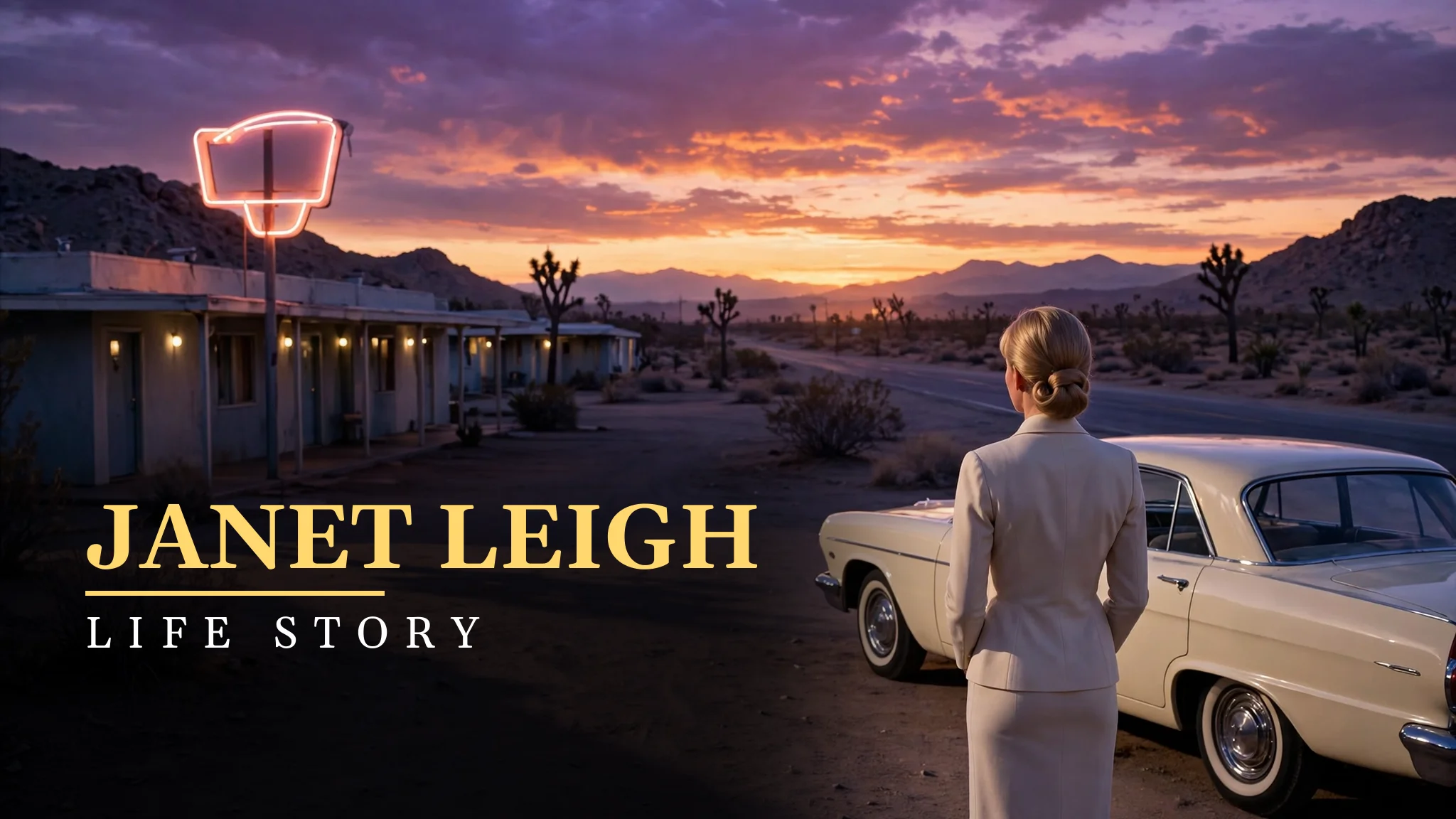
In nineteen sixty, Janet Leigh starred in Psycho, a film directed by Alfred Hitchcock. She played Marion Crane, a young woman who steals money from her boss and runs away, stopping at a lonely motel run by a quiet young man named Norman Bates. The film was a thriller, and it was different from anything Hitchcock had made before. It was made in black and white, it had a small budget, and it was shocking in a way that audiences had never seen. Janet was the star of the first part of the film, and then, in one of the most famous scenes in film history, her character was killed in the shower.
The shower scene lasted only a few minutes, but it took a week to film, and it was made with great care. Hitchcock used many short shots, quick cuts, and the sound of a knife, and the audience never saw the knife touch her body, but they felt the horror. The scene changed the way films were made, and it changed the way audiences watched films. Janet’s performance in the scene was brave and honest, and she later said that she was afraid of showers for the rest of her life. She was joking, but only partly, because the scene had a real effect on her, and on millions of people who saw it.
Her work in Psycho won her the Golden Globe Award for Best Supporting Actress, and she was nominated for the Academy Award for Best Supporting Actress. It was the highest honour of her career, and it showed that the film industry respected her work. She was proud of the nomination, and she was proud of the film. She knew that she had been part of something special, and she knew that the film would be remembered for a long time. She was right. Psycho is still watched today, and it is still studied by film students and by directors who want to learn how to make a thriller.
The film also gave her a problem. People remembered her for the shower scene, and they forgot the rest of her work. She was asked about the scene for the rest of her life, and she answered with grace and humour. She wrote a book about the film, Psycho: Behind the Scenes of the Classic Thriller, which was published in nineteen ninety five, and in it she told the story of how the film was made, and how the shower scene was filmed. The book was well received, and it showed that she was a thoughtful and intelligent woman who understood her own work. She was not bitter about being remembered for one scene. She was proud of it, and she was proud of the film.
Later Films, Books, and Working With Her Daughter
After Psycho, Janet Leigh continued to work in films, but the big leading roles became fewer. She appeared in The Manchurian Candidate in nineteen sixty two, a tense political thriller, and in Bye Bye Birdie in nineteen sixty three, a light musical comedy. She worked steadily through the nineteen sixties and seventies, in films and on television, and she was always professional and prepared. She was a mature actress now, and she played mothers, wives, and older women with the same care she had given to her younger parts.
She also began to write books. She wrote about her life in Hollywood, about her work with Hitchcock, and about her family. Her books were honest and well written, and they gave readers a clear picture of what it was like to be a film star in the golden age of Hollywood. She wrote with warmth and humour, and she did not pretend that her life was perfect. She wrote about the hard parts, the failed marriages, the pressure, and the loss of privacy, and she also wrote about the joy of acting and the love of her family. Her books are a valuable record of a time that has now passed.
In the late nineteen seventies, she appeared in the horror film Halloween, which starred her daughter Jamie Lee Curtis in her first big role. Janet played a small part in the film, and it was a joy for her to work with her daughter. Two years later, in nineteen eighty, she appeared with Jamie Lee again in The Fog, another horror film directed by John Carpenter. The two films brought her to a new generation of fans, young people who had not seen her early work, and who loved her in the horror films. She was in her fifties, and she was still working, still learning, and still enjoying her job.
She continued to appear on television and in films into the nineteen nineties, and she was honoured by the film industry for her long career. She was a woman who had worked for more than fifty years, and she had done it with grace and with professionalism. She was also a grandmother, and she enjoyed her family life in California. She lived quietly in her later years, spending time with her husband, her daughters, and her grandchildren, and staying in touch with the world of film that she loved.
The Final Years and a Quiet Goodbye
Janet Leigh died on 3 October two thousand four at her home in Beverly Hills, California, at the age of seventy seven. She had been ill with vasculitis, a condition that affects the blood vessels, and she had been in poor health for some time. Her death was reported around the world, and tributes came from actors, directors, and fans. Her daughter Jamie Lee spoke with great love about her mother, and she said that her mother had been a kind and strong woman who had taught her a great deal. The film world remembered her as a talented actress, a professional, and a woman who had given her life to her work.
She was buried in a private family service, and her legacy lives on in her films. Psycho is still one of the most famous films ever made, and Touch of Evil is still studied by film students. Her other films, from Little Women to The Naked Spur, are still watched by people who love old Hollywood. She was a star who worked hard, who loved her family, and who kept going for more than fifty years. That is a life to admire, and it is a life that still has something to teach anyone who wants to work in films.
Her daughters, Kelly and Jamie Lee, have both spoken about their mother with love and respect. Jamie Lee in particular has said that her mother taught her how to be a professional, how to treat people well, and how to work hard. That is a fine legacy for a mother to leave, and it is one that Janet Leigh would have been proud of. She was not only a film star. She was a mother, a wife, and a writer, and she did all of those things well. She was Janet Leigh, and the world was a better place because she was in it.
My Take:
When I think about Janet Leigh, the first thing I think about is how unfair it is to remember a person for only one scene. The shower scene in Psycho is famous, and it deserves to be famous, because it changed cinema, but Janet Leigh was much more than that scene. She was an actress who worked for more than fifty years, who played in westerns, dramas, comedies, and thrillers, and who gave good performances in all of them. I think we should remember the whole woman, not only the few minutes in the shower. She was a professional, a mother, and a writer, and she deserves to be remembered for all of it.
I admire her for the way she was discovered, because it shows how much of life is luck. She was on a skiing holiday, she met Norma Shearer, and her life changed in a week. That is a strange and wonderful thing, and it is a reminder that we should be ready when luck comes. Janet was ready. She was pretty, she was bright, and she was willing to work, and when the chance came, she took it. She did not waste it. She learned, she practised, and she built a career that lasted for decades. That is the right way to use luck, and it is a lesson for all of us. Be ready, work hard, and when the door opens, walk through it.
Her work in Psycho impresses me because it was brave. She was the star of the film, and then she was killed in the first part of the story. That was a bold choice for an actress, and it was a bold choice for Hitchcock. She trusted him, and she gave a performance that was honest and real. She did not ask for a bigger part, and she did not complain. She did the work, and she did it well. I think that takes a kind of courage that is easy to miss. It is the courage to trust a director, to take a risk, and to let the film be more important than your own fame. She did that, and the film is better because of it.
I also think about the shower scene, and how it affected her. She said that she was afraid of showers for the rest of her life, and I believe her. A scene that is shocking for the audience can also be hard for the actress who has to play it. She had to lie in a shower, cold water running, a knife flashing, and a camera close to her face, for a whole week of filming. That is hard work, and it is not glamorous. She did it, and she did it well, and she lived with the memory of it for the rest of her life. I respect her for that, and I think we should remember that the people who make shocking scenes are real people, and they feel the shock too.
Her marriage to Tony Curtis makes me sad, because they seemed like a golden couple, and the marriage ended after eleven years. I do not think either of them was a bad person. I think they were two young stars who grew apart, who were busy, and who wanted different things. She raised their daughters, she kept working, and she found happiness again with Robert Brandt, a marriage that lasted forty two years. That tells me that she learned from her first marriage, and that she found the right person in the end. I am glad she did, because everyone deserves a marriage that lasts, and a home that feels safe. She found that with Brandt, and she treasured it.
I love the fact that she wrote a book about Psycho, because it shows that she was a thoughtful woman who wanted to tell her own story. She did not let other people tell it for her. She wrote about how the film was made, how the shower scene was filmed, and what it was like to work with Hitchcock. That book is a gift to film lovers, and it is a gift to anyone who wants to understand how a great film is made. She wrote with clarity and honesty, and she did not pretend that the work was easy. She told the truth, and that is a brave thing to do.
Her work with her daughter Jamie Lee also touches me. She appeared in Halloween and The Fog with her daughter, and it must have been a joy for her to see Jamie Lee become a star. She had been a star herself, and now her daughter was a star too, and they could work together. That is a beautiful thing, and it is a rare thing. A mother and daughter, both actresses, both working in the same film, both loved by the audience. I think that must have made Janet very proud, and I think it is one of the happiest parts of her story. She was not only a star. She was a mother who watched her daughter shine, and she was happy for her.
I also respect her professionalism. She was known in Hollywood as a woman who arrived on time, who knew her lines, and who treated people well. That is not a small thing. In a business where many stars are difficult, she was easy to work with, and directors wanted to work with her again. She was a star who understood that a film is made by many people, not only by the star, and she treated the crew with respect. That is a good example for anyone in any job. Be on time, know your work, and treat people well. Janet Leigh did that for fifty years, and it is one of the reasons her career lasted so long.
If I compare her with other stars of her time, what stands out is her steadiness. She was not the biggest star in Hollywood, and she was not the most famous, but she was steady. She worked, she learned, she raised her children, and she kept going. She did not burn out young, and she did not fade away in sadness. She worked, she wrote, and she lived a full life. That steadiness is a quality that we do not praise enough. We praise the bright and the loud, but we forget the steady and the reliable. Janet Leigh was steady, and she was reliable, and that is a fine thing to be.
For a young reader, I think the lesson is simple. Do not be afraid to take a risk, and do not be afraid to be remembered for one thing, as long as you know that you are more than that one thing. Janet Leigh took a risk in Psycho, and she was remembered for it, but she knew that she was more than the shower scene. She was an actress, a mother, and a writer, and she lived a full life. That is the lesson to copy. Take the risk, do the work, and know who you are, even if the world only remembers one part of you.
I also think her story teaches us to be kind to people who are known for one famous moment. It is easy to ask Janet Leigh about the shower scene again and again, and to forget to ask her about her other films, her books, and her family. She answered those questions with grace, but she deserved to be asked about the whole of her life. We should remember that famous people are people too, and they have a whole life, not only a famous moment. Janet Leigh had a whole life, and it was a good life, and we should remember it in full.
In the end, I think Janet Leigh matters because she was part of a film that changed cinema, and because she was a woman who worked hard for more than fifty years. Her films are still watched, her book is still read, and her daughters still speak of her with love. She was a star, a mother, and a writer, and she did all of those things well. She died at seventy seven, at home, with her family near her, after a long and full life. I am glad she lived that long, and I am glad she found happiness with Robert Brandt. She deserved that happiness, after a life of hard work and hard losses, and she earned it with a lifetime of professionalism and kindness.
One more thought stays with me. When I watch Psycho today, I see a woman who is afraid, who is running away, and who makes a mistake. She is not a hero, and she is not a villain. She is a real person, and Janet Leigh played her as a real person. That is why the film works. It is not only the shock of the shower scene. It is the humanity of Marion Crane, a woman who wanted a better life and made a wrong choice. Janet understood that woman, and she played her with honesty. That honesty is her gift to us, and it is a gift that will last as long as people watch films.
I also think about Touch of Evil, and how it shows a different side of her. In that film she plays a woman who is in danger, who is afraid, and who keeps her dignity. It is a dark film, and it is a difficult film, and she gave a strong performance in it. Working with Orson Welles was not easy, and she met the challenge with professionalism. I admire that, because it shows that she was willing to do hard work, even when the film was not a big hit. She did the work because it was good work, and she trusted the director. That is a good way to choose your work, by the quality of the people and the story, not only by the money or the fame.
There is a lesson in her life about growing older in Hollywood. She was a young star, and then she was a mother, and then she was an older actress, and she played each stage with grace. She did not pretend to be young for ever, and she did not complain when the leading roles became fewer. She took the parts that suited her age, she wrote books, and she worked with her daughter. That is a dignified way to grow old in a business that is often cruel to older women. She showed that an actress can still matter at fifty, at sixty, and at seventy, if she is willing to work and to learn.
When I think about her daughters, I feel glad for her. She raised two girls who became actresses, and she gave them advice that came from real experience. Jamie Lee Curtis has spoken about her mother with love, and she has said that her mother taught her how to be a professional. That is a fine thing for a mother to leave behind, a daughter who is proud of her, and who learned from her. Janet Leigh was not only a star. She was a teacher, a mother, and a friend to her children, and that is a legacy that matters more than any film.
In the end, I think Janet Leigh teaches us that a single moment does not define a person, even if the whole world remembers that moment. She was the woman in the shower, yes, but she was also the woman in the western, the woman in the thriller, the woman who wrote books, and the woman who raised two daughters. She was a whole person, and she lived a whole life. When we remember her, we should remember the whole life, not only the shower. That is the honest way to remember anyone, and it is the way Janet Leigh deserves to be remembered.
I also think about how much she gave to the world of film, and how her work is still studied today. Young actors watch Psycho, they study her performance, and they learn how to play a real person in a thriller. She taught them that a performance does not have to be loud to be powerful, and that honesty is more important than glamour. That is a lesson that will last as long as people make films, and it is a legacy that no award can match. She was a teacher as well as a star, because her films are her classroom, and actors are still her students.
Frequently Asked Questions
When was Janet Leigh born and when did she die?
Janet Leigh was born Jeanette Helen Morrison on 6 July 1927 in Merced, California, and she died on 3 October 2004 at her home in Beverly Hills, California, at the age of seventy seven. Her career lasted more than fifty years, from her first film in nineteen forty seven to her later work in the nineteen nineties.
How was Janet Leigh discovered?
She was discovered at eighteen when the actress Norma Shearer saw her on a skiing holiday, took her photograph, and showed it to people at MGM. The studio invited her for a screen test, signed her to a contract, and gave her the stage name Janet Leigh.
What is Janet Leigh’s most famous film?
Her most famous film is Psycho from nineteen sixty, directed by Alfred Hitchcock, in which she played Marion Crane. She is killed in the famous shower scene early in the film, a scene that changed the history of cinema and is still talked about today.
Did Janet Leigh win an Oscar for Psycho?
She was nominated for the Academy Award for Best Supporting Actress for Psycho, and she won the Golden Globe Award for Best Supporting Actress for the same role. It was the highest honour of her career, and the only Oscar nomination she received.
Who were Janet Leigh’s daughters?
She had two daughters with her third husband, Tony Curtis: Kelly Curtis, born in nineteen fifty six, and Jamie Lee Curtis, born in nineteen fifty eight. Both became actresses, and Jamie Lee became a famous star in horror films and comedies.
What other films did Janet Leigh appear in?
She appeared in Little Women in nineteen forty nine, Scaramouche in nineteen fifty two, The Naked Spur in nineteen fifty three, Touch of Evil in nineteen fifty eight, The Manchurian Candidate in nineteen sixty two, and Bye Bye Birdie in nineteen sixty three, among many others.
Did Janet Leigh work with her daughter Jamie Lee Curtis?
Yes, she appeared with Jamie Lee in the horror films Halloween in nineteen seventy eight and The Fog in nineteen eighty, both directed by John Carpenter. She was proud to work with her daughter, and the films brought her to a new generation of fans.


