Jennifer Jones: The Life Story Behind Hollywood's Romantic Star
In this post
- A Tulsa Girl in a Travelling Theatre Family
- Robert Walker, New York, and a First Marriage
- The Song of Bernadette and an Oscar
- Selznick, Stardom, and a Powerful Partnership
- Duel in the Sun, Love, and Passion on Screen
- Loss, Mental Health, and a Daughter’s Death
- Later Years, Art, and Helping Others
- What Romance Costs When It Is Real
- My Take:
Jennifer Jones was a romantic star, and she was a shy star, and those two things together made her different from almost anyone else in Hollywood. She played Bernadette, a young girl who sees a vision of the Virgin Mary, and she won an Academy Award for it. She played a passionate, troubled woman in Duel in the Sun, and she played a woman in love in Love Is a Many-Splendored Thing. She was beautiful, she was talented, and she was sensitive, and audiences loved her for the way she made romance feel real, and painful, and true.
Behind the romance, there was shyness, there was sadness, and there was a private life that was often difficult. She was married to the powerful producer David O. Selznick, who controlled her career, and she faced loss, including the death of a daughter, and her own struggles with mental health. She was a woman who gave everything to her roles, and who paid a price for that giving. She lived to be ninety years old, and she spent her later years helping others who faced mental illness, through a foundation she started in her daughter’s memory.
This is the story of a girl from Oklahoma who became a romantic star, and of a woman who turned her own pain into help for others. It is a story of beauty, of love, of loss, and of courage, and it is a story that still matters today.
A Tulsa Girl in a Travelling Theatre Family
Jennifer Jones was born Phylis Lee Isley on 2 March 1919 in Tulsa, Oklahoma. Her parents, Flora and Phillip Isley, owned and operated a travelling theatre company, and Jennifer grew up in the world of the stage. She travelled with her parents, she watched plays, she learned how actors worked, and she began to perform herself as a young girl. She was not a Hollywood child. She was a theatre child, and she learned her craft in small towns, in tents, and in theatres across America.
As a young girl, she was shy, and she was sensitive. She liked to read, she liked to act, and she liked to be in the world of stories. She went to school, she studied, and she dreamed of a life on stage. Her parents supported her, and they taught her to work hard, to be professional, and to respect the audience. She learned that acting is not only about being noticed. It is about telling a story, and about making people feel something real.
She went to Northwestern University in Illinois, and then to the American Academy of Dramatic Arts in New York, where she studied acting seriously. She was a good student, and she was a hard worker, and she was ready to begin her career. She was in her late teens, and she was about to become an actress, first on stage, and then in films. She changed her name from Phylis Isley to Jennifer Jones, a name that sounded brighter and more suited to Hollywood, and she began to look for work.
The travelling theatre family mattered because it gave her a foundation. She had learned to act, to travel, to work hard, and to be part of a team. She had also learned to be shy, to be sensitive, and to feel deeply, and those qualities would help her in her roles, and would also make her private life more difficult. She was a girl who felt things deeply, and that depth made her a great actress, and a vulnerable person.
Robert Walker, New York, and a First Marriage
As a young actress in New York, Jennifer Jones met Robert Walker, a talented young actor, and they married in 1939. Walker was a kind, funny man, and the two of them were a young couple in love, trying to make their way in the theatre and in films. They had two sons, Robert Jr. and Michael, and they built a life together. Jennifer loved Walker, and she tried to be a good wife and mother, even while she was building her career.
She appeared in small film roles in the early 1940s, and she learned how a film set worked. She was pretty, she was talented, and she was professional, but Hollywood had many pretty and talented young women. She needed a role that would show what she could really do, and she had to wait for it. She worked steadily, she earned her living, and she learned her craft. She was a working actress, not a star, and she was patient, but she was also ambitious, and she wanted more.
Her marriage to Walker faced difficulties, as many young marriages do, especially when both partners are actors, and when both are trying to build careers. They separated, and they divorced in 1945, after six years. The divorce was sad, and it was a loss for both of them, and for their sons. Jennifer was in her mid-twenties, and she had already faced the end of a marriage, and the challenge of raising two sons, while building a film career. That is a hard thing to do, and she did it with courage.
The early years in New York and the marriage to Walker mattered because they gave her experience, both as an actress and as a woman. She had learned to act, to love, to marry, and to face loss, and those lessons would help her in her later roles, which were often about love, loss, and passion. She was not a star who had been handed success. She was a woman who had worked, loved, and lost, and who brought all of that experience to her acting.
The Song of Bernadette and an Oscar
In 1943, Jennifer Jones starred in The Song of Bernadette, a film based on the true story of Bernadette Soubirous, a young girl in Lourdes, France, who, in 1858, said that she had seen a vision of the Virgin Mary. Jennifer played Bernadette with a simple, sincere, and deeply moving honesty that made audiences believe her. She was not a glamorous star in the film. She was a poor, sickly girl, in simple clothes, with a clear, honest face, and she was beautiful because she was true. The film was a hit, and it brought her the Academy Award for Best Actress.
The Oscar was a high point in her career, and it was a well-deserved honour. She had worked for years, she had taken small parts, and now she had won the highest award in film. She was only twenty-four years old, and she was a star. The Oscar recognised her talent, and it showed that Hollywood respected her as a serious actress, not only as a pretty face. She was proud of the award, and she should have been. It was a reward for years of hard work, and it was a sign that she had reached the top of her profession.
The film was produced by David O. Selznick, one of the most powerful producers in Hollywood, who had made Gone with the Wind. Selznick saw Jennifer’s talent, and he decided to build her career. He signed her to a contract, he chose her films, and he guided her work. He was a powerful man, and he was a demanding one, and his control over her career would become a central part of her life, for better and for worse. At the time, his support was a gift, because it gave her the best roles, the best directors, and the best films. Later, his control would become a burden, because it limited her freedom.
The Song of Bernadette is an important part of her story because it shows her at her best. She was simple, sincere, and deeply moving, and she made audiences believe in Bernadette, and in the power of faith. That is a difficult thing to do, and Jennifer did it beautifully. She had found a role that suited her sensitivity, her shyness, and her depth, and she had made it her own.
Selznick, Stardom, and a Powerful Partnership
After The Song of Bernadette, Jennifer Jones worked closely with David O. Selznick, who became her producer, her mentor, and, in 1949, her husband. Selznick was a brilliant producer, and he was also a controlling one. He chose her films, he decided which roles she would play, and he managed her public image. He gave her the best opportunities, and he also limited her choices. Jennifer was a talented actress, and she was grateful for his support, but she was also a woman who wanted to make her own decisions, and that tension would stay with her for many years.
She starred in Since You Went Away in 1944, a film about a family during the Second World War, and in Love Letters in 1945, for which she was nominated for an Academy Award. She also starred in Duel in the Sun in 1946, a passionate western in which she played Pearl Chavez, a beautiful, troubled woman who is torn between two brothers, played by Gregory Peck and Joseph Cotten. The film was a hit, and it showed that Jennifer could play a passionate, sensual woman, not only a saintly girl like Bernadette. She was versatile, she was skilled, and she was beautiful, and she made each film better by being in it.
She was nominated for Academy Awards for Love Letters, Duel in the Sun, and Portrait of Jennie in 1948, in which she played a mysterious woman who appears and disappears in the life of an artist. She was nominated five times in total, and she won once, for Bernadette. Those nominations show that Hollywood respected her as one of the best actresses of her time, and that she was a serious, talented star, not only a romantic one.
Her marriage to Selznick lasted until his death in 1965, and it was a long and complicated partnership. Selznick loved her, and he supported her career, but he also controlled it, and that control was hard for Jennifer. She was a shy, sensitive woman, and she needed space to be herself, but Selznick’s world was large, loud, and demanding. She did her best, and she loved him, but the marriage was not easy. It was a partnership of talent, of love, and of power, and it shaped her life in many ways.
Duel in the Sun, Love, and Passion on Screen
Duel in the Sun in 1946 is one of Jennifer Jones’s most famous films, and it is also one of the most passionate. She played Pearl Chavez, a woman of mixed race, who is taken in by a wealthy Texas family, and who is torn between two brothers, one good, one bad. The film is full of desire, of jealousy, and of violence, and Jennifer played Pearl with a raw, honest passion that shocked audiences at the time. She was not a sweet, innocent girl. She was a woman who felt deeply, who loved fiercely, and who suffered for it. The film was a hit, and it is still remembered today as one of the most passionate westerns ever made.
She also starred in Love Is a Many-Splendored Thing in 1955, a romantic film set in Hong Kong, in which she played a Eurasian doctor who falls in love with an American journalist, played by William Holden. The film was a hit, and it won Academy Awards, including Best Song for its famous title song. Jennifer played her role with warmth and with sadness, and she made audiences believe in a love that was beautiful, and that was doomed by prejudice and by war. It is one of her best-loved films, and it shows her at her most romantic.
These films show that Jennifer Jones was a romantic star, but she was not a simple one. She played women who loved deeply, who suffered, and who faced difficult choices. She did not play romance as a fairy tale. She played it as a real, human experience, with joy and with pain mixed together. That honesty made her a great romantic actress, and it made her films feel true, even when they were dramatic and passionate.
Her romantic roles also show her sensitivity. She was a shy woman, and she felt things deeply, and she brought that depth to her roles. She did not act romance. She felt it, and she let the audience feel it too. That is a rare gift, and it is a gift that made her a star. She was not only beautiful. She was sensitive, and she was true, and audiences loved her for it.
Loss, Mental Health, and a Daughter’s Death
Jennifer Jones faced deep loss in her private life. Her first husband, Robert Walker, died in 1951, at the age of thirty-two, after struggling with mental illness and alcohol. It was a sad loss, and it affected Jennifer deeply, because Walker was the father of her sons, and because she had loved him, even after their divorce. She also faced the death of her second husband, David O. Selznick, in 1965, after sixteen years of marriage. Selznick’s death left her a widow, and she had to face life without the man who had guided her career for more than twenty years.
The greatest loss came in 1976, when her daughter Mary Jennifer Selznick, born in 1954, died by suicide at the age of twenty-one. Mary Jennifer had struggled with mental illness, and her death was a devastating blow to Jennifer. She was a mother who had lost a child, and there is no greater pain. She faced that pain with courage, and she decided to use it to help others. She founded the Jennifer Jones Simon Foundation for Mental Health and Education, named after her daughter and her third husband, Norton Simon, whom she married in 1971. The foundation worked to help people who faced mental illness, and to educate the public about it. It was a generous and brave choice, and it showed that Jennifer wanted to turn her own loss into help for others.
Jennifer herself had struggled with mental health problems, including depression, and she understood what it meant to need help. She was a shy, sensitive woman, and she had faced the pressure of Hollywood, the control of Selznick, and the loss of loved ones. She did not hide from her pain, and she did not pretend that it had not happened. She sought help, and she tried to help others. That is a brave choice, and it deserves respect.
Her later marriage to Norton Simon, a wealthy businessman and art collector, lasted until his death in 1993, and it gave her stability in her later years. Simon was a kind, intelligent man, and he supported Jennifer’s work with the foundation. Together, they built a life centred on art, on family, and on helping others. It was a happy marriage, and it gave Jennifer a sense of peace that she had not always had.
Later Years, Art, and Helping Others
In her later years, Jennifer Jones lived a quieter life. She appeared less in films, but she was still remembered as a star from Hollywood’s golden age. Her last major film was The Towering Inferno in 1974, a disaster film in which she played a supporting role. She was welcomed as a star, and she was grateful for the loyalty of her fans. She lived in California, and she spent time with her family, with her art collection, and with her foundation work.
She was a collector of art, along with Norton Simon, and she helped to build one of the finest art collections in America, which is now housed in the Norton Simon Museum in Pasadena, California. She loved art, she loved beauty, and she loved to share it with others. The museum is a lasting legacy, and it shows that Jennifer was more than a film star. She was a woman who loved art, who loved culture, and who wanted to give something beautiful to the world.
Her foundation work was also a lasting legacy. The Jennifer Jones Simon Foundation helped many people who faced mental illness, and it educated the public about the need for care, for understanding, and for compassion. Jennifer spoke openly about her daughter’s death, and about her own struggles, hoping to help others who faced similar problems. That honesty is rare, and it is brave, and it deserves to be remembered. She used her fame for a good purpose, and she helped many people.
Jennifer Jones died on 17 December 2009 in Malibu, California, at the age of ninety. She had lived a long life, and she had seen Hollywood change many times. She had been a romantic star, a wife, a mother, and a helper of others, and she had done all of those things with sensitivity and with courage. Her death was mourned by her family, by her friends, and by fans who remembered her films. She was buried in California, and her life was remembered as a story of beauty, love, loss, and help.
What Romance Costs When It Is Real
Jennifer Jones’s romantic films were beautiful, but they were also painful, because real romance is painful. She played women who loved deeply, who suffered, and who faced difficult choices, and she did it with an honesty that made audiences believe her. That honesty came from her own life, from her own loves, losses, and struggles. She knew what love felt like, and she knew what loss felt like, and she brought that knowledge to her roles. That is why her romance felt real, and why it still moves people today.
Her story also shows that a romantic star can be a shy, sensitive person, who needs privacy, who needs care, and who needs help. Jennifer was not a loud, confident star. She was a quiet, thoughtful woman, who felt things deeply, and who needed time to recover from the demands of Hollywood. That sensitivity made her a great actress, and it also made her vulnerable. It is important to remember that, because we often assume that stars are strong and confident, and we forget that they are human, with the same needs as everyone else.
In the end, Jennifer Jones turned her pain into help for others, through her foundation, and through her honesty about mental illness. That is a powerful legacy, and it is one that still matters. She did not let her loss define her. She used it to help others, and that is a brave and generous choice. That is the Jennifer Jones I want to remember, a romantic star who became a helper, and a woman who loved deeply, and who gave deeply, even after loss.
My Take:
When I think about Jennifer Jones, I think first about romance, and about how romance can be both beautiful and painful. She played women who loved deeply, who suffered, and who faced difficult choices, and she played them with an honesty that made audiences believe her. That honesty came from her own life, from her own loves and losses, and it made her a great romantic actress. I admire that honesty deeply, because romance is often shown as a fairy tale, with no pain, no loss, and no difficulty. Jennifer showed romance as it really is, with joy and with sorrow mixed together, and that is a more truthful, and a more beautiful, way to show it.
I admire her sensitivity most of all. She was a shy, sensitive woman, who felt things deeply, and who brought that depth to her roles. She did not act romance. She felt it, and she let the audience feel it too. That sensitivity is a rare gift, and it is a gift that should be respected, because it takes courage to feel deeply in front of a camera, and to let the audience see it. Jennifer had that courage, and she used it in every role. She was not afraid to be vulnerable, and that vulnerability made her a great actress.
What makes me sad about her story is the loss of her daughter Mary Jennifer, who died by suicide at twenty-one. There is no greater pain for a mother than losing a child, and Jennifer faced that pain with courage, but it must have been devastating. I feel sad for Mary Jennifer, who struggled with mental illness, and who died too young, and I feel sad for Jennifer, who loved her daughter deeply, and who had to live with that loss for the rest of her life. I admire the way Jennifer turned that loss into help for others, through her foundation, but I also feel the sadness of the loss itself, and I think it is important to remember it, with kindness and with respect.
I also feel sad about her shyness, and about the pressure she faced in Hollywood. She was a shy woman in a loud business, and she was controlled by David O. Selznick, a powerful man who chose her films and managed her career. That control must have been hard for a sensitive person, who needed space to be herself. I feel sad that she did not always have that space, and that she had to work within Selznick’s world, even when it was difficult. She did her best, and she gave great performances, but the cost was real, and it is a cost that many sensitive people pay in a loud world.
I think about her work in The Song of Bernadette, and I am moved when I remember it. She played Bernadette, a young girl who sees a vision, and she played her with a simple, sincere honesty that made audiences believe her. She was not glamorous in that film. She was poor, sickly, and simple, and she was beautiful because she was true. I think about the people who watched that film and felt faith, and hope, and comfort, because of Jennifer. That is a powerful influence, and it is one that lasts longer than any single film.
I think about her work in Duel in the Sun, and I admire it too. She played Pearl Chavez, a passionate, troubled woman, and she played her with a raw, honest passion that shocked audiences. She was not a sweet, innocent girl. She was a woman who felt deeply, who loved fiercely, and who suffered for it. That is a difficult role, and Jennifer played it beautifully. I think about the people who watched that film and saw Pearl, and who thought about desire, about jealousy, and about how love can be both beautiful and dangerous. That is a thoughtful film, and Jennifer’s performance in it is one of her best.
Her foundation work is the part of her story that I admire most after her acting. She founded the Jennifer Jones Simon Foundation for Mental Health and Education, in memory of her daughter, and she worked to help people who faced mental illness, and to educate the public about it. That was a brave and generous choice, because it meant talking openly about her daughter’s death, and about her own struggles, in a time when mental illness was not talked about openly. She did it because she wanted to help others, and because she believed that no family should face mental illness alone. That is a beautiful legacy, and it is one that still matters.
I also think about her art collection, and about the Norton Simon Museum, which she helped to build with her husband. She loved art, she loved beauty, and she loved to share it with others. That is a generous thing, and it tells me a lot about Jennifer. She was not only interested in films. She was interested in art, in culture, and in giving something beautiful to the world. That is a life worth celebrating, and it is a life worth telling.
If I could ask her one question, I would ask her how she kept her sensitivity when Hollywood tried to make her tough. She was a shy, sensitive woman in a business that often rewards loudness and confidence. How did she keep her softness, her depth, and her honesty? I think she would say that she never let Hollywood change who she was, and that she always trusted her own feelings. That is good advice, and it is advice that comes from a life lived with courage.
In the end, I feel both admiration and sadness when I think about Jennifer Jones. Admiration for her romance, her sensitivity, her Oscar, and her work to help others. Sadness for the losses she faced, for the control she lived under, and for a daughter who died too young. Both feelings are true, and both belong in her story. She was not only a romantic star on screen. She was a woman who worked hard, loved deeply, and turned her pain into help for others. That is the Jennifer Jones I want to remember.
I also learn from her that sensitivity is a form of strength. She was shy, she was sensitive, and she felt things deeply, and that made her a great actress, and a compassionate person. Sensitivity is often dismissed as weakness, but Jennifer shows us that it is strength, because it allows us to feel, to understand, and to help others. That is a lesson I want to keep, because the world needs more sensitivity, and more people like Jennifer Jones.
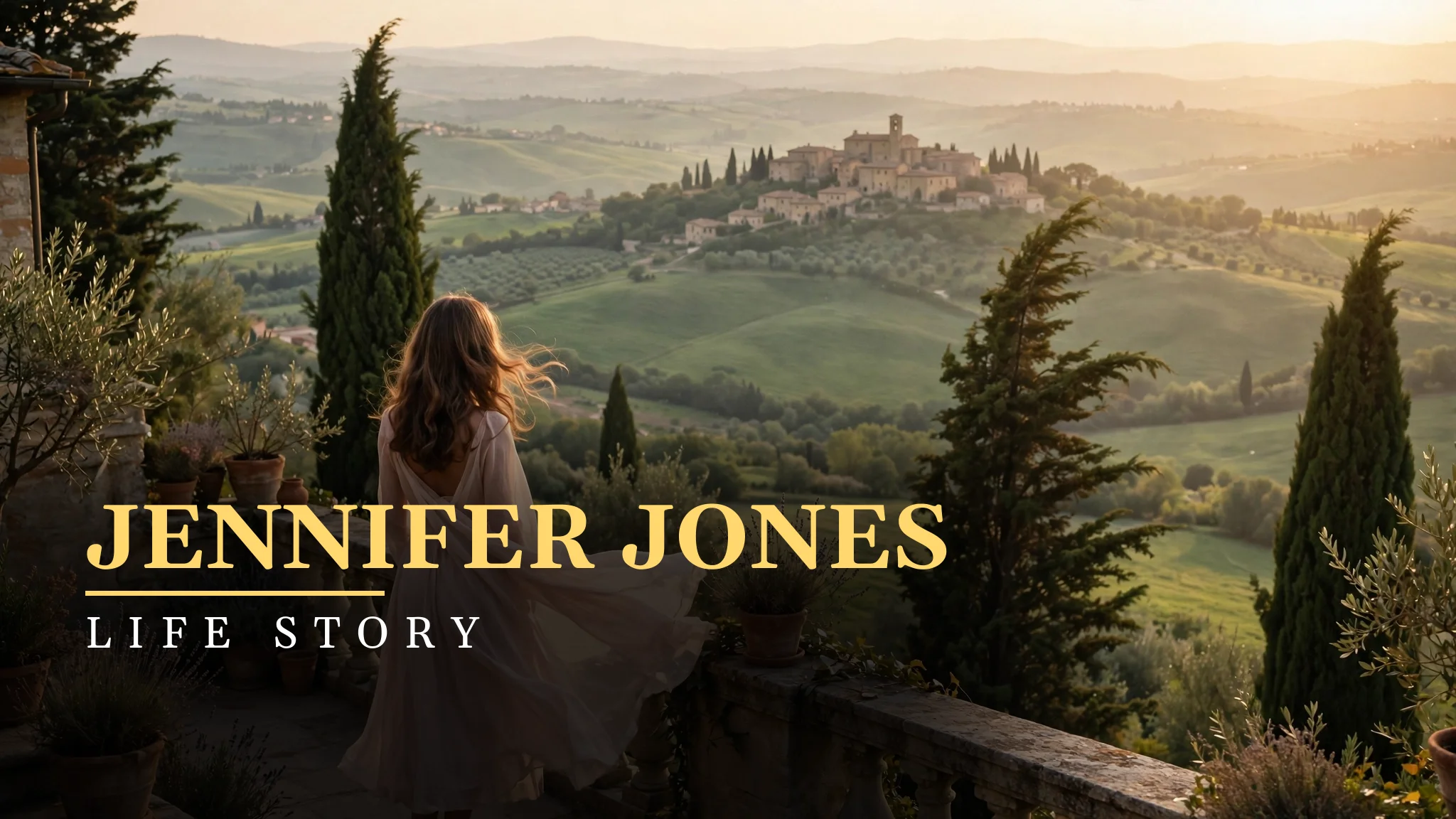
I think her legacy is a good one, and I think it is worth remembering. She showed the world that a romantic star could be sensitive, honest, and brave, and that a woman who faced loss could turn that loss into help for others. Her films are still shown today, and they still give pleasure to people who like romantic, passionate films. Her foundation is still remembered, and it still helps people. That is a life worth celebrating, and it is a life worth telling. When I think of Jennifer Jones, I think of a woman in a pink dress on a terrace in Tuscany, looking out over green hills, romantic, beautiful, and brave, and I smile, because that image is beautiful, and it will last.
I also think about the young people today who are shy, who are sensitive, and who dream of a life in acting. Jennifer Jones proves that it is possible, and that sensitivity can be a gift, not a weakness. She proves that you do not need to be loud to be a star. You need to be true, to be brave, and to keep going. That is a message of hope, and it is a message that still matters. I hope that young people who read about Jennifer Jones will feel that hope, and will believe in themselves, as she believed in herself.
I keep thinking about the way she played Bernadette, because that role captures everything I admire about Jennifer. She was simple, sincere, and deeply moving, and she made audiences believe in Bernadette, and in the power of faith. She was not glamorous in that film. She was poor, sickly, and simple, and she was beautiful because she was true. I think about the people who watched that film and felt faith, and hope, and comfort, because of Jennifer. That is a powerful influence, and it is one that lasts longer than any single film, because it lives in the hearts of the people who were moved by it.
I also think about her travelling theatre childhood, and about how it shaped her. She grew up in a theatre company, she travelled from town to town, she watched plays, and she learned how actors worked. That childhood gave her a love of stories, a respect for the audience, and a willingness to work hard. It also gave her a sensitivity, a shyness, and a depth that made her a great actress, and a vulnerable person. She was a girl who felt things deeply, and that depth made her performances feel real, and it also made her private life more difficult. That is a complicated gift, and it is one that Jennifer carried with her for her whole life.
There is another part of her story that stays with me, and it is her art collection, and the Norton Simon Museum. She loved art, she loved beauty, and she loved to share it with others, along with her husband Norton Simon. The museum is a lasting legacy, and it shows that Jennifer was more than a film star. She was a woman who loved culture, who loved beauty, and who wanted to give something beautiful to the world. That generosity is a beautiful thing, and it tells me a lot about Jennifer. She was not only interested in films. She was interested in art, in beauty, and in giving.
I wonder what she would say to a young person today who is shy, who is sensitive, and who dreams of a life in acting. I think she would smile, and she would say, be true, be brave, and keep going. I think she would tell that young person to trust their feelings, to work hard, and to remember that sensitivity is a gift, not a weakness. That is good advice, and it is advice that comes from a life lived with romance, sensitivity, and courage.
I also think about the way she played Jennie in Portrait of Jennie, because that role captures her mystery and her romance. She played a woman who appears and disappears in the life of an artist, a woman who is beautiful, strange, and a little bit magical, and she played her with a quiet, haunting beauty that made audiences wonder who she really was. The film is a romantic fantasy, and it is still loved today by people who like stories about love, about art, and about mystery. Jennifer’s performance in it is one of her best, and it shows her at her most sensitive and most romantic.
Finally, I think about her as a woman who turned loss into help, through her foundation, and through her honesty about mental illness. She lost a daughter, she faced her own struggles, and she decided to use her pain to help others. That is a brave and generous choice, and it is one that still matters today, when many families face mental illness, and need help, understanding, and compassion. Jennifer shows us that loss does not have to be the end of a story. It can be the beginning of a new chapter, in which we help others, and in which we find meaning in our pain.
That is why I will keep watching her films, and why I will keep telling her story, with gratitude for the romance she gave us.
Frequently Asked Questions
What film won Jennifer Jones an Academy Award?
She won the Academy Award for Best Actress for The Song of Bernadette in 1943, in which she played Bernadette Soubirous, a young girl in Lourdes who said she saw a vision of the Virgin Mary.
What is Jennifer Jones best known for besides Bernadette?
She is best known for Duel in the Sun from 1946, in which she played the passionate Pearl Chavez, and for Love Is a Many-Splendored Thing from 1955, a romantic film set in Hong Kong.
Who was Jennifer Jones married to?
She was married to the actor Robert Walker, then to the producer David O. Selznick from 1949 until his death in 1965, and later to the businessman and art collector Norton Simon from 1971 until his death in 1993.
What foundation did Jennifer Jones start?
She founded the Jennifer Jones Simon Foundation for Mental Health and Education, in memory of her daughter Mary Jennifer, who died by suicide in 1976, to help people facing mental illness.
When did Jennifer Jones die?
She died on 17 December 2009 in Malibu, California, at the age of ninety, after a long life as a romantic star, wife, mother, and helper of others.
Where was Jennifer Jones born?
She was born Phylis Lee Isley on 2 March 1919 in Tulsa, Oklahoma, where her parents ran a travelling theatre company, and she grew up performing on stage across America.


