Jimi Hendrix: The Life Story Behind Rock's Guitar God
In this post
Jimi Hendrix was born Johnny Allen Hendrix on 27 November 1942 in Seattle, Washington, the son of James Allen Hendrix, a soldier, and Lucille Jeter Hendrix, a young woman of Cherokee and African-American descent, and he grew up in poverty, in a family that struggled to make ends meet, moving from house to house in Seattle’s Central District. His parents divorced when he was nine, and his mother died when he was fifteen, losses that left him with a sense of rootlessness that he carried for the rest of his short life. He was a shy, quiet boy who found his voice in a guitar, an instrument he picked up at fifteen and never put down.
By the time he was twenty, Jimi was playing guitar in bands in Seattle, then in Nashville, then in New York, working as a sideman for Little Richard, the Isley Brothers and Curtis Knight, learning the craft of rhythm and blues and earning a reputation as a guitarist of extraordinary talent. In 1966, in New York, he was discovered by Chas Chandler, the bass player of the Animals, who brought him to London, where he formed the Jimi Hendrix Experience with Noel Redding and Mitch Mitchell, and recorded Are You Experienced, an album that changed the history of rock music. He was twenty-four, and he was on his way to becoming the greatest guitarist who ever lived.
His career lasted only four years, from 1966 to 1970, but in that time he recorded three studio albums with the Experience, Are You Experienced, Axis: Bold as Love and Electric Ladyland, and he performed at the Monterey Pop Festival in 1967, at Woodstock in 1969, and at the Isle of Wight in 1970, concerts that became legendary. He was a showman, a songwriter and an innovator, a musician who turned the electric guitar into an instrument of infinite possibility, and who influenced every guitarist who came after him.
Jimi died on 18 September 1970 in London, England, at the age of 27, after taking sleeping pills and drinking wine, a death that was ruled an accident, and that made him a member of the 27 Club, alongside Brian Jones, Janis Joplin and Jim Morrison. This is his life story, from a poor boy in Seattle to the greatest guitarist in the history of rock.
Seattle and the Childhood
Johnny Allen Hendrix was born on 27 November 1942 in Seattle, Washington, at King County Hospital, to James Allen Hendrix, who was serving in the United States Army, and Lucille Jeter Hendrix, who was seventeen at the time of his birth. His father, who was known as Al, was stationed in Alabama when Jimi was born, and he did not meet his son until Jimi was three, when he was discharged from the Army and returned to Seattle. The family lived in poverty, in a series of rented houses in Seattle’s Central District, and Al worked as a gardener and as a labourer, while Lucille worked as a waitress, and the family struggled to pay the rent and to buy food.
Jimi’s parents divorced in 1951, when he was nine, and his father was given custody of Jimi and his younger brother Leon, while Lucille, who was an alcoholic, saw her children rarely, and died in 1958, when Jimi was fifteen, from a ruptured spleen, a death that affected him deeply and that he wrote about in his songs, including The Wind Cries Mary, which was inspired by his mother’s memory. He was a quiet, shy boy, who was bullied at school for his poverty and for his clothes, and who found solace in music, listening to the records of Muddy Waters, B.B. King, Robert Johnson and Elvis Presley on the radio, and dreaming of playing the guitar.
At fifteen, in 1958, his father bought him his first guitar, a second-hand acoustic that cost five dollars, and Jimi taught himself to play, practising for hours every day, learning chords from books and from friends, and playing along to records on the radio. He joined his first band, the Velvetones, at school, and then the Rocking Kings, a band that played in clubs in Seattle, and he was already showing a talent that was remarkable, a guitarist who could play with a feel and a creativity that was beyond his years. He left school in 1961, at the age of eighteen, without graduating, and he enlisted in the United States Army, a decision that would change his life.
The Army and the Sideman Years
In May 1961 Jimi enlisted in the United States Army, and he was assigned to the 101st Airborne Division at Fort Campbell, Kentucky, where he trained as a paratrooper, making twenty-six jumps before he was discharged in June 1962, after injuring his ankle in a jump. He later said that the Army was not for him, and that he had enlisted to avoid going to jail, after being caught riding in a stolen car, a story that has been disputed by his biographers, but the experience gave him discipline and it gave him time to practise his guitar, playing in the barracks and in clubs near the base. After his discharge he moved to Clarksville, Tennessee, and then to Nashville, where he began to work as a sideman, playing guitar for bands on the chitlin’ circuit, the network of Black clubs in the American South.
In Nashville he played with the Isley Brothers, touring with them in 1964, and recording with them on the single Testify, and he also played with Little Richard, touring with him in 1964 and 1965, and learning from the flamboyant singer how to perform, how to work a crowd, and how to make a show out of a song. Little Richard fired him, by one account, because Jimi’s playing and his stage presence were upstaging the star, a compliment that showed how talented Jimi had become, and that foreshadowed the career that was to come. He also played with Curtis Knight and the Squires in New York, recording with them in 1965 and 1966, and earning a living as a session musician, a life that was hard and poorly paid, but that taught him the craft of the guitar.
By 1966 Jimi was living in New York, playing in clubs in Greenwich Village, including the Cafe Wha?, where he performed as Jimmy James and the Blue Flames, a band that played a mix of blues, rock and R&B, and that drew the attention of musicians and of record executives who recognised his talent. He was twenty-three, and he was playing guitar in a way that no one had heard before, with a feedback, a distortion and a creativity that was revolutionary, but he was still unknown, still broke, and still waiting for his chance, a chance that came in the form of Chas Chandler, a British musician who saw him play and who changed his life.
Chas Chandler and the Move to London
Chas Chandler was the bass player of the Animals, a British band that had hits with House of the Rising Sun and We Gotta Get Out of This Place, and in 1966, after the Animals broke up, he came to New York to find new talent to manage and to produce. He saw Jimi play at the Cafe Wha? in July 1966, and he was so impressed that he offered to bring him to London, to form a band and to record an album, a proposal that Jimi accepted, and that led to his arrival in London in September 1966, with Chandler as his manager and his producer. Chandler renamed him Jimi Hendrix, dropping the double m, and he formed the Jimi Hendrix Experience, with Noel Redding, a guitarist who switched to bass, and Mitch Mitchell, a drummer who had played with Georgie Fame, a trio that would become one of the greatest bands in rock history.
The Experience’s first single, Hey Joe, was released in December 1966, and it reached number six on the British chart, a success that was followed by Purple Haze, released in March 1967, which reached number three, and The Wind Cries Mary, which reached number six. The band’s first album, Are You Experienced, was released in May 1967, and it reached number two on the British chart, and it was a revelation, with songs that included Foxy Lady, Manic Depression, Fire and Are You Experienced, all of them showcasing Jimi’s guitar playing, his songwriting and his voice, a sound that was unlike anything else in rock, a mix of blues, psychedelia and hard rock that was entirely new.
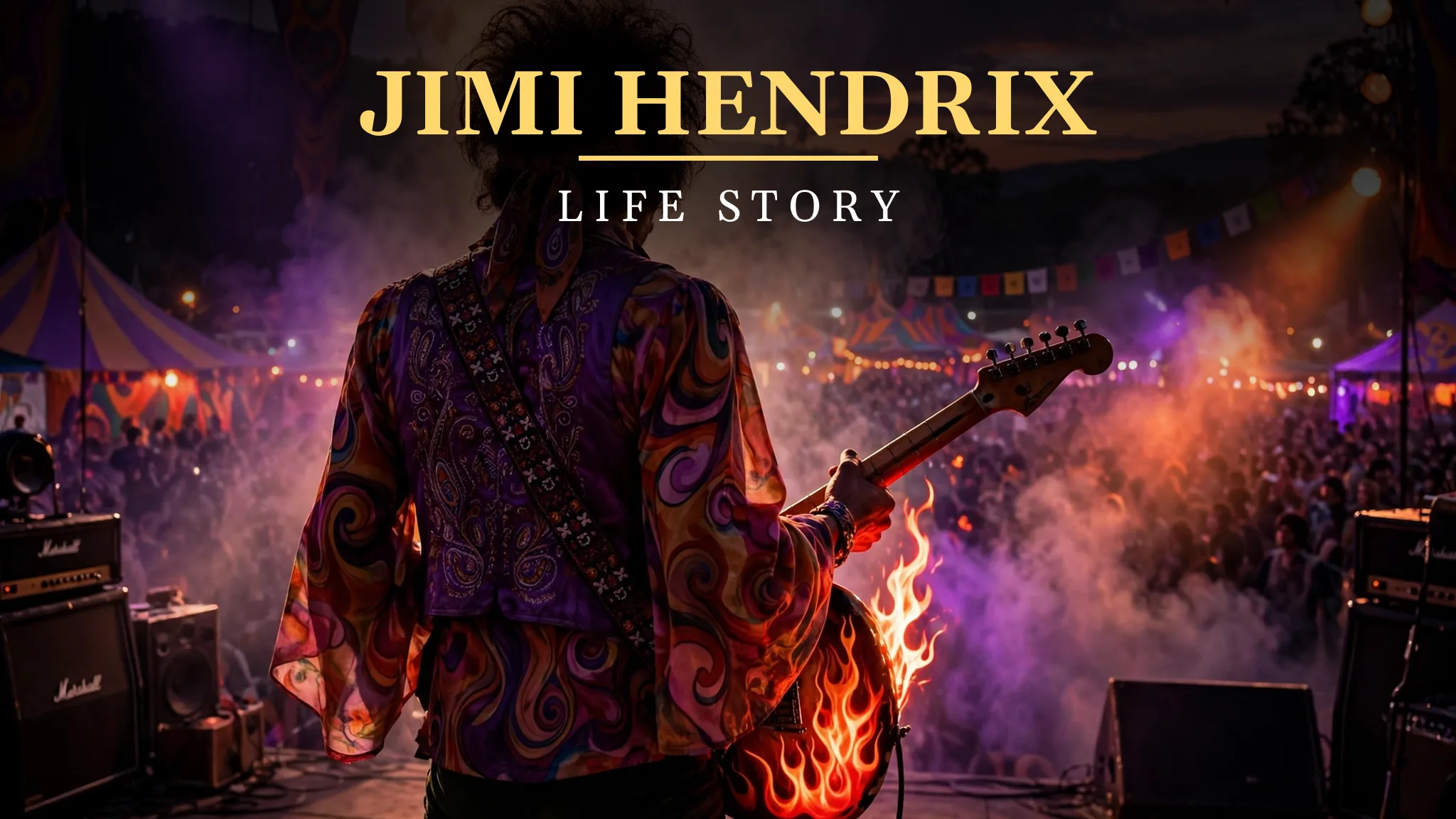
The band’s success in Britain was immediate, and Jimi became a star, with his flamboyant stage presence, his Afro hair, his colourful clothes and his guitar playing, which included playing behind his back, with his teeth, and setting his guitar on fire, a stunt he performed at the Monterey Pop Festival in 1967, and that became one of the most famous images in rock. He was twenty-four, and he was the most talked-about musician in Britain, a Black American guitarist who had come to London and conquered it, a story that was as unlikely as it was triumphant.
Are You Experienced and Purple Haze
Are You Experienced was released in May 1967, and it is regarded as one of the greatest debut albums in the history of rock, a record that introduced Jimi’s guitar playing, his songwriting and his band to the world. The album’s songs included Purple Haze, a song with a riff that has become one of the most famous in rock, and lyrics that were inspired by a dream Jimi had, in which he was walking under the sea, and Foxy Lady, a song about a woman that became a concert staple, and Fire, a song that became an anthem, and The Wind Cries Mary, a ballad that showed Jimi’s tenderness, and Are You Experienced, a song that asked the listener if they were ready for a new kind of music.
The album was recorded in London, at Olympic Studios, with Chas Chandler producing and with the engineer Eddie Kramer, who would become Jimi’s closest collaborator, and it was made on a small budget, in a few weeks, with Jimi playing guitar, singing and writing the songs, and with Noel Redding and Mitch Mitchell providing the rhythm section. The record’s sound was revolutionary, with Jimi using feedback, distortion, wah-wah and other effects to create a guitar sound that was like nothing heard before, a sound that was both beautiful and violent, and that made the electric guitar into an instrument of infinite possibility.
The album reached number two in Britain, and it reached number five in America, after its release there in August 1967, and it has sold millions of copies, and it is still regarded as a classic, a record that every guitarist studies, and that every rock fan knows. The album’s success made Jimi a star in America as well as in Britain, and it set the stage for the concerts and the albums that were to follow, and it established him as the most important guitarist of his generation.
Monterey and Woodstock
On 18 June 1967 Jimi performed at the Monterey Pop Festival in California, in a concert that became legendary, and that introduced him to an American audience. He was introduced by Brian Jones of the Rolling Stones, who called him the most exciting performer I have ever heard, and Jimi played a set that included Hey Joe, Purple Haze, Foxy Lady and Wild Thing, a song by the Troggs that he ended by setting his guitar on fire, kneeling before it and smashing it, a performance that was filmed for the documentary Monterey Pop, and that became one of the most famous moments in the history of rock. The performance made Jimi a star in America, and it established his reputation as a showman as well as a musician.
Two years later, on 18 August 1969, Jimi performed at the Woodstock Festival in New York, in front of an audience of four hundred thousand people, in a concert that was the climax of the festival and that became the most famous performance of his career. He played a set that lasted more than two hours, and that included a rendition of The Star-Spangled Banner, the American national anthem, that he played on his guitar, with feedback and distortion, as a protest against the Vietnam War, a performance that became an iconic moment in American culture, and that is still discussed today as a statement about America, about war and about freedom.
The Woodstock performance was the high point of Jimi’s career, and it showed him at the peak of his powers, a guitarist who could play with a technical brilliance and an emotional depth that was unmatched. The concert was filmed and recorded, and it has been released in various forms, and it remains the definitive document of Jimi as a live performer, a musician who could hold an audience of hundreds of thousands with his guitar alone, and who could make a national anthem into a work of art.
Electric Ladyland and the Final Albums
Electric Ladyland was released in October 1968, and it was Jimi’s third album with the Experience, and his most ambitious, a double album with sixteen tracks, including All Along the Watchtower, a cover of a Bob Dylan song that Dylan himself said was better than his own version, and Voodoo Child (Slight Return), a song that became a concert staple, and Crosstown Traffic, a song with a kazoo-like guitar sound, and the title track, Electric Ladyland, a song that was inspired by Jimi’s dream of a place where music and love were free. The album reached number one in America, Jimi’s only number one album, and it was praised by critics as a masterpiece, a record that showed the full range of his talent, from blues to psychedelia to funk.
The album was recorded in New York, at the Record Plant, with Eddie Kramer engineering, and it was a difficult record to make, with Jimi spending long hours in the studio, inviting friends to play, and recording take after take, a process that frustrated Noel Redding and Mitch Mitchell, and that led to tensions in the band. The album’s cover, which featured nineteen naked women, was controversial, and it was banned in some stores, but the record’s music was undeniable, and it remains one of the greatest albums ever made, a double album that holds together despite its length, because Jimi’s guitar and his vision carry it from start to finish.
After Electric Ladyland, Jimi formed a new band, the Band of Gypsys, with Billy Cox on bass and Buddy Miles on drums, and he recorded a live album, Band of Gypsys, released in 1970, that included Machine Gun, a song about the Vietnam War that is regarded as one of the greatest live performances ever recorded. The Band of Gypsys was short-lived, but it showed a new direction for Jimi’s music, towards funk and R&B, and it suggested that his best work was still ahead of him, a promise that was cut short by his death.
The Guitar and the Innovation
Jimi’s guitar playing was revolutionary, and it changed the way the electric guitar was played, and it influenced every guitarist who came after him, from Eric Clapton to Eddie Van Halen to Prince. He played a Fender Stratocaster, a guitar he held upside down, because he was left-handed, and he used feedback, distortion, wah-wah, fuzz and other effects to create sounds that had never been heard before, sounds that were like a voice, like a storm, like a dream. He played with his teeth, behind his back, and with the guitar on fire, but those were showmanship, and the real innovation was in his hands, in his ability to make the guitar sing, to make it cry, and to make it speak.
He was also a songwriter of great talent, writing songs that were poetic, psychedelic and personal, with lyrics that drew on his dreams, his experiences and his imagination. Purple Haze was inspired by a dream, The Wind Cries Mary was inspired by his mother, and Little Wing was inspired by a girl he had seen at a concert, a song that has become one of the most beloved in rock. His songs were simple in structure, but complex in feeling, and they showed a songwriter who was as talented as he was as a guitarist, a musician who could write a ballad and a rock anthem with equal skill.
His influence is incalculable. Every guitarist who has played rock music since 1970 has been influenced by Jimi, whether they know it or not, and his records are studied in schools and universities as examples of innovation, of creativity and of the power of the electric guitar. He was a musician who changed the instrument, and who changed the music, and who did it in four years, a career that was brief but that has lasted, and that will be felt for as long as people play the guitar.
The Death in London
On 18 September 1970 Jimi died in London, England, at the Samarkand Hotel in Notting Hill, at the age of 27, after taking nine sleeping pills, Vesparax, and drinking wine, and choking on his own vomit. He had spent the evening with his girlfriend, Monika Dannemann, a German figure skater, and he had taken the pills to help him sleep, a dose that was far larger than the recommended amount, and that, combined with the alcohol, caused him to asphyxiate. He was taken to St Mary Abbots Hospital, where he was pronounced dead at 11:30 a.m., and the coroner ruled that his death was an accident, caused by an overdose of barbiturates, a verdict that has been disputed by some, but that remains the official finding.
His death shocked the music world, and it made him a member of the 27 Club, a group of musicians who died at the age of 27, including Brian Jones, Janis Joplin and Jim Morrison, all of whom died within a year of each other, a coincidence that has become a legend in rock music. Jimi’s funeral was held in Seattle, on 1 October 1970, at the Dunlap Baptist Church, and it was attended by his family, his friends and his fellow musicians, including Mitch Mitchell, Noel Redding and Miles Davis, and he was buried at Greenwood Cemetery in Renton, Washington, where his grave has become a place of pilgrimage, visited by thousands of fans every year.
The circumstances of his death have been the subject of speculation for more than fifty years, with theories ranging from suicide to murder, but the evidence supports the coroner’s verdict, that Jimi took too many sleeping pills and that he choked, a death that was accidental but that was also a consequence of the lifestyle he had lived, with drugs, alcohol and exhaustion. His death ended a career that had lasted only four years, and it deprived the world of a musician who was still growing, still experimenting, and still at the peak of his powers.
The Legacy of Jimi Hendrix
Jimi’s legacy is immense. He is widely regarded as the greatest guitarist of all time, a ranking that has been given to him by Rolling Stone magazine, by the Rock and Roll Hall of Fame, and by musicians in every genre, and his albums, Are You Experienced, Axis: Bold as Love and Electric Ladyland, are regarded as classics, studied in schools and universities as examples of innovation, of songwriting and of guitar playing. His records have sold millions of copies, and his music is played every day, by guitarists who study his technique and by fans who love his songs.
His influence on other musicians is incalculable. Eric Clapton, who was regarded as the greatest guitarist in Britain before Jimi arrived, said that Jimi changed everything, and that after hearing him, he knew he would never be the same, and other guitarists, from Jimmy Page to Stevie Ray Vaughan to John Mayer, have said the same, that Jimi was the standard against which all other guitarists are measured, a musician whose playing was both technical and emotional, and whose innovation has never been matched.
Today Jimi is remembered as the greatest guitarist who ever lived, and his name is synonymous with the electric guitar, and with the sound of rock music at its most creative and most free. He was born in Seattle, he worked in Nashville, New York and London, and he died in London, and his songs remain the sound of a young man who picked up a guitar and changed the world. His life was short, but his influence has lasted, and it will be felt for as long as people play the guitar.
My Take:
What I admire about Jimi Hendrix is that his guitar was the wildest in rock music, a guitar that could play a song, and make it sound like a cry, and that changed the sound of the electric guitar forever. That is a rare thing, because many guitarists have clever licks, but few have a guitar that is wild, and Jimi’s guitar was wild, in the sense that it made every song he played sound alive, and that is why he is the greatest guitarist ever, and why his guitar is still studied today, by guitarists who want to learn how to play, and who listen to Jimi, and who try to understand his genius, and who know they never will, because it was unique, and it was Jimi’s, and it was a gift, and that gift is still here, in recordings that are more than fifty years old, and that are still powerful, still moving, and still relevant, today.
Purple Haze is the song I think about most, because it is one of the most beloved songs ever recorded, and Jimi’s performance is at its heart. He played it, about a haze, that is purple, and it became his signature, a song that he played, in every concert, and that audiences sang, along with him, and that is a part of his legacy, a legacy that is still felt today, in every concert, where Purple Haze is played, and where audiences remember Jimi, and that is a beautiful thing, and it is a part of his story that is both touching and inspiring, and that will be told for as long as Purple Haze is played, and Purple Haze will always be played, because it is a classic, and because it is Jimi, and because it is a song about a haze, that became an anthem, and that is a gift that few guitarists possess, the gift of making a song into an anthem, and Jimi had it, and he used it, in Purple Haze, and in every song he played.
All Along the Watchtower is a song I love, because it became one of Jimi’s most beloved songs, and Jimi played it, with a guitar that was wild, and that was soulful, and that made it feel personal, and that is a gift that few guitarists possess, the gift of making a cover, sound like your own, and Jimi had it, and he used it, in All Along the Watchtower, and in every song he played, and that is why the song is still a classic, and why it is still one of his most beloved songs, a song that is both a hit, and a work of art, and that is a rare thing, and it is a part of why Jimi is a genius, and why his music is still important today, more than fifty years after All Along the Watchtower was recorded, because it is timeless, because it is honest, and because it is Jimi.
Are You Experienced is an album that moves me, because Jimi released it, in 1967, and it became a huge success, and it made him a superstar, and that is a testament to his talent, and to his determination, and to the power of a great guitarist, who, even when he is young, can write an album, that will be remembered, for decades, and that is a lesson worth remembering, for anyone who wants to be a guitarist, because it shows that you can write a great album, at twenty-four, and you can be great, and the world will listen, if you are talented, and if you are true, and Jimi was both, and that is why his debut is inspiring, and that is a part of his story that is both touching and inspiring, and that will be told for as long as Jimi is remembered, and Jimi will always be remembered, as the greatest guitarist ever, and as a man who was, in every sense, a legend, and a genius.
The lesson I take from Jimi is that sound matters, even when it is wild. He was a guitarist, who used feedback, and distortion, and wah-wah pedals, to make a sound, that had never been heard before, and that is a lesson for anyone who wants to be an artist, because Jimi shows that you can use sound, to make art, and that is a powerful message, for anyone who wants to be a guitarist, because Jimi shows that playing guitar can be art, and that art can be wild, and that is a beautiful thing, and it is a part of why his story is inspiring, and why it will always be inspiring, and it is a reminder that we should not just play, but create, the way Jimi did, and make our music into art, and that is a lesson worth remembering, for every guitarist out there.
I also think about his childhood in Seattle, because he was a boy, who played, a broom, as a guitar, and who dreamed of becoming a guitarist, and that is a beautiful thing, and it is a part of his story that is both touching and inspiring, because it shows a boy, who had nothing, and who became a legend, and that is a legacy that matters, in its own way, alongside his songs and his guitar, because his family is his greatest legacy, and they have honoured him, by being themselves, just as he was himself, and that is a beautiful thing, and it is a part of his story that is both touching and inspiring, and that will be told for as long as Jimi is remembered, and Jimi will always be remembered, as the greatest guitarist ever.
His Woodstock performance is something I admire, because he played, the Star-Spangled Banner, on his guitar, with feedback, and distortion, and that made an audience feel, in a way that few performances can, and that is a gift that few guitarists possess, the gift of making a national anthem, sound like a cry, and Jimi had it, and he used it, at Woodstock, and in every concert he gave, and that is why his Woodstock performance is still one of his most beloved performances, and why it is still watched today, by people who love Jimi, and who are moved by him, because he was a genius, and because his music was a gift, and that gift is still here, in a recording that is more than fifty years old, and that is still powerful, still moving, and still relevant, today.
Finally, I believe Jimi Hendrix was one of the greatest musicians who ever lived, and his recordings are classics that will be played for as long as songs are played. He was the greatest guitarist ever, he was the greatest musician of his generation, and he was a legend, and his story is one of talent, sound, and a life lived with a guitar. He will always be remembered as the man who played Purple Haze, and who did it, with a guitar that will never be forgotten.
One more thing I want to say is that his three albums, Are You Experienced, Axis: Bold as Love, and Electric Ladyland, released in just eighteen months, are a testament to his talent, because he recorded them, in just a year and a half, and they are all classics, and that is a record that speaks for itself. He was great, at twenty-four, and he was great at twenty-five, and that is a rare achievement, and it is a reminder that talent does not fade with age, and that a great guitarist can be great for a lifetime, if he has the talent, the determination, and the guitar that Jimi possessed, and that is a legacy that will never be forgotten.
When I think about Seattle, his birthplace, I think about how far he travelled, from a boy with a broom to the most famous guitarist in the world, and how much he achieved. He was a boy who was bullied, and who found his way, through music, and who became a legend, and that is a story that inspires anyone who has been bullied, because it shows that you can survive bullying, and you can become great, and you can turn your pain into art, and that is a hopeful message, and one that Jimi embodied, in every song he played, and in every concert he gave.
I will end by saying that listening to Jimi Hendrix play was a privilege, and I am grateful to have heard his guitar. He was wild, he was soulful, and he was unmistakable, and those three things together make a great guitarist. He is the greatest guitarist ever, he is the greatest musician of his generation, and he is Jimi, and he will always be remembered as such, as a legend, and as a guitar that will never be forgotten.
There is a final thought I want to leave with, and it is about the line from Purple Haze, where he sings, excuse me while I kiss the sky, a line that has stayed with me, because it is a lesson about dreaming, about kissing the sky, and about being human. Jimi played that line with a warmth that has stayed with me, because it is a lesson about life, about dreaming, and about being human. That is the power of his playing: it teaches us how to live, and it makes us better people, by showing us that dreaming matters, and that we should dream, of a better life, and that is a lesson I will carry with me, always.
And if you have never heard Purple Haze, listen to it, because it is one of the great songs of all time, and Jimi’s performance is at its heart. Listen to it for the story, for the haze, and for the guitar, and for the man who played it with a conviction that is unforgettable. That is the Jimi Hendrix I will remember: not just the guitarist, but the man, who was wild, soulful, and unmistakable, and who will never be forgotten.
One last memory: the image of him in a colourful jacket, playing a white electric guitar upside down on stage, with a smile that is both wild and warm, and that is unforgettable. That image is iconic, and it is beautiful, and it is the image that will define him forever. He was the greatest guitarist ever, and he was Jimi, and he was the greatest musician of his generation.
Her legacy will live on through his recordings, through his guitar, and through the generations of guitarists he inspired, who heard his guitar and wanted to play the way he played. That is a fitting legacy for a man who defined guitar, and who did it with a guitar and a talent that will never be forgotten. He is gone, but his guitar remains, and his name will be remembered as one of the greats.
Finally, I want to say thank you, Jimi Hendrix, for Purple Haze, for All Along the Watchtower, and for a life lived with a guitar that spoke for rock. You were a great guitarist, and you were a great man, and the world is a better place because you were in it. Your recordings are still here, your legacy is still here, and your example is still here, and that is a life that mattered, and a life that will never be forgotten.
And one more thing: if you are a guitarist, play like Jimi, because he is the guitarist every guitarist deserves to be, a guitarist who plays with his heart, and who makes an audience feel. Play like Jimi, the way Jimi Hendrix played, and the world will be a better place for it, because the world needs more guitarists like him, who play with wildness, with soul, and with humanity.
There is a last lesson in his life that I carry with me, and it is this: be wild, even when it is hard, because being wild is a choice, and Jimi chose it, every day, in every song, and in every part of his life. That is a lesson worth remembering, and it is one I will carry with me, always, because the world needs more people like Jimi Hendrix, who are wild, and who do it, with a guitar, and with a talent, that will never be forgotten.
One final thought: his album Electric Ladyland, released in 1968, is a testament to his talent, because he recorded it, as a double album, and it included All Along the Watchtower, and Voodoo Child, and that is a record that speaks for itself. He was great, as a guitarist, and he was great as a songwriter, and that is a range that few guitarists possess, and it is a reminder that Jimi was not just a guitarist, he was a musician, and a great one, and that is a legacy that will never be forgotten.
And if you ever doubt that a guitar can speak for peace, remember Jimi Hendrix, because he did, with the Star-Spangled Banner, at Woodstock, a performance that made millions of people feel, and that is still watched today, by people who love rock, and who believe, that peace matters, and that is a legacy that will last, long after his songs are played, because his guitar is still here, and his influence is still here, and that is a gift that will never fade.
There is one more thing I want to say, and it is about his father, because he bought Jimi, his first real guitar, for five dollars, at a secondhand shop, and that is a reminder that a father who believes in an artist can change their life, and that Jimi was lucky to have his father, and that his father was lucky to have Jimi, and that is a beautiful thing, and it is a part of his story that shows the power of belief, and of a father who cares, and who does the right thing, and that is a legacy that matters, in its own way, alongside his songs and his guitar.
His story also reminds me that a boy from Seattle can become a legend, if he has talent, determination, and a guitar, and that is a hopeful message for anyone who feels poor, or disadvantaged, or forgotten. Jimi was poor, and he was disadvantaged, and he became one of the greatest musicians in history, because he embraced who he was, and he used his talent to become great. That is a lesson worth remembering, for every poor person out there, and for every guitarist who wants to be heard.
I also want to mention his mother Lucille, because she died, when Jimi was fifteen, and that was a tragedy, that shaped Jimi, for the rest of his life, and that is a part of his story that is both sad and important, because it shows that even a genius, can lose his mother, and that is a lesson worth remembering, for anyone who has lost a mother, because Jimi shows that you can lose your mother, and you can still be great, and you can still play, and that is a beautiful thing, and it is a part of his story that is both touching and inspiring.
And finally, I think about the fact that he died at 27, and that he had so much more to give, and that is a reminder that life is short, and that we should make the most of it, the way Jimi Hendrix did, playing with a guitar that was a gift, and living a life that was both beautiful and tragic, and that is a life worth living, and a life worth remembering, and I am grateful to have learned about it, and to have shared it with you.
Frequently Asked Questions
When was Jimi Hendrix born?
Jimi Hendrix was born on 27 November 1942 in Seattle, Washington, USA, as James Marshall Hendrix. He taught himself guitar after his father bought him a five-dollar Supro Ozark at age fifteen.
What is Jimi Hendrix most famous for?
He is most famous as the greatest guitarist in rock history, and for Purple Haze, All Along the Watchtower, Foxy Lady, and his Woodstock performance of the Star-Spangled Banner.
What was Jimi Hendrix’s Woodstock performance?
On 18 August 1969 he played the Star-Spangled Banner on electric guitar at Woodstock, using feedback and distortion to evoke bombs and sirens during the Vietnam War, a legendary performance.
When did Jimi Hendrix die?
He died on 18 September 1970 in London, England, at the age of 27, of a drug overdose, after a career of only four years that changed the electric guitar forever.
What guitar did Jimi Hendrix play?
He played a Fender Stratocaster, restrung and played upside down because he was left-handed, a style that became iconic and is still imitated by guitarists today.
What are Jimi Hendrix’s best albums?
His three Experience albums, Are You Experienced (1967), Axis: Bold as Love (1967), and Electric Ladyland (1968), were all released within eighteen months and are all regarded as classics.


