Jiří Menzel: The Life Story Behind the Closely Watched Trains Director
In this post
- Born in Prague on the Edge of War
- Film School and the Czech New Wave
- Closely Watched Trains: A Small Film, a Big Prize
- Banned Films and Hard Years
- My Sweet Little Village and Later Success
- I Served the King of England and the Final Years
- Legacy: The Gentle Eye of Czech Cinema
- Theatre, Acting, and a Life on Stage
- My Take:
Jiří Menzel made films that were quiet, funny and full of human warmth, and he did it in a country where making films was never simple. His best-known film, Closely Watched Trains, won an Academy Award, and it is still loved today for its gentle humour and its sad, honest look at life during the Second World War. Menzel did not make loud films. He made small films about small people, and he found greatness in their everyday lives.
He was born in Prague in 1938, and he grew up in a Czechoslovakia that was changing fast, first under Nazi occupation, then under communist rule. He studied film in Prague, and he became part of the Czech New Wave, a group of young directors who wanted to tell true stories about real life. His films are full of trains, villages, food, love and laughter, and they are also full of a quiet sadness about how history can crush ordinary people.
This is the story of a director who stayed close to his roots, who loved the writer Bohumil Hrabal, and who kept making films about Czech life for more than fifty years. It is a story about patience, about humour in hard times, and about a man who believed that a small, honest film could be more powerful than a big, loud one.
Born in Prague on the Edge of War
Jiří Menzel was born on 23 February 1938 in Prague, the capital of Czechoslovakia, just months before the country was torn apart by the Second World War. His father, Josef Menzel, was a writer and journalist, and his family lived in a world of books, newspapers and ideas. The young Jiří grew up listening to stories, and he learned early that words and pictures could shape how people saw the world.
The war and the years that followed shaped his childhood. Czechoslovakia was occupied, then freed, then taken over by a communist government, and a child growing up in Prague in those years learned that history is not something far away. It is something that comes into your street, into your school, and into your home. Menzel later said, in his work if not always in words, that ordinary people live inside big history, and they try to keep living, loving and laughing even when history is cruel.
As a young man, Menzel studied at the film school in Prague, FAMU, where he met other students who would become famous directors. The school gave him a chance to learn the craft of film, to watch films from around the world, and to think about what kind of director he wanted to be. He was not interested in grand, heroic stories. He was interested in small, human stories, and in the way people talk, eat, work and fall in love.
His father’s work as a writer also mattered. Menzel grew up with a love of Czech literature, and that love would later lead him to the writer Bohumil Hrabal, whose books became the basis for his best films. The link between literature and film, between words on a page and images on a screen, was at the centre of Menzel’s career from the start.
Film School and the Czech New Wave
At FAMU, Menzel was part of a generation of young filmmakers who later became known as the Czech New Wave. These directors were young, they were fresh from film school, and they wanted to make films that felt real. They used natural light, real locations, and actors who behaved like ordinary people, not like stars. They told stories about everyday life, about work, about love, and about the small absurdities of living under a strict political system.
Menzel’s early work showed his gift for comedy and for observation. He could watch a group of people in a room and find the humour in the way they talked, the way they moved, and the way they tried to impress each other. He did not need big jokes. He found humour in small details, in a look, in a pause, in a sentence that was said in the wrong way. That kind of humour is hard to do well, and Menzel did it better than almost anyone in Czech cinema.
He also learned to work with the writer Bohumil Hrabal, whose short stories and novels were full of the same kind of humour and humanity. Hrabal wrote about ordinary Czech people, about workers, about dreamers, about people who talk too much and drink too much and love too much, and Menzel understood those characters at once. Their partnership would become one of the most important in Czech film history.
The Czech New Wave was a short, bright moment in Czech cinema, and it was cut short by the Soviet invasion of 1968. Many directors left the country, and many films were banned. Menzel stayed, and he had to find a way to keep working in a system that did not always trust him. That was not easy, and it shaped the rest of his career.
Closely Watched Trains: A Small Film, a Big Prize
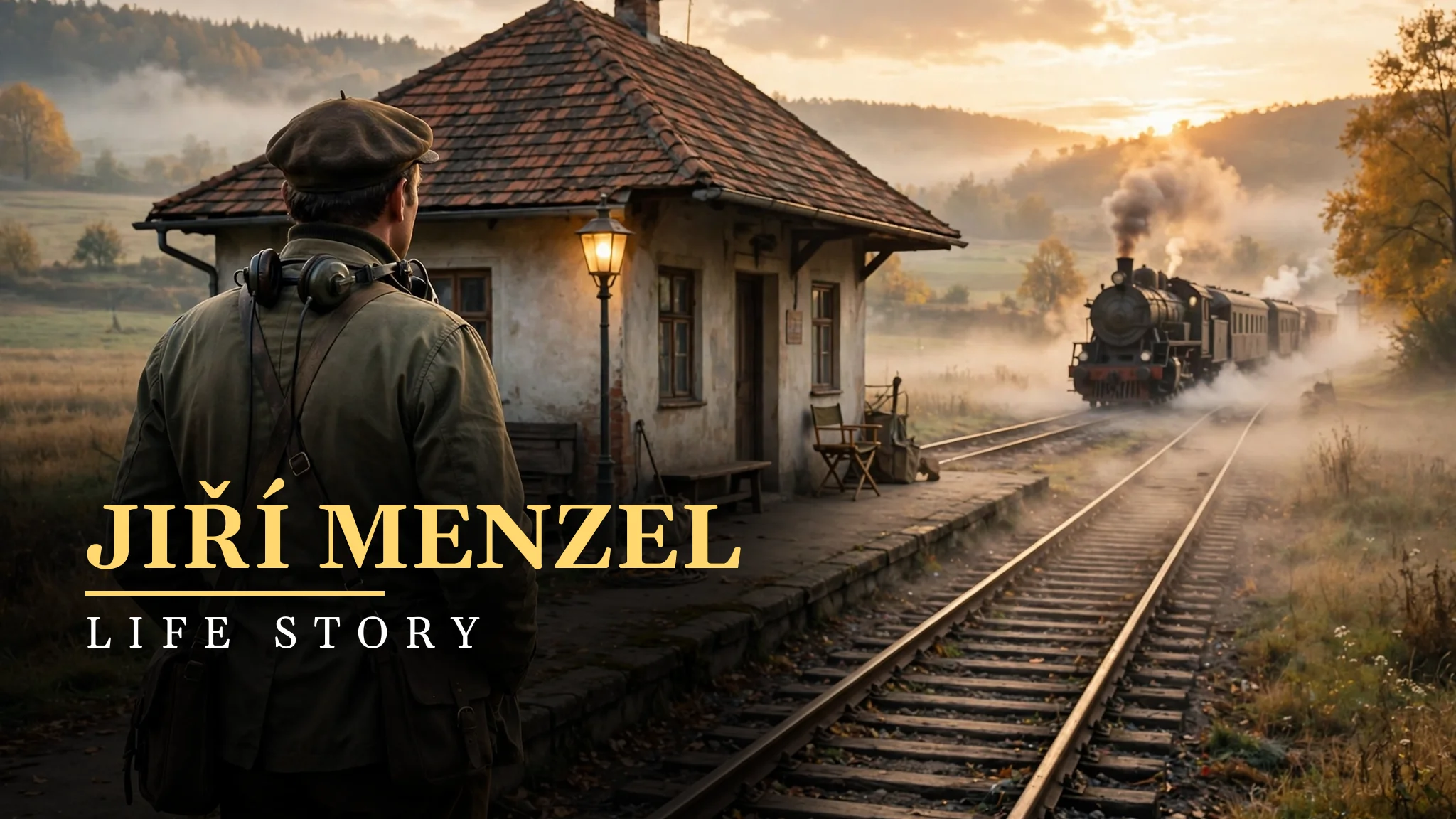
In 1966, Menzel directed Closely Watched Trains, based on a novel by Bohumil Hrabal, and it became his most famous film. The story is set during the Second World War, at a small railway station in Czechoslovakia, and it follows a young man named Miloš Hrma, who works as an apprentice at the station and who is trying to become a man. The film is funny, tender and sad, and it shows the war not as a big battle, but as something that touches the lives of ordinary people in a small place.
The film’s hero is not a soldier or a hero in the usual sense. He is a shy young man who worries about love, about sex, about his job, and about what it means to be brave. Menzel treats him with great kindness, and the audience laughs with him, not at him. The railway station becomes a whole world, with its own rules, its own jokes, and its own dangers, and the train that passes through it brings both hope and death.
Closely Watched Trains won the Academy Award for Best Foreign Language Film in 1968, and it made Menzel known around the world. The Oscar was a huge honour for a young Czech director, and it showed that a small, quiet film from a small country could speak to audiences everywhere. The film is still shown today, and it is still loved for its warmth, its humour, and its honest look at how young people grow up in a time of war.
The success of the film also gave Menzel a place in film history that he never lost. Even when his later films were less well known outside Czechoslovakia, Closely Watched Trains remained a classic, and it is often named as one of the best Czech films ever made. It is a film that proves that a story does not need to be big to be great. It only needs to be true.
Banned Films and Hard Years
After the Soviet invasion of 1968, life for Czech filmmakers became much harder. The government tightened its control over film, and many films were banned or shelved. Menzel made a film called Larks on a String, based on another Hrabal story, in 1969, but the film was banned and was not shown in Czechoslovakia for more than twenty years. It was only after the fall of communism in 1989 that audiences at home could see it properly, and it later won the Golden Bear at the Berlin Film Festival in 1990.
These were hard years for Menzel. He could not always make the films he wanted to make, and he had to work in theatre as well as in film to keep going. He directed plays, he acted, and he waited for chances to return to the cinema. He did not leave Czechoslovakia, as some of his friends did, and he did not stop working. He found ways to keep telling stories, even when the system made it difficult.
In the 1970s and 1980s, he made a series of popular Czech comedies, including films about village life, about hunting, and about ordinary people trying to enjoy themselves. These films were loved by Czech audiences, even if they were not always loved by critics, because they were funny, warm and easy to understand. They showed Menzel’s gift for making people laugh, and they kept his name alive at home.
The banned years also taught Menzel patience. He learned that a film can wait, that a story does not die just because it is not shown at once, and that an artist can keep working even in hard times. When Larks on a String was finally shown, it was clear that the wait had been worth it, and that Menzel’s early work had not lost its power.
My Sweet Little Village and Later Success
In 1985, Menzel made My Sweet Little Village, a warm comedy about life in a small Czech village, and it became one of his most loved films. The film follows a simple, kind-hearted man named Otík, who lives in the village and who is loved by everyone, even though he is not clever in the usual way. The film is funny, gentle and full of love for village life, and it was nominated for an Academy Award for Best Foreign Language Film.
The film showed Menzel at his best. He loved the village, he loved its people, and he showed their lives with respect and humour. He did not make fun of them. He celebrated them, and he showed that a small place can be a whole world, with its own rules, its own kindness, and its own problems. Audiences in Czechoslovakia loved the film, and it is still one of the most popular Czech films ever made.
In the years that followed, Menzel continued to work in film and theatre, and he remained a respected figure in Czech culture. He was not a director who chased international fame. He was a director who told Czech stories for Czech audiences, and who also happened to be loved abroad. That balance is rare, and it is part of what makes his career special.
He also worked as an actor, appearing in films by other directors, and he was known as a warm, funny and wise presence in Czech cultural life. People who worked with him often said that he was kind, that he listened, and that he made the set a happy place. That kindness is visible in his films, and it is one of the reasons they still feel fresh today.
I Served the King of England and the Final Years
In 2006, Menzel returned to the work of Bohumil Hrabal with I Served the King of England, a film based on Hrabal’s novel about a young waiter who dreams of becoming rich and important. The film follows the waiter’s life through the 1930s, the war, and the communist years, and it shows how ambition, love and history can change a person. The film was a success in the Czech Republic and abroad, and it showed that Menzel, even in his late sixties, still had the energy and the humour to make a big, rich film.
The film was a fitting return to Hrabal, the writer who had given Menzel his greatest success forty years earlier. It was as if Menzel had come full circle, from a young director making a film about a railway station to an older director making a film about a waiter who serves kings and presidents. Both films are about young men trying to find their place in the world, and both are told with the same gentle humour and the same love for ordinary people.
In his final years, Menzel’s health became poor, and he worked less. He had suffered from health problems for some time, and he spent his last years in Prague, cared for by his family. He remained a beloved figure in Czech culture, and his films continued to be shown on television, at festivals, and in cinemas, where new audiences discovered them.
Menzel died on 5 September 2020 in Prague, at the age of eighty-two. His death was mourned in the Czech Republic and around the world, and tributes praised him as one of the greatest Czech directors, a man who had made films that were funny, human and true, and who had never lost his love for his country and its people.
Legacy: The Gentle Eye of Czech Cinema
Jiří Menzel’s legacy is the legacy of a director who believed in small stories. He did not make films about kings or generals. He made films about railway workers, waiters, villagers and young men in love, and he showed that their lives matter as much as anyone else’s. That belief is at the heart of his work, and it is why his films still move people today.
His partnership with Bohumil Hrabal is one of the great partnerships in European cinema. Together, they created a world that was funny, sad, warm and true, a world that felt like Czechoslovakia itself. Their films are still studied in film schools, and they are still loved by audiences who may not know Czech history but who know what it feels like to be young, to be in love, and to try to be brave.
Menzel also left a legacy of patience and kindness. He waited twenty years for one of his films to be shown, and he did not become bitter. He kept working, he kept laughing, and he kept telling stories. That patience is a lesson for any artist who faces hard times, and it is a lesson that Menzel lived, not just talked about.
Today, Closely Watched Trains is still the film that most people think of when they hear his name, and that is fair. It is a perfect film, small and great at the same time. But his other films, from My Sweet Little Village to I Served the King of England, are also worth watching, because they show the same gentle eye, the same humour, and the same love for people. That is the legacy of Jiří Menzel, and it is a legacy that will last.
Theatre, Acting, and a Life on Stage
Jiří Menzel was not only a film director. He was also a theatre director and an actor, and he spent much of his life on stage, both directing plays and appearing in films made by other directors. His theatre work was important to him, because the theatre in Prague was a place where Czech culture lived, where audiences came to laugh, to think, and to feel, even in hard times, and where a director could work closely with actors, in a live space, without the distance of a camera. Menzel directed plays by Czech writers, he worked with actors he loved, and he brought the same gentle humour and the same love for ordinary people to the stage that he brought to his films, and audiences loved his theatre work for the same reasons they loved his films.
As an actor, Menzel appeared in many films, often in small, funny, warm roles, and he was known as a kind, wise presence on screen, a man with a round face, a gentle smile, and a voice that made people feel at ease. He acted in films by his friends, he acted in his own films, and he acted in films by younger directors who wanted to work with a legend of Czech cinema. His acting was not showy. It was natural, like his directing, and it showed that he understood actors because he was one himself, and that he knew how hard it is to be in front of a camera, to remember lines, and to be truthful in a scene. That understanding made him a better director, because he knew what actors need: patience, trust, and a director who listens.
Menzel’s work in theatre also helped him during the hard years when his films were banned or when he could not make the films he wanted. The theatre gave him a place to work, a place to tell stories, and a place to stay close to his audience, even when the film industry was closed to him. He did not stop working when film was difficult. He turned to the stage, and he kept his art alive, and that is a lesson in resilience, in finding another way to do what you love, when the first way is blocked. Many artists give up when one door closes, but Menzel found another door, and he walked through it with the same humour and the same love for his craft.
His life on stage also made him a beloved figure in Czech cultural life, a man who was known not only for his films, but for his presence, his jokes, his wisdom, and his kindness to young actors and directors. People who worked with him in the theatre often said that he made the rehearsal room a happy place, that he listened, that he laughed, and that he made everyone feel valued. That kindness is visible in his films, and it is also visible in the memories of the people who knew him, and it is part of why his death in 2020 was mourned so widely, not only as the loss of a great director, but as the loss of a good, kind man who had been part of Czech life for more than fifty years.
In his later years, Menzel continued to work in theatre and in film, even as his health became poor, and he remained a respected, loved figure, whose films were shown on television, at festivals, and in schools, where new audiences discovered them. He was a man who had lived through war, through communism, through the Velvet Revolution, and through a new, democratic Czech Republic, and he had kept his humour, his humanity, and his love for his country through all of it. That is a remarkable achievement, and it is why his story is not only about films, but about a life well lived, with art, with friends, and with a deep love for the people around him.
Menzel’s films also show a deep love for food, for eating together, and for the small pleasures of Czech life, and that love is visible in Closely Watched Trains, in My Sweet Little Village, and in I Served the King of England, where meals, drinks, and conversations around a table are not only background, but a central part of how people live, love, and connect. He films food with a warmth, a humour, and a respect that make the audience feel hungry, not only for the food, but for the company, for the laughter, and for the feeling of being together, in a small place, with people you love, and that is a very Czech feeling, a feeling of home, of community, and of simple joy, that Menzel captures better than almost any other director, and that makes his films feel like a warm meal, shared with friends, on a cold day.
My Take:
I think about Jiří Menzel and I feel calm, because his films are calm, even when they are about war and hard times. He does not shout, he does not rush, and he does not try to impress me with big effects. He invites me to sit down, to watch ordinary people, and to laugh with them, and that invitation feels like a gift. In a world full of loud films, Menzel’s quiet films are a reminder that a small story can be enough, and that a small life can be full of meaning. I admire that calm, and I wish more films had it.
What I love most about Closely Watched Trains is its hero, Miloš Hrma, because he is not a hero in the usual sense. He is shy, he is worried, he makes mistakes, and he is trying to grow up in a world that is at war. I see myself in him, and I think many viewers do too, because we have all been young and unsure, and we have all wanted to be brave without knowing how. Menzel treats this young man with great kindness, and he never makes fun of him. That kindness is what makes the film so moving, and it is what makes me trust Menzel as a director.
I also think about the banned film, Larks on a String, and what it must have felt like to make a film and then not be allowed to show it for twenty years. That is a long time to wait, and it would be easy to become angry or to give up. Menzel did not give up. He worked in theatre, he made other films, and he waited. When the film was finally shown and won a prize in Berlin, it must have felt like a vindication, not only for him, but for all the artists who had to wait. I learn from that patience. Good work does not die just because it is hidden for a while. It waits, and it can still find its audience.
The partnership with Bohumil Hrabal moves me, because it shows what can happen when a director and a writer truly understand each other. Hrabal wrote about Czech people with humour and love, and Menzel filmed those people with the same humour and love. They did not try to change each other. They trusted each other, and the result was films that feel like they were made by one mind. I think about my own work, and I think about how important it is to find people who understand what you are trying to do, and to trust them. That trust is rare, and Menzel and Hrabal had it.
I feel sad when I think about the years after 1968, when Czech cinema lost its freedom and many directors had to stop or leave. Menzel stayed, and he kept working, but he could not always make the films he wanted. That is a loss, not only for him, but for all of us, because we will never know what other films he might have made in those years. I do not want to make that loss sound small, because it was not small. It was a real cost, paid by a real artist, and by many other artists too. I respect Menzel for staying and for finding a way to keep working, even when the work was not what he had dreamed of.
Another thing I admire is his love for village life in My Sweet Little Village. The film is about a simple man, Otík, who is not clever, not rich, not powerful, and yet he is loved by everyone around him. That is a powerful idea, that kindness and goodness matter more than cleverness or success. In a world that often praises the clever and the rich, Menzel praises the kind and the simple, and I think that is a brave choice. It tells me that a good life is not about being the best. It is about being good to the people around you, and about being part of a community.
I also think about his later film, I Served the King of England, and how it brings his career full circle. He started with a young man at a railway station, and he ended with a young waiter who dreams of being important. Both young men learn that ambition is not enough, that history is bigger than they are, and that love and kindness matter more than money. That is a lesson Menzel kept telling, in different ways, for fifty years, and it never felt old, because it is true. I admire a director who can tell the same truth in many different stories, and make each one feel fresh.
If I have a criticism, it is only that Menzel’s films are not as well known outside the Czech Republic as they should be. Many people know Closely Watched Trains, but they do not know My Sweet Little Village, or Larks on a String, or I Served the King of England. That is a shame, because those films are just as good, and they show different sides of his talent. I wish more film lovers would take the time to watch them, because they would find humour, warmth and wisdom in each one. His legacy deserves a wider audience, and I hope this story helps a few more people find his films.
For a young reader, I would say this. Do not think you need a big story to make something good. Start with the people around you, with your village, your town, your family, your station, your kitchen, and tell their story with honesty and humour. Menzel did that, and he won an Oscar. He did not need superheroes or special effects. He needed a train, a young man, and a writer who understood Czech life. That is a lesson I will keep, because it tells me that my own small world is enough, if I look at it with care.
In the end, I think Jiří Menzel teaches us that gentleness is a strength, not a weakness. He was gentle with his characters, gentle with his audience, and gentle with his country, even when his country was not gentle with him. That gentleness is what makes his films last. They do not attack the viewer. They invite the viewer in, and they stay with the viewer long after the film is over. I am grateful for that invitation, and I think his films will keep inviting new viewers for many years to come.
I think about Menzel as an actor, and I feel warm, because he was not a star actor, but a character actor, a man who played small, funny, kind roles, and who made those roles feel real. I admire that, because it takes humility to play a small role well, to not try to steal the scene, but to serve the story, and Menzel did that, both as an actor and as a director. He understood that a film is not about one person, but about a group of people working together, and that a small role, played well, can be as important as a lead role. That is a lesson for any team, in any field: do your small job well, with love, and the whole work will be better.
Another thought that stays with me is about his theatre work during the banned years, because it shows resilience in a very practical way. When his film Larks on a String was banned, he did not sit at home and feel sorry for himself. He went to the theatre, he directed plays, he acted, and he kept his art alive. I think about my own life, and about the times when a door has closed for me, and I wonder if I have been as resourceful as Menzel, if I have looked for another door, or if I have simply waited. Menzel teaches me to look for another way, to keep working, even if the work is different from what I had planned, because work itself, done with love, can keep a person alive and hopeful.
I also think about his kindness in the rehearsal room, because that is a detail that many people who worked with him remembered, and it tells me a lot about his character. He made people feel valued, he listened, he laughed, and he created a happy place to work. That is not a small thing. Many directors are difficult, angry, or cold, and they make their actors afraid. Menzel made his actors feel safe, and safe actors can be brave, can try new things, and can give better performances. I learn from that. In my own work, I should try to make the people around me feel safe, valued, and happy, because that is when they will do their best work, and that is when the work itself will be better.
There is also a sadness in thinking about his later health, because he suffered for some years before he died, and he worked less, and he was cared for by his family. That is a hard part of any life, to become ill, to lose strength, and to need care, and it is a part that Menzel faced with the same quiet dignity that he showed in his films. I feel sad for him, and I feel grateful that his family was there for him, and that his films were there for his audience, even when he could no longer make new ones. His films became a comfort, not only for him, but for all of us, and that is a beautiful thing.
Finally, I think about Menzel’s life as a whole, as a man who lived through so much history, and who kept his humour through it all. He was born before the war, he grew up under communism, he lived through the invasion, through the ban, through the revolution, and through a new democracy, and he never lost his gentle, funny, human way of looking at the world. That is a remarkable achievement, and it is why I will remember him, not only as a director of Closely Watched Trains, but as a man who showed that humour, kindness, and patience can survive even the hardest times, and that a small, honest film can be a form of resistance, a form of love, and a form of hope.
I also think about the railway station in Closely Watched Trains, and how it becomes a whole world in Menzel’s film, with its own rules, its own jokes, its own dangers, and its own beauty. A station is a place where people arrive and leave, where trains bring news, soldiers, and love, and where a young man can grow up, learn about life, and become brave, all in a small, ordinary place. Menzel understood that, and he filmed the station with love, with attention to its details, its lamps, its tracks, and its people, and he made it feel like a home, not only a workplace. That is a gift, to find a whole world in a small place, and to show the audience that their own small place, their own station, their own village, is also a world, full of stories, if they look at it with care.
Another thought that stays with me is about Miloš Hrma, the young hero, and how shy, how worried, and how human he is, and how Menzel never makes fun of him, even when he makes mistakes, even when he is afraid, even when he does not know how to be a man. That kindness is rare in cinema, where young heroes are often made to be cool, confident, and perfect, and Menzel’s kindness to his hero is what makes the film so moving, because it tells young viewers that it is okay to be shy, to be afraid, and to be unsure, and that bravery is not about being fearless, but about trying, even when you are afraid, and about doing the right thing, even when it is hard.
Frequently Asked Questions
When was Jiří Menzel born and when did he die?
Jiří Menzel was born on 23 February 1938 in Prague, Czechoslovakia, and he died on 5 September 2020 in Prague, at the age of eighty-two. He studied film at FAMU in Prague and became one of the leading directors of the Czech New Wave.
What is Jiří Menzel’s most famous film?
His most famous film is Closely Watched Trains, released in 1966 and based on a novel by Bohumil Hrabal. The film is set at a small railway station during the Second World War and follows a young apprentice named Miloš Hrma. It won the Academy Award for Best Foreign Language Film.
Why was Larks on a String banned?
Larks on a String was made in 1969, after the Soviet invasion of Czechoslovakia, and it was banned by the authorities for more than twenty years. The film, also based on a story by Bohumil Hrabal, was only shown widely after the fall of communism in 1989, and it later won the Golden Bear in Berlin in 1990.
What is My Sweet Little Village about?
My Sweet Little Village is a warm comedy from 1985 about life in a small Czech village, centred on a simple and kind-hearted man named Otík. The film celebrates village life, community and kindness, and it was nominated for an Academy Award for Best Foreign Language Film.
Who was Bohumil Hrabal?
Bohumil Hrabal was a Czech writer whose novels and stories were the basis for several of Menzel’s best films, including Closely Watched Trains, Larks on a String and I Served the King of England. Hrabal wrote with humour and love about ordinary Czech people, and Menzel understood his world very well.
What was Menzel’s last major film?
Menzel’s last major film was I Served the King of England, released in 2006 and based on Hrabal’s novel about a young waiter who dreams of wealth and importance. The film follows the waiter through the 1930s, the war and the communist years, and it was a success at home and abroad.


