Joan Manuel Serrat: The Life Story Behind Spain's Songwriting Legend
In this post
- A Childhood in Barcelona
- Nova Cançó and Singing in Catalan
- Mediterráneo and a Songwriter for All Spain
- Songs of Love, Land, and Memory
- Exile, Return, and a Long Career
- A Legacy Written in Song
- The Sea, the Land, and the Songs of Home
- Honours and a Nation’s Gratitude
- A Voice for Catalonia and for Spain
- My Take:
Joan Manuel Serrat is one of the most respected songwriters in the Spanish-speaking world, a man whose songs have become part of the everyday language of Spain and Latin America. His voice is warm and gentle, his guitar is simple, and his words are clear, honest, and full of feeling. He has written about the sea, about his childhood, about love, about his mother, and about the land he comes from, and his songs are sung by people of all ages, in homes, in schools, and in concert halls. He is not a loud star. He is a quiet one, and his quietness is his strength.
He was born in Barcelona, and he grew up in a working-class neighbourhood, in a family that loved music and that taught him to value honesty and hard work. He became part of the Nova Cançó, a movement of Catalan singers who wanted to sing in their own language, and he later became famous across Spain and Latin America for songs like “Mediterráneo” and “Penélope”. His career has lasted for more than fifty years, and he has never lost the respect of his audience or of his fellow musicians.
His story is a story of a songwriter who stayed true to his roots, who sang in Catalan and in Spanish, who lived through dictatorship and democracy, and who retired with the love of a whole country behind him. This is the story of Joan Manuel Serrat, a man who gave Spain some of its most beautiful songs, and who never stopped being the boy from Barcelona.
A Childhood in Barcelona
Joan Manuel Serrat i Teresa was born on 27 December 1943 in Barcelona, the capital of Catalonia, in the north-east of Spain. He grew up in the neighbourhood of Poble-sec, a working-class area near the port, where his father worked and where his mother looked after the family. His father, Josep Serrat, was a member of a trade union, and his mother, Ángeles Teresa, was a housewife who loved to sing. Music was a normal part of life in the house, and the young Joan Manuel listened to the songs his mother sang, to the radio, and to the music of the streets.
As a boy, he was quiet, thoughtful, and good at school. He liked to read, he liked to write, and he liked to listen to music. He learned to play the guitar, and he began to write his own songs as a teenager. He was not a child star, and he did not dream of fame. He dreamed of writing songs that were true, songs that spoke about the life he saw around him, about his neighbourhood, his family, and his city.
Barcelona in the 1940s and 1950s was a hard place. Spain was under the rule of General Franco, and the Catalan language, which was the language of Serrat’s home, was banned from public life. Children were taught in Spanish at school, and Catalan was spoken only at home, in private. That experience shaped Serrat deeply. He learned that a language is not just a way of speaking. It is a way of being, and to lose it is to lose a part of yourself. That lesson would stay with him for the rest of his life.
He studied at university, and he worked for a time, but music kept pulling him back. He joined a group of young Catalan singers who wanted to sing in their own language, and he began to perform in small venues. He was a young man with a guitar, a clear voice, and a set of songs that were honest and simple, and people who heard him began to say that he had something special.
Nova Cançó and Singing in Catalan
In the 1960s, Joan Manuel Serrat became part of the Nova Cançó, which means “New Song”, a movement of Catalan singers who wanted to make modern music in the Catalan language. The movement was a cultural and political act, because singing in Catalan under Franco’s rule was a brave thing to do. The language had been pushed out of schools, out of radio, and out of public life, and to sing in it was to say that it was alive, and that it mattered.
Serrat’s early songs in Catalan were beautiful and simple, and they quickly became popular. He sang about his neighbourhood, about his mother, about the sea, and about the everyday life of Barcelona. His voice was warm, his guitar was gentle, and his words were clear. He was not a political singer in the loud sense. He was a singer who wrote about life, and life, in Catalonia at that time, was political.
In 1968, he was chosen to represent Spain at the Eurovision Song Contest, with the song “La, la, la”. He asked to sing the song in Catalan, but the authorities refused, and he refused to sing it in Spanish. Another singer, Massiel, sang the song instead, and she won the contest. Serrat’s refusal was a brave act, and it made him a hero to many Catalans, but it also brought him trouble. He was banned from television and from radio in Spain for a time, and he had to leave the country.
He went to live in Mexico for a while, where he was welcomed warmly, and where he performed for audiences who loved his music. His exile was not long, but it was an important part of his story. It showed that he was willing to pay a price for his beliefs, and that his language and his identity were more important to him than fame.
Mediterráneo and a Songwriter for All Spain
When Serrat returned to Spain, he began to sing in Spanish as well as in Catalan, and his audience grew. In 1971, he released the album “Mediterráneo”, which is widely regarded as his masterpiece, and as one of the greatest Spanish albums ever made. The title song, “Mediterráneo”, is a beautiful, gentle song about the sea, about the Mediterranean, and about the feeling of coming home. It became one of the most loved songs in the Spanish language, and it is still sung today by people of all ages.
The album also included other songs that became classics, and it showed a songwriter at the height of his powers. His words were simple, but they were deep, and they spoke about universal feelings: love, loss, home, and the passage of time. He was no longer just a Catalan singer. He was a singer for all of Spain, and for all of Latin America, and his songs travelled across the Atlantic, where they were loved in Mexico, in Argentina, and in many other countries.
One of his other most famous songs is “Penélope”, a sad and beautiful song about a woman who waits for a lover who never returns. The song is based on the story of Penelope from Greek myth, who waited for Odysseus, but Serrat made it his own, turning it into a story about a woman in a Spanish town, waiting at a station, year after year. The song is a masterpiece of storytelling, and it shows his gift for turning a simple idea into a song that moves people deeply.
Through the 1970s, his fame grew. He toured Spain and Latin America, he released more albums, and his concerts were full of fans who sang his songs with him. He was respected by his fellow musicians, and he was loved by his audience. He had become one of the great songwriters of the Spanish language, and his place in music was secure.
Songs of Love, Land, and Memory
Joan Manuel Serrat’s songs are about the things that matter most in life: love, family, home, and memory. He has written about his mother, in songs that are tender and full of love, and he has written about his childhood, about the streets of Barcelona, and about the sea. His words are simple, but they are never simple-minded. They are the words of a man who has thought deeply about life, and who has found a way to say hard things in a gentle way.
He has also set the poems of great Spanish poets to music, including the poems of Antonio Machado and Miguel Hernández. These albums, in which he sang the words of poets who had died long before him, showed his respect for Spanish literature, and they introduced the poems to a new audience. Many people in Spain first heard the poems of Machado through Serrat’s songs, and that is a gift that he gave to his country.
His music is not loud, and it is not fashionable. It is quiet, warm, and timeless, and it does not depend on the latest trend. He sings with a guitar, with a small band, and with a voice that is clear and honest. His concerts are intimate, even in large venues, and his audience listens in silence, because they know that his words are worth hearing. He does not need big effects. He needs a song, and a listener, and that is enough.
He has also written about social issues, about freedom, and about the need for justice, but he has always done it in a gentle way. He does not shout. He tells a story, and he lets the story speak for itself. That approach has made his songs last, because they are not tied to a single moment. They are about feelings that are always true, and they speak to people in every generation.
Exile, Return, and a Long Career
Serrat’s life has been shaped by the history of Spain. He lived through the dictatorship, he was banned, he went into exile, and he returned to a free country. He has also faced health problems, including cancer, which he has spoken about openly, and he has recovered and returned to the stage. Through all of this, he has kept singing, kept writing, and kept performing, and his audience has stayed with him.
In the 1980s and 1990s, he continued to record and to tour, releasing albums that were well received, and performing in Spain, in Latin America, and in other countries. He worked with other artists, including his friend Joaquín Sabina, with whom he recorded albums and toured. The two men, Serrat and Sabina, are very different singers, but they share a love of words, and their friendship has produced some wonderful music.
He has received many honours for his work, including the Premio Princesa de Asturias, one of the highest awards in Spain, and he has been honoured in Latin America as well. His songs are studied in schools, his albums are regarded as classics, and his place in Spanish culture is secure. He is not just a singer. He is a national figure, a man whose songs are part of the shared memory of a country.
In 2022, he announced his retirement from the stage, after a farewell tour called “El vicio de cantar”, which means “The Vice of Singing”. The tour was a celebration of his career, and his concerts were full of fans who had followed him for decades. He sang his greatest songs, he thanked his audience, and he said goodbye to the stage with grace and with warmth. It was the end of a long and beautiful career.
A Legacy Written in Song
Joan Manuel Serrat’s legacy is his songs. They are sung in homes, in schools, and in concert halls, and they are loved by people who may never have seen him perform. His song “Mediterráneo” is one of the most loved songs in the Spanish language, and it will be sung for generations to come. His other songs, like “Penélope”, “Cantares”, and “Lucía”, are also part of the culture of Spain, and they are known by millions of people.
He showed that a singer could be honest, gentle, and brave at the same time. He sang in Catalan when it was forbidden, he refused to sing in Spanish when he believed it was wrong, and he paid the price for his beliefs. He also showed that a singer could sing in two languages, and could be loved in both. His career is a model for any artist who wants to stay true to himself, and to his roots, while reaching a wide audience.
He also showed that a songwriter can grow old with grace. He did not try to be young forever, and he did not try to follow every new fashion. He wrote songs that were true to his age, to his experience, and to his feelings, and his audience grew old with him. That is a rare achievement, and it is one that few singers can match.
Today, Joan Manuel Serrat is remembered as one of the greatest songwriters in the Spanish language, a man who gave Spain its voice, and who never stopped being the boy from Barcelona. His songs are still sung, still loved, and still true, and his place in music is secure.
The Sea, the Land, and the Songs of Home
Joan Manuel Serrat’s songs are full of the places he loves: the sea, the streets of Barcelona, and the land of Catalonia. The Mediterranean is the most important of these places, and his song “Mediterráneo” is a love letter to it. He sings about the sea as if it were a person, a friend, and a home, and his words capture the feeling of standing by the water, of watching the waves, and of feeling at peace. The sea is not just a background in his songs. It is a character, and it is one that his listeners know well, because many of them have stood by the same sea.
His songs about Barcelona are also central to his work. He sings about his neighbourhood, Poble-sec, about its streets, its people, and its everyday life, and he does it with a warmth that makes the listener feel as if they know the place. He does not write about Barcelona as a tourist would, with famous buildings and grand views. He writes about it as a person who lives there, who walks its streets, and who loves its small, ordinary corners. That honesty is what makes his songs feel true.
He has also written about the land, about the countryside of Catalonia, and about the simple life of farmers, fishermen, and workers. His songs celebrate ordinary people, and they give dignity to lives that are often ignored by popular music. He sings about a mother, about a fisherman, about a child, and he makes each of them feel important. That is a gift, and it is one that few songwriters have. To make an ordinary life feel worthy of a song is a real achievement.
These songs of home are the reason his music has lasted so long. Fashion changes, but home does not, and a song about the sea, about a street, or about a mother will always be true. Serrat understood that, and he built his career on it. His songs are not about the moment. They are about the things that last, and that is why they are still sung today.
Honours and a Nation’s Gratitude
Joan Manuel Serrat has received many of the highest honours in Spain, and they are a recognition of a career that has lasted for more than fifty years. He was awarded the Premio Princesa de Asturias for the Arts, one of the most prestigious awards in the Spanish-speaking world, and the honour was a moment of national pride. The award recognised not only his music, but his contribution to Spanish culture, to the Catalan language, and to the freedom of expression. It was a fitting tribute to a man who had given so much to his country.
He has also received honours in Latin America, where his songs are loved, and where he is regarded as one of the great songwriters of the Spanish language. His albums have won awards, his concerts have been celebrated, and his name is known in every Spanish-speaking country. He is not just a Spanish singer. He is a singer for the whole Spanish-speaking world, and his honours reflect that.
His farewell tour, “El vicio de cantar”, was itself a kind of honour, because it showed how deeply he is loved. His concerts were full of fans who had followed him for decades, who sang every word with him, and who thanked him for his music. The tour was a celebration, and it was a chance for a whole country to say goodbye to a singer who had been part of their lives for so long. It was an emotional farewell, and it was a fitting end to a great career.
Today, his songs are studied in schools, his albums are regarded as classics, and his place in Spanish culture is secure. He is a national figure, a man whose songs are part of the shared memory of a country, and whose work will be loved for generations to come. The honours he has received are well deserved, and they are a small repayment for the gift he has given to Spain.
A Voice for Catalonia and for Spain
Joan Manuel Serrat’s career is a story of two languages, two identities, and one singer who refused to choose between them. He sings in Catalan, the language of his home, and in Spanish, the language of the whole country, and he is loved in both. That double life is not easy, because it means living between two worlds, and being judged by both. But Serrat has handled it with grace, and he has shown that a singer can be true to his roots and still reach a wide audience.
His Catalan songs are a gift to his people. They keep the language alive, they celebrate its beauty, and they give Catalan listeners songs that speak to their hearts in their own tongue. His Spanish songs are a gift to the whole country, and they show that a Catalan singer can speak to all of Spain. Together, those two bodies of work make him a unique figure, a singer who belongs to Catalonia and to Spain at the same time, and who is loved in both places.
His refusal to sing at Eurovision in 1968 was a defining moment, because it showed that his language mattered more to him than fame. He paid a price for that refusal, but he also gained something: the respect of his people, and the knowledge that he had stayed true to himself. That respect has lasted for more than fifty years, and it is one of the reasons his farewell tour was so emotional. His fans were not just saying goodbye to a singer. They were saying goodbye to a man who had stood up for them, and for their language, when it mattered most.
Today, Serrat is remembered as a voice for Catalonia and for Spain, a singer who bridged two worlds, and who showed that identity is not a choice between one thing and another. It is a way of holding both, of singing in two languages, and of loving two homes. That is a lesson for anyone who feels caught between two places. You do not have to choose. You can be both, and you can sing in both, and your songs will be richer because of it.
My Take:
When I think about Joan Manuel Serrat, the first thing I feel is calm. His music is not loud, it is not fast, and it does not try to shock you. It is calm, warm, and gentle, and it invites you to listen, not to shout along. I think that calm is a rare thing in popular music, and it is a valuable one. In a world that is often noisy, a quiet song can be a relief, and Serrat’s songs are a relief. When I hear “Mediterráneo”, I feel as if I am sitting by the sea, watching the water, and thinking about home. That feeling is real, and it is the reason his songs have lasted for so long.
I also admire his courage in refusing to sing at Eurovision in 1968. He was a young man, he had been chosen to represent his country, and it was a huge honour. To say no, because he wanted to sing in Catalan, was a brave act, and it cost him dearly. He was banned, he had to leave Spain, and his career was damaged. But he did it anyway, because his language mattered more to him than fame. I think that is a powerful lesson. Fame is a tempting thing, and it is easy to say yes to it, even when the price is high. Serrat said no, and he paid the price, and his refusal made him a hero to many people. I respect that deeply, because it shows that he knew who he was, and he was not willing to change himself for a contest.
What I find most beautiful about his work is the way he writes about his mother, about his childhood, and about the sea. His songs are not about grand ideas. They are about small, real things: a street in Barcelona, a mother’s hands, the sound of the Mediterranean. Those small things are the things that make a life, and Serrat understood that. He did not need to write about kings or heroes. He wrote about ordinary people, and he made them feel important. That is a gift, and it is one that few songwriters have. I think his songs teach us to look at our own lives, at our own streets and our own families, and to see that they are worth singing about.
I also think about his friendship with Joaquín Sabina, and how different the two men are. Sabina is wild, funny, and dark, while Serrat is calm, gentle, and warm. And yet they are friends, and they have made music together. I think that friendship is a good example of how two very different artists can respect each other, and can learn from each other. It shows that music is not a competition. It is a conversation, and the conversation is richer when different voices take part. I admire that, and I think it is a lesson for anyone who works in a creative field. You do not have to be like everyone else. You can be yourself, and you can still be friends with people who are different.
I have to be honest about one thing, and that is that his music is not for everyone. Some people find it too slow, too quiet, or too old-fashioned, and they prefer music with more energy. I understand that, but I do not think it is a fair criticism to say that a song is bad because it is gentle. Gentleness is not a weakness. It is a choice, and it is a hard choice, because the world often rewards loudness. Serrat chose gentleness, and he made it work for more than fifty years. That is a remarkable achievement, and it shows that there is a place for quiet music in a loud world.
I also think about his retirement, and how gracefully he did it. He did not wait until he could no longer sing, and he did not try to go on forever. He announced a farewell tour, he sang his greatest songs, he thanked his audience, and he said goodbye. That is a dignified way to end a career, and it shows that he respects his audience enough to leave while he is still himself. Many artists try to go on too long, and they end up as a shadow of what they were. Serrat did not. He left with his head high, and his fans will remember him as he was at his best.
What I learn from his story is that roots matter. He was born in Barcelona, he grew up in a working-class neighbourhood, and he never forgot where he came from. His songs are full of his home, his language, and his people, and that is why they are so powerful. A singer who forgets his roots can become a star, but he cannot become a voice for his people. Serrat became a voice for his people, because he stayed true to his roots, and he sang about the life he knew. That is a lesson for anyone who leaves home to seek success. Do not forget where you came from. Carry it with you, and it will make your work stronger.
In the end, I think Joan Manuel Serrat matters because he gave Spain some of its most beautiful songs, and he did it with honesty, with courage, and with a quiet grace that is rare in popular music. His voice is still heard in homes, in schools, and in concert halls, and his songs will be sung for generations to come. He is a songwriter, a poet, and a man who never stopped being the boy from Barcelona, and I am grateful for the songs he has given us.
I also think about his neighbourhood, Poble-sec, and how it shaped him. It was a working-class area, near the port, where people worked hard, lived simply, and looked after each other. To grow up in a place like that teaches a person about community, about honesty, and about the value of ordinary life. Serrat learned those lessons, and his songs are full of them. He does not write about rich people or famous people. He writes about workers, about mothers, about fishermen, and about children, and he gives them dignity. I think that is a beautiful thing, and it is one of the reasons his songs have lasted so long. Ordinary life is the life most of us live, and a singer who honours it is a singer who honours us.
I think about his mother, Ángeles Teresa, and the songs he wrote about her. A mother is often the first person who sings to a child, and Serrat’s mother sang to him. Her voice, her love, and her care are in his music, in the tenderness of his ballads, and in the warmth of his voice. I think that is a lovely part of his story. He did not learn music in a school. He learned it at home, from his mother, and that learning stayed with him for his whole life. When he sings about his mother, he is singing about the person who gave him music, and that is a debt that can never be fully repaid, but he has tried, in song after song.
I also think about his father, Josep Serrat, who was a trade union member, a man who believed in justice, and who taught his son to stand up for what is right. That lesson is in Serrat’s life, in his refusal to sing at Eurovision in Spanish, and in his willingness to pay a price for his beliefs. A father who teaches his son to be brave is giving him a great gift, and Serrat used that gift well. He was brave when it mattered, and he did not regret it, even when it cost him dearly.
I want to say something about his voice, because it is a voice that is easy to underestimate. It is not a loud voice, and it is not a dramatic voice. It is a warm, gentle voice, and it can be missed if you are not listening carefully. But if you do listen, you hear something special: a voice that is honest, that is kind, and that carries feeling without showing off. I think that kind of voice is harder to sing with than a loud voice, because it requires control, and it requires the singer to trust the song. Serrat trusts his songs, and that trust is clear in every note he sings.
I also think about the Catalan language, and how important it is to his story. Under Franco, Catalan was banned from public life, and children were taught in Spanish at school. To sing in Catalan was an act of courage, and Serrat did it, even when it cost him his career for a time. I think that is a powerful lesson about language. A language is not just a way of speaking. It is a way of being, and to lose it is to lose a part of yourself. Serrat refused to lose his language, and he helped to keep it alive, through his songs, through his courage, and through his example. That is a legacy that goes beyond music.
I think about his time in Mexico, when he was in exile, and how it must have felt. To leave your home, to live in a strange country, and to sing for people who love you but who are not your own people, is a hard experience. But it also teaches you about the world, and it gives you new friends, new ideas, and new songs. Serrat’s time in Mexico was not long, but it was important, because it showed him that his music could travel, and that it could be loved far from home. That knowledge gave him confidence, and it helped him to build a career that spanned the whole Spanish-speaking world.
I also think about his health, and about the cancer he faced, and how he spoke about it openly. To face a serious illness, to undergo treatment, and to return to the stage takes courage, and Serrat did it with the same quiet dignity that has always defined him. He did not make a show of his illness, and he did not ask for pity. He dealt with it, he recovered, and he went back to singing. I think that is a good example for anyone facing a hard time. You do not have to be loud about your courage. You can be quiet, and still be brave.
I think about his retirement, and how gracefully he did it. He announced a farewell tour, he sang his greatest songs, he thanked his audience, and he said goodbye. That is a dignified way to end a career, and it shows that he respects his audience enough to leave while he is still himself. Many artists try to go on too long, and they end up as a shadow of what they were. Serrat did not. He left with his head high, and his fans will remember him as he was at his best, singing “Mediterráneo” with a warm voice and a gentle smile.
I also think about the young songwriters who listen to him, and who try to write like him. They study his lines, they try to match his simplicity, and they learn from his example. That is a wonderful thing, because it means that his influence will continue, through the next generation of singers. He opened a door for Spanish songwriters, and many have walked through it. I think that is a large part of his legacy, and it is one that will last.
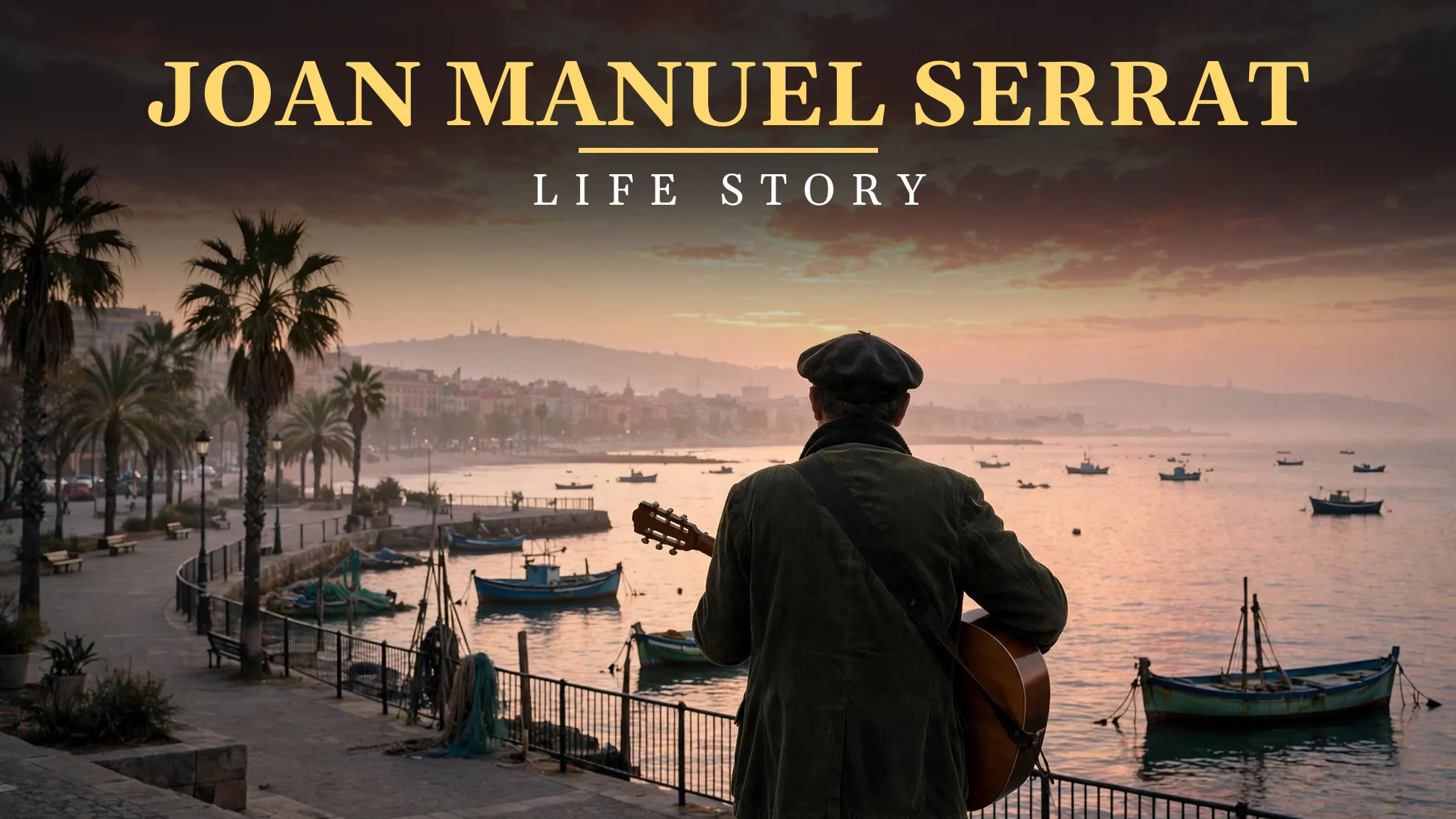
In the end, I come back to the simple image of a man with a guitar, standing on a seafront promenade at sunrise, looking out over the sea. That image is the heart of his story, because it shows a singer who is at peace, who is at home, and who is singing about the things he loves. He is not shouting, he is not showing off, and he is not trying to impress anyone. He is singing, and his song is enough. I hope his songs are sung for many more generations, because the world needs more of that calm, more of that warmth, and more of that honesty.
Frequently Asked Questions
Where was Joan Manuel Serrat born?
Joan Manuel Serrat was born on 27 December 1943 in Barcelona, in the neighbourhood of Poble-sec, a working-class area near the port. He grew up there, and his childhood in Barcelona shaped his songs for the rest of his life.
What is the Nova Cançó?
The Nova Cançó, or “New Song”, was a movement of Catalan singers in the 1960s who wanted to make modern music in the Catalan language. Serrat was one of its leading figures, and singing in Catalan under Franco’s rule was a brave cultural and political act.
Why did Serrat refuse to sing at Eurovision in 1968?
He was chosen to represent Spain with the song “La, la, la”, but he asked to sing it in Catalan, and the authorities refused. He refused to sing it in Spanish, so another singer, Massiel, sang it and won. His refusal made him a hero in Catalonia but brought him a ban and exile.
What is Joan Manuel Serrat’s most famous song?
His most famous song is “Mediterráneo”, from the album of the same name released in 1971. The song is a gentle, beautiful tribute to the Mediterranean Sea, and it is one of the most loved songs in the Spanish language.
What is the song Penélope about?
“Penélope” is a sad and beautiful song about a woman who waits for a lover who never returns, based on the story of Penelope from Greek myth. Serrat turned it into a story about a woman waiting at a station in a Spanish town, year after year.
When did Joan Manuel Serrat retire?
He announced his retirement from the stage in 2022, after a farewell tour called “El vicio de cantar” (The Vice of Singing). The tour celebrated his long career and allowed his fans to hear his greatest songs live one last time.


