Joe Pesci: The Life Story Behind the Goodfellas Star
In this post
- A Child Performer in Newark
- Music, Comedy, and the Long Road
- Raging Bull and the Big Break
- Goodfellas, the Oscar, and Tommy DeVito
- Casino, Retirement, and a Quiet Life
- The Irishman and a Triumphant Return
- Lethal Weapon, My Cousin Vinny, and the Funny Side
- The Music, the Golf, and a Man Who Left It All
- Love Ranch, the Long Wait, and the Irishman
- My Take:
Joe Pesci is a small man with a big presence. He is short, he is fast-talking, and he can turn from funny to frightening in a single second. That sudden change is what makes him unforgettable. One moment he is making you laugh, and the next moment you are afraid of what he might do. Few actors can do both at once, and Pesci does it better than almost anyone.
He started as a child, singing and performing in New Jersey, long before films found him. He worked as a musician, as a comedian, and as a barber, and he gave up acting more than once before it finally took hold. His story is not a straight line to fame. It is a story of false starts, of leaving and coming back, and of a talent that would not stay hidden.
His story runs from Newark to Hollywood, from Raging Bull to Goodfellas, from a burglar in Home Alone to a quiet mob boss in The Irishman. It is the story of a man who never wanted to be a star, who retired when he was at the top, and who came back when the right film called him.
A Child Performer in Newark
Joseph Frank Pesci was born on 9 February 1943 in Newark, New Jersey, to an Italian-American family. His father worked as a forklift driver and a bartender, and his mother worked part-time as a barber. He grew up in Belleville, New Jersey, in a working-class neighbourhood where people knew each other, where family mattered, and where a boy with talent was encouraged to show it.
As a child, he began to perform. He appeared on a television variety show as a young boy, and he sang and acted in local productions. He was a natural performer, quick, funny, and full of energy, and people around him noticed it early. He was not a shy child. He liked the stage, and the stage liked him.
He also learned to play the guitar, and music became a second love. He played in bands as a teenager, and he dreamed of a life in music as much as a life in acting. He was a working-class boy with two talents, and he did not yet know which one would carry him further. He tried both, and he kept trying, even when neither one paid very well.
The Newark years gave him his voice and his manner. He speaks fast, with a New Jersey accent, and he carries himself like a man from the streets. That quality stayed with him for the rest of his career, and it made his characters feel real. When he plays a tough man from New York or New Jersey, you believe him, because he is one.
Music, Comedy, and the Long Road
As a young man, Pesci worked as a musician, playing guitar in bands and singing in clubs. He released an album in 1968 called Little Joe Sure Can Sing!, under the name Joe Ritchie, and he performed as a singer for several years. He also worked as a comedian, performing in clubs with his friend Frank Vincent, who later became a famous actor himself. The two of them made people laugh, and they learned how to work a room, how to time a joke, and how to hold an audience.
He also worked as a barber, cutting hair to pay the bills while he waited for his break in show business. It was a hard life, and it was not glamorous, but it taught him about ordinary people. He met all kinds of men in the barber shop, and he listened to the way they talked, the way they joked, and the way they argued. That listening became part of his acting, and it gave his characters a truth that other actors could not fake.
He began to appear in films in the 1970s, taking small parts, but he did not find success quickly. He appeared in The Death Collector in 1976, a low-budget crime film, where he played a small-time criminal. The film was not a hit, but it brought him to the attention of Robert De Niro, who saw the film and was impressed by Pesci’s performance. De Niro remembered him, and that memory would change Pesci’s life.
The long road mattered. He spent years as a musician, a comedian, and a barber, and he learned how to perform in front of real people, not just cameras. He learned timing, he learned how to listen, and he learned how to be patient. When his chance finally came, he was ready, because he had spent a lifetime learning how to hold an audience.
Raging Bull and the Big Break
In 1980, Robert De Niro and Martin Scorsese cast Pesci in Raging Bull, the story of the boxer Jake LaMotta. Pesci played Joey LaMotta, Jake’s brother and manager, a man who tries to keep his brother from destroying himself. The role was the biggest of his life, and he played it with a mix of loyalty, anger, and love that made the film feel real. He was nominated for an Academy Award for Best Supporting Actor, and he became known around the world.
The film was a triumph, and it changed everything for him. He had gone from cutting hair in New Jersey to standing on the biggest stage in film, and he had done it by being himself. He did not try to be a movie star. He played a brother, a friend, and a working man, and audiences believed him because he was telling the truth.
In the years that followed, he appeared in films such as Easy Money in 1983, a comedy, and Once Upon a Time in America in 1984, Sergio Leone’s epic about gangsters. He played small but memorable parts, and he built a reputation as an actor who could be funny and frightening in the same scene. He was not a leading man, but he was a scene-stealer, and directors loved him for it.
He also appeared in the Lethal Weapon films, playing Leo Getz, a fast-talking, nervous witness who becomes a friend to the two detectives. The role was comic, and it showed that he could make audiences laugh as well as feel afraid. He was becoming one of the most versatile actors in Hollywood, and he was doing it without ever leaving behind the New Jersey boy he had been.
Goodfellas, the Oscar, and Tommy DeVito
In 1990, Pesci played Tommy DeVito in Goodfellas, Martin Scorsese’s film about the rise and fall of a mobster named Henry Hill. Tommy is a violent, unpredictable man, funny one moment and terrifying the next, and Pesci played him with a ferocity that shocked audiences. The most famous scene in the film, in which Tommy asks “What do you mean, I’m funny?” and turns a joke into a threat, became one of the most quoted scenes in film history. It is a perfect example of what Pesci can do: he makes you laugh, and then he makes you afraid, and you never know which one is coming next.
He won the Academy Award for Best Actor in a Supporting Role for the performance, and it was the highest honour of his career. He had waited a long time for it, and he had earned it with a performance that people still talk about today. Tommy DeVito is one of the great characters in American film, and Pesci made him unforgettable.
In the same period, he appeared in Home Alone in 1990, playing Harry, one of the two burglars who try to rob a house guarded by a clever boy. The film was a huge hit with families, and it showed a completely different side of Pesci. He was funny, clumsy, and harmless, and children loved him for it. He returned for Home Alone 2 in 1992, and the two films made him known to a whole new audience of young viewers.
He also appeared in My Cousin Vinny in 1992, playing a New York lawyer who defends his cousin in a small Alabama town. The film was a comedy, and Pesci played the part with a warmth and a humour that won him many new fans. He showed that he could be a leading man, not just a supporting actor, and that he could carry a film on his own.
Casino, Retirement, and a Quiet Life
In 1995, Pesci appeared in Casino, Scorsese’s film about Las Vegas, playing Nicky Santoro, a violent mob enforcer. The role was similar to Tommy DeVito, but darker, and Pesci played it with a terrifying energy that made the film feel dangerous. It was one of his last major roles for many years, and it remains one of the most powerful performances of his career.
After Casino, he began to step back from acting. He appeared in a few more films, including 8 Heads in a Duffel Bag and Gone Fishin’, but he was working less and less. In 1999, he announced that he had retired from acting, and he went to live a quiet life. He played golf, he made music, and he stayed out of the spotlight. He had been famous, he had won an Oscar, and he had decided that he had done enough. It was a rare choice in Hollywood, where most actors never stop, but it suited him. He had never wanted fame for its own sake.
He did return to music, releasing an album in 1998 called Vincent LaGuardia Gambini Sings Just for You, named after his character in My Cousin Vinny. The album was a mix of jazz and humour, and it showed that his love of music had never gone away. He was a singer before he was a film star, and he remained a singer at heart.
His personal life has been private. He was married to Claudia Haro from 1988 to 1992, and they have a daughter, Tiffany. He has kept his family life out of the public eye, and he rarely gives interviews. He is a man who values his privacy, and he has protected it throughout his career.
The Irishman and a Triumphant Return
In 2019, after twenty years away from major film roles, Pesci returned to the screen in The Irishman, Martin Scorsese’s epic about a hitman and the mob. He played Russell Bufalino, a quiet, powerful mob boss who controls everything from behind the scenes. The role was very different from Tommy DeVito. Russell is calm, soft-spoken, and patient, and Pesci played him with a restraint that surprised many viewers. He was nominated for an Academy Award for Best Supporting Actor, his third nomination, and the film brought him back to the centre of the film world.
He had turned down the role many times before accepting it, and he only agreed when Scorsese convinced him that the part was right. That reluctance tells us something about him. He does not act for money or for fame. He acts when the work matters to him, and when the director is someone he trusts. The Irishman mattered to him, and he gave it everything he had.
The return was a triumph. Critics praised his performance, audiences loved seeing him again, and the film became one of the most talked-about of the year. It proved that he had lost none of his talent during his years away, and that he could still command the screen with a quiet look or a few soft words. He was seventy-six years old, and he was still one of the finest actors working in film.
Today, Joe Pesci stands as one of the most beloved actors of his generation. He is small, he is funny, he is frightening, and he is unforgettable. He has won an Oscar, he has made audiences laugh and gasp, and he has done it all on his own terms. He is a reminder that a great actor does not need to be tall, handsome, or loud. He needs to be true, and Pesci has always been true.
Lethal Weapon, My Cousin Vinny, and the Funny Side
In 1989, Pesci joined the Lethal Weapon series, playing Leo Getz, a fast-talking, nervous witness who becomes a friend to the two detectives played by Mel Gibson and Danny Glover. Leo is a small-time criminal who talks too much, who is always in trouble, and who makes audiences laugh every time he appears. Pesci played him with a comic energy that was completely different from Tommy DeVito, and he returned to the role in Lethal Weapon 3 in 1992 and Lethal Weapon 4 in 1998. The films were huge hits, and Leo became one of the most loved characters in the series.
In 1992, he starred in My Cousin Vinny, playing Vincent LaGuardia Gambini, a New York lawyer who has never tried a case and who must defend his cousin in a small town in Alabama. The film is a comedy, and Pesci played Vinny with a warmth, a humour, and a New York swagger that won him many new fans. He showed that he could be a leading man, not just a supporting actor, and that he could carry a whole film on his own. The film remains one of the most loved comedies of the 1990s, and Pesci’s performance is the reason why.
He also appeared in comedies such as Gone Fishin’ in 1997, with Danny Glover, and in 8 Heads in a Duffel Bag in 1997, a dark comedy about a hitman who loses his bag. These films were not all successful, but they showed that Pesci was willing to try new things, and that he enjoyed making people laugh. He was not only a dramatic actor. He was a comedian, and he had been one since his early days in clubs with Frank Vincent.
What is striking about these comic roles is how different they are from his gangster parts. Leo Getz is nervous and funny. Vinny Gambini is confident and charming. Tommy DeVito is frightening. Pesci played all three with the same fast-talking New Jersey energy, but he made each one feel like a different person. That is the mark of a great actor: the voice stays the same, but the character changes, and the audience believes every one of them.
The Music, the Golf, and a Man Who Left It All
Music has always been a part of Pesci’s life. He began as a singer and a guitarist, and he released his first album, Little Joe Sure Can Sing!, in 1968, when he was still a young man. He sang jazz and pop standards, and he performed in clubs, learning how to hold an audience with his voice. He returned to music in 1998, releasing Vincent LaGuardia Gambini Sings Just for You, an album named after his character in My Cousin Vinny, and he released another album, Pesci… Still Singing, in 2019, when he was seventy-six years old. He never stopped being a singer, even when films made him famous.
After he retired from acting in 1999, he lived a quiet life, playing golf, making music, and spending time with his family and friends. He has often said that he loves golf, and that it gives him a peace that acting never did. He lives in New Jersey, close to where he grew up, and he has kept his life simple. He does not attend many Hollywood events, and he does not seek attention. He is a man who has had fame, and who has chosen to live without it.
He has remained close friends with Robert De Niro and Martin Scorsese, the two men who changed his life. De Niro remembered him from a small film and called him for Raging Bull, and Scorsese cast him in Goodfellas, Casino, and The Irishman. Those friendships have lasted for more than forty years, and they are built on trust and on shared work. Pesci does not work with just anyone. He works with people he trusts, and De Niro and Scorsese are at the top of that list.
He turned down many roles during his years away, and he only agreed to return for The Irishman when Scorsese convinced him that the part was right. That reluctance tells us something important about him. He does not act for money or for fame. He acts when the work matters, and when the people matter. That is a rare attitude in Hollywood, and it is why his performances are so strong. He only says yes when he means it.
Love Ranch, the Long Wait, and the Irishman
In 2010, Pesci returned to the screen in Love Ranch, a film about a couple who run a brothel in Nevada, playing Charlie Botero, a former boxer who owns the ranch with his wife. The role was his first major film part in more than a decade, and he played Charlie with a quiet, weary strength that showed he had lost none of his talent. It was a small film, and it was not a major hit, but it proved that he could still act, and that he was still a force on screen. It was a warm-up for the bigger return that was yet to come.
He had turned down The Irishman many times before he finally said yes. Martin Scorsese called him again and again, and Pesci said no, because he did not want to come back for just any role. He only agreed when he was convinced that the part of Russell Bufalino was right, and that the film was worth his time. That reluctance tells us something important about him. He does not act for money or for fame. He acts when the work matters, and when the people matter, and The Irishman mattered.
In the film, he plays Russell Bufalino, a quiet, powerful mob boss who controls everything from behind the scenes. The role is very different from Tommy DeVito. Russell does not shout. He does not threaten. He speaks softly, he looks at you, and you understand that he is in charge. Pesci played the part with a restraint that surprised many viewers, and it brought him his third Academy Award nomination. He was seventy-six years old, and he was still one of the finest actors in the world.
The film used new technology to make the actors look younger in some scenes, and Pesci’s performance had to work across many decades of the character’s life. He played Russell as a young man, as a middle-aged boss, and as an old man in prison, and he made each stage feel real. It was a remarkable achievement, and it proved that his twenty years away had not dulled his talent. He had simply been waiting for the right film, and when it came, he gave it everything he had.
My Take:
When I think about Joe Pesci, the first thing I feel is a little bit of fear, and a little bit of laughter, at the same time. That is his gift. He can make you laugh, and then, in the same second, he can make you afraid. Most actors can do one or the other. Pesci can do both, and he can switch between them so fast that you do not see it coming. That is why his scenes stay in your mind long after the film is over.
I admire how he started. He was a child performer, a singer, a guitarist, a comedian, and a barber. He did not go to a fancy acting school. He learned his craft in clubs, in barber shops, and on small stages, in front of real people. That is a hard way to learn, but it is a real way. He learned how to time a joke, how to listen to an audience, and how to hold a room. When he finally got to Hollywood, he already knew how to perform, because he had been performing all his life.
What I find most interesting is that he gave up acting more than once. He was a musician, he was a barber, and he was happy to leave films behind when they did not work out. That takes a kind of courage that most actors do not have. Most actors cling to fame, even when it is not working. Pesci walked away, and he lived a normal life. Then, when Robert De Niro remembered him from a small film and called him for Raging Bull, he came back, and he was ready. I think that readiness came from his years away. He had lived a real life, and he brought that life to his acting.
Raging Bull is the film I think about most, because it is the film that made him famous. He plays Joey LaMotta, the brother of a boxer who is destroying himself, and he plays the part with a mix of love and anger that feels completely real. He is not the star of the film. De Niro is the star. But Pesci is the heart of the film, because he is the man who tries to save his brother, and who fails. That failure is heartbreaking, and Pesci plays it without any tricks. He just shows a man who loves his brother and who cannot help him. I think that is one of the great supporting performances in film history.
Goodfellas is the film everyone talks about, and for good reason. Tommy DeVito is a terrifying character, and Pesci plays him with a ferocity that is hard to watch. The “funny how?” scene is famous because it shows how quickly a joke can turn into a threat. One moment Tommy is laughing, and the next moment he is staring at you, and you do not know if he is joking or if he is going to hurt you. That uncertainty is what makes the scene so powerful. I have watched it many times, and it still makes me nervous. That is great acting.
What I find remarkable is that the same man who played Tommy DeVito also played Harry in Home Alone. Harry is a clumsy burglar who gets hit on the head, who falls down stairs, and who makes children laugh. It is a completely different kind of performance, and Pesci does it just as well. That range is rare. Most actors who play a terrifying gangster cannot also play a funny burglar in a family film. Pesci can, and he does it without ever losing his own style. He is funny in both roles, but in one film the humour is frightening, and in the other it is warm. That is a gift.
I also think about My Cousin Vinny, because it shows another side of him. He plays Vinny Gambini, a New York lawyer who has never tried a case, and who has to defend his cousin in Alabama. The film is a comedy, and Pesci is funny, warm, and charming in it. He shows that he can be a leading man, not just a supporting actor, and that he can carry a film on his own. I love that film, because it is light and fun, and it shows that Pesci is not only a dark actor. He is a complete actor, and he can do almost anything.
There is something sad in his story too. He retired in 1999, when he was still at the top, and he stayed away for twenty years. I understand why. He had done enough, and he wanted a quiet life. But I also think about what we lost during those twenty years. He could have made many more great films, and we missed them. I do not blame him. A person has the right to stop, and to live a quiet life. But as a film lover, I wish he had made more films in those years. His return in The Irishman showed what we had been missing.
The Irishman is a wonderful late chapter. He plays Russell Bufalino, a mob boss who is calm, quiet, and patient, and he plays the role with a restraint that is very different from Tommy DeVito. He does not shout. He does not threaten. He just looks at you, and you understand that he is in charge. That performance brought him his third Oscar nomination, and it proved that he had lost nothing during his years away. He was seventy-six, and he was still one of the best actors in the world. I think that is remarkable.
I admire his privacy. He rarely gives interviews, he keeps his family life to himself, and he does not chase attention. He is a small man who does not need to be the centre of attention. He lets his work speak for him, and his work speaks loudly. I think that is a good way to live, especially in Hollywood, where so many people talk too much. Pesci talks on screen, and he is silent off it, and that silence makes his screen work even more powerful.
If I have a criticism, it is that he has sometimes been typecast as the violent gangster, and that typecasting has limited the roles he was offered. He is capable of much more than playing tough men, as My Cousin Vinny and Home Alone prove, but Hollywood often saw him only as Tommy DeVito. I think that is a waste of his talent, and I wish directors had given him more chances to play different kinds of men. But he made the most of the roles he was given, and he turned a stereotype into art.
For a young reader, I think the lesson of his life is about patience and about knowing yourself. He started as a child, he tried music, he tried comedy, he worked as a barber, and he gave up acting more than once. He did not rush. He waited for the right chance, and when it came, he was ready. That is a slow way to build a career, but it is a strong way. He did not become famous young, and he did not burn out. He built a career that lasted, because he knew who he was and what he could do.
I also think his story teaches something about size. He is a short man, and in Hollywood, where leading men are often tall and handsome, that could have been a problem. But Pesci turned his size into a strength. He is small, but he is fierce, and that contrast makes him even more frightening on screen. A small man who is not afraid is more dangerous than a big man who is. Pesci understood that, and he used it. That is a useful lesson for anyone who feels too small, too short, or too different. The thing that makes you different can be the very thing that makes you powerful.
When I look at his whole career, I see a man who never wanted to be a star, and who became one anyway, because his talent was too strong to hide. He played the brother, the gangster, the burglar, the lawyer, and the boss, and he made each one feel real. He retired when he wanted to, and he came back when he wanted to, and he did it all on his own terms. That is a rare and admirable life.
In the end, I think Joe Pesci matters because he shows that great acting is about truth, not about size or looks. He is small, he is fast-talking, and he is unforgettable, because he tells the truth in every role he plays. He makes us laugh, he makes us afraid, and he makes us feel, and that is what great acting is for.
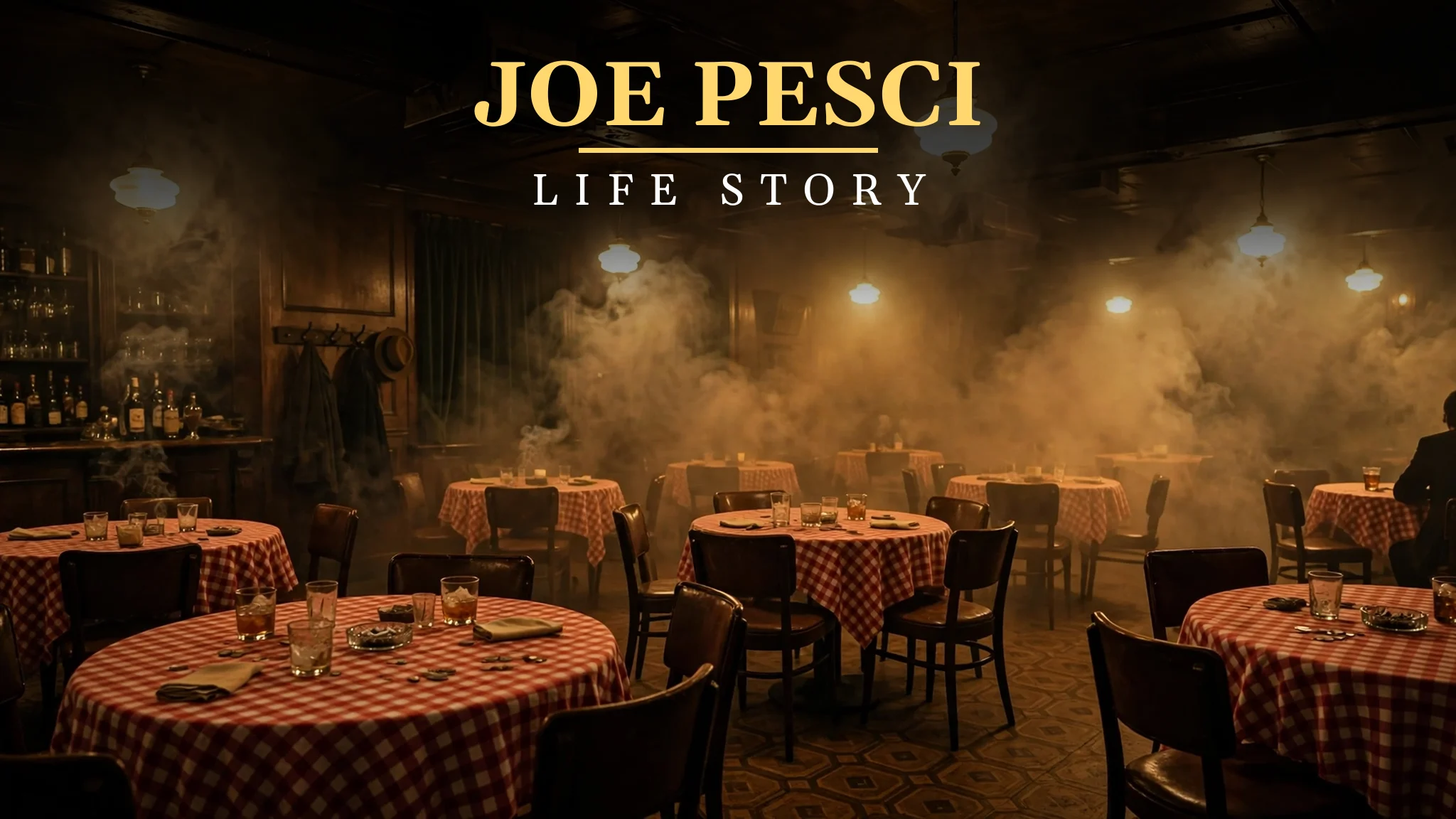
One more thought stays with me. When I picture him, I picture the smoky restaurant in the image for this story: red-checked tables, warm lamps, and one man in a dark suit, sitting alone at a far table, waiting. That is a good picture of his career, because he has always been the man at the far table, watching, waiting, and ready to act when the moment comes. And when the moment comes, no one can look away.
I also think about Leo Getz in Lethal Weapon, because it shows how funny Pesci can be. Leo is a nervous, fast-talking witness who is always in trouble, and Pesci plays him with a comic energy that makes audiences laugh every time he appears. It is a completely different kind of performance from Tommy DeVito, and it proves that Pesci is not only a dramatic actor. He is a comedian, and he has been one since his early days in clubs. I love that he could make people laugh and make people afraid, sometimes in the same year, and do both brilliantly.
Another thing I notice is his music. He released his first album in 1968, before he was famous, and he released another one in 2019, when he was seventy-six. That is more than fifty years of singing, and it tells me that music was never just a hobby for him. It was a part of who he was, from the beginning to the end. He sang jazz, he sang pop, and he sang with the same energy he brought to his acting. I think that is beautiful. A person who keeps singing for fifty years is a person who loves what they do, and who does it for joy, not for fame.
I think about his friendship with Robert De Niro, because it is one of the great friendships in Hollywood. De Niro saw Pesci in a small film, he remembered him, and he called him for Raging Bull. That one call changed Pesci’s life. Then Scorsese cast him in Goodfellas, Casino, and The Irishman, and the three of them built some of the greatest films ever made together. That is a remarkable story, and it shows what can happen when one person believes in another. De Niro believed in Pesci, and Pesci repaid that belief with performances that no one else could have given.
When I think about his retirement, I think about it as wisdom, not as giving up. He had won an Oscar, he had made great films, and he decided that he had done enough. He went to play golf, to make music, and to live a quiet life. Most actors never stop, because they are afraid of being forgotten. Pesci was not afraid. He knew what he had done, and he was content. Then, when Scorsese called him for The Irishman, he came back, because the work mattered. That is a good way to live: do the work when it matters, and live your life when it does not.
I also think about Love Ranch, his return to the screen in 2010, because it shows that he never really left. He plays Charlie Botero, a former boxer who runs a brothel in Nevada, and he plays the part with a quiet, weary strength. It was a small film, and it was not a hit, but it proved that he could still act, and that he was still a force on screen. It was a warm-up for The Irishman, and it showed that his twenty years away had not dulled his talent. He had simply been waiting, and when the right film came, he was ready.
Another thing I notice is how many times he said no to The Irishman before he said yes. Scorsese called him again and again, and Pesci kept refusing, because he did not want to come back for just any role. He only agreed when he was convinced that the part was right. That takes real courage, to say no to a great director, again and again, until the work is worthy of you. Most actors would have said yes at once, because they wanted the fame. Pesci waited, because he wanted the work to matter. That is a rare attitude, and it is why his performance as Russell Bufalino is so strong. He only says yes when he means it, and when he means it, he gives everything.
Frequently Asked Questions
Where was Joe Pesci born?
Joe Pesci was born on 9 February 1943 in Newark, New Jersey, to an Italian-American family, and he grew up in Belleville, New Jersey. His father worked as a forklift driver and bartender, and his mother worked part-time as a barber.
What did Joe Pesci do before he became a film star?
Before films, he worked as a singer and guitarist, released an album in 1968, performed comedy in clubs with Frank Vincent, and worked as a barber. He learned timing and how to hold an audience in front of real people long before Hollywood found him.
Which film first made Joe Pesci famous?
Raging Bull in 1980 made him famous, when he played Joey LaMotta, the brother and manager of boxer Jake LaMotta. The performance brought him his first Academy Award nomination and changed his career completely.
What is the famous “funny how” scene in Goodfellas?
In Goodfellas from 1990, his character Tommy DeVito asks “What do you mean, I’m funny?” and turns a joke into a threat in a few seconds. The scene became one of the most quoted in film history, and Pesci won the Oscar for the role.
Did Joe Pesci really retire from acting?
Yes, he largely retired from acting in 1999 after a long career, choosing a quiet life of golf and music. He returned to major film work twenty years later in The Irishman in 2019, playing the quiet mob boss Russell Bufalino.
How is Joe Pesci in Home Alone different from Goodfellas?
In Home Alone from 1990, he plays Harry, a clumsy burglar who makes children laugh, a complete contrast to the terrifying Tommy DeVito in Goodfellas. The two roles show his rare range, from frightening to funny, in the same year.
What did Joe Pesci win an Oscar for?
He won the Academy Award for Best Supporting Actor for Goodfellas in 1990, playing Tommy DeVito. He was also nominated for Raging Bull in 1980 and for The Irishman in 2019, giving him three Oscar nominations in total.


