Joe Root: The Life Story Behind England's Cricket Star
In this post
Joe Root was born on 30 December 1990 in Sheffield, South Yorkshire, and raised in a family where cricket was not a hobby but a way of life. His father, Matt Root, played club cricket for Sheffield Collegiate, one of the most famous club teams in England, and his mother, Helen, supported the family while the boys played. His younger brother, Billy Root, also became a professional cricketer, playing for Nottinghamshire and Glamorgan, and the two brothers grew up with a bat in their hands, playing in the garden, in the street, and at the club where their father played. Joe attended King Ecgbert School in Sheffield, where he was a good student and a talented sportsman, and he joined the Yorkshire academy as a teenager, the first step on a path that would take him to the top of world cricket.
He made his Test debut for England in December 2012, in Nagpur, India, at the age of twenty-one, and within a few years he was the best batsman in the England team, then the captain, and then, by December 2024, the highest run-scorer in England’s Test history, passing Alastair Cook’s record of 12,472 runs. He also won the World Cup with England in 2019, in one of the most dramatic finals ever played, and he has played more than 150 Test matches, scoring more than 13,000 runs, with more than thirty centuries. This is the story of how a boy from Sheffield became England’s greatest run-maker, and what it cost him to lead a team through its hardest years.
A Boy From Sheffield With a Bat in His Hands
Sheffield is a city in South Yorkshire, known for steel, for football, and for a proud, working-class culture that values hard work and loyalty. Root grew up in the suburb of Dore, in a house where cricket was discussed at the dinner table, where his father took him to Sheffield Collegiate Cricket Club, and where he learned the game from men who had played it for decades. Sheffield Collegiate is one of the most famous clubs in England, with a history that goes back to the nineteenth century, and it has produced a number of professional cricketers, including Michael Vaughan, the former England captain who also came through the Yorkshire system. Root joined the club as a boy, playing in junior teams, and he quickly showed a talent that set him apart: a straight bat, a good eye, and a temperament that did not change whether he was scoring runs or getting out.
His father, Matt, was a solid club cricketer, a man who played for the love of the game, and he coached his sons in the garden, throwing balls at them, teaching them to play straight, to leave the good balls, and to wait for the bad ones. Joe’s mother, Helen, was the organiser, driving the boys to matches, washing their whites, and making sure they did their homework. The family was close, and cricket was the thread that held it together. Joe’s younger brother Billy, born in 1992, followed him into the game, and the two brothers played together at Sheffield Collegiate, with Joe as the older, more serious brother, and Billy as the younger, more flamboyant one. That relationship, of an older brother who sets an example and a younger brother who tries to follow it, would shape Joe’s leadership style later, when he captained England and had to look after younger players.
At school, Root was a good all-round sportsman, playing football and cricket, but cricket was always his first love. He was spotted by Yorkshire scouts as a teenager, and he joined the Yorkshire academy, where he trained with other talented young players, including Jonny Bairstow, who would become his England teammate, and Adil Rashid, the leg-spinner. The academy was demanding, with early morning training, fitness work, and matches against other counties, and Root thrived in it, because he loved to practise, because he loved to bat, and because he never seemed to get tired of the game. He made his debut for Yorkshire’s second team as a teenager, and then for the first team in 2009, at the age of eighteen, playing against Essex in a County Championship match, a debut that marked him as a player to watch.
The Yorkshire Way and the Academy Years
Yorkshire is one of the great counties in English cricket, with a history that goes back to 1863, and with a tradition of producing tough, uncompromising cricketers. The county’s academy, based at Headingley in Leeds, is one of the best in the country, and it has a reputation for discipline: players are expected to turn up on time, to work hard, and to respect the game. Root fitted that culture perfectly. He was not the most naturally gifted player in the academy, and he was not the biggest or the strongest, but he was the hardest worker, the one who stayed latest in the nets, the one who asked the coaches the most questions, and the one who never complained about a bad decision or a low score.
He made his first-class debut for Yorkshire in 2009, and he scored his first century in 2010, against Kent, a hundred that announced him as a player of real quality. He also played for England’s Under-19 team, touring Sri Lanka and Bangladesh, and he was part of the England Lions, the second team, which tours and plays against other countries’ second teams. The Lions tour to Sri Lanka in 2012 was particularly important, because he scored runs against a strong attack, and because the England selectors, who were looking for a young batsman to replace the retiring players, noticed him. He was twenty-one, he was scoring runs for Yorkshire, and he was ready for the next step.
The Yorkshire years also taught him about leadership. He captained the Yorkshire second team, he learned how to talk to older players, how to encourage a bowler who was having a bad day, and how to handle the pressure of a county that expects to win. Yorkshire won the County Championship in 2014 and 2015, with Root as a key player, and those titles gave him a sense of what it meant to be part of a winning team, a feeling he would chase with England for the next decade. He also learned about the importance of the club game, about the volunteers who run the clubs, the parents who drive children to matches, and the culture of English cricket that begins in a village green and ends at Lord’s. That understanding would later make him a popular captain, because he never forgot where the game came from.
The Debut in Nagpur and the First Hundred
Root made his Test debut for England on 13 December 2012, in the fourth Test against India in Nagpur, a match that England needed to draw to win the series. He was twenty-one years old, he was batting at number six, and he was facing an Indian attack that included Ravichandran Ashwin, one of the best spinners in the world, on a pitch that was turning. He scored 73 in the first innings, a calm, composed innings that lasted more than 200 balls, and 20 not out in the second, helping England to draw the match and win the series 2-1, their first series win in India since 1984-85. The debut was a success, and it showed the selectors that they had found a batsman who could play spin, who could bat for a long time, and who did not get nervous on the big stage.
His first Test hundred came six months later, in May 2013, at Headingley, his home ground, against New Zealand. He scored 104, opening the batting, in a match that England won by 247 runs, and the hundred was celebrated by the Headingley crowd, who had watched him grow up in Yorkshire cricket. He followed it with a hundred at Lord’s in the Ashes series of 2013, scoring 180 against Australia, a innings that included a memorable moment when he was hit on the head by a bouncer and carried on batting, a sign of the toughness that would define his career. The Ashes series, which England won 3-0, made Root a household name, and it established him as a player who could perform in the biggest series in cricket.
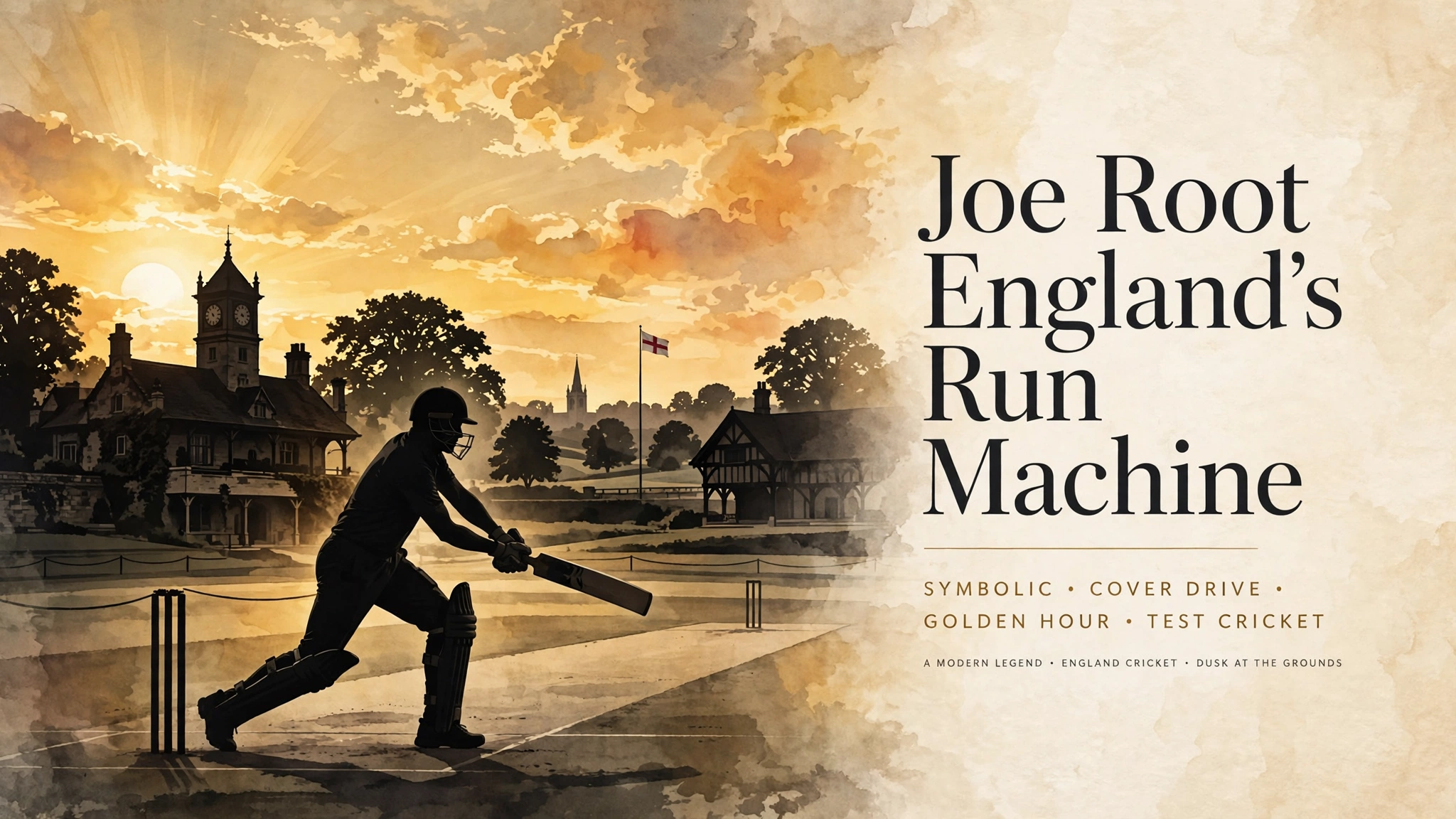
The early years of his Test career were a period of rapid growth. He scored hundreds in Australia, in the West Indies, and in England, and he rose through the rankings, reaching the top of the ICC Test batting rankings in 2015, at the age of twenty-four. He was not a power hitter, and he was not a flamboyant stroke-maker. He was a technician, a man who played the ball late, who used his wrists to guide it through the gaps, and who built an innings ball by ball, hour by hour. His cover drive, played with a straight bat and a full face, became one of the most recognisable shots in world cricket, and his ability to score runs in all conditions, on turning pitches in Asia, on seaming pitches in England, and on fast pitches in Australia, made him one of the most complete batsmen in the world.
The Rise to the Top of the Batting Rankings
By 2015, Root was the best batsman in the England team, and by 2016 he was one of the best in the world. He scored 1,477 Test runs in 2016, the most by any batsman in the world that year, and he was named in the ICC Test Team of the Year. He also became a key player in England’s limited-overs teams, playing in the World Cup in 2015, in which England were knocked out in the group stage, a failure that led to a revolution in English white-ball cricket, and in the World T20 in 2016, in which England reached the final and lost to the West Indies. Root’s white-ball batting was different from his Test batting: he was more inventive, he played ramps and reverse sweeps, and he scored quickly, but he never lost the technical foundation that made him so reliable in Tests.
The years 2015 to 2017 were also a period when Root’s personal life changed. He married Carrie Cotterell, his long-term partner, in December 2018, in a ceremony in Sheffield, and they have two children: a son, Alfred, born in January 2017, and a daughter, Isabella, born in July 2020. The marriage gave him a stability that helped his cricket, and he has spoken about how becoming a father changed his perspective, making him more patient and more aware of the importance of family. He also became a senior player in the England team, a man that younger players looked to for advice, and a man that the selectors saw as a future captain.
His batting during this period was remarkable for its consistency. He scored hundreds in South Africa, in India, in Australia, and at home, and he did it with a technique that was both classical and modern: a high elbow, a still head, and a willingness to play the ball under his eyes. He was also a useful part-time bowler, bowling off-spin, and a brilliant fielder, particularly at slip, where he took catches that other fielders would not have reached. He was, in short, a complete cricketer, and the only question was whether he would become captain, and whether captaincy would help or hinder his batting. The answer came in 2017, when Alastair Cook resigned and Root was appointed captain, at the age of twenty-six, the youngest England Test captain since Michael Vaughan.
Captaincy and the Weight of Leadership
Root was appointed England Test captain in February 2017, succeeding Alastair Cook, who had led the team for four years and who was England’s highest Test run-scorer at the time. Root was twenty-six, he was the best batsman in the team, and he was seen as a natural leader: calm, thoughtful, and popular with his teammates. His first series as captain was at home against South Africa in the summer of 2017, which England won 3-1, and his first hundred as captain came in that series, at Lord’s, a hundred that showed he could score runs while leading the team. The early months were promising, and it looked as though Root would be a successful captain.
The difficulties came on the tours that followed. In the winter of 2017-18, England toured Australia for the Ashes, and they lost 4-0, a heavy defeat that exposed weaknesses in the batting and the bowling, and that put Root under pressure. He scored runs on the tour, including a hundred in Sydney, but he also faced criticism for his tactics, for his field placements, and for his inability to inspire a team that was outplayed. The following year, England toured New Zealand and lost, and then they toured Sri Lanka and won, and then they toured the West Indies in 2019 and lost, a defeat that was particularly painful because England had been expected to win. Root’s captaincy was a mix of highs and lows, and the highs included a 3-1 win in South Africa in 2019-20, a series in which England played some of their best cricket under his leadership.
The lowest point came in the winter of 2021-22, when England toured Australia for the Ashes and lost 4-0 again, a defeat that led to calls for Root to resign. He had captained England in 64 Test matches, more than any other England captain, and he had won 27 of them, also a record, but he had also lost 26, and the team had become inconsistent, brilliant one week and poor the next. He resigned in April 2022, saying that the job had taken a toll on him, that it was time for someone else, and that he wanted to focus on his batting. The decision was widely praised, and it was followed by a remarkable revival in his batting: freed from the burden of captaincy, he scored runs at a rate he had never achieved before, including four hundreds in the summer of 2022, and he returned to the top of the batting rankings.
The Ashes, the Runs and the Records
Root’s record as a batsman is extraordinary. By the end of 2024, he had played more than 150 Test matches, scored more than 13,000 runs, and made more than 35 centuries, the most by any England batsman. In December 2024, during England’s tour of New Zealand, he passed Alastair Cook’s record of 12,472 Test runs, becoming England’s highest run-scorer in Test history, a moment that was celebrated by his teammates, by Cook himself, who was commentating on the match, and by cricket fans around the world. The record was particularly meaningful because Cook had been Root’s predecessor as captain, and because the two men had played together for years, with Cook as the senior partner and Root as the young batsman learning from him.
His Ashes record is more complicated. He has played in five Ashes series, in 2013, 2013-14, 2015, 2017-18 and 2021-22, and he has scored hundreds in Ashes matches, including 180 at Lord’s in 2013 and 190 at Lord’s in 2017, but he has never scored a hundred in Australia, a statistic that has been noted by critics and that Root himself has acknowledged. The Ashes is the biggest series in cricket, and the fact that he has not yet made a hundred in Australia is a gap in his record, one that he will have a chance to fill in future tours. His overall record against Australia is still strong, with more than 2,000 runs, but the missing hundred is a reminder that even the greatest players have a weakness, and that Root’s career, like all careers, is not perfect.
The World Cup win in 2019 was the other highlight of his career. England hosted the tournament, and Root was a key player, scoring 556 runs in the competition, including two hundreds, and taking a number of catches in the field. The final, against New Zealand at Lord’s on 14 July 2019, was one of the most dramatic matches in cricket history: the scores were tied after 50 overs, tied again after a Super Over, and England won on the boundary countback rule, a rule that has since been changed. Root was on the field for the final ball, and he has spoken about the chaos of that day, about the tension, about the joy, and about how the win changed English cricket, giving the team a belief that they could win major tournaments. He also played in the 2023 World Cup in India, in which England were disappointing, but the 2019 win remains the defining moment of his white-ball career.
The Cover Drive and the Art of Batting
What makes Root’s batting special is not power but precision. He is not a big man, and he does not hit the ball as hard as some of his contemporaries, but he places it with a accuracy that is rare. His cover drive, played off the front foot, with a straight bat and a full follow-through, is one of the most beautiful shots in cricket, and it has been photographed and filmed thousands of times. He also plays the sweep shot well, particularly against spin, and he has developed a ramp shot in white-ball cricket, scooping the ball over the wicketkeeper’s head, a shot that would have been unthinkable for a classical batsman a generation ago. The combination of classical technique and modern innovation is the reason he has succeeded in all formats, and it is the reason younger players study his batting.
His temperament is equally important. Root rarely shows emotion on the field, whether he is scoring a hundred or getting out for a duck. He walks to the crease, takes guard, and bats, with a calmness that his teammates find reassuring. That calmness is not an accident. It comes from years of practice, from playing in Yorkshire, from captaining England, and from learning to handle pressure. He has spoken about how he prepares for a match, about visualising his innings, about breathing, and about focusing on the next ball rather than the scoreboard. Those are simple ideas, and they are hard to practise, but Root practises them every day, and they are the reason he has scored so many runs.
Off the field, Root is known as a kind, humble man, a player who signs autographs for children, who thanks the groundstaff, and who treats everyone with respect. He was awarded an MBE in the 2020 New Year Honours for services to cricket, and he has used his fame to support charities, including the Sheffield Children’s Hospital and the Lord’s Taverners, a charity that gives disadvantaged children the chance to play cricket. He is, by most accounts, one of the most popular cricketers in England, not just because of his runs, but because of the way he carries himself, with a smile, with a sense of humour, and with a genuine love for the game that began in a garden in Sheffield, with a bat in his hands and his father throwing balls at him.
My Take:
When I think about Joe Root, I think about a smile, because he is the rare great batsman who looks as if he is enjoying himself even when the team is in trouble. That smile is not a performance; it is the sign of a boy from Sheffield who genuinely loves batting, and who has never lost that love despite the pressure of captaincy, the weight of records, and the pain of Ashes defeats. I think his story is a useful reminder that a career does not have to be built on anger or drama to be great. It can be built on technique, patience and joy, and it can last just as long.
The lesson I take from Root is that joy is a form of strength, because he bats with a smile that keeps him relaxed, and that relaxation helps him score runs when others tighten up. There is a quiet kind of courage in starting over after a setback, and this life has that courage in it more than once, which is why it still speaks to people today. One of the most hopeful parts of this story is that the best chapter did not always come first, because some of the finest work arrived after the setbacks, when the person knew themselves better. I think this life also teaches us about grace under pressure, because the cameras are always on, and the way a person behaves on the worst day often says more than the way they behave on the best day. I think we often forget how young these stars were when the pressure began, because a teenager carrying the hopes of a nation is still a teenager, with the same doubts and the same need for kindness as anyone else. I admire the way this person treated rivals, because respect for an opponent is often the clearest sign of confidence, and the greatest rivalries in this story made both sides better. What I notice most is how much this person had to adapt, because the game, the industry and the audience all changed, and standing still would have meant falling behind. The money and the headlines can distract from the real achievement, which is simply this: a person kept doing difficult work, in public, for many years, and kept finding ways to do it better. There is a final lesson about letting go, because every career ends, and the people who plan for that ending, and who find new purpose after it, tend to enjoy the years that follow. I believe the story also warns us about believing our own headlines, because headlines are written in a hurry, and a wise person reads them lightly and keeps working. The part of this story I would underline for parents is the role of encouragement without pressure, because the young star in this tale flourished when support came with freedom, not with fear. There is a practical lesson here about health and rest, because the body and the mind both have limits, and the stars who respect those limits usually last the longest.
I also learn from him that honesty about limits is wise, because stepping down as captain improved his batting and his happiness, and knowing when to let go is a skill. What stays with me about this life is not the list of honours, because honours fade from memory, but the way a person kept showing up when the work was hard and the applause was far away. What I hope readers remember is not a single number or a single date, but the feeling of this life: that hard work, honestly done, can still take a person further than anyone expected. I find the late chapters of this life especially moving, because they show a person learning to enjoy the work again after years of carrying it like a burden. I think the deepest lesson is about identity, because when the cheering stops, a person still needs to know who they are without the title, the shirt or the stage. This life shows that a dream can be both bigger than the person and still within reach, because the gap between the two is closed one small step at a time. I would also point to the courage it took to change, because changing a style, a team or a whole direction in front of millions of watching eyes is far harder than it looks. I keep thinking about the cost of fame in this life, because the same attention that brings love also brings judgement, and learning to live with both is a skill nobody is born with. What makes this story worth reading again is that it refuses to be only one thing, because it holds triumph and trouble side by side, and that is how real lives actually feel. I think the legacy here is not only about records, because records are made to be broken, but about the standard that was set for everyone who came after. The final thought I keep returning to is balance, because a great career is only part of a good life, and the people who protect their health, their family and their peace tend to enjoy the journey far more. I keep returning to the small moments in this story, because the grand finals are easy to remember, while the quiet practice sessions and the kind words are the parts that actually built the career.
His 2021 run-scoring year teaches me that consistency is built in the nets, because the runs that looked effortless were the result of thousands of hours of quiet practice. What I take away most is that consistency beats intensity, because a person who shows up every day for years will usually outlast the person who burns bright for one season. The story also shows that talent without humility rarely lasts, because the moment a person believes they have nothing left to learn, the game or the audience moves on without them. I think this story earns its place because it is not only about one person, because it also tells us something about the country, the era and the sport or art that shaped them. There is something reassuring about a career that was not perfect, because perfection is a myth, and a real life with mistakes in it is far more useful to the rest of us. I keep coming back to the idea of discipline, because talent opens the door, but discipline is what keeps a person in the room year after year. The most interesting question this story leaves behind is not what was won, but what comes next, because a great career creates a platform, and what a person does with that platform matters just as much. I think the real lesson here is about patience, because the world loves an overnight success story, yet almost every overnight success took years of quiet mornings to build. I admire the way the best years of this career were not just about winning, because winning alone is empty, and the joy seemed to come from playing the game well and sharing it with others. There is a lesson here about handling the days when nothing works, because every long career has them, and the difference between quitting and continuing is often just one more morning of trying. There is a generosity in this career that is easy to miss, because giving time, money or encouragement to others rarely makes the headlines, yet it shapes how a person is remembered. The part of this story that feels most human is the beginning, when nobody knew the name and the dream looked far too big for the life around it.
The Ashes defeats remind me that even the greatest players have an unconquered mountain, and that having one keeps a career honest and hungry. If you read this story as a map rather than a museum piece, you can see the choices that mattered: which coach to trust, which risk to take, which offer to refuse, and when to rest. If there is one thing to copy from this life, it is the habit of preparation, because the great performances that look effortless are almost always the most rehearsed. I find myself thinking about the young people reading this story, because the message for them is simple: start where you are, use what you have, and keep going long enough for luck to find you. There is something honest about a career that includes failure, because it reminds the rest of us that a bad day, a lost final or a poor season does not have to define a whole life. Looking at this career from a distance, the pattern is clear: the early years were about learning, the middle years were about proving, and the later years were about giving something back to the game or the art that made it all possible. What strikes me most is the patience in this story, because the world wanted everything fast, and this person kept choosing the slower, steadier road instead. I believe the most useful lesson is about handling pressure, because the pressure never really goes away, and the people who last learn to carry it without letting it crush them. I notice how often the turning points in this life came from other people: a coach who believed, a parent who sacrificed, a friend who told the truth when flattery would have been easier. The story reminds me that support matters as much as skill, because nobody reaches the top alone, and the people who carried the bags, kept the home and believed early deserve a share of the credit. The legacy of this life will probably be argued about for years, and that is fine, because the argument itself shows how much the work mattered to people. The older I look at this story, the more I see the role of family and close friends, because fame is loud, and a steady private life is what keeps a person standing.
Finally, his Yorkshire roots show me that staying close to home can keep a person grounded, because Root never forgot where he came from or who helped him get here. What I would tell a young reader is to look past the trophies and study the routines, because the trophies are the result, while the routines are the part anyone can actually copy. I notice that the most loved moments in this career were often the shared ones, because a victory celebrated with a team, a family or a crowd lasts longer in memory than a victory celebrated alone. This life shows that a dream can be both bigger than the person and still within reach, because the gap between the two is closed one small step at a time. I think this life also teaches us about grace under pressure, because the cameras are always on, and the way a person behaves on the worst day often says more than the way they behave on the best day. I think we often forget how young these stars were when the pressure began, because a teenager carrying the hopes of a nation is still a teenager, with the same doubts and the same need for kindness as anyone else. The older I look at this story, the more I see the role of family and close friends, because fame is loud, and a steady private life is what keeps a person standing. What I would tell a young reader is to look past the trophies and study the routines, because the trophies are the result, while the routines are the part anyone can actually copy. I think the legacy here is not only about records, because records are made to be broken, but about the standard that was set for everyone who came after. There is a practical lesson here about health and rest, because the body and the mind both have limits, and the stars who respect those limits usually last the longest. There is something reassuring about a career that was not perfect, because perfection is a myth, and a real life with mistakes in it is far more useful to the rest of us. I admire the way this person treated rivals, because respect for an opponent is often the clearest sign of confidence, and the greatest rivalries in this story made both sides better.
The story also shows that talent without humility rarely lasts, because the moment a person believes they have nothing left to learn, the game or the audience moves on without them. The legacy of this life will probably be argued about for years, and that is fine, because the argument itself shows how much the work mattered to people. I would also point to the courage it took to change, because changing a style, a team or a whole direction in front of millions of watching eyes is far harder than it looks. If there is one thing to copy from this life, it is the habit of preparation, because the great performances that look effortless are almost always the most rehearsed. What makes this story worth reading again is that it refuses to be only one thing, because it holds triumph and trouble side by side, and that is how real lives actually feel. There is a quiet kind of courage in starting over after a setback, and this life has that courage in it more than once, which is why it still speaks to people today. I keep thinking about the cost of fame in this life, because the same attention that brings love also brings judgement, and learning to live with both is a skill nobody is born with. I keep coming back to the idea of discipline, because talent opens the door, but discipline is what keeps a person in the room year after year. What strikes me most is the patience in this story, because the world wanted everything fast, and this person kept choosing the slower, steadier road instead. I think this story earns its place because it is not only about one person, because it also tells us something about the country, the era and the sport or art that shaped them. There is a generosity in this career that is easy to miss, because giving time, money or encouragement to others rarely makes the headlines, yet it shapes how a person is remembered. I keep returning to the small moments in this story, because the grand finals are easy to remember, while the quiet practice sessions and the kind words are the parts that actually built the career. I think the real lesson here is about patience, because the world loves an overnight success story, yet almost every overnight success took years of quiet mornings to build. The part of this story I would underline for parents is the role of encouragement without pressure, because the young star in this tale flourished when support came with freedom, not with fear. I believe the story also warns us about believing our own headlines, because headlines are written in a hurry, and a wise person reads them lightly and keeps working. Looking at this career from a distance, the pattern is clear: the early years were about learning, the middle years were about proving, and the later years were about giving something back to the game or the art that made it all possible.
Frequently Asked Questions
When was Joe Root born?
Joe Root was born on 30 December 1990 in Sheffield, England.
Is Joe Root England’s leading Test run-scorer?
Yes, in 2024 he passed Alastair Cook to become England’s leading run-scorer in Test cricket.
How many Tests did Joe Root captain for England?
He captained England in a record 64 Test matches, winning 27 of them.
What is Joe Root known for as a batsman?
He is known for a beautiful cover drive, superb timing, and being one of the best players of spin in the world.
Did Joe Root win the Ashes in Australia?
No, he has not yet won an Ashes series in Australia, either as a player or as a captain.


