John Cusack: The Life Story Behind Hollywood's Romantic Star
In this post
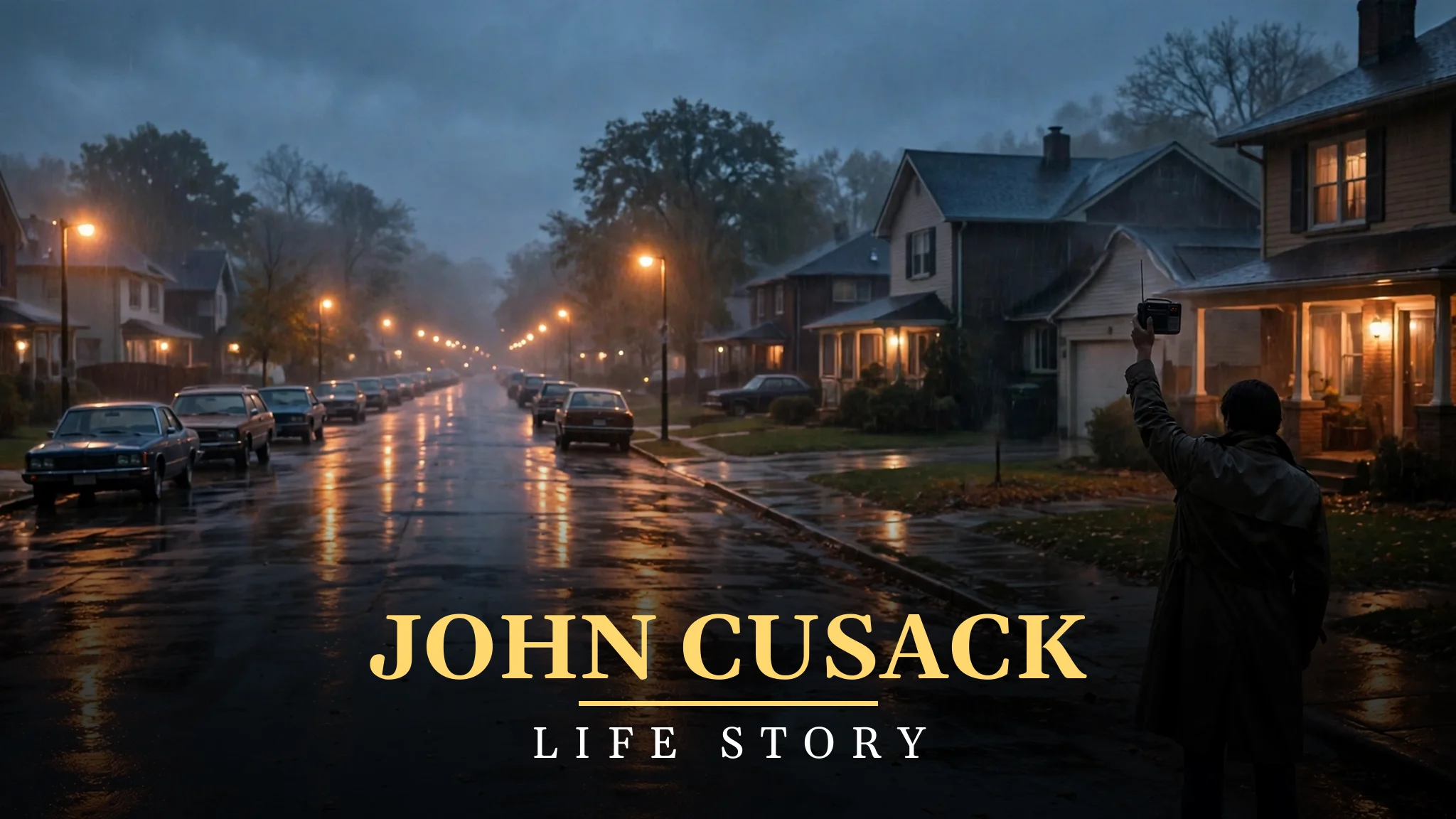
There is a single image that defines John Cusack for millions of people. A young man stands outside a girl’s house in the rain, holding a boombox above his head, playing a love song into the night. He does not knock on the door. He does not shout. He just stands there, wet and hopeful, and lets the music speak for him. That scene, from the film Say Anything, has become one of the most famous moments in American cinema, and it tells you almost everything you need to know about Cusack as an actor. He has always played men who feel too much, who care too much, and who do not know how to hide it.
John Cusack was born into a family of actors in Illinois, and he grew up on stages and in rehearsal rooms. He was a child actor who became a teenage star, and then a grown man who refused to play by Hollywood’s rules. He could have been a conventional leading man. He had the looks, the talent, and the early success. But he chose a different path. He chose strange films, funny films, dark films, and films that asked hard questions. He wrote his own scripts, he produced his own work, and he spoke his mind about politics and about the film industry itself.
He is also a man who has stayed close to his roots. He never moved to Los Angeles to live the Hollywood life. He kept his home in Chicago, he kept his friendships from childhood, and he kept working with the same people again and again. His sister Joan became a famous actress too, and the two of them have shared the screen more than once. This is the story of an actor who became a symbol of romantic hope for a whole generation, and who then spent the rest of his career proving that he was much more than that one scene in the rain.
Growing Up Cusack in Evanston
John Paul Cusack was born on 28 June 1966 in Evanston, Illinois, a town just north of Chicago. His father, Dick Cusack, was an actor and filmmaker, and his mother, Nancy, was a teacher. John was one of five children, and almost all of them went into acting. His older sister Ann, his sister Joan, his brother Bill, and his younger sister Susie all worked as actors at one time or another. The Cusack house was full of scripts, rehearsals, and talk about films and plays. For a child growing up in that house, acting was not a strange dream. It was the family business.
Evanston in the 1970s was a comfortable, leafy suburb, but the Cusack family was not a conventional suburban family. Dick Cusack was a man with strong political views, and he raised his children to think about the world, to ask questions, and to care about justice. The children were encouraged to read, to argue, and to form their own opinions. John took this seriously. He was a thoughtful boy, sometimes quiet, sometimes funny, and he had a mind that was always working. He did not just want to perform. He wanted to understand why people did the things they did, and that curiosity would shape his acting for the rest of his life.
As a boy, John joined the Piven Theatre Workshop in Evanston, a respected acting school run by Byrne Piven, the father of the actor Jeremy Piven. The workshop was a serious place, and it taught young actors to work hard, to listen, and to find the truth in a scene. John spent years there, and he learned the craft from the ground up. He appeared in plays, he worked with other young actors, and he began to understand that acting was not about showing off. It was about being honest, about being present, and about trusting the other people on stage with you.
The Piven Workshop also gave him a community. Many of the friends he made there would stay with him for the rest of his life, and many of them would work with him again and again in films. That sense of loyalty to a group of people, to a place, and to a way of working would become one of the defining features of his career. He was not an actor who moved from project to project, collecting famous co-stars. He was an actor who built a circle of people he trusted, and who returned to them whenever he could.
A Teenage Star in the 1980s
John Cusack began acting in films while he was still a teenager. His first film role came in 1983, in the comedy Class, and he followed it with a small part in Sixteen Candles in 1984, the beloved teen film directed by John Hughes. He was only eighteen years old, but he already had a natural ease on screen. He did not look like he was acting. He looked like a real teenager, funny, awkward, and full of feeling. That natural quality made him stand out, and directors began to notice him.
In 1985, he starred in The Sure Thing, a romantic comedy about a college student who travels across America to meet a girl he has only seen in a photograph. The film was a success, and it showed that Cusack could carry a film on his own. He was charming without being slick, and he was funny without trying too hard. Audiences liked him, and they liked the way he played young men who were smart, sensitive, and a little bit lost. He was not the typical teen idol of the 1980s. He was something more interesting, and people could feel it.
The 1980s gave him a string of roles in films about young people, including Better Off Dead, Stand by Me, and The Journey of Natty Gann. Each of these films showed a different side of him, and each of them added to his reputation as one of the most talented young actors of his generation. He worked hard, he learned from every director, and he began to think about what kind of actor he wanted to be. He did not want to be a teen star forever. He wanted to grow, to take on harder roles, and to make films that meant something.
By the end of the decade, he was ready for the role that would define him. In 1989, he starred in Say Anything, directed by Cameron Crowe, playing Lloyd Dobler, a young man who falls in love with a clever, ambitious girl named Diane Court. Lloyd is not rich, he is not a genius, and he does not have a plan for his life. What he has is a good heart, and the courage to stand outside Diane’s window in the rain, holding a boombox above his head. The film was a success, and the boombox scene became famous around the world. For many people, Lloyd Dobler became the ideal of what a young man in love should be: honest, brave, and unafraid to show his feelings.
The Nineties: Grosse Pointe Blank and a Writer’s Mind
The 1990s were the decade when John Cusack became more than an actor. He became a writer, a producer, and a man who chose his own path. He did not want to wait for Hollywood to offer him good roles. He wanted to create them himself. In 1997, he starred in Grosse Pointe Blank, a dark comedy about a hitman who returns to his hometown for his high school reunion. Cusack co-wrote the film, and he produced it as well. The film was funny, strange, and full of feeling, and it showed a side of Cusack that audiences had not seen before. He could be dark, he could be dangerous, and he could still make you laugh.
Grosse Pointe Blank was also a film about going home, about facing the past, and about wondering whether a person can change. These were themes that mattered to Cusack, and he returned to them again and again. The film was made with his friends, and it had a personal feeling that many Hollywood films lack. It was not a big studio product. It was a film made by people who cared about it, and audiences could feel the difference. It became a cult favourite, and it remains one of his best-loved films.
In 1999, he appeared in Being John Malkovich, a strange and brilliant film directed by Spike Jonze. Cusack played Craig Schwartz, a puppeteer who discovers a doorway into the mind of the actor John Malkovich. The film was unlike anything else in cinemas at the time, and it was praised by critics around the world. Cusack’s performance was brave and funny, and it showed that he was willing to take risks that other leading men would never take. He did not care about looking handsome or heroic. He cared about the story, about the idea, and about the strange, wonderful world the film created.
The same period brought him roles in films such as Con Air, where he played a federal marshal, and The Thin Red Line, the war film directed by Terrence Malick. These were big, serious films, and they showed that Cusack could work with the most respected directors in the world. He was no longer just the boy with the boombox. He was a mature actor, a writer, a producer, and a man who had built a career on his own terms. He had done it without moving to Los Angeles, without playing the Hollywood game, and without giving up the things he believed in.
High Fidelity and the Art of Talking to the Camera
In 2000, John Cusack starred in High Fidelity, a film based on the novel by Nick Hornby. He played Rob Gordon, the owner of a failing record shop in Chicago, a man who has just been left by his girlfriend and who decides to revisit his past relationships to understand where he went wrong. Cusack co-wrote the screenplay, and he produced the film as well. It was a deeply personal project, and it showed in every scene. Rob Gordon talks directly to the camera, he makes lists of his favourite songs, and he tries to understand why love keeps failing him. The film was funny, sad, and honest, and it became one of the most loved films of its time.
High Fidelity worked because Cusack understood the character so well. Rob Gordon is a man who hides behind music, who uses songs and lists to avoid facing his own feelings. Cusack played him with a mixture of humour and pain, and he made the audience care about a man who was often selfish, often foolish, and often wrong. The film was also a love letter to Chicago, to record shops, and to the kind of friendships that are built around shared taste in music. It was a film that could only have been made by someone who loved those things, and Cusack did.
The film also showed his skill as a writer. He had a gift for dialogue that sounded like real people talking, for jokes that were smart without being cruel, and for scenes that were funny and sad at the same time. He was not just an actor reading someone else’s words. He was a creator, shaping the story from the beginning. That creative control mattered to him, and it would shape the rest of his career. He wanted to make films that he believed in, even if they were not the biggest hits, and High Fidelity proved that this approach could work.
In the years that followed, he continued to mix big films with small ones. He appeared in Serendipity, a romantic comedy, and in 1408, a horror film based on a story by Stephen King, in which he played a writer who spends a night in a haunted hotel room. He appeared in War, Inc., a political satire that he co-wrote and produced, and in Grace Is Gone, a quiet drama about a father who must tell his daughters that their mother has died in the war in Iraq. Each of these films showed a different side of him, and each of them reflected his interests, his politics, and his belief that films should say something true about the world.
Politics, Principles, and Speaking Out
John Cusack has never been afraid to say what he thinks, and this has made him one of the most outspoken actors in Hollywood. He has written about politics, he has spoken about war, about the power of large corporations, and about the need for ordinary people to stand up for what they believe. He has used social media to share his views, and he has taken part in public debates that many actors would avoid. For Cusack, this is not a hobby. It is part of who he is, and it comes from the way he was raised. His father taught him to think, to question, and to care about justice, and he has carried those lessons into his adult life.
This outspokenness has had a cost. Hollywood is a business, and studios do not always like actors who criticise the system. Some people in the industry have said that his views made it harder for him to get big roles, and Cusack himself has spoken about the way the film business has changed, with fewer mid-budget films and fewer chances for actors to make the kind of movies he loves. He has not apologised for his views, and he has not softened them to please anyone. He believes that a person with a public voice has a duty to use it, and he has lived by that belief.
His political work has also shaped the films he has chosen. He has been drawn to stories about power, about ordinary people caught in difficult situations, and about the gap between what governments say and what they do. He has produced and acted in films that ask hard questions, and he has supported independent filmmakers who want to tell stories that the big studios will not touch. For him, film is not just entertainment. It is a way to think about the world, to challenge people, and to start conversations that matter.
In recent years, he has continued to act, to write, and to speak out. He has appeared in films and television shows, he has worked with young directors, and he has kept his home in Chicago. He has never become a Hollywood insider, and he has never tried to be one. He has remained what he always was: a thoughtful, funny, stubborn man from Evanston who loves films, who loves his family, and who believes that art should mean something. That independence has cost him some roles, but it has also given him something more valuable. It has given him a career that is truly his own.
Chicago, Family, and a Life Lived on His Own Terms
John Cusack has always been a Chicago man. While many actors move to Los Angeles and build their lives around the film industry, Cusack stayed close to his roots. He has lived in Chicago for much of his life, and the city has shaped him. It is a city with a strong sense of itself, a place where people are direct, where they work hard, and where they do not suffer fools gladly. Cusack has that same quality. He is direct, he is funny, and he does not pretend to be something he is not. Chicago gave him a home, and it gave him a place to return to when the work was done.
His family has always been close to him. His sister Joan became one of the most respected actresses of her generation, and the two of them have worked together in films such as Say Anything, Grosse Pointe Blank, and High Fidelity. Their scenes together have a warmth and a humour that comes from a real relationship, and audiences can feel it. His other siblings have also worked in acting, and the Cusack family remains one of the most remarkable acting families in America. For John, family is not just a private matter. It is part of his work, and part of his life.
He has never married, and he has spoken about his private life only rarely. He prefers to keep his personal world separate from his public work, and he has guarded that privacy carefully. In a world where celebrities share everything, Cusack has chosen to share only what he wants to share. That choice is part of his independence. He does not owe the public his private life, and he has never pretended otherwise. He gives his work to the world, and he keeps the rest for himself.
As he has grown older, Cusack has continued to work, taking on roles in films and television, writing, and speaking about the things he cares about. He has not tried to stay young, and he has not tried to repeat his early success. He has let his career change as he has changed, and he has found new kinds of roles that suit the man he has become. He is no longer the boy with the boombox, but he is still the same person: thoughtful, funny, stubborn, and honest. That is a rare thing in Hollywood, and it is why his fans have stayed with him for so long.
Why John Cusack Still Matters
John Cusack matters because he showed a generation of young men that it was all right to feel things deeply. Lloyd Dobler, standing in the rain with a boombox, became a symbol of a new kind of hero. He was not a warrior, he was not a rich man, and he was not a genius. He was a boy who loved a girl, and who was brave enough to show it. For millions of people, that image became a standard for what love should look like: honest, open, and unafraid. That is a powerful legacy, and it is one that Cusack carries with grace, even though he has spent much of his career trying to show that he is more than that one scene.
He also matters because he refused to let Hollywood decide who he was. He wrote his own films, he produced his own work, and he spoke his mind, even when it cost him. In an industry that rewards obedience, he chose independence. That choice made his career harder, but it also made it more honest. Young actors who look at his career can see that there is another way to work in films, a way that does not require giving up your beliefs or your friends. That lesson is worth more than any single box office hit.
His films will last because they are about real people. High Fidelity is about a man who cannot understand love, and who tries to learn. Grosse Pointe Blank is about a man who wants to change, and who is not sure if he can. Say Anything is about a boy who loves a girl, and who is brave enough to say so. These are simple stories, but they are told with honesty, humour, and feeling, and that is why people still watch them. Cusack’s work reminds us that a film does not need to be big to be important. It needs to be true.
My Take:
When I think about John Cusack, I think about the boombox first, and I think that is all right, because the boombox matters. It matters not because it is a famous scene, but because of what it says about love. Lloyd Dobler does not buy Diane a present. He does not write her a long letter. He does not try to impress her with money or with clever words. He stands outside her house in the rain, holding a boombox above his head, and he lets a song do the talking. That is a brave thing to do, because it is a public thing to do. Everyone on the street can see him. He could be laughed at. He could be ignored. He does it anyway, because he loves her, and because he wants her to know it. I think that is one of the most honest images of love in all of cinema, and I think it is why people still remember it.
I admire Cusack because he never tried to be a conventional movie star. He could have done it. He was good looking, he was talented, and he had a huge hit with Say Anything. Hollywood was ready to make him the next romantic leading man, to put him in one romantic comedy after another, to make him rich and famous in the easiest possible way. He said no. He chose Grosse Pointe Blank, a film about a hitman. He chose Being John Malkovich, a film about a doorway into another man’s head. He chose High Fidelity, a film about a sad man in a record shop. None of those are easy choices. They are the choices of a man who cares more about the work than about the fame, and I respect that more than I can say.
What I find most interesting about him is his loyalty. He has worked with the same people again and again, he has kept his home in Chicago, and he has stayed close to his family. In Hollywood, people change friends as often as they change films. They move to Los Angeles, they forget where they came from, and they build a new life that has nothing to do with the old one. Cusack did not do that. He kept his friends from the Piven Theatre Workshop, he kept working with his sister Joan, and he kept his roots in Evanston and Chicago. That loyalty tells me that he is a person who values real relationships over useful ones, and that is a rare quality in any business, let alone in Hollywood.
I also admire his willingness to speak his mind. It would be easy for a famous actor to stay quiet, to avoid politics, to smile for the cameras and say nothing that might upset anyone. Cusack does the opposite. He writes, he argues, he criticises, and he takes sides. I do not agree with everything he says, and I do not think anyone should agree with everything a celebrity says, but I respect the courage it takes to speak when silence would be easier. He comes from a family that taught him to think and to care about justice, and he has carried that teaching into his adult life. That is not a small thing. It is easy to forget your principles when you become rich and famous. It is much harder to keep them, and he has kept his.
There is a sadness in his story too, and I want to be honest about it. I think his career could have been bigger, in the simple sense of more leading roles in more successful films, if he had been willing to play the Hollywood game. He has spoken about this himself, about the way the film business changed, about the way mid-budget films disappeared, and about the way actors who speak out can find doors closing. I find that sad, because he is a talented man, and the world would be better if talented people were given more chances to make the films they believe in. But I also think there is something noble about his choice. He traded a bigger career for an honest one, and that is a trade that takes real courage.
I think about High Fidelity a lot, because it is a film that understands something true about people. Rob Gordon hides behind music. He makes lists, he argues about songs, and he uses his taste in records as a way to avoid facing his own failures in love. I think many of us do the same thing, in different ways. We hide behind our work, behind our hobbies, behind our opinions, because it is easier than admitting that we have made mistakes. Cusack understood that, and he played it with a mixture of humour and pain that felt completely honest. I do not think many actors could have done that. It takes a person who knows himself, who knows his own faults, to play a character like that without making him a joke or a villain.
If I have a criticism, it is that I sometimes wish he would make more films like the ones he made in the late 1990s and early 2000s. Grosse Pointe Blank and High Fidelity are films that feel personal, that feel like they were made by someone who cared deeply about them. In recent years, he has appeared in many films, but not all of them have that same feeling. I understand why. The film business is hard, and an actor must work, but I hope he finds another project that he loves as much as those two, and that he writes it, produces it, and makes it his own. He still has that talent, and the world still needs films like that.
What I learn from John Cusack is a lesson about staying true to yourself. He could have been a bigger star if he had been willing to be someone else. He chose to be himself, and that choice cost him some things, but it also gave him something that money cannot buy. It gave him a career that he can be proud of, a life that he chose, and a set of films that people still love. I think that is a good trade. I think most people, if they are honest, would rather be proud of their work than famous for something they do not believe in.
I also learn something about love from his most famous scene. Lloyd Dobler does not try to be perfect. He does not try to be rich or clever or strong. He tries to be honest. He stands in the rain and he shows Diane who he really is, and he hopes that is enough. I think that is the best advice about love that any film has ever given. You cannot buy love, you cannot trick someone into loving you, and you cannot pretend to be someone you are not. You can only be honest, be brave, and hope that the other person sees you clearly. That is what Lloyd does, and that is why people still love him.
When I watch Cusack’s films now, I see a man who grew up in public, who made mistakes, who took risks, and who never stopped trying to make films that mattered. He is not a perfect actor, and he is not a perfect person, but he is an honest one, and honesty is the rarest thing in Hollywood. I hope he keeps working, keeps writing, and keeps speaking his mind, because the world needs more people like him, people who care about the work, who care about their friends, and who care about the truth.
In the end, I think John Cusack teaches us that a good life is not about becoming the biggest star. It is about finding your people, doing work you believe in, and staying true to where you came from. He found his people at the Piven Theatre Workshop, he did work he believed in with Grosse Pointe Blank and High Fidelity, and he stayed true to Chicago and to his family. That is a full life, and it is a life worth admiring. The boombox in the rain was only the beginning. The real story is what came after, and it is a story about a man who refused to let fame change him.
One more thought stays with me. The boombox scene works because it is simple. A boy, a girl, a song, and the rain. There is no trick, no special effect, no clever twist. It is just a person showing another person how he feels. I think that is why it has lasted for so many years. In a world full of noise, simplicity is powerful. Cusack understood that, and he built a career on that same simplicity: honest acting, honest writing, and honest feelings. I would rather watch one honest film than ten loud ones, and I believe he would say the same.
I also keep thinking about his work in 1408, because it shows a side of him that people forget. He spends most of that film alone in a hotel room, talking to himself, frightened, and trying to stay sane. There is no one to act with, no love interest, no friend to lean on. It is just one man, in one room, facing his own fear. Cusack carries the whole film on his shoulders, and he does it brilliantly. That is a hard thing to do, and it proves that he is a much stronger actor than many people give him credit for. He does not need a big cast or a big budget. He needs a good story and a camera, and he can do the rest himself.
Another thing that moves me is the way he has worked with his sister Joan over so many years. Their scenes together in Grosse Pointe Blank and High Fidelity have a warmth that comes from a real relationship, from a lifetime of knowing each other, of growing up in the same house, of sharing the same jokes. You cannot fake that. When they are on screen together, you feel like you are watching two people who truly know each other, and that feeling is precious. Family is at the heart of his work, and it is at the heart of his life, and I respect that deeply.
I also think about the price he paid for his independence. Hollywood is a business, and it does not always reward people who speak their minds. Cusack has said things that made powerful people uncomfortable, and he has made films that challenged the way things work. That takes courage, and it has cost him roles. But I think he would say it was worth it, because a career built on silence is not a career worth having. He chose to speak, and he chose to make films he believed in, and that choice is what makes his work matter. I would rather be honest and less famous than famous and silent, and I think he would say the same.
Finally, I think about what his career means for young people who want to make films. He shows them that you do not need permission from a big studio to tell a story. You can write it yourself, you can produce it yourself, and you can make it with your friends. Grosse Pointe Blank and High Fidelity were made that way, and they are still loved today. That is a powerful lesson: if you have a story, tell it, even if no one offers you the money to tell it. Find a way, work with people you trust, and make it yourself. Cusack did that, and his films are still here, still funny, still sad, and still true.
I also think about the way Cusack has handled getting older in an industry that worships youth. He has not tried to stay young, he has not chased the same roles he played at twenty-five, and he has not pretended that time has stood still. He has let his career change as he has changed, taking on roles that suit the man he is now, writing when he wants to write, and speaking when he wants to speak. That is a dignified way to grow older in public, and it is one that many stars never learn. They cling to the past, they try to repeat their early success, and they end up looking sad. Cusack did the opposite. He moved forward, he found new things to do, and he stayed true to himself. That is a lesson for all of us: growing older is not something to fear. It is something to embrace, if you are willing to change with it.
Frequently Asked Questions
What is the boombox scene in Say Anything?
In Say Anything, John Cusack plays Lloyd Dobler, who stands outside the home of Diane Court in the rain and holds a boombox above his head, playing a love song for her. The scene has become one of the most famous romantic moments in American film.
What films did John Cusack write and produce himself?
He co-wrote and produced Grosse Pointe Blank in 1997, a dark comedy about a hitman returning for his high school reunion, and he co-wrote and produced High Fidelity in 2000, about a record shop owner revisiting his past relationships.
Is John Cusack related to Joan Cusack?
Yes, Joan Cusack is his older sister. Both grew up in Evanston, Illinois, in a family of actors, and they have appeared together in films such as Say Anything, Grosse Pointe Blank, and High Fidelity.
Why did John Cusack stay in Chicago instead of moving to Los Angeles?
Cusack has kept his home in Chicago because he values his roots, his friendships, and a life away from the Hollywood system. He began acting at the Piven Theatre Workshop in Evanston and has stayed loyal to the people and the place where he started.
What kind of roles did John Cusack play in the 1990s?
In the 1990s he played a wide range of roles, including a hitman in Grosse Pointe Blank, a puppeteer in Being John Malkovich, a federal marshal in Con Air, and a soldier in The Thin Red Line, showing his range beyond romantic comedies.
Has John Cusack ever been married?
John Cusack has never married, and he keeps his private life largely out of the public eye. He prefers to let his films and his writing speak for him rather than sharing personal details.
What is High Fidelity about?
High Fidelity is about Rob Gordon, a record shop owner in Chicago who has just been left by his girlfriend and decides to revisit his five worst break-ups to understand where he went wrong in love.


