John Hurt: The Life Story Behind the Screen Legend
In this post
John Hurt was one of those actors whose face told a story before he even spoke, with a thin and thoughtful face, a voice that could be soft and sad, and a talent for playing men who were broken, brave, and deeply human. He was a man who could play a monster and make you feel sorry for him, who could play a hero and make you see his fear, and who could play a villain and make you understand why he did what he did. Millions of people know him as Kane in Alien, the man who sits down to dinner on a spaceship and whose chest bursts open in one of the most famous scenes in cinema, and millions more know him as John Merrick in The Elephant Man, a man whose face is badly deformed and whose heart is gentle and kind. Behind those famous roles lies a long career that began in art school, moved through the theatre, and ended with a knighthood and a place among the greatest actors Britain has ever produced.
He was born in Chesterfield, a town in Derbyshire, and he grew up as the son of a clergyman, in a home where books and religion were part of everyday life. He did not come from a theatre family, and he did not go to drama school as a young man. He studied art, he worked as a teacher, and he found his way onto the stage through a love of stories and a desire to understand people. That slow and unusual path gave him a maturity and a depth that many younger actors do not have, and it shaped the kind of performer he became.
What makes his story worth telling is the range of his work and the honesty of his performances. He played Caligula, he played Winston Smith, he played a heroin addict, he played a wizard, and he played a Doctor, and each time he made the character feel real. He was not a man who chased fame, and he did not try to be a star in the loud sense. He chose good work, he played complex people, and he let his talent speak for itself. This is the story of how a boy from Chesterfield became Sir John Hurt, and how he did it by working hard, by being brave, and by staying true to himself.
A Chesterfield Boy and the Son of a Clergyman
John Vincent Hurt was born on 22 January 1940 in Chesterfield, Derbyshire, England. His father, Phineas, was a clergyman in the Church of England, and his mother, Arnould, was a former actress who had given up the stage to raise a family. John was the youngest of three children, and he grew up in a home where books, music, and religion were part of everyday life. He went to school in Derbyshire, and he showed an early love of art and of drawing, which would later lead him to art school and to a career that began far from the stage.
He was a quiet and thoughtful boy, and he liked to watch people and to understand why they behaved as they did. He was not the loudest boy in the room, but he had a clear voice and a strong presence, and teachers noticed that he could hold an audience when he spoke. He also had a love of the countryside, of walking in the hills around Chesterfield, and of reading books that opened up new worlds to him. Those early years gave him a love of stories that would stay with him for the rest of his life.
As a young man he went to Grimsby Art School and then to Saint Martin’s School of Art in London, where he studied painting and drawing. He was good at art, and he worked as a teacher for a time, but he felt that something was missing. He liked to paint, but he wanted to tell stories with his whole body and his voice, not just with a brush. That feeling grew stronger, and in his early twenties he decided to apply to drama school, a brave decision for a man who had already built a life in another field.
He was accepted into the Royal Academy of Dramatic Art, RADA, in London, and he trained there in the early 1960s. He was older than most of his fellow students, and he brought a maturity and a focus that came from having worked in the real world. He learned voice, movement, and the study of plays, and he worked hard to make up for the years he had spent away from the stage. His teachers saw that he had a rare talent, and they gave him the chance to play leading roles in student productions.
RADA, I Claudius, and the First Great Roles
After RADA, Hurt began his professional career on the stage and in small film parts, and he soon became known as a thoughtful and talented actor. He appeared in the film A Man for All Seasons in 1966, playing Richard Rich, and his performance was noticed by critics who saw that he had a special gift for playing men who are weak, ambitious, and human. He worked in the theatre, in television, and in film, taking on a wide range of parts and learning his craft night after night.
His great breakthrough on television came in 1976, when he played Caligula in the BBC series I, Claudius, a drama about the Roman emperors. Caligula is a mad and cruel emperor, and Hurt played him with a mixture of charm, madness, and terror that made audiences unable to look away. His performance was praised as one of the greatest ever seen on British television, and it made him known to viewers across the country. He showed that he could play a monster and make him feel human, and that is a rare skill.
He also appeared in the film Midnight Express in 1978, playing Max, a heroin addict in a Turkish prison, and his performance won him a BAFTA Award and an Academy Award nomination for Best Supporting Actor. He played Max with a raw and honest power, showing the pain of addiction and the fear of prison in a way that made audiences feel as if they were there with him. The film was a success, and it brought him to the attention of Hollywood directors who saw that he was an actor of great depth.
The stage and television years gave Hurt a strong base, and they taught him how to work with a company, how to listen to other actors, and how to make a performance feel alive every night. He was a serious and dedicated actor, and he prepared carefully for every role. He did not seek attention for himself, and he did not try to be a celebrity. He simply did the work, and he did it well, and that is why directors kept asking him back.
Alien, The Elephant Man, and World Fame
Hurt’s most famous film role came in 1979, when he played Kane in Alien, the science fiction horror film directed by Ridley Scott. Kane is the crew member who finds an egg on an alien planet, and who is attacked by a creature that lays an egg inside him. In one of the most famous scenes in cinema, the alien bursts out of his chest during a meal on the spaceship, and Hurt’s performance in that scene, his shock, his pain, and his fear, made it unforgettable. The film was a huge success, and it made him known to audiences around the world.
The next year he played John Merrick in The Elephant Man, a film directed by David Lynch about a man in Victorian London whose face and body are badly deformed, and who is treated as a freak by the world. Hurt played Merrick under heavy make-up, and his performance was praised as one of the greatest ever seen on screen. He showed Merrick as a gentle, intelligent, and kind man who wants to be loved, and he made audiences cry for a character they might otherwise have feared. He was nominated for the Academy Award for Best Actor, and he won a BAFTA Award for his work.
He also appeared in the film 1984 in 1984, playing Winston Smith, the hero of George Orwell’s novel about a future where the government watches everyone. He played Winston as a quiet and brave man who tries to think for himself in a world that forbids thought, and his performance was praised for its sadness and its power. The film was a success, and it showed that Hurt could carry a whole film on his shoulders with the strength of his acting alone.
These three films, made within five years of each other, made Hurt a star, and they showed the world what he could do. He could be a spaceman, a deformed man, and a rebel in a future world, and each time he made the character feel real. He was not a conventional leading man, and he did not look like a Hollywood star, but his talent made him unforgettable, and audiences loved him for it.
A Life of Many Roles and Many Films
After Alien and The Elephant Man, Hurt took on a wide range of film roles, showing that he was far more than a horror actor. He appeared in Heaven’s Gate, in The Hit, in Scandal, and in many other films that showed his range. He played in the film Rob Roy, in Contact, in V for Vendetta, and in other films that brought him to new audiences. He could be a villain, a hero, a father, or a friend, and each time he made the character feel real, even when the story was strange or dark.
He also worked in television, appearing in dramas and in series that showed his talent for playing complex men. He played in the series The Naked Civil Servant, in which he played Quentin Crisp, a flamboyant and brave man who lived openly as a gay man in a time when that was dangerous. His performance was praised for its honesty and its courage, and it won him a BAFTA Award. He showed that he was not afraid to play characters who were different, and that he understood the pain of being an outsider.
He voiced characters in animated films, including The Lord of the Rings, in which he voiced Aragorn, and Watership Down, in which he voiced Hazel, the rabbit hero. His voice was soft and clear, and it made those characters feel warm and real, even though the audience could not see his face. He understood that a voice can tell a story as well as a face, and he used his voice with great skill throughout his career.
By the time he was cast as Ollivander in Harry Potter, Hurt had already spent decades in film and television, and he had built a body of work that was rich and varied. He was not a newcomer who had been given a lucky break. He was a seasoned actor who had earned his place, and he brought all of that experience to every role he played, whether it was large or small.
Ollivander, Doctor Who, and Later Fame
Hurt’s later fame came when he was cast as Garrick Ollivander in the Harry Potter films, the wandmaker who sells Harry his first wand in the first film, and who returns in later films to help Harry understand the power of wands. Ollivander is a small but important character, and Hurt played him with a quiet and mysterious power that made audiences remember him. He appeared in Harry Potter and the Philosopher’s Stone in 2001, and in Harry Potter and the Deathly Hallows in 2010 and 2011, and his scenes with Daniel Radcliffe were among the most loved in the series.
He also played the War Doctor in the television series Doctor Who, in the fiftieth anniversary special The Day of the Doctor in 2013. The War Doctor is a version of the Doctor who fought in a great war, and who carries the guilt of his actions. Hurt played him with a sadness and a wisdom that made the character unforgettable, and fans of the series loved his performance. He showed that he could join a beloved series and make it his own, even in a single episode.
His later work also included the film Jackie, in which he played a priest, and the film Tinker Tailor Soldier Spy, in which he played Control, the head of British intelligence. He continued to work into his seventies, taking on parts that interested him and that challenged him, and he did not stop learning. He was knighted in 2015, becoming Sir John Hurt, in recognition of his services to drama, and the honour was a fitting mark of a lifetime of great work.
The later years were a time of great happiness for Hurt, because he was working with young actors who admired him, and with directors who respected his talent. He became a mentor to many, and he taught them by example how to be a professional. His work in those later films and television shows will be remembered for as long as people watch Harry Potter and Doctor Who, and it is a fitting crown to a long and great career.
Marriages, Family, and a Private Life
Hurt’s private life was kept largely out of the public eye, and he preferred to let his work speak for itself. He was married four times, and he had two sons, Sasha and Nick, with his third wife, Joan Dalton. His marriages were not always happy, and he spoke honestly about the difficulties of being an actor and a husband at the same time. He did not hide his mistakes, and he did not pretend that his life was perfect, but he kept working and he kept trying to be a good father to his sons.
He was known for his kindness to young actors, for his generosity, and for his sense of humour, which was dry and sharp. He did not seek attention for his private life, and he did not court the press, but those who knew him spoke of a man who was kind, funny, and deeply loyal to his friends. He lived in Norfolk, in the east of England, and he enjoyed a quiet life away from the film set when he was not working, spending time with his family, with his books, and with his love of the countryside.
He was also known for his love of art, which had been his first career, and he kept painting and drawing throughout his life. He understood that art and acting are both ways of telling stories, and he brought that artistic eye to every role he played. He did not see acting as a job that ended when the camera stopped. He saw it as a way of life, and he lived it with the same care and the same attention that he brought to a painting.
Through all the years of fame, Hurt kept a strong link to his family and to his home in Norfolk, and he kept returning there when he could. He understood that fame can fade, but home and family last, and he kept those things close to his heart. He was a man who loved his work, loved his sons, and loved to tell stories, and that is a good life by any measure.
Illness, Death, and a Lasting Legacy
In 2015, Hurt was diagnosed with pancreatic cancer, a serious illness that he spoke about with honesty and with courage. He continued to work for as long as he could, and he did not hide his illness from the public. He received treatment, and he kept acting, appearing in films and on television even while he was ill. He showed a bravery that inspired many people who were facing their own illnesses, and he did it with the same quiet strength that he brought to his acting.
He died on 25 January 2017, at the age of seventy-seven, just three days after his birthday, and his death was mourned around the world. Tributes came from actors, directors, and from fans who had grown up watching him in Alien, in The Elephant Man, and in Harry Potter. Theatres in London dimmed their lights in his honour, and newspapers around the world wrote about his life and his work, remembering him as one of the greatest actors Britain has ever produced.
His legacy is not measured in one famous film or one hit television show, but in the many performances he gave, the many audiences he moved, and the many younger actors who learned from his example. He was a leading light of British theatre and film, and he helped to keep the tradition of great, honest acting alive for new generations. His work in Alien, in The Elephant Man, in 1984, and as Ollivander will be watched and remembered for years to come, and each new audience will discover a performer who is brave, sad, funny, and true.
Today John Hurt stands as one of the great actors of his time, a knight, a BAFTA winner, and a performer whose work touched audiences in theatres, cinemas, and living rooms around the world. His story is one of talent, bravery, and honesty, and it shows that a long career built on real skill can be more lasting than a short burst of fame. He did the work, he did it well, and he kept doing it, and that is a legacy any actor would be proud to leave.
He is also remembered for his thin face, for his soft voice, and for his love of stories, and those memories will stay with the people who knew him and who saw him work. He was a man who could play a monster and make you feel sorry for him, and that is a rare gift. That is a life well lived, and a legacy that will last for generations to come.
His influence can also be seen in the way younger actors now talk about acting. Many of them speak of him as an example of how to build a life in the craft without losing yourself, and how to keep learning even after you have won awards. He showed that the work does not end when the applause ends, and that the next role is always a chance to learn something new.
My Take:
When I think about John Hurt, the first thing I feel is a sense of awe at the range of his talent. I have seen many actors who are good in one kind of role, but Hurt was good in every kind of role. He could play a spaceman, a deformed man, a Roman emperor, a wizard, and a Doctor, and each time he made the character feel real. I admire that range, because it is not easy to do. It takes a lifetime of work, a deep understanding of people, and a willingness to take risks, and Hurt had all of those things.
I think his performance in The Elephant Man is one of the greatest things ever seen on screen, and I feel sad that many people have never seen it. He plays John Merrick under heavy make-up, and yet you can feel his kindness, his intelligence, and his sadness through the make-up. I watched that film and I cried, not because the film is loud or sad in a simple way, but because Hurt is so gentle and so true. He shows Merrick as a man who wants to be loved, and that is a powerful thing for an actor to do.
I admire the way he played Kane in Alien, because it would have been easy to make that scene a simple shock. Hurt did not do that. He played Kane as a man who is curious, who is brave, and who is afraid, and when the alien bursts out of his chest, you feel his shock and his pain as if it were your own. I watched that scene and I felt as if I was there on the spaceship, and that is what a great actor does. He takes a moment that could be silly, and he makes it real and terrifying.
I also think about his role as Winston Smith in 1984, and I feel that it is one of the most important performances of his career. He plays a man who tries to think for himself in a world that forbids thought, and he does it with a quiet sadness that stays with you long after the film ends. I think about the world we live in today, and I feel that Winston’s story is still relevant, because it reminds us that freedom of thought is precious, and that we must protect it.
What moves me most in his story is his honesty about his illness. He was diagnosed with pancreatic cancer, and he spoke about it openly, and he kept working for as long as he could. I think that is brave, because many famous people try to hide their illness. Hurt did not hide. He faced it with dignity, and he showed other people who are ill that it is possible to keep living, to keep working, and to keep being yourself, even when times are hard. That is a lesson I carry with me.
I also think about his childhood as the son of a clergyman, and how that shaped him. He grew up in a home where books and religion were part of everyday life, and he learned to think about big questions: what is right, what is wrong, and what does it mean to be human. I think that gave his performances a depth that other actors do not have. He was not just playing a character. He was asking questions about life, and he was inviting the audience to ask those questions too.
I think about his role as Caligula in I, Claudius, and I find it fascinating that a man who was so kind in real life could play such a cruel emperor. Yet even in that role, you can see Hurt’s intelligence and his understanding of power, and you can see why Caligula is so dangerous. He is not a monster. He is a man who has been given too much power, and who has lost his way, and that makes him more frightening than a simple monster. I think that shows how well Hurt understood people.
I also think about his work as Quentin Crisp in The Naked Civil Servant, and I admire his courage in playing a gay man who lived openly in a time when that was dangerous. He played Crisp with honesty and with pride, and he showed that it is possible to be yourself even when the world tells you not to be. I think that is a powerful message, and it is one that still matters today, when many people still face prejudice for who they are.
I think his story teaches us about the value of starting late and of following a different path. He studied art, he worked as a teacher, and he did not go to drama school until his early twenties, yet he became one of the greatest actors of his time. I think that is an important message for young people who do not have a straight path. It tells them that talent and hard work matter more than where you start, and that you can learn your craft at any age, if you are willing to work for it.
I also feel that his voice is one of the most beautiful things about his work. It was soft and clear, and it made every line he spoke feel important. When I hear him as Ollivander, I feel as if I am in a magic shop, and when I hear him as Hazel in Watership Down, I feel as if I am in a field with rabbits. That is a rare gift, and it is one that made him unforgettable. I wish more actors would learn from him, and understand that how you speak can be as important as what you say.
When I look at his later work, I see a performer who never stopped growing. He played the War Doctor in Doctor Who, he played Control in Tinker Tailor Soldier Spy, and he played a priest in Jackie, and he was still able to surprise an audience in his seventies. I think that is a hopeful message for older people, because it shows that life does not end at sixty or seventy. It can get richer and more interesting, if you keep learning and keep working.
I think about his death in 2017, and I feel sad that we have lost such a great actor. He died just three days after his seventy-seventh birthday, and he had so much more to give. Yet I also feel glad that he lived a long and full life, and that he left so much work behind for us to enjoy. His films, his television dramas, and the memories of his stage performances will stay with us, and new audiences will discover him for years to come. That is a good legacy, and it is one that few actors can match.
I also think about the young actors in Harry Potter, and how lucky they were to work with him. He was a mentor to them, and he taught them by example how to be a professional, how to be kind, and how to enjoy the work. I think that kind of teaching is more important than any award, because it passes the craft on to the next generation, and it keeps the theatre and the film world alive.
In the end, I think John Hurt’s story is about talent, bravery, and honesty. He did not chase fame, he did not chase money, and he did not chase the easy roles. He chased good work, and he found it, again and again, for more than fifty years. He played monsters and heroes, emperors and wizards, and he played them all with a depth and an honesty that made audiences love him. I admire him for that, and I think his life is a lesson for anyone who wants to do something well.
One more thought stays with me, and it is about the quiet power of his face. I have seen many handsome actors, and I have forgotten most of them. Hurt’s face was thin and thoughtful, and it stayed with you. It is the face of a person who has lived, who has suffered, and who has learned. I think that is the best kind of acting, and the best kind of life: not loud, not showy, but true.
I also think about how he made John Merrick feel like a real person to a whole generation of viewers. Many people who saw The Elephant Man will never forget Merrick’s kindness, and that is a wonderful thing. He gave them a man who was deformed on the outside and beautiful on the inside, and he made the world see that beauty. I think that is a gift that will last for a long time.
I also think about his love of art, and how he kept painting throughout his life. That tells me he was a man who loved to create, who loved to look at the world, and who wanted to understand it. He did not just act. He lived as an artist, and he brought that artistic spirit to everything he did. I think that is a beautiful way to live, and it is one that I hope to remember.
Finally, I think his story is a reminder that a long career built on real skill can be more lasting than a short burst of fame. He worked for more than fifty years, he played hundreds of roles, and he left a legacy that will be remembered for a long time. I am glad that I have had the chance to learn from his life, and I hope that other people will learn from it too, because it shows what happens when talent meets hard work, and when bravery meets honesty.
I also think about the boy from Chesterfield who went to art school, and how far he travelled from that small beginning. He became a knight, he became Ollivander, and he became one of the greatest actors of his time, yet he never forgot where he came from. That is a good lesson for anyone who leaves home to follow a dream: you can go far, you can change, and you can still carry the best parts of home with you.
One last thought stays with me, and it is about the way he listened on stage. In every role I have read about, he listened to the other actors as if what they were saying truly mattered. That is a rare skill, and it is one that makes every scene better. I think we could all learn from it, in our own lives, to listen more and to speak less, and to give other people the same attention that Hurt gave to his fellow actors.
I also think about the many people who wrote tributes to him after his death, and how they all spoke of his kindness. He was not just a great actor. He was a great person, and the people who knew him will miss him for that as much as for his work. That is the best kind of legacy, and it is one that I hope to leave in my own life.
One more lesson I take from him is about not being afraid to be different. He did not look like a Hollywood star, and he did not try to be one. He was himself, thin and thoughtful, and he trusted that his talent was enough. I think we should all try to be more like that, to be ourselves, and to trust that our own voice is enough.
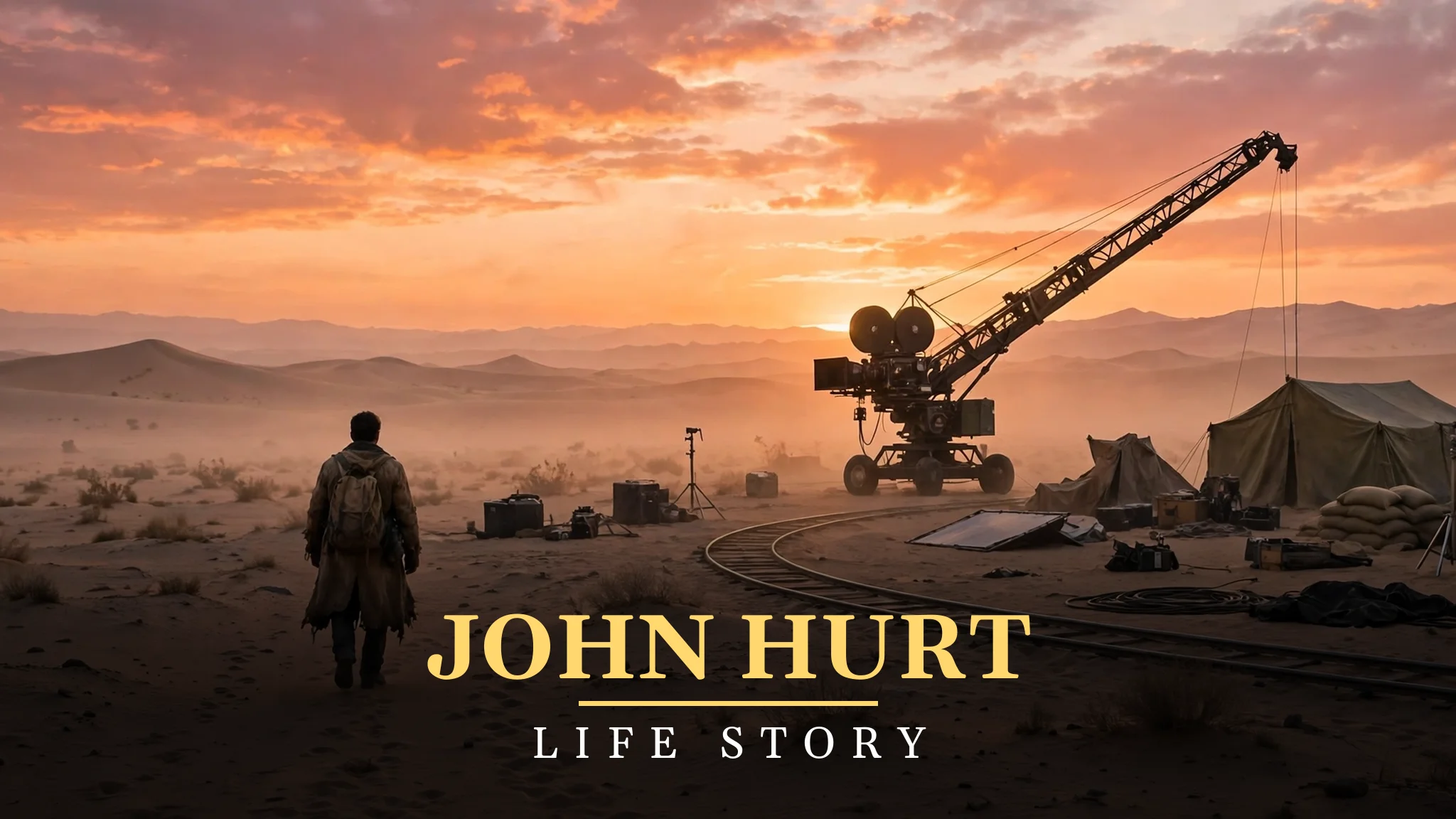
Finally, I think about the image of him walking across a desert film set at sunset, with a camera crane and tents around him. It is a fitting image for a man who spent his life on film sets, telling stories in strange and beautiful places. He knew that people are not simple, and that even the most broken person can have a brave heart. That is a truth worth remembering, and it is one that Hurt’s life and work teach us well.
Frequently Asked Questions
Why was John Hurt’s performance in The Elephant Man so praised?
He played John Merrick under heavy make-up with gentleness and intelligence, showing a kind man inside a deformed body, and he was nominated for an Oscar for it.
What happened to John Hurt’s character in Alien?
He played Kane, who is attacked by an alien creature, and in a famous dinner scene the alien bursts out of his chest, one of the most famous moments in cinema.
What did John Hurt play in I, Claudius?
He played the mad emperor Caligula in the 1976 BBC series, a performance praised as one of the greatest ever seen on British television.
Was John Hurt knighted?
Yes, he was knighted in 2015 for his services to drama, becoming Sir John Hurt, one of the most honoured actors in Britain.
What was John Hurt’s role in Harry Potter?
He played Garrick Ollivander, the wandmaker who sells Harry his first wand, appearing in the first film and in the final two films.
Who did John Hurt play in Doctor Who?
He played the War Doctor in the fiftieth anniversary special The Day of the Doctor in 2013, a Doctor who fought in a great war.
When did John Hurt die?
He died on 25 January 2017 at the age of seventy-seven from pancreatic cancer, an illness he had spoken about openly and bravely.


