John Mellencamp: The Life Story Behind Rock's Small Town Star
In this post
- A Boy Born Fighting in Seymour
- Teenage Trouble and a First Taste of Music
- Johnny Cougar and the Long Climb
- Jack and Diane and the American Heartland
- Farm Aid and a Voice for Farmers
- Hard Years, New Music, and Staying True
- Still Singing, Still Painting, Still Seymour
- Painting, Acting, and a Wider Life
- My Take:
John Mellencamp sings about small towns because he comes from one, and he never tried to hide it. His voice is rough, his songs are plain, and his stories are about ordinary people who work hard, love their homes, and feel left behind by a changing country. When Jack and Diane played on the radio in 1982, millions of listeners heard their own youth in it. Two young people, a small town, and a future that felt both wide open and already closing in.
He was born in Seymour, Indiana, a town in the south of the state where factories, farms, and Friday night football shaped daily life. He grew up in a working family, learned the guitar as a teenager, and dreamed of a life in music while most people around him expected him to stay and work like everyone else. The road from Seymour to the top of the charts was long, and it was full of wrong turns, bad advice, and a stage name he did not choose.
What makes his story last is not one hit song. It is the way he kept going for more than fifty years, writing songs about America as he saw it, painting pictures, speaking his mind, and helping farmers through Farm Aid. He fought with record companies, he fought for his name, and he fought to keep his music honest. He is still working today, still touring, still recording, and still telling the truth as he sees it.
His voice is the first thing people notice, and it is not a smooth voice. It is rough, a little worn, and full of feeling, like a man who has spent a lifetime talking to ordinary people and listening to their stories. When he sings about a small town, you believe him, because he still lives in one. When he sings about work, you believe him, because he has worked hard all his life. That honesty is rare in popular music, where many singers pretend to be something they are not. John Mellencamp never pretended. He sang about Seymour, Indiana, because that was where he came from, and he sang about the people there because they were the people he knew best.
His songs have been used in films, in television shows, and in advertisements, and they have been covered by other artists who admired his writing. That is a sign of a great songwriter. When other singers want to record your songs, it means your words are strong enough to stand on their own. John has written songs that other people want to sing, and that is a compliment that money cannot buy. His music has travelled far beyond Indiana, to every corner of America and to many other countries, and it has found listeners who have never been to a small town but who understand the feelings in his songs.
He has also been a painter for many years, and his paintings have been shown in galleries across America. His paintings are bold, direct, and full of colour, much like his songs. He paints portraits of people, scenes from American life, and images that are both funny and sad. Painting gave him a second way to express himself, a quiet way to work away from the stage and the studio. It also showed that he is an artist in the fullest sense, a man who needs to make things, whether they are songs or pictures, and who is not content to do only one thing.
A Boy Born Fighting in Seymour
John Mellencamp was born on 7 October 1951 in Seymour, Indiana. He arrived in the world with a serious problem. He had spina bifida, a condition that affects the spine, and as a baby he needed surgery to correct it. The operation saved his life, and it left him with a scar and a sense that life had given him a hard start. He grew up knowing that he had survived something serious before he could even walk, and that feeling stayed with him.
His family lived an ordinary life in a small Indiana town. His father worked in the electrical industry, and his mother kept the home running. John was the third child in the family, and he was a restless boy who liked to move, to play, and to make noise. He was not a quiet child who sat still. He wanted to be outside, to be with friends, and to find something that felt bigger than the streets around his home.
Seymour was the kind of place where everyone knew everyone else. The town had factories, churches, schools, and a main street where people met and talked. For a boy with big dreams, it could feel both safe and small. John loved the place, but he also felt the pull of somewhere else. He listened to the radio, heard the music coming out of Memphis and Detroit and New York, and wondered if a boy from Indiana could ever be part of that world.
As a teenager, he found the guitar. Music gave him a voice, and it gave him a way to say things he could not say in ordinary talk. He played in local bands, learned songs by other artists, and began to write his own. He was not a polished student of music. He learned by playing, by listening, and by trying again when a song did not work. The guitar became the tool he would use for the rest of his life.
Teenage Trouble and a First Taste of Music
John’s teenage years were not easy. He was a wild young man who liked to test limits, and he got into trouble more than once. He was arrested as a teenager, and he spent time thinking about what kind of life he wanted. He married young, at the age of eighteen, and he soon became a father. The early marriage did not last, but it taught him a hard lesson about growing up fast and taking responsibility for his choices.
He kept playing music through those years, even when life was messy. He formed bands, played in bars and clubs around Indiana, and tried to get noticed. The music scene in the Midwest was small, and a young singer had to work hard to be heard. John played wherever he could, and he learned how to hold a crowd, how to read a room, and how to keep going when the pay was low and the audience was small.
In the mid-1970s, he decided to try his luck in New York. He drove east with little money and a lot of hope, and he looked for anyone who would listen to his songs. The city was full of young musicians with the same dream, and it was easy to be ignored. John did not give up. He played his songs for anyone who would stop and listen, and he kept knocking on doors until one opened.
That door opened when he met Tony DeFries, a manager who had worked with David Bowie. DeFries saw something in the young man from Indiana and signed him to a record deal. It was the break John had been waiting for, but it came with a price. The company decided to call him Johnny Cougar, a name John did not like and did not choose. He was told that his real name did not sound right for a rock star, and he had to live with a false name for years.
Johnny Cougar and the Long Climb
His first albums came out under the name Johnny Cougar, and they did not make him a star. The records sold slowly, the reviews were mixed, and John felt that the music did not sound like him. He was being pushed toward a slick, commercial sound that did not fit the plain, honest songs he wanted to write. He argued with the record company, but he was young, and he had little power. He kept working, kept touring, and kept learning how the music business really worked.
The turning point came slowly, album by album. He began to write songs that sounded more like the life he knew, songs about small towns, working people, and young love. His voice grew stronger, and his band grew tighter. He toured constantly, playing small halls and clubs, and he built a following of fans who liked his direct style. He was not a glamorous star. He was a working musician, and that honesty began to win people over.
In 1979, he released an album called John Cougar, and in 1980 he followed it with Nothin’ Matters and What If It Did. The songs were getting better, and the radio began to pay attention. He scored a hit with a song called I Need a Lover, which showed that his plain, driving rock could reach a wide audience. It was not yet the big breakthrough, but it proved that he could write a song people wanted to hear again and again.
By the early 1980s, John had started to take back control of his name and his music. He began to use the name John Cougar Mellencamp, a step toward the name he was born with. He was tired of being a product shaped by other people. He wanted to be himself, and he wanted his songs to sound like the place he came from. The next album would change everything, and it would make him one of the biggest stars in American rock.
Jack and Diane and the American Heartland
In 1982, John released the album American Fool, and it became a huge success. The album included two songs that would define his career. Hurts So Good was a driving rock song about desire and pain, and it became a hit. Jack and Diane was a slower, sweeter story about two American teenagers in a small town, holding on to each other while life moved fast around them. The song went to number one, and it made John Mellencamp a star.
Jack and Diane worked because it was true to life. The song did not talk about fame or luxury. It talked about a boy and a girl, a small town, and the feeling that youth does not last forever. The line about life going on long after the thrill of living is gone hit listeners hard, because it was honest. People in small towns across America heard their own story in it, and they made the song their own.
The album that followed, Uh-Huh, came out in 1983 and kept the run going. It included songs like Pink Houses and Crumblin’ Down. Pink Houses became one of his most famous songs, a portrait of America that was both loving and angry. It talked about people in small houses, working hard, dreaming of something better, and finding that the American dream did not always work out the way they had been told. The song was catchy, but it was also serious, and that mix became his trademark.
By the mid-1980s, John Mellencamp was one of the biggest rock stars in America. He was selling millions of records, playing large arenas, and appearing on television and magazine covers. He had finally won back his real name, and he was making the music he wanted to make. The boy from Seymour had become a voice for the American heartland, and people listened because he sounded like he meant every word.
Farm Aid and a Voice for Farmers
In 1985, John helped start Farm Aid, a concert and a movement to help American family farmers who were losing their land. He joined Willie Nelson and Neil Young in putting on the first Farm Aid concert in Illinois, and the event raised money and attention for farmers in trouble. It was not a one-time show. Farm Aid became a yearly event, and John stayed involved for decades, playing the concerts and speaking out for the people who grow the food the country eats.
Farm Aid showed a new side of John. He was not just a singer. He was a man who used his fame to help people who had no voice in the music business. He had grown up around working people, and he knew what it felt like to be ignored by powerful companies and distant politicians. The farmers he met were losing their farms to debt, and he felt their pain as his own. He spoke plainly about it, and he did not stop.
His music in the late 1980s and early 1990s kept that spirit. Albums like Scarecrow, The Lonesome Jubilee, and Big Daddy dealt with work, family, loss, and the changing American landscape. The Lonesome Jubilee brought in fiddles and accordions, giving his rock a folk sound that felt like the countryside itself. Songs like Paper in Fire, Cherry Bomb, and Check It Out showed a writer who was growing older and thinking harder about what lasts in life.
He also began to paint. Painting became a second art for him, a quiet way to express himself away from the stage. He painted portraits and scenes in a bold, direct style, and he held exhibitions of his work. Some people were surprised that a rock star could paint, but John did not care. He had always been an artist who needed more than one way to say what he felt, and painting gave him that.
Hard Years, New Music, and Staying True
The 1990s brought changes and hard times. Music changed, radio changed, and the big rock stars of the 1980s had to find a new place. John kept recording, but his albums sold less than they had before. He had a heart attack in 1994, a serious warning that forced him to slow down and take care of his health. He recovered, but the experience changed him. He thought more about time, about family, and about what mattered most.
He kept writing songs that were honest and direct. Albums like Dance Naked, Mr. Happy Go Lucky, and John Mellencamp showed a man who was still looking for the truth in his music. He worked with new musicians, tried new sounds, and refused to become a nostalgia act who only played his old hits. He still played Jack and Diane and Pink Houses at his shows, because the fans loved them, but he also played new songs, because he was still a writer.
His personal life had its own ups and downs. He married and divorced more than once, and he raised children while trying to keep a career going. He was open about his mistakes, and he did not pretend to be perfect. He spoke about his failures as plainly as he spoke about his successes, and that honesty made his fans trust him even more. He was a man who had lived a real life, with real problems, and he put that life into his songs.
In 2008, he was inducted into the Rock and Roll Hall of Fame, a recognition of a career that had lasted more than thirty years. It was a proud moment, but John did not treat it as the end of the story. He kept recording, kept touring, and kept painting. He released albums in the 2010s and 2020s, and he worked with other artists, including a collaboration with Stephen King on a stage musical called Ghost Brothers of Darkland County. He was still curious, still working, and still unwilling to sit still.
Still Singing, Still Painting, Still Seymour
In recent years, John Mellencamp has kept a steady pace of work. He has toured across America, playing theatres and arenas, and he has released new albums that deal with aging, loss, and the country he loves. His voice has grown rougher with time, but that roughness suits his songs. He sounds like a man who has lived through a lot and is still standing, and his audiences respect that.
He still lives in Indiana, near the place where he grew up. He did not move to Los Angeles or New York and forget where he came from. He stayed close to the land, to the people, and to the small towns that shaped his music. He paints in his studio, he writes songs, and he spends time with his family. He is a grandfather now, and he has spoken about how much his family means to him.
His legacy is clear. He is one of the great American songwriters, a man who wrote about ordinary life with honesty and heart. His songs are played on the radio every day, and new generations of listeners discover Jack and Diane, Pink Houses, and Small Town and feel that they were written for them. Farm Aid is still going, still helping farmers, and still a sign that music can do more than entertain.
John Mellencamp’s story is the story of a boy who was born fighting, who grew up in a small town, who was given a false name and took back his real one, and who became a voice for millions of people who rarely hear their own lives in songs. He is still here, still singing, and still telling the truth as he sees it.
Painting, Acting, and a Wider Life
John Mellencamp has never been content to be only a singer. In the 1990s, he began to paint seriously, and painting became a second career for him. He paints in a bold, expressive style, with strong colours and direct images, and his work has been exhibited in galleries in New York, in Los Angeles, and in other cities. He paints portraits, landscapes, and scenes from American life, and his paintings have the same honesty as his songs. They are not pretty pictures. They are real pictures, of real people, with real feelings, and they show a man who sees the world clearly.
He also tried acting, appearing in films and in a stage musical that he wrote with the writer Stephen King. The musical, called Ghost Brothers of Darkland County, was a story about brothers, about ghosts, and about the American South, and it showed John’s interest in telling stories in new ways. He was not a trained actor, but he was willing to try, and he learned from the experience. It was another example of his curiosity, his willingness to take a risk, and his belief that an artist should keep learning.
His work as a painter and as a writer has given him a life beyond the stage. When he is not touring, he is in his studio in Indiana, painting, writing, and thinking about his next project. He has said that painting is a private pleasure, a way to be alone with his thoughts, and that it helps him to write better songs. The two arts feed each other, and they have made him a richer artist. He is not just a rock star. He is a man who makes things, and who will keep making them for as long as he can.
Over the years, John has received many honours for his music, including his induction into the Rock and Roll Hall of Fame in 2008. He has also been honoured for his work with Farm Aid, and for his support of American farmers. These honours matter to him, but they are not the reason he works. He works because he has something to say, and because he believes that a song can change a person’s mind, or at least make them feel less alone. That belief has kept him going for more than fifty years, and it will keep him going for many more.
His influence can be heard in the music of younger artists who write about small towns, about working people, and about America. Many of them have said that John Mellencamp showed them that it was possible to write about ordinary life and to make it sound important. He showed them that you do not have to come from a big city to matter, and that you do not have to pretend to be someone else to succeed. That is a powerful legacy, and it is one that will last long after his last concert.
Today, his songs are still played on the radio, in films, and at concerts, and new listeners discover them every day. A teenager in a small town hears Jack and Diane and feels that the song was written for them. A worker driving home hears Pink Houses and thinks about their own life. A farmer hears about Farm Aid and knows that someone cares. That is the power of John’s music. It speaks to people where they live, and it tells them that their lives matter.
My Take:
When I think about John Mellencamp, I think about how rare it is for a famous singer to stay close to the place that made him. Most stars leave their hometowns as soon as they can, and they never look back. They move to big cities, they buy big houses, and they forget the streets where they grew up. John did not do that. He stayed in Indiana, he kept his life there, and he kept writing about small towns because he still lived in one. That choice matters to me, because it tells me that his songs were not a trick. They were a report from home.
I admire his stubbornness. He was given a name he hated, Johnny Cougar, and he had to live with it for years. A lot of young singers would have accepted it and moved on, because the record company was paying the bills. John did not accept it forever. He pushed, little by little, until he got his real name back. That takes patience and courage. It is easy to fight once, in a loud argument. It is harder to keep fighting over years, in small steps, until you win. I respect that kind of quiet stubbornness, because it is the kind that actually changes things.
I also admire the way he writes about ordinary people. Jack and Diane is not about a movie star or a rich man. It is about two kids in a small town, and it works because everyone has been young and unsure. Pink Houses is not a simple patriotic song. It is a song that loves America and is angry with America at the same time. That is a hard thing to do in a pop song. Most songs pick one side. They are either happy or sad, proud or angry. John lets both feelings live in the same song, and that is why his best work still feels true.
There is something I find sad in his story, too. He was born with a serious medical problem, and he had surgery as a baby. He survived, but he carried that scar for the rest of his life. I think that early fight shaped him. When you start life by fighting to live, you do not take life for granted. You also do not scare easily. I see that in his music. He is not afraid to say hard things. He is not afraid to be unpopular. That courage probably came from knowing, from the very start, that life is fragile and short.
I think about his teenage years a lot. He married young, he became a father young, and he made mistakes. A lot of people would judge him for that, but I do not. I think it is honest to admit that growing up is messy. He did not pretend that his youth was perfect. He wrote about it, he learned from it, and he kept going. That is what I want to learn from him. Mistakes do not have to end a life. They can be the start of a better one, if you are willing to face them and keep working.
Farm Aid is the part of his story that moves me most. It is easy for a rich singer to write a cheque and forget about it. John did not do that. He helped start Farm Aid, and he stayed with it for decades. He played the concerts, he met the farmers, he listened to their stories, and he spoke up for them when no one else would. That is real work, and it is work that does not bring fame. It brings respect, and it brings help to people who need it. I think that is the best use of fame I have seen in this whole series of stories.
I also think about his heart attack in 1994. He was a man in his forties, at the top of his career, and suddenly his body told him to slow down. That must have been frightening. I admire the way he handled it. He did not quit music. He did not pretend it had not happened. He recovered, he changed his habits, and he kept working at a pace he could manage. He also started thinking more about time, about getting older, and about what he wanted to leave behind. His later songs are quieter and sadder in places, and I think that is because he understood, in a new way, that time is limited.
His painting surprises me in a good way. A lot of rock stars try a second art and fail, because they treat it as a hobby. John treats painting seriously. He has held exhibitions, he has sold his work, and he has spoken about painting as a real part of his life. I like that he needed more than music to say what he felt. It tells me that he is a true artist, not just a singer who got lucky. An artist needs to make things, and if one form is not enough, he finds another.
If I have a criticism, it is that some of his later albums are hard to find and hard to love on first listen. His voice has grown rougher, his songs have grown darker, and he does not chase radio hits anymore. Some fans miss the big choruses of the 1980s. I understand that feeling. I miss them too, sometimes. But I also think it would be worse if he pretended to be twenty-five forever. He is an older man now, and his music sounds like an older man who has lived a lot. That is honest, even if it is not always easy to listen to.
I think about his marriages and his family, and I feel a mix of respect and sadness. He has been married several times, and he has children from different marriages. He has said openly that he was not always a good husband, and that he made mistakes at home as well as in his career. I respect that honesty. It is easy to blame other people. It is harder to say, I was wrong, and I am sorry. He seems to have learned from those years, and he speaks with warmth about his children and grandchildren now. That matters more to me than a perfect record.
What I take from his story, most of all, is the idea that you do not have to leave home to matter. John Mellencamp became famous around the world, but he did it by writing about Seymour, Indiana. He did not pretend to be from somewhere else. He did not invent a glamorous past. He told the truth about his town, and the world listened. That gives me hope. It says that a small place can produce a big voice, and that an honest story can travel further than a fancy one.
I also learn from him that a career is not one big moment. It is a long series of small choices. He chose to keep playing when the first albums failed. He chose to fight for his name. He chose to help farmers. He chose to paint. He chose to keep writing new songs when it would have been easier to play only the old hits. Each choice, on its own, was small. Together, they made a life.
When I listen to Small Town now, I hear it differently than I did when I was younger. I used to think it was a simple song about a simple place. Now I hear the pride in it, and the sadness, too. A small town can hold you, and it can hold you back. John knows both sides. He stayed, and he left, and he came back, and he wrote about all of it. That is why his songs last. They are not about a place on a map. They are about the feeling of belonging somewhere, and the feeling of wanting more, at the same time.
In the end, I think John Mellencamp teaches me to be honest about where I come from, to keep working even when the first tries fail, and to use whatever success I find to help people who have less. He is not a perfect man, and he would be the first to say so. He is a real man, with a rough voice, a paintbrush, a guitar, and a stubborn love for his home. That is enough. That is more than enough, and it is why I will keep listening to his songs.
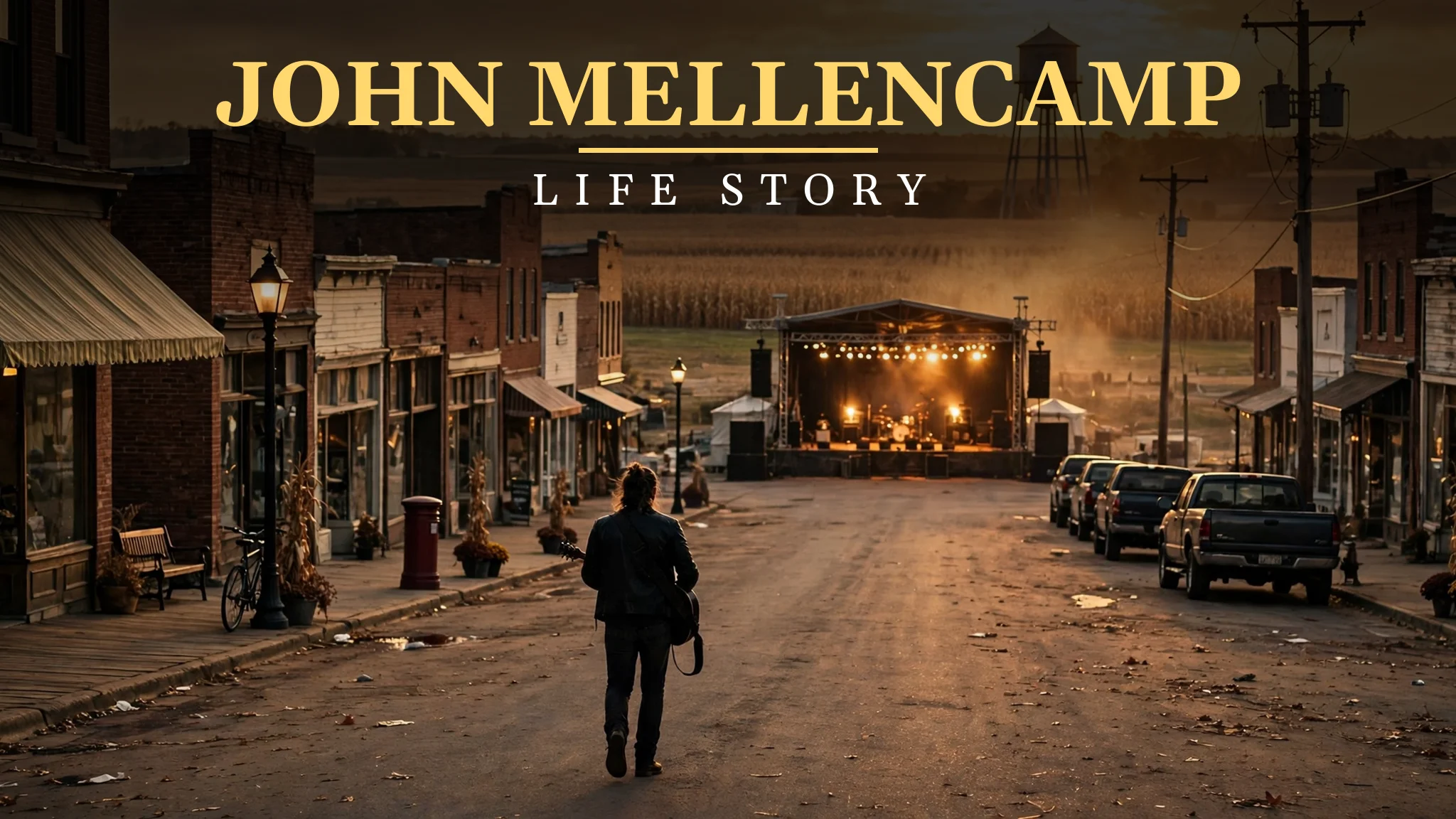
I keep returning to the image of the boy from Seymour walking down a small street with a guitar, not knowing if anyone would ever listen. Someone did listen. Millions of people did. And the reason they listened is that he never stopped sounding like himself. I want to remember that the next time I feel small, or far from where I want to be. You do not have to sound like everyone else. You have to sound like you, and you have to keep going until the right people hear it.
I think about the song Small Town, and I feel a deep affection for it. It is a simple song, with a simple melody, but it says something important: that a small town can be a good place to live, that it can hold you, and that it can be home. John wrote it about Seymour, but it could be about any small town in America. I like that. It tells me that my own town, my own home, matters, even if it is not famous. It tells me that ordinary places are worth singing about.
I also think about the way John writes about work. His songs are full of people who work hard, who get up early, who come home tired, and who keep going. He respects those people, and he writes about them with dignity. He does not make fun of them, and he does not pity them. He honours them. That is rare in popular music, where working people are often ignored or mocked. John gives them a voice, and I am grateful for that.
When I listen to Cherry Bomb, I hear a song about youth, about dancing, about being young and free. It is a happy song, but it is also a sad song, because youth does not last. John knows that, and he sings about it with a smile and a tear at the same time. I like songs that can hold two feelings at once. They feel more true than songs that are only happy or only sad. Life is both, and John’s songs know that.
I think about his friendship with Willie Nelson and Neil Young, and I like what I see. They are three very different men, but they came together to help farmers, and they stayed together for decades. That is a real friendship, built on shared values, not on fame. They did not do Farm Aid for publicity. They did it because they believed farmers deserved help. I respect that kind of friendship, and I wish more people had it.
I also think about John’s health, and about his heart attack in 1994. He was a man in his forties, at the top of his career, and suddenly he had to face his own mortality. That must have been frightening, and it must have changed him. I think it made him more serious, more thoughtful, and more grateful for the time he had left. His later songs are quieter and sadder, and I think that is because he understood, in a new way, that life is short and precious.
I wonder what John would say to a young musician starting out today. I think he would say, write about what you know, be honest, and do not let anyone change your name or your sound. He learned that lesson the hard way, when he was called Johnny Cougar, and he fought for years to get his real name back. That is good advice for anyone, not just musicians. Be yourself, even when it is hard, even when people tell you to be someone else.
I think about his paintings, and I am glad he paints. It shows that an artist does not have to do only one thing. He can sing, he can paint, he can write, and he can do all of them well. It also shows that creativity does not stop when you get older. John is in his seventies now, and he is still painting, still writing, still touring. That gives me hope. It says that age does not have to end creativity. It can deepen it.
When I hear his voice now, older and rougher than it was in the 1980s, I hear a man who has lived a lot. His voice has cracks in it, but those cracks make it more beautiful, not less. It is like an old guitar that sounds better with age. I like that. It tells me that getting older is not a bad thing. It can make you wiser, kinder, and more honest, if you let it.
I keep coming back to Farm Aid, because it is the best part of his story. He could have been just a rock star, but he chose to be more. He chose to help farmers, to play concerts for them, to speak up for them, and to stay with the cause for forty years. That is not a publicity stunt. That is a life’s work, and it is a work that has helped thousands of people. I think that is the most important thing John Mellencamp has ever done, even more important than his hit songs.
In the end, I want to remember John Mellencamp as a man who stayed true to his home, to his name, and to his beliefs. He is a singer, a painter, a farmer’s friend, and a father, and he has lived a full, honest life. His songs will be played for a long time, his paintings will be seen, and Farm Aid will go on. That is a legacy to be proud of, and I am glad I learned about it.
Frequently Asked Questions
Where was John Mellencamp born and when?
John Mellencamp was born on 7 October 1951 in Seymour, Indiana. He had surgery as a baby for spina bifida, a condition that affects the spine, and he grew up in the small town that later shaped so many of his songs.
Why was he first called Johnny Cougar?
His first record company gave him the stage name Johnny Cougar because they felt his real name did not sound right for a rock star. He did not like the name, and over time he changed it first to John Cougar Mellencamp and then to his real name, John Mellencamp.
What are John Mellencamp’s best-known songs?
His best-known songs include Jack and Diane, Hurts So Good, Pink Houses, Small Town, Crumblin’ Down, Paper in Fire, and Cherry Bomb. Jack and Diane reached number one in 1982, and Pink Houses and Small Town remain among his most loved songs today.
What is Farm Aid and how did Mellencamp help start it?
Farm Aid is a yearly concert series and movement that raises money and support for American family farmers. Mellencamp helped start it in 1985 with Willie Nelson and Neil Young, and he has stayed involved with the concerts and the cause for decades.
Did John Mellencamp have a heart attack?
Yes, he had a heart attack in 1994, when he was in his forties. He recovered and kept working, but the experience made him slow down, look after his health, and think more deeply about time, family, and what mattered most.
Is John Mellencamp in the Rock and Roll Hall of Fame?
Yes, he was inducted into the Rock and Roll Hall of Fame in 2008. The honour recognised a career of more than thirty years, from his early albums as Johnny Cougar to his later work as a songwriter, painter, and Farm Aid supporter.
Does John Mellencamp still live in Indiana?
Yes, he still lives in Indiana, near the area where he grew up. He has kept his home and his studio there, and he continues to write songs, paint, and tour from his base in his home state.


