Johnny Ventura: The Life Story Behind the Merengue Legend
In this post
- Santo Domingo in 1940 and a Teenager Who Dreamed of Buildings
- Singing for Other People’s Bands
- The Combo Show: A Smaller Band That Moved Like Theatre
- Patacón Pisao and the Songs That Became Household Words
- Viña del Mar, Christmas Records, and the Long Middle Years
- From the Stage to City Hall
- The Last Years, the Virus, and a Country in Mourning
- My Take:
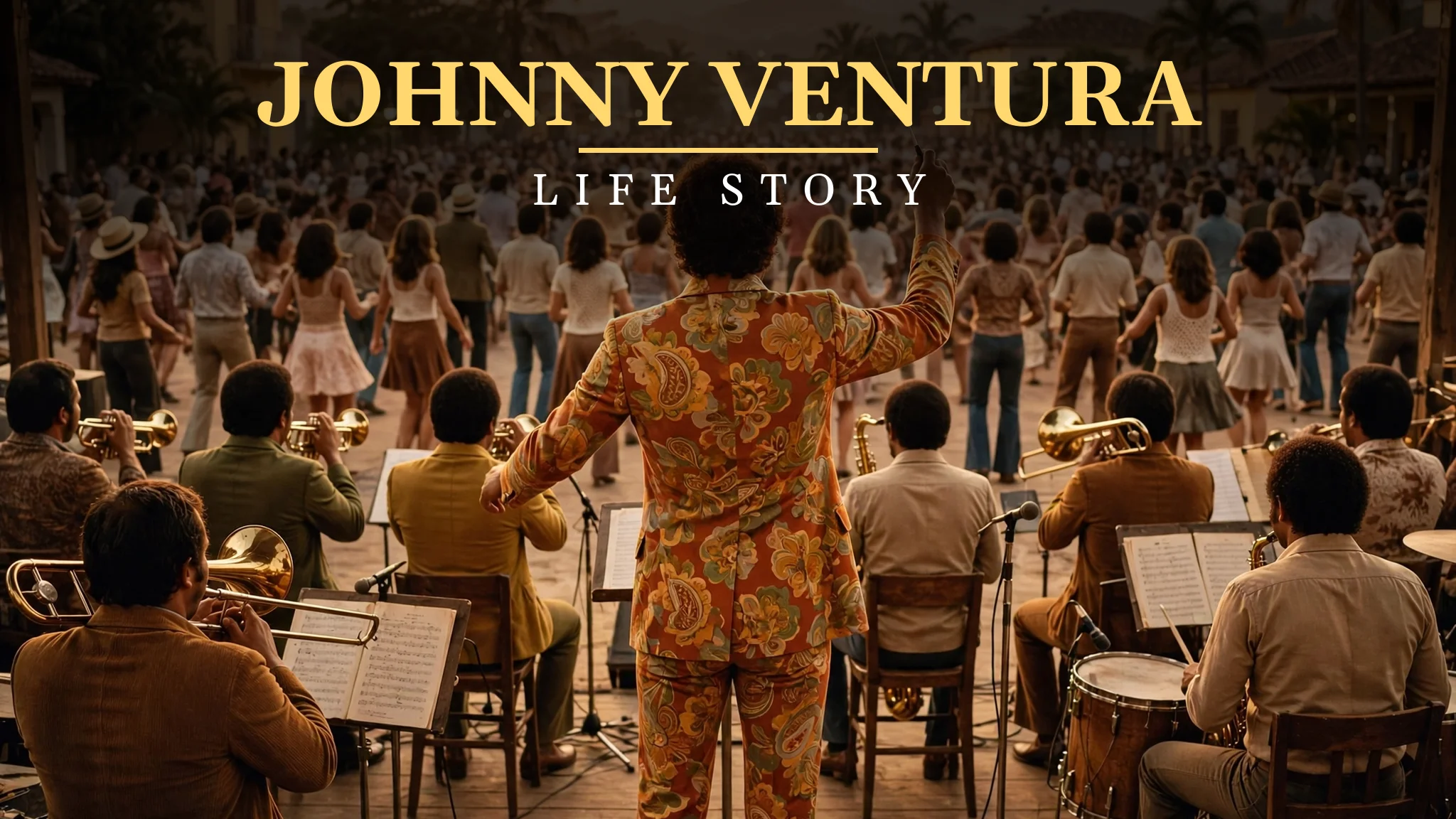
When a Dominican party reaches its loudest point, there is a good chance a Johnny Ventura record is playing, and there is an even better chance that somebody in the room can sing every word of it without thinking. For more than sixty years Ventura stood at the centre of merengue, not as a quiet keeper of an old sound but as the man who rebuilt it for the stage, the radio, and the dance floor. People called him El Caballo Mayor, the Big Horse, a nickname that suited a performer who seemed to run at full speed from the first note to the last, who danced while he sang, who pointed at the brass section as if he were directing traffic, and who treated a concert as a piece of theatre rather than a polite recital.
Juan de Dios Ventura Soriano entered the world on 8 March 1940 in Santo Domingo, the capital of the Dominican Republic. The city he was born into was not the tourist capital of later decades. It was a working Caribbean capital, full of corner shops, radio sets, church bells, and music drifting out of open windows. Merengue was already the sound of the country, played at weddings, birthdays, and street parties, and it belonged to everybody, rich and poor alike. Ventura grew up inside that sound. He did not have to go looking for music. Music was the background noise of his childhood, and by the time he was a teenager he had decided that he wanted to stand in front of it rather than simply listen to it.
What sets Ventura apart from many singers of his generation is how many different lives he fitted into one career. He was a bandleader who changed the shape of a merengue orchestra. He was a recording artist with more than a hundred productions to his name. He was a showman whose choreography made other bandleaders look stiff by comparison. And then, in middle age, he became a public servant, first as a deputy in Congress, then as vice mayor of Santo Domingo from 1994 to 1998, then as mayor of the city from 1998 to 2002. Few musicians anywhere have moved so completely from the stage into the town hall and back again, and fewer still have been loved in both places.
Santo Domingo in 1940 and a Teenager Who Dreamed of Buildings
Santo Domingo in the early 1940s was a city where a boy could hear three kinds of music before breakfast: a merengue on the radio, a hymn from a nearby church, and somebody practising an instrument in the next house. Ventura was born into that mixture on 8 March 1940, and his full name, Juan de Dios Ventura Soriano, was the name his family used long before the stage name Johnny Ventura existed. The family did not have great wealth, and like many Dominican families of the time they lived close together, shared what they had, and treated a gathering as incomplete without somebody singing.
As a teenager Ventura showed two interests that seemed to pull in different directions. One was music, which he loved openly and practised whenever he could. The other was architecture. He wanted to design buildings, and the story told about his youth is that the money for university simply was not there, so the drawing board had to wait and the microphone took its place. Whether he ever fully let go of that first ambition is hard to say, but it is worth remembering, because the man who later arranged brass sections, dancers, and stage lighting like a director was always arranging things in space, always thinking about how a performance looked as well as how it sounded.
He began singing when he was sixteen, according to accounts of his early life, and he learned his trade the hard way, in front of real audiences who would not pretend to enjoy something dull. In those years the Dominican Republic was still under the long shadow of the Trujillo era, and popular music was one of the few places where ordinary people could feel free, loud, and happy in public. A young singer who could make a room move was not a luxury. He was a necessity. Ventura understood that early, and he built his whole approach around it: never stand still, never let the energy drop, never give the crowd a reason to sit down.
School and singing competed for his time, and singing won, but not because he was careless about learning. He was, by several accounts, a serious young man who paid attention to how bands worked, how arrangers wrote for brass, and how a song was put together. He watched older musicians the way an apprentice watches a master carpenter, noting which notes made people shout and which ones made them drift away. That habit of watching, of treating every performance as a lesson, stayed with him for the rest of his life, and it explains why a singer who started in the early 1960s was still filling halls in the 2010s.
Singing for Other People’s Bands
Before Ventura ever led a band of his own, he spent the early 1960s moving from one established group to another, collecting experience the way a traveller collects stamps. He sang with the orchestra of the percussionist Donald Wild. He sang with Rondón Votau’s group. He spent time with Papa Molina’s La Super Orquesta San José, one of the respected names of the period. Each of these jobs taught him something different: how a percussion section drives a dance, how a large orchestra balances its brass, how a bandleader holds a room, and how a singer survives a long night of sets without losing his voice.
The turning point in this apprenticeship came in 1962, when he joined the Combo Caribe of Luis Pérez. With that band he made his first recordings, and the two songs most often named from that moment tell the story of a young man finding his feet. One was “La Agarradera”, written by Pérez himself. The other was “Cuidado Con el Cuabero”, which Ventura wrote himself. With Combo Caribe he recorded his first LP, a twelve-song album, and for the first time his voice existed on a record that strangers could buy, play, and judge. A first LP does not make a star, but it does make a singer real, and Ventura was now real in a way he had not been before.
Those early years were not glamorous. Dominican bands of the early 1960s travelled in difficult conditions, played in halls that were sometimes little more than roofs over a concrete floor, and depended on a crowd that paid at the door. A singer learned to read a room quickly, to change a song if the dancers were losing interest, and to keep going when the equipment failed. Ventura learned all of that, and he also learned what he did not want. He did not want to be one voice among many in a big orchestra that never moved. He wanted a band that behaved like a show, and that idea was already forming in his mind before anyone gave him the chance to try it.
It is worth pausing on the word that would soon define him: combo. In the Dominican music of the time, the big orchestra was the standard shape, with rows of musicians standing in place and playing with formal precision. A combo was smaller, tighter, and quicker on its feet. Ventura had spent years inside big groups, and he had begun to think that smaller might be better, that a band with fewer players could move faster, rehearse dance steps, and react to a crowd in real time. He did not yet have the money or the backing to prove it, but the idea was there, waiting for the right person to push him toward it.
The Combo Show: A Smaller Band That Moved Like Theatre
That push came in 1964 from Ángel Guinea, a Cuban impresario who looked at Ventura and insisted that he stop singing for other people and form his own orchestra. The result was El Combo Show, a name that said exactly what Ventura intended. It was a combo, a compact band, and it was a show, a piece of entertainment in which the musicians moved, the singer danced, and the audience was part of the performance rather than a spectator watching from a distance. In the history of Dominican popular music, the founding of El Combo Show is treated as a genuine dividing line, because merengue after Ventura did not look the same as merengue before him.
The change was not only about size. Ventura brought in elements that older bandleaders considered foreign to merengue, including a sharper, faster energy that owed something to rock and roll and to the stagecraft of American show bands. His brass sections hit harder. His rhythm section drove the dancers forward instead of merely keeping time. His singers and players rehearsed steps, turns, and gestures, so that a song became a small piece of theatre. Some traditionalists grumbled, as traditionalists always do, but the dancers did not grumble. They filled the floor, and that settled the argument more decisively than any review could.
Ventura himself was the centre of the spectacle. He did not stand behind a microphone and wait for applause. He moved across the stage, called out to the band, laughed, pointed, and pulled the crowd into the song. His voice was a baritone, strong and warm, and it carried easily over brass and percussion. But his real instrument was his energy. People who saw the Combo Show in its prime describe a performer who seemed incapable of standing still, and that restlessness became his trademark. The nickname El Caballo Mayor, the Big Horse, fitted him because a horse, in Dominican speech, suggests power, speed, and a refusal to be held back.
The Combo Show also changed what a merengue band could be commercially. Ventura recorded prolifically, and over the course of his career he was credited with more than a hundred productions, more than any other Dominican artist. That number matters, because it shows a working musician rather than a man who made three hits and retired. He kept recording, kept touring, and kept testing new songs on live audiences. Some records became classics. Others were forgotten. But the habit of constant work kept him close to his public, and it kept his band sharp, because a band that records and tours without stopping does not have time to grow stale.
Patacón Pisao and the Songs That Became Household Words
Every great Latin singer has a handful of songs that escape from the charts and enter ordinary life, so that people sing them at weddings without knowing who wrote them, and Ventura had more of those than most. The most famous is “Patacón Pisao”, a title that refers to a flattened plantain, a humble Dominican food, and the song turned that everyday image into a dance-floor anthem. It is still played at Dominican parties today, more than half a century after Ventura first made it his own, and it is the song most people name first when they are asked to sum him up in a single title.
Close behind it came a run of titles that Dominicans know by heart. “Capullo y Sorullo” was one. “¿Pitaste?” was another, a playful, teasing song that showed Ventura’s gift for humour. “Merenguero Hasta la Tambora” was a statement of identity, a song in which the singer declared himself a merengue man down to the drum that gives the music its heartbeat. “Yo Soy el Merengue”, “Si Vuelvo a Nacer”, and “El Tabaco” belong to the same group of songs that the United States Congress itself listed when it honoured Ventura after his death, a sign that these were not merely hits but pieces of cultural property that a whole community recognised as its own.
What made these songs last was not cleverness alone. Ventura sang them as if he meant every word, and he arranged them so that a room full of people who had never read a note of music could join in. The choruses were simple enough to shout. The brass lines were bright enough to remember after a single hearing. The rhythm was strong enough to carry a dancer who had never taken a lesson. That is a difficult combination to achieve, and it is why so many later merengue singers copied Ventura’s approach without ever quite matching his ease. He made it sound simple, and simple, in popular music, is the hardest thing of all.
The songs also travelled. Ventura’s audiences were not confined to Santo Domingo. He drew large crowds across the Caribbean, across Latin America, and in the United States, where Dominican communities in New York and elsewhere treated his concerts as a piece of home. In 1984 he performed twice at the Viña del Mar International Song Festival in Chile, one of the most important stages in Latin music, and the invitation itself was a measure of how far a singer from Santo Domingo had travelled. A year later, in 1985, he released another Christmas-themed album, “Navidad Sin Ti”, because in Dominican life Christmas music is not a side project but a serious part of the year’s calendar, and Ventura understood that a singer who could own December owned a piece of every family’s year.
Viña del Mar, Christmas Records, and the Long Middle Years
The middle of Ventura’s career is easy to overlook because it lacks a single dramatic breakthrough, but it is the part that explains his longevity. After the first wave of Combo Show hits, he did not disappear, and he did not become a nostalgia act. He kept touring, kept recording, and kept his band in front of audiences who were growing up with his songs as the soundtrack of their lives. In a business where most stars fade within a decade, Ventura stayed visible for six, and that kind of staying power comes from work rather than luck.
Part of the secret was his willingness to keep the band fresh without abandoning its identity. New singers, new arrangers, and new players passed through El Combo Show over the decades, and Ventura treated the band as a living thing rather than a museum. He also understood the calendar of Dominican life. Christmas albums, summer tours, festival appearances, and concerts for Dominican communities abroad all had their place, and he planned his year around them. A singer who only chases the charts will eventually run out of charts to chase. A singer who becomes part of a people’s year, the way Ventura did, can keep working as long as his voice holds out.
His honours accumulated in the same steady way. He was inducted into the International Latin Music Hall of Fame in 1999. The Latin Recording Academy gave him a Latin Grammy Lifetime Achievement Award in 2006, an honour reserved for artists whose work has shaped Latin music itself. Reports of his career often mention six Latin Grammy wins in total, along with dozens of gold and platinum records, and while the exact tally varies from one account to another, the shape of the story does not: the institutions of Latin music recognised Ventura as a builder, not merely a hitmaker. He had changed the genre, and the genre’s own organisations eventually said so in public.
There were also the quieter signs of a long career. His son Jandy Ventura, whose full name is Juan José Ventura Flores, grew up inside the music and eventually became a singer and bandleader in his own right, carrying the family name onto stages his father had once played. That kind of succession does not happen by accident. It happens when a father treats music as a craft to be passed on rather than a secret to be kept, and Ventura seems to have done exactly that. When he sang with his son, or watched his son lead a band, he was watching his own work continue in a new pair of hands.
From the Stage to City Hall
Ventura’s move into politics surprised people who thought a singer should stay on the stage, but it made sense to anyone who had watched him work a room. A bandleader and a mayor do similar things: they read a crowd, they organise people, they keep a difficult operation moving, and they are judged by results rather than promises. Ventura had spent thirty years doing the first of those jobs in public, and in the 1990s he decided to try the second. He had already served as a deputy in the Congress of the Dominican Republic, and in 1994 he became vice mayor of Santo Domingo, the city of his birth. Four years later, in 1998, he was elected mayor, and he served in that office until 2002.
Being mayor of Santo Domingo is not a ceremonial job. The city is the capital of the country, home to more than a million people, with all the problems of a large Caribbean city: traffic, rubbish collection, markets, neighbourhoods that need water and light, and a population that expects its mayor to be visible. Ventura approached the job the way he approached a concert, by being present, by talking to people directly, and by treating public service as a performance in the best sense, something done in front of the people it serves. His supporters said he brought the same energy to the town hall that he had brought to the stage. His critics, as critics do, questioned whether a singer belonged in politics at all. The voters, in 1998, answered that question in his favour.
He served his four years as mayor and then returned to music, which is itself a telling detail. Many entertainers who enter politics never come back, either because they lose an election badly or because they discover they prefer power to applause. Ventura came back to the stage, and the stage welcomed him. He was still the same singer, still the same bandleader, but he now carried a different kind of authority, the authority of a man who had run a city and returned to his first love. In 2020, at the age of eighty, he stood for mayor again and came third, a result that showed both how much affection remained for him and how much Dominican politics had moved on. He accepted the result and kept singing, which was, in its own way, the most Ventura-like response possible.
It is worth asking what politics gave him and what it cost him. What it gave him was a direct connection to the daily life of his city, a reminder that the people who danced to his songs also needed buses, clean streets, and working services. What it cost him was time away from the band, and the risk that some listeners would judge his music through the lens of his party, the Dominican Revolutionary Party, rather than through the music itself. Ventura seems to have accepted that trade without regret. He had always sung for the whole country, rich and poor, and he seems to have believed that serving the whole country was a natural extension of that, not a departure from it.
The Last Years, the Virus, and a Country in Mourning
Ventura never really retired, and that is one of the most important facts about him. In his seventies he was still performing, still recording, and still appearing at festivals and concerts where younger singers treated him with the respect due to a founder. He had become a living link to the merengue of the 1960s, and every time he stepped onto a stage he reminded his audience that the music they loved had a history, and that he had helped to write it. Age slowed him, as it slows everybody, but it did not silence him, and his audiences did not want it to.
In March 2020, at the start of the coronavirus pandemic, Ventura announced that he had tested positive for COVID-19 and was taken to hospital. For a man of eighty, that news frightened his fans across the Dominican Republic and beyond, because the early months of the pandemic were terrifying for older people. A month later, in April 2020, he announced that he had recovered and tested negative, and the relief was genuine. He had survived the virus, and for a time it seemed as if he would keep surviving everything else as well. He returned to public life, and his recovery became one more story his fans told about his toughness, the toughness that had earned him the nickname of the Big Horse in the first place.
The end, when it came, was sudden. On 28 July 2021 Ventura suffered a heart attack and was taken to a hospital in Santiago de los Caballeros, where he died at the age of eighty-one. His son Jandy confirmed the news, and within hours the Dominican Republic was in mourning. The president, fellow musicians, politicians, and ordinary fans all said the same thing in different words: a piece of the country’s soul had gone. His funeral and the tributes that followed were not the formal mourning of a distant celebrity. They were the grief of a people who had danced to his songs at their weddings, sung them at their parties, and voted for him to run their capital city.
The United States Congress honoured him the day after his death, with a speech that named his songs and called him the most prominent merengue artist in the world. That kind of tribute, from a foreign legislature, is rare for a singer, and it says something about how far Ventura’s music had travelled. He had started as a teenager singing in Santo Domingo bands, and he ended as a figure whose death was marked on the floor of the United States House of Representatives. Between those two points lay sixty years of work, more than a hundred recordings, a mayor’s office, and a catalogue of songs that Dominicans will still be singing when the people who first heard them are gone. That is not a bad definition of a life well spent.
My Take:
I think Johnny Ventura is the kind of artist who is easy to enjoy and hard to fully appreciate, because the joy is so obvious that it hides the work underneath it. When I listen to “Patacón Pisao” I hear a party, and that is the point, but when I stop and think about what Ventura actually did, I realise the party was engineered. He took a big, slow, formal orchestra tradition and rebuilt it as a small, fast, moving show. He taught brass players to dance. He taught a singer to conduct with his whole body. He turned a concert into something you watched as well as heard. That is not a small change. It is the difference between a band that plays music and a band that puts on a show, and Ventura understood the difference when he was still in his twenties.
What I admire most is that he never treated merengue as a museum piece. A lot of musicians who love a tradition become its guards, and they spend their careers telling younger players what they are not allowed to do. Ventura did the opposite. He borrowed energy from rock and roll, he borrowed stagecraft from show bands, he changed the size of the orchestra, and he did it all without making merengue stop sounding like merengue. That takes confidence, and it takes taste. Anybody can add a loud guitar to a traditional song and call it modern. Ventura added movement, pace, and theatre, and the result still sounded Dominican, still sounded like the music people had grown up with, only faster and brighter. I think that is the hardest trick in popular music, and he pulled it off for sixty years.
I also think about the teenager who wanted to be an architect and could not afford university. That detail stays with me, because it explains so much about the man he became. He did not get the formal training he wanted, so he trained himself in public, night after night, in front of audiences who would not forgive a dull show. There is a kind of education in that, a harder one than a classroom, and Ventura passed it with honours. I wonder sometimes what kind of buildings he would have designed if the money had been there, and then I realise he did design something: he designed a band, a stage, a way of performing, and a career that held together for six decades. That is architecture of a different kind, and it lasted longer than most buildings do.
His politics interest me more than I expected them to. I am usually suspicious when a famous singer runs for office, because fame is not a qualification for governing, and a crowd that loves your songs may not love your budgets. But Ventura did not treat politics as a hobby or a photo opportunity. He served as a deputy, he served four years as vice mayor, and he served four years as mayor of a capital city of more than a million people. That is real work, and it is work that leaves a record. I do not know enough about the details of his administration to praise every decision he made, and I would not pretend to, but I respect the seriousness of it. He did not dip a toe into politics and run away. He stayed, he governed, and then he went back to singing, which suggests he saw public service as a chapter rather than a new identity.
There is something else about his political career that I keep turning over in my mind. Ventura sang for everybody, rich and poor, and his concerts were places where Dominican society mixed in a way it rarely does elsewhere. When he became mayor, that same mixing became his job. A mayor cannot only serve his fans. He has to serve the people who never bought a record, never went to a concert, and never voted for him. I think Ventura understood that, because he had spent his whole life reading rooms full of strangers and trying to make them happy at the same time. A concert is not a city, and I do not want to pretend the skills transfer perfectly, but the habit of paying attention to ordinary people, of noticing when a room is unhappy and changing what you are doing, is a habit a mayor could use. I suspect it helped him more than his critics expected.
I find his longevity genuinely moving. Sixty years on stage is not a normal career. It is longer than most marriages, longer than most businesses, longer than the entire recording career of most of the singers who copied him. To last that long, a performer has to do two things that are almost contradictory: he has to stay the same enough that people recognise him, and he has to change enough that people do not get bored. Ventura managed both. The brass, the energy, the dancing, the humour, those stayed. The players changed, the arrangements changed, the venues changed, and the country around him changed beyond recognition. He changed with it without ever becoming unrecognisable, and I think that is why grandmothers and grandchildren could enjoy the same concert, each hearing something different in it.
His death hit me harder than I expected when I read about it, partly because of the timing. He had survived COVID-19 at eighty, and that survival felt like a promise, as if the Big Horse was simply too tough to be beaten by anything. Then a heart attack took him in a single day, in Santiago, far from the Santo Domingo stages where he had made his name. There is a lesson in that, and it is not a comfortable one: toughness is real, but it is not a guarantee. A man can survive a pandemic and still be taken by his own heart. I think Ventura would have understood that. He sang about life as it is, not as we wish it to be, and his songs always had room for sadness inside the joy.
What I take from his story, if I had to put it in one sentence, is that joy is work. Ventura made joy look easy, and that is why people sometimes underestimated him. But joy on that scale, for that long, in front of that many people, does not happen by accident. It happens because somebody rehearses the steps, arranges the brass, writes the song, travels to the next town, and does it again the next night. It happens because somebody treats a party as a serious responsibility. Ventura treated it that way for sixty years, and the Dominican Republic is happier, louder, and more itself because he did. I think that is a fine thing to have done with a life, and I think the nickname fits him in the end, not because he was a horse but because he kept running, at full speed, until the day he stopped.
I also want to say something about his son Jandy, because the story does not end with Ventura’s death. A father’s music living on through his son is a common thing in the world, but it is not automatic. It requires a father who teaches rather than competes, and a son who respects the original without becoming a copy of it. From what I can see, that is what happened here. Jandy Ventura leads his own band, sings his father’s songs, and also sings his own, and audiences accept him because the connection is real. I like that. It means the Combo Show is not only a memory. It is a living thing, carried forward by the next generation, and that is the best kind of memorial a singer can have.
If I could ask Ventura one question, it would be about the moment in 1964 when Ángel Guinea told him to form his own band. I would want to know whether he was frightened, whether he lay awake wondering if the small band would fail, whether he missed the safety of singing for somebody else’s orchestra. I suspect he was frightened, because any honest person would be, and I suspect he did it anyway, because the idea of the Combo Show was too clear in his mind to ignore. That is the moment I would want to hear about, because it is the moment when a talented singer became a leader, and leadership, in music as in politics, begins with a decision to stop waiting for permission.
Finally, I think Ventura’s life is a reminder that a country’s music is not a decoration. It is a kind of public wealth, as real as its roads and its schools, and the people who build it deserve to be treated as builders. Ventura built merengue into something modern, something exportable, something a whole nation could be proud of, and he did it without ever leaving the country that made him. He could have moved to New York or Miami and chased a different career. He stayed, he served, and he sang, and when he died the whole country stopped to notice. I cannot think of a better ending for a singer, or a better reason to remember him.
There is one more thing about Ventura that I keep coming back to, and it is the way he handled being copied. Once the Combo Show proved that a small, moving band could fill a hall, everybody wanted a small, moving band. Younger singers took his steps, his brass attacks, his way of talking to the crowd, and used them as their own. Some older artists would have been bitter about that, and some would have sued, or sulked, or insisted on being called the only real thing. Ventura does not seem to have done any of that. He kept working, kept recording, and let the copyists discover for themselves how hard the original was to match. I admire that kind of confidence, the kind that does not need to guard a formula because it knows the formula was never the whole secret. The secret was the man doing it, night after night, with a stamina nobody else could rent.
I also think his story says something useful about ambition that is not about money. Ventura recorded more than a hundred productions, he toured the world, he won a Lifetime Achievement Award, and yet the ambition that drove him never looked like greed. It looked like a desire to be useful, to be the person a country called on when it wanted to celebrate, and also when it wanted a mayor. That is a different kind of ambition from the one that chases a bigger house or a bigger fee. It is the ambition to matter to the place you come from, and I think Ventura achieved it more completely than almost any singer I have read about. When he died, the mourning was not only for a voice. It was for a man who had been present in Dominican life for so long that people could not remember a time before him.
One more thought stays with me, about the flattened plantain in “Patacón Pisao”. It is such a small, ordinary thing to build a national anthem around, a piece of food that poor families eat every day, and Ventura turned it into a song that rich and poor sing together. That choice tells me he never forgot who he was singing for. He did not need a grand subject to make a grand song. He needed an honest one, something his audience recognised from their own kitchens, and he trusted that recognition to do the work. I think a lot of songwriters could learn from that trust. You do not have to impress people with how clever you are. You have to show them something they already know, in a way that makes them glad to know it.
And when I picture him now, I do not picture the mayor in a suit, or the award winner on a stage in a tuxedo. I picture the bandleader in the middle of a hot hall, sweat on his face, pointing at the trumpets, laughing at his own joke, and refusing to let the music slow down. That picture is the one his audiences carried home with them, and it is the one that will last. A singer can be remembered for a voice, or for a hit, or for an office he held, but Ventura will be remembered for a feeling, the feeling of a room full of people moving together, and that feeling does not need a monument. It only needs somebody to put the record on.
Frequently Asked Questions
Where was Johnny Ventura born? Johnny Ventura was born as Juan de Dios Ventura Soriano on 8 March 1940 in Santo Domingo, in the Dominican Republic. He grew up in the capital city.
What is Johnny Ventura’s most famous song? His most famous songs include Patacon Pisao, Capullo y Sorullo, and Merenguero Hasta la Tambora. Patacon Pisao is one of his signature songs, and it is still played at Dominican parties today.
Why was Johnny Ventura called El Caballo Mayor? He was called El Caballo Mayor, which means the Big Horse, because he was strong, fast, and unstoppable on stage, with a voice and an energy that could fill any room.
Was Johnny Ventura a mayor? Yes, Johnny Ventura was elected mayor of Santo Domingo in 1998, and he served until 2002. He also served as a deputy in the Congress of the Dominican Republic.
When did Johnny Ventura die? Johnny Ventura died on 28 July 2021 at the age of eighty-one, after suffering a heart attack. The whole Dominican Republic mourned him as a national hero.
What is Johnny Ventura’s legacy in merengue? He modernised merengue with his Combo Show, adding more brass, rhythm, and energy, and he carried the music to the world. His songs are now classics, and his son Jandy Ventura carries on his music.


