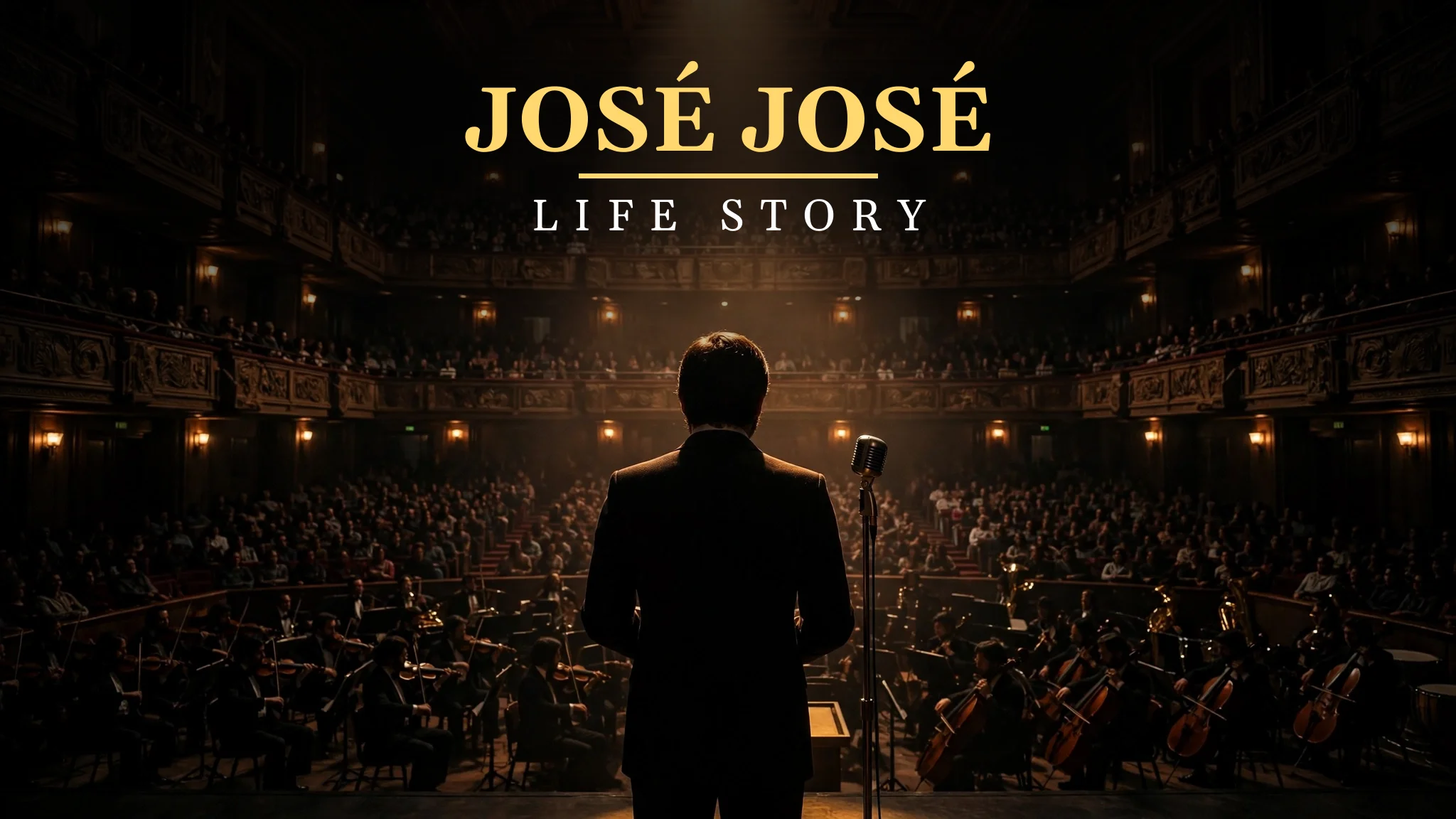
José José: The Life Story Behind Mexico's Prince of Song
In this post
- A Boy From Mexico City With Music in His Blood
- El Triste and the Night That Changed Everything
- Gavilan o Paloma, Lo Pasado Pasado, and the Peak Years
- The Voice Fades and the Struggle With Alcohol
- The Final Years and a Farewell in Mexico City
- The Prince of Song and His Legacy
- The Voice Other Singers Admired
- My Take:
José José was called the Prince of Song, and the name suited him. He had one of the most beautiful voices in Latin music, a tenor that could be soft and tender one moment and strong and soaring the next. He sang romantic ballads that spoke of love, loss, and longing, and his songs became part of the lives of millions of people across Mexico and Latin America. His voice was his gift, and it was also his burden, because he lost it, slowly and painfully, to illness and to alcohol, and he spent his later years trying to hold onto what remained.
His real name was José Rómulo Sosa Ortiz, and he was born in Mexico City in 1948. His father was a tenor in the National Opera, and his mother was a pianist, so music was in his home from the start. He began singing as a young man, and his breakthrough came in 1970, when he sang El Triste at a festival in Mexico City and moved the audience to tears. From that night on, he was a star, and he remained one for decades, with hits like Gavilán o Paloma, Lo Pasado, Pasado, and La Nave del Olvido.
His story is also a story of struggle. He fought alcoholism for many years, he faced health problems, and his voice faded. He died in 2019, and his death was mourned across the Spanish-speaking world. This is the story of how a boy from Mexico City became the Prince of Song, and why his voice still matters.
A Boy From Mexico City With Music in His Blood
José Rómulo Sosa Ortiz was born on 17 February 1948 in Mexico City, in the neighbourhood of Azcapotzalco. His father, José Sosa, was a tenor who sang with the National Opera of Mexico, and his mother, Margarita Ortiz, was a pianist. The house was full of music, and the boy grew up hearing his father practise, hearing the piano, and hearing the songs of the opera and of Mexican popular music. Music was not a hobby in his home. It was daily life.
As a boy, he sang in the church choir, and he learned to read music and to control his voice. He had a natural gift, a clear tenor that could hold a note and make it soar, and people who heard him noticed it. He was not only a singer. He was a musician who understood melody, harmony, and the way a song is built. He learned the guitar and the piano, and he began to dream of a career in music, even though his father wanted him to follow a different path.
His father died when José was still young, and the loss changed his life. The family faced hard times, and José had to work to help support them. He sang in clubs and bars, he played in small groups, and he learned how to perform for a live audience. He was a young man with a great voice and no money, trying to make a living from music in a big city that did not care about his gift. Those hard years taught him discipline, and they taught him what it meant to sing for people who had come to hear a song, not a star.
He also sang with a trio, Los Peg, and he recorded his first songs in the late 1960s. His early records did not make him a star, but they gave him a base. He was learning his craft, and he was waiting for the moment that would change everything. The boy from Azcapotzalco with music in his blood was becoming a singer, and the moment was coming.
El Triste and the Night That Changed Everything
In 1970, José José took part in the second Festival de la Canción Latina, held in Mexico City, and he sang a song called El Triste. The song is a ballad about a man who is sad because his love has left him, and it is a hard song to sing. It needs a voice that can be soft and tender, and then strong and soaring, and it needs a singer who can hold the feeling from the first note to the last. José José sang it that night, and the audience was moved to tears.
He did not win the festival. The prize went to another singer, but the audience knew what they had heard. They gave him a standing ovation, and the performance became legendary. El Triste became his signature song, and it made him a star overnight. The song played on radio stations across Mexico and Latin America, and it introduced his voice to millions of people. It was the night that changed his life, and it is still the night people talk about when they talk about José José.
The success of El Triste brought him a record deal, and he began to release albums that sold well. He became one of the most popular singers in Mexico, and his voice was praised by critics and by other singers. He was not only a popular singer. He was a singer’s singer, a man whose control, whose phrasing, and whose feeling were admired by musicians across Latin America. He had a gift, and the world had heard it.
The festival night also showed something about his character. He did not win, but he won the audience, and that mattered more. He sang with honesty, he gave everything he had, and the people felt it. That honesty became the heart of his career, and it is why his songs still move listeners today. The boy from Mexico City had become the Prince of Song, and the crown was earned in a single night.
Gavilan o Paloma, Lo Pasado Pasado, and the Peak Years
The years after El Triste brought a string of hits that made José José one of the biggest stars in Latin music. Gavilán o Paloma, which means Hawk or Dove, became one of his most loved songs. It is about a man who is torn between two ways of loving, and it is sung with a power that shows the full range of his voice. The song became a classic, and it is still one of the songs most linked to his name.
Another of his best-loved songs is Lo Pasado, Pasado, which means What Is Past Is Past. It is a song about letting go of a love that has ended, and it is sung with a sadness that feels real. The song became a favourite at concerts and on radio, and it showed his gift for singing about loss in a way that comforted listeners. He also recorded La Nave del Olvido, a song about a ship of forgetting, which became another of his signature songs. Together, these hits made him a star whose voice was known across the Spanish-speaking world.
During these peak years, he toured widely, playing in Mexico, the United States, and Latin America. His concerts drew large crowds, and his albums sold in the millions. He won awards, he appeared on television, and he became one of the most respected voices in Latin music. He was not only a popular singer. He was a cultural figure, a man whose voice was part of the soundtrack of millions of lives.
He also recorded with some of the best songwriters and producers in Latin music, and his albums were carefully made. He chose songs that suited his voice, and he sang them with a control that few singers could match. The peak years were long, and they made him a legend. He was the Prince of Song, and the title was not a nickname. It was a fact, recognised by everyone who heard him sing.
The Voice Fades and the Struggle With Alcohol
José José’s later years were marked by a painful struggle. He fought alcoholism for many years, and the drinking damaged his health and his voice. He spoke openly at times about his problem, and he tried to stop, but the addiction was strong, and it returned. He also faced health problems, including diabetes and other illnesses, and his voice, the gift that had made him famous, began to fade.
The loss of his voice was slow and cruel. A singer who loses his voice loses more than a career. He loses the thing that defines him, the thing that makes him who he is. José José kept singing, but his voice was weaker, and his concerts became shorter. He could no longer hit the high notes that had once soared, and his fans could hear the change. It was painful for them, and it was more painful for him.
He also faced personal and family problems. His marriages ended, his health worsened, and he moved to the United States, where he lived in Florida in his later years. He continued to perform when he could, and his fans came to hear him, not only for the voice but for the man, for the songs, and for the memories. They sang along, and they carried the high notes for him, because they loved him and they loved the songs.
The struggle with alcohol and illness is the sad part of his story, and it is important to tell it honestly. He was a great singer who faced a great problem, and he did not always win. But he kept trying, and he kept singing, and that persistence matters. His story is a reminder that talent does not protect a person from hardship, and that even a prince can fall. What matters is how he carries himself through the fall, and José José carried himself with dignity.
The Final Years and a Farewell in Mexico City
In his final years, José José lived in Florida, in the United States, and his health continued to decline. He performed rarely, and his appearances were emotional, with fans coming to hear the songs they had loved for decades. He was no longer the young man who had moved an audience to tears with El Triste. He was an older man, frail and tired, but still a singer, still the Prince of Song, and still loved.
He died on 28 September 2019, at the age of seventy-one, in a hospital in Florida. His death was mourned across Mexico and Latin America, and tributes came from singers, fans, and public figures. His body was brought back to Mexico, and his funeral drew large crowds. He was honoured in Mexico City, and his fans said goodbye to the voice that had sung the soundtrack of their lives.
The farewell was emotional because his songs had been part of so many lives. People had danced to his songs, cried to his songs, and fallen in love to his songs. His voice had been there in their happiest moments and in their saddest ones, and losing him felt like losing a part of their own history. The crowds that gathered to say goodbye were not only mourning a singer. They were mourning a voice that had been with them for fifty years.
His children, José Joel and Marysol, were part of the farewell, and the family came together to honour him. The Prince of Song was laid to rest, but his songs remained, and they are still sung today. The farewell in Mexico City was not only an ending. It was a reminder that a great voice does not die. It lives on in the songs, and in the people who sing them.
The Prince of Song and His Legacy
Today, José José is remembered as the Prince of Song, one of the greatest voices in Latin music. His songs, El Triste, Gavilán o Paloma, Lo Pasado, Pasado, and La Nave del Olvido, are classics, sung at parties, at concerts, and in quiet moments across Mexico and Latin America. They are songs about love, loss, and longing, and they will be sung for many years to come, because the feelings they describe do not change.
His legacy is his voice. It was a tenor of rare beauty, a voice that could be soft and strong, tender and soaring, and it set a standard for romantic singers in Latin music. Young singers still listen to his recordings to learn how to sing a ballad, how to hold a note, and how to make a song feel true. That is a real legacy, and it will last as long as people sing.
He is also remembered as a man who faced hardship with dignity. He fought alcoholism, he lost his voice, and he kept singing. His story is a reminder that talent does not protect a person from struggle, and that even the greatest voice can fade. What matters is the songs, and the songs remain. The boy from Azcapotzalco who sang in a church choir became a prince, and his crown was his voice. The voice is gone, but the songs are still here, and they are still sung.
The Voice Other Singers Admired
José José was not only loved by his fans. He was admired by other singers, and that admiration is a special kind of honour. Musicians across Latin America listened to his recordings to learn how to sing a ballad, how to hold a note, and how to make a song feel true. He was a singer’s singer, a man whose control, whose phrasing, and whose feeling were studied by professionals who knew how hard it is to sing the way he did. That respect, from people who understand the craft, is worth more than any award.
Young singers still study him today. They listen to El Triste to learn how to build a song from a whisper to a cry, and they listen to Gavilán o Paloma to learn how to use power without shouting. His recordings are a school, and they teach lessons that no classroom can teach. A voice like his does not come from technique alone. It comes from feeling, from honesty, and from a deep understanding of the song, and those are things a singer must learn by listening to the best.
He also received tributes from other artists, who recorded his songs and performed them in his honour. Those tributes show that his music belongs not only to him but to the whole world of Latin music. When a singer’s songs are sung by others, it means the songs have a life of their own, and they will outlive the singer. José José’s songs have that life, and they are still being sung, by young singers and old ones, in concerts and in homes across Latin America.
His influence is also visible in the way romantic singers approach a ballad today. The slow build, the careful phrasing, the willingness to be tender before being strong, these are things he perfected, and they are now part of the language of Latin pop. He did not invent the ballad, but he showed how beautifully it could be sung, and every romantic singer who came after him owes him something, whether they know it or not.
What this admiration shows is that his legacy is not only about hits. It is about craft, about the art of singing, and about a standard that he set for everyone else. He was the Prince of Song, and the title was given to him not only by his fans but by his fellow singers, who recognised in him a master of their art. That is a rare honour, and it is one that will last as long as people sing.
The voice is gone, but the lessons remain. A young singer who wants to learn how to sing a ballad can still put on a José José record and hear how it is done, note by note, breath by breath. That is a gift that does not fade, and it is one of the reasons his name will be remembered for a long time. He was a teacher, even if he never set out to be one, and his recordings are his classroom.
His albums in his later years, even as his voice faded, were still loved by his fans, who bought them not for the high notes but for the man, for the songs, and for the memories. They sang along, and they carried the high notes for him, because they loved him and they loved the songs. That is a beautiful thing, a singer and his audience sharing a song when the voice can no longer carry it alone.
He also received honours in his later years, including tributes from other artists and from the city of Mexico, which recognised his place in the culture. Those honours matter, but the real honour was simpler. It was the fact that his songs were sung at weddings, at parties, and in quiet moments, by people who had never met him and never would. That is the honour a singer truly wants.
His children, Jose Joel and Marysol, have kept his memory alive, sharing his songs and his story with new listeners. They grew up with a father who was a legend, and they carry that legacy with love. A singer’s family carries the weight of fame too, and his family has carried it with dignity.
His voice, even in recordings made decades ago, remains one of the most beautiful in Latin music. Young singers still listen to those records to learn how to sing a ballad, and they hear, note by note, how it is done. That is a gift that does not fade, and it is one of the reasons his name will be remembered for a long time.
His presence on the radio has also shaped his legacy. For decades, his songs played in cars, in homes, and in shops across Mexico and Latin America, and they became part of daily life. A listener did not have to buy a ticket to hear him. He was there, on the radio, in the background of ordinary days, and that closeness is why his voice feels like a friend to so many people.
His style, too, has become part of his identity. The careful phrasing, the tender build, and the soaring high notes are recognised everywhere, and fans love him for them. That is a sign of how deeply his music has reached his audience. They do not only listen to his songs. They carry them, and they sing them, in good times and in hard ones.
My Take:
I think Jose Jose’s story is really about a voice, and I want to say why that matters to me. He had one of the most beautiful voices in Latin music, a tenor that could be soft and tender one moment and strong and soaring the next. When he sang El Triste, people cried. When he sang Gavilan o Paloma, people felt the power. His voice was a gift, and it was also his burden, because he lost it, slowly and painfully, and he spent his later years trying to hold onto what remained. That is a sad story, and it is also a human one, and I think it deserves to be told honestly.
What I admire most is the voice itself. I have listened to his recordings, and I am struck by the control. He does not shout. He does not show off. He holds a note, he lets it grow, and he gives the song room to breathe. That takes real skill, and it takes real feeling. Many singers have good voices, but few have a voice that makes an audience cry. Jose Jose had that voice, and he used it with care. I respect that deeply, because a voice like that is rare, and it is a gift that should be honoured.
I also admire the night of El Triste. He did not win the festival, but he won the audience, and that mattered more. He sang with honesty, he gave everything he had, and the people felt it. I think that is a lesson for anyone who performs, or who creates anything. You do not have to win the prize to win the people. You have to be honest, you have to give your best, and you have to trust that the audience will feel it. Jose Jose did that, and the audience did feel it, and that night made him a star.
But the sad part of his story is the struggle with alcohol, and I want to talk about it honestly. He fought alcoholism for many years, and the drinking damaged his health and his voice. I think it is important to say that he was not a bad person because he struggled. He was a human being with a problem, and the problem was strong. He tried to stop, and he did not always succeed, and that is the truth about addiction. It is not a weakness of character. It is an illness, and it is hard to beat. I feel sympathy for him, and I think anyone who has seen a loved one struggle with addiction will feel it too.
The loss of his voice is the part that moves me most. A singer who loses his voice loses more than a career. He loses the thing that defines him, the thing that makes him who he is. Jose Jose kept singing, but his voice was weaker, and his concerts became shorter. He could no longer hit the high notes that had once soared, and his fans could hear the change. I imagine how painful that must have been, to stand on stage and know that the voice is gone, and to keep singing anyway, because the songs matter and the audience matters. That takes courage, and I respect it.
I also think about his fans, and what they did for him. They came to his concerts in his later years, they sang along, and they carried the high notes for him, because they loved him and they loved the songs. That is a beautiful thing. A singer gives his voice to his audience for decades, and in the end, the audience gives their voices back to him. I think that is the real meaning of the title Prince of Song. It is not only about the voice. It is about the bond between a singer and his people, a bond that lasts even when the voice fades.
If I had to name the lesson of his story, I would say it is about taking care of the gift you are given. Jose Jose had a rare gift, and he did not always take care of it. The drinking damaged it, and the illness damaged it, and by the end, the gift was gone. I think that is a warning for anyone with a talent, in music or in any work. A gift is not yours to waste. It needs care, rest, and respect. If you do not take care of it, you can lose it, and once it is gone, you cannot get it back. That is a hard lesson, and it is one that Jose Jose’s story teaches plainly.
What would I tell a reader who has never heard him? I would say, start with El Triste, because it is the song that made him, and it is still his best introduction. Then listen to Gavilan o Paloma, because it shows the power of his voice. Then listen to Lo Pasado, Pasado, because it shows his gift for singing about loss in a way that comforts. And then listen to La Nave del Olvido, because it shows his gift for a song that is both sad and beautiful. That is a good way to hear his story in his own voice.
In the end, I think Jose Jose was one of the greatest voices in Latin music, a prince whose crown was his voice, and whose story is both beautiful and sad. I admire his talent, I respect his dignity, and I feel for the struggle he faced. His voice is gone, but his songs remain, and they will be sung for a long time, because they speak plainly about love, about loss, and about longing, and those are things that do not change.
I also think about his father, and the music in his home. His father was a tenor with the National Opera, and his mother was a pianist, so Jose Jose grew up hearing great music every day. That start gave him an ear for melody, for harmony, and for the way a song is built. He learned to read music, he sang in a church choir, and he understood the craft of singing from a young age. I think that training mattered, because a voice alone is not enough. A singer also needs to understand music, and Jose Jose did. He was not only a natural talent. He was a trained musician, and that training showed in every song he sang.
Another thing I admire is his honesty about his struggles. He spoke openly at times about his alcoholism, and he did not hide it. That takes courage, because fame often demands a perfect image, and admitting a problem breaks that image. Jose Jose broke it, and he did it because he wanted to be honest. I respect that, because honesty about a struggle can help others who face the same struggle. A singer who says, I have a problem, and I am trying, gives hope to listeners who have their own problems. That is a different kind of gift, and it matters.
I also think about his children, Jose Joel and Marysol, and what they inherited from him. They grew up with a father who was a legend, and they watched him rise and fall, and they stayed by him. That is a hard thing for children, to see a parent struggle in public, and I feel sympathy for them. They loved him, and they honoured him at his farewell, and that love is part of his story. A singer’s family carries the weight of fame too, and Jose Jose’s family carried it with dignity.
There is also the question of what his story teaches about taking care of a gift. He had a rare voice, and he did not always take care of it. The drinking damaged it, and the illness damaged it, and by the end, the gift was gone. I think that is a warning for anyone with a talent, in music or in any work. A gift is not yours to waste. It needs care, rest, and respect. If you do not take care of it, you can lose it, and once it is gone, you cannot get it back. That is a hard lesson, and it is one that his story teaches plainly.
I also think about the farewell in Mexico City, and what it meant. Thousands of fans gathered to say goodbye, and they sang his songs in the streets. That is not only a funeral. It is a tribute, a way for people to say, your voice was part of my life, and I will not forget it. I find that moving, because it shows that a singer’s work does not end with his death. It lives on in the people who sang along, and in the songs they still sing. Jose Jose’s farewell was a reminder that a great voice does not die. It lives on in the songs, and in the people who sing them.
If I could give him one tribute, it would be this. He sang with honesty, he gave everything he had, and he moved millions of people to tears. That is the work of a great singer, and it is a rare gift. His voice is gone, but his songs remain, and they will be sung for a long time, because they speak plainly about love, about loss, and about longing, and those are things that do not change.
I also think about the young singers who study him today, and what they can learn. They can learn that a ballad is not only about hitting high notes. It is about feeling, about phrasing, and about honesty. They can learn that a singer must take care of his voice, must rest, and must respect his gift. And they can learn that a career is long, and that the hard years are part of it, not the end of it. Jose Jose is a teacher, even if he never set out to be one, and his recordings are his lessons.
Finally, I think his story is a reminder that talent does not protect a person from hardship, and that even a prince can fall. What matters is how he carries himself through the fall, and Jose Jose carried himself with dignity. He kept singing, he kept trying, and he kept his love for music until the end. I admire his talent, I respect his dignity, and I feel for the struggle he faced. His voice is gone, but his songs remain, and they will be sung for a long time.
I also think about the older fans who have followed him since the night of El Triste, and why they stayed. They watched him rise, they watched him struggle, and they stayed with him through it all. That loyalty is rare, and it shows the bond he built by singing with honesty. He did not only sell them songs. He gave them a voice they could trust, and they trusted him for fifty years.
Another thing I notice is his courage in being honest about his struggles. He spoke openly about his alcoholism, and he did not hide it. That takes a special kind of strength, because fame often demands a perfect image. He broke that image, and he did it to be honest. I respect that deeply, and I think it helped others who faced the same struggle.
And I hope his story reminds young singers to take care of their gift. A voice is not yours to waste. It needs care, rest, and respect, and if you give it those things, it will carry you for a lifetime. Jose Jose’s voice carried him for decades, and his songs will carry him further still.
I also think about the simple comfort his music gives. His songs are played in quiet moments, when a person is sad or lonely, and they make that person feel less alone. That is a real gift, and it is one that should not be underestimated. A singer who can comfort a stranger with a song has done something important, and Jose Jose did it, for millions of people, for decades.
Frequently Asked Questions
Where was José José born?
José José, whose real name was José Rómulo Sosa Ortiz, was born on 17 February 1948 in Mexico City, in the neighbourhood of Azcapotzalco. His father was a tenor with the National Opera of Mexico, and his mother was a pianist.
What is José José’s most famous song?
His most famous song is El Triste, which he sang at the Festival de la Canción Latina in Mexico City in 1970. The performance moved the audience to tears and made him a star, even though he did not win the festival prize.
Why was José José called the Prince of Song?
He was called the Prince of Song because of his beautiful tenor voice and his mastery of the romantic ballad. His control, phrasing, and feeling were admired by musicians and fans across Latin America, and the title recognised his place as a leading voice.
What happened to José José’s voice?
His voice faded in his later years because of illness and the effects of alcoholism, which he struggled with for many years. He continued to perform when he could, but he could no longer hit the high notes that had made him famous, and his concerts became shorter.
When did José José die?
José José died on 28 September 2019, at the age of seventy-one, in a hospital in Florida, in the United States. His body was brought back to Mexico, and his funeral in Mexico City drew large crowds of fans.
What are José José’s other famous songs?
Besides El Triste, he is known for Gavilán o Paloma, Lo Pasado, Pasado, and La Nave del Olvido. These songs became classics of Latin music and are still sung at parties, concerts, and in quiet moments across Mexico and Latin America.


