Juan Manuel Fangio: The Life Story Behind F1's First Master
In this post
Juan Manuel Fangio was already an old man by the standards of racing when he became the best driver in the world. He was 40 years old when he won his first Formula One title, an age when most drivers today are long retired, and he won four more titles after that, in cars that were dangerous, unreliable, and hard to drive. He did it without the fitness training, the simulators, or the teams of engineers that modern drivers have. He did it with a mechanic’s hands, a calm head, and a feel for a car that no one else could match.
He came from Balcarce, a small town in the Argentine pampas, where the roads were made of dirt and the distances were long. He learned to drive on those roads, in races that lasted for days and covered thousands of kilometres, and he learned to fix his own car when it broke down in the middle of nowhere. That education was very different from the karting schools that produce modern drivers, and it gave him a toughness that no classroom could teach. He was not a boy who dreamed of Formula One. He was a man who loved cars, and who drove them better than anyone else, wherever he went.
What makes Fangio special is not only his five titles, a record that stood for nearly fifty years. It is the way he won them, with four different teams, in an era when drivers died often, and when a champion had to be brave in a way that is hard to imagine today. He was also a gentleman, a man who was respected by his rivals, who helped younger drivers, and who never boasted about his success. This is the story of a mechanic from Argentina who became the first master of Formula One, and who set a standard that every champion since has been measured against.
Balcarce, the Pampas, and a Mechanic’s Hands
Juan Manuel Fangio was born on 24 June 1911 in Balcarce, a town in the province of Buenos Aires in Argentina. His parents were Italian immigrants, and his father worked as a stonemason. The family was not rich, and Juan Manuel grew up in a simple home, where work was valued and where a boy was expected to learn a trade. He left school early, and he went to work as a mechanic, first in a garage in Balcarce, and later in his own workshop. He learned to take an engine apart, to fix it, and to put it back together, and that skill would stay with him for his whole life.
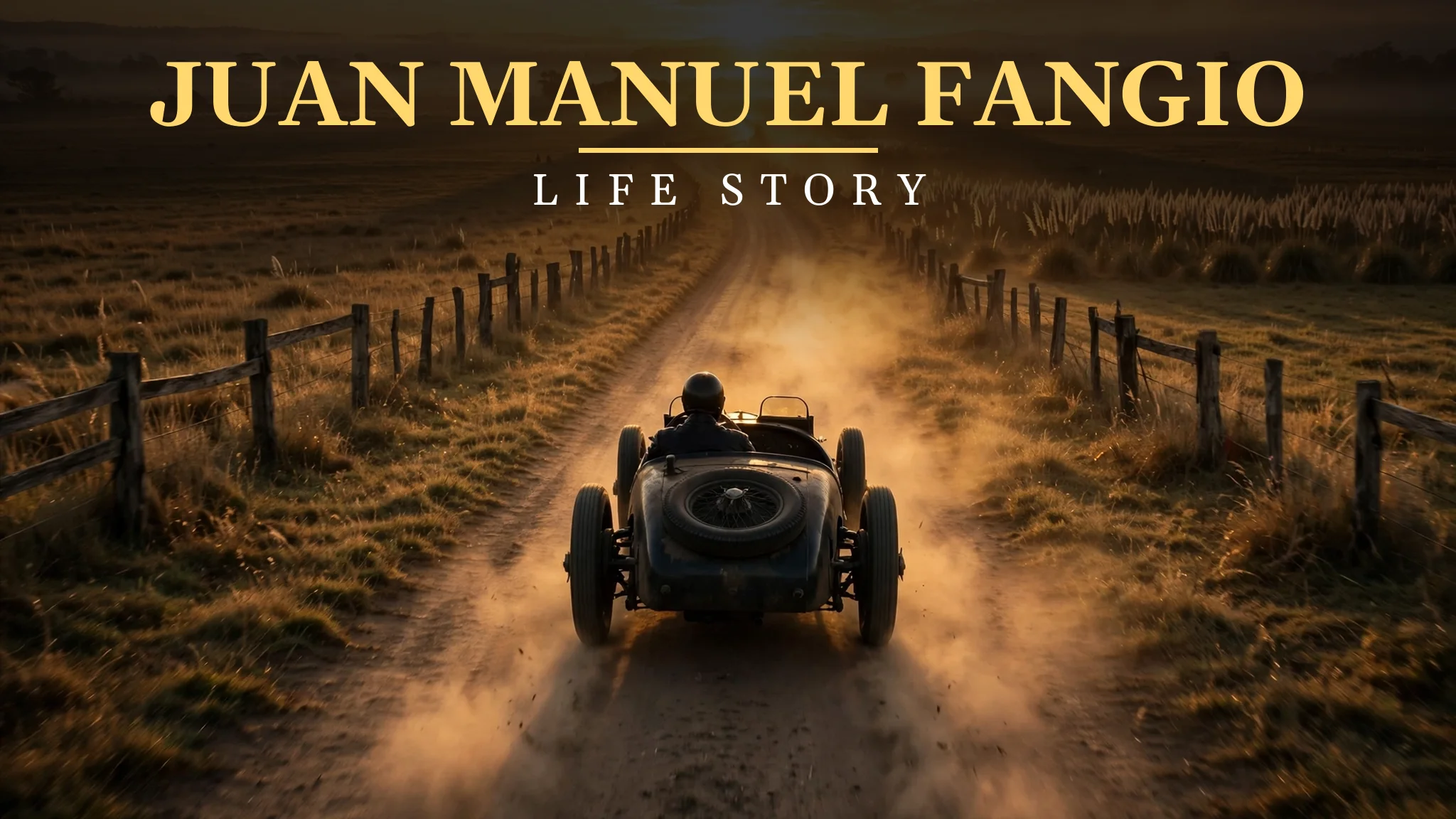
He loved cars from a young age, and he loved to drive them fast on the dirt roads around Balcarce. The pampas are flat, wide, and empty, and the roads are long and straight, with dust and stones that make driving dangerous. Fangio learned to drive on those roads, and he learned to read the surface, to feel when a car was about to slide, and to control it with gentle hands. He was not a reckless driver. He was a careful driver who understood his machine, because he had built it and fixed it himself.
He began racing in local events in Argentina, in long-distance road races that were very different from the short circuits of Europe. These races, known as Turismo Carretera, covered hundreds of kilometres on public roads, through towns and villages, and they lasted for hours or even days. A driver had to be strong, patient, and able to fix his car on the side of the road if it broke down. Fangio was good at all of those things, and he won races in Argentina, becoming a national hero in a country that loved motor racing.
He also raced in other parts of South America, travelling to Brazil, Chile, and Peru, and he learned to drive on different surfaces, in different weather, and at high altitude. That experience made him a complete driver, because he had driven in conditions that European drivers had never seen. He was not a specialist in one type of track. He was a driver who could adapt to anything, and that adaptability would later help him in Formula One, where he raced on circuits in many different countries.
By the late 1940s, he was the best driver in South America, and he was invited to race in Europe. He was already in his late thirties, which was old for a racing driver, and many people in Europe thought he was too old to succeed. He proved them wrong, and he did it in a way that was quiet and unshowy, just as he had done in Argentina. He did not arrive in Europe with a big entourage or a lot of noise. He arrived with a suitcase, a mechanic’s knowledge, and a calm belief in his own ability.
Long Road Races Across South America
Fangio’s early career in Argentina was built on the long road races that were the heart of South American motorsport. These races were not held on closed circuits with barriers and run-off areas. They were held on public roads, through towns, over mountains, and across deserts, and they were dangerous in a way that is hard to understand today. A driver could hit a tree, a rock, or a spectator, and there was no medical help nearby. Fangio drove those races for years, and he survived them, which was an achievement in itself.
He won the Argentine national championship, and he became famous in his home country, where people followed his races on the radio and in the newspapers. He was a hero, but he was a modest hero, who did not seek fame. He drove because he loved it, and because he was good at it, and he did not think of himself as a star. That modesty stayed with him when he went to Europe, and it made him popular with other drivers, who respected a man who did not boast.
He also learned the importance of preparation in those long races. A driver who did not prepare his car properly would break down in the middle of nowhere, and he would lose hours fixing it. Fangio prepared his cars carefully, because he was a mechanic, and he knew what could go wrong. He checked every part, he carried spares, and he drove in a way that protected his car, because he knew that finishing a race was more important than leading it for a short time. That lesson, that a race is won by finishing, would help him in Formula One, where many races were lost by drivers who pushed too hard and broke their cars.
He travelled to Europe for the first time in 1948, when he was 37 years old, and he raced in France and Italy. He did not win immediately, because the European cars and circuits were different from the ones he knew, but he learned quickly. He was a fast learner, and he was willing to listen to other drivers and engineers. He did not pretend to know everything. He asked questions, he watched, and he adapted. That willingness to learn, even when he was already a champion in South America, was one of his greatest strengths.
In 1949, he won races in Europe, and he began to attract the attention of the big teams. Alfa Romeo, the Italian team that had dominated the early years of Formula One, signed him for 1950, the first year of the world championship. He was 39 years old, and he was about to start a career that would make him the most famous driver in the world, even though he had started it much later than everyone else.
Five Titles With Four Different Teams
Fangio won his first world title in 1951, with Alfa Romeo, at the age of 40. He won three races that year, and he beat his team-mate, Giuseppe Farina, who had won the first title in 1950. It was a close fight, and it showed that Fangio was not only fast, but also consistent. He did not win every race, but he scored points in almost every race, and he made fewer mistakes than his rivals. He was already a master, even though he had only been in Formula One for two years.
He missed much of 1952 because of a serious crash at Monza, where he broke his neck, and he spent months recovering. He came back in 1953, with Maserati, and he finished second in the championship, even though the car was not the best. In 1954, he won his second title, driving for both Maserati and Mercedes, because he changed teams during the season, and he won races for both of them. It was a remarkable achievement, and it showed that he could win in any car, not only in one team’s car.
In 1955, he won his third title with Mercedes, in a season that was marked by a terrible crash at Le Mans, where many spectators were killed, and where Mercedes withdrew from racing at the end of the year. Fangio won the title, but he was saddened by the deaths, and he was a man who took the dangers of racing seriously. He did not celebrate his title in a wild way. He accepted it quietly, as he accepted everything in his life.
In 1956, he won his fourth title with Ferrari, and in 1957 he won his fifth title with Maserati, at the age of 46. His win at the Nürburgring in 1957 is often called the greatest drive in Formula One history, because he started the race with a lead, lost time in the pits, and then drove faster than anyone had ever driven on that dangerous circuit to catch the leaders and win. He broke the lap record again and again, and he won by a small margin. It was a drive that showed everything he was: brave, skilled, and calm under pressure.
He retired at the end of 1958, after a season in which he did not win a race, and he felt that his time was over. He had won five titles in seven seasons, a record that stood until Michael Schumacher won his sixth title in 2003, nearly fifty years later. He had won 24 races from 51 starts, a win rate that is still one of the best in the history of the sport. He had done it all in his forties, in an era when drivers died often, and when a champion had to be brave in a way that modern drivers do not have to be.
The Nürburgring Drive of 1957
The German Grand Prix at the Nürburgring in 1957 is the race that defines Fangio, and it is worth telling in detail, because it shows what made him different. The Nürburgring was a long, dangerous circuit, more than 22 kilometres around, through forests and hills, with more than 170 corners. It was a track that punished mistakes, and it was a track that rewarded a driver who knew it well. Fangio knew it well, because he had raced there many times, and he respected it.
He started the race in a Maserati, and he took the lead early. He then pitted for fuel and tyres, and he lost time in the pits, falling behind the two Ferraris of Mike Hawthorn and Peter Collins. He was almost a minute behind, with only ten laps to go, and most drivers would have given up. Fangio did not give up. He drove faster than he had ever driven, breaking the lap record on lap after lap, and he caught the Ferraris with two laps to go. He passed them both, and he won the race.
It was a drive that shocked the people who watched it, because it was not a drive by a young man in his twenties. It was a drive by a 46-year-old man, in a car that was not the fastest, on the most dangerous circuit in the world. He drove on the edge, but he did not crash, and he did not make a mistake. He drove with a precision that seemed impossible, and he won by a small margin. After the race, he said that he had never driven so fast, and that he would never drive that fast again. He knew that he had taken a risk, and he knew that he had been lucky as well as skilled.
That race is still talked about today, because it shows what a great driver can do when he is at his best. It was not a race won by a better car, or by luck, or by a mistake from another driver. It was a race won by a driver who was better than everyone else on that day, on that track, in those conditions. It was Fangio at his peak, and it was the last great win of his career, because he retired the next year.
He also won the title that year, his fifth, and he did it with a calm that was typical of him. He did not celebrate wildly. He accepted the title, he thanked his team, and he went home to Argentina. He was a champion, but he did not act like a star. He acted like a man who had done his job well, and who was ready to go home.
Kidnapped in Cuba and a Gentleman’s Retirement
In 1958, in his final season, Fangio was kidnapped in Cuba, in an event that is one of the strangest stories in Formula One. He was in Havana for a Grand Prix that was not part of the world championship, and he was taken from his hotel by rebels who were fighting against the Cuban government. They held him for a day, and they treated him well, and they released him unharmed. He later said that he had not been frightened, and that the rebels had been polite to him. It was a strange end to a strange career, and it showed that Fangio was a man who stayed calm even in the most unusual situations.
He retired from racing later that year, after the French Grand Prix, where he finished fourth. He did not announce his retirement with a big speech. He simply stopped, and he went home to Argentina. He was 47 years old, and he had been racing for more than twenty years. He had won five titles, and he had nothing left to prove. He was tired, and he wanted to live a quiet life, away from the dangers of racing.
After his retirement, he became a national hero in Argentina, and he was given honours by the government. He worked for Mercedes-Benz in Argentina, and he helped to promote the sport in his home country. He was also involved in the building of a museum in Balcarce, in his home town, where his cars and trophies are kept today. He did not become a rich businessman, and he did not seek fame. He lived a simple life, and he was respected by everyone who met him.
He also stayed in touch with the drivers who came after him, and he was a mentor to younger Argentine drivers. He did not give long speeches, and he did not try to teach them his secrets. He gave them simple advice, about being careful, about preparing the car, and about respecting the track. He was a gentleman, and he treated everyone with kindness, whether they were a champion or a young driver who had just started.
He died on 17 July 1995 in Buenos Aires, at the age of 84, after a period of ill health. His death was mourned in Argentina and around the world, and many drivers paid tribute to him. He was buried in Balcarce, in his home town, and his funeral was attended by thousands of people. He had been a hero for fifty years, and he had never lost the respect of his countrymen, because he had never forgotten where he came from.
The Record That Stood for Fifty Years
Fangio’s record of five world titles stood for nearly fifty years, until Michael Schumacher won his sixth title in 2003. That is a long time for a record to stand in any sport, and it shows how great Fangio was. He won his titles in an era when drivers changed teams often, when cars were unreliable, and when a driver could die in any race. He won them with four different teams, Alfa Romeo, Mercedes, Ferrari, and Maserati, which is a record that has never been matched. No other driver has won titles with four different teams, and that fact alone shows how adaptable he was.
His win rate was also remarkable. He won 24 races from 51 starts, which means he won almost half of the races he entered. That is a better win rate than most modern champions, who race in many more races and win a smaller percentage of them. He also took pole position in many races, and he set fastest laps in many races, which shows that he was fast as well as consistent. He was not a driver who won by luck. He won by being the best, race after race, year after year.
His record is even more impressive when you consider his age. He won his first title at 40, and his last at 46, an age when most drivers are retired. He was not a young prodigy. He was a mature man who had learned his craft over many years, and who used his experience to beat younger drivers. That is a lesson for anyone who thinks that success only comes to the young. Fangio proved that experience can beat youth, if the older person is willing to work hard and to keep learning.
He also set a standard for sportsmanship that is still remembered today. He was a gentleman on and off the track, and he was respected by his rivals, who knew that he would race fairly. He did not block other drivers, he did not crash into them, and he did not use dirty tricks to win. He won by driving better than them, and that was enough for him. That standard is one that modern drivers are still measured against, and it is why Fangio is still called the greatest driver of all time by many people who know the history of the sport.
Why Fangio Is Still Called the Greatest
Juan Manuel Fangio is still called the greatest driver of all time by many experts, and there are good reasons for that. He won five titles in seven seasons, he won with four different teams, and he did it in an era when racing was far more dangerous than it is today. He was not protected by modern safety measures, and he did not have a team of engineers to help him. He had his own skill, his own experience, and his own courage, and that was enough.
He also had a quality that is hard to measure, but easy to see: he was a complete driver. He could drive on any track, in any weather, in any car, and he could win. He could drive a fast car, and he could drive a slow car, and he could make a slow car go faster than it should. He was a mechanic, and he understood his car, and he was a racer, and he understood his rivals. That combination is rare, and it is why he was so successful.
His legacy is also about the way he lived his life. He was a modest man, a gentleman, and a hero in his home country, and he never forgot where he came from. He did not become arrogant, and he did not become rich and famous in a way that changed him. He stayed true to himself, and he was respected for it. That is a legacy that goes beyond racing, and it is one that many people admire, even if they know nothing about Formula One.
Today, when people argue about the greatest driver of all time, Fangio’s name is always mentioned, alongside Senna, Schumacher, and Hamilton. Some people choose a modern driver, because they have won more races and more titles. Others choose Fangio, because he won in a harder era, with fewer races, and with more danger. There is no right answer, but the fact that Fangio is still in the conversation, more than sixty years after he retired, shows how great he was. He was the first master of Formula One, and he set a standard that every champion since has tried to reach.
My Take:
I think Juan Manuel Fangio is the most impressive driver in the history of Formula One, and the reason is his age. He won his first title at 40, and his last at 46, in a sport where most drivers are finished by 35. That tells me something important about life, which is that it is never too late to become great, if you are willing to work hard and to keep learning. He did not start racing in Europe until he was 37, and he did not win a title until he was 40, and yet he became the best driver in the world. I find that hopeful, because it tells me that a late start is not a bad start, and that experience can be more valuable than youth.
What I admire most is his background as a mechanic. He did not come from a rich family, and he did not go to a racing school. He learned to fix cars in a garage in Balcarce, and he learned to drive on dirt roads in the pampas, where a mistake could kill you. That education made him a complete driver, because he understood his car from the inside, not only from the driver’s seat. When his car broke down, he knew what was wrong, and he knew how to fix it. Modern drivers have engineers to do that for them, but Fangio did it himself, and that self-reliance is something I admire deeply, because it shows that he was not dependent on anyone else.
I also admire his calm. He was not a driver who shouted, or who crashed into other drivers, or who made a scene. He was a quiet man who drove smoothly, who prepared carefully, and who won by being better, not by being louder. That calm is hard to maintain in a dangerous sport, where fear is always present, and where a single mistake can be fatal. Fangio stayed calm, and he stayed alive, and he won five titles. That tells me that calm is not weakness. Calm is strength, and it is the strength that lasts longest.
The Nürburgring drive in 1957 is the part of his story that amazes me most, because it is almost impossible to understand. He was 46 years old, he was a minute behind with ten laps to go, and he drove faster than he had ever driven, breaking the lap record again and again, to win. I have tried to imagine what that must have felt like, to be driving on the most dangerous circuit in the world, at speeds that no one had reached before, knowing that one mistake would kill you, and still pushing harder. It is a level of courage and skill that I cannot fully understand, but I can admire it, and I can learn from it, because it shows what a human being can do when he is at his best.
I think about his kidnapping in Cuba, too, and how he handled it with the same calm that he handled everything else. He was taken from his hotel by rebels, he was held for a day, and he was released unharmed. He said later that he had not been frightened, and that the rebels had treated him well. I do not know if that is true, or if he was simply being polite, but I admire the way he did not make a drama out of it. He did not write a book about it, and he did not use it to gain sympathy. He treated it as a strange event in a long life, and he moved on. That is a mature way to handle a frightening experience, and it is a lesson for anyone who has been through something scary.
What I learn from Fangio is that preparation matters more than talent. He prepared his cars carefully, because he was a mechanic, and he prepared himself carefully, because he knew that a long race requires patience. He did not win by being the fastest driver on the first lap. He won by being the best driver over the whole race, and over the whole season. That is a lesson I can use in my own work, because I know that the person who prepares well will often beat the person who is more talented but less prepared. Fangio was both talented and prepared, and that is why he was unbeatable for so many years.
I also learn from him that a gentleman can be a champion. He was respected by his rivals, he helped younger drivers, and he never boasted about his success. In a sport where many drivers are arrogant, Fangio was humble, and that humility did not make him weak. It made him stronger, because people wanted to help him, and people wanted to work with him. I think that is a lesson for anyone who wants to succeed, because success is not only about being good at your job. It is also about being a good person, and Fangio was a good person, by all accounts, and that is why his legacy has lasted.
If I have to be honest about what is sad in his story, I would say that it is sad that he raced in such a dangerous era, and that so many of his rivals died. He lost friends in crashes, and he saw drivers die in front of him, and he kept racing anyway. That must have been hard, and it must have weighed on him, even if he did not talk about it. I think about that when I read about modern racing, where drivers are protected by halos, by safe barriers, and by medical teams, and I am grateful that the sport is safer now, because no one should have to die to entertain a crowd. Fangio survived, but many of his contemporaries did not, and that is a sad part of his story.
I also think about his life after racing, and how he stayed true to his roots. He went back to Argentina, he worked for Mercedes, he helped build a museum in Balcarce, and he lived a simple life. He did not become a celebrity who lived in Monaco or London. He lived in his home country, close to his family, and he was happy. That tells me that success does not have to change you, and that you can be a world champion and still be a normal person who loves his home town. I find that reassuring, because it shows that fame is not the most important thing. Home is.
In the end, I think Fangio’s story is about a man who started late, who worked hard, who stayed calm, and who became the greatest driver of his time, not by being the youngest or the fastest, but by being the most complete. He was a mechanic, a driver, a gentleman, and a hero, and he did it all in his forties, when most people think it is too late. That is a story that gives me hope, and it is a story that I will remember whenever I think that I have started too late, or that I am too old to learn something new. Fangio started late, and he became the best, and that is a lesson that will last as long as people race cars.
I also think about the fact that Fangio won titles with four different teams, which no other driver has ever done. That tells me something about his adaptability, because each team had a different car, a different way of working, and different people, and Fangio had to learn each one, quickly, and win with it. He did not need a team to be built around him. He could join a team, understand its car, and win, in his first season. That is a rare skill, and it is one that modern drivers, who often stay with one team for many years, do not always have. Fangio had it, because he was a mechanic, and because he understood cars, not only driving.
Another part of his story that stays with me is the long road races in Argentina, where he learned to drive for hours, on dirt roads, through towns and villages, with no medical help nearby. Those races taught him patience, and they taught him to look after his car, because if the car broke down in the middle of nowhere, he would have to fix it himself, on the side of the road. That experience made him a complete driver, because he understood that finishing a race is more important than leading it for a short time, and that a driver who looks after his car will win more races than a driver who abuses it. I think that lesson applies to many jobs, because the person who looks after their tools will last longer than the person who breaks them.
I think about his modesty, too, and how he never boasted about his five titles, even though they were a record for nearly fifty years. He accepted his titles quietly, he thanked his team, and he went home to Argentina. He did not write a book boasting about himself, and he did not go on television to talk about how great he was. He just lived his life, and he let his record speak for him. That is a humble way to be a champion, and it is one that I admire, because it shows that he did not need praise to feel good about himself. He knew what he had done, and that was enough.
His relationship with other drivers is another thing I respect. He was respected by his rivals, who knew that he would race fairly, and who knew that he would not block them, or crash into them, or use dirty tricks. He won by driving better than them, and that was enough for him. That fairness is rare in sport, and it is why he is still called a gentleman, more than sixty years after he retired. I think that is a legacy that matters, because it shows that you can be the best, and still be fair, and that winning fairly means more than winning by cheating.
I also wonder what Fangio would have thought about modern Formula One, with its huge teams, its simulators, and its drivers who start karting at the age of five. I think he would have been amazed by the technology, but I also think he would have said that the basics have not changed: a driver still has to understand his car, still has to be brave, and still has to be calm under pressure. He had all three, and he won five titles with them, in cars that were far more dangerous than modern cars, and that is why his record stood for so long, and why he is still in the conversation about the greatest driver of all time.
I think about Balcarce, too, and the museum there, where his cars and trophies are kept, and where people from all over the world go to see them. That museum is a fitting tribute to a man who came from a small town, and who became the best in the world, and who never forgot his home. He is buried in Balcarce, and his town is proud of him, and that pride is a legacy that will last, because it is about a place, as well as a person, and about a boy who left a small town, and who came back a hero, and who stayed a hero for the rest of his life.
I also think about his win rate, 24 wins from 51 starts, which means he won almost half of the races he entered, a rate that is still one of the best in history. That is a remarkable statistic, and it shows how dominant he was, in an era when cars were unreliable, and when drivers died often, and when a win was hard to come by. He won almost half his races, and that is a level of success that few drivers have ever matched, in any era, and it is why he is still called the greatest, more than sixty years after he retired.
Another thing I notice is that Fangio never had a big team built around him, in the way that modern champions do, with dozens of engineers, and with a car designed specifically for him. He joined teams, he learned their cars, and he won, in his first season, with four different teams. That adaptability is rare, and it is a skill that modern drivers, who often stay with one team for many years, do not always have. Fangio had it, because he was a mechanic, and because he understood cars, and because he was willing to learn, even when he was already a champion.
Finally, I think his story is a reminder that it is never too late to become great. He started racing in Europe at 37, he won his first title at 40, and his last at 46, when most drivers are retired. That is a hopeful message, for anyone who thinks they have started too late, or that they are too old to learn something new. Fangio started late, and he became the best, and that is a lesson that will last as long as people race cars, and as long as people dream of becoming great, even when they are older than everyone else.
Frequently Asked Questions
When was Juan Manuel Fangio born?
Juan Manuel Fangio was born on 24 June 1911 in Balcarce, Argentina, to Italian immigrant parents. He grew up in Balcarce, worked as a mechanic, and learned to drive on the dirt roads of the Argentine pampas.
How many Formula One world titles did Fangio win?
Fangio won five Formula One world titles, in 1951, 1954, 1955, 1956 and 1957. His record of five titles stood for nearly fifty years until Michael Schumacher won his sixth title in 2003.
Why is Fangio’s 1957 Nürburgring win so famous?
At the 1957 German Grand Prix, Fangio fell almost a minute behind after a pit stop, then broke the lap record lap after lap to catch and pass the two Ferraris and win. It is often called the greatest drive in Formula One history, and it came when he was 46 years old.
Which teams did Fangio win titles with?
Fangio won titles with four different teams, Alfa Romeo, Mercedes, Ferrari and Maserati, which is a record no other driver has matched. He won 24 races from 51 starts, a win rate of almost half his races.
Was Juan Manuel Fangio kidnapped in Cuba?
Yes, in 1958 Fangio was taken from his hotel in Havana by rebels fighting the Cuban government and held for a day before being released unharmed. He said later that he had been treated well, and he retired from racing later that year.
When did Juan Manuel Fangio die?
Fangio died on 17 July 1995 in Buenos Aires at the age of 84. He was buried in his home town of Balcarce, where a museum keeps his cars and trophies, and he is remembered in Argentina as a national hero.


