Julia Child: The Life Story Behind the Beloved Chef
In this post
- A Tall Girl in Pasadena Who Never Learned to Cook
- War Work, Paul Child, and a First Taste of France
- The Cookbook That Took Ten Years
- The French Chef and Television Fame
- Later Years, Honours, and a Kitchen in a Museum
- A Late Start That Changed American Cooking
- The Kitchen, the Pots, and the Way She Taught
- My Take:
Julia Child is remembered as the happiest person ever to cook on television. She was tall, she was loud, she laughed at her own mistakes, and she made French cooking look like something any person could try at home. When a chicken slipped, when a cake fell, when a potato went flying, she did not hide it. She smiled, she picked it up, and she carried on. That honesty made millions of people love her, and it changed the way America thought about food.
What most people do not know is that she could not cook at all until she was an adult. She grew up in a house with a cook, she went to a good college, she worked in an office during the war, and she married a man who loved food. It was only when she moved to France, at the age of thirty-six, that she took her first real cooking lesson. She was a beginner, and she was not a natural. She burned things, she made mistakes, and she kept going. Twelve years later, she was the author of the most famous cookbook in America, and a year after that she was on television, teaching the whole country to make a French omelette.
This is the story of a woman who found her true work late in life, and who proved that it is never too late to learn a new skill. It is a story about France, about a husband who believed in her, about a cookbook that took years to write, and about a television show that made a tall, cheerful woman with a warbling voice into one of the best-loved people in America.
A Tall Girl in Pasadena Who Never Learned to Cook
Julia Carolyn McWilliams was born on 15 August 1912 in Pasadena, California. She was the eldest of three children, and her father, John McWilliams, was a successful businessman who worked in land and farming. Her mother, Julia Carolyn Weston, came from a family with money, and the family lived in a large, comfortable house. Julia grew up tall, strong, and full of energy. She was nearly six feet two inches tall as an adult, and even as a girl she stood out in a crowd. She loved sport, she loved the outdoors, and she was not a quiet, delicate child. She was loud, funny, and always ready for an adventure.
The family had a cook, as many wealthy families did in those days, and Julia did not need to learn to cook. Her mother did not cook much either, and the kitchen was the cook’s place, not Julia’s. She grew up eating good food, but she did not know how it was made. She went to school in California, and she was a good student, though she was more interested in sport and in being with her friends than in books. She played tennis, she played golf, and she enjoyed the outdoor life of Southern California. Food was something that appeared on the table, and she did not think much about where it came from.
After school, Julia went to Smith College in Massachusetts, one of the great women’s colleges in America. She studied history, and she graduated in 1934. College was a time of learning and of growing up, and Julia made friends there who stayed with her for the rest of her life. She was not sure what she wanted to do next, and like many young women of her time, she went back to California and looked for work. She worked in advertising in New York for a time, and she wrote for a local paper, but she had not yet found the work that would make her life.
The war changed everything. When the United States entered the Second World War, Julia wanted to help. She tried to join the women’s branches of the armed forces, but she was told she was too tall. She did not give up. She joined the Office of Strategic Services, the wartime intelligence service that later became the CIA, and she worked as a research assistant and a clerk. It was not glamorous work, but it was important, and it took her far from home. She was sent to Ceylon, now Sri Lanka, and then to China, and there she met the man who would change her life.
War Work, Paul Child, and a First Taste of France
In Ceylon, Julia met Paul Child, a man ten years older than her, who worked for the Office of Strategic Services as well. Paul was quiet, cultured, and deeply interested in food, art, and the good things in life. He had lived in Paris, he spoke French, and he loved to eat well. Julia was drawn to him at once, not only because he was kind and clever, but because he opened a door to a world she had never known. He talked about French food, about wine, about the pleasure of a good meal, and Julia listened. She had never met anyone quite like him, and she knew that her life would be different with him in it.
They married on 1 September 1946, after the war ended, and they settled in Washington, D.C., where Paul worked for the United States government. Julia tried to cook for her husband, and she soon found that she was not good at it. Paul was patient, and he encouraged her, but the meals were plain and often went wrong. Julia was not discouraged. She was curious, and she wanted to learn. She took a few cooking lessons, and she began to read cookbooks, but she was still a beginner, and she knew it.
In 1948, Paul was posted to Paris, to work at the American embassy, and the couple moved to France. Julia arrived in Paris at the age of thirty-six, and she fell in love with the city at once. The markets, the shops, the smell of bread, the taste of a simple soup in a small restaurant: it was all new to her, and it was wonderful. She has said that her first meal in France, a lunch of oysters and sole meunière in Rouen, was a revelation. She had never tasted food like it, and she knew at once that she wanted to learn how to make it herself.
She enrolled at the Cordon Bleu, the famous cooking school in Paris, and she began to learn French cooking from the beginning. She was older than most of the students, and she was American, and she did not speak French well at first. The teachers were strict, and the work was hard. She learned how to hold a knife, how to make a stock, how to cook an egg, and how to make a sauce. She made mistakes, she burned things, and she kept going. She also learned that French cooking was not about magic. It was about method, about care, and about practice. A person who followed the method and practised could learn it, and Julia was willing to practise.
At the Cordon Bleu she met Simone Beck, known as Simca, and Louisette Bertholle, two French women who were writing a cookbook about French cooking for American readers. They invited Julia to join them, and the three women began to work together. It was a partnership that would change Julia’s life. Simca was passionate and demanding, Louisette was steady and practical, and Julia was the American who could explain French cooking in words that American home cooks could understand. Together, they began to write the book that would become Mastering the Art of French Cooking.
The Cookbook That Took Ten Years
Writing a cookbook sounds simple, but the book Julia and her friends wrote was not simple at all. They wanted to teach American women, who had small kitchens and little time, how to cook real French food. That meant testing every recipe many times, writing down every step in clear words, and making sure that a person who had never made a sauce could follow the instructions and get it right. Julia was a perfectionist about this. She tested a recipe again and again until she was sure it worked, and she rewrote the instructions until they were clear.
The work took years. Julia, Simca, and Louisette cooked, tasted, argued, and rewrote. They sent the manuscript to publishers, and the first publisher turned it down, saying it was too long and too detailed. Julia did not give up. She believed in the book, and she believed that American cooks were ready for it. Another publisher, Alfred A. Knopf, agreed to publish it, and after more work and more testing, Mastering the Art of French Cooking was published in 1961. Julia was forty-nine years old.
The book was a success from the start. American readers loved it because it was clear, it was honest, and it treated them as serious cooks. It did not talk down to them. It told them that French cooking was not a mystery, but a skill that could be learned, and it gave them the steps to learn it. The book sold well, and it made Julia famous in the food world. She was no longer a student. She was an author, and her book was on the shelves of kitchens all over America.
The book also changed the way Americans cooked. Before Julia, many American cookbooks were short and simple, with few details. Julia’s book was long, detailed, and full of explanations. It taught people not just what to do, but why to do it. It taught them that a sauce needed time, that an omelette needed a hot pan, and that a chicken needed to be browned properly. Readers who followed her instructions found that they could make food that tasted like the food they had eaten in France, and that discovery was exciting. Julia had given them a key, and they used it.
The French Chef and Television Fame
The book led to television, and television made Julia a star. In 1962, she appeared on a Boston television show to talk about her book, and she cooked an omelette live on air. The viewers loved it. She was tall, she was cheerful, she talked as she cooked, and she made the whole thing look like fun. The station, WGBH in Boston, asked her to make a regular show, and in 1963 The French Chef began. It was one of the first cooking shows on American television, and it ran for ten years.
The show was unlike anything else on television. Julia cooked in a real kitchen, with real ingredients, and she made real mistakes. If she dropped something, she picked it up. If a dish did not look perfect, she said so, and she carried on. Viewers loved her honesty, and they loved her voice, which was high, warbling, and full of joy. She talked to the camera as if she were talking to a friend in her own kitchen, and she made the audience feel that they could cook too. She was not a distant expert. She was a friend who happened to know a great deal about French food.
The show won awards, including an Emmy, and it made Julia famous across America. People who had never cooked a French meal watched her every week, and many of them tried her recipes at home. She became a familiar face, and her name became a byword for good cooking. She wrote more books, she made more television shows, and she became a public figure who spoke about food, about eating well, and about the pleasure of a good meal shared with friends.
Her life with Paul was central to all of this. Paul supported her work, he photographed her food, he helped with the books, and he shared her love of France. They lived in Cambridge, Massachusetts, in a house with a kitchen that became famous in its own right. The kitchen was large, with high counters built for Julia’s height, and with her copper pots hanging on the wall. It was the kitchen where she filmed, where she tested recipes, and where she cooked for friends. Paul’s health declined in later years, and Julia cared for him, and his death in 1994 was a great loss to her. She carried on working, but she missed him deeply.
Later Years, Honours, and a Kitchen in a Museum
In the years after The French Chef, Julia kept working. She wrote more books, including The Way to Cook and Julia’s Kitchen Wisdom, and she made new television shows, including Julia Child and Company and Baking with Julia. She also worked with other chefs, and she became a mentor to a new generation of American cooks. She was generous with her time, and she believed that cooking was a skill that should be shared, not kept secret. Young chefs who met her found her warm, funny, and encouraging, and they carried her lessons into their own work.
She also became a voice for good food in America. She spoke against the fashion for low-fat food that had no taste, and she argued that butter, cream, and good ingredients were not the enemy. She believed that a person should eat well, enjoy their food, and not be afraid of pleasure. That view was not always popular, but Julia held it with courage, and she said what she thought in her own cheerful way. She was not a doctor, and she did not pretend to be one. She was a cook, and she spoke as a cook, about taste, about joy, and about the table as a place where people came together.
In 2003, Julia received the Presidential Medal of Freedom, the highest civilian honour in the United States, for her work in bringing French cooking to America and for her long career in television and writing. It was a fitting honour for a woman who had started cooking at thirty-six and had changed the way a whole country ate. She accepted it with joy, and she continued to work, even in her nineties, writing, talking about food, and encouraging young cooks.
Julia Child died on 13 August 2004, two days before her ninety-second birthday, in California. She had lived a long, full life, and she had left a legacy that is still felt today. Her kitchen, the famous kitchen in Cambridge, was given to the Smithsonian National Museum of American History, where it is now on display. Visitors can see the copper pots, the high counters, and the tools she used, and they can remember the tall, cheerful woman who cooked there. Her books are still in print, her shows are still watched, and her name is still a byword for the joy of cooking. She proved that it is never too late to learn, and that a person who loves what they do can change the world, one meal at a time.
A Late Start That Changed American Cooking
Julia Child’s story matters because she started late, and she started badly. She was not a child prodigy in the kitchen. She was a grown woman who burned her first meals and who had to learn everything from the beginning. That is a hopeful story for anyone who feels that they have missed their chance. Julia missed nothing. She found her work at thirty-six, she published her great book at forty-nine, and she became a television star in her fifties. Her best years came after most people would have said her life was settled, and that is a lesson worth remembering.
Her way of teaching also mattered. She did not teach by making people feel small. She taught by making them feel brave. She showed her mistakes, she laughed at them, and she told her viewers that a mistake was not a failure. It was a step on the way to getting it right. That kindness made people willing to try, and trying is the only way to learn. Many cooks today still teach in her style, showing the mess as well as the finished dish, and they owe that style to Julia. She made the kitchen a friendly place, and she made cooking a joy rather than a test.
The Kitchen, the Pots, and the Way She Taught
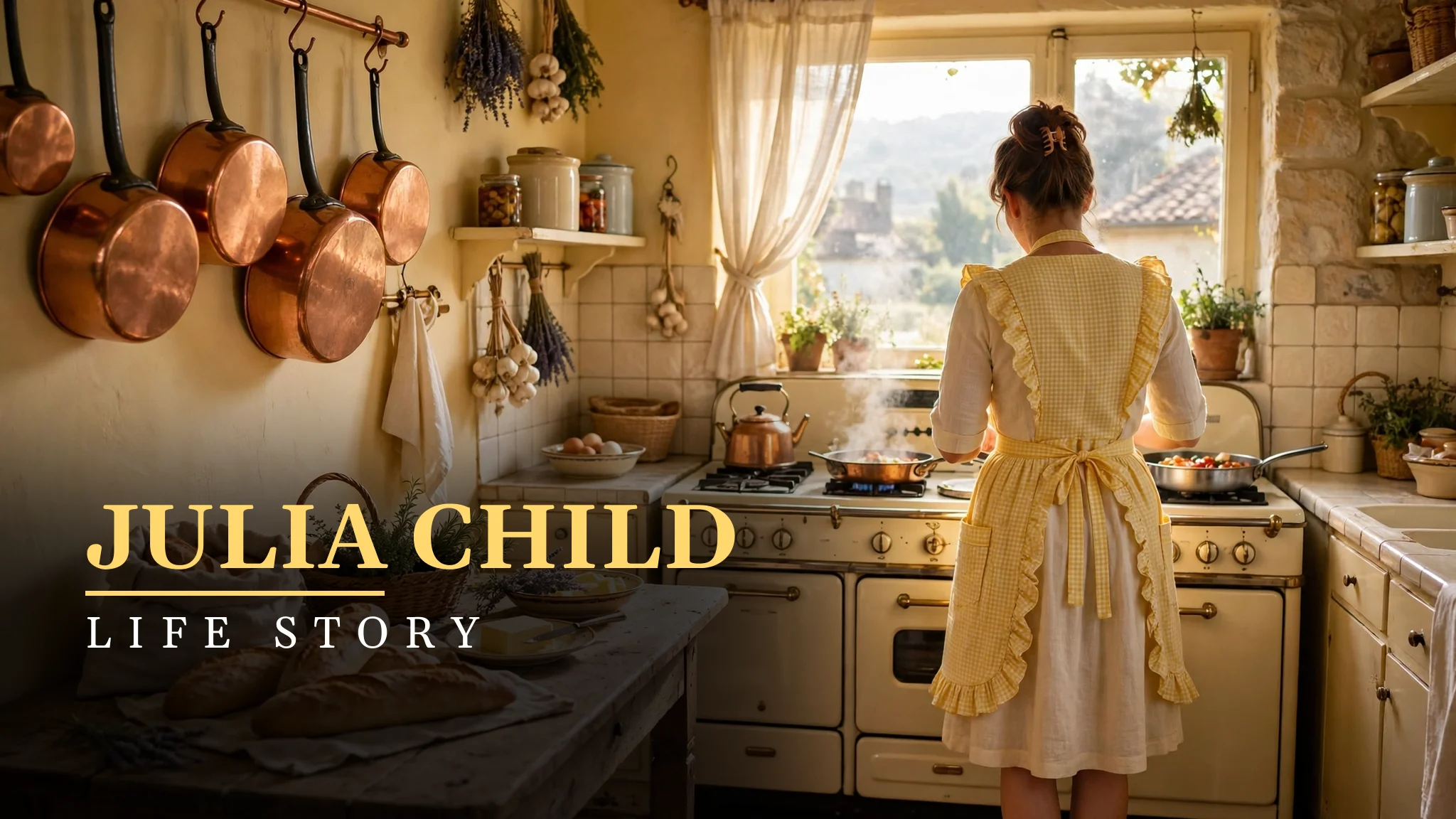
Julia Child’s kitchen in Cambridge became almost as famous as she was, and it tells a great deal about how she worked. The counters were built high, because she was tall, and the copper pots hung on a pegboard on the wall, where she could reach them easily. Every tool had its place, and she knew where everything was. Visitors to the kitchen felt at once that it was a working kitchen, not a show kitchen. There were stains on the stove, marks on the counters, and tools that had been used for years. That was the point. Julia believed that a kitchen should be used, not admired from a distance, and her kitchen showed it.
She taught in a way that was new for television. She did not stand behind a desk and read a recipe. She stood at the stove, she talked while she worked, and she let the audience see the whole process, including the parts that went wrong. If a soufflé fell, she said so. If a chicken stuck to the pan, she dealt with it. She told her viewers that cooking was not about being perfect. It was about paying attention, about learning from the mistake, and about trying again. That message reached people who had been afraid to cook, because they thought that one mistake would ruin the meal. Julia showed them that a mistake was only a mistake, and that the meal could still be good.
She also taught by explaining why things worked. She did not just say to add butter. She said why butter mattered, what it did to the sauce, and what would happen if you left it out. She did not just say to use a hot pan. She said why the pan had to be hot, and what would happen to the food if it was not. That way of teaching gave her viewers real knowledge, not just a list of steps. A person who understood why a sauce thickened could make a different sauce the next day, without a recipe. Julia wanted her viewers to become cooks, not just followers of recipes, and her books and shows were built around that idea.
Her influence spread far beyond her own shows. Chefs who grew up watching her, writers who learned from her books, and home cooks who tried her recipes all carried her lessons into their own kitchens. She helped to create a new kind of American cook, one who was curious about other countries, who cared about good ingredients, and who was not afraid to try a difficult dish. Before Julia, French cooking in America was something for rich people in restaurants. After Julia, it was something a home cook could try on a Saturday afternoon, and that change was her great gift to American food.
She also changed what people expected from a cooking show. Before her, cooking on television was often stiff and formal, with a presenter who never made a mistake and never laughed. Julia made it warm and human, and that warmth became the model for the cooking shows that followed. Presenters today who talk to the camera, who taste as they go, and who show the real work of cooking are following a path she made. She did not invent television cooking, but she made it friendly, and that friendliness is still the heart of the best food television today.
My Take:
I love Julia Child’s story, and I love it for a simple reason: she started late, and she started badly, and she still became great. I think about how many people feel that their chance has passed. They are thirty, or forty, or fifty, and they think that the time to learn something new is gone. Julia proves that idea wrong in the clearest way possible. She was thirty-six when she took her first real cooking lesson, forty-nine when her great book was published, and in her fifties when she became a television star. Her best work came after most people would have said her life was settled. That is a hopeful message, and it is one I would give to anyone who feels too old to start again.
What I admire most about her is her joy. She did not cook with a stern face. She cooked with laughter, with a loud voice, and with a clear delight in the food itself. When she tasted a sauce and it was good, her whole face lit up. When something went wrong, she laughed and carried on. That joy is rare, and it is catching. A person who watches Julia cook feels happier, and feels braver about trying to cook themselves. I think that joy was not an act. It came from a real love of food, of France, and of sharing a meal with people she liked. She was not performing happiness. She was happy, and the camera caught it.
I also admire her honesty about mistakes. In a world where television cooks now show only perfect dishes, Julia showed the mess. She dropped a potato, she broke a cake, she burned a sauce, and she told the audience what had happened. That honesty takes courage, because most people want to hide their mistakes. Julia did the opposite. She used her mistakes to teach. She showed that a mistake was not the end of a meal, and that a cook who keeps going can still serve something good. I think that lesson goes far beyond cooking. It is a lesson for life. We all make mistakes, and the people who succeed are not the people who never make them. They are the people who pick up the potato, laugh, and carry on.
Her partnership with Paul matters to me a great deal. He was the person who first showed her the world of good food, and he stayed beside her for the whole journey. He took photographs for her books, he helped her test recipes, and he shared her love of France. When his health failed, she cared for him, and when he died, she grieved and she kept working. That is a marriage in the true sense: two people who help each other grow, who share a dream, and who stay together through the hard years as well as the good ones. I respect that deeply, because a career is easier when someone believes in you at home, and Julia had that belief from Paul from the very start.
I think about her height, too, because it is a small detail that says a lot. She was six feet two inches tall, and in her time, a tall woman was often told to be smaller, quieter, and less noticeable. Julia did the opposite. She stood tall, she spoke loudly, and she took up space in her kitchen and on television. She did not apologise for being big, or loud, or different. She made her size part of her charm. I like that, because many people are told to shrink themselves to fit in, and Julia refused. She was herself, fully, and the world loved her for it. That is a lesson for anyone who has ever felt too big, too loud, or too different.
What I learn from her is that learning is not only for the young. She went to cooking school at thirty-six, and she was older than her classmates, and she did not speak French well, and she made mistakes every day. She could have given up and said that cooking was not for her. Instead, she stayed, she practised, and she learned. That willingness to be a beginner as an adult is a brave thing, and it is rarer than we think. Most adults are afraid to look foolish, and so they stop learning. Julia was not afraid to look foolish, and so she kept learning for the rest of her life. I would tell any person who wants to learn something new to remember her, and to be willing to be a beginner again.
I also learn from her that detail matters. Her cookbook was not a short list of recipes. It was a long, careful book, with every step explained, because she knew that a home cook needed to understand why a thing worked, not just what to do. That care took years, and it meant testing a recipe again and again until it was right. That is slow work, and it is not glamorous, but it is the work that makes a book last. Her book is still in print more than sixty years later, and that is because she did the slow work well. In a world that wants everything fast, Julia reminds me that slow, careful work is worth doing.
There is a part of her story that makes me a little sad, and that is the way she was sometimes mocked for her voice. Her voice was high and warbling, and comedians copied it, and some people laughed at it. Julia knew about the jokes, and she laughed at them herself, but I think it is worth saying that her voice was part of her. She did not try to change it to sound more serious. She spoke as she spoke, and she let the world hear her as she was. I admire that, because it is easy to change yourself to please other people, and it is hard to stay yourself when people laugh. She stayed herself, and in the end, the voice that people mocked became one of the most loved voices on television.
I think about her view on food, too. She believed in butter, in cream, in good ingredients, and in the pleasure of eating well. In a time when many people were told to fear fat and to eat food with no taste, Julia said plainly that food should taste good, and that a person should enjoy their meal. She was not a doctor, and she did not give medical advice. She gave cooking advice, and her advice was to cook well, to eat with friends, and to take pleasure in the table. I think that is a healthy view, because food is not only fuel. It is also joy, and company, and memory. A meal shared with people you love is worth more than a meal eaten alone in fear of calories.
If I am honest, I do not think every recipe in her book is easy, and I do not think every home cook will make a perfect soufflé on the first try. Some of her recipes are long, and some need tools and time that a busy person may not have. That is a fair criticism, and Julia herself knew it. She did not write for people in a hurry. She wrote for people who wanted to learn, and who were willing to take time. I respect that, even if it means her book is not for every night of the week. It is for the nights when a person wants to cook something special, and to learn something new, and that is a good enough reason for a book to exist.
What I take from Julia Child, in the end, is a simple and hopeful lesson: begin, even if you begin late, even if you begin badly, and keep going. She began at thirty-six, she burned her first meals, she was turned down by a publisher, and she still became one of the most loved cooks in America. She did it by practising, by laughing at her mistakes, by working with people she trusted, and by loving the work itself. I think that is a lesson for anyone who has a dream they have put off for too long. It is not too late. Julia proved it, one omelette at a time, and her story is still teaching people today.
I will remember her not as a perfect cook, but as a joyful one, a tall woman in a kitchen in Cambridge, with copper pots on the wall and a laugh that filled the room. She taught a whole country to cook, she taught them to enjoy their food, and she taught them that it is never too late to learn. That is a legacy to be proud of, and it is one that still warms the kitchens of people who never met her, but who learned from her all the same.
I also think about the way she worked with Simca and Louisette, because that partnership says a lot about her. Writing a cookbook with two other women, in a foreign language, over many years, is not easy. There were arguments, there were disagreements about recipes, and there were times when the book seemed as if it would never be finished. Julia stayed with it. She listened, she argued back, and she kept the work going. That is a lesson in collaboration. A great book is rarely the work of one person alone, even when one name is on the cover. Julia knew that, and she gave credit to her partners, even when the fame came mostly to her. I respect that, because many famous people forget the people who helped them at the start.
Her house in Cambridge, and the kitchen inside it, also stay in my mind. She and Paul built a home that was made for cooking, with high counters for her height and pots within easy reach. It was not a show home. It was a working home, where friends came to eat, where recipes were tested, and where a life was lived. I like the idea that her most famous room was not a studio or an office, but a kitchen, a place where people gather, talk, and eat together. That is a fitting symbol for her life. She did not build her fame in a boardroom. She built it at a stove, with a wooden spoon in her hand.
I think about her age once more, because it is the part of her story that gives me the most hope. She was forty-nine when her great book came out, and she was in her fifties when she became a television star. In a world that tells women they must succeed young or not at all, Julia’s life says the opposite. She succeeded late, and she succeeded fully, and she kept working into her nineties. I would tell any woman, or any person, who feels that life has passed them by to look at Julia Child and to remember that a life is long, and that a new chapter can begin at any age. That is not a small lesson. It is a life-changing one, and it is the lesson I carry most from her story.
When I think of her now, I think of a tall woman laughing in a kitchen, holding up a chicken that did not quite work, and telling the camera that it was fine, that it would still taste good, and that the cook should carry on. That image is simple, but it holds everything I admire about her: the joy, the honesty, the courage, and the love of food. She taught a country to cook, and she taught them to laugh while they did it, and that is a gift that does not fade.
I also think about the way she worked with her hands, and how that connects to her teaching. She did not teach from a book alone. She showed her hands, she showed the knife, she showed the pan, and she let the audience see the work itself. That is a different kind of teaching from a lecture, and it is a kinder one, because it says to the viewer that cooking is something you do with your hands, not something you memorise. I think that is why so many people who watched her felt that they could cook, even if they had never cooked before. She made the work visible, and visible work feels possible.
I also think about the young cooks who watch her shows today, on video, and who see a tall woman laughing in a kitchen, and who feel brave enough to try. Those cooks were not born when Julia was alive, but they learn from her still, because her joy, her honesty, and her love of food do not fade with time. A great teacher teaches beyond her own lifetime, and Julia Child is still teaching, one omelette at a time, to people she will never meet.
Frequently Asked Questions
When was Julia Child born?
Julia Child was born on 15 August 1912 in Pasadena, California, as Julia Carolyn McWilliams. She was the eldest of three children in a wealthy family, and she grew up tall, sporty, and full of energy.
How old was Julia Child when she learned to cook?
She did not learn to cook properly until she moved to France at the age of thirty-six. She enrolled at the Cordon Bleu in Paris, where she learned French cooking from the beginning, making many mistakes along the way.
What is Mastering the Art of French Cooking?
It is the famous cookbook Julia wrote with Simone Beck and Louisette Bertholle, published in 1961 when Julia was forty-nine. It taught American home cooks how to make real French food, with clear, detailed instructions, and it became a great success.
What was The French Chef?
The French Chef was Julia’s television cooking show, which began on WGBH in Boston in 1963 and ran for ten years. She cooked live, talked to the camera, and showed her mistakes, which made viewers love her and trust her.
Who was Julia Child’s husband?
She married Paul Child on 1 September 1946. Paul worked for the United States government, loved French food and art, and supported Julia’s work for the whole of their marriage. He died in 1994.
When did Julia Child die?
Julia Child died on 13 August 2004 in California, two days before her ninety-second birthday. Her famous kitchen in Cambridge is now on display at the Smithsonian National Museum of American History.
Why is Julia Child still famous today?
She is still famous because she changed the way America cooked, made French cooking friendly and clear, and showed on television that cooking could be joyful and that mistakes were part of learning. Her books are still in print and her shows are still watched.


