Julia Jacklin: The Life Story Behind the Crushing Star
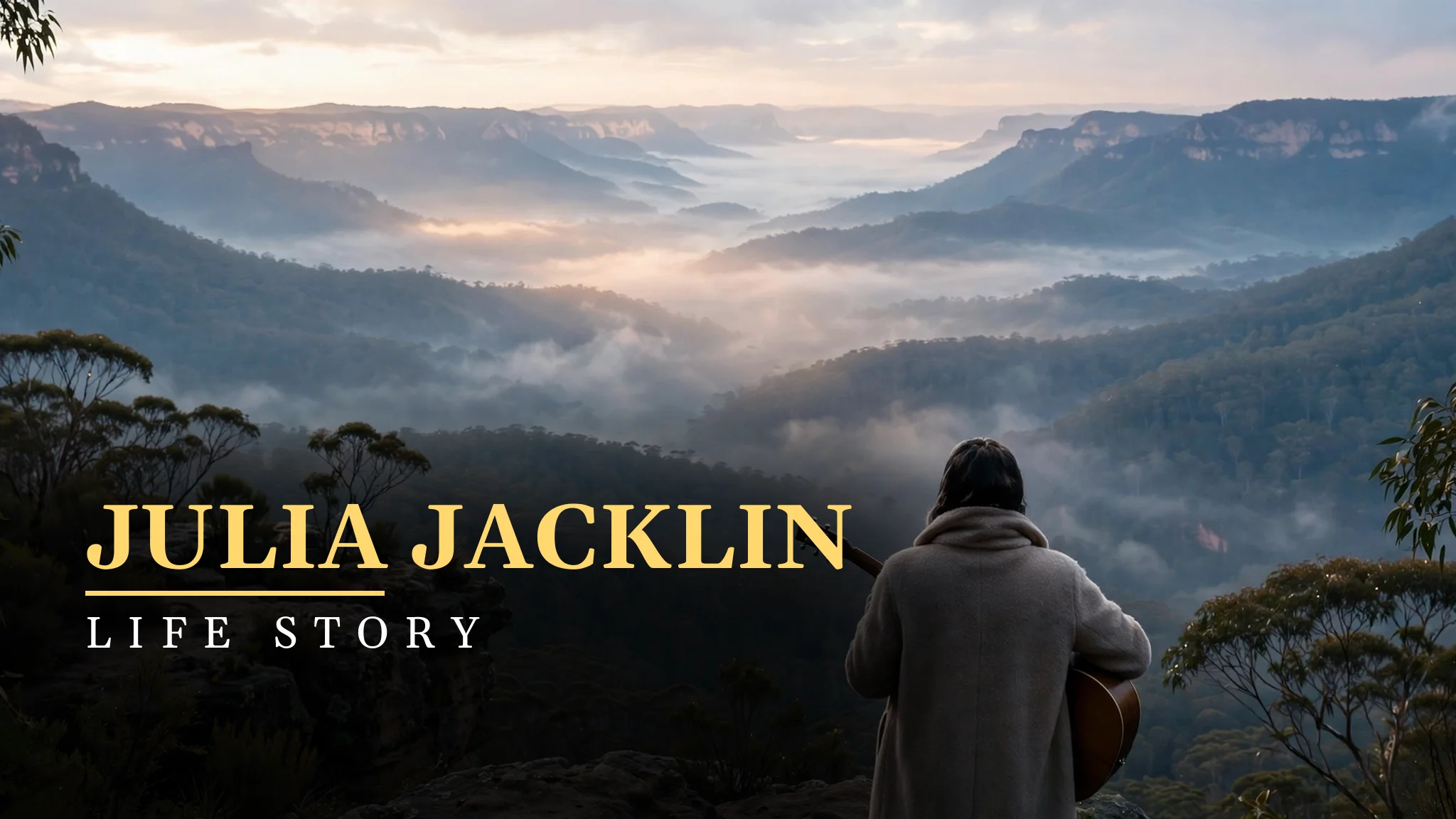
In this post
- Growing Up in the Blue Mountains
- Sydney and the First Steps in Music
- Don’t Let the Kids Win and the First Album
- Crushing and the Songs About Love
- Pre Pleasure and Looking Back
- What Her Songs Mean to Listeners
- The Live Shows and the Quiet Room
- The Voice That Grows With You
- The Mountains That Never Leave
- My Take:
Julia Jacklin is a singer and songwriter from the Blue Mountains of New South Wales who became known for songs that are quiet, honest, and deeply personal. Her voice is soft and clear, and her songs are about love, about the body, about family, and about the feeling of growing up and changing. She does not shout. She sings as if she is telling you a secret, and that softness makes her songs feel very close.
She was born in the Blue Mountains, a place of mist, forest, and steep valleys west of Sydney, and that landscape has stayed in her music. Her songs feel like that place, cool, quiet, and a little bit lonely. She came to fame slowly, through small shows and word of mouth, and her album Crushing, released in 2019, made her one of the most respected songwriters in Australia and beyond.
This is the story of a girl from the mountains who learned to write songs that tell the truth. It is about a first album that asked young people not to let the kids win, about a second album that talked about love and the body, and about a third album that looked back at a childhood in a religious home. It is a story of quiet courage.
Growing Up in the Blue Mountains
Julia Jacklin was born on 30 August 1990 in the Blue Mountains, in the Australian state of New South Wales. The Blue Mountains are a range of steep valleys, eucalyptus forests, and misty mornings, about an hour west of Sydney. It is a beautiful place, and it is also a quiet one. Growing up there gave Julia a love of nature, of space, and of the feeling of being a little bit apart from the busy world. That feeling has stayed in her songs.
As a child, she grew up in a family where faith was important. She has spoken about going to church, about singing in a religious setting, and about the way that upbringing shaped her view of the world. It gave her a sense of right and wrong, a love of singing, and also a set of questions that she would carry into her adult life. Her later songs would look back at that childhood with honesty, with love, and with a clear eye for the parts that were hard.
She was not a child star. She went to school in the Blue Mountains, she lived an ordinary Australian childhood, and she found music slowly. She learned to sing, she learned the guitar, and she began to write songs that were about her own life. She was drawn to singers who told the truth, who sang in a simple way, and who did not hide behind a big sound. That taste would shape her whole career.
The Blue Mountains matter because they gave her a sound that is still and spacious. Her songs are not crowded. They have room to breathe, like a valley full of mist. When she sings, it feels as if there is space around the words, and that space lets the listener think and feel. She has never lost that quality, even when she moved to the city and began to tour the world.
Sydney and the First Steps in Music
When Julia was old enough, she moved to Sydney to study and to make music. Sydney is a big and busy city, very different from the quiet Blue Mountains, and the move was a big change. She studied at university, and she began to play music in the city’s small venues. She also played in a band called Phantastic Ferniture, a group that made loud and fun indie rock. Playing in a band taught her how to work with other musicians, how to play on a stage, and how to make a sound that was bigger than one person.
But her own songs were different from the band’s songs. They were quieter, more personal, and more focused on her voice and her guitar. She began to write songs that were about her own life, about love, about family, and about the feeling of being young and unsure. She played them in small rooms, and people began to notice. Her voice was soft, but it was strong, and her words were honest in a way that made listeners stop and pay attention.
She also worked in other jobs to support herself while she made music. That is the life of many young musicians. You work, you write, you play at night, and you hope that the music will one day pay for itself. Julia did that with patience. She did not rush. She wrote songs, she played them, and she let her audience grow slowly, one show at a time.
The Sydney years were the foundation of her career. She learned how to be a performer, how to write a song that was true, and how to keep going when the work was hard. She also learned that her quiet way of singing was not a weakness. It was her strength. In a loud city, a quiet song can be the most powerful sound in the room.
Don’t Let the Kids Win and the First Album
In 2016, Julia Jacklin released her first album, Don’t Let the Kids Win. The title is a piece of advice, a warning to young people not to let the noise of the world drown out their own voice. The album included songs such as Pool Party, Leadlight, and Coming of Age. It was a gentle and thoughtful record, full of songs about growing up, about love, and about the feeling of being caught between childhood and adult life.
Pool Party is one of the best-known songs from the album. It is about a summer party, about watching people, about the feeling of being young and a little bit lost. It is a song that captures the strange mix of joy and sadness that comes with being young. The album was praised by critics in Australia and overseas, and it began to win her fans who loved its honesty and its quiet beauty.
Don’t Let the Kids Win was important because it showed that Julia Jacklin was a real songwriter, not just a singer with a pretty voice. The songs were well written, the stories were clear, and the feelings were true. She had found her voice, and she was using it to say things that mattered. The album did not make her a pop star. It made her something better. It made her a songwriter that other songwriters respected.
The success of the first album also brought her to the attention of the wider music world. She began to tour in Australia, Britain, and America, playing to audiences who had heard the album and wanted to hear the songs live. She played small rooms and festivals, and she learned how to hold a crowd with only her voice and her guitar. The quiet girl from the Blue Mountains was now singing to the world.
Crushing and the Songs About Love
In 2019, Julia Jacklin released her second album, Crushing. The title is a good description of the album. It is about the crushing feeling of love, about the way love can press on you, about the body, and about the pain of a relationship that is not working. The album included songs such as Head Alone, Pressure to Party, and Don’t Know How to Keep Loving You. It was a brave and honest record, and it became her most loved album.
Head Alone is a song about wanting space in a relationship, about the need to be alone sometimes, about the feeling that love should not mean losing yourself. It is a song that many people recognised, because it says something that is hard to say. Pressure to Party is a song about the pressure to go out, to be fun, to act as if everything is fine when it is not. Don’t Know How to Keep Loving You is a song about a love that is fading, about the sadness of not knowing how to hold on. Together, these songs make an album that is about the real and difficult parts of love.
Crushing was praised by critics around the world. It was named one of the best albums of the year by many music writers, and it won her a wider audience. It also showed her growth as a writer. The songs were more direct, more personal, and more willing to talk about the body and about desire. She was not afraid to write about things that many singers avoid, and that honesty made the album feel important.
The album also showed her growth as a performer. She toured the world, playing bigger rooms and bigger festivals, and she learned how to sing these personal songs in front of thousands of people. That is not an easy thing to do. A song about the body, about love, about pain, is a private thing, and to sing it in public takes courage. Julia Jacklin had that courage, and her audiences loved her for it.
Pre Pleasure and Looking Back
In 2022, Julia Jacklin released her third album, Pre Pleasure. The album looks back at her childhood, at her family, and at the religious upbringing that shaped her. It includes songs such as Lydia Wears a Cross and Love, Try Not to Let Go. The album is about the things that come before pleasure, about the rules, the guilt, and the lessons of childhood, and about how those things stay with us as adults.
Lydia Wears a Cross is a song about a girl at school, about faith, about the feeling of being different, and about the way a childhood belief can stay in the mind long after it has gone. It is a song that is both tender and sharp, and it shows Julia’s gift for writing about the past with a clear eye. Love, Try Not to Let Go is a song about holding on to love, about the fear of losing it, and about the wish to keep it alive. Both songs show a songwriter who is looking back with honesty and with care.
Pre Pleasure was praised by critics, and it confirmed that her audience had stayed with her. She toured again, and she continued to play the songs from all three albums. She also continued to grow as an artist, writing songs that were more detailed, more reflective, and more open about her own life. The album showed that she was not afraid to look at her past, even when it was hard, and that she could turn that looking into beautiful music.
In the years since, she has kept working, kept touring, and kept writing. She has become one of Australia’s most respected songwriters, and she is known around the world for her quiet and honest songs. Her career is not built on loud hits or big scandals. It is built on songs that tell the truth, and that is a strong foundation for a long career.
What Her Songs Mean to Listeners
Julia Jacklin matters because her songs give a voice to feelings that are hard to say. She writes about the body, about love, about family, and about the feeling of growing up, in a way that is simple and true. Many listeners, especially young women, have said that her songs helped them understand their own lives. That is a deep kind of connection, and it is rare.
In Australia, she is seen as one of the country’s finest songwriters. She came from the Blue Mountains, she wrote from her own life, and she took her songs to the world without changing who she was. Her success showed other young writers that a quiet song can travel as far as a loud one, and that honesty is a strength in music.
Her legacy is still being written, because she is still young and still working. But even now, it is clear what it will be. She will be remembered as the singer who wrote Crushing, as a voice that was soft and strong at the same time, and as a songwriter who told the truth about love, about the body, and about growing up. That is a legacy of honesty and courage, and it will last as long as people keep turning to her songs.
The Live Shows and the Quiet Room
One of the best ways to understand Julia Jacklin is to see her live. Her concerts are quiet, close, and full of the feeling that everyone in the room is sharing something personal. She stands on stage with her guitar, she sings in a soft and clear voice, and the audience listens in silence, leaning in to hear every word. It is a very different kind of concert from a loud rock show. It is a show that asks the audience to be still, to pay attention, and to feel. That stillness is powerful, and it is one of the reasons her fans love her so deeply.
She has toured Australia, Britain, America, and Europe, and she has played in small rooms and in large concert halls. Singing a quiet song in a large room is not easy. A big crowd wants energy, and a soft song can be lost. But Julia Jacklin has learned how to make a large room feel small. She talks to the audience, she tells the story behind a song, and she sings with such honesty that people stop talking and start listening. Her concerts are known for that quiet, for the way a whole crowd can go silent and then sing along softly to a song about love.
She has also performed on television and at festivals, where her songs have reached people who had never heard them before. Those performances are important, because they take a song from a small room to a living room, and they make a new fan out of a stranger. Julia Jacklin performs those songs with the same honesty she brings to a small club, and that honesty is what makes them work on any stage.
The live shows are also a reminder that her songs are not only for listening. They are for feeling, for thinking, and for understanding your own life a little better. When a crowd sings Head Alone together, it is a room full of people who have all wanted space in a relationship, and who are all telling each other that it is alright to want it. That is a beautiful thing, and it is the heart of Julia Jacklin’s work.
She has also played in a band, Phantastic Ferniture, and that experience taught her how to work with other musicians, how to play loud, and how to make a sound that is bigger than one person. Playing in a band is a different skill from playing alone, because you must listen, you must share, and you must let the other person’s ideas change your own. Julia did that well, and it made her a stronger solo performer, because she knew how a band works and how to lead one when she needed to.
In the years since her breakthrough, she has become one of Australia’s most respected songwriters. She has won praise from critics, she has toured the world, and she has built a career on honest songs. She has also stayed close to her roots, and she still writes as if she is talking to one person in the Blue Mountains. That is the secret of her success, and it is the reason her fans will stay with her for a long time.
The Voice That Grows With You
One of the most interesting things about Julia Jacklin is how her voice has grown with her. On her first album, she sang like a young woman finding her way, soft and a little unsure. On Crushing, she sang with more confidence, more directness, and more honesty about the body and about love. On Pre Pleasure, she sang with the wisdom of someone looking back at her childhood, with a clear eye and a kind heart. Each album shows a different stage of her life, and each one is true to the moment it was made.
That growth is a sign of a real artist. A singer who makes the same album again and again is not growing. A singer who lets her songs change as she changes is growing, and Julia Jacklin does that. Her fans have grown with her, and they have followed her from the Blue Mountains to the world stage, from a first album about growing up to a third album about looking back. That is a journey worth following, and it is one that is still going on.
The Mountains That Never Leave
Julia Jacklin’s music will always carry the Blue Mountains with it, no matter where she goes. The mist, the forest, the steep valleys, and the quiet mornings are all in her songs, in the space between the words, in the stillness of her voice, and in the feeling that there is room to breathe. She has toured the world, she has played in big cities, and she has sung to thousands of people, but the mountains are still there, in every note she sings.
That is a powerful thing. Many singers leave home and forget it. Julia Jacklin left home and carried it with her, and she made it part of her art. Her songs are a reminder that where we come from shapes who we are, and that we should never be ashamed of it. The Blue Mountains gave her a love of stillness, a love of space, and a love of the quiet, and those gifts have made her one of Australia’s finest songwriters.
In the end, her story is about home, about the place that made her, and about the courage to take that place with you wherever you go. She did, and her songs are better for it. They are songs of the mountains, sung to the world, and the world is lucky to hear them.
Her songs will keep finding new listeners, because the feelings she writes about do not go out of fashion. Young people will always want space in love, will always wonder how to keep loving someone, and will always look back at their childhood with questions. Julia Jacklin writes about those feelings with a soft voice and a clear eye, and that is why her music will last.
My Take:
When I think about Julia Jacklin, the first thing I feel is a kind of quiet. Her songs are not loud, and they do not try to impress me. They sit with me, they speak softly, and they tell me the truth. I think that is a rare and beautiful thing in music. In a world full of noise, a quiet voice can be the most powerful sound, because it makes you stop and listen. Julia Jacklin’s voice does that. It makes me stop, and it makes me think about my own life.
I admire the way she writes about the body. Many singers avoid that subject, or they write about it in a way that is not honest. Julia Jacklin writes about it directly, about the feeling of being in a body, about the pressure to please someone else, about the need for space. Head Alone is a perfect example. It is a song about wanting to be alone, about the right to have your own space even when you love someone. That is a hard thing to say, and she says it with great care. I respect that courage. It takes a brave person to write about the body in a way that is honest and not ashamed.
What moves me most about her story is the Blue Mountains. She grew up in a place of mist and forest, a quiet place far from the busy city, and that quiet has stayed in her music. Her songs have space in them, like a valley full of mist. They are not crowded. They breathe. I like that. It reminds me that where we come from shapes how we see the world. The mountains gave her a love of stillness, and she has carried that stillness into every song she has written. Even when she sings in a big city, the mountains are still there in her voice.
I also think about her religious childhood, and how she writes about it with such honesty. She does not attack her past, and she does not pretend it was perfect. She looks at it with a clear eye, with love and with questions. Lydia Wears a Cross is a song about that childhood, about a girl, about faith, about the feeling of being different. I find that very moving. It is hard to write about your childhood without being bitter or without being too soft. Julia Jacklin finds the middle ground. She tells the truth, and she does it with kindness. That is a sign of a mature songwriter.
The album Crushing is one of my favourite records of recent years, because it is about the real and difficult parts of love. Most love songs are about the happy beginning or the sad ending. Crushing is about the middle, about the feeling of being pressed, about the pain of a love that is not working, about not knowing how to keep loving someone. That is a feeling that many people know, but few songs talk about. Julia Jacklin talked about it, and she did it with great care. I think that is why the album touched so many people. It said something they had felt but could not say.
If I have a worry, it is that her quiet way of singing might be overlooked by people who want loud and simple music. Her songs ask the listener to pay attention, to listen to the words, to sit with the feeling. Not everyone wants to do that. But I think the listeners who do pay attention are the ones who stay. They become loyal fans, because they know that her songs are worth the effort. A song that asks you to listen is a song that respects you, and I respect her for that.
I also admire her patience. She did not become famous in a week. She wrote songs, she played small shows, she played in a band, and she let her audience grow slowly. Then Don’t Let the Kids Win came, and then Crushing came, and then the world knew her name. That slow build is the honest way to a career. It is not as exciting as a sudden rise, but it is stronger, because it is built on real work and real fans. I want to remember that when I feel impatient in my own life. Good things take time, and the time is not wasted.
For a young reader, the lesson I take from Julia Jacklin is to write about your own life, even when it is hard. Write about your family, about your childhood, about your body, about your love. Do not be afraid of the subjects that feel too personal. Those are the subjects that matter most, because they are the ones that other people are afraid to talk about too. When you write about them, you give other people permission to feel them. That is a gift, and it is the gift that Julia Jacklin gives with every album.
I also think her story teaches us about the value of softness. In a world that often rewards loudness, softness can feel like a weakness. Julia Jacklin shows that softness is a strength. Her soft voice carries more feeling than a loud voice, because it is honest. Her quiet songs stay in the mind longer than a loud song, because they ask you to think. I want to remember that when I feel that I must shout to be heard. Sometimes the best thing is to speak softly, and to let the truth do the work.
In the end, I think Julia Jacklin’s story is about growing up, and about the courage to look at your own life with a clear eye. She grew up in the mountains, she moved to the city, she fell in love, she learned about her body, she looked back at her childhood, and she turned all of it into songs. That is a full life, and it is a life worth writing about. I hope she keeps writing for a long time, because the world needs more songs like hers, songs that are quiet, honest, and true.
One more thought stays with me. It is about the title Don’t Let the Kids Win. It is a piece of advice, a warning not to let the noise of the world drown out your own voice. I think that is a message for all of us. The world is full of noise, full of people telling us who to be, what to like, and how to live. Julia Jacklin’s career is proof that you can keep your own voice, even when the noise is loud. You can write your own songs, you can sing in your own way, and the world will listen. That is a hopeful message, and it is one I will carry with me.
I also think about the way her songs sound on a misty morning, and how they seem to belong to those moments. Her songs are like the Blue Mountains, cool, quiet, and a little bit lonely. They are songs for a walk in the fog, for a drive through the hills, for a moment when you are alone with your thoughts. That is a special kind of song, one that fits the landscape it came from, and Julia Jacklin writes it better than anyone.
Another thing I notice is how her songs give a voice to young women. Many of her listeners are young women who have felt the pressure to please someone else, who have wanted space, who have not known how to keep loving someone. Her songs say those things out loud, and that gives her listeners permission to feel them too. That is a powerful gift. A song that says what you cannot say is a friend, and Julia Jacklin’s songs are that kind of friend.
I also want to say something about her religious childhood, and how she writes about it with such care. She does not attack her past, and she does not pretend it was perfect. She looks at it with a clear eye, with love and with questions. That is a mature way to write about childhood. It is easy to be bitter, and it is easy to be too soft. It is hard to be honest and kind at the same time, and Julia Jacklin does it. That is a sign of a songwriter who has grown up, and who is not afraid of her own past.
I also think about the title Pre Pleasure, and how true it is. Before pleasure, there are rules, there is guilt, there are lessons, and there is the feeling that you must earn the right to be happy. Julia Jacklin wrote an album about that feeling, and she did it with great care. I respect that honesty. It tells me that she is not afraid of the hard parts of life, and that she will keep writing about them, even when they are difficult. That is the mark of a real songwriter.
Finally, I think her story is a reminder that a quiet voice can be a strong voice. In a world that often rewards loudness, softness can feel like a weakness. Julia Jacklin shows that softness is a strength. Her soft voice carries more feeling than a loud voice, because it is honest. Her quiet songs stay in the mind longer than a loud song, because they ask you to think. I want to remember that when I feel that I must shout to be heard. Sometimes the best thing is to speak softly, and to let the truth do the work.
I also think about the way her albums tell a story when you listen to them in order. Don’t Let the Kids Win is about growing up, Crushing is about love and the body, and Pre Pleasure is about looking back at childhood. Together, they make a kind of diary, a record of a life in three parts. I like that. It tells me that an album is not only a collection of songs. It can be a chapter in a life, and when you put the chapters together, you see the whole story. Julia Jacklin’s three albums are three chapters, and I look forward to the next one.
Another thing I notice is how her songs help young women in particular. Many of her listeners are young women who have felt the pressure to please someone else, who have wanted space, who have not known how to keep loving someone. Her songs say those things out loud, and that gives her listeners permission to feel them too. That is a powerful gift. A song that says what you cannot say is a friend, and Julia Jacklin’s songs are that kind of friend to many people.
I also think about the way her songs sound when you listen to them alone, late at night, and how they seem to understand you. Crushing is an album for a night when you are thinking about love, about your body, about the feeling of being pressed by something you cannot name. It does not offer easy answers. It offers the comfort of knowing that someone else has felt the same way, and that comfort is a powerful thing. A song that understands you is a friend, and Julia Jacklin’s songs are that kind of friend.
Another thing I notice is how her career shows the value of growing slowly. She did not rush from one album to the next. She took her time, she lived her life, and she wrote when she was ready. That patience is rare, and it is the reason her albums feel so complete. Each one is a chapter, and each chapter is true to the moment it was made. I want to remember that when I feel rushed. Good work takes time, and the time is not wasted.
One more thought stays with me, and it is about the mountains. They are quiet, they are old, and they do not hurry. Julia Jacklin’s music is like that too. It is quiet, it is patient, and it does not rush. In a world that is always in a hurry, a quiet song is a gift, and hers are among the best.
Frequently Asked Questions
Who is Julia Jacklin?
Julia Jacklin is an Australian singer and songwriter from the Blue Mountains, New South Wales, born on 30 August 1990. She is known for her quiet, honest songs about love, the body, family, and growing up. She is one of Australia’s most respected modern songwriters.
What is Julia Jacklin’s most famous album?
Her most famous album is Crushing, released in 2019. It includes Head Alone, Pressure to Party, and Don’t Know How to Keep Loving You. The album was praised by critics around the world and is seen as one of the best albums of its year.
What was Julia Jacklin’s first album?
Her first album was Don’t Let the Kids Win, released in 2016. It includes Pool Party, Leadlight, and Coming of Age. The album is about growing up and about the feeling of being caught between childhood and adult life.
What is Pre Pleasure about?
Pre Pleasure, released in 2022, is about her childhood and her religious upbringing. It includes Lydia Wears a Cross, a song about a girl at school and about faith, and Love, Try Not to Let Go, a song about holding on to love. The album looks back at the past with honesty and care.
Where is Julia Jacklin from?
She is from the Blue Mountains in New South Wales, Australia, a range of steep valleys and eucalyptus forests west of Sydney. She later moved to Sydney to study and to make music. The quiet and misty landscape of the Blue Mountains has shaped her sound.
Did Julia Jacklin play in a band?
Yes, she played in a band called Phantastic Ferniture, which made loud and fun indie rock. Playing in a band taught her how to work with other musicians and how to perform on stage. Her own solo songs are quieter and more personal than the band’s music.
Why do people connect with Julia Jacklin’s songs?
People connect with her songs because they are honest about feelings that are hard to say, such as the need for space in love, the pain of a fading relationship, and the questions of a religious childhood. Her soft voice and simple words make listeners feel understood and less alone.


