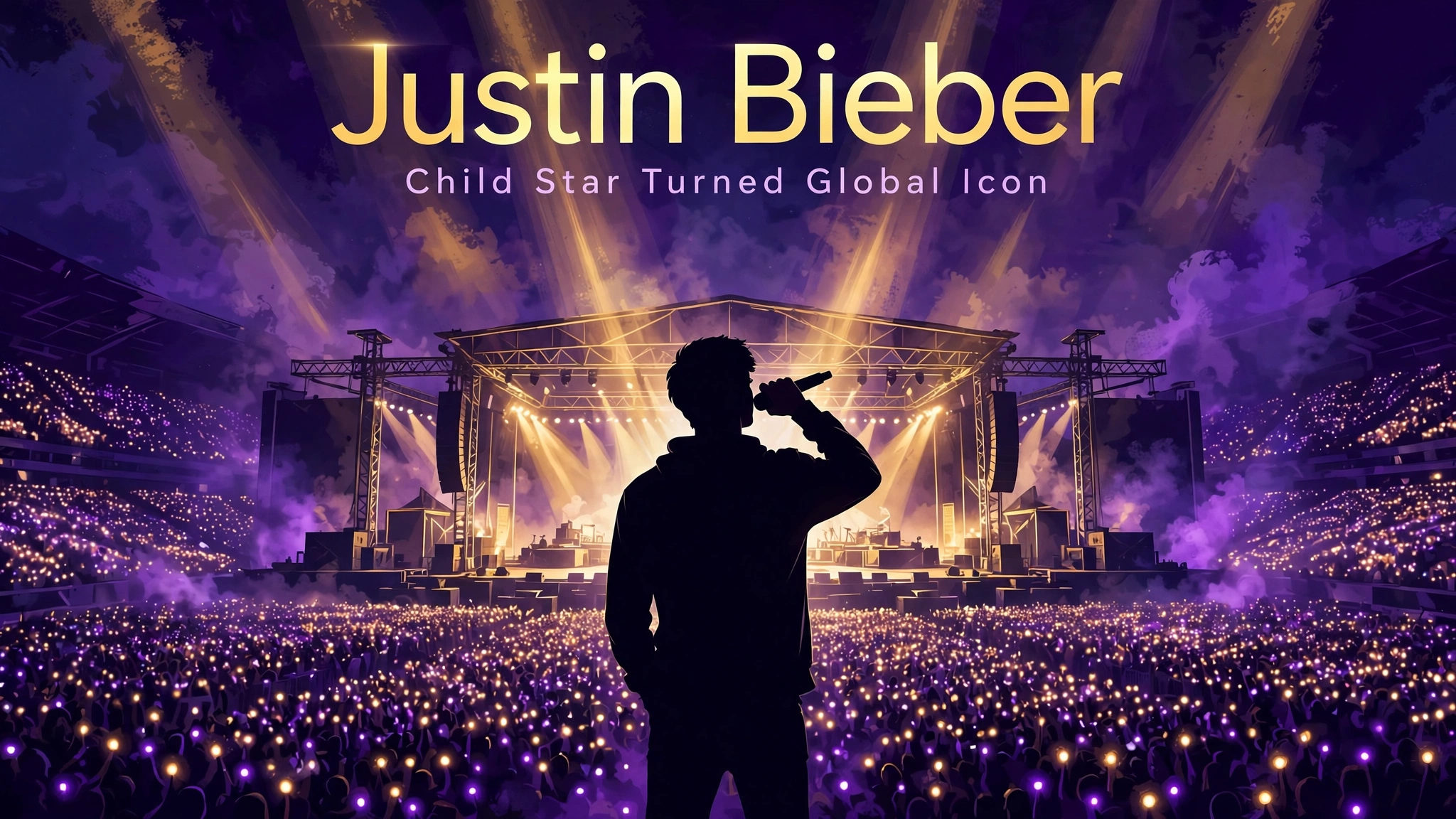
Justin Bieber: The Life Story of a Child Star Turned Global Icon
In this post
- A Small-Town Childhood in Stratford, Ontario
- Discovered on YouTube and the First Record Deal
- Baby, Fame and Life as a Teen Idol
- The Difficult Years and the Cost of Growing Up Famous
- Purpose and the Comeback That Changed Everything
- Marriage, Health and a Quieter Life
- What Justin Bieber’s Story Teaches About Fame
- My Take:
Justin Bieber was still a child when the whole world started watching him, and that single fact explains almost everything that came after. Born in London, Ontario, and raised in Stratford, he learned drums, piano, guitar and trumpet before most children his age had picked a favourite subject at school. His mother posted videos of him singing on YouTube so family could watch, and those small home clips travelled further than anyone in Stratford could have imagined. A talent manager found them, a record deal followed, and a twelve-year-old boy suddenly had a career that most adults only dream about.
What makes his story different from a simple rise to fame is how public every stage of it was. There was no quiet period where he could make mistakes away from cameras. His first hit, his first tour, his first heartbreak, his worst behaviour and his later attempts to change were all filmed, photographed and argued about online. Millions of people felt they knew him, even though they had never met him, and that strange closeness became both his greatest advantage and his heaviest burden.
This is the story of a boy who became a brand before he became an adult, and of a man who then had to work out who he was underneath the brand. It covers the early years in Canada, the explosion of “Baby”, the difficult teenage years in the spotlight, the comeback built around Purpose, his marriage, his health, and the quieter, more careful life he has tried to build since. It is a story about talent, timing, pressure and second chances, and it still has chapters left to be written.
A Small-Town Childhood in Stratford, Ontario
Justin Drew Bieber was born on 1 March 1994 in London, Ontario, and grew up in Stratford, a small city known more for theatre than for pop music. He was raised mainly by his mother, Pattie Mallette, in a modest home, and money was often tight. That background matters, because it shaped the way he later talked about his early life: not as a polished show-business childhood, but as an ordinary Canadian upbringing with hockey, school, church and music filling the days. He was not born into the industry. He found his way into it from the outside.
Music came early and it came naturally. He taught himself to play several instruments, and by the time he was a young teenager he could sit at a piano, pick up a guitar or play drums with a confidence that surprised adults. He sang in local talent shows and busked on the streets of Stratford, performing for whoever happened to walk past. Those street performances were an education in themselves. There was no stage, no lighting and no audience that had paid to be kind. He had to earn attention, one passer-by at a time, and that skill stayed with him when the audiences grew to tens of thousands.
In 2007 his mother began uploading videos of his performances to YouTube, mainly so relatives could see him sing. The videos showed a boy singing covers of songs by artists such as Usher, Ne-Yo and Stevie Wonder, and viewers began sharing them far beyond the family. Within a relatively short time, the clips had been watched millions of times. It was one of the first times the internet had turned an unknown teenager into a star without a television show or a traditional talent contest doing the work first, and it changed how the music industry thought about discovering new artists.
Discovered on YouTube and the First Record Deal
The turning point came when Scooter Braun, a talent manager, came across one of those YouTube videos. He tracked Bieber down, flew him to Atlanta, and arranged a meeting with Usher, who became a mentor and helped guide the early career. A record deal followed with Island Records, and Bieber moved from Stratford to the United States to record his first music. He was around thirteen years old, leaving school, home and everything familiar behind for a professional life that most teenagers could not imagine.
His first release, the EP My World, arrived in 2009, and its lead single “One Time” became a hit in several countries. Bieber became the first artist to have seven songs from a debut record enter the Billboard Hot 100, a result that showed his audience was not a small niche but a large, organised fan base. The fans, who called themselves Beliebers, were central to his rise. They shared videos, voted in polls, bought records and turned his social media accounts into some of the most followed of their time.
The pace was extraordinary. Within about a year he had gone from busking in Stratford to performing on television, meeting presidents and playing sold-out shows. His debut album, My World 2.0, followed in 2010, and its single “Baby”, featuring Ludacris, became one of the best-selling singles of all time and, for years, one of the most viewed videos on YouTube. The song made him a household name, but it also fixed an image of him in the public mind as a boyish teen idol, an image he would later struggle to outgrow.
Baby, Fame and Life as a Teen Idol
“Baby” changed everything, and not all of it was easy. The song was everywhere in 2010, and Bieber was suddenly one of the most famous teenagers on the planet. He toured the world, released a 3D concert film, Never Say Never, in 2011, and won awards that put him beside artists twice his age. For a boy who had grown up with little money, the change in lifestyle was total: private jets, security teams, hotel suites and a schedule decided by other people. He later spoke about how strange it felt to have the whole world know his name while he was still figuring out who he was.
Fame at that age came with a kind of attention that is hard to describe without living it. Every haircut was news. Every friendship was photographed. Every rumour, whether true or not, spread across the internet within hours. His relationship with Selena Gomez, which began around 2010, became one of the most followed celebrity relationships of the decade, and its ups and downs were treated as public property. For an adult, that level of attention would be exhausting. For a teenager, it was the only life he knew.
The music kept coming. Under the Mistletoe, a Christmas album, arrived in 2011, and Believe followed in 2012, with a more mature, dance-influenced sound. Songs such as “Boyfriend” and “Beauty and a Beat” showed he was trying to move beyond the teen idol label. He was also growing up in public in the literal sense: his voice changed, his style changed, and audiences watched him try to become an adult artist while the world still wanted the boy from “Baby”. That tension between who he had been and who he wanted to become would define the next chapter of his life.
The Difficult Years and the Cost of Growing Up Famous
Between roughly 2013 and 2015, Bieber’s public image took a sharp turn. Reports of reckless behaviour, run-ins with police, cancelled shows and angry outbursts filled the news. He was arrested in Miami in 2014 in connection with a driving incident, and other incidents in Canada and elsewhere added to a picture of a young star who seemed out of control. Some of it was exaggerated by the media, and some of it, by his own later admission, was real. He has since spoken openly about feeling lost, angry and overwhelmed during those years, and about using substances and making choices he now regrets.
It is worth pausing on why this happened, because the pattern is familiar among child stars. Bieber had spent his teenage years with almost no normal life: no regular school, no privacy, and adults around him whose jobs depended on his success. When he tried to behave like a normal teenager, the consequences were public and permanent. When he tried to push back against the pressure, it was reported as a scandal. There were very few people in his life who could tell him to stop, and even fewer who had nothing to gain from his fame.
What saved his career, if anything did, was that the music never entirely stopped, and the talent underneath the headlines was real. His 2015 collaboration with Skrillex and Diplo on “Where Are Ü Now” reminded listeners that his voice could carry a different kind of record, and it set up the most important comeback of his career. The difficult years had damaged his reputation, but they had not ended it, and the next album would give him a chance to explain himself through music rather than through apologies.
Purpose and the Comeback That Changed Everything
Purpose, released in November 2015, was the album that rebuilt Justin Bieber’s career. Its lead singles, “What Do You Mean?”, “Sorry” and “Love Yourself”, were enormous hits, and the album’s sound, shaped by producers including Skrillex, felt modern and adult in a way his earlier work had not. “Sorry” in particular became one of the biggest songs of his career, and the album won critical respect that had often been missing before. For the first time in years, the conversation about Bieber was about the music first and the behaviour second.
The Purpose tour that followed was one of the biggest of the decade, but it also showed how fragile the comeback was. In 2017, Bieber cancelled the remaining dates of the tour, saying he needed rest and time to focus on his health and wellbeing. At the time, some fans were disappointed, but the decision now looks like a turning point. He was choosing, for the first time, to step back from the machine that had run his life since he was thirteen. That choice, to rest rather than to keep earning, said more about his priorities than any interview could.
During the same period he appeared on hit collaborations that kept him at the top of the charts without a full album of his own, including “Despacito” with Luis Fonsi and Daddy Yankee, and “I’m the One” with DJ Khaled. These songs showed a different side of his career: not the teen idol carrying everything alone, but a featured voice who could lift someone else’s record. It was a quieter kind of success, and it suited the new phase of his life, in which fame was something to manage rather than something to chase.
Marriage, Health and a Quieter Life
In 2018 Bieber married Hailey Baldwin, now Hailey Bieber, and the marriage became the centre of his public life in a way his earlier relationships had not. He spoke about faith, about wanting a stable home, and about the work of building a life that did not depend on being famous. The couple’s relationship has been closely watched, but Bieber has also been more careful about what he shares, drawing a line between his public work and his private life that did not exist when he was a teenager.
His health also became part of the story. In 2022 he revealed that he had Ramsay Hunt syndrome, a condition that caused partial facial paralysis and forced him to cancel tour dates. He shared a video explaining the condition, and the response was largely sympathetic, a contrast with the coverage of his behaviour a decade earlier. It was a reminder that behind the headlines there was a real person dealing with a real medical problem, and that the body, after years of touring and pressure, has limits that fame cannot remove.
His later albums, Changes in 2020 and Justice in 2021, reflected this quieter, more personal phase. Justice included the hit “Peaches”, and the album’s themes of love, faith and responsibility were a long way from the boy who sang “Baby”. He has released music less often since then, and his public appearances have become rarer. That slower pace seems deliberate. After more than fifteen years in the spotlight, Bieber appears to be choosing a life in which music is one part of who he is, not the whole of it.
What Justin Bieber’s Story Teaches About Fame
Bieber’s career is often used as a case study in what early fame does to a person, and the lessons are not simple. On one side, he had advantages almost no one else gets: a global audience before he was fifteen, access to the best producers and songwriters, and a fan base that stayed loyal through his worst years. On the other side, he paid a price that is easy to underestimate: a childhood spent working, a private life that was never really private, and a public image that was decided for him before he was old enough to vote.
The most interesting part of his story is not the rise or the fall, but the long attempt to grow up in public and come out the other side. Many child stars do not manage it. Bieber did, at least in part, because he had a talent that survived the headlines, a fan base that was willing to wait, and, eventually, a willingness to stop, rest and change direction. His comeback was not a single moment but a slow process of making better music, making better choices and accepting that he could not control what people thought of him.
His legacy is still being written. He has sold tens of millions of records, broken streaming records, and influenced a generation of artists who were discovered online. But his most lasting impact may be as a warning and an example: a reminder that talent discovered on the internet still belongs to a real child, and that the world should be careful with the young people it makes famous. Whether his next chapter is more music, more business or a quieter life away from the stage, the story so far already says something important about fame, growth and second chances.
My Take:
I think the most honest way to look at Justin Bieber is to start with the child, not the celebrity. When I picture a thirteen-year-old leaving Stratford for Atlanta, I do not see a pop star making a clever career move. I see a boy who could sing, who had a mother doing her best, and who walked into a world that was ready to use him before it was ready to protect him. That is the part of the story that still bothers me, because the music industry has repeated this pattern many times, and each time we act surprised when the child at the centre of it struggles. Bieber’s talent was obvious, but talent does not make a child ready for global fame, and no amount of money makes up for losing a normal adolescence.
What I find genuinely impressive is that he survived it at all. Look at how many child stars do not. The pressure he faced was not only the pressure of work, but the pressure of being watched by millions of people who felt entitled to an opinion about his hair, his friends, his girlfriend and his mistakes. I have seen adults fall apart under far less attention, so I am not quick to judge the way he behaved in his late teens. Some of it was his fault, and he has said so himself, but a large part of it was the predictable result of giving a teenager unlimited money, unlimited attention and almost no privacy, then acting shocked when he behaved like a teenager with unlimited money and attention.
The Purpose era is the part I respect most, because it was not just a musical comeback, it was a personal one. “Sorry” and “Love Yourself” worked because they sounded like a person who had actually learned something, not like a marketing team writing an apology. And the decision to cancel the Purpose tour, which must have cost an enormous amount of money, was the first time I felt he was choosing himself over the machine. That is a hard choice for anyone, and it is much harder when thousands of people depend on you keeping going. I think that decision marked the real turning point, more than any single song.
I also think his marriage and his health struggles changed the way the public saw him, and that change was deserved. When he spoke about Ramsay Hunt syndrome, he was not selling anything. He was a young man telling the truth about a frightening medical problem, and the sympathy he received showed that audiences can be kind when they are given a real person to respond to instead of a headline. I wish that kindness had been there earlier, when he was nineteen and clearly struggling, but I am glad it arrived eventually. It suggests that the public can grow up too, even if it takes a decade.
My honest opinion is that Bieber’s legacy should be measured in two ways. As a musician, he proved that an artist discovered on YouTube could become one of the biggest pop stars in the world, and he left behind songs that will be played for decades. As a person, he proved that it is possible to make serious mistakes in public, to be written off, and to come back with better work and a steadier life. That second achievement is rarer and more valuable than the first. I do not know what his next chapter will be, and I do not think he owes us one on a schedule. If he makes more music, I will listen. If he chooses a quieter life, I think he has earned it. Either way, the boy from Stratford who sang on the street has already done something remarkable: he grew up in front of the world, and he is still standing.
There is also a lesson here for parents and for the industry, and I think it is the most important one in the whole story. When a child shows extraordinary talent, the adults around them face a choice between protecting the child and promoting the talent, and too often promotion wins because the rewards are immediate and the damage is slow. Bieber’s mother has spoken about the difficulty of those decisions, and I do not blame her for them, because she was navigating something no ordinary parent is trained for. But the industry that profited from a thirteen-year-old had a responsibility too, and for years it treated his wellbeing as less important than his output. If his story changes how even one record label handles a young artist, then the difficult years will have meant something beyond the headlines.
I also want to say something about the fans, because they are a real part of this story and they are often treated as a joke. The Beliebers were teenagers themselves, and they organised, defended and supported an artist they loved with a loyalty that most musicians never experience. When Bieber was at his lowest, many of them stayed, and when he came back with Purpose, they were ready to listen with fresh ears. That kind of loyalty cannot be bought with marketing, and it is one of the reasons his comeback worked. It also shows something hopeful about fandom: that it can be patient, forgiving and genuinely caring, even in an online world that usually rewards cruelty and quick judgement.
Finally, I think the fairest verdict is that Bieber is still a work in progress, and that is fine. He does not need to release an album every year to prove his worth, and he does not need to explain himself to strangers to earn respect. He has already given the world some of the defining pop songs of his generation, and he has shown that a person can be written off by the whole internet and still rebuild a life on steadier ground. Whatever comes next, whether it is new music, new business ventures or simply a quieter family life, I hope it is chosen by him rather than demanded of him, because after seventeen years of living for an audience, choosing for himself would be the most grown-up thing he has ever done.
Frequently Asked Questions
How was Justin Bieber discovered?
He was discovered after his mother posted videos of him singing on YouTube in 2007. Talent manager Scooter Braun found the videos, arranged a meeting with Usher, and Bieber signed a record deal with Island Records.
What was Justin Bieber’s first big hit?
His breakthrough single was “One Time” in 2009, but his first global smash was “Baby”, featuring Ludacris, from his debut album My World 2.0 in 2010.
Why did Justin Bieber cancel the Purpose tour?
He cancelled the remaining dates in 2017, saying he needed rest and time to focus on his health and wellbeing after a long period of touring.
Is Justin Bieber married?
Yes. He married Hailey Baldwin, now Hailey Bieber, in 2018. The couple have spoken publicly about their faith and their life together.
What health condition did Justin Bieber reveal in 2022?
He revealed he had Ramsay Hunt syndrome, which caused partial facial paralysis and led him to cancel tour dates while he recovered.
What is Justin Bieber’s best-selling album?
Purpose, released in 2015, is widely regarded as his most successful and critically praised album, with hit singles including “Sorry”, “Love Yourself” and “What Do You Mean?”.