Kang Dong-won: The Life Story Behind Korea's Big Screen Star
In this post
- Growing Up in Busan and Finding a New Path
- The First Steps on Screen and Too Beautiful to Lie
- Maundy Thursday, Jeon Woo-chi, and Learning the Craft
- The Priests, Master, and the Height of Stardom
- Peninsula, Broker, and a New Kind of Leading Man
- The Quiet Star and What His Career Means
- The Man Behind the Calm Face
- My Take:
Kang Dong-won is one of those actors whose face seems to belong on a cinema screen. He is tall, calm, and handsome in a quiet way, and when he walks into a scene, the camera seems to find him without trying. For more than twenty years he has been one of South Korea’s biggest film stars, moving between romance, thriller, comedy, horror, and large-scale action with a ease that few actors manage. He has played a priest fighting evil, a con man chasing money, a soldier in a ruined city, and a quiet man learning to care for a child. In each role he looks like a different person, yet something steady runs through all of them: a seriousness, a patience, and a refusal to rush.
He was born in Busan, the great port city on the south coast of Korea, and he did not grow up dreaming of film sets. He studied mechanical engineering at university, a practical subject for a young man with a strong mind for how things work. Then, almost by accident, he was noticed for his looks and his height, and he began working as a model. Modelling took him to runways and photo shoots, and it gave him a public face before he had any acting skill at all. Many models try acting and fail. Kang Dong-won did not fail. He worked, he learned, and within a few years he was carrying films on his own name.
What makes his story worth telling is not only the fame. It is the patience behind it. He did not become a star in one night, and he did not stay a star by repeating one trick. He chose strange films, difficult films, and films that asked him to change. He worked with many of Korea’s best directors, and he kept coming back to the cinema even when television offered easier money and wider fame. This is the story of a young man from Busan who became one of the most trusted leading men in Korean film, and who did it by taking his time.
Growing Up in Busan and Finding a New Path
Kang Dong-won was born on 18 January 1981 in Busan, South Korea. Busan is a city of harbours, markets, hills, and sea wind, very different in feeling from the capital, Seoul. Life there is busy and direct, and people are known for speaking plainly and working hard. Kang grew up in that world, and the calm, grounded quality that people later saw on screen seems to have roots in it. He was a tall boy, and as he grew older his height and his looks began to draw attention, but there was nothing in his early life that pointed clearly toward acting.
At school he was a good student, and he went on to study mechanical engineering at Hanyang University in Seoul. Engineering is a subject that needs logic, patience, and care with detail, and those qualities would later show in the way he approached acting. He did not study drama, and he did not spend his teenage years on stage. His path to acting came from outside, not from a childhood plan. He was, by his own account, a young man looking for a direction, and the direction found him.
While he was at university, he was spotted and invited to try modelling. In the late 1990s and early 2000s, Korean fashion was growing fast, and a tall young man with a strong face could find work quickly. Kang began walking runways and appearing in photo shoots, and he was good at it. He had a natural stillness in front of a camera, a way of holding a pose without forcing it. Modelling gave him money, confidence, and a taste of public life, but it also showed him its limits. A model is looked at. An actor is listened to. Kang wanted the second thing.
The change did not happen in a single day. He took acting lessons, he watched films closely, and he began to think about what it meant to play a real person rather than to show a coat. He was still young, and he had time, but he also knew that modelling fame fades quickly. If he wanted a long career, he would need a real craft. So he began to build one, quietly and without fuss, the way he would do everything that followed.
The First Steps on Screen and Too Beautiful to Lie
Kang Dong-won’s first acting work came on television, where many young Korean actors learn their trade. He appeared in dramas in the early 2000s, and the work taught him the basics: how to hit a mark, how to speak to a camera, how to keep a scene alive when the day is long. Television in Korea moves fast, and a young actor learns quickly or is left behind. Kang learned quickly, and directors noticed that he had something more than a model’s face. He listened, he stayed calm under pressure, and he did not overact.
His first big film role came in 2004, in the romantic comedy Too Beautiful to Lie, where he played a young man who meets a woman pretending to be his fiancee on a journey. The film was light and funny, and it gave Kang his first real chance to carry a film. Audiences liked him, and the film did well. For many actors, a hit romantic comedy becomes a cage: they are asked to play the same charming young man again and again. Kang took the success, but he did not stay in the cage.
In the same period he appeared in the film Temptation of Wolves, also in 2004, a youth romance that made him very popular with young audiences. He played a tough, quiet young man with a painful past, and the role suited him. Teenagers put his picture on their walls, and his name became known across the country. It would have been easy to spend the next ten years playing handsome young men in love stories. Many actors do exactly that, and they earn a great deal of money. Kang, however, seemed to want something harder.
He began to choose films that asked more of him. In 2005 he appeared in Duelist, a visually striking period action film directed by Lee Myung-se, where he played a detective chasing a mysterious thief. The film was unusual and beautiful, and it showed that Kang was willing to work on projects that were not safe bets. He was building a reputation as an actor who cared about the film itself, not only about his own image, and that reputation would shape the rest of his career.
Maundy Thursday, Jeon Woo-chi, and Learning the Craft
In 2006, Kang Dong-won took on a role that changed how serious critics saw him. In Maundy Thursday, directed by Song Hae-sung, he played a young man on death row who meets a woman who visits prisoners. The film was slow, sad, and deeply human, and it asked Kang to play a man with almost nothing left: no freedom, no future, and very little hope. He played it with a quiet honesty that surprised people who had only seen him in light romances. The film did not make him a star in the simple sense. It made him an actor.
Around the same time he continued to work in very different kinds of films, and that range became his signature. He could be funny, he could be dark, and he could be still. Directors began to trust him with roles that needed a strong centre, because Kang had a way of holding a film together without shouting. He did not need big gestures. A look, a pause, or a small change in his voice could carry a scene, and other actors seemed to work better beside him because he gave them room.
In 2009 he starred in Jeon Woo-chi: The Taoist Wizard, a large fantasy adventure film directed by Choi Dong-hoon. Kang played a mischievous Taoist wizard from the Joseon era who is thrown into the modern world, and the film mixed comedy, action, and fantasy in a way that Korean audiences loved. It was a big hit, and it showed that Kang could carry a large commercial film with ease. He was funny in it, but the humour came from the character, not from jokes pasted on top. The wizard was clever, careless, and charming, and Kang made him feel real even when the story was pure fantasy.
The years that followed were full of work. He appeared in the thriller The Secret Reunion in 2010, playing a North Korean spy, and he kept moving between genres with a freedom that few Korean stars enjoy. He did not seem to fear failure. If a film was interesting, he took it. If a director was good, he worked with them. That attitude kept his career fresh, and it meant that audiences never quite knew what he would do next.
The Priests, Master, and the Height of Stardom
By the middle of the 2010s, Kang Dong-won was firmly one of Korea’s top film stars, and the films he chose showed his confidence. In 2015 he starred in The Priests, a horror film about two Catholic priests trying to save a young girl from an evil spirit. Kang played the younger priest, a man of faith who must face something he cannot explain. The film was a surprise hit, earning far more than expected, and it showed that Korean audiences would follow Kang into a dark, serious story. His performance was calm and controlled, and the fear in the film felt real because he played it as a man trying to stay steady, not as a man screaming for the camera.
In 2016 he starred in Master, a crime film about a large fraud case, alongside Lee Byung-hun and Kim Woo-bin. Kang played a detective chasing a powerful con man, and the film was a big commercial success. It was the kind of large, polished Korean crime film that fills cinemas in winter, and Kang was at the centre of it, holding the story together with a steady, intelligent performance. He was no longer the young model trying acting. He was a leading man who could be trusted with a film’s success.
In the same year he also appeared in A Violent Prosecutor, another hit, and his name on a poster had become a promise of quality. Producers knew that a Kang Dong-won film would be taken seriously, and audiences knew that he would not waste their time. He had reached the height of stardom, but he had done it without scandal and without noise. He rarely gave interviews, he did not chase attention on social media, and he let the work speak. In a film world full of loud personalities, his quietness stood out.
He also began to take on work outside Korea, and he showed that he could work in different film cultures. For a Korean actor of his generation, that was still rare, and it widened the audience for his work. He was not only a Korean star. He was becoming a name that film lovers in other countries recognised.
Peninsula, Broker, and a New Kind of Leading Man
In 2020, Kang Dong-won starred in Peninsula, the follow-up to the hit zombie film Train to Busan. He played a former soldier who returns to a ruined Korean peninsula to find money, and finds people trying to survive instead. The film was released during the pandemic, when cinemas around the world were struggling, and it still drew large audiences. Kang’s character was a man who had lost almost everything and had to learn to care again, and he played that slow change with care. The film was big and loud, full of car chases and action, but at its centre was a quiet story about guilt and second chances.
In 2022 he appeared in Broker, directed by the Japanese master Hirokazu Kore-eda, a film about people who leave babies in a box outside a church and the brokers who sell them to new families. Kang played one of the brokers, a man who seems selfish at first and slowly shows a softer, sadder side. The film was shown at the Cannes Film Festival, one of the most important film festivals in the world, and it won the Best Actor prize for his co-star Song Kang-ho. For Kang, the film was a chance to work with a director known for gentle, human stories, and he used the chance well. His performance was small and careful, and it showed how much he had grown as an actor.
Broker also showed a new side of his career. He was no longer only the handsome leading man. He was a mature actor, interested in difficult moral questions, in people who do wrong things for reasons that are not simple, and in stories that do not end with a neat answer. He played men who were flawed and still worth understanding, and he did it without judging them. That is a hard thing to do, and it is one reason directors keep asking him back.
In the years after Broker, he continued to choose work that mattered to him. He appeared in the film Uprising in 2024, a large historical action film set during the Japanese invasions of Korea, and he took on a role as a producer as well as an actor, showing that he was thinking about the future of Korean film, not only about his own parts. He was becoming an older star, but he was not slowing down. He was changing, and the change suited him.
The Quiet Star and What His Career Means
Kang Dong-won has never been a loud celebrity. He does not appear in gossip stories often, he does not talk about his private life in public, and he does not seem to enjoy fame for its own sake. In interviews, when he gives them, he speaks simply and directly, and he talks about films, not about himself. That privacy has made him something of a mystery, and the mystery has only added to his appeal. People project their own ideas onto him, and he lets them, because he knows that an actor’s job is to disappear into a role, not to sell his own life.
He is also known for the care he takes with his scripts, reading them closely and asking questions about his character before he agrees to a role. Directors have spoken about his preparation, about the way he arrives on set knowing his lines and knowing what his character wants, and about the way he listens to their guidance without losing his own understanding of the part. That preparation is not glamorous, and it is not visible to the audience, but it is the foundation of his best work, because a performance that looks effortless is almost always the result of long, careful thought. Kang has built his career on that kind of thought, and it shows in the steadiness of his films.
His career also tells a larger story about Korean cinema. When he started, Korean films were growing fast but were still mostly watched at home. By the 2020s, Korean films were winning at Cannes and at the Oscars, and Korean actors were known around the world. Kang was part of that rise, not as a single hero, but as one of a group of strong actors who made Korean cinema what it is. He worked with the best directors, he took risks, and he stayed loyal to the cinema when television offered more money.
He has also shown that a career can be built slowly. He did not rush, he did not chase every offer, and he did not try to stay young forever. He let himself grow older on screen, and he took roles that suited the man he had become. That is why his later films feel richer than his early ones. The young model has become a thoughtful actor, and the thoughtful actor has become a trusted presence in Korean film.
Today, Kang Dong-won remains one of the most respected names in Korean cinema. Young actors look up to him, directors want to work with him, and audiences still buy tickets when his name is on a poster. He has not said everything he has to say, and his best work may still be ahead of him. What is certain is that his story so far is a story of patience, of careful choices, and of a man who learned that the quiet way can also be the strong way.
The Man Behind the Calm Face
To understand Kang Dong-won, it helps to look at what he does when he is not on screen. He is known for being private, and he has kept his family life and his friendships out of the public eye. That is a choice, and in Korea, where stars are watched closely, it is not an easy choice to keep. He has managed it by being consistent: he does not feed rumours, he does not answer personal questions, and he does not use his private life to promote a film. The result is that when people talk about him, they talk about his work, and that is how he seems to want it.
He is also known for being careful with his money and his time. He has invested in films, he has worked as a producer, and he has supported projects that he believes in. He does not take every role that is offered, and he is willing to wait for a good script. That patience has cost him some easy paydays, but it has given him a filmography that he can be proud of. Few actors can look back at twenty years of work and find so little that feels wasted.
His height and his looks were the first things people noticed, but they are not the reason he lasted. Many handsome actors fade when youth fades. Kang lasted because he learned a craft, and because he kept learning it. He studied his characters, he listened to his directors, and he was willing to look foolish, tired, or cruel when a role needed it. A model protects his image. An actor gives it away. Kang made that change, and he never looked back.
In the end, his story is a simple one, and that is its strength. A young man from Busan found a door he had not expected, walked through it, and then spent twenty years learning how to do the work properly. He did not shout, he did not hurry, and he did not pretend. He just kept working, film after film, until the work itself became the story.
My Take:
I have spent a long time thinking about Kang Dong-won, and what stays with me is not any single film but the feeling of steadiness that runs through his whole career. I admire actors who are loud and full of energy, and there is a place for that kind of acting. But I think there is something rarer in an actor who can be still and still hold your attention. Kang Dong-won can stand in a scene and say almost nothing, and you still watch him. You watch because you feel that something is happening inside the character, even if the face does not show it at once. That is a difficult skill, and I do not think it can be faked for long. A camera sees through faking very quickly. It sees when an actor is only posing, and it sees when an actor is really thinking. Kang Dong-won, in his best work, is really thinking.
I think his early life matters more than it seems to at first. He did not grow up on a stage. He studied engineering, a subject that teaches you to solve problems step by step and to check your work. I believe that training stayed with him. When I watch his acting, I see a man who builds a character the way an engineer builds a machine: piece by piece, with care, and with no part that does not belong. He does not throw in extra emotion to impress you. He puts in only what the scene needs, and he trusts you to notice. That trust is a form of respect for the audience, and I wish more actors had it.
What I admire most is the way he refused to stay in the easy box. After his early romantic hits, he could have spent a decade playing the same handsome young man, earning a great deal of money and never being challenged. Many people would have done that, and no one would have blamed him. But he chose Maundy Thursday, a slow film about a man on death row, and he chose Duelist, a strange and beautiful film that was not a safe commercial bet. I think those choices tell you who he is. He was not interested in being loved for his face. He was interested in being good at his job, and he understood that being good meant taking risks. That is a lesson that goes far beyond acting. In any job, the safe path pays well at first, but it makes you smaller over time. The hard path is frightening, but it is the one that lets you grow.
I also think about the quietness of his fame. In a world where celebrities are expected to share everything, to post every day, to turn their lives into content, Kang Dong-won has stayed private. I respect that deeply. It is not easy to say no to attention when attention is offered to you every day. It takes a strong sense of self to know that your work is enough, and that you do not need to sell your private life to stay relevant. I think his privacy has actually helped his acting, because when you do not know too much about the actor, you can believe him more easily as a character. You are not thinking about his last interview or his last photo. You are thinking about the man on the screen, and that is as it should be.
When I think about The Priests, I think about how brave that choice was. A horror film about priests and evil spirits could easily have become silly, and in many countries it would have been treated as a joke. Kang played it straight, with faith and fear held together in the same face, and the film worked because he believed in it. I think that is a lesson about taking your work seriously even when the subject is strange. If you treat a story with respect, the audience will too. If you wink at the audience and tell them not to take it seriously, they will not. Kang never winks. He commits, and that commitment carries the film.
Master and A Violent Prosecutor showed me another side of him, the side that can carry a big commercial film without losing his calm. I have seen many actors who become louder when a film gets bigger, as if they need to match the size of the budget. Kang does the opposite. He stays the same size, and the film comes to him. I think that is real confidence. It is the confidence of a man who knows that he does not need to shout to be heard. In my own life, I have met people like that, people who speak quietly in a meeting and everyone listens, because their words have weight. I think Kang Dong-won is that kind of person, and I think his films prove it.
Peninsula came at a strange time, during a pandemic, when cinemas were empty and people were afraid. I remember that the film still drew audiences, and I think part of the reason was that people wanted a big story about survival and second chances. Kang’s character in that film is a man who has given up on himself, and who slowly learns to care again. I found that moving, because I think many people felt that way during those years. They had lost something, and they were not sure how to start again. To watch a character go through that, and to see it played without melodrama, felt honest. I do not think the film is perfect, but I think Kang’s performance in it is honest, and honesty is what I remember.
Broker is, for me, his most interesting recent film, because it asks a question with no easy answer. The men in the film do something that is wrong, and yet the film asks you to understand them, to see their kindness and their damage at the same time. I think Kang’s performance is perfect for that story, because he does not try to make his character likeable. He lets the character be complicated, and he trusts the audience to sit with that complication. I wish more films did that. Too many films tell you who to love and who to hate in the first ten minutes. Broker does not, and Kang does not, and the result is a film that stays with you after it ends. I thought about it for days, and I think that is the mark of good art.
I also want to say something about his work as a producer and his interest in the future of Korean film. I admire actors who think beyond their own roles, who ask what kind of films should be made and who should make them. It is easy to be a star and to think only about your next part. It is harder to think about the industry, about young directors, about stories that need money to be told. I do not know all the details of his producing work, and I do not want to invent them, but the fact that he has taken on that role tells me that he cares about more than himself. I think that is a sign of maturity, and I think it bodes well for the next part of his career.
There is a sadness in his story too, and I do not want to ignore it. The sadness is not about any one event. It is about the way fame can be lonely, and the way a private person must live in a public world. I imagine that it is hard to walk through an airport or a market and be stared at, and hard to know who likes you for yourself and who likes you for your fame. Kang has handled that with grace, but I do not think it has been free. Privacy has a cost, and the cost is that people invent stories about you when you do not tell your own. I think he has accepted that cost, and I respect him for it, but I also feel for him. No one should have to choose between being known and being left alone.
What can a reader learn from Kang Dong-won? I think the first lesson is patience. He did not become a great actor in a year. He became one over twenty years, by working, by learning, and by refusing to rush. In a world that promises fast success, that is a hard lesson to hear, but it is a true one. The second lesson is about choice. Your career is not made by the offers you accept. It is made by the offers you refuse, and by the strange, difficult projects you say yes to when no one understands why. The third lesson is about quietness. You do not need to be the loudest person in the room to be the most important. Sometimes the quiet person is the one holding everything together, and if you learn to be that person, you will be trusted in a way that loud people rarely are.
I also think his story teaches something about starting late and starting differently. He did not begin as a child actor. He did not study drama from a young age. He studied engineering, he modelled, and he came to acting from the side. That should give hope to anyone who feels that they have started the wrong thing, or that they are too old, or too late. You are not too late. You are only on a different road, and the different road may teach you things that the straight road never could. Kang’s engineering mind, his modelling eye, his Busan directness: all of those things became part of his acting, and none of them would have been there if he had followed the usual path.
If I could ask him one question, I would ask him how he chooses a script. I would want to know what he looks for on the first page, and what makes him put a script down. I suspect his answer would be simple, and that simplicity would itself be the lesson. He would probably say that he looks for a true person, a true story, and a director he can trust. I think that is enough. A career built on those three things will not always be easy, but it will be honest, and honesty lasts longer than fame.
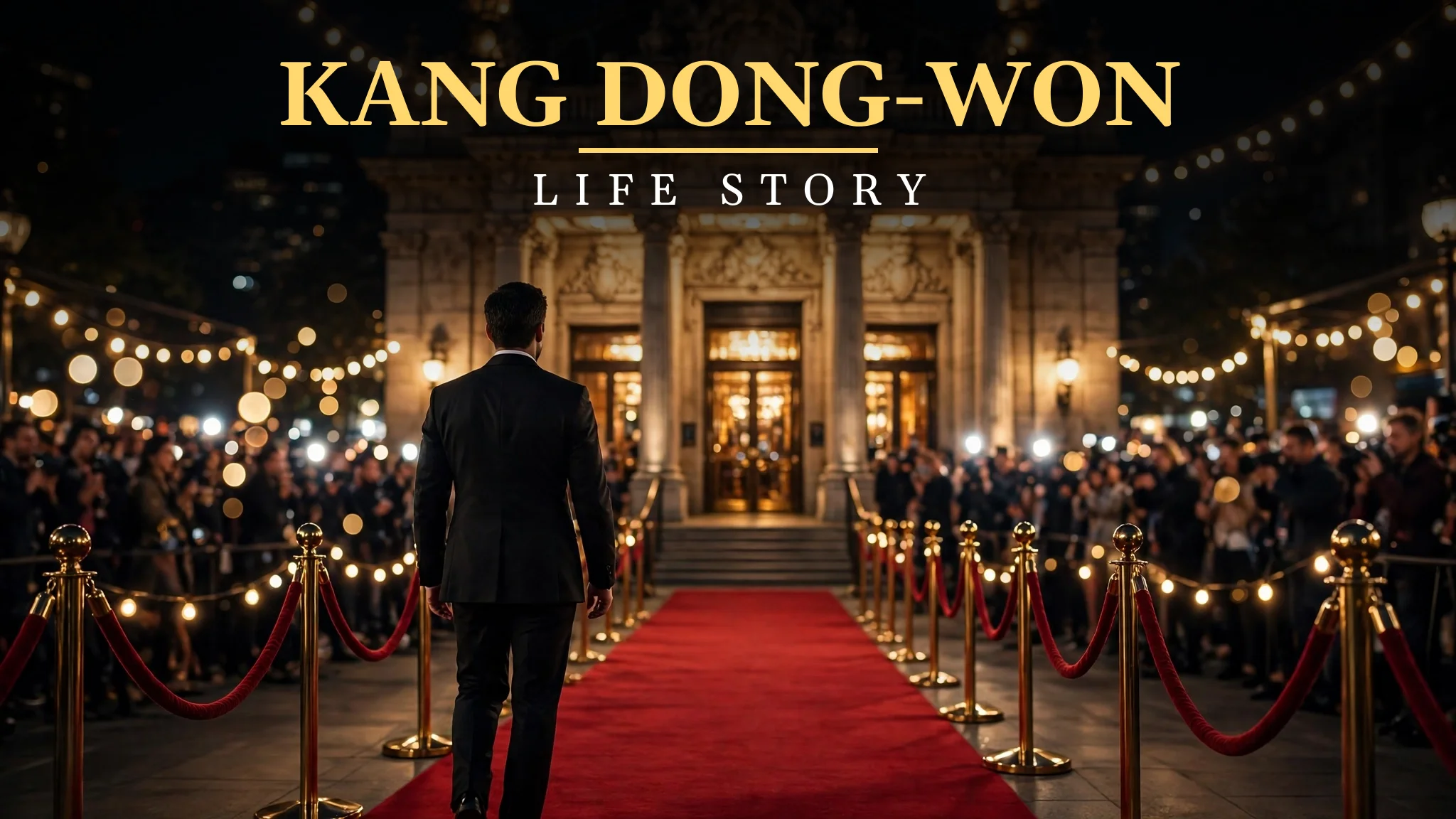
In the end, I come back to the image of him walking down a red carpet, seen from behind, moving toward a bright building while crowds watch. That image fits him. He walks toward the light, but he does not turn around to show off. He just keeps walking, steady and calm, toward the work. I think that is the best way to describe Kang Dong-won. He is not a man who chases the light. He is a man who walks toward it, quietly, and lets the work do the talking. I hope he keeps doing that for many years, and I hope his next films are as brave as the ones that came before.
One more thought stays with me, and it is about how little noise surrounds him compared with how much work he has done. In an age when so many public figures seem to need constant noise to prove they still exist, Kang Dong-won proves the opposite. He disappears for a while, he chooses carefully, and then he returns with a film that reminds everyone why he matters. I find that rhythm healthy, and I think it is something the rest of us could learn from in our own lives. We do not need to announce every step we take. We can work in silence, choose with care, and let the result speak when it is ready. That is not hiding. That is discipline, and it is the kind of discipline that builds a career worth remembering rather than a moment worth forgetting.
Frequently Asked Questions
Who is Kang Dong-won?
Kang Dong-won is a South Korean film actor born in Busan in 1981, known for films such as The Priests, Master, Peninsula, and Broker. He began as a model after studying mechanical engineering, then moved into acting and became one of Korea’s most respected leading men. He is known for a calm, serious acting style and for choosing a wide range of film roles.
What was Kang Dong-won’s first famous film?
His early fame came from the romantic comedy Too Beautiful to Lie in 2004 and the youth romance Temptation of Wolves in the same year. Those films made him popular with young audiences across Korea. He later proved himself as a serious actor in Maundy Thursday in 2006 and in the fantasy hit Jeon Woo-chi in 2009.
What is Kang Dong-won best known for internationally?
Outside Korea, he is best known for Peninsula, the follow-up to Train to Busan, and for Broker, directed by Hirokazu Kore-eda and shown at the Cannes Film Festival. Both films reached wide international audiences. He is also known for The Priests and Master, which were major hits in Korea.
Did Kang Dong-won study acting at university?
No, he studied mechanical engineering at Hanyang University in Seoul. He was noticed as a model while he was a student, and he learned acting through lessons and through work on television and in films. His different background is often noted as part of what makes his approach to acting so careful and methodical.
Is Kang Dong-won active on social media?
He is known for keeping a very private life and for rarely giving interviews or sharing personal details in public. He does not seek attention outside his film work, and he lets his films speak for him. Fans usually follow his career through film news and official announcements rather than through personal posts.
What kind of roles does Kang Dong-won usually play?
He plays a wide range, from romantic leads and fantasy heroes to priests, detectives, spies, and flawed men trying to change. He is often cast as a calm, serious man at the centre of a story, and directors trust him to hold a film together without overacting. His range across genres is one of the reasons his career has lasted so long.


