Kate Bush: The Life Story Behind the Running Up That Hill Star
In this post
Kate Bush is one of the most original singers Britain has ever produced, and she is also one of the most private. She had a number one hit at nineteen with a song inspired by a nineteenth-century novel, she made records that sounded like no one else, she disappeared from the stage for thirty-five years, and then she returned to the top of the charts in her sixties because a television show used one of her old songs. Her career does not follow the usual rules, and that is exactly why people love her.
She was born in Kent, in the south-east of England, and she grew up in a musical family. She learned to play the piano, she wrote songs as a teenager, and she was discovered by David Gilmour of Pink Floyd, who helped her make her first recordings. From the start, she was different. She sang in a high, expressive voice, she wrote about literature, history, and strange ideas, and she made videos and stage shows that looked like theatre rather than pop. She was not trying to fit in. She was trying to make the music she heard in her head.
Her story is about talent, about control, and about the courage to step away. She stopped touring after one tour in 1979, and she did not perform live again until 2014. She released albums slowly, sometimes with gaps of many years, and she refused to explain herself to the press. In a world where pop stars are expected to be visible all the time, she chose to be invisible, and the music became more mysterious because of it. When “Running Up That Hill” became a hit again in 2022, a new generation discovered her, and they found that the old songs still sounded fresh.
A Musical Childhood in Kent
Catherine Bush was born on 30 July 1958 in Bexleyheath, Kent, and she grew up in Welling, in a family where music and art were part of everyday life. Her father was a doctor, her mother was a nurse, and her older brothers, John and Paddy, were both musical. Paddy played folk instruments, and John was a poet and a photographer. The house was full of books, records, and instruments, and Kate learned to play the piano as a child. She also learned to sing, and she began to write her own songs while she was still at school.
She was a quiet, thoughtful child, and she liked to read. She read Emily Brontë’s novel “Wuthering Heights” as a teenager, and the book made a deep impression on her. She also liked fairy tales, myths, and stories about strange and magical things, and those interests would later appear in her songs. She was not a typical pop teenager. She was more interested in books and in music than in fashion or in being part of a crowd, and that independence would shape her whole career.
At school, she was a good pupil, but she was also restless. She wanted to make music, and she spent her free time writing songs and playing the piano. Her family supported her, and her brothers helped her by playing on her early recordings and by encouraging her to keep writing. The family home became a kind of small studio, where she could try out ideas and learn how to turn a feeling into a song.
When she was sixteen, David Gilmour of Pink Floyd heard a tape of her songs and was impressed. He helped her record a demo, and he helped her get a record deal with EMI. That was an extraordinary piece of luck, but it was also a sign of how good the songs already were. A famous musician does not help a teenager unless the music is special, and Gilmour could hear that Kate Bush was special. The demo led to a contract, and the contract led to her first album.
The house in Kent was also full of stories, because her father liked to tell tales and her brothers liked to make things. Kate learned early that a story could be told in many ways, through a book, through a picture, or through a song, and she liked the idea that a song could carry a whole world inside it. That belief stayed with her, and it is why her songs feel like small films or small novels rather than simple pop tunes. She was not writing to fill three minutes. She was writing to open a door into another place.
Wuthering Heights and a Number One at Nineteen
Kate Bush’s first single, “Wuthering Heights”, was released in January 1978, and it reached number one in Britain. She was nineteen, and she was the first woman to have a number one hit in Britain with a song she had written herself. The song was inspired by Emily Brontë’s novel, and it was sung from the point of view of Cathy, the ghostly heroine, calling out to Heathcliff across the moors. It was a strange choice for a first single, and it was a brave one, because most new singers were expected to sing a simple love song.
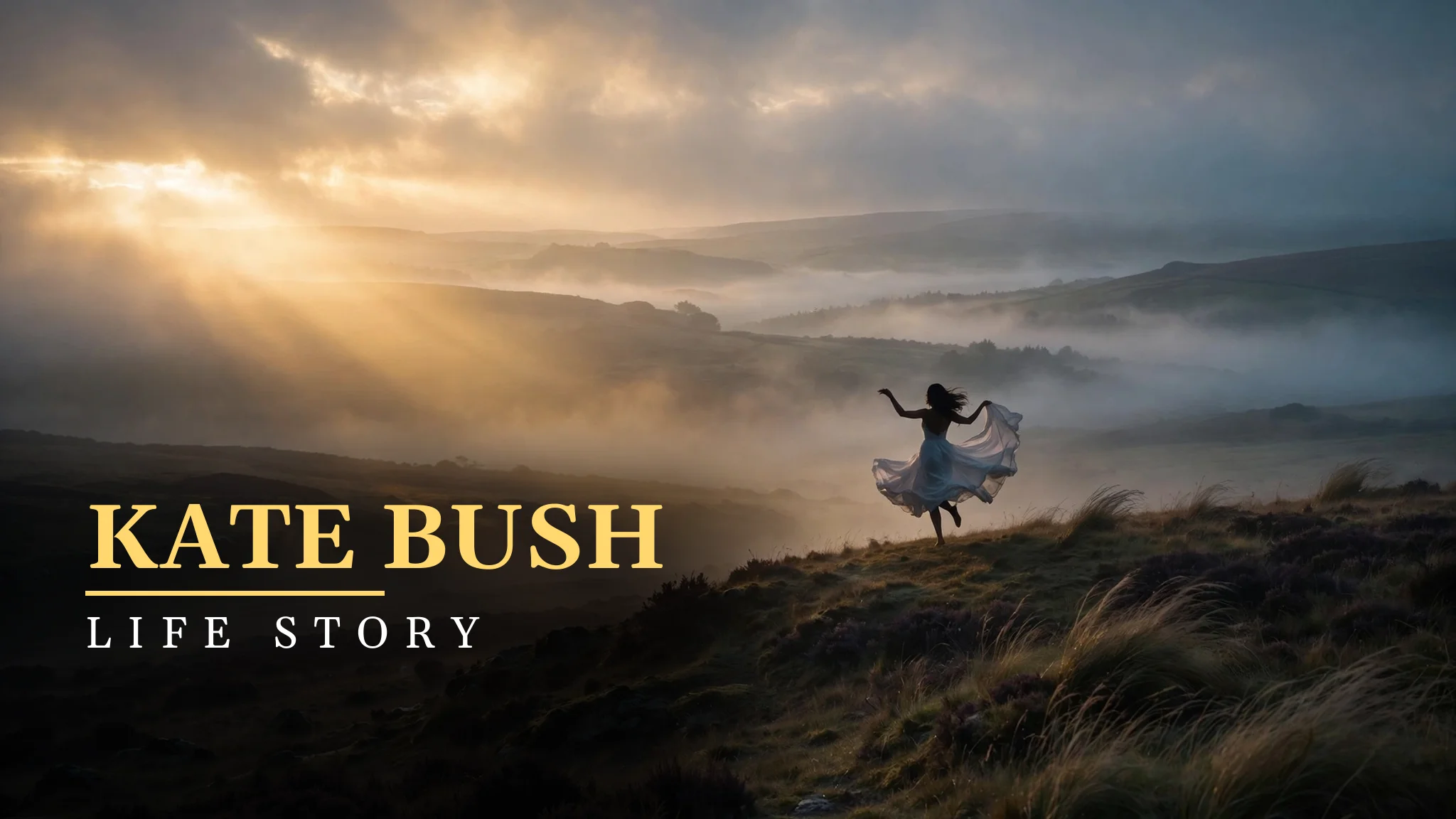
The record worked because it was so different. Her voice was high and dramatic, the piano played a simple, haunting melody, and the words told a story that listeners could feel even if they had not read the book. The video, in which she danced in a white dress on a misty hillside, became famous, and it showed that she was not just a singer. She was a performer who thought about movement, about images, and about how a song should look as well as how it should sound.
Her first album, “The Kick Inside”, was released in 1978, and it included “Wuthering Heights” and other songs she had written as a teenager. The album was a success, and it showed that she was a serious songwriter, not just a singer with one unusual hit. She followed it with a second album, “Lionheart”, later in the same year, and she began to build a reputation as a young artist with a vivid imagination and a strong sense of her own vision.
In 1979, she went on her first and only tour for many years, a tour called “The Tour of Life”. The show was ambitious, with dance, mime, costume changes, and theatrical staging, and it was praised for its originality. It was also exhausting, and it cost a great deal of money to stage. After the tour ended, she decided not to tour again, and that decision would shape the rest of her career. She would make records, but she would not perform them live in the usual way.
The first album also showed how much work had gone into the songs before anyone heard them. Many of the songs had been written when she was still a teenager, and they had been worked on, changed, and polished over several years. That slow process was unusual for a pop singer, but it meant that the album sounded complete. It was not a collection of rushed songs. It was a record made by someone who had been thinking about music for a long time, and who had a clear idea of what she wanted to say.
The Dreaming, Hounds of Love, and Total Control
In the early 1980s, Kate Bush took more control of her music. She built her own studio, she learned about recording technology, and she began to produce her own records. Her third album, “Never for Ever”, released in 1980, included the hit “Babooshka”, and it reached number one in Britain. Her fourth album, “The Dreaming”, released in 1982, was more experimental, with songs about a bank robbery, about a soldier, and about the dangers of war. The album was not as commercially successful as her earlier work, but it showed that she was willing to take risks.
Her fifth album, “Hounds of Love”, released in 1985, is widely regarded as her masterpiece. It included the hits “Running Up That Hill”, “Cloudbusting”, and “Hounds of Love”, and it was a great success. The album was divided into two parts: a set of hit singles on the first side, and a seven-song suite called “The Ninth Wave” on the second side, which told the story of a woman lost at sea. The suite was ambitious, and it showed that she could use an album to tell a long, complex story, not just to collect singles.
“Running Up That Hill” became one of her best-known songs, with its driving beat, its synthesiser sound, and its words about wanting to swap places with someone you love so that you can understand them. The song reached number three in Britain in 1985, and it became a hit in many other countries. “Cloudbusting” was inspired by the story of Wilhelm Reich and his son Peter, and its video, which featured the actor Donald Sutherland, was praised for its beauty and its sadness. The album made her a star in a new way, not just as a singer with a strange voice, but as an artist with a complete vision.
She followed “Hounds of Love” with “The Sensual World” in 1989, which included the title song inspired by James Joyce’s novel “Ulysses”, and with “The Red Shoes” in 1993, which was influenced by the film of the same name. Both albums were well received, but they were also the last albums she would release for more than a decade. She was becoming more private, and she was spending more time at home, away from the music business.
Building her own studio was a turning point, because it gave her the freedom to work at night, to try strange sounds, and to keep a song until it was right. A studio owned by a record company has a clock running, and every hour costs money, but her own studio had no such pressure. She could spend a week on a single sound, or she could leave a song for a month and return to it with fresh ears. That freedom is one of the reasons her records from the 1980s sound so detailed and so carefully made.
Silence, Family, and the Long Wait
After “The Red Shoes” in 1993, Kate Bush largely disappeared from public life. She had a son, Bertie, in 1998, and she devoted herself to raising him. She lived in the countryside, she rarely gave interviews, and she did not release new music for twelve years. For many fans, the silence was frustrating, but it was also part of her mystery. She was not a pop star who needed to be in the news. She was an artist who worked when she was ready, and who lived her life away from the cameras.
She returned in 2005 with the album “Aerial”, a double album that included songs about the sky, about the sea, and about the beauty of everyday life. The album was praised by critics, and it showed that her talent had not faded during the long break. She followed it with “Director’s Cut” in 2011, a reworking of songs from “The Sensual World” and “The Red Shoes”, and with “50 Words for Snow” in the same year, an album about winter, snow, and the quiet of the cold months. The albums were released without a tour, and without much promotion, but they were welcomed by fans who had waited a long time.
In 2014, she surprised everyone by announcing a series of concerts in London, called “Before the Dawn”. It was her first live performance in thirty-five years, and the shows sold out very quickly. The concerts were not a simple greatest-hits show. They were a theatrical production, with songs from “Hounds of Love” and “Aerial” performed as part of a story, with actors, film, and elaborate staging. The shows were praised, and they proved that she could still command a stage, even after so many years away.
The concerts were also a reminder of how much she had given up by not touring. She could have been one of the biggest live acts in the world, but she had chosen a different path. She had chosen to make records at her own pace, to live privately, and to perform only when she felt the work was right. That choice cost her money and fame, but it also gave her freedom, and that freedom is part of why her music still feels so personal.
The years of silence also gave her time to read, to walk, and to live a life that was not shaped by the music business. She lived in the countryside, she raised her son, and she watched the seasons change without having to turn every experience into a song. That quiet life fed her music in a different way, because when she did return with ‘Aerial’, the songs were full of the sky, the sea, and the small details of everyday life. A singer who has lived quietly often hears more than a singer who is always on tour.
Running Up That Hill and a New Generation
In 2022, “Running Up That Hill” became a hit again, thirty-seven years after it was first released. The song was used in the television series “Stranger Things”, in a key scene involving the character Max, and young viewers who had never heard of Kate Bush discovered the song and fell in love with it. The record reached number one in Britain, in the United States it reached number three, and it became one of the most streamed songs of the year. Bush was sixty-three, and she had a number one hit again, with a song she had written when she was in her twenties.
The return was remarkable because it was not planned. She had not released a new single, she had not gone on television to promote it, and she had not changed the song. The song itself had done the work, and a new generation had found it. Bush responded with a rare public statement, thanking the makers of “Stranger Things” and saying how moved she was that young people loved the song. She also released a statement about the song’s meaning, and about how grateful she was for the new audience.
The success also led to renewed interest in her whole catalogue, and many young listeners discovered albums such as “Hounds of Love” and “The Kick Inside” for the first time. For older fans, it was a vindication. They had always known that her music was special, and now the rest of the world was catching up. For Bush herself, it was a strange and happy moment, a reminder that a good song does not have a sell-by date.
She has continued to live privately since then, and she has not rushed to release new music or to tour again. She was made a CBE in 2013 for her services to music, and she has received many other honours. Her influence can be heard in the work of many younger singers, who admire her originality, her control, and her willingness to be different. She is now recognised as one of the most important British artists of the last fifty years.
Her early work with David Gilmour also deserves to be remembered, because it shows how a young singer can be helped without being controlled. Gilmour heard her tapes, he liked what he heard, and he used his name to open doors, but he did not try to change her songs or to make her sound like someone else. That kind of help is rare in the music business, where a famous mentor often wants to shape a young artist in his own image. Gilmour let Kate Bush be Kate Bush, and that generosity helped her to start her career on her own terms.
The Music That Keeps Growing
Kate Bush has continued to live privately, and she has not rushed to release new music, but her influence has grown with every year. Younger singers talk about her as a model, not just because of her songs, but because of the way she controlled her career. She built her own studio, she produced her own records, and she refused to let the music business decide how often she should work. That independence is rare, and it has become more important as the business has changed, because many young artists now look for ways to keep control of their own work.
Her songs have also been used in films and in television, and each time they are used, a new audience discovers them. The music does not sound dated, because it was never tied to a single fashion. A synthesiser sound from 1985 can sound fresh in 2022 if the song underneath it is strong, and ‘Running Up That Hill’ proved that. The song’s return was not a trick of nostalgia. It was a sign that a well-made song can wait for its moment, and that the moment can come decades after the song was written.
She has also been recognised by the music world in formal ways, including her CBE in 2013, and by the many lists and polls that place ‘Hounds of Love’ among the greatest albums ever made. Those honours matter, but they do not tell the whole story. The real honour is the way her music is still listened to, still talked about, and still loved by people who were not born when it was made. That is a rare achievement, and it is one that few artists ever reach.
Her legacy is not just a set of hit singles. It is the example of an artist who trusted her own imagination, who protected her privacy, and who made music at her own pace. She showed that a singer does not have to tour every year, does not have to release an album every year, and does not have to explain herself to the press. She showed that the work itself can be enough, and that if the work is good, the audience will find it, even if it takes thirty years.
She also worked with other artists in ways that showed her generosity, including her work with Peter Gabriel on the song ‘Don’t Give Up’, in which she sang a gentle, hopeful vocal that became one of the most loved duets of the 1980s. The song is about a man who has lost his job and his hope, and her voice is the voice of the person who tells him not to give up. It is a beautiful performance, and it shows that she could sing someone else’s song with the same feeling she brought to her own.
My Take:
I think Kate Bush is the most interesting singer in this whole group, and I say that because she never did what she was supposed to do. A pop star is supposed to have a hit, then another hit, then a tour, then another hit, and to keep going until the public gets tired of them. Kate Bush had a hit at nineteen, and then she decided to make the music she wanted to make, at the speed she wanted to make it, and to disappear when she wanted to disappear. That is not how the music business works, and it is not how most pop stars behave. It takes a very strong person to do that, and I admire her for it.
I admire “Wuthering Heights” because it is such a strange first single. Most singers would start with a safe love song, something simple that the radio would play without thinking. Kate Bush started with a song about a ghost calling out across the moors, inspired by a novel written more than a hundred years earlier. That is a brave choice, and it tells me that she was never interested in being a normal pop star. She was interested in stories, in literature, and in feelings that are hard to put into words. The fact that the song reached number one proves that the public is sometimes ready for something strange, if the song is good enough.
I also admire her voice, because it is not like anyone else’s voice. It is high, it is dramatic, and it can sound like a young girl and like an old woman in the same song. Some people find it hard to listen to at first, because it is so different from a normal pop voice. I think that difference is the point. She does not sing like other people because she does not think like other people. Her voice is the sound of her imagination, and once you get used to it, it becomes addictive. I can hear her influence in many younger singers, but none of them sound quite like her, and that is a sign of how original she is.
What I find sad in her story is the price she paid for her privacy. She stopped touring in 1979, and she did not perform live again for thirty-five years. That means that millions of people never saw her sing in person, and that she missed out on the joy of playing her songs to a live audience. I understand why she stopped. The tour was exhausting, and it cost a lot of money, and she wanted to work in a studio rather than on a stage. But I still feel sad that she was away for so long, because a live performance is a different thing from a record, and I think she would have been wonderful to see.
I think “Hounds of Love” is her best album, and I think it is one of the best albums ever made in Britain. The first half has the hits, and the second half, “The Ninth Wave”, is a story about a woman lost at sea, told in seven songs. That is an ambitious idea, and it could have gone badly wrong. Instead, it works beautifully, because the music is so vivid and the singing is so committed. When I listen to “The Ninth Wave”, I feel cold, I feel afraid, and I feel hopeful, all at the same time. That is what great art does. It makes you feel things you did not expect to feel, and it does it through music alone.
I also think about the long silence after “The Red Shoes”, and about how hard that must have been for her fans. She had a son, she lived in the countryside, and she did not release music for twelve years. I can understand why she did it. She wanted to be a mother, and she wanted to live a normal life, and she did not want the music business to take that away from her. I respect that choice, but I also think it shows how hard it is to be a woman artist and a mother at the same time. A man artist can have a child and keep working, and no one questions it. A woman artist is often expected to choose, and Kate Bush chose her son. I think she made the right choice, but I also think it is sad that she had to choose at all.
The return in 2022, with “Running Up That Hill”, is one of my favourite stories in modern music. A song written in 1985, about wanting to swap places with someone you love, becomes a hit again because it is used in a television show about teenagers fighting monsters. That is a wonderful, strange, and completely fitting way for Kate Bush to return to number one. She did not plan it, she did not promote it, and she did not change the song. The song did the work, and a new generation found it. I think that proves something important. A good song does not belong to one decade. It belongs to anyone who hears it and feels it, whenever they hear it.
I also admire the way she responded to the success. She wrote a short, gracious statement, she thanked the makers of “Stranger Things”, and she said how moved she was. She did not rush out a new album, she did not go on a tour, and she did not try to cash in on the moment. She let the song speak for itself, and she stayed private. That is a very Kate Bush way to handle fame, and it is a dignified way. Many singers would have used the moment to sell as much as they could. She used it to say thank you, and then she went back to her life.
If I have a criticism, it is that her music can be hard to get into at first. Some of her songs are strange, some of her lyrics are obscure, and some of her albums take time to understand. I think that is also a strength, because music that is easy to understand at first is often easy to forget. But I do think that a new listener might need help to find their way in. I would tell them to start with “Running Up That Hill” and “Hounds of Love”, and then to listen to “Wuthering Heights” and “Cloudbusting”, and then to try “The Ninth Wave” when they are ready. That is a good path into her work, and it rewards patience.
For a young reader, I think the lesson from Kate Bush is to trust your own imagination and to protect it. She trusted hers, even when it led her to write songs about ghosts, about snow, and about women lost at sea. She protected it by building her own studio, by producing her own records, and by stepping away when she needed to. That is a hard thing to do, because the world will always tell you to be more normal, to be more commercial, and to be more visible. Kate Bush said no, and she made great art anyway. That is a lesson worth learning.
I keep thinking about her concerts in 2014, “Before the Dawn”, and about how brave it must have been to return to the stage after thirty-five years. She was fifty-six, she had not performed live for most of her adult life, and she was about to sing in front of thousands of people who had waited decades to see her. The shows were a triumph, and they proved that she had not lost her nerve. I think that is a powerful message. It is never too late to return to something you love, even if you have been away for a long time.
In the end, I think Kate Bush teaches us that originality is worth the risk. She could have been a normal pop star, with a string of safe hits and a regular touring schedule. Instead, she became something rarer: an artist who made the music she wanted to make, in the way she wanted to make it, and who was rewarded, in the end, by a new generation who found her songs and loved them. I will remember her not just for “Running Up That Hill”, but for the long, strange, beautiful career that made that song possible.
I also think about the way she used dance and movement in her work, because that is a part of her art that is often overlooked. Her early videos showed her dancing in a way that was strange and expressive, and her stage shows used mime and theatre to tell a story. That was not a gimmick. It was a belief that a song should be seen as well as heard, and that the body can say things the voice cannot. I think that belief made her videos and her concerts feel like complete works of art, rather than simply a singer standing in front of a microphone.
Another thing I admire is her relationship with her brothers, especially Paddy, who played on her records and helped her find the folk sounds that appear in many of her songs. A family that makes music together is a rare thing, and it gave her a support system that many young singers do not have. She was not alone in the studio. She had people she trusted, people who knew her, and people who could tell her when a song was not working. That trust is part of why her early records sound so confident.
I also think about the cost of her perfectionism. She spent years on some albums, and she left long gaps between records, and that must have been frustrating for her fans and for her record company. I wonder if she ever worried that the audience would forget her, or that the music business would move on without her. I think she did worry, but she also knew that a rushed record would be worse than a late one. That is a brave choice, and it is one that many artists are afraid to make.
When I listen to ‘50 Words for Snow’, I hear a singer who is comfortable with quiet. The album is slow, it is about winter, and it is about the beauty of stillness. That is not a record made for the charts. It is a record made for listeners who are willing to sit and to listen, and it rewards that patience. I think it shows a maturity that is rare in pop music, where the usual rule is to be louder, faster, and more exciting. Kate Bush chose to be quieter, and that choice made the album more powerful.
Finally, I think about what her story means for a young artist today. The music business now moves faster than ever, and young singers are expected to post every day, to tour constantly, and to release music all the time. Kate Bush did the opposite, and she still succeeded. Her story tells a young artist that it is possible to protect your privacy, to work slowly, and to trust your own imagination, and still to be loved by millions. That is a hopeful message, and it is one that I think will last.
I also think about her CBE in 2013, and about what it meant for a singer who had spent so much of her life away from the public eye. The honour was a formal recognition, but it was also a sign that the country had caught up with her. She had always been ahead of her time, and the CBE was a way of saying that her time had come, and that her work mattered to British culture as a whole.
Finally, I think about the young listeners who found her through ‘Stranger Things’, and about how lucky they are to have discovered her at a young age. They have a whole catalogue to explore, from ‘The Kick Inside’ to ‘50 Words for Snow’, and each album will teach them something new about what music can do. I hope they take their time with it, and I hope they learn from her example that it is possible to be original, to be private, and to be successful, all at the same time.
Frequently Asked Questions
How old was Kate Bush when Wuthering Heights reached number one?
She was nineteen when “Wuthering Heights” reached number one in Britain in 1978, making her the first woman to top the British charts with a song she had written herself.
What book inspired Kate Bush’s first hit?
“Wuthering Heights” was inspired by Emily Brontë’s novel of the same name, and Bush sang it from the point of view of Cathy, the ghostly heroine calling to Heathcliff.
Why did Kate Bush stop touring in 1979?
After her ambitious “Tour of Life” in 1979, she decided not to tour again for many years, preferring to work in the studio and to control her music at her own pace.
What is The Ninth Wave on Hounds of Love?
“The Ninth Wave” is the second half of her 1985 album “Hounds of Love”, a seven-song suite telling the story of a woman lost at sea and fighting to survive.
When did Kate Bush return to the stage?
She returned to live performance in 2014 with a series of concerts in London called “Before the Dawn”, her first live shows in thirty-five years.
How did Running Up That Hill become a hit again in 2022?
The song was used in the television series “Stranger Things”, where it became linked to the character Max, and young viewers streamed it in huge numbers, taking it to number one in Britain.
What honour did Kate Bush receive for her music?
She was made a CBE in 2013 for her services to music, recognising her work as one of Britain’s most original and influential artists.


