Kate Winslet: The Life Story Behind Titanic's Rose
In this post
- Growing Up in a Theatre Family in Reading
- Heavenly Creatures and a Fearless Debut
- Titanic and the Biggest Film in History
- The Reader, the Oscar, and a Career of Choices
- Mare of Easttown and the Television Triumph
- Body Image, Honesty, and Standing Her Ground
- Family, Later Work, and a Lasting Legacy
- My Take:
Growing Up in a Theatre Family in Reading
Kate Elizabeth Winslet was born on October 5, 1975, in Reading, Berkshire, England, into a family where acting was not a dream but a way of life. Her father, Roger Winslet, was an actor who struggled to find steady work, and her mother, Sally, worked as a barmaid and a nanny, and the family lived in a modest home where money was often short and where the children learned early that the theatre was both a passion and a precarious profession. Her grandparents on both sides had worked in the theatre, her sisters Anna and Beth also became actresses, and her brother Joss became a musician, so the house was full of rehearsals, scripts, and conversations about plays. It was a warm, noisy, creative household, but it was also one where the realities of an actor’s life, the gaps between jobs, the auditions that led nowhere, the bills that arrived anyway, were visible to a child from the very beginning.
Winslet has described herself as a chubby, confident child who loved performing and who was not afraid to take up space, even when the world told girls to be smaller. She began acting in school plays and local theatre, and at the age of eleven she was accepted into the Redroofs Theatre School in Maidenhead, a specialist school for young performers. The school gave her formal training in acting, dancing, and singing, and it also gave her a sense of what a professional life in the theatre might look like. She has spoken about the discipline of those years, about the early mornings and the long rehearsals, and about the teachers who pushed her to take the work seriously. She was not a child who stumbled into acting by accident; she was a child who chose it, deliberately and early, and who worked at it with a seriousness that surprised the adults around her.
Her first professional work came while she was still a teenager, with appearances in television commercials, a role in the BBC children’s science fiction series Dark Season in 1991, and a part in the sitcom Get Back. She also appeared in a stage production of Adrian Mole, and she was learning, job by job, how the business worked. The money was not much, and the roles were small, but each one taught her something, about cameras, about directors, about the patience required to wait for your moment on a set. She has said that those early years were important because they taught her that acting was work, not magic, and that the actors who lasted were the ones who treated it as a craft to be learned rather than a gift to be admired. That attitude would carry her through the biggest film in history and through the long career that followed it.
Heavenly Creatures and a Fearless Debut
Kate Winslet’s film debut came in 1994, when she was eighteen years old, in Peter Jackson’s Heavenly Creatures, a dark, beautiful, and deeply disturbing film based on a true story of two teenage girls in New Zealand whose intense friendship ends in murder. Winslet played Juliet Hulme, a clever, imaginative, theatrical girl who builds a fantasy world with her friend Pauline and who, when that world is threatened, chooses violence over separation. It was an extraordinarily demanding role for a first film, requiring her to be charming and terrifying in the same scene, and she played it with a confidence that stunned critics. The film won awards at festivals around the world, and Winslet was praised as a major new talent, an actress who could hold the screen with an intensity that seemed far beyond her years. She had arrived, and she had arrived in a role that no one could forget.
What made the performance so remarkable was not just the talent but the fearlessness. Heavenly Creatures is not a safe film, and Juliet is not a safe character, and a young actress could easily have played her as a villain or as a victim. Winslet did neither; she played her as a real, complicated girl, full of imagination and anger and love, and she made the audience understand, if not forgive, the choices Juliet makes. Peter Jackson has spoken about the audition process, about the hundreds of girls he saw, and about the moment he realised that Winslet was the one, because she brought something to the role that no one else had: a kind of fierce, unapologetic intelligence. The film remains one of the great debuts in cinema history, and it set the tone for everything that followed, because it showed that Winslet was not interested in being a conventional leading lady; she was interested in being an actress.
The success of Heavenly Creatures brought her attention from Hollywood, and she followed it with a series of roles that showed her range. In 1995, she played Marianne Dashwood in Ang Lee’s Sense and Sensibility, a performance of warmth and wit that earned her an Academy Award nomination for Best Supporting Actress at the age of twenty, making her one of the youngest nominees in the category’s history. She played Ophelia in Kenneth Branagh’s Hamlet in 1996, and she took on the role of a young woman in Jude, a bleak adaptation of Thomas Hardy’s novel. Those parts span romance, period drama, and tragedy, and what they share is Kate’s willingness to let a character be difficult, unlikable, and fully human rather than merely sympathetic. She was building a career that was unusually serious for an actress of her age, and she was doing it by choosing directors and material that challenged her rather than by chasing fame.
Titanic and the Biggest Film in History
In 1997, Kate Winslet took on the role that would define her life: Rose DeWitt Bukater in James Cameron’s Titanic, the story of a young woman from a wealthy family who falls in love with a poor artist, played by Leonardo DiCaprio, aboard the doomed ship. The film was one of the most expensive ever made, the shoot was famously difficult, with long hours in cold water tanks and a director known for his relentless perfectionism, and the pressure on its two young stars was enormous. Winslet has spoken about the physical toll of the production, about the bruises and the exhaustion, about the moments when she wondered whether the film would ever be finished, and about the determination that kept her going. She also formed a close friendship with DiCaprio, a friendship that has lasted for decades and that remains one of the most famous in Hollywood, built on a shared experience that few other people can understand.
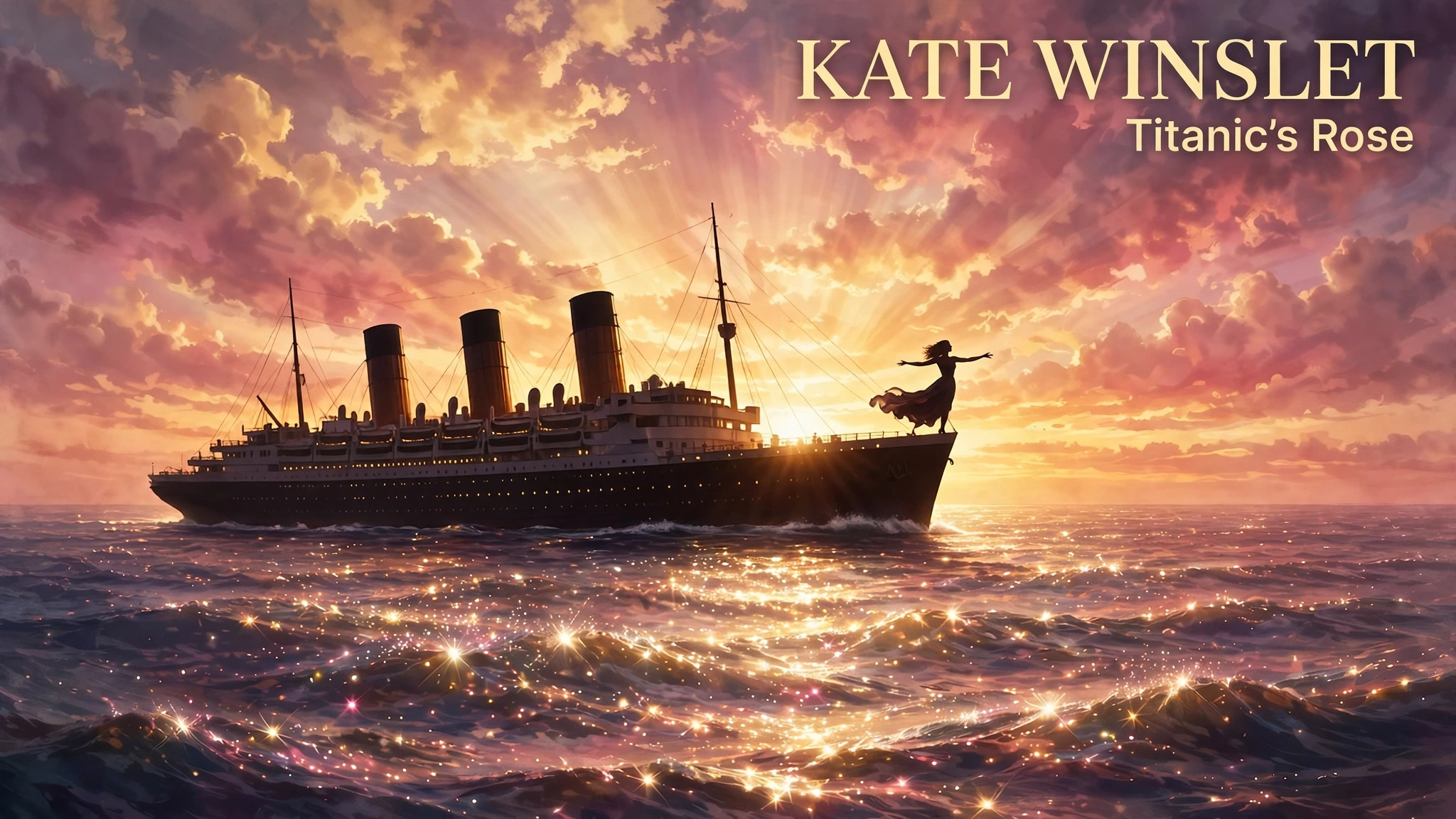
When Titanic was released, it became a phenomenon unlike anything the film industry had ever seen. It was the first film to earn more than a billion dollars at the box office, it won eleven Academy Awards, including Best Picture, and it made Winslet and DiCaprio the most famous young actors in the world. Rose became an icon, the image of a woman standing at the bow of a ship with her arms outstretched, the red dress, the necklace, the drawing, all of it entered popular culture in a way that few performances ever do. Winslet was nominated for the Academy Award for Best Actress, and although she did not win that year, the nomination confirmed that she was not just a star of a blockbuster but a serious actress. The film’s success changed her life in ways that were both wonderful and overwhelming, and she has spoken honestly about the difficulty of being twenty-two years old and recognised everywhere she went.
The fame that followed Titanic was intense, and Winslet has been candid about the fact that she did not enjoy all of it. She was followed by photographers, written about constantly, and reduced in the press to a single role, as though Rose were the only thing she had ever done or would ever do. She has spoken about the pressure to look a certain way, about the criticism of her body in the tabloids, and about the decision she made, quite deliberately, to step back from blockbusters and to choose smaller, more interesting films. That decision was brave, because many actors would have chased the next Titanic, and it was smart, because it allowed her to build a career that was defined by her choices rather than by a single success. The years after Titanic would show that she was far more than Rose, and that the actress who had played her was capable of almost anything.
The Reader, the Oscar, and a Career of Choices
After Titanic, Kate Winslet made a series of choices that surprised people who expected her to become a conventional movie star. She appeared in small, independent films like Hideous Kinky and Holy Smoke, she played a woman in a troubled marriage in Little Children, and she took on the role of Clementine in Eternal Sunshine of the Spotless Mind in 2004, a performance of wild, funny, heartbreaking originality that earned her another Oscar nomination. She worked with directors like Sam Mendes, Todd Field, and Michel Gondry, and she built a reputation as an actress who would take risks, who would play unlikable characters, and who would choose a good script over a big paycheck. She was nominated for the Academy Award five times before she finally won, and each nomination was for a different kind of role, which tells you something about the range of her work.
The Oscar finally came in 2009, for her performance as Hanna Schmitz in The Reader, a film based on Bernhard Schlink’s novel about a woman who has a relationship with a teenage boy and who is later put on trial for her role in the Holocaust. It was a difficult, controversial role, and Winslet played it with a moral complexity that refused to make Hanna either a monster or a victim. She won the Academy Award for Best Actress, and her acceptance speech, in which she spoke about practising her speech in the shower since she was a child, was charming and self-deprecating and widely loved. The win was the culmination of fifteen years of work, and it was also a vindication of the choices she had made since Titanic, the choice to be an actress rather than a star, to take the hard roles, and to trust that the work would eventually be recognised.
Since the Oscar, Winslet has continued to work in film, television, and theatre, with a career that remains remarkably varied. She won an Emmy for her performance in the HBO miniseries Mildred Pierce in 2011, playing a single mother in the 1930s who builds a business and loses almost everything, and she won another Emmy for Mare of Easttown in 2021, playing a small-town detective in Pennsylvania whose personal life is as messy as her cases. She has appeared in films like Steve Jobs, where she played Joanna Hoffman, and The Dressmaker, and she has taken on roles in big franchises like Avatar: The Way of Water, where she played a Na’vi warrior and learned to hold her breath underwater for minutes at a time. Each of these projects is different, and each one shows an actress who is still curious, still working, and still unwilling to be defined by a single role, even one as famous as Rose.
Mare of Easttown and the Television Triumph
Mare of Easttown, released in 2021, was a revelation for audiences who had not followed Kate Winslet’s television work, and it became one of the most talked-about shows of the year. She played Mare Sheehan, a detective in a small Pennsylvania town, a woman who is grieving the loss of her son, struggling with her family, and trying to solve a murder while her own life falls apart. The performance was raw, unglamorous, and deeply human, and Winslet played Mare without any vanity, letting the character’s exhaustion and anger show in every scene. She also insisted on keeping the character’s appearance realistic, refusing to have her wrinkles and imperfections smoothed away, and that decision became part of the conversation about the show. The series was a critical and commercial success, and Winslet won the Emmy for Outstanding Lead Actress in a Limited Series, her second Emmy, and the show proved that she could carry a television drama as completely as she had carried films.
What made Mare of Easttown so powerful was the way it used Winslet’s talent for playing ordinary women in extraordinary circumstances. Mare is not a glamorous detective; she is a tired, flawed, working-class woman who is doing her best in a town where everyone knows everyone else’s business, and Winslet played her with a specificity that made the character feel real rather than generic. She learned the Delaware County accent, she worked with the show’s creator Brad Ingelsby to understand the town, and she brought a lifetime of experience to a role that could easily have been a caricature. The show’s success also showed that audiences were hungry for stories about middle-aged women, about mothers and grandmothers and working women, and that Winslet was one of the few actresses who could tell those stories with the depth they deserved.
The show also marked a new phase in Winslet’s career, one in which television became as important as film. She has spoken about the creative freedom that television offers, about the time to develop a character over seven episodes rather than two hours, and about the quality of the writing in modern television. Mare of Easttown was followed by other television projects, including the HBO series The Regime in 2024, where she played a fictional European chancellor, a role that was both satirical and serious. These projects show an actress who is not afraid to experiment, who is willing to play characters who are difficult and unlikeable, and who understands that the best work is often found in the places where the audience least expects it.
Body Image, Honesty, and Standing Her Ground
Throughout her career, Kate Winslet has been one of the most outspoken actresses in Hollywood about body image, and her honesty on the subject has made her an important voice for many women. From the earliest days of her fame, she was criticised in the tabloids for her weight, for her curves, for not looking like the thin, conventional ideal of a movie star, and she refused to apologise for her body or to change it to fit someone else’s idea of beauty. She has spoken about the pressure she felt as a young woman, about the comments from directors and agents, and about the decision she made to stop listening to them. She has also spoken about the importance of teaching her children to love their bodies, and about the responsibility she feels as a public figure to show that beauty comes in many shapes.
Her stance on body image is not just talk; it has shaped her career choices. She has refused to allow her photographs to be retouched, she has spoken out against magazines that altered her image without permission, and she has insisted on playing characters who look like real women rather than airbrushed ideals. In Mare of Easttown, she famously refused to have a scene changed in which her stomach was visible, saying that the character was a real woman and that real women have stomachs. That kind of honesty is rare in Hollywood, and it has earned her admiration from audiences who are tired of seeing only one kind of body on screen. She has also been a vocal critic of the way the industry treats women’s appearance, and she has used her platform to argue for a more honest, more inclusive idea of beauty.
The impact of her honesty extends beyond her own career. Young actresses have spoken about how Winslet’s example gave them the confidence to refuse to change their bodies, and women who are not in the industry have said that her words helped them feel better about themselves. She has never claimed to have all the answers, and she has been open about her own insecurities, but her willingness to talk about them, and to stand her ground, has made a real difference. In an industry that often rewards silence and compliance, Winslet’s voice has been a reminder that an actress can be both successful and honest, and that the two are not incompatible. Her legacy, in this respect, may be as important as her performances, because it is about changing the way women are seen, not just on screen but in the world.
Family, Later Work, and a Lasting Legacy
Kate Winslet’s personal life has been as eventful as her career, and she has spoken about it with a candour that is unusual for a star of her stature. She was married to assistant director Jim Threapleton from 1998 to 2001, with whom she has a daughter, Mia, who has herself become an actress. She was married to director Sam Mendes from 2003 to 2011, with whom she has a son, Joe, and she has been married to businessman Edward Abel Smith, formerly known as Ned Rocknroll, since 2012, with whom she has a son, Bear. She has spoken about the difficulty of balancing a demanding career with motherhood, about the guilt and the joy, and about the importance of being present for her children even when work takes her away. She has also spoken about the support of her family, and about the way her children have kept her grounded in a world that can easily make a person lose perspective.
In recent years, Winslet has continued to take on ambitious projects, including her directorial debut with the film Goodbye June, and her work as a producer on projects that reflect her interests. She has also become involved in environmental causes, including ocean conservation, and she has used her platform to speak about issues she cares about. She remains one of the most respected actresses in the world, not because she chases fame, but because she has built a career on the quality of her work, and because she has done it with a honesty and a humour that have made her beloved by audiences and colleagues alike. Directors who have worked with her talk about her preparation, her intelligence, and her willingness to take risks, and younger actors talk about her as a role model, someone who has shown that it is possible to have a long, varied, and meaningful career without compromising who you are.
Kate Winslet’s legacy is already secure, and it is still growing. She is the actress who played Rose in Titanic, and that will always be part of her story, but she is also the actress who played Hanna Schmitz, Clementine Kruczynski, Mare Sheehan, and Mildred Pierce, and each of those roles is a different kind of achievement. She is an Oscar winner, an Emmy winner, and a Grammy winner, one of the few performers to have won all three, and she has done it by choosing roles that challenged her and by refusing to be defined by any single success. For young actors, her story is a reminder that a career is built over decades, not in a single film, and that the best work comes from taking risks and from trusting your own judgement.Her story, of a girl from Reading who became one of the most respected actresses alive, is still being written, one careful choice at a time.
My Take:
Rose Was Only the Beginning
When people talk about Kate Winslet, the conversation almost always starts with Titanic, and I understand why, because Rose is one of the most famous characters in film history, and the image of her at the bow of the ship is burned into the memory of everyone who saw the film. But I think the most interesting thing about Winslet’s career is what she did after Titanic, because that is where her real story begins. Many actors would have spent the rest of their lives trying to repeat that success, chasing the next blockbuster, the next billion-dollar film, and the next magazine cover. Winslet did the opposite: she stepped back, she chose small films, she played difficult women, and she built a career that was defined by her choices rather than by a single role. That decision, made when she was twenty-two years old and the most famous young actress in the world, tells me more about her character than any performance ever could, because it shows a person who knew what she wanted and who was not afraid to turn down the easy path.
What I admire about that choice is not just the bravery but the intelligence behind it. Winslet understood, even at twenty-two, that fame is not the same as a career, and that the actress who is known only for one role is in danger of being forgotten when the next big film comes along. By choosing smaller, more interesting work, she ensured that she would be remembered for her talent rather than for her fame, and that the directors who mattered would take her seriously. The result is a filmography that is unusually rich, with performances in Eternal Sunshine of the Spotless Mind, Little Children, The Reader, and Mare of Easttown, each one different from the others, each one proof that she is an actress of extraordinary range. I think that is the real lesson of her career: the most famous role is not always the most important one, and the smartest move is often the one that looks, at the time, like a step back.
I also think about the pressure she must have felt, because the whole world was watching her after Titanic, and the whole world had an opinion about what she should do next. The tabloids were writing about her body, the studios were offering her every blockbuster they had, and the public was expecting her to become a conventional movie star. To say no to all of that, to choose Hideous Kinky over a franchise, to choose a small film about a troubled marriage over a big paycheck, requires a kind of self-knowledge that is rare at any age, let alone at twenty-two. I find that inspiring, not because I think everyone should turn down money, but because it shows that it is possible to build a career on your own terms, even when the world is telling you to do something else. Winslet did that, and the career she built is the proof that it works.
The Actress Who Refuses to Be Airbrushed
There is a moment in Mare of Easttown that I think about often, not because it is dramatic, but because it is honest. Winslet, playing a tired detective, is shown in a scene where her stomach is visible, and she refused to let the producers change it, saying that Mare was a real woman and that real women have stomachs. That small act of refusal is, for me, one of the most important moments in her career, because it captures everything she stands for: honesty over image, truth over vanity, and a belief that the audience deserves to see real people rather than airbrushed ideals. In an industry that spends millions of dollars making women look perfect, Winslet’s insistence on looking real is a radical act, and it is one that has had a real impact on the way women are shown on screen.
I think her stance on body image matters because it is not just about her, but about the millions of women who watch her films and who have been told, in a thousand ways, that their bodies are wrong. When a star as famous as Winslet says that she will not be retouched, that she will not apologise for her curves, and that she will not change herself to fit a magazine’s idea of beauty, it gives other women permission to feel the same way about themselves. That is a powerful thing, and it is a responsibility that Winslet has taken seriously throughout her career. She has spoken about it in interviews, she has written about it, and she has lived it in her choices, and the consistency between what she says and what she does is what makes her credible. She is not a celebrity who talks about body positivity while quietly having work done; she is a woman who has stood her ground, publicly and repeatedly, and who has paid a price for it in the form of tabloid criticism and industry pressure.
What I find most admirable is that she has done this without becoming bitter or angry, and without turning her stance into a brand. She talks about body image with humour and with honesty, she acknowledges her own insecurities, and she does it in a way that feels like a conversation rather than a lecture. That tone matters, because it makes her message accessible to people who might otherwise tune it out, and it shows that it is possible to be both serious and warm, both principled and funny. I think that is why her words have resonated with so many people, and why her legacy in this area may be as lasting as her performances. The films will be remembered, but so will the example she set, and that example is still changing the way women see themselves.
Why The Reader and Mare of Easttown Matter Most
If I had to choose the performances that define Kate Winslet for me, I would not choose Titanic, even though it is the most famous, but The Reader and Mare of Easttown, because those are the roles where her talent is most fully on display. In The Reader, she plays Hanna Schmitz, a woman who is both a victim and a perpetrator, who is illiterate and proud, who is guilty and human, and she plays her without ever asking the audience to forgive her or to condemn her. That moral ambiguity is extraordinarily difficult to sustain, because the audience wants a clear answer, and Winslet refuses to give them one. She trusts the audience to sit with the discomfort, to hold two truths at once, and that trust is the mark of a great actress. The performance won her the Oscar, and it deserved to, because it is one of the most complex portrayals of a woman in modern cinema, and it is a role that almost no other actress could have played.
Mare of Easttown matters for a different reason, because it is a performance about ordinary life, about a woman who is not extraordinary in any conventional sense, but who is rendered extraordinary by the depth of Winslet’s attention. Mare is tired, she is grieving, she is angry, and she is doing her best, and Winslet plays her with a specificity that makes her feel like a real person rather than a character in a television show. The accent, the clothes, the way she moves, the way she talks to her mother and her daughter, all of it feels lived in, and that lived-in quality is what makes the show so compelling. I think the performance is a masterclass in the art of playing a normal person, which is much harder than playing a queen or a spy, because there is nothing to hide behind, no costume or accent to do the work for you. Winslet does the work herself, and the result is a character who feels like someone you might know.
Together, these two performances show the range of her talent, from the moral complexity of Hanna to the everyday humanity of Mare, and they show why she is one of the most respected actresses of her generation. She is not an actress who relies on a single trick, or who plays the same character in every film, but one who approaches each role as a new problem to be solved, and who brings a lifetime of experience to the solution. That is the kind of career that lasts, because it is built on craft rather than on fame, and it is the kind of career that I think young actors should study, not just for the performances, but for the choices behind them. The roles she chose, and the roles she turned down, are as much a part of her story as the films themselves.
What Her Career Teaches About Longevity
When I look at Kate Winslet’s career as a whole, from Heavenly Creatures in 1994 to Mare of Easttown in 2021 and beyond, what strikes me most is the longevity, and the fact that she has remained relevant and respected for more than thirty years in an industry that discards actresses quickly. That longevity is not an accident; it is the result of choices, of discipline, and of a refusal to be defined by any single moment. She did not chase fame after Titanic, she did not chase youth as she got older, and she did not chase trends when the industry changed. Instead, she kept choosing good scripts, kept working with good directors, and kept playing characters who were interesting, even when they were not glamorous. That consistency is the secret to a long career, and it is a secret that many actors never learn, because it requires patience and a willingness to say no.
I also think her longevity is a testament to her intelligence, because she has understood, at every stage of her career, what the moment required. As a young actress, she needed to prove she could act, and she did that with Heavenly Creatures and Sense and Sensibility. After Titanic, she needed to prove she was more than a blockbuster star, and she did that with Eternal Sunshine and Little Children. In her thirties, she needed to prove she could win an Oscar, and she did that with The Reader. In her forties, she needed to prove she could carry a television drama, and she did that with Mare of Easttown. At each stage, she asked herself what the next challenge was, and she met it, and that willingness to keep challenging herself is what has kept her work fresh. It is a lesson for anyone in any career: the moment you stop challenging yourself is the moment you start to fade, and Winslet has never stopped.
Finally, I want to say that I am looking forward to what comes next for her, because she shows no sign of slowing down, and because her recent work as a director suggests that she is still finding new ways to tell stories. Goodbye June, her directorial debut, is a new chapter, and it is one that I am curious to see, because it will show us what kind of stories she wants to tell when she is the one in charge. Whatever she does next, I expect it to be thoughtful, honest, and different from what came before, because that is the pattern of her career, and it is a pattern that has never failed her. Her story is a reminder that the best careers are not built in a single moment, but over decades of careful, brave, and intelligent choices, and that is a lesson worth remembering.
And if there is one image I carry away from her whole career, it is not the ship or the red dress, but the detective in a small Pennsylvania town, tired and determined, refusing to give up on a case or on herself. That image, more than any red carpet, tells the truth about who Kate Winslet is: an actress who found fame young, refused to let it define her, and built something lasting instead.
Frequently Asked Questions
How did Kate Winslet become famous?
Kate Winslet became famous as Rose DeWitt Bukater in Titanic in 1997, the highest-grossing film of its time. She had already earned praise for Heavenly Creatures in 1994 and an Oscar nomination for Sense and Sensibility in 1995.
What did Kate Winslet win an Oscar for?
Kate Winslet won the Academy Award for Best Actress in 2009 for playing Hanna Schmitz in The Reader. It was her sixth nomination, after earlier nominations for Sense and Sensibility, Titanic, Eternal Sunshine of the Spotless Mind, and Little Children.
Where is Kate Winslet from?
Kate Winslet was born in Reading, Berkshire, England, on October 5, 1975, into a theatre family. She trained at the Redroofs Theatre School in Maidenhead and began acting professionally as a teenager.
What is Kate Winslet’s best TV show?
Many consider Mare of Easttown, the 2021 HBO limited series in which she played detective Mare Sheehan, her best television work. It won her an Emmy, and she also won an Emmy for Mildred Pierce in 2011.
Is Kate Winslet married?
Yes, Kate Winslet has been married to businessman Edward Abel Smith since 2012. She was previously married to Jim Threapleton and to director Sam Mendes, and she has three children.
What are Kate Winslet’s most famous movies?
Her most famous films include Titanic, Heavenly Creatures, Sense and Sensibility, Eternal Sunshine of the Spotless Mind, The Reader, Little Children, Steve Jobs, and Avatar: The Way of Water.


