Kathleen Turner: The Life Story Behind the Romancing the Stone Star
In this post
- A Diplomat’s Daughter Around the World
- London, the Stage, and a New York Start
- Body Heat and a Star Is Born
- Romancing the Stone and the Adventure Years
- The War of the Roses, Jessica Rabbit, and a Voice
- Arthritis, the Stage, and a Brave New Life
- The Accidental Tourist, Serial Mom, and the 1990s
- Friends, the Stage, and Teaching
- The Perfect Family, Californication, and Finding My Voice
- My Take:
Kathleen Turner has one of the most famous voices in Hollywood. It is low, smoky, and full of confidence, and when she speaks, you listen. She arrived on screen in Body Heat, a film that made her a star overnight, and she became one of the biggest actresses of the 1980s, playing adventurers, lawyers, and mothers with a fire that no one else could match. She was bold, she was funny, and she was unafraid, and audiences loved her for it.
She grew up around the world, the daughter of a diplomat, and she lived in many countries before she ever acted. She studied in London, she worked on the stage, and she came to Hollywood with a training and a confidence that set her apart. She did not stumble into fame. She earned it, and she held onto it with hard work.
Her story runs from Missouri to London to Hollywood, from a femme fatale to a romantic adventurer to a stage actress, and from a painful illness that changed her body to a brave new life as a teacher and an advocate. It is the story of a strong, honest woman who faced everything life gave her, and who never stopped working.
A Diplomat’s Daughter Around the World
Kathleen Turner was born on 19 June 1954 in Springfield, Missouri. Her father, Allen, worked for the United States Foreign Service, and her mother, Patsy, was a homemaker. Because of her father’s job, the family moved often, and Kathleen grew up in many different places, including Cuba, Venezuela, and London. She was a child of the world, and she learned early how to adapt to new places, new schools, and new people.
As a girl, she was strong-willed and outspoken. She did not fit easily into the quiet life of a diplomat’s daughter, and she wanted to do something bigger with her life. She liked to perform, she liked to speak her mind, and she did not hide her feelings. She was a girl who knew what she wanted, and she was not afraid to say so.
She went to school in London, where the family lived for several years, and she began to act in school plays. London gave her a love of the theatre, and she decided that she wanted to be an actress. She studied at the Central School of Speech and Drama in London, one of the most respected acting schools in the world, where she learned the craft of acting from the inside.
The travelling years gave her a gift: she could live anywhere, talk to anyone, and adapt to any situation. That gift stayed with her, and it made her a versatile actress. She could play an American, a Briton, or a woman from anywhere, because she had lived in many places and had learned to listen to the way people spoke.
London, the Stage, and a New York Start
After her training in London, Turner moved to New York, where she worked on the stage and in television. She was a serious actress, and she took her craft seriously. She appeared in plays, she worked in soap operas, and she built a reputation as a strong, confident performer who could handle difficult roles. She was not a typical Hollywood beauty. She was a thinking actress, with a low voice and a direct manner, and directors noticed her.
She appeared in the television series The Doctors, and she worked in the theatre, where she learned how to hold a stage. She was patient, and she was willing to take small parts, because she believed that good work would lead to more good work. She did not chase fame. She chased the craft, and she trusted that fame would follow if the work was good enough.
In the late 1970s, she began to get noticed. She was a tall, strong woman with a voice that stood out, and she had a presence that made people watch her. She was not afraid to be bold, and she was not afraid to play women who were complicated, difficult, and real. That boldness would soon make her famous, but it also set her apart from many other actresses of her time.
The stage years mattered because they gave her a foundation. She had training, she had discipline, and she had a deep respect for acting. She was not a star who had been discovered by accident. She was a professional, and she had earned her place.
Body Heat and a Star Is Born
Turner’s breakthrough came in 1981, when she played Matty Walker in Body Heat, a thriller about a lawyer who falls in love with a married woman who may be planning to murder her husband. The film was hot, tense, and stylish, and Turner’s performance as Matty, a woman who is beautiful, clever, and dangerous, made her a star overnight. She was twenty-seven years old, and she had never appeared in a film before, but she played the part with a confidence that made audiences believe she had been doing it for years.
The film became a classic, and it made Turner one of the most talked-about actresses in Hollywood. She was not a shy newcomer. She was a bold, adult woman, and she played a character who was in control of her own life, even when that life was dangerous. That boldness was new, and audiences loved it. She had arrived, and she had arrived as a star.
In the years that followed, she appeared in many strong films. She played in The Man with Two Brains in 1983, a comedy with Steve Martin, and she showed that she could be funny as well as sexy. She was not a one-note actress. She could play a femme fatale, a comedian, and a romantic lead, and she did each one with the same energy and the same honesty.
Body Heat changed her life. She was now a major star, and she was offered many more roles. But it also set a pattern. People began to see her as a sexy, dangerous woman, and she had to fight to show that she could play many other kinds of characters. She fought that fight for the rest of her career, and she won it, again and again.
Romancing the Stone and the Adventure Years
In 1984, Turner starred in Romancing the Stone, an adventure film about a romance novelist named Joan Wilder who travels to Colombia to rescue her sister and who falls in love with a rough adventurer played by Michael Douglas. The film was a huge hit, and it made Turner a star of a different kind. She was not a femme fatale now. She was a funny, brave heroine, a woman who starts out afraid and who becomes an adventurer herself.
She returned to the role in The Jewel of the Nile in 1985, and the two films became beloved classics. Audiences loved the chemistry between Turner and Douglas, and they loved watching Joan grow from a shy writer into a woman who could handle danger. Turner played the part with humour and heart, and she showed that she could lead a big commercial film without losing her intelligence.
In the same period, she appeared in Prizzi’s Honor in 1985, a dark comedy about the mob, directed by John Huston, where she played a hitwoman. The role brought her a Golden Globe Award, and it showed that she could be funny, dangerous, and romantic all at once. She was at the height of her powers, and she was one of the biggest stars in Hollywood.
She also appeared in Peggy Sue Got Married in 1986, playing a woman who travels back in time to her high school years and who gets a second chance at her life. The role brought her an Academy Award nomination for Best Actress, and it showed a softer, more thoughtful side of her. She played Peggy as a woman who is sad, funny, and hopeful, and audiences loved her for it.
The War of the Roses, Jessica Rabbit, and a Voice
In 1989, Turner starred in The War of the Roses, a dark comedy about a couple whose divorce turns into a war, opposite Michael Douglas. The film was funny, painful, and shocking, and Turner’s performance as Barbara Rose, a woman who is fighting for her home and her life, was one of the finest of her career. She played the part with a ferocity that made audiences laugh and gasp at the same time.
She also became famous for her voice work. In 1988, she provided the voice of Jessica Rabbit in Who Framed Roger Rabbit, the animated character who is famous for saying that she is not bad, she is just drawn that way. Turner was not credited for the role at the time, but her low, smoky voice became one of the most famous in animation. It was a perfect fit for her, because her voice was already legendary.
She continued to work in films through the late 1980s and early 1990s, appearing in The Accidental Tourist in 1988, playing a dog trainer, and in Serial Mom in 1994, a dark comedy by John Waters, where she played a perfect suburban mother who is secretly a killer. The role was funny and strange, and it showed that she was not afraid to take risks. She was a star who liked to surprise people, and she did it again and again.
By the early 1990s, she was one of the most respected actresses in Hollywood. She had played adventurers, lawyers, mothers, and killers, and she had done each one with the same bold energy. She was a woman who could do anything, and audiences trusted her to do it well.
Arthritis, the Stage, and a Brave New Life
In the early 1990s, Turner was diagnosed with rheumatoid arthritis, a painful disease that affects the joints and that made it hard for her to move. The illness changed her body, and it changed her career. She gained weight from the medication, she was in pain, and she could no longer take the physical roles she had once played. Hollywood, which values youth and beauty, began to offer her fewer parts, and she faced a difficult time.
She did not hide her illness. She spoke about it openly, and she became an advocate for people living with arthritis. She talked about the pain, about the medication, and about how hard it was to keep working when her body was failing her. That honesty helped many people, and it made her a voice for those who live with chronic illness. She did not pretend that everything was fine. She told the truth, and that truth mattered.
She turned to the stage, where she found new life as an actress. She played in Cat on a Hot Tin Roof on Broadway, she played Martha in Who’s Afraid of Virginia Woolf? in London and on Broadway, and she played Mrs. Robinson in The Graduate on the stage. These were strong, complex roles, and she played them with a depth that came from her own experience. The stage did not care about her weight or her illness. It cared about her talent, and her talent was as strong as ever.
She also appeared in television, playing Chandler Bing’s father, Charles Bing, in the series Friends, a role that showed her humour and her willingness to play against type. She has continued to work in theatre, film, and television, and she has become a teacher, sharing what she has learned with younger actors. She is a woman who has faced a hard illness, and who has kept going, with courage and with grace.
Today, Kathleen Turner stands as one of the great actresses of her generation. She is bold, she is honest, and she is unafraid, and her work in Body Heat, Romancing the Stone, and Peggy Sue Got Married will be watched for many years to come. She is a reminder that a great actress is not defined by her body, but by her voice, her mind, and her heart.
The Accidental Tourist, Serial Mom, and the 1990s
In 1988, Turner played Muriel Pritchett in The Accidental Tourist, a film about a travel writer, played by William Hurt, who has lost his son and who is trying to find a way to live again. Muriel is a bright, funny dog trainer who falls in love with him, and Turner played her with a warmth and a humour that made the character feel real. The film won the Academy Award for Best Supporting Actress for Geena Davis, and Turner’s performance was a central part of its success. She showed that she could play a warm, loving woman, not just a femme fatale.
In 1991, she starred in V.I. Warshawski, playing a tough private detective in Chicago, based on the novels by Sara Paretsky. The film was not a major hit, but Turner played the part with the same bold energy she brought to all her roles. She was a woman who could handle herself, who was not afraid of danger, and who did her job well. It was a role that suited her, because she has always played strong women who do not wait for someone else to save them.
In 1994, she played Beverly Sutphin in Serial Mom, a dark comedy by John Waters, about a perfect suburban mother who is secretly a serial killer. The role was funny, strange, and shocking, and Turner played it with a bright, cheerful manner that made the character even more disturbing. She was a star who was not afraid to take risks, and Serial Mom proved it. She could play a killer and make audiences laugh, and she could do it without ever losing her charm.
She also appeared in Moonlight and Valentino in 1995, a film about four women dealing with loss, and in The Real Blonde in 1997, a comedy about actors in New York. She continued to work steadily through the 1990s, taking roles in films of many kinds, and she showed that she could play almost any kind of woman. She was a versatile actress, and she was not afraid to try new things, even when they were strange or risky.
Friends, the Stage, and Teaching
In 2001, Turner appeared in the television series Friends, playing Charles Bing, the father of Chandler Bing, a role that surprised many viewers. Charles is a transgender woman who performs in Las Vegas, and Turner played the part with humour and warmth. It was a small role, but it showed her willingness to play against type, and her ability to make any character feel human. She was not afraid to be funny, and she was not afraid to play a character that challenged audiences.
She also found a new life on the stage in the 2000s. She played Mrs. Robinson in The Graduate on Broadway in 2000, a role made famous by Anne Bancroft in the film, and she played Martha in Who’s Afraid of Virginia Woolf? on Broadway in 2005, one of the hardest roles in American theatre. Martha is a fierce, funny, and painful character, and Turner played her with a depth that came from her own experience. Her performance earned her a Tony Award nomination, and it proved that she was still one of the finest stage actresses in America.
She has also become a teacher, sharing what she has learned with younger actors, and she has spoken about the craft of acting with honesty and with humour. She teaches that acting is about truth, about listening, and about being brave enough to show who you really are. She has also continued to appear in films and television, including Californication in 2009, where she played a talent agent, and Dumb and Dumber To in 2014, where she played the mother of the two heroes. She has kept working, in every medium, because she loves the work and because the work loves her.
Today, she is remembered as one of the great actresses of her generation, and as a woman who faced a painful illness with courage and with grace. She is bold, she is honest, and she is unafraid, and her work on the stage and on the screen will be remembered for many years to come.
The Perfect Family, Californication, and Finding My Voice
In 2011, Turner played Eileen Cleary in The Perfect Family, a comedy about a Catholic mother who tries to win a prize for the perfect family, even as her own family falls apart. The role was warm, funny, and sad, and Turner played Eileen with a humour and a heart that made the character feel real. She was a mother again, but a different kind of mother from the ones she had played before, a woman who is trying to be perfect and who is learning that perfection is not possible. It was a beautiful performance, and it showed that she could still lead a film in her fifties.
In 2009, she appeared in Californication, a television series about a troubled writer in Los Angeles, playing Sue Collini, a tough talent agent. The role was sharp, funny, and direct, and Turner played it with the same bold energy she had brought to all her best work. She was not afraid to be funny, and she was not afraid to play a woman who is tough and who speaks her mind. She was a working actress, and she took the parts that interested her, whether they were large or small.
In 2014, she appeared in Dumb and Dumber To, playing Fraida Felcher, the mother of the two heroes, a role that showed her humour and her willingness to play in a broad comedy. She was sixty years old, and she was still making audiences laugh, still taking on new kinds of roles, and still surprising people. She did not settle into one easy image. She kept trying new things, and she did them well.
She also created a one-woman cabaret show called Finding My Voice, which she toured in 2018 and 2019, singing songs and telling stories from her life and career. The show was a joy, and it showed that she could still command a stage, still sing, and still make an audience laugh and cry. It was a new chapter for her, and it proved that she was still an artist, still learning, and still growing. She has worked for more than forty years, and she shows no sign of stopping, because she still loves the work and because the work still loves her.
My Take:
When I think about Kathleen Turner, the first thing I hear is her voice. It is low, smoky, and full of confidence, and it is one of the most famous voices in Hollywood. When she speaks, you listen, because she sounds like a woman who knows what she wants and who is not afraid to say it. That voice is her gift, and it is why she became a star. She did not need to shout. She just needed to speak, and the room would go quiet.
I admire how she started. She grew up around the world, the daughter of a diplomat, living in Cuba, Venezuela, and London. She learned to adapt to new places, to new schools, and to new people, and that adaptability made her a versatile actress. She studied in London, she worked on the stage in New York, and she came to Hollywood with training and confidence. She did not stumble into fame. She earned it, one play and one television role at a time. I think that preparation is the heart of her story.
What I find most interesting is Body Heat. She had never appeared in a film before, and she played Matty Walker, a woman who is beautiful, clever, and dangerous, with a confidence that made audiences believe she had been doing it for years. That is an extraordinary debut. Most actors need time to learn how to act on camera. Turner did it at once, and she made it look easy. I think that is because she had trained on the stage, and because she understood her character completely. She did not play Matty as a simple femme fatale. She played her as a smart woman who knows what she wants, and that intelligence makes the character far more interesting than a simple villain.
Romancing the Stone is the film I think about most, because it shows a completely different side of her. She plays Joan Wilder, a romance novelist who is shy, afraid, and living a small life, and who travels to Colombia and becomes an adventurer. The film is funny, exciting, and romantic, and Turner plays Joan’s growth with humour and heart. She starts out as a woman who is afraid of everything, and she ends as a woman who can handle danger. That journey is the heart of the film, and Turner makes it believable. I love that she could play both Matty and Joan, two very different women, and make both feel real. That is the mark of a great actress.
I also think about Peggy Sue Got Married, because it shows a softer side of her. She plays a woman who travels back in time to her high school years, and who gets a second chance at her life. The role is sad, funny, and hopeful, and Turner plays it with a tenderness that surprised people who only knew her as a femme fatale. It brought her an Oscar nomination, and it deserved it. It proved that she was not only a sexy star. She was a serious actress who could play a real woman with real feelings.
There is something sad in her story too, and it is the sadness of her illness. She was diagnosed with rheumatoid arthritis in the early 1990s, a disease that made it hard for her to move, that changed her body, and that cost her film roles. Hollywood is a cruel place for a woman whose body changes, and Turner faced that cruelty directly. She gained weight from her medication, she was in pain, and directors stopped calling. That must have been a terrible time, for a woman who had been one of the biggest stars in the world. I think about how hard it must have been to go from Romancing the Stone to being told that you are no longer wanted, and I feel angry on her behalf.
But I admire how she faced it. She did not hide her illness. She spoke about it openly, she became an advocate for people with arthritis, and she turned to the stage, where her talent mattered more than her body. She played Martha in Who’s Afraid of Virginia Woolf?, one of the hardest roles in theatre, and she played it with a depth that came from her own pain. That is a brave choice, and it shows that she is not a woman who gives up. She found a new stage, and she kept working, even when Hollywood turned away.
I also think about her voice work as Jessica Rabbit. She was not even credited for the role, but her voice became famous around the world. Jessica Rabbit is a cartoon character, but Turner’s voice made her feel real, funny, and human. I love that she could do that with just her voice, without her face or her body. It proves that her talent was never only about how she looked. It was about how she sounded, how she thought, and how she felt. That is why she survived when Hollywood turned away. Her voice could not be taken from her.
Another thing I notice is her work in Friends, where she played Chandler’s father. It was a small role, but it showed her humour and her willingness to play against type. She was not afraid to be funny, and she was not afraid to play a character that surprised people. That willingness to surprise is part of what makes her great. She never settled into one easy image. She kept trying new things, even when they were strange or risky.
If I have a criticism, it is that Hollywood wasted her talent after her illness. She was one of the finest actresses of her generation, and she should have been offered many more leading roles, even after her body changed. Instead, the industry turned away, because it values youth and beauty more than talent. I think that is a shame, and I think it says more about Hollywood than it says about Turner. She proved on the stage that she was still a great actress, and the film world should have listened.
For a young reader, I think the lesson of her life is about courage. She was brave on screen, playing bold women who were not afraid to take risks, and she was brave in real life, facing an illness that changed her body and her career. She did not hide, she did not give up, and she did not pretend that everything was fine. She told the truth, and she kept working. That is a powerful lesson: when life changes you, do not hide. Face it, talk about it, and find a new way forward.
I also think her story teaches something about voice. She has a famous voice, but she also has a voice in a deeper sense: she speaks her mind, she says what she thinks, and she does not let other people define her. That is a useful lesson for anyone, especially for a young woman. Your voice is your power, and you should use it, even when people tell you to be quiet. Turner used hers, and it made her a star, and it kept her going when Hollywood tried to silence her.
When I look at her whole life, I see a woman who travelled the world as a girl, who studied in London, who became a star overnight in Body Heat, who led an adventure in Romancing the Stone, who earned an Oscar nomination for Peggy Sue Got Married, and who faced a painful illness with courage and honesty. She did not let the illness end her career. She found the stage, she found new roles, and she kept working. That is a full life, and it is a life built on talent, courage, and truth.
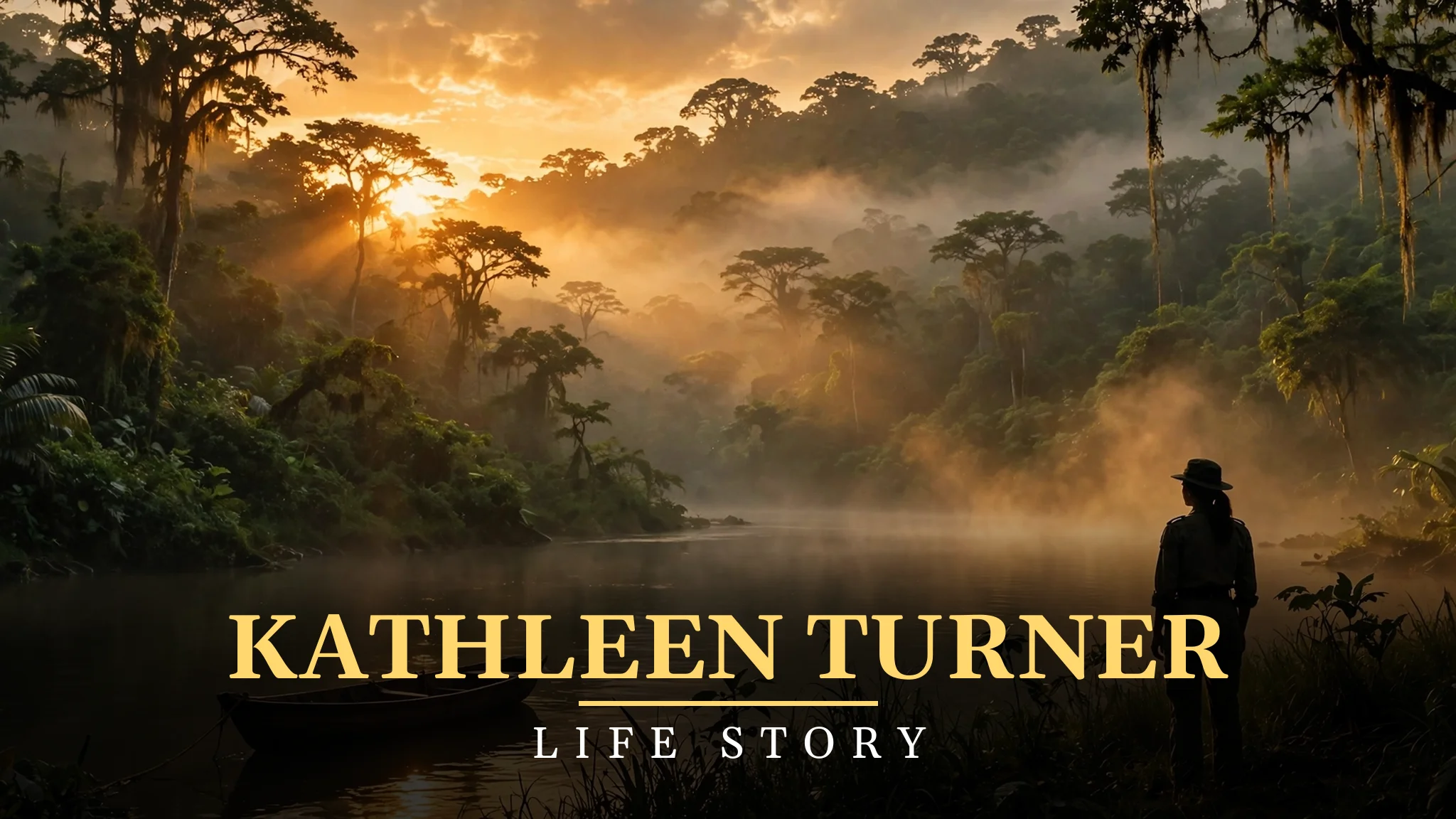
One more thought stays with me. When I picture her, I picture the jungle river in the image for this story: a woman in a hat, standing on a misty riverbank at sunrise, looking out over calm water, with a small boat waiting nearby. That is a good picture of her life, because she has always been an adventurer, looking out at the world with courage, and ready to take the boat, even when she does not know where the river will lead.
I also think about The Accidental Tourist, because it shows a warm side of her that people sometimes forget. She plays Muriel Pritchett, a dog trainer who falls in love with a grieving travel writer, and she plays the part with a humour and a heart that makes the film work. It is a very different role from Matty Walker in Body Heat, and it proves that she was never just a femme fatale. She could play a warm, loving woman, and she could make the audience believe in her. I think that range is one of her greatest strengths, and it is why she lasted so long.
Another thing I notice is Serial Mom, because it is such a strange and brave choice. She plays Beverly Sutphin, a perfect suburban mother who is secretly a killer, and she plays the part with a bright, cheerful manner that makes the character even more disturbing. Most stars would never take a role like that, because they would worry about their image. Turner took it, and she made it funny, shocking, and unforgettable. I love that she was willing to take risks, even when they were strange. She did not care about looking perfect. She cared about doing interesting work.
I think about her stage work as well, especially Who’s Afraid of Virginia Woolf?, where she played Martha, one of the hardest roles in American theatre. Martha is fierce, funny, and painful, and Turner played her with a depth that came from her own life. She was in pain, she had faced illness, and she brought that pain to the role. Her performance earned her a Tony nomination, and it proved that she was still one of the finest stage actresses in America. I think the stage saved her career, because it cared about her talent, not about her body, and she gave the stage everything she had.
When I think about her role in Friends, as Chandler’s father, I feel a deep admiration for her courage. It was a small role, but it was a bold one, and she played it with humour and warmth. She was not afraid to play a character that challenged audiences, and she was not afraid to be funny. That willingness to surprise people is part of what makes her great. She never settled into one easy image. She kept trying new things, even when they were difficult, and she did them well.
I also think about her work as a teacher, because it shows that she cares about the next generation. She teaches young actors that acting is about truth, about listening, and about being brave enough to show who you really are. That is a beautiful lesson, and it comes from a woman who has lived it. She has been brave in her work, she has been brave in her life, and she has told the truth about her illness, her career, and her struggles. I think that honesty is her greatest gift, and it is why people still love her, and why they will keep loving her.
I also think about The Perfect Family, because it shows a warm side of her that people sometimes forget. She plays Eileen Cleary, a Catholic mother who tries to win a prize for the perfect family, even as her own family falls apart, and she plays the part with a humour and a heart that makes the character feel real. It is a beautiful performance, and it shows that she could still lead a film in her fifties. She was not a young star anymore. She was a mature woman, and she played the part with the same honesty she had brought to all her best work. I think that is a wonderful thing. She did not try to play young women forever. She played her age, and she played it well.
Another thing I notice is her one-woman show, Finding My Voice, which she toured in 2018 and 2019, singing songs and telling stories from her life. It is a joyful show, and it shows that she can still command a stage, still sing, and still make an audience laugh and cry. She is in her sixties, and she is still learning, still growing, and still finding new ways to perform. That is a remarkable spirit. Most people slow down as they get older. Turner found a new stage, and she filled it with her voice, her stories, and her truth. I love that about her. She never stops, and she never gives up.
Frequently Asked Questions
Where was Kathleen Turner born and where did she grow up?
Kathleen Turner was born on 19 June 1954 in Springfield, Missouri, the daughter of a diplomat in the United States Foreign Service. She grew up in many places, including Cuba, Venezuela, and London, learning to adapt to new countries and new people.
What was Kathleen Turner’s first film?
Her first film was Body Heat in 1981, where she played Matty Walker, a beautiful and dangerous married woman. She had never appeared in a film before, but her confident performance made her a star overnight.
Who did Kathleen Turner play in Romancing the Stone?
In Romancing the Stone from 1984, she played Joan Wilder, a shy romance novelist who travels to Colombia to rescue her sister and falls in love with an adventurer played by Michael Douglas. She returned to the role in The Jewel of the Nile in 1985.
Was Kathleen Turner nominated for an Oscar?
Yes, she was nominated for Best Actress for Peggy Sue Got Married in 1986, playing a woman who travels back in time to her high school years. She also won a Golden Globe for Prizzi’s Honor in 1985.
Did Kathleen Turner voice Jessica Rabbit?
Yes, she provided the voice of Jessica Rabbit in Who Framed Roger Rabbit in 1988, though she was not credited for the role at the time. Her low, smoky voice became one of the most famous in animation.
What illness does Kathleen Turner live with?
She was diagnosed with rheumatoid arthritis in the early 1990s, a painful disease that affects the joints and changed her body and her career. She has spoken openly about it and became an advocate for people living with arthritis.
What stage roles has Kathleen Turner played?
She has played many major stage roles, including Maggie in Cat on a Hot Tin Roof, Martha in Who’s Afraid of Virginia Woolf?, and Mrs. Robinson in The Graduate. The stage gave her a new life after Hollywood offered her fewer film roles.


