Kazunari Ninomiya: The Life Story Behind Arashi's Actor
In this post
- A Tokyo Childhood and a Mother’s Choice
- Arashi and a Debut at Sixteen
- Yamada Taro and the Actor Who Could Make You Laugh and Cry
- Letters from Iwo Jima and Working with Clint Eastwood
- Gantz, Later Films, and a Film Actor at His Peak
- Marriage, Family, and a Life Kept Private
- The Actor He Is Today
- Gaming, YouTube, and a Star Who Plays for Fun
- My Take:
Kazunari Ninomiya is a star who has always been a little different from the other members of Arashi, and that difference is his strength. He is quiet, he is funny in a dry way, he is clever, and he is a serious actor who has worked with some of the greatest directors in the world. He can sing and dance with Arashi in front of tens of thousands of people, and he can also play a soldier on a small island in a film by Clint Eastwood, and he can make both feel true. That range, from pop idol to film actor in a Hollywood war film, is rare, and it is the reason his name is respected by people who know acting, not only by fans who love Arashi.
He started as a boy in Johnny’s, he debuted with Arashi when he was sixteen, and he became known as an actor through television dramas and films that showed he could be funny, sad, and serious, often in the same role. He has played a poor student, a soldier, a detective, a father, and many other kinds of men, and he has made each one feel like a real person. He is not a star who depends on being liked. He depends on being believed, and audiences have believed him for more than twenty-five years.
This is the story of Kazunari Ninomiya, a boy from Tokyo who became a member of Arashi and a film actor, and a look at how a quiet, clever performer can build a career that is respected around the world.
A Tokyo Childhood and a Mother’s Choice
Kazunari Ninomiya was born on 17 June 1983 in Tokyo, Japan. He grew up in a normal family in Tokyo, and he was a lively boy who liked to play and to make people laugh. He was not yet thinking of a career in entertainment. He was living a normal life, going to school, spending time with friends, and enjoying the city around him. But he had a face that stood out, and he had a natural way of being funny and clever that other people noticed.
When he was twelve, his mother sent his application to Johnny’s, the talent agency that made many of Japan’s biggest male stars, without telling him. That application changed the direction of his life. Joining Johnny’s as a junior is a big step for a young boy. It means long rehearsals, early mornings, and a life built around training, but it also means a chance to learn from the best, to perform on stage, and to build a career in music and acting. Ninomiya took that step, and he took it with a humour and a cleverness that people around him noticed. He was not a boy who was playing at being a star. He was a boy who wanted to work, and who was willing to learn.
As a Johnny’s Jr, Ninomiya spent his days rehearsing, dancing behind older stars, and taking small acting jobs whenever they came. It was not glamorous work. It meant waiting in corridors, practising the same steps again and again, and learning to be patient while other people were on stage. Many boys left during those years, because the wait felt endless. Ninomiya stayed, because he liked the work itself, the music, the movement, and the feeling of being part of a group that was trying to get better. He also liked making people laugh, and he found that even in rehearsals, a joke at the right moment could lift everyone’s spirits. That humour became part of his reputation, and it stayed with him for the rest of his career.
He also made close friends with other Johnny’s boys, including the four other boys who would later become Arashi with him. Those friendships mattered, because they gave him people who understood his life, who knew what it felt like to wait, to rehearse, and to be judged. They also gave him a team, and that team would become one of the most successful groups in Japanese history. Ninomiya did not know that then. He was a boy learning to sing and dance, and he was doing it with care and with humour.
Arashi and a Debut at Sixteen
In 1999, Ninomiya became one of the five boys in Arashi, a new group put together by Johnny’s. The other four were Satoshi Ohno, Sho Sakurai, Aiba Masaki, and Jun Matsumoto, and together they sang bright, cheerful songs that soon filled concert halls and television screens across Japan. Ninomiya’s part in the group was easy to spot once you knew him: he was the quick talker, the one with a dry joke, the one who could make the others laugh in the middle of a rehearsal. Fans loved that side of him, because it made Arashi feel like a group of real friends, not like five strangers standing in a line.
He was sixteen when the group began, and sixteen is a strange age to become famous. One day you are a schoolboy, and the next day your face is on posters, your songs are on the radio, and thousands of people are singing along with you. Ninomiya handled that change with humour. He did not pretend to be a perfect idol. He joked, he teased his fellow members, and he stayed himself, and fans loved him for it. He also worked hard at the singing and the dancing, because a pop group lives or dies by its stage show, and Ninomiya took that work seriously, even when he was making jokes about it.
Over the years Arashi grew into something much bigger than a pop group. They hosted their own television programmes, they sang at the year-end Kohaku show, they sold millions of records, and they became a part of daily life in Japan, like a favourite television show that everyone watches. Ninomiya was in the middle of all of it, singing, dancing, hosting, and acting, and he was also building a separate life as a film actor. Doing both at once meant very long days, and very little rest, but he managed it by being organised and by loving both kinds of work, the music and the acting, in different ways.
The five members stayed together for more than twenty years, and in that time they became close in a way that only people who share a life can be. They knew each other’s habits, each other’s jokes, and each other’s worries, and they looked after each other when the work was hard. When the group stopped performing together at the end of 2020, it was the end of a chapter that had lasted most of Ninomiya’s adult life. He did not mourn it in public. He moved on to film and television, and to his gaming channel, and he showed that he could stand on his own, without the group behind him, just as he had stood on his own as a film actor in Letters from Iwo Jima years before.
Yamada Taro and the Actor Who Could Make You Laugh and Cry
In 2007, Ninomiya starred in Yamada Taro Monogatari, a television drama about a high school boy who is poor, who has many younger siblings, and who pretends to be rich at school. The drama was funny and warm, and it asked Ninomiya to play a boy who is kind, who is clever, and who is trying to look after his family while keeping a secret. He played the part with a humour and a warmth that made audiences love him, and the drama was a success. It showed that he could be a leading man in a comedy, and that he could make people laugh and cry in the same episode.
The drama was important because it showed Ninomiya’s range. He could be funny, he could be sad, and he could be serious, all in one role. He did not play Yamada Taro as a simple funny boy. He played him as a real person, a boy who is poor, who is responsible, and who is trying to do the best he can for his family. That honesty made the drama work, and it made Ninomiya a star in his own right, not only as a member of Arashi.
He also appeared in other dramas in those years, including dramas about school, work, and family, and he played each role with the same clever, honest style. He played a teacher, a student, a lover, and a man in trouble, and he made each one feel real. That range is rare, and it is one of the reasons his career kept growing. Directors could cast him in many kinds of stories, because he did not bring the same face to every role. He brought a different person each time, and he made that person believable.
During those years he also worked in films, and his film roles showed that he could handle stories that were more serious and more adult than television dramas. He played characters who were in trouble, who were sad, or who were trying to find their place in the world, and he played them with an honesty that made audiences take notice. That range, from a funny schoolboy to a serious film character, showed directors that he was not limited to one kind of role.
Letters from Iwo Jima and Working with Clint Eastwood
In 2006, Ninomiya took a step that few Japanese actors ever take. He appeared in Letters from Iwo Jima, a film directed by the American director Clint Eastwood, about Japanese soldiers on the island of Iwo Jima during the Second World War. The film tells the story from the Japanese side, and it is a serious, sad, and deeply human look at war. Ninomiya played Saigo, a young soldier who is a baker in civilian life, who is sent to the island, and who tries to survive while watching his friends die around him.
Working with Eastwood is a mark of trust. Eastwood is a director who has worked with some of the best actors in the world, and he does not cast a young actor in a film like Letters from Iwo Jima unless he believes he can hold his own. For Ninomiya, the experience meant working on a large international production, with actors from Japan and America, and with a director whose way of working is careful and exact. It also meant that people outside Japan began to learn his name. A film by Eastwood is watched all over the world, and even a supporting role in it can change an actor’s life.
Letters from Iwo Jima was not a light film, and it was not a commercial hit in the usual sense. It was a film that asked a lot of its audience, and it asked a lot of its actors. Ninomiya’s part was central, and he carried it with a quiet, honest performance that made Saigo feel like a real person, not like a symbol. He showed Saigo’s fear, his love for his family, his wish to live, and his sadness at the war around him, and he did it without overacting. The film was praised by critics around the world, and it was nominated for Academy Awards, and Ninomiya’s performance was part of the reason it was loved.
The film also changed his career in Japan. He was no longer only a member of Arashi who acted. He was an actor who had worked with Clint Eastwood, and that changed how directors and producers saw him. It also changed how he saw himself. He had proved that he could stand on a world stage, and after that, the choice of what to do next mattered even more. He could have chased Hollywood roles, but he stayed close to Japanese film and television, where the stories he cared about were being told.
Gantz, Later Films, and a Film Actor at His Peak
After Letters from Iwo Jima, Ninomiya continued to work in films that showed his range. In 2011, he starred in Gantz, a science fiction film based on a manga, about a group of people who are brought back to life and forced to fight aliens. The film was action-packed, strange, and full of special effects, and it was very different from Letters from Iwo Jima. Ninomiya played Kei Kurono, a young man who is selfish at first, and who slowly learns to care for other people, and he played the part with an energy that made audiences root for him. The film was a success, and it had a sequel, and it showed that he could be an action star as well as a serious actor.
He also appeared in films such as The Tale of Iya, a film about a man who lives in a remote valley, and other stories that dealt with serious, adult themes. He played characters who were in trouble, who were sad, or who were trying to find their place in the world, and he played them with the same quiet, honest style that had always been his. His film work gave him a chance to reach audiences in cinemas, and it gave him a place among young film actors in Japan.
In later years he appeared in films such as The First Gentleman, and in dramas that dealt with family, work, and the lives of adults in Tokyo. He played a father, a husband, a worker, and a man in trouble, and he made each one feel real. That growth felt natural, because Ninomiya himself was growing up in public, and his audience was growing up with him. A star who grows with his audience can last a long time, and Ninomiya has done that.
He also worked as a narrator and as a presenter, using his voice in new ways, and he became a familiar voice on Japanese television. His clever, dry humour made him a popular guest on variety shows, where he could make people laugh with a single line. That humour is part of who he is, and it is why audiences love him. He is not a star who tries to be funny all the time. He is funny in a quiet, clever way, and that humour makes his serious roles feel even more real, because you know the man behind them can laugh.
Marriage, Family, and a Life Kept Private
In 2019, Ninomiya married a former television announcer, and the news was shared in a simple and quiet way. The couple have since welcomed children, and they have kept the details of their family life to themselves, as many Japanese stars do. Ninomiya has always been careful about his private life, and he has done it by staying quiet about his personal relationships and by focusing on his work. That privacy is a choice, and it is a wise one, because it lets people talk about his acting rather than about gossip.
Balancing a busy career with a family is hard for any actor, and it is harder still for a star as busy as Ninomiya. He has worked in film, television, and music, all at once, for many years, and adding a family to that life means making choices about time, about rest, and about what matters most. Ninomiya has made those choices in his own way, taking work that fits his life and his values, and stepping back when he needs to. That patience is part of his character, and it shows in the way his career has lasted without burning out.
His marriage also changed how people see him, in a small way. He is no longer only the clever young man from Arashi. He is a husband and a father, and a working actor who is building a life as well as a career. That change is normal, and it is also important, because it shows that a star can grow up in public without losing himself. Ninomiya has grown up in public, from a Johnny’s Jr to a married actor and father, and he has done it without scandal, without noise, and without losing the dry humour that made people notice him in the first place.
He has also faced the challenge of Arashi going on hiatus at the end of 2020. After more than twenty years together, the group stopped performing as a group, and each member began to work on his own. For Ninomiya, that meant the end of a chapter that had defined his whole adult life, and the start of a new chapter in which he must stand alone as an actor. He has handled that change with grace, by taking on film and television roles, and by showing that he can carry a story on his own, without the group behind him.
The Actor He Is Today
Today, Kazunari Ninomiya is one of Japan’s most respected actors, and his name is linked with Arashi, with Letters from Iwo Jima, with Gantz, and with many other films and dramas. He started as a boy in Johnny’s, debuted with Arashi at sixteen, became famous as Yamada Taro, and grew into a film actor who worked with Clint Eastwood. He did all of that while growing up in public, and while keeping his private life private. That is a remarkable career for someone still in his forties.
His legacy is still being written, because he is still working and still taking on new roles. But even now, his story has a clear shape. It is a story about a boy whose mother sent his application to Johnny’s, who debuted in a pop group, who became famous through a school drama, and who then built a career on serious, honest film work. It is a story about patience, about hard work, and about the idea that a career built slowly can last longer than a career built in a single moment.
For young actors in Japan, he is a useful example. He shows that a pop idol can become a serious film actor, that a school drama can be a real beginning, and that a role in a Hollywood film can be a second beginning. He also shows that a person can be famous and still keep a private life, and that a career can grow slowly and still reach a high place. Kazunari Ninomiya did not rush. He built his name step by step, and that is why his name still means something today.
He also stands for a kind of Japanese acting that is quiet, clever, and honest. His performances do not shout. They are focused, they are thoughtful, and they feel true. That quietness is his strength, and it is why audiences trust him. When he is sad on screen, you believe the sadness. When he is funny, you believe the humour. That trust is the most valuable thing an actor can earn, and Ninomiya has earned it over twenty-five years of work.
Gaming, YouTube, and a Star Who Plays for Fun
Ninomiya is known as a keen gamer, and that love of games is a real part of who he is, not a hobby he hides. He has talked about games in interviews, he has played them with friends, and he has shared his love of gaming with fans in a way that feels honest and fun. In 2020, he opened a YouTube channel with other Johnny’s members, a channel where they play games, talk, and show a relaxed, funny side of themselves that fans do not see on television. The channel became popular, because it showed Ninomiya as he really is: clever, funny, and a little competitive, playing games with friends and laughing at himself when he loses.
Gaming matters in his story because it shows a different side of fame. On television, a star must be polished, must be on time, and must give a good performance. On a gaming channel, a star can be relaxed, can make mistakes, and can laugh about them. Ninomiya does that, and fans love him for it. They see a person who is not trying to be perfect, who is just playing a game with friends, and that honesty makes him feel close, not distant. It is a kind of fame that is built on being yourself, not on being a perfect image.
The channel also gave him a new way to connect with fans after Arashi went on hiatus. When the group stopped performing together, fans worried that they would not see the members any more. Ninomiya’s channel gave them a place to see him, to hear him talk, and to watch him play, even when he was not in a drama or a film. That connection matters, because it keeps a star close to his audience, even when his work changes. It also shows that Ninomiya understands how fans feel, and that he wants to stay in touch with them in a simple, honest way.
Gaming also fits his personality. He is clever, he likes to think, and he likes to solve problems, and games ask for all of those things. A game is a puzzle, a challenge, and a story, and Ninomiya plays it with the same care he brings to acting. He does not play to show off. He plays to have fun, to learn, and to spend time with friends. That attitude is part of who he is, and it is why his gaming work feels true, not like a marketing trick. It is a hobby that became a part of his career, and it has made his career richer and more human.
My Take:
I think Kazunari Ninomiya is one of the most interesting actors in Japan, because he is quiet, clever, and serious, all at the same time. When I look at his career, I do not see a star who is trying to be loved by everyone. I see a star who is trying to be true, and who trusts that audiences will love the truth. That is a brave way to work, because it means you do not chase popularity. You chase good work, and you trust that popularity will follow. Ninomiya has done that, and popularity has followed him, in Arashi, in television, and in film. I admire that, because it shows a person who knows what matters, and who does not let fame change him.
I think about his mother sending his application to Johnny’s without telling him, and I find that story both funny and moving. A mother who believes in her son, who sees something in him that he does not yet see in himself, and who takes a chance on his behalf: that is a beautiful thing. I imagine Ninomiya at twelve, learning that he had been entered into an audition, and feeling surprised, nervous, and maybe a little excited. I think that moment changed his life, and I think he owes a great deal to his mother for seeing what he could become. It also makes me think about how important family is, even for a famous person. A mother who believes in you can change your whole life.
Letters from Iwo Jima is the film I think about most, because it is a film about war, about soldiers on a small island, and about a young man who is a baker in civilian life and who tries to survive. Ninomiya played Saigo as a real person, not as a hero, and he showed Saigo’s fear, his love for his family, and his wish to live. I think about what it must have been like for him to work with Clint Eastwood, a director with such a long history, and to be trusted with a central role in a film about war. That trust is a mark of respect, and Ninomiya earned it. He did not play Saigo as a loud hero. He played him quietly, with an honesty that made audiences feel his fear and his hope. That is a performance that will be remembered for a long time.
Yamada Taro Monogatari is another drama I think about, because it is funny and warm, and Ninomiya played a boy who is poor, who has many siblings, and who pretends to be rich at school. I think about what it must have been like for him to play a character who is kind, clever, and responsible, and to make audiences laugh and cry in the same episode. He did it well, because he understood Yamada Taro. He understood that the boy is not a joke. He is a real person, trying to look after his family while keeping a secret, and he deserves to be played with respect. That respect made the drama work, and it made Ninomiya a star in his own right.
Gantz is a film that surprises me, because it is so different from Letters from Iwo Jima. It is a science fiction film, full of action and special effects, and Ninomiya played Kei Kurono, a young man who is selfish at first and who slowly learns to care for other people. I think about how hard it must have been for him to change from a quiet soldier to a loud action hero, and I think he did it well. He showed that he could be physical, that he could be angry, and that he could carry an action film. That range is rare, and it is one of the reasons his career has lasted. He is not only a serious actor. He is an actor who can do many things, and he does them all with care.
What I learn from him is that quiet can be strong. I think many young people believe that to succeed, you must be loud, or funny, or charming, or beautiful. Ninomiya shows that you can succeed by being quiet, by being clever, and by giving honest performances again and again. That quietness is not a weakness. It is a strength, because it means that directors trust you with hard roles, and audiences trust you to tell the truth. I think that lesson matters, especially for young actors who think they must change themselves to be liked. Ninomiya did not change himself. He stayed quiet and clever, and he let his quietness be his strength.
I also learn from him that a pop idol can become a serious film actor. I think many people believe that a pop star cannot be a serious actor, and that an actor cannot be a pop star. Ninomiya proves that belief wrong. He was a pop star, and he became a serious actor, and he did it by taking his acting seriously, by choosing good roles, and by working hard at his craft. He did not treat acting as a side job. He treated it as a real career, and he gave it his full care. That respect for acting is what made him a good actor, and it is what made audiences trust him.
I do feel a little worry for him, because he has worked for so long, in two careers at once, and that is a long time to work. I hope he rests, I hope he takes time for his family, and I hope he does not feel that he must always be working to be valued. He has already proved himself many times over. He does not need to prove himself again and again. I hope the people around him give him space to rest, and I hope he takes that space when he needs it. A tired actor cannot give his best work, and Ninomiya has always given his best work. He deserves rest as much as he deserves praise.
In the end, I think Kazunari Ninomiya matters because he shows that an actor can be quiet and still be heard. He is a serious actor, a funny man, a member of Arashi, and a film star, and he does each one with care. He has played a soldier, a schoolboy, a detective, and a father, and he has made each one feel real. I will keep watching his work, and I will keep expecting him to be honest, because honesty is what he has always given us. That is my take on him, and it is a take I feel with real respect and warmth.
I want to finish with a thought about Arashi, because I think the group matters in his story. Five boys, working together for more than twenty years, becoming one of the most loved groups in Japanese history: that is a beautiful thing. I imagine Ninomiya looking back on those years, on the concerts, on the television shows, on the fans, and feeling proud. I hope he keeps that pride, and I hope he keeps the friendships he made in Arashi, because those friendships are a gift. That image, of five young men singing together on a stage, is the image I will keep when I think of Kazunari Ninomiya. It is a simple image, and it is a true one, and it explains a great deal about who he is.
I also think about his gaming channel, and I think it deserves more praise than it usually gets. A star who plays games on YouTube, who laughs at himself, who makes mistakes, and who shows a relaxed side of himself, is a star who trusts his fans. Ninomiya trusts his fans, and they trust him in return. I think that trust is a beautiful thing, because it shows that fame does not have to be distant. It can be close, it can be funny, and it can be human. When I watch him play a game, I do not see a perfect star. I see a real person, having fun with friends, and that is a kind of fame that I admire.
There is something else I notice about him, and it is the way he has balanced a pop career and a film career for so long without letting either one take over. Many stars choose one and leave the other behind. Ninomiya kept both, and he gave both his full care. He sang with Arashi, he acted in films, and he played games on YouTube, all at the same time, and he did each one well. That balance is rare, and it is a strength. It shows a person who is organised, clever, and serious about his work in all its forms. I think young people who want to do more than one thing can learn from him: you do not have to choose one talent. You can do many, if you work hard at each one.
I also wonder what he will do next, now that Arashi is on hiatus and he is standing alone as an actor. I hope he plays more soldiers, more fathers, more men in trouble, and many other kinds of people, and I hope he keeps the quiet, clever style that has always been his. I think he will, because he has always let his roles grow with him, and he has never tried to freeze himself at one age. That willingness to grow is a sign of a smart actor, and it is a sign of a person who knows who he is. I will be watching his next roles with interest, and I will be hoping for the best for him.
One more role stays with me about Ninomiya, and it is the surgeon in Black Pean, a drama about a doctor who is brilliant, arrogant, and feared by everyone in his hospital. That is a difficult character, because the audience must respect him even when he is being rude, and Ninomiya made them respect him by showing the skill underneath the arrogance. He played the surgeon as a man who knows he is the best, who does not suffer fools, and who still cares about saving lives, even when he will not say so. I think that role showed a colder, sharper side of him, a side that Yamada Taro and Saigo do not show, and it proved that he can be unlikeable and still be watched. A leading man who can be cold and still be loved is a rare thing, and Ninomiya is one of them.
I also keep thinking about the way he uses silence in his films. In Letters from Iwo Jima, there are scenes where Saigo says nothing, where he only looks at the sea, or at a photograph of his family, and you can feel everything he is feeling without a single word. Ninomiya plays those silences with a stillness that is hard to learn. Most actors fill silence with movement or with talk, because silence feels frightening. Ninomiya lets the silence sit, and he trusts the audience to feel it with him. That trust is the heart of his acting, and it is why his war film feels so human. He does not shout his way to the truth. He lets the quiet do the work, and that is a beautiful way to act.
I also think about his gaming channel, and about what it says about him. A star who plays games on camera, who loses, who laughs at himself, and who lets fans see him being ordinary, is a star who is not afraid to be himself. Ninomiya is not afraid. He knows that fans love him for who he is, not for a perfect image, and he trusts them enough to show them the ordinary parts of his life. I think that trust is beautiful, and I think it is rare. Many stars hide their hobbies, because they think fans will judge them. Ninomiya shares his, and fans love him more for it. That is a lesson in honesty, and it is one that more stars should learn.
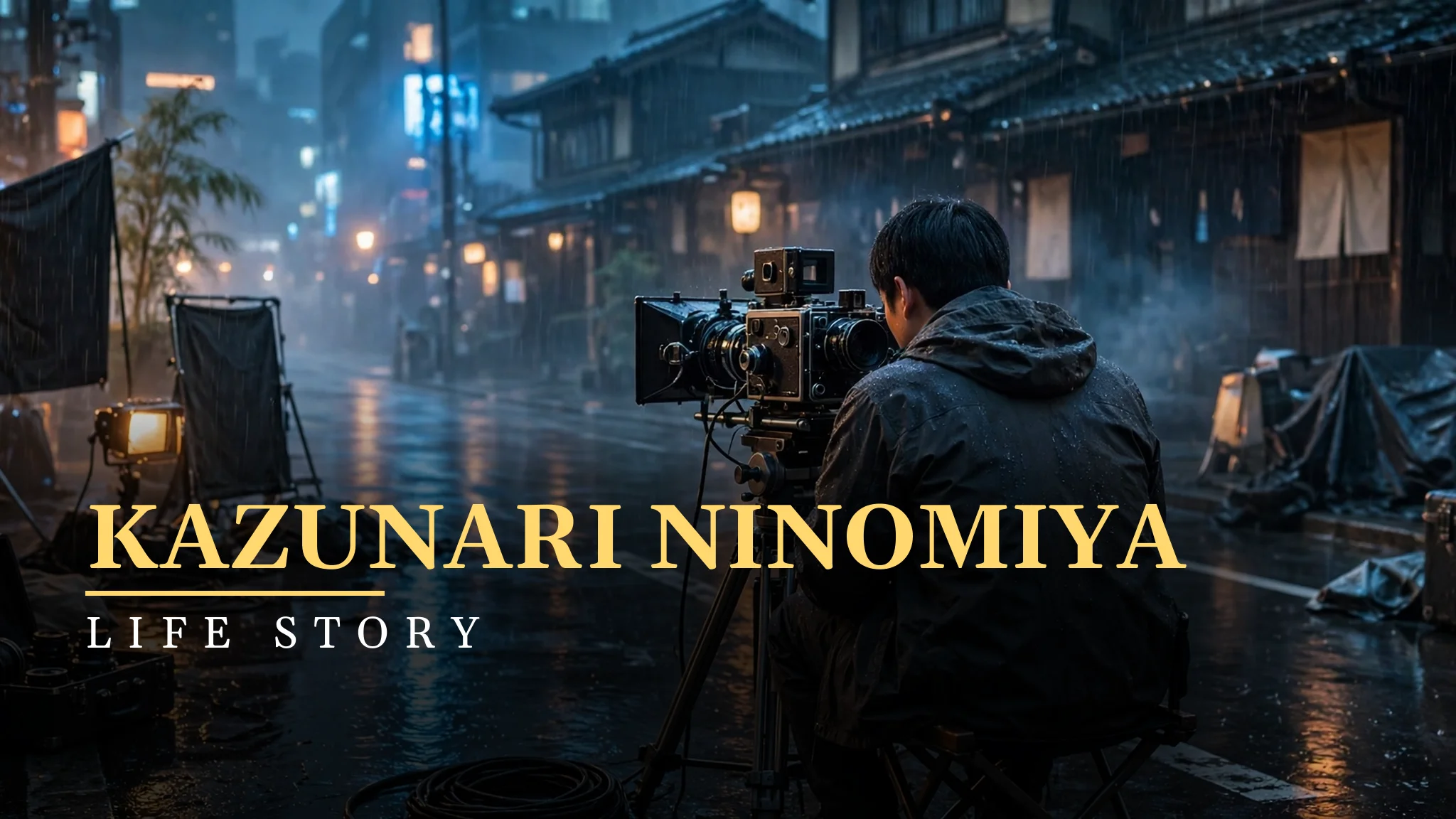
And I think about the rainy street in his cover image, the man crouching behind a film camera at night, with lights and equipment around him, and I think it fits him in a way I did not expect. He is a person who loves the work behind the camera as much as the work in front of it, who understands that a film is made by people standing in the rain, being patient, and caring about a story. He is not only an actor. He is a worker, a gamer, a father, and a man who loves his craft. I will be watching his next film, and I will be hoping it is as honest as Saigo was, because honesty is what he has always given us.
I also keep thinking about the way Ninomiya protects his private life, and about how hard that is for a man as famous as he is. He married in 2019, he became a father, and he told the public almost nothing about it. No photographs, no long interviews, no details about his children. Some stars share everything, because they think fans demand it. Ninomiya shares almost nothing, because he believes his family is not part of the show. I think that boundary is wise, and I think it is brave, because it means saying no to a public that wants to know everything. His fans have respected that boundary, and that respect says something good about them too: they love his work, and they do not demand his home life in return. That is a healthy kind of fame, and I hope more stars learn to draw that line.
And I think about the way he plays games to rest, and about what that says about a man who spends his days being other people. Acting is hard work. It means long hours, heavy emotions, and a camera watching your face all day. After a day like that, most actors go home and try to forget the role. Ninomiya goes home and plays a game, where he can be himself, where he can lose, where he can laugh at his own mistakes, and where nobody is judging his performance. I think that is a healthy way to rest, and I think it is one of the reasons he has stayed sane in a business that breaks many people. He knows who he is when the cameras are off, and he protects that person. That is a kind of wisdom, and it is one I admire.
Frequently Asked Questions
When was Kazunari Ninomiya born?
Kazunari Ninomiya was born on 17 June 1983 in Tokyo, Japan, and his mother sent his application to Johnny’s when he was twelve.
When did Kazunari Ninomiya debut with Arashi?
He debuted as a member of Arashi in 1999, when he was sixteen, along with Satoshi Ohno, Sho Sakurai, Aiba Masaki, and Jun Matsumoto.
What role did Kazunari Ninomiya play in Letters from Iwo Jima?
He played Saigo, a young soldier who was a baker in civilian life, in Letters from Iwo Jima in 2006, directed by Clint Eastwood.
Did Kazunari Ninomiya star in Yamada Taro Monogatari?
Yes, he played Yamada Taro in 2007, a poor high school boy with many siblings who pretends to be rich at school.
Did Kazunari Ninomiya star in Gantz?
Yes, he played Kei Kurono in Gantz in 2011, a science fiction film based on a manga about people forced to fight aliens.
Is Kazunari Ninomiya married?
Yes, he married in 2019, and the couple have since welcomed children, while keeping their family life mostly private.
What kind of actor is Kazunari Ninomiya known as?
He is known as a quiet, clever, and versatile actor who has played soldiers, schoolboys, detectives, and fathers across film and television.


