Kendji Girac: The Life Story Behind France's Gypsy Pop Star
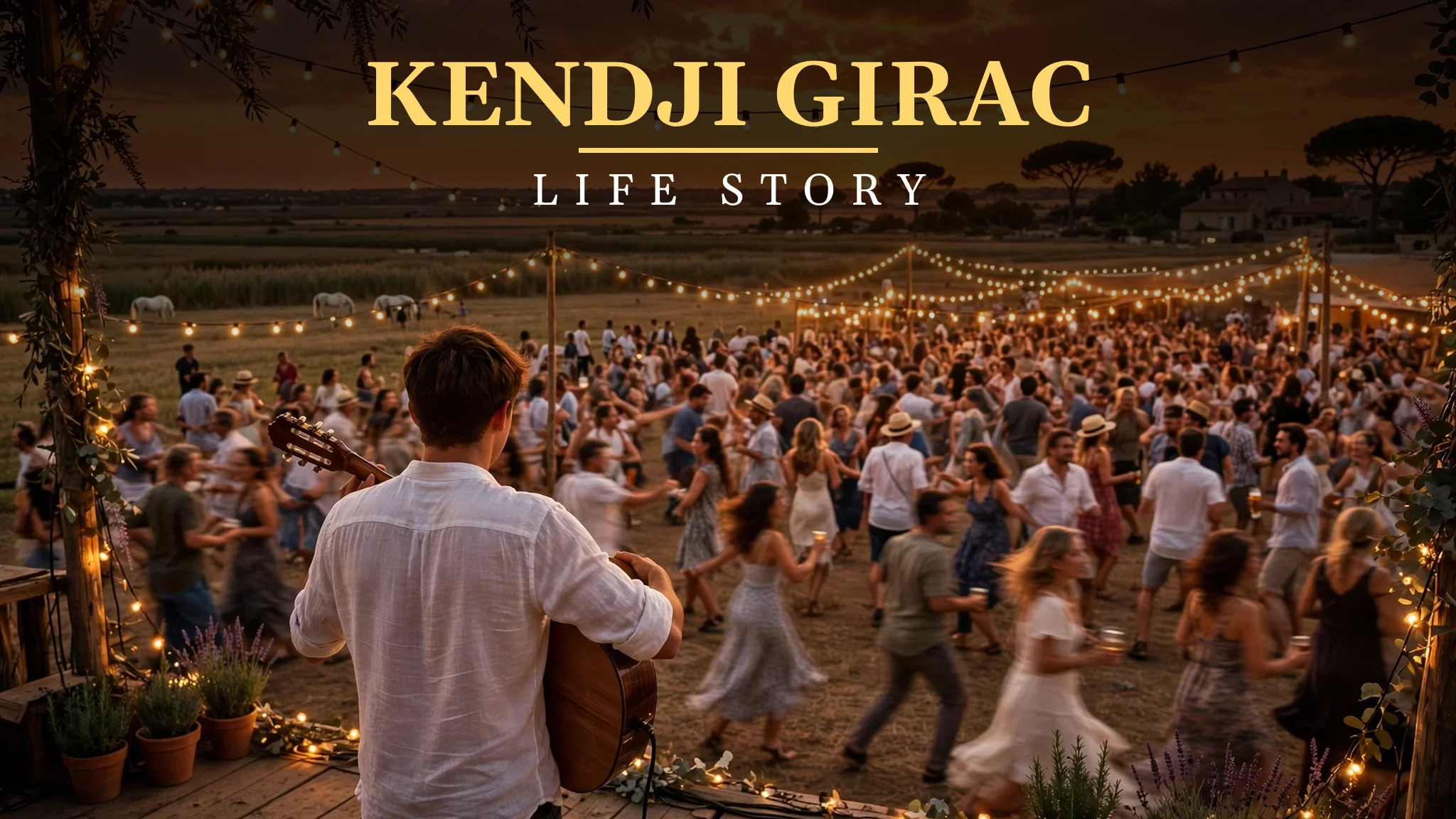
In this post
There are voices that sound like they come from a single place, and there are voices that sound like they come from a whole world of travel, family, and tradition. Kendji Girac has one of the second kind. When he sings, you can hear the guitars of the gypsy camps of southern France, the rhythms of Spain, the melodies of Latin America, and the energy of modern French pop, all mixed together in a way that feels natural and joyful. He does not sing like a person who learned music from a book. He sings like a person who learned it from his family, around a fire, with a guitar in his hands.
He was born in Périgueux, in the Dordogne region of south-west France, into a Catalan gypsy family, and music was part of his life from the day he was born. He learned to play the guitar as a boy, he sang with his family, and he grew up in a community where music was not a hobby but a way of living together. When he won The Voice in France in 2014, at the age of seventeen, he became a star overnight, but he was not a beginner. He was a young man who had been playing music for most of his life.
This is the story of how a boy from a travelling community became one of the best-selling singers in France, and how he carried his heritage with him onto the biggest stages in the country. It is a story about family, about tradition, about a voice that makes people dance, and about the hard parts of fame that came with the success. It is also a story about a young man who had to grow up very fast, in front of millions of people, and who is still finding his way.
A Childhood in a Gypsy Family
Kendji Girac was born on 3 July 1996 in Périgueux, a town in the Dordogne region of south-west France, into a Catalan gitano family. The gitano community, part of the wider Romani people, has a long and proud musical tradition, and Kendji grew up inside it. His family lived in caravans, moving from place to place, and music was at the centre of their life. In the evenings, the family would gather around a fire, someone would take out a guitar, and the songs would begin. For a child growing up in that world, music was not something you learned at school. It was something you breathed.
His grandfather was a guitarist, and he taught Kendji to play when the boy was still very young. Kendji learned the gypsy guitar style, with its fast and passionate runs, its rhythms that make people clap and dance, and its melodies that carry both joy and sadness. He practised for hours, and he played with his uncles, his cousins, and his friends. He also learned to sing, and his voice had a warmth and a power that made people stop and listen, even when he was only a boy.
Life in a travelling family was not always easy. The family moved often, the money was not always there, and the world outside the community did not always treat gypsy families with kindness. Kendji has spoken about the prejudice his people have faced, and about the pride he feels in his heritage. He grew up knowing that he was different from the other children at school, and he learned to be proud of that difference rather than ashamed of it. His family gave him a strong sense of who he was, and that sense has stayed with him through all the years of fame.
School was a part of his life, but music was always the bigger part. He left school early to work and to play music, and he spent his teenage years playing at weddings, at parties, and at family gatherings. He was already a musician, earning his living with a guitar, before most boys his age had even thought about what they wanted to do with their lives. Those years gave him a skill that no school could teach: the ability to play for real people, in real moments, and to make them happy.
The Voice and a Star Is Born
In 2014, when Kendji was seventeen, he auditioned for the third season of The Voice in France. He walked onto the stage with his guitar, and he sang “Bella” by the artist known as Maître Gims, in a version that mixed French pop with gypsy guitar. The coaches turned their chairs, and he joined the team of the singer Mika. Week after week, he sang songs that showed off his voice, his guitar, and his heritage, and the audience fell in love with him.
The Voice is a competition, and every week brings the risk of going home, but Kendji seemed to grow stronger with each performance. He sang with a joy that was infectious, and he played his guitar with a skill that impressed even the coaches. He was young, he was charming, and he was different from every other singer on the show. The viewers saw a boy from a gypsy family, singing with his whole heart, and they voted for him in huge numbers. In May 2014, he won the competition, becoming the youngest winner of The Voice in France at that time.
Winning The Voice changed his life in a single night. Before the show, he was a young guitarist playing at family parties. After the show, he was a national star, with a record contract, a team of managers, and millions of people who knew his name. The change was sudden and overwhelming, and he had to learn to live with fame while he was still a teenager. He did it with the help of his family, who stayed close to him, and with a humility that impressed everyone who met him.
The victory also meant something for his community. For the gypsy families of France, seeing one of their own win the biggest singing show in the country was a moment of pride. Kendji became a symbol of what a young person from a travelling family could achieve, and he carried that responsibility with him. He did not hide his background. He celebrated it, and he made it part of his music, his image, and his story.
Color Gitano and a Record-Breaking Debut
After winning The Voice, Kendji released his first single, “Color Gitano”, in 2014, and it became a huge hit. The song was a celebration of his heritage, with a joyful rhythm, a catchy chorus, and a guitar that danced through the whole track. It was a song that made people want to dance, and it was played on radios, in cars, and at parties across France. It was the perfect first single for a young singer who wanted the world to know who he was and where he came from.
His first album, called simply “Kendji”, followed in 2014, and it became one of the best-selling albums of the year in France. It included “Color Gitano”, “Andalouse”, and other songs that mixed French pop with Spanish and Latin rhythms. The album sold hundreds of thousands of copies, and it won him awards and invitations to sing on the biggest stages in France. He was no longer a television winner. He was a recording star, with a real career and a real audience.
The album’s success was remarkable for a debut, and it showed that his appeal went far beyond the fans of The Voice. People who had never watched the show bought his album because they loved the music. They loved the energy, the guitar, the voice, and the joy that came through every song. He had found a sound that was both traditional and modern, and it spoke to a wide audience, from young people in the cities to families in the countryside.
He toured France with the album, singing in concert halls and at festivals, and he discovered the joy and the exhaustion of life on the road. He sang night after night, he met his fans, and he learned what it meant to be a star. The tour was a success, and it confirmed that he was not a one-season wonder. He was a singer with a future, and the future looked bright. But it also brought the first pressures of fame, and he would have to learn to handle them.
Andalouse, Ensemble, and the Years of Hits
In the years after his debut, Kendji released a string of hit songs and albums that kept him at the top of French pop. His second album, “Ensemble”, came in 2015, and it included the song “Conmigo”, a duet with the singer Soprano, which became another big hit. The album showed a singer who was growing, with songs that were more varied and more confident, and it sold in huge numbers. He was now one of the most popular young singers in France, and his concerts were filled with fans of all ages.
His third album, “Amigo”, came in 2018, and it included the song “Pour oublier”, a song about heartbreak that showed a more serious and emotional side. The album also included collaborations with other artists, and it proved that he could do more than joyful party songs. He could sing about love, about loss, and about the things that matter to a young man growing up in the public eye. His audience grew with him, and they appreciated the honesty of his newer songs.
In 2020, he released “Mi vida”, an album that mixed pop, Latin, and gypsy sounds, and it included the song “Habibi”, which became a hit. The album came during the pandemic, a hard time for all musicians, but his fans stayed loyal, and the album was a success. He continued to tour when he could, and he continued to write songs that spoke to his life and his heritage. His music had become a bridge between France and Spain, between pop and tradition, and between the young and the old.
He also became a familiar face on French television, appearing on shows, coaching young singers, and working with other artists. He was no longer the shy boy from The Voice. He was a confident young man, a star in his own right, and a respected figure in French music. But behind the success, there were also hard times, and the pressure of fame was beginning to take its toll.
He also learned the business of music the hard way, by playing for real audiences who paid real money and expected a good show. A wedding crowd will not pretend to enjoy a bad performance, and a family party will not clap politely for a singer who is not giving his best. Kendji learned to read a room, to change a song when the mood changed, and to keep playing until the last guest had danced. Those skills, learned in the hardest school of all, served him well when he later stood on television in front of millions of people, because a camera is nothing compared to a room full of relatives who expect you to make them dance.
His family also taught him the value of loyalty. In a travelling community, your family is your home, your work, and your safety, and you do not abandon them when life gets better. Kendji has kept that loyalty through all the years of fame. His family travels with him, they work with him, and they keep him grounded when the world of show business tries to pull him away. That loyalty is one of the reasons his fans trust him, because they can see that success has not changed the way he treats the people who loved him before he was famous.
The Guitar That Made Him Different
What set Kendji apart on The Voice, and what still sets him apart today, is his guitar. Many singers on television stand still and sing, with a band behind them. Kendji plays, and he plays with a skill that comes from a long tradition. The gypsy guitar style he learned from his grandfather is fast, passionate, and full of rhythm, and it gives his music a sound that no other French pop star has. When he plays, the guitar is not just an accompaniment. It is a second voice, talking to the audience in its own language.
He learned the style by watching and by doing, not by reading books about music. He watched his grandfather’s hands, he copied the movements, he practised until his fingers hurt, and then he practised some more. He learned the rumba rhythms, the fast runs, the chords that make people clap, and the quiet moments that make people listen. He also learned to sing while he played, which is harder than it looks, because the guitar and the voice must move together like two dancers. He mastered that balance as a teenager, and it became his signature.
The guitar also gave him confidence. A young singer on a big stage can feel small and alone, but a young singer with a guitar in his hands has something to hold on to, something that connects him to his family and his heritage. When Kendji walked onto The Voice stage with his guitar, he was not just a contestant. He was a musician, carrying his tradition with him, and the audience could feel that. It is one of the reasons they voted for him, and it is one of the reasons his music still sounds different from everyone else’s.
Hard Times and a Life in the Spotlight
Fame is never easy, and for a young man who became famous at seventeen, it brought challenges that few people understand. Kendji had to grow up in public, with every mistake watched and judged, and with the pressure to always be cheerful, always be available, and always be the joyful singer the public loved. That is a heavy burden for a young person, and it is not surprising that he sometimes found it hard to carry.
In April 2024, he was seriously injured in a shooting incident in Biscarrosse, in south-west France, and he was taken to hospital. The news shocked France, and his fans waited anxiously for news of his recovery. He survived, and he later spoke about the incident, saying that it had been an accident during a difficult moment in his personal life. He recovered, and he returned to music, but the incident was a reminder that fame does not protect a person from the hard parts of life, and that even a beloved star can face dark moments.
He has also spoken about the pressure of being a role model for his community, and about the difficulty of living a normal life when everyone knows your name. He has tried to protect his family, to keep his private life private, and to find time for the simple things: playing guitar with his family, spending time with his children, and living in the south-west of France that he loves. That balance is hard to find, and he is still learning how to keep it.
Through the hard times, his music has remained a source of strength. He has continued to write, to record, and to perform, and his fans have stayed with him. His later albums, including “L’école de la vie” from 2022 and “Vivre…” from 2024, show a singer who is still growing, still learning, and still finding new things to say. He is no longer a teenager. He is a man in his late twenties, a father, and an artist with a long story behind him.
He also became a coach and a mentor on television, helping young singers who were starting where he had started. He understood their fear, because he had felt it himself at seventeen, and he tried to give them the advice he wished someone had given him. He told them to be themselves, to trust their roots, and to sing with their hearts. That advice, coming from a man who had lived it, carried more weight than any lesson from a book, and the young singers listened.
His live shows also became famous for their warmth, with audiences that included grandparents and grandchildren, families who had followed him since The Voice, and new fans who had discovered him through his later songs. He learned to talk to the crowd between songs, to joke with them, and to make a big hall feel like a family gathering. That closeness is rare in modern pop, and it is one of the reasons his fans keep coming back, year after year, to hear him play.
What Kendji Girac Means Today
Today, Kendji Girac is one of the most popular singers in France, with millions of records sold, with hit songs that are still played on the radio, and with a fan base that spans generations. He is known for his voice, his guitar, his joy, and his heritage, and he is respected as an artist who has stayed true to himself. He has won major French music awards, he has filled concert halls, and he has become a familiar and loved figure in French culture.
His influence can be seen in the young singers who followed him, especially young artists from travelling and immigrant communities who saw that it was possible to reach the top without hiding who they were. He showed that a gypsy boy from Périgueux could become a star, and that his heritage was not a barrier but a strength. That message has travelled far beyond music, and it has given hope to many young people who feel different from the world around them.
He continues to record and to perform, and his concerts still have the joy of a family party, with guitars, dancing, and singing that brings people together. He is still young, still writing, and still growing, and his story is far from over. For anyone who dreams of a life in music, his story is a reminder that the best music comes from who you are, from your family, and from the place you come from, and that no one can take that away from you.
My Take:
When I think about Kendji Girac, the first thing I hear in my mind is a guitar, played fast and joyfully, with people clapping and dancing around a fire. That is the sound of his childhood, and it is the sound that he carried with him onto the biggest stages in France. I love that he did not leave that sound behind when he became famous. He brought it with him, and he made the whole country listen to it. That takes courage, because the music industry often tells young artists to forget their roots and to sound like everyone else. He did the opposite. He made his roots the centre of his music, and the country loved him for it.
I admire his family, because they are the real foundation of his story. He did not learn music from a school or from a television show. He learned it from his grandfather, from his uncles, from his cousins, sitting around a fire and playing until late at night. That is the oldest way to learn music, and it is the best way, because it teaches you that music is not a product. It is a way of being together, a way of sharing joy and sadness, a way of belonging. When I hear him sing, I hear that family, and I hear the love that holds it together. That is why his music feels warm, even when you do not understand the words.
What I like most about his early songs is their joy. “Color Gitano” is a song that makes you want to dance, even if you are sitting down. It is full of energy, full of colour, and full of pride. It is a song that says, this is who I am, and I am proud of it. That pride is infectious, and it is why the song became a hit. People do not just want to hear a good tune. They want to feel the joy of the singer, and Kendji’s joy is real. He is not pretending. He is a young man who loves to sing, who loves his family, and who loves his heritage, and that love comes through in every note.
I also think about the prejudice his community has faced, and about how his success has challenged it. Gypsy families in France have often been treated unfairly, judged by people who do not know them, and pushed to the edges of society. When Kendji won The Voice, he did not just win a singing competition. He showed millions of French people that a gypsy boy could be talented, charming, hard-working, and loved. That is a powerful thing, and it goes far beyond music. He became a bridge between his community and the rest of France, and that bridge has helped people to see each other in a new way. I respect him for carrying that responsibility, even though he never asked for it.
There is something I find sad in his story, and it is the speed at which he had to grow up. He was seventeen when he won The Voice, and in a single night he went from a boy playing guitar at family parties to a national star with a record contract and a team of managers. That is too fast for anyone, and it is especially hard for a teenager. He had to learn to live with fame, with money, with pressure, and with the expectations of millions of people, while he was still learning who he was. I think he handled it with remarkable grace, but I also think the industry should be kinder to young winners. A seventeen-year-old needs time, space, and protection, not just a contract and a tour schedule.
I think about the incident in 2024, and I feel a deep sadness for him. A young man, a father, a beloved singer, seriously injured in a moment of personal difficulty, with the whole country watching and waiting for news. I do not want to dwell on the details, because they belong to him and his family, but I do want to say that I admire the way he faced it. He recovered, he spoke honestly about what had happened, and he returned to music. That takes strength, and it takes a kind of honesty that is rare. He did not hide, and he did not pretend that everything was fine. He faced the truth, and he kept going. I respect that deeply.
I also admire the way his music has grown. His early songs were joyful and simple, and that was right for a teenager. His later songs are more thoughtful, more emotional, and more mature. “Pour oublier” is a song about heartbreak, and it shows a young man who has lived and loved and lost. That growth is natural, and it is a sign of a real artist. He is not stuck in the past, repeating the same song again and again. He is growing, and his audience is growing with him. I want to hear the songs he will write in the next ten years, when he has lived even more, because I think they will be his best work.
If I have a criticism, it is a small one, and it is really a wish. I wish the music industry would let him take his time, to write songs when he is ready, to rest when he needs to rest, and to live a normal life with his family. The pressure to always be producing, always be touring, always be visible, is exhausting, and it is especially hard for a young father. He has given so much to his fans already. He deserves the space to breathe, to be with his children, and to come back to music when he is ready. A rested artist makes better music than a tired one, and I hope the people around him understand that.
I think about his children, too, and about what kind of father he wants to be. He grew up in a family where music was everything, where the guitar was always in someone’s hands, and where the evenings were full of songs. I hope his children grow up in that same world, with the same love of music, and with the same pride in their heritage. I think they will, because he carries that world with him wherever he goes. He is not just a singer. He is a keeper of a tradition, and he is passing it on to the next generation, just as his grandfather passed it on to him.
Another thing that stays with me is his guitar playing, because it is easy to focus on his voice and forget how good he is with a guitar. He plays with a speed and a feeling that comes from years of practice, and from a tradition that goes back generations. When he plays, you can hear the gypsy guitar masters of the past, and you can hear his own style on top of it. That is a rare combination: respect for tradition, and the confidence to add your own voice to it. I think that is why other musicians respect him so much. They know that his talent is real, and that it was earned through years of hard work, not given to him by a television show.
In the end, what I take from the story of Kendji Girac is a simple idea: be proud of where you come from, and let that pride sing. He could have hidden his heritage, he could have tried to sound like a standard pop star, and he might have had a short career. Instead, he sang his heritage loudly, and he built a career that has lasted for more than a decade. That is a lesson for anyone who feels different, who comes from a small community, or who has been told that their background is a problem. Your background is not a problem. It is your music, and if you play it with honesty and joy, the world will listen.
One last thought stays with me. When I hear his songs, I hear a party, and I hear a family, and I hear a young man who loves to make people happy. That is a beautiful thing in a world that often feels heavy. He reminds us that music can be joyful, that it can bring people together, and that it can make a room full of strangers feel like a family. I am glad he is still singing, and I hope he keeps singing for a long time, because the world needs more joy, and he has joy to give.
I also think about the way he has handled being a father in the public eye, and how he has tried to give his children a normal life despite the fame. He has spoken about wanting his children to grow up with the same values he grew up with: family, music, honesty, and pride in who they are. That is not easy when your father is a famous singer and photographers follow you, but he tries, and I admire the effort. A star who protects his children’s privacy is a star who understands what matters, and Kendji understands that better than most.
There is another thing I notice, and it is the way his fans have stayed with him through the hard times. When the news of his injury spread in 2024, the messages of support came from all over France, from young people and old people, from his community and from far beyond it. That support was not just about a pop star. It was about a young man who had become part of people’s lives, whose songs had been played at their weddings and their parties, and who felt like a friend. That kind of loyalty cannot be bought. It is earned, year after year, by being honest and by being kind, and Kendji has earned it.
I sometimes think about what his grandfather would say if he could see him now, playing on the biggest stages in France, with his guitar and his voice, in front of thousands of people. I think he would be proud, not only of the fame, but of the way Kendji has kept the tradition alive. The old man taught a boy to play around a fire, and that boy grew up to carry the music to the whole country. That is a beautiful story, and it is a reminder that the best teachers are often the people closest to us, the ones who take the time to show us how to do something with love.
I also want to say something about joy, because Kendji’s music is full of it, and joy is a serious thing. We live in a world that often feels heavy, with bad news every day, and a singer who can make people dance and smile is doing something important. His concerts are not just shows. They are parties, where people of all ages come together, where families dance, where strangers become friends for an evening. That is a gift, and it is one that he gives generously. I hope he never loses that joy, because the world needs it, and because it is the truest part of who he is.
Finally, I think about the future, and I feel hopeful for him. He is still young, he is still learning, and he has already survived the hardest parts of fame. He has a family, he has a community, he has a guitar, and he has a voice that people love. Those are the things that last, and they will carry him through whatever comes next. I want to hear the songs he will write in the coming years, the songs of a man who has lived, loved, and learned, because I think they will be his best work. And I think his fans will be there to hear them, just as they have been there from the start, clapping and dancing, as they did around the fire when he was a boy.
Frequently Asked Questions
Where was Kendji Girac born and what is his background?
Kendji Girac was born on 3 July 1996 in Périgueux, in south-west France, into a Catalan gitano family. He grew up in a travelling community where music, especially the guitar, was a central part of family life.
How did Kendji Girac become famous?
He won the third season of The Voice in France in 2014, at the age of seventeen, as part of Mika’s team. His first single, “Color Gitano”, became a huge hit soon after his victory.
What is Kendji Girac’s most famous song?
His most famous song is “Color Gitano”, released in 2014, a joyful celebration of his gypsy heritage. Other well-known songs include “Andalouse”, “Conmigo”, and “Habibi”.
What albums has Kendji Girac released?
His albums include “Kendji” from 2014, “Ensemble” from 2015, “Amigo” from 2018, “Mi vida” from 2020, “L’école de la vie” from 2022, and “Vivre…” from 2024.
What happened to Kendji Girac in 2024?
In April 2024 he was seriously injured in a shooting incident in Biscarrosse, in south-west France, and he was taken to hospital. He recovered and later said the incident had been an accident during a difficult personal moment, and he returned to music.
Does Kendji Girac still perform today?
Yes, he continues to record new music and to perform in France, and his concerts remain popular with fans of all ages. His music still mixes French pop with the guitar and rhythms of his gypsy heritage.


