Kim Nam-gil: The Life Story Behind Korea's Intense Star
In this post
- A Seoul Childhood and the Pull of the Stage
- Small Roles, Hard Years, and the Theatre
- Queen Seondeok and the Role That Changed Everything
- The Shameless, The Pirates, and the Dark Film Years
- The Fiery Priest and the Comic Turn
- Through the Darkness, Island, and the Later Years
- The Producer, the Foundation, and Giving Back
- My Take:
Kim Nam-gil is an actor who does not blend in. When he appears on screen, something changes in the room. His eyes are intense, his voice is low and rough, and his characters often carry a wound that they do not talk about. He has played a tragic lover from ancient Korea, a priest who fights with his fists, a detective chasing a serial killer, and a pirate sailing stormy seas. In every role he brings the same fire, but he never plays the same man twice. That is why, after more than twenty years, audiences still watch him closely. They never quite know what he will do next, and neither, it seems, does he.
He was not an overnight star. He worked for years in small roles, in theatre, and in films where few people noticed him. Then one role, as the beautiful and doomed Bidam in the historical drama Queen Seondeok, changed everything. Suddenly the whole country knew his name, and his face was on every magazine. What he did next was even more interesting than the fame itself. He did not chase easy leading roles. He chose dark films, strange films, and roles that asked him to be cruel, funny, broken, or afraid. He built a career out of intensity, and he has kept that intensity burning ever since.
This is the story of a man who waited a long time to be seen, and who, once seen, refused to be simple. It is a story about patience, about theatre, about a single role that opened a door, and about an actor who walked through that door and kept walking into darker and more interesting rooms.
A Seoul Childhood and the Pull of the Stage
Kim Nam-gil was born on 13 March 1981 in Seoul, South Korea. He grew up in the capital at a time when Korea was changing fast, and like many boys of his generation he was expected to study hard, get a good job, and live a steady life. Acting did not look like a steady life. It looked like a dream, and dreams were not encouraged. But Kim felt the pull of the stage early, and he followed it even when the path was unclear.
He studied acting, and he spent time in theatre, where an actor learns the hardest lessons. In theatre there is no second take, no close-up to save you, and no editing to hide a weak moment. You must be present, you must be loud enough to reach the back row, and you must keep going even when you forget a line. Kim learned those lessons, and they gave him a strength that screen actors who never do theatre often lack. His voice, his body, and his timing all carry the mark of the stage.
His early screen work was small. He appeared in minor film roles and in television parts that did not make him famous, and he worked under a different stage name for a time, Lee Han, in his early years. Those years were hard, and they tested him. Many young actors give up after a few years of small roles and low pay. Kim did not give up. He kept auditioning, he kept studying, and he kept believing that a role would come that fit him. That belief, held through years of being overlooked, is one of the most important parts of his story.
He also learned to watch people. Actors who wait a long time learn to observe, because observation is free and it costs nothing to practise. He watched how people walk when they are angry, how they sit when they are tired, and how they hide what they feel. When his chance finally came, all that watching paid off. He did not need to invent a character from nothing. He had been collecting people for years.
Small Roles, Hard Years, and the Theatre
Before fame, Kim Nam-gil’s life was a life of small parts and long waits. He appeared in films in the early 2000s, taking whatever work he could find. The pay was small, the recognition was smaller, and the future was uncertain. But he treated each small role as a lesson, and he learned how a film set works, how a director thinks, and how to make a few lines of dialogue feel real.
Theatre remained his home during those years. On stage he could play full characters, not just walk-on parts, and he could feel an audience respond in real time. That experience gave him confidence, and it gave him a voice that could fill a room. When people later praised his powerful screen presence, they were seeing the result of years on stage, where presence is not a gift but a skill that is built night after night.
He also faced the ordinary pressures of a young man in Korea. He had to serve in the military, and he had to think about money, family, and the future. Acting did not promise any of those things. It promised only work, and not even steady work. Yet he stayed. I think that staying is the bravest part of any actor’s story, because it is easy to start and hard to continue when no one is clapping. Kim continued, and that continuation is what made everything else possible.
By the late 2000s, he was a skilled actor with almost no public fame. He was ready, but the world had not noticed him yet. That is a strange place to be: good enough, and still unknown. Many actors in that place become bitter. Kim seems to have become patient instead, and patience, in the end, was rewarded in a way that bitterness never is.
Queen Seondeok and the Role That Changed Everything
In 2009, Kim Nam-gil was cast as Bidam in the historical drama Queen Seondeok, and his life changed. Bidam was a beautiful, clever, and tragic figure, a man who loves the queen and is destroyed by that love and by politics. Kim played him with a mix of charm, anger, and sadness that made audiences fall in love with the character. People talked about his face, his voice, and the way he could make a single look carry a whole scene. The drama was a huge hit, and Bidam became one of the most loved characters in Korean television history.
The fame that followed was sudden and overwhelming. Kim went from being an unknown actor to being a star in a matter of weeks. His face was on posters, his name was in headlines, and fans waited for him wherever he went. For an actor who had waited so long, the sudden attention must have been both wonderful and frightening. Wonderful, because the work had finally been seen. Frightening, because fame can take away the very privacy that makes acting possible.
He won awards for the role, and he became one of the most sought-after actors in Korea. Producers offered him leading roles in dramas and films, and he could have chosen the easiest path: romantic leads, handsome heroes, safe hits. He chose a harder path instead. He took time away, he served in the military, and when he returned he chose roles that were darker and more difficult. That choice surprised people, but it also showed who he was. He had not waited all those years to play the same man again and again.
Bidam remains the role that many fans love most, and it is easy to see why. It was the perfect meeting of actor and character: a man who is beautiful and broken, loyal and doomed, and who loves too much for his own good. Kim played all of that without overacting, and the performance has lasted in the memory of Korean audiences for more than fifteen years.
The Shameless, The Pirates, and the Dark Film Years
After Queen Seondeok and his military service, Kim Nam-gil returned to the screen with a series of bold film choices. In 2015 he starred in The Shameless, a crime film about a detective who falls in love with the girlfriend of a man he is hunting. The film was shown at the Cannes Film Festival, and Kim’s performance was praised for its rawness. He played a man who is tired, dirty, and morally lost, and he did it without trying to make the character likeable. The film was dark, and his performance was darker, and critics noticed.
In 2014 he had starred in The Pirates, a large adventure film about pirates searching for treasure in the Joseon era. It was a big commercial hit, and it showed that Kim could carry a fun, large-scale film as well as a dark one. He played a bandit leader with humour and energy, and the film’s success proved that his fame from television could translate to the cinema. He was not only a drama star. He was a film star too.
He continued to take on difficult roles. In Memoir of a Murderer in 2017, he played a young man connected to a serial killer, and in The Fiery Priest, which came later, he would show his comic side as well. But in those middle years, the pattern was clear: he wanted roles with weight, roles that asked him to be uncomfortable, and roles that other actors might avoid. He played men who were not heroes, men who made bad choices, and men who paid for those choices. That honesty made his work stand out in a film world full of clean heroes.
He also began to work as a producer and to support cultural projects, showing that he thought about more than his own career. He founded a cultural foundation, Gilstory, which works to preserve cultural heritage and to support the arts. That work is quieter than acting, but it tells you something about the man. He was not only taking from Korean culture. He was trying to give something back.
The Fiery Priest and the Comic Turn
In 2019, Kim Nam-gil starred in The Fiery Priest, a drama about a Catholic priest with a bad temper who teams up with a detective to solve a murder. The role was a surprise, because audiences knew Kim as an intense, tragic actor, and here he was being funny, angry, and warm all at once. The drama was a huge hit, and it won him the Grand Prize at the SBS Drama Awards. People who had only seen his dark films discovered that he could make them laugh, and people who had only seen his dramas discovered that he could be light as well as heavy.
The Fiery Priest worked because Kim played the priest as a real man, not as a joke. He was a man of faith who had lost his temper, who had been hurt, and who fought for justice in his own rough way. The humour came from the character, not from silly lines, and the action came from his anger at a world that lets bad people win. It was a perfect role for him, because it mixed everything he does well: intensity, humour, sadness, and a strong sense of right and wrong.
The success of the drama brought him a new audience, including younger viewers who had not seen Queen Seondeok. It also showed that he could lead a long drama series and keep it fresh for many episodes. That is a different skill from film acting, and Kim proved that he had it. He was not only a film actor who sometimes did television. He was a complete actor, at home in both worlds.
After The Fiery Priest, he continued to work in both film and television, taking on roles that mixed genres and moods. He appeared in the film Emergency Declaration in 2022, a large disaster film, and he returned to television in dramas that showed his range. He was no longer the young man waiting for a chance. He was a star who could choose, and he chose with the same boldness that had marked his whole career.
Through the Darkness, Island, and the Later Years
In 2022, Kim Nam-gil starred in Through the Darkness, a drama about Korea’s first criminal profiler, based on a true story. He played a man who must understand the minds of serial killers in order to catch them, and the role was dark, quiet, and deeply disturbing. He played it with a stillness that made the horror feel real, and the drama was praised for its writing and its acting. It was a reminder that Kim is at his best when a role asks him to go into a dark place and to come back with the truth.
In the same period he starred in Island, a fantasy drama about a man fighting demons on Jeju Island. The role mixed action, fantasy, and tragedy, and it showed that he could still carry a large, strange story. He played a man cursed to fight evil forever, and the loneliness of that character suited him. He has often played men who are alone, and he plays loneliness well, because he understands that it is not only sadness. It is also strength, and it is also a choice.
He also returned as the fiery priest in a second season, and he continued to work in films that interested him. His later career has been marked by a willingness to work in streaming dramas, in large films, and in smaller projects, as long as the story is good. He does not seem to care about the size of the project. He cares about the truth of the character, and that is why his work has stayed fresh.
Today, Kim Nam-gil is one of Korea’s most respected actors, known for his intensity, his range, and his refusal to be simple. Young actors look up to him, directors want to work with him, and audiences still wait to see what he will do next. He has come a long way from the small roles and the long waits, but he has not forgotten them. The fire that he shows on screen was lit in those hard years, and it has never gone out.
The Producer, the Foundation, and Giving Back
One of the most interesting parts of Kim Nam-gil’s later career is not an acting role at all, but the work he has done as a producer and as the founder of a cultural foundation, and that work deserves to be told in full, because it shows a different side of the man. He founded Gilstory, a cultural foundation that works to preserve Korean cultural heritage, to support the arts, and to tell the stories of places and people that might otherwise be forgotten. That is not the kind of work a star does for publicity. It is slow, quiet work, involving old buildings, old documents, and old stories, and it takes patience, money, and a genuine love of history. Kim has given all three, and he has done it without making a great noise about it, which is characteristic of the way he does everything.
His interest in heritage is not an accident. It grows out of the roles he has played, many of which are set in Korean history, from the Joseon era to the modern period, and out of a belief that a country’s past is not only in museums but in the daily life of its people. He has spoken about the importance of remembering, about the danger of forgetting, and about the way a culture can lose itself if it does not protect its stories. That belief is serious, and it is one reason his foundation matters. It is not a hobby. It is a commitment, and it has become a central part of his life outside acting, a part that will last longer than any single film.
He has also worked as a producer, helping to make films and projects that he believes in, and that work has taught him a different side of the industry. An actor sees a film from the inside, as a character. A producer sees it from the outside, as a whole, with a budget, a schedule, and a team that must be looked after. Kim has learned to see both sides, and that wider view has made him a better actor, because he understands what a director needs, what a crew needs, and what a story needs to survive. He is not only thinking about his own performance. He is thinking about the film, and that is a mark of maturity.
His producing work has also allowed him to support younger artists, directors, and writers who might not otherwise get a chance. The Korean film industry, like every film industry, is hard for newcomers, and a star who uses his name and his money to help them is doing something important. Kim has done that, quietly, without seeking praise, and the people he has helped remember it. That generosity is part of why he is respected, not only by audiences but by the people who work with him, because they know that he cares about the future of Korean culture, not only about his own career.
There is also a personal side to this work that is worth understanding. Kim Nam-gil waited a long time to be famous, and he knows what it feels like to be overlooked, to be told that your work does not matter, and to keep going anyway. That experience has made him sympathetic to others who are overlooked, to small stories, to old places, and to young artists who have not yet been seen. He is, in a sense, giving back the patience that was given to him, or rather, the patience that he learned to give himself. That is a beautiful thing, and it is one reason his foundation feels honest rather than performative. It comes from his own life, not from a public relations plan.
Finally, it is worth saying plainly what this work means for his legacy. Long after his films have been watched and re-watched, the buildings he helped to save, the stories he helped to preserve, and the artists he helped to support will still be there, and they will be part of his contribution to Korea. An actor’s legacy is usually measured in films, in awards, and in box office numbers, and Kim will be remembered for those things. But he will also be remembered for the quieter work, for the foundation, for the producing, and for the belief that culture matters enough to protect. That is a legacy to be proud of, and it is one that will outlast fame.
My Take:
I think Kim Nam-gil is the kind of actor who reminds me that waiting is not wasting time, and I have thought about that while writing his story. He waited for years in small roles, in theatre, in parts that no one remembered, and it would have been easy to call those years wasted. But they were not wasted. They were the years when he learned to watch people, to use his voice, to stand on a stage and hold an audience, and to keep going when no one was clapping. When his chance finally came, he was ready in a way that a young star who had never waited could not have been. I think that is a lesson for anyone who feels stuck. You are not stuck. You are learning, and the learning will show when the door opens.
What moves me most about Bidam is not the beauty or the romance, although both were real. It is the sadness of a man who loves too much and who cannot change the world he lives in. Kim played that sadness without asking for pity, and that is why people still remember the character. He did not cry to make the audience cry. He held the pain inside, and the audience felt it because he felt it. I think that is the difference between acting that impresses you and acting that stays with you. Impressive acting shows you the emotion. Lasting acting lets you feel it for yourself, and Kim does the second kind.
I also admire the way he chose darkness after fame. After Queen Seondeok, he could have played handsome heroes for ten years and earned a fortune. Instead he played a tired detective in The Shameless, a man who is dirty and lost and wrong, and he played him honestly. I think that choice took courage, because audiences want to love their stars, and they do not always want to see them dirty and broken. Kim trusted the audience to follow him into the dark, and the audience did. That trust is a form of respect, and I wish more stars had it. It is easy to give people what they want. It is harder to give them what they need, and Kim seems to understand the difference.
The Fiery Priest surprised me, and I think it surprised many people who thought they knew Kim Nam-gil. I had thought of him as a tragic actor, a man of intensity and pain, and then I saw him make people laugh while also making them angry at injustice. I realised that I had put him in a box, and that he had broken out of it without asking my permission. That is a good reminder for all of us. People are bigger than the boxes we put them in, and an actor who can be both tragic and funny is a bigger actor than one who can only be one thing. I think Kim’s comic turn made his tragic work even stronger, because now we know that the sadness is a choice, not a limit.
His work in Through the Darkness stayed with me for a different reason. It is a dark drama about real crimes, and it asks the viewer to think about evil without turning away. Kim plays a profiler who must enter the mind of a killer, and he does it with a quietness that is frightening. I think the performance is brave because it does not offer easy answers. It does not tell you that evil is simple, or that good people always win. It tells you that understanding evil is hard work, and that the work can damage the person who does it. I respect a drama that is willing to be that honest, and I respect an actor who is willing to carry that honesty.
I also want to say something about his cultural work, about Gilstory and his efforts to preserve heritage. I think it is easy for a famous person to give money to a cause and to be praised for it. It is harder to give time, to care about old buildings and old stories, and to use your fame to protect things that cannot protect themselves. Kim seems to do the second thing, and I admire him for it. It tells me that he thinks about Korea, not only about himself, and that he understands that an actor is part of a culture, not separate from it. That sense of responsibility is rare, and it makes his fame feel earned rather than lucky.
There is a loneliness in his performances that I keep coming back to. His characters are often alone, even when they are surrounded by people. Bidam is alone in his love. The detective in The Shameless is alone in his guilt. The profiler in Through the Darkness is alone in his understanding. I think Kim plays loneliness well because he knows it, not only as an actor but as a person who waited a long time to be seen. Waiting teaches you loneliness, and it also teaches you how to live with it. I do not say that to pity him. I say it because I think his loneliness has become a strength, a way of seeing the world clearly, without illusion.
What can a reader learn from Kim Nam-gil? I think the first lesson is to keep going when no one is watching. The years of small roles were not a failure. They were a training, and they made the success possible. The second lesson is to choose the hard role, not the easy one, because the hard role is the one that teaches you something. The third lesson is to be more than one thing. Do not let people call you only tragic, or only funny, or only handsome. Be all of those things, and be them honestly, and you will surprise people, including yourself.
If I could ask him one question, I would ask him what he learned in theatre that film never taught him. I suspect he would talk about the audience, about the feeling of a live room, and about the discipline of doing it all in one take. I think that answer would tell us a lot about why his screen work feels so alive. He is not acting for a camera. He is acting for people, and the camera happens to be there. That is a small difference, but I think it is the difference between a star and an actor, and Kim Nam-gil is an actor.
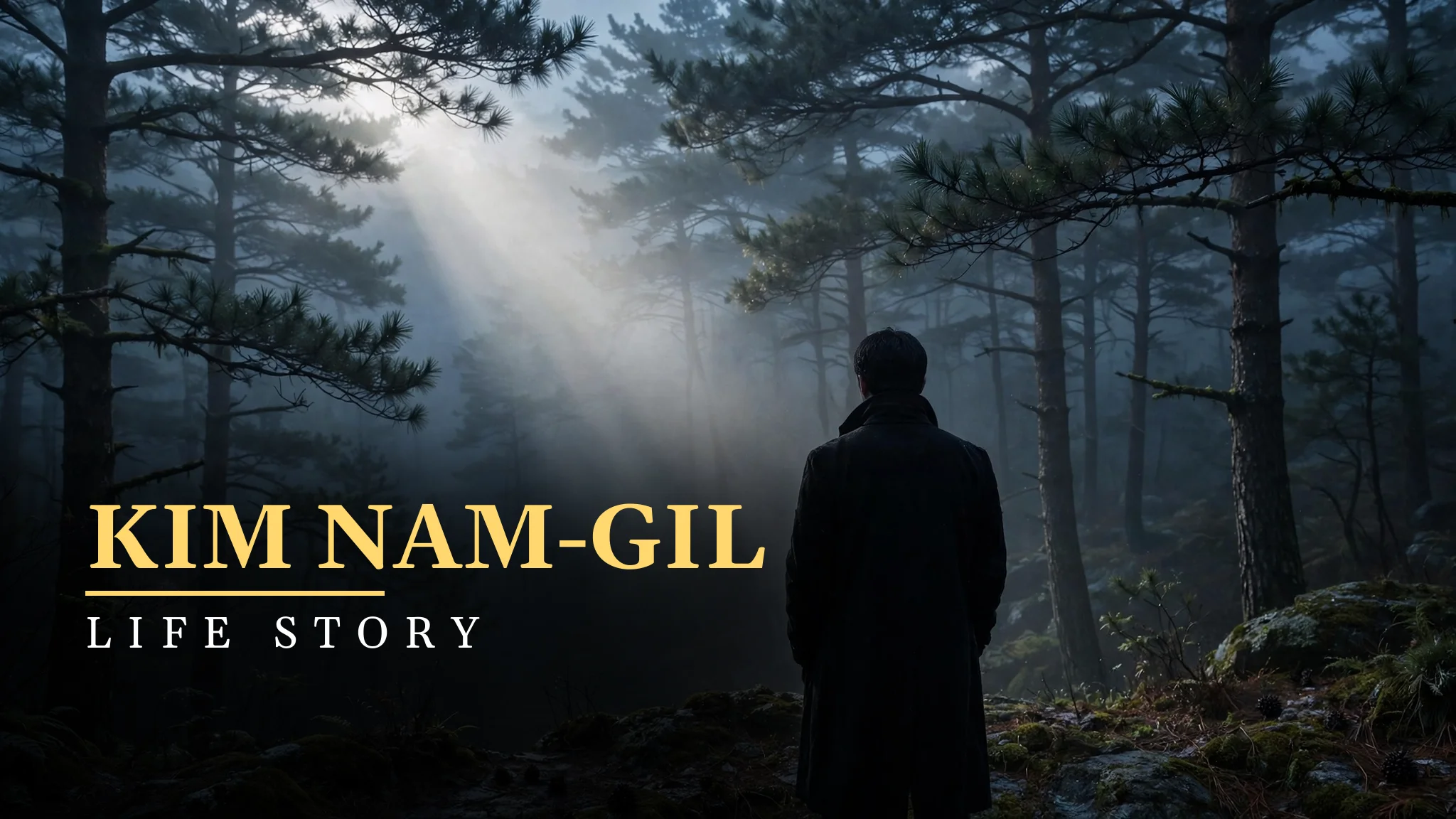
In the end, I come back to the image of him in a misty forest, standing alone among tall trees, with light breaking through the fog. That image fits him, because his career has been a walk through fog: long stretches where the path was unclear, and then sudden light, and then fog again. He kept walking, and the light kept coming. I hope he keeps walking, and I hope the light keeps finding him. I think Korean acting is better because he is in it, and I think anyone who has waited a long time for their chance will find hope in his story.
I also keep thinking about his foundation work, because it tells me something about the man that his films alone do not. A star who gives money to a cause is common. A star who gives time to old buildings, old stories, and young artists is rarer, and it shows a different kind of care. Kim Nam-gil cares about Korea, not only about himself, and that care makes his fame feel earned rather than lucky. I think that is a lesson for anyone who becomes successful: success is not only about what you take, it is about what you give back, and giving back is what makes success last. He has understood that, and I respect him for it.
There is another thought that stays with me, about the way he plays loneliness. His characters are often alone, even when they are surrounded by people, and he plays that loneliness without asking for pity. I think that comes from his own years of waiting, from the long time when he was good and unknown, and from the knowledge that being alone is not the same as being empty. Loneliness can be a place where you learn to see clearly, and Kim’s performances show that clarity. He sees people clearly, he sees himself clearly, and he lets the audience see clearly too. That is a gift, and it is one that I am grateful for.
I also think about the difference between intensity and noise. Kim Nam-gil is intense, but he is not noisy. He does not shout to show that he is serious. He is still, he is watchful, and he lets the intensity build slowly, until it is impossible to ignore. I wish more actors understood that difference, and I wish more people in life understood it too. You do not need to be loud to be strong. You need to be steady, and to be true, and to let your strength show in small moments rather than in big ones. Kim shows that, film after film, and I think it is one of the most important lessons his career teaches.
If I could watch only one of his performances again, it would be Bidam, because it is the role that made him, and because it is the role in which all his gifts come together: beauty, sadness, anger, and love, held in a single face. I would watch it and be reminded that a single role, played with total honesty, can change a life, and that the life it changes is not only the actor’s, but the audience’s too. That is a beautiful thing, and it is why I will keep watching his films, and why I hope he keeps making them for many years to come.
I also keep thinking about the way he plays priests and men of faith, because it shows a different side of his intensity. In The Priests, he plays a young priest who must face evil, and he does it with a calm that comes from belief, not from fear. He does not play faith as a performance. He plays it as a quiet, steady thing, a thing that holds a person together when the world is falling apart. I think that is a truthful picture of faith, and it is one that many viewers recognised, whether or not they share that faith. To play a man of faith honestly, without making him into a saint or a fool, is a hard thing, and Kim did it with grace.
There is another thought that stays with me, about the way he handles success. After Queen Seondeok, he could have taken every offer, earned a fortune, and played the same role for ten years. He did not. He took time away, he served in the military, and he came back to play darker, harder roles. That choice tells you who he is. He was not interested in being loved for his face. He was interested in being good at his job, and he understood that being good meant taking risks. That is a lesson that goes far beyond acting, and it is one that I hope readers take with them.
I also think about the young actors who look up to him, and about what they learn from watching him. They learn that waiting is not wasting time, that a small role can teach you as much as a big one, and that intensity is not about shouting. It is about being still, being watchful, and letting the emotion build slowly. That is a valuable lesson, and it is one that will shape Korean acting for years to come, because the actors who learn from Kim will carry his honesty into their own work.
One more thought stays with me, and it is about patience. Kim Nam-gil waited for years in small roles, and he did not give up, and that patience is the foundation of everything that followed. I hope readers who feel overlooked take heart from that, and I hope they keep working, because the door can open late, and when it opens, the years of waiting will have made them ready.
Frequently Asked Questions
Why is Kim Nam-gil so famous in Korea?
He became famous through his role as Bidam in the 2009 historical drama Queen Seondeok, which was a huge hit across Korea. His intense performance made the character one of the most loved in Korean television history. He later proved his range in films like The Shameless and in the hit drama The Fiery Priest.
What is Kim Nam-gil’s best-known drama?
Many fans name Queen Seondeok as his best-known drama, because Bidam made him a star. Others name The Fiery Priest, where he played a hot-tempered priest and won the Grand Prize at the SBS Drama Awards. Both dramas show very different sides of him, and both are good places to start.
Did Kim Nam-gil work in theatre before television?
Yes, he spent important early years working in theatre, where he learned voice, presence, and the discipline of live performance. Those years shaped the powerful screen presence he is known for today. He also took many small film and television roles before his breakthrough.
What is Gilstory?
Gilstory is a cultural foundation started by Kim Nam-gil that works to preserve cultural heritage and to support the arts in Korea. It reflects his interest in history and culture beyond acting. He has used his fame to support projects that protect old stories and places.
What kind of roles does Kim Nam-gil usually play?
He is known for intense, complex men, including tragic lovers, detectives, priests, and fighters. He often plays characters who are lonely, angry, or morally torn, and he plays them with honesty rather than glamour. In recent years he has also shown a strong comic side, especially in The Fiery Priest.
Is Kim Nam-gil still acting?
Yes, he remains very active in both film and television, including Through the Darkness, Island, and a second season of The Fiery Priest. He continues to choose a mix of dark, comic, and large-scale roles. His career is still growing, more than twenty years after he began.


