Kuami Eugene: The Life Story Behind Ghana's Rockstar
In this post
- A Boy From Akim Oda Who Loved Church Music
- MTN Hitmaker and the Night That Changed Everything
- Angela and the First Great Hits
- Son of Africa, Artiste of the Year, and the Peak
- The Rockstar Style and the Love of Highlife
- Setbacks, Criticism, and the Pressure to Stay on Top
- What Kuami Eugene Means to Ghana Today
- A Career Still Rising
- My Take:
Kuami Eugene calls himself the Rockstar, and in Ghana, almost everyone agrees with him. He is not a rock singer in the usual sense. He is a highlife and Afrobeats singer with a smooth voice, a gift for melody, and a habit of writing songs that stay in the listener’s head for days. His songs are played at parties, at weddings, on the radio, and in the streets, and his name has become one of the biggest in Ghanaian music. He did not arrive at that place by luck. He arrived there through church singing, through school, through a talent show, and through years of hard work in the studio.
He was born Eugene Marfo on 1 February 1997 in Akim Oda, a town in the Eastern Region of Ghana. He grew up in a home where music and faith were close together, and he learned to sing in church, where his voice was first heard by people outside his family. As a boy, he taught himself to play instruments, picking up the guitar, the piano, and the drums with a patience that surprised the adults around him. He was not a child who waited to be taught. He listened, he watched, and he tried until the sound was right.
His breakthrough came in 2016, when he won the MTN Hitmaker talent show in Ghana, a competition that has launched several of the country’s biggest stars. From there, he signed with Lynx Entertainment, one of Ghana’s leading record labels, and he began to release the songs that would make him famous. Angela, Wish Me Well, Open Gate, and Monica became hits that are still played today, and in 2020 he was named Artiste of the Year at the Ghana Music Awards. This is the story of how a boy from Akim Oda became the Rockstar of Ghana.
A Boy From Akim Oda Who Loved Church Music
Akim Oda is a town in the Eastern Region of Ghana, a place of markets, schools, and churches, and it gave Kuami Eugene a childhood that was both ordinary and musical. He grew up in a family that valued faith, and church was at the centre of his early life. In church, he learned to sing with feeling, because the songs were about God and about hope, and the audience was not judging a performance. They were listening for something honest, and a young singer learns honesty in that kind of room. If the feeling is not real, people can tell, and Kuami learned early that a voice means little without the feeling behind it.
He was drawn to music before he was drawn to anything else. As a child, he sang in the church choir, and he began to teach himself to play instruments. He picked up a guitar, he sat at a piano, and he tried the drums, learning each one by listening and by practising again and again. A child who teaches himself to play several instruments is a child with a rare kind of patience. He did not have a formal teacher for every instrument. He had his ears, his hands, and his willingness to keep trying until the sound matched the sound in his head.
School was also part of his life, and he moved between his studies and his music with a balance that would serve him well later. He attended school in Ghana, and as he grew older, he began to think about music as more than a hobby. He performed at school events, he sang at local gatherings, and he began to write his own songs. His writing was simple and direct. He wrote about love, about life, and about the things he saw around him, and he wrote in a way that ordinary people could understand. That plain style became one of his strengths.
His family supported his interest in music, but they also taught him that talent alone is not enough. A musician needs discipline, good manners, and respect for the people who listen. Kuami took those lessons to heart. He practised, he listened to the great highlife singers who had come before him, and he worked on his voice the way an athlete works on the body, slowly and steadily. He did not rush. He waited until he had a voice that was ready, and a sense of who he wanted to be as a singer. That patience would become one of the marks of his career.
MTN Hitmaker and the Night That Changed Everything
In 2016, Kuami Eugene took part in MTN Hitmaker, one of Ghana’s most popular television talent shows, and his life changed. Talent shows are a hard test for a singer. The contestant must sing in front of judges, in front of cameras, and in front of a whole country, and there is no place to hide. Kuami did not hide. He sang with a calm confidence that surprised many viewers, and he played instruments on stage as well, showing that he was not only a singer but a musician. Week after week, he grew stronger, and the audience began to notice him.
The final of the show was held in 2016, and Kuami Eugene was named the winner. Winning a talent show is a big moment, but it is also only a beginning. The show ends, the attention moves on, and the winner has to prove that he is more than a television contestant. Kuami understood that, even in the excitement of winning. He had a voice, he had a prize, and he had a large audience that was willing to listen once. The hard part was making them listen a second time, and a third time, and for years after that.
Winning Hitmaker gave him a recording contract with Lynx Entertainment, a label run by the producer Richie Mensah, one of the most respected figures in Ghanaian music. A good label matters to a young singer, because it takes care of the business side of music and lets the singer focus on the songs. For Kuami, that support came at the right time. Richie became a mentor to him, teaching him how to write, how to record, and how to handle the pressures of fame. That guidance was as valuable as the contract itself, and Kuami has often spoken with warmth about what Richie taught him.
He also learned how the music business worked in those early months after the show. He learned that a song takes time to write, that a studio session can last for hours, and that a hit song is not made by luck alone. He learned to work with producers, to take advice without losing his own ideas, and to be patient when a song did not work the first time. Those lessons were as valuable as the applause, and he carried them into the years that followed. The boy from Akim Oda was now a professional singer, and he was ready to prove it.
Angela and the First Great Hits
Kuami Eugene’s first big hit was Angela, released in 2017, a warm and romantic highlife song about a woman whose name the whole country soon knew. The song was simple, melodic, and beautifully sung, and it became one of the most played songs in Ghana that year. Listeners loved its gentle rhythm, its sweet melody, and the way Kuami sang it with a sincerity that felt real. It was played at weddings, at parties, and on the radio, and it gave him a signature song, a track that people would always associate with his name.
He followed Angela with other strong releases, including Wish Me Well, a song about wishing well to someone who has left, and Open Gate, a song with a brighter, more danceable rhythm. Each song showed a different side of his talent. Angela was romantic, Wish Me Well was emotional, and Open Gate was joyful, and together they showed that Kuami was not a singer with only one mood. He could sing about love, about loss, and about celebration, and each feeling sounded true in his voice. His fans began to trust him. If a new Kuami Eugene song came out, they knew it would be well sung and well written.
His debut album, Rockstar, released in 2018, gathered his songs into a collection that showed the range of his talent. The title was a statement. He was not a shy newcomer. He was a singer who believed in himself, and he wanted the world to know it. The album included his early hits and new songs, and it confirmed what his singles had promised. He was not a talent show winner with only one song. He was an artist building a body of work, one song at a time.
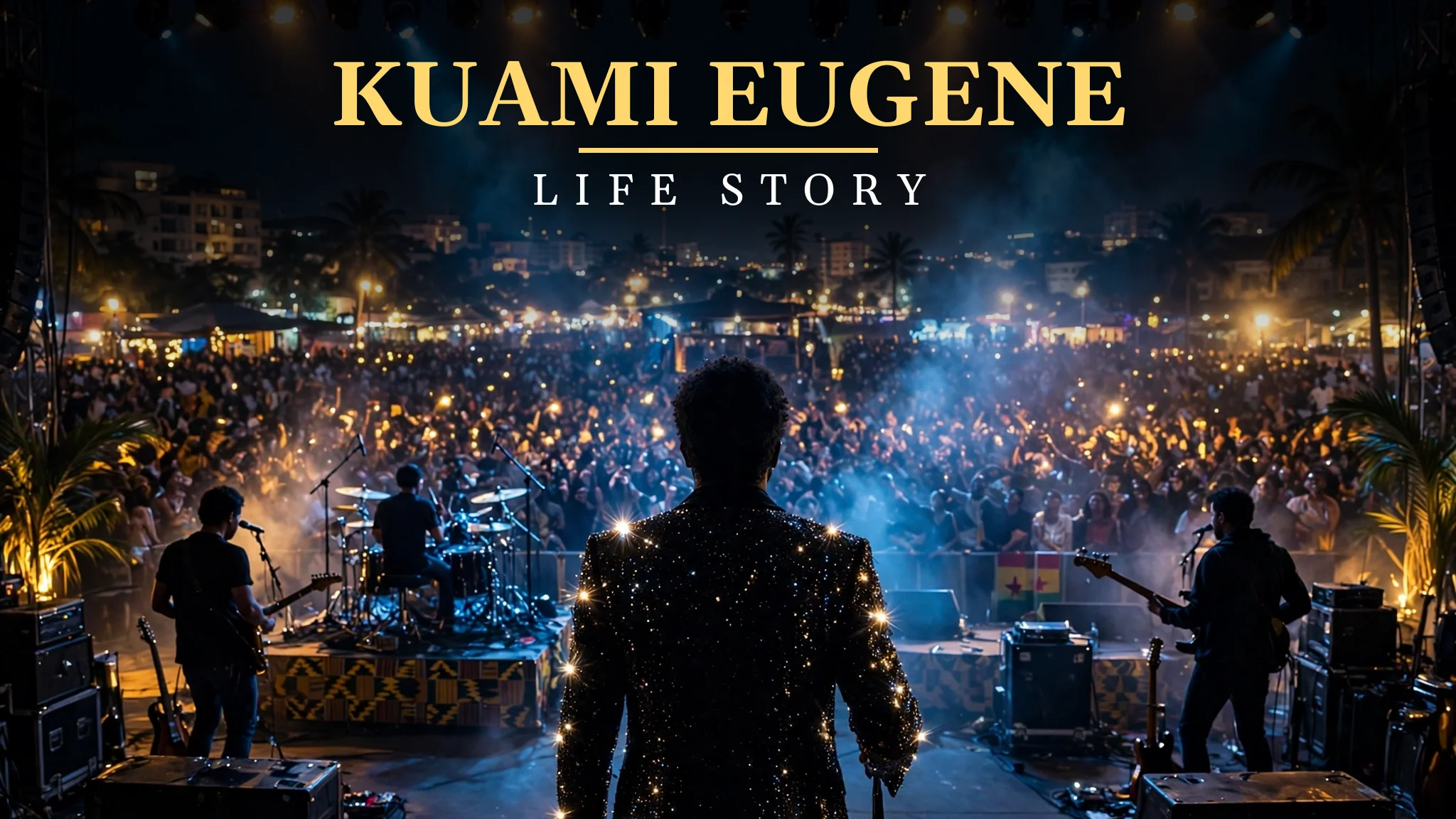
He also became known for his live performances. Kuami Eugene on stage is a different experience from Kuami Eugene on a recording. On stage, he sings, he plays guitar, and he talks to the audience with a warmth that makes a large hall feel small. He performs with a band, he lets a song stretch and breathe, and he gives the crowd a show that they remember. Audiences in Ghana and beyond began to seek out his shows, because they knew they would hear a singer who could truly sing and truly play, without tricks to hide behind.
Son of Africa, Artiste of the Year, and the Peak
In 2020, Kuami Eugene reached the peak of his career so far. He released his second album, Son of Africa, a collection of songs that showed how much he had grown since his debut. The album included the hit song Open Gate, as well as other tracks that became popular across Ghana and Nigeria. It was a confident album, made by a singer who knew his sound and who was not afraid to show it. The title, Son of Africa, was a statement of pride. He was a son of Ghana, a son of Africa, and his music belonged to the whole continent.
That same year, he was named Artiste of the Year at the Vodafone Ghana Music Awards, the biggest honour in Ghanaian music. To win that award is to be told that you are the finest artist in the country, and Kuami had earned it through years of hard work. He had released hit after hit, he had performed on big stages, and he had built a loyal audience that followed him from song to song. The award was a recognition of all of that, and it was a moment of great pride for him and for his family in Akim Oda.
He also began to work with artists from other countries, most notably from Nigeria, and those collaborations helped his music to travel further. He sang with Nigerian stars, he performed at shows alongside them, and he built friendships that helped his career. Working with a singer from another country means learning a new way of writing, a new rhythm, and a new way of hearing a song. Kuami took those lessons in his stride. He kept his highlife heart at the centre of each song, and he let the other artist bring something new around it.
His success also brought him a large following on social media, where fans shared his songs, his videos, and his performances. He learned to use those platforms to stay close to his audience, posting new music, sharing moments from his life, and thanking the people who supported him. That closeness mattered, because a singer who stays close to his fans will keep them, even when new stars appear. Kuami understood that, and he worked hard to keep that connection alive.
The Rockstar Style and the Love of Highlife
Kuami Eugene’s music is rooted in highlife, the rich Ghanaian sound that has been loved for generations, and he has always been proud of that root. Highlife is a music of melody, of guitar, and of stories about love and life, and Kuami learned it from the singers who came before him. He listened to the great highlife records, he studied their melodies, and he brought that sound into the present, mixing it with Afrobeats and with modern pop. The result is a sound that feels both old and new, a sound that a grandmother and a grandchild can both enjoy.
His nickname, the Rockstar, is a part of his identity as a performer. He wears bold clothes, he wears sunglasses, and he carries himself with a confidence that matches the name. Some people might think that confidence is arrogance, but those who know his story see it differently. He is a young man from a small town who worked hard to become a star, and his confidence is the confidence of someone who knows what he has earned. He does not hide his pride in his work, and he does not apologise for it. That pride is part of what makes his shows so enjoyable.
He is also a songwriter for other artists, and that work shows another side of his talent. A singer who can write a hit for himself is one thing. A singer who can write a hit for someone else is another, because it means he understands how different voices work. Kuami has written songs for other Ghanaian artists, and those songs have become hits as well. That skill has made him one of the most respected figures in the Ghanaian music business, a singer who is also a craftsman.
His voice is the centre of everything he does. It is smooth, warm, and clear, and it can move from a soft line to a powerful chorus without losing its shape. He takes care of that voice, he practises, and he performs with a discipline that is easy to miss. In a music world that often rewards noise over quality, he built his career on the opposite idea. Sing well, write good songs, work hard, and respect the audience. That approach has kept him at the top of Ghanaian music for years.
Setbacks, Criticism, and the Pressure to Stay on Top
Fame brought Kuami Eugene pressures that are easy to miss from the outside. When a singer wins Artiste of the Year, the whole country expects the next song to be even better, and that expectation is heavy. Every new release is compared with Angela, with Open Gate, and with his best work, and if a song does not become a hit at once, people begin to ask whether the singer has lost his touch. Kuami felt that pressure, and he dealt with it by working steadily rather than frantically, releasing music when it was ready and trusting his audience to stay with him.
He also faced criticism, as every famous singer does. Some critics said his songs sounded too similar to each other, that he used the same melodies and the same style too often. Others said he was too confident, too loud about his own success. He answered that criticism the best way a singer can, by making new music. He tried new sounds, he worked with new producers, and he showed that he could grow. His album Love and Chaos, released in 2023, was a step in that direction, a collection that showed a more mature and varied side of his writing.
There were also the ordinary challenges of a long career in music. The charts move quickly, new stars appear every year, and a singer who was on top last year can be forgotten this year if he does not keep working. Kuami did not stop working. He released songs, he performed, and he stayed close to his fans. He understood that a career is not built on a single hit. It is built on years of work, and he was willing to put those years in.
He has also spoken about the importance of family and of staying grounded. He comes from Akim Oda, and he has kept his family and his home close, even as his fame grew. He has talked about the values he learned as a boy, about hard work, about respect, and about faith, and those values have helped him to stay steady in a business that can be loud and restless. He shares his music with the world, but he keeps the details of his private life mostly to himself, and his fans have learned to respect that boundary.
What Kuami Eugene Means to Ghana Today
Today, Kuami Eugene stands as one of the leading voices in Ghanaian music, and his place in it is clear. He showed that highlife could live happily alongside Afrobeats, that a young singer from a small town could become the biggest star in the country, and that a talent show winner could build a real career rather than fading away. He showed that a singer who can play instruments, write songs, and perform live has a strength that no studio trick can replace.
His influence can be seen in the young singers who have followed him. Many of them now write songs that mix highlife with Afrobeats, many of them play guitar, and many of them sing about love in plain words rather than in grand statements. Kuami did not invent that style, but he proved that it could work on the biggest stage in Ghana. A young singer in Akim Oda today can look at his career and see a path that starts in church, goes through school, and ends on a stage in front of thousands of people. That path is real, because Kuami walked it.
He has also become a proud ambassador for Ghanaian music. When he performs abroad, he carries the sound of his country with him, and when he speaks about his home, he speaks with warmth. He has won awards, he has been played on radio around the world, and he has built a loyal audience that follows him from song to song. His real achievement, though, is simpler. He made the whole of Ghana sing along to his songs, and that is a rare thing, and it is the reason his story is still being written.
A Career Still Rising
Kuami Eugene is still young, and his career is still in its early chapters. He has a talent show win, two major albums, a third album, and an Artiste of the Year award behind him, and he has a list of hit songs that many singers would envy. He has performed in many countries, he has worked with artists from across Africa, and he has built a loyal audience that follows him from song to song. The next chapters of his story will be about what he does with that foundation. Will he write bolder songs? Will he try new sounds? Will he keep the highlife heart that made him famous, or will he let it grow into something new?
What seems certain is that he will keep working. He has never been a singer who rests on a single hit, and he has never let success make him lazy. He works at his own pace, he trusts his ear, and he keeps his family and his home close. Those habits have served him well so far, and they are likely to serve him well in the years ahead. The boy from Akim Oda who learned music in church is now the Rockstar of Ghana, and the best of his story may still be to come.
My Take:
When I think about Kuami Eugene, the first thing that comes to my mind is his confidence. I do not mean the kind of confidence that shouts or boasts. I mean the quiet confidence of a young man who knows what he can do and is not afraid to say it. He calls himself the Rockstar, and he wears the name like a jacket that fits him. Some people might find that name too bold, but I find it honest. He worked hard to become a star, he earned the name, and he is not going to hide it. I like that. I like a singer who believes in himself, because belief is the first step to making good music.
What I admire most about him is that he is a real musician, not only a singer. He plays guitar, he plays piano, and he plays drums, and he learned those instruments by himself as a boy. That matters to me, because a singer who can play an instrument understands music in a deeper way than a singer who only sings. He hears the chords, he feels the rhythm, and he knows how a song is built from the inside. When he writes a song, he is not just writing words. He is building a whole piece of music, and you can hear that care in his songs. Angela is not just a pretty melody. It is a well-built song, and it sounds like it was made by someone who knows how music works.
I also think about his childhood in church, and about what that taught him. Church singing is a good school for a young voice, because it teaches a singer to sing with feeling. Kuami learned that lesson well. When he sings about love, I believe him. When he sings about loss, I believe him. That belief is the reason his songs are played at weddings and at quiet moments at home. A singer who has learned to sing honestly in church will sing honestly everywhere else, and Kuami does. His voice has a warmth to it that comes from that early training, and it is one of the reasons his songs last.
His win on MTN Hitmaker is a part of his story that I find interesting, because talent shows are often treated as a shortcut, and they are often unkind to the singers who take part in them. Kuami did not treat the show as a shortcut. He treated it as a beginning. He won, he signed with a good label, he found a mentor in Richie Mensah, and he worked hard to prove that he was more than a television winner. That is the difference between a contest winner and a real artist. A contest winner needs the show. A real artist needs the show only once, and then the music speaks for itself. Kuami is a real artist, and his career proves it.
Angela is the song I return to most often when I think about him, because it captures everything he does well. It is a simple song, a love song, and it does not try to be clever. It simply lets his voice carry the feeling, and the feeling is warm and honest. I have heard that song at weddings, I have heard it on the radio, and I have heard it in the streets, and each time it sounds right. That is the mark of a great song. It fits many moments, because the feeling in it is true. I think every singer should have a song like that, a song that proves what they can do, and Kuami has one. He has more than one, but Angela is the one that stays with me.
I also want to talk about his highlife roots, because they matter more than many listeners realise. Highlife is the music of Ghana, a sound that has been loved for generations, and Kuami has kept it alive for a new generation. He did not treat highlife as an old sound to be left behind. He treated it as a living sound, one that could be mixed with Afrobeats and with modern pop, and he made it fresh again. That is a gift to Ghanaian music. A young listener who hears Kuami today is hearing highlife, even if they do not know the name of the style. They are hearing the guitar, the melody, and the stories that have always been part of Ghanaian music, and they are loving it. That connection to the past is precious, and Kuami carries it well.
If I am honest, I do think there is a weakness in his work, and it is the weakness that his critics have named. Some of his songs do sound similar to each other. The melodies are beautiful, but they sometimes follow the same shape, and the lyrics sometimes say the same thing in the same way. I do not blame him for that. A singer with a hit sound is under enormous pressure to repeat it, and the safest way to do that is to copy the first hit. But I think his best work will come when he takes more risks, when he writes a song that sounds different from Angela, even if it is not an instant hit. His album Love and Chaos was a step in that direction, and I hope he keeps walking it.
Another thing I think about is his confidence, and whether it sometimes makes him seem distant. He is a star, he knows he is a star, and he does not hide it. I respect that, but I also wonder whether a singer who is so confident can sometimes feel far away from his fans. Fans want to feel close to the singer they love, and if the singer seems too sure of himself, that closeness can be hard to find. I do not think Kuami should change who he is. His confidence is part of his charm. But I think a little more of the boy from Akim Oda, the boy who learned music in church, would help listeners to feel closer to him. His music is warm, and the man behind it deserves to be known a little better.
What moves me most about Kuami is the way he represents Ghana to the world. When he performs abroad, he does not pretend to be from somewhere else. He sings with a Ghanaian heart, he speaks about Akim Oda with pride, and he carries the sound of highlife with him. For a young person in Ghana, that matters. It tells them that their town, their language, and their music are enough. They do not need to move to another country or to change who they are in order to be heard. Kuami was heard because he was himself, and that is a powerful message for any young singer in Ghana.
I think about the young boys in Ghana who want to sing and play guitar, and I think Kuami is one of the best examples they could have. He shows them that a singer does not need to be born in a big city to be a star. He shows them that practice matters, that patience matters, and that a voice trained with care will carry a singer further than a voice that is only loud. He also shows them that a musician can be a songwriter, a performer, and a star all at once, and that those roles do not have to be separate. That is a powerful message, and I hope young musicians in Ghana hear it clearly.
His work as a songwriter for other artists is another part of his story that I admire. A singer who can write a hit for himself is one thing. A singer who can write a hit for someone else is another, because it means he understands how different voices work. Kuami has done that, and those songs have become hits as well. That generosity is rare, and it is one of the reasons he is respected by other musicians in Ghana. He does not keep his talent to himself. He shares it, and he helps other singers to succeed. That is a kind of leadership, and it is one that the Ghanaian music scene needs.
I also admire the way he treats his success. He does not boast in a cruel way. He thanks the people who helped him, he thanks his fans, and he keeps working. That humility is not an act. It is the natural result of growing up in a home where music was work, not magic. He learned as a boy that a song takes effort, and he has never forgotten that lesson. When Angela became a hit, he did not act as if he had been chosen by luck. He acted as if he had been given a chance, and he used it well. I think that attitude will carry him further than any single song.
If I had to choose one lesson from his life for a young reader, it would be this. Learn your craft, and trust it, even when the world wants you to hurry. Kuami could have rushed his music after winning Hitmaker, releasing songs before they were ready. He did not. He worked with a mentor, he learned how to write and record, and he released songs when they were ready. That patience is rare in a young singer, and it is one of the reasons his career has lasted. A song made in a hurry will be forgotten in a hurry. A song made with care will last, and Kuami’s songs have lasted.
I will keep listening to his music, and I will be watching to see what he does next. He is still young, and his best songs may still be ahead of him. If he keeps writing honestly, if he takes risks when he is ready, and if he keeps the highlife heart that made him special, I think he will have a long career. The boy from Akim Oda who learned music in church has already given Ghana songs that the whole country sings along to. That is a fine achievement. The next achievement will be to show that he can do it again, in his own way, and on his own terms. I believe he can.
One more thing stays with me when I think about him, and it is the way his songs treat love. He does not write about love as a grand drama or as a game. He writes about it as something warm and steady, a feeling that grows slowly between two people who pay attention to each other. That view of love is rare in pop music, where love is often loud, jealous, or broken. Kuami writes about the kind of love that lasts, the kind that is built on small acts of care rather than on big gestures. I find that view refreshing, and I think it is one reason his songs are played at weddings and at quiet evenings at home. A song about lasting love is a gift, and he gives it generously.
I also think about the work behind the smoothness. A smooth voice does not happen by accident. It takes breath control, it takes practice, and it takes the discipline to sing the same line again and again until it sounds effortless. Listeners hear the ease, but they do not always see the hours of rehearsal that made it possible. Kuami has put in those hours, and his voice shows it. When he holds a note, it does not wobble. When he moves from a low line to a higher one, the change is smooth. That control is the mark of a singer who has trained himself well, and it is one of the reasons his live performances sound so close to his recordings.
Finally, I think his story is a reminder that a small town can produce a big star, and that a star does not have to forget where he came from. Kuami Eugene came from Akim Oda, he learned music in church, he won a talent show, and he became the Rockstar of Ghana. He did not do it by pretending to be someone else. He did it by being himself, loudly and proudly, and by working hard every day. I hope he keeps doing it for many years to come, because Ghanaian music is better with a voice like his in it, a voice that is smooth, warm, and entirely his own.
Frequently Asked Questions
What is Kuami Eugene’s real name and where is he from?
Kuami Eugene’s real name is Eugene Marfo, and he was born on 1 February 1997 in Akim Oda, in the Eastern Region of Ghana.
How did Kuami Eugene become famous?
He won the MTN Hitmaker talent show in 2016, then signed with Lynx Entertainment. His song Angela in 2017 became his first major hit across Ghana.
What is Kuami Eugene’s most famous song?
Angela is his signature song, a warm highlife love song from 2017. Wish Me Well, Open Gate, and Monica are also among his best-known hits.
What albums has Kuami Eugene released?
His debut album Rockstar came out in 2018, followed by Son of Africa in 2020 and Love and Chaos in 2023.
Why is Kuami Eugene called the Rockstar?
Rockstar was the title of his debut album, and it became his nickname. It reflects his confident stage style, his bold fashion, and his belief in his own talent.
What award did Kuami Eugene win in 2020?
He was named Artiste of the Year at the Vodafone Ghana Music Awards in 2020, the biggest honour in Ghanaian music.


