Kurt Cobain: The Life Story Behind Nirvana's Voice
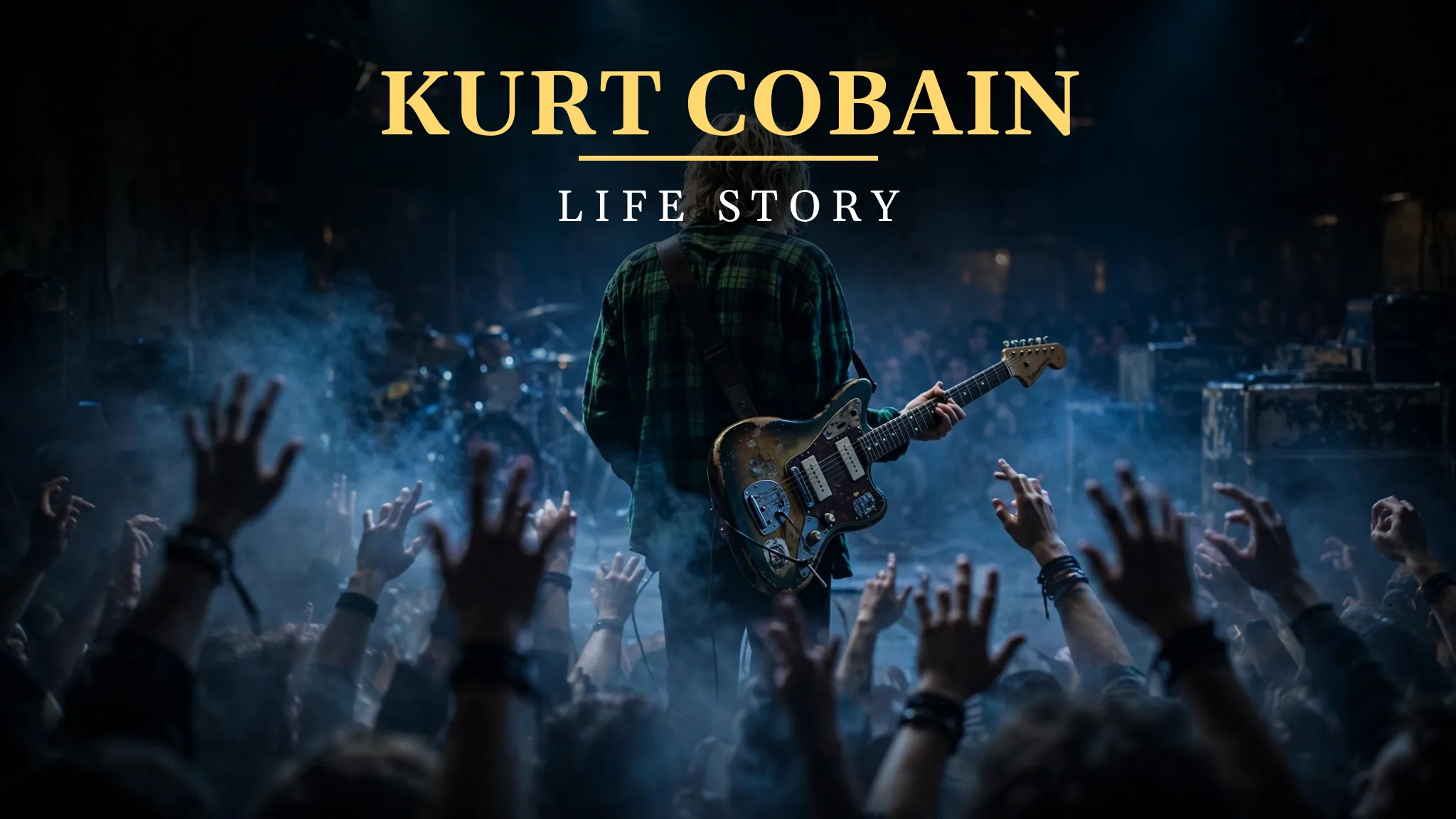
In this post
Kurt Cobain was born on 20 February 1967 in Aberdeen, Washington, a logging town on the Pacific coast, and he grew up in a working-class family that split apart when he was nine. His parents, Donald Cobain, a mechanic, and Wendy Fradenburg, a waitress, divorced, and Kurt lived first with his mother, then with his father, then with relatives, moving from house to house and feeling unwanted in all of them. He was a shy, artistic boy who drew constantly, played the guitar, and listened to the Beatles, Led Zeppelin and the punk bands that were coming out of Britain and America.
As a teenager Cobain discovered punk rock, and it changed his life. He saw the Melvins, a local band from Montesano, play in Aberdeen, and he began to write songs that mixed the melody of the Beatles with the noise of punk. He formed a band with Krist Novoselic, a tall, lanky bass player he had met at school, and after several false starts and several drummers, they settled on the name Nirvana, a word that Cobain liked because it suggested peace and freedom, and because it was the opposite of what their music sounded like.
Nirvana’s second album, Nevermind, released in September 1991, became one of the biggest-selling albums in history, with more than thirty million copies sold worldwide. The single Smells Like Teen Spirit became an anthem for a generation, and Cobain, who was twenty-four, became the most famous rock musician in the world, a reluctant spokesman for young people who felt alienated and angry. He did not want the role, and he said so constantly, but the fame only grew, and the pressure it put on him became unbearable.
Cobain died on 5 April 1994 in Seattle, Washington, at the age of 27, of a self-inflicted gunshot wound, after a long struggle with depression, chronic stomach pain and heroin addiction. He had recorded only three studio albums with Nirvana, but they were enough to change the sound of rock music. This is his life story, from a logging town in Washington to the top of the charts.
Aberdeen and the Childhood
Kurt Donald Cobain was born on 20 February 1967 in Grays Harbor Hospital in Aberdeen, Washington, to Donald Leland Cobain, a mechanic at a local garage, and Wendy Elizabeth Fradenburg, a waitress. He was a happy child, according to his family, energetic and artistic, and he began drawing at an early age, filling notebooks with cartoons and sketches. He also showed an interest in music, singing along to the Beatles records his parents played, and his aunt Mary, who was a musician herself, gave him his first guitar when he was fourteen, a used electric that he played constantly.
When Cobain was nine, his parents divorced, and the divorce changed him profoundly. He lived first with his mother, who remarried and moved the family several times, and then with his father, who also remarried, and he felt like an outsider in both homes. He moved between relatives, sleeping on couches and in spare rooms, and he became withdrawn and angry, a pattern that would stay with him for the rest of his life. He later said that the divorce made him ashamed and that he never felt loved after it, a statement that friends and biographers have quoted often, because it explains so much of what came later.
At Aberdeen High School, Cobain was a loner who spent his time drawing, writing and listening to music. He was interested in art and in punk rock, and he formed a band with friends, playing covers of Led Zeppelin and the Sex Pistols at school dances. He also began to write his own songs, filling notebooks with lyrics about alienation, anger and the small-town life he hated. He graduated in 1985, though he barely attended classes in his final year, and he left Aberdeen soon afterwards, moving to Olympia, Washington, where he lived in a series of apartments and worked odd jobs, including as a janitor, while he tried to make music his living.
Nirvana and the First Album
Nirvana was formed in 1987, when Cobain and Krist Novoselic, a bass player he had met in Aberdeen, began playing together in earnest. Novoselic was six feet seven inches tall, and he played a bass that looked small in his hands, but the two of them shared a taste in music, from the Beatles to the Melvins, and they began writing songs that mixed melody with noise. They went through several drummers, including Aaron Burckhard and Chad Channing, and they recorded a demo tape that circulated among local record labels, attracting the attention of Sub Pop, an independent label in Seattle.
Their first album, Bleach, was released in June 1989 on Sub Pop, and it was recorded for six hundred dollars, in a single weekend, with the producer Jack Endino. The album was heavy and raw, with songs like About a Girl, which showed Cobain’s melodic gifts, and Blew, which showed his love of noise, and it sold modestly, about forty thousand copies, but it established Nirvana as one of the leading bands in the Seattle scene. The album’s sound, which combined the heaviness of metal with the melody of pop, became known as grunge, though Cobain disliked the term.
Bleach also introduced Cobain’s songwriting, which was built on contrast, a quiet verse followed by a loud chorus, a structure he had learned from the Pixies, a Boston band he admired enormously. The songs were short and direct, with lyrics that were often cryptic, and they showed a writer who could turn a personal feeling into a universal one. The album did not make Nirvana famous, but it gave them a foundation, and it led to a deal with a major label, Geffen Records, which signed the band in 1990 and gave them the budget to make a record that would change everything.
Nevermind and Smells Like Teen Spirit
Nevermind was recorded in the spring of 1991 with the producer Butch Vig, in a studio in California, and it was released on 24 September 1991, on the same day as albums by the Red Hot Chili Peppers and other major acts. The album’s first single, Smells Like Teen Spirit, was released a few weeks earlier, and it became a phenomenon, with its video, showing teenagers moshing in a school gymnasium, played constantly on MTV. The song’s riff, which Cobain had written as a joke, borrowing from the Pixies, became one of the most famous in rock, and the album shot to number one on the Billboard chart in January 1992, displacing Michael Jackson’s Dangerous.
The album’s success was unexpected, even by the band, and it made Nirvana the biggest rock band in the world in a matter of months. The songs, including Come as You Are, Lithium and In Bloom, were melodic and accessible, but they were also angry and alienated, and they spoke to a generation of young people who felt disconnected from the slick pop music of the 1980s. Cobain, who had written the songs in his bedroom in Olympia, became a spokesman for that generation, a role he never wanted and never accepted, telling interviewers that he was just a musician, not a leader.
The fame that followed Nevermind was intense and disorienting, and it changed Cobain’s life in ways he had not expected. He was suddenly rich, famous and under constant scrutiny, and the press followed his every move, reporting on his marriage to Courtney Love, the birth of his daughter Frances Bean, and his struggles with drugs and depression. He told friends that he missed the days when Nirvana played small clubs, and that the success had made him miserable, a feeling that would only deepen in the years that followed.
In Utero and the MTV Unplugged
In Utero was released in September 1993, and it was a deliberate attempt by Cobain to make a record that was less commercial than Nevermind, a raw and abrasive album that would alienate the new fans and return the band to its roots. He chose Steve Albini, a producer known for his unpolished sound, to record it, and the album’s songs, including Heart-Shaped Box, Rape Me and All Apologies, were darker and more personal than anything on Nevermind. The album reached number one in Britain and America, despite its abrasive sound, and it showed that Cobain’s audience would follow him anywhere.
The album’s success was followed by a tour that was difficult for Cobain, whose health was failing, and in November 1993 Nirvana recorded an episode of MTV Unplugged, the acoustic television show, in New York. The performance, in which Cobain played an acoustic guitar and sang in a quiet, intimate voice, was one of the finest of his career, and it included covers of songs by the Meat Puppets, Lead Belly and David Bowie, as well as stripped-down versions of Nirvana’s own songs. The recording was released as an album in November 1994, seven months after Cobain’s death, and it won the Grammy Award for Best Alternative Music Album.
The Unplugged performance showed a different side of Cobain, a musician who could be tender and vulnerable, and who understood the folk and blues traditions that underlay his music. His version of Lead Belly’s Where Did You Sleep Last Night, in which his voice cracks on the final verse, is one of the most moving moments in rock history, and it has been cited by musicians and critics as the finest performance of his career. The show was his last major performance, and it remains the recording that most people turn to when they want to hear what Cobain could do at his best.
Courtney Love and Frances Bean
Cobain met Courtney Love, the singer of the band Hole, in 1991, and the two married in February 1992 in Waikiki, Hawaii, in a ceremony on the beach. Love was a forceful personality, and the marriage was passionate and turbulent, with both of them struggling with drug addiction and with the pressures of fame. Their daughter, Frances Bean Cobain, was born in August 1992, and the couple’s parenting was the subject of intense press scrutiny, including a Vanity Fair article that accused Love of using heroin while pregnant, a charge she denied, and that led to a custody investigation by social services.
The marriage was also a creative partnership, in the sense that Love and Cobain understood each other’s music and supported each other’s work, but it was also destructive, and friends said that the two of them enabled each other’s addictions. Cobain wrote songs about Love, including Heart-Shaped Box, and Love wrote songs about Cobain, and their relationship became a public drama, reported in detail by the tabloid press. The couple lived in Seattle, in a house that became a gathering place for musicians, and their life together was chaotic, loving and painful in equal measure.
Frances Bean, who was nineteen months old when her father died, has grown up to become an artist and a model, and she has spoken rarely about her father, saying that she prefers to remember him through his music and through the stories of people who knew him. She controls his estate, with her mother, and she has overseen the release of archival material, including the album Montage of Heck, a collection of Cobain’s home recordings, released in 2015. The marriage to Love remains one of the most discussed relationships in rock history, and it is the subject of books, films and endless speculation.
The Stomach Pain and the Addiction
Cobain suffered from chronic stomach pain for most of his adult life, a condition that doctors never fully diagnosed, and that he treated with heroin, which he said was the only thing that relieved it. The pain began in his late teens, and it worsened as he became famous, and he wrote about it in his journals, describing it as a burning sensation that made it hard to eat, sleep or perform. He saw many doctors, who suggested everything from ulcers to stress, but no treatment worked, and the heroin, which he began using in the late 1980s, became his way of coping.
His heroin use became public knowledge in the early 1990s, and it worried his bandmates, his family and his management, who tried repeatedly to get him into treatment. He entered rehabilitation programmes several times, including a clinic in Los Angeles in March 1994, from which he walked out after a few days, flying back to Seattle, where he died a week later. His friends said that the addiction was only part of the problem, and that his depression, which had been present since childhood, was the deeper issue, a sadness that the fame and the money had made worse, not better.
The combination of pain, addiction and depression made Cobain’s final years a struggle, and his performances became erratic, with shows cancelled and concerts cut short. He told friends that he wanted to quit the band, that he was tired of being a rock star, and that he wanted a quiet life with his family, but the machinery of fame made it hard to stop. His journals, published after his death, show a man who was thoughtful, funny and deeply unhappy, and who understood his situation clearly, even as he was unable to change it.
The Death in Seattle
On 5 April 1994 Cobain died in his home in Seattle, at the age of 27, of a self-inflicted gunshot wound, after writing a note that quoted Neil Young’s line, it’s better to burn out than to fade away. His body was found three days later, on 8 April, by an electrician who had come to install a security system, and the news led the broadcasts around the world. His death made him a member of the 27 Club, the group of musicians who died at twenty-seven, including Jimi Hendrix, Janis Joplin and Jim Morrison, a coincidence that was widely noted, and that added to the mythology around him.
The note he left was addressed to his childhood imaginary friend, Boddah, and it spoke of his loss of passion for music, his guilt about faking it on stage, and his love for his wife and daughter. The note has been analysed endlessly, and its meaning is still debated, but its central message was clear, that Cobain felt he could no longer perform with honesty, and that he preferred to die than to continue. His wife, Courtney Love, read parts of the note at a public memorial in Seattle, where thousands of fans gathered to mourn.
His funeral was a private affair, attended by family and close friends, and he was cremated, with his ashes scattered in several places, including a Buddhist temple in New York and the Wishkah River in Aberdeen, a place he had loved as a boy. The public memorial in Seattle drew thousands of fans, who sang his songs and left flowers and notes at his home. The death shocked the music world, and it remains one of the most discussed events in the history of rock, a loss that is still felt by the generation that grew up with his music.
The Songwriting and the Sound
Cobain’s songwriting was built on contrast, a quiet verse followed by a loud chorus, a structure he had learned from the Pixies, and it became the defining sound of grunge. His songs were short, usually under four minutes, and they were built on simple chord progressions that he played on a cheap guitar, often a Fender Mustang or a Jaguar, through a distorted amplifier. The melodies were strong and memorable, and they worked even when played acoustically, as the MTV Unplugged performance showed, a sign of how well the songs were written.
His lyrics were often cryptic, with images that seemed random but that carried an emotional weight, and he wrote them quickly, filling notebooks with fragments that he assembled into songs. He was influenced by the Beatles, by punk rock, and by the literature he read, including the works of William Burroughs and Samuel Beckett, and his lyrics reflected a mind that was literary and angry in equal measure. Songs like Smells Like Teen Spirit, with its famous opening line, load up on guns, bring your friends, became anthems, even though Cobain himself said he did not know what the lyrics meant.
He was also a gifted visual artist, and he designed Nirvana’s album covers, including the famous image of a baby swimming after a dollar bill on the cover of Nevermind, a photograph that has become one of the most recognisable in rock history. He drew constantly, filling notebooks with cartoons, collages and sketches, and his visual art, which was exhibited after his death, shows the same dark humour and the same anger as his songs. He was a complete artist, in the sense that he worked in several media, and he did it all with a seriousness that few rock musicians have matched.
The Legacy of Nirvana
Nirvana’s three studio albums, Bleach, Nevermind and In Utero, are regarded as classics, and they changed the sound of rock music, bringing the underground sound of Seattle to the mainstream and ending the dominance of hair metal and polished pop. The band’s success opened the door for other Seattle bands, including Pearl Jam, Soundgarden and Alice in Chains, and it changed the way record companies thought about alternative music, signing bands that would previously have been ignored. The grunge movement that Nirvana led was short-lived, but its influence is still heard in rock music today.
Cobain has been inducted into the Rock and Roll Hall of Fame, as a member of Nirvana, in 2014, and his journals, his artwork and his home recordings have been published and exhibited, giving fans a fuller picture of his life and his mind. His guitars, including the Martin D-18E he played at MTV Unplugged, have sold at auction for millions of dollars, a sign of how revered he remains. His daughter Frances Bean has overseen the release of archival material, and his estate continues to manage his legacy with care.
Today Cobain is remembered as one of the great songwriters of his generation, and his music is played every day around the world. He was born in Aberdeen, he worked in Seattle, and he died in Seattle, and his songs remain the sound of a young man who felt alienated and angry, and who turned those feelings into music that spoke to millions. His life was short, but his influence has lasted, and it will be felt for as long as people play the guitar.
My Take:
What I admire about Kurt Cobain is that he did not want to be famous, and that is part of why he became the most famous rock star of his generation. He was the voice of a generation, a reluctant spokesman, for young people who felt angry, and lost, and who found, in his songs, a voice that spoke for them, a voice that was raw, and honest, and that sang Smells Like Teen Spirit, a song that became an anthem, for a generation, and that changed rock music forever, and that is a legacy that will never be forgotten, and that is a part of why Kurt Cobain is one of the greatest musicians who ever lived, a man who was, in every sense, a legend, and a tragedy, and who will always be remembered, as the voice of Nirvana, and as the man who sang, with a voice that was a gift, and that will never fade.
Nevermind is the album I think about most, because it is one of the greatest albums ever made, and Kurt’s performance is at its heart. He released it, in 1991, and it sold more than 30 million copies, and it made Nirvana the biggest band in the world, and it included Smells Like Teen Spirit, Come as You Are, and Lithium, songs that are still played today, as classics, and that show Kurt at his best, as a singer, and as a songwriter, who could write a song about anger, and about pain, and make it sound beautiful, and that is a gift that few songwriters possess, the gift of making anger sound beautiful, and Kurt had it, and he used it, in Nevermind, and in every album he made, and in every concert he gave, and that is why Nevermind is still regarded as one of the greatest albums ever made.
Smells Like Teen Spirit is a song I love, because it became an anthem, for a generation, and Kurt wrote it, inspired by a phrase, spray-painted on his wall, by his friend Kathleen Hanna, and he did not know it was a deodorant, and he thought it was a revolutionary slogan, and he wrote a song, about it, a song that became an anthem, and that is a part of his story that is both funny and inspiring, because it shows a man who could take a joke, and turn it into a song, that would change rock music forever, and that is a gift that few songwriters possess, the gift of turning a joke into an anthem, and Kurt had it, and he used it, in Smells Like Teen Spirit, and in every song he wrote, and that is why the song is still a classic, and why it is still one of the most beloved songs ever recorded.
MTV Unplugged is a recording that moves me, because Kurt sang, with an acoustic guitar, and with a voice that was raw, and that was honest, and that made an audience feel, in a way that few voices can, and that included Where Did You Sleep Last Night, a traditional song, by Lead Belly, that Kurt sang, with a voice that was raw, and that was haunting, and that made the audience feel, in a way that few voices can, and that is a part of his legacy, a legacy that is still felt today, in every singer who covers a song, and who wants to make it their own, and who looks to Kurt, as the model, and as the master, and that is a beautiful thing, and it is a part of his story that is both touching and inspiring, and that will be told for as long as Unplugged is listened to, and Unplugged will always be listened to, because it is a classic, and because it is Kurt Cobain.
The lesson I take from Kurt is that speaking for a generation matters, even when you do not want to. He did not want to be famous, and he became the voice of a generation, and that is a lesson for anyone who feels shy, or who feels like an outsider, because Kurt shows that you can be shy, and you can be great, and you can be loved, and that is a powerful message, for anyone who wants to be an artist, because Kurt shows that being yourself is a gift, and that it can make you great, and that is a beautiful thing, and it is a part of why his story is inspiring, and why it will always be inspiring, and it is a reminder that we should not hide our shyness, but embrace it, the way Kurt did, and make it into art.
I also think about his pain, because it was real, and it was deep, and he turned it into art, and that is a gift that few songwriters possess, the gift of turning pain into beauty, and Kurt had it, and he used it, in every song he wrote, and that is why his songs are still powerful today, more than thirty years after they were written, because they are honest, because they are true, and because they are Kurt Cobain, and that is a legacy that will never fade, and a life that will always be remembered, as one of the greatest in the history of rock music, a man who turned his pain into art, and who did it, with a guitar, and with a voice, and with a talent that was extraordinary, and that will never be forgotten.
His daughter Frances is a part of his story I love, because she has grown up, and has become an artist, in her own right, and she has spoken, about her father, with love, and with honesty, and that is a beautiful thing, and it is a part of his legacy, a legacy that is as important as his songs, and that will be remembered, long after his songs are sung, because his daughter is his greatest legacy, and she has honoured him, by being herself, just as he was himself, and that is a beautiful thing, and it is a part of his story that shows him as a father, not just as a rock star, and that is a legacy that matters, in its own way, alongside his songs and his guitar.
Finally, I believe Kurt Cobain was one of the greatest musicians who ever lived, and his recordings are classics that will be played for as long as songs are sung. He was the voice of Nirvana, he was the greatest rock singer of his generation, and he was a legend, and his story is one of talent, pain, and a life lived with a guitar. He will always be remembered as the man who sang Smells Like Teen Spirit, and who did it, with a voice that was a gift, and that will never be forgotten.
One more thing I want to say is that his death, at 27, was a tragedy, because he had so much more to give, and that is a reminder that life is short, and that we should make the most of it, the way Kurt did, singing with a voice that was a gift, and living a life that was both beautiful and tragic, and that is a life worth living, and a life worth remembering, and I am grateful to have learned about it, and to have shared it with you, and to have told his story, because it is a story that matters, and that will always matter, as long as Nevermind is played, and Nevermind will always be played, because it is a classic, and because it is Kurt Cobain.
When I think about Aberdeen, his birthplace, I think about how far he travelled, from a shy boy in Washington to the most famous rock star in the world, and how much he achieved. He was a boy who was bullied, and who found his way, through music, and who became a legend, and that is a story that inspires anyone who has been bullied, because it shows that you can survive bullying, and you can become great, and you can turn your pain into art, and that is a hopeful message, and one that Kurt embodied, in every song he sang, and in every concert he gave.
I will end by saying that listening to Kurt Cobain sing was a privilege, and I am grateful to have heard his voice. He was raw, he was honest, and he was unmistakable, and those three things together make a great singer. He is the voice of Nirvana, he is the greatest rock singer of his generation, and he is Kurt Cobain, and he will always be remembered as such, as a legend, and as a voice that will never be forgotten.
There is a final thought I want to leave with, and it is about the line from Come as You Are, where he sings, come as you are, as you were, as I want you to be, a line that has stayed with me, because it is a lesson about acceptance, about being yourself, and about being loved, for who you are. Kurt sang that line with a warmth that has stayed with me, because it is a lesson about life, about love, and about being human. That is the power of his singing: it teaches us how to live, and it makes us better people, by showing us that acceptance matters, and that we should come, as we are, and that is a lesson I will carry with me, always.
And if you have never heard Nevermind, listen to it, because it is one of the great albums of all time, and Kurt’s performance is at its heart. Listen to it for the story, for the guitar, and for the voice, and for the man who sang it with a conviction that is unforgettable. That is the Kurt Cobain I will remember: not just the musician, but the man, who was raw, honest, and unmistakable, and who will never be forgotten.
One last memory: the image of him in a striped shirt, playing a guitar, on a dimly lit stage, with a smile that is both shy and warm, and that is unforgettable. That image is iconic, and it is beautiful, and it is the image that will define him forever. He was the voice of Nirvana, and he was Kurt Cobain, and he was the greatest rock singer of his generation.
His legacy will live on through his recordings, through his guitar, and through the generations of musicians he inspired, who heard his guitar and wanted to play the way he played. That is a fitting legacy for a man who defined grunge, and who did it with a guitar and a voice that will never be forgotten. He is gone, but his music remains, and his name will be remembered as one of the greats.
Finally, I want to say thank you, Kurt Cobain, for Nevermind, for Smells Like Teen Spirit, and for a life lived with a guitar that was raw. You were a great musician, and you were a great man, and the world is a better place because you were in it. Your recordings are still here, your legacy is still here, and your example is still here, and that is a life that mattered, and a life that will never be forgotten.
And one more thing: if you are a musician, play like Kurt, because he is the musician every musician deserves to be, a musician who plays with his heart, and who makes an audience feel. Play like Kurt, the way Kurt Cobain played, and the world will be a better place for it, because the world needs more musicians like him, who play with rawness, with honesty, and with humanity.
There is a last lesson in his life that I carry with me, and it is this: get help, when you need it, because getting help is a choice, and Kurt did not get help, in time, and he died, at 27, and that is a tragedy, and it is a part of his story that is both sad and important, because it shows that addiction is a disease, and that depression is a disease, and that they destroy lives, even the lives of the most talented people, and that is a lesson worth remembering, and it is one I will carry with me, always, because the world needs more people who get help, when they need it, and who do it, with courage, and with honesty.
One final thought: his album Nevermind, which sold more than 30 million copies, is a testament to his talent, because he wrote it, at twenty-four, and that is a record that speaks for itself. He was great, at twenty-four, and he was great at every age, and that is a rare achievement, and it is a reminder that talent does not fade with age, and that a great musician can be great for a lifetime, if he has the talent, the determination, and the voice that Kurt possessed, and that is a legacy that will never be forgotten.
And if you ever doubt that a song can speak for a generation, remember Kurt Cobain, because he did, with Smells Like Teen Spirit, a song that became an anthem, for a generation, and that is still sung today, by young people who feel angry, and lost, and who find, in Kurt’s songs, a voice that speaks for them, and that is a legacy that will last, long after his songs are sung, because his voice is still here, and his influence is still here, and that is a gift that will never fade.
There is one more thing I want to say, and it is about his bandmate Dave Grohl, because he was Kurt’s drummer, and he became a legend, in his own right, with the Foo Fighters, and he has kept Kurt’s memory alive, after his death, and that is a beautiful thing, and it is a part of his story that shows him as a friend, not just as a bandmate, and that is a legacy that matters, in its own way, alongside his songs and his guitar, because his friends are his greatest legacy, and they have honoured him, by being themselves, just as he was himself, and that is a beautiful thing, and it is a part of his story that is both touching and inspiring.
His story also reminds me that a shy boy from Aberdeen can become a legend, if he has talent, determination, and a guitar, and that is a hopeful message for anyone who feels shy, or bullied, or different. Kurt was shy, and he was bullied, and he became one of the greatest musicians in history, because he embraced who he was, and he used his talent to become great. That is a lesson worth remembering, for every shy person out there, and for every person who dreams of being a musician.
I also want to mention his mother Wendy, because she loved him, and she was loyal to him, and she has kept his memory alive, after his death, and that is a beautiful thing, and it is a part of his story that shows him as a son, not just as a rock star, and that is a legacy that matters, in its own way, alongside his songs and his guitar, because his family is his greatest legacy, and they have honoured him, by being themselves, just as he was himself, and that is a beautiful thing, and it is a part of his story that is both touching and inspiring.
And finally, I think about the fact that he died at 27, and that he had so much more to give, and that is a reminder that life is short, and that we should make the most of it, the way Kurt Cobain did, singing with a voice that was a gift, and living a life that was both beautiful and tragic, and that is a life worth living, and a life worth remembering, and I am grateful to have learned about it, and to have shared it with you.
Frequently Asked Questions
When was Kurt Cobain born?
Kurt Cobain was born on 20 February 1967 in Aberdeen, Washington, USA. He grew up in a small logging town, was bullied at school, and formed Nirvana with Krist Novoselic in 1987.
What is Kurt Cobain most famous for?
He is most famous for leading Nirvana and for Nevermind (1991), which sold over 30 million copies, and for Smells Like Teen Spirit, Come as You Are, and Lithium, songs that defined grunge.
What is Smells Like Teen Spirit about?
Smells Like Teen Spirit was inspired by a phrase spray-painted by Kathleen Hanna of Bikini Kill. Cobain thought it was a revolutionary slogan, not knowing it referred to a deodorant brand.
When did Kurt Cobain die?
He died on 5 April 1994 in Seattle, Washington, at the age of 27, by suicide, joining the 27 Club of musicians who died at that age.
Who was in Nirvana with Kurt Cobain?
Nirvana was Kurt Cobain on guitar and vocals, Krist Novoselic on bass, and Dave Grohl on drums from 1990. Grohl later formed the Foo Fighters after Cobain’s death.
What was Nirvana’s MTV Unplugged?
In November 1993 Nirvana recorded MTV Unplugged in New York, an acoustic concert released as an album that is regarded as one of the greatest live recordings ever made.


