Lee Grant: The Life Story Behind Hollywood's Respected Star
In this post
- A New York Childhood and a Love of the Stage
- Detective Story and the First Taste of Film
- The Blacklist Years and the Long Wait
- A Return to the Screen in the 1960s
- Shampoo, Television, and a Second Career
- Later Life, Family, and a Long View
- What Her Life Still Means
- Teaching, Directing, and Passing It On
- My Take:
Lee Grant built her career twice, and that is what makes her story different from most Hollywood stories. She began as a bright young actress in New York, praised for her stage work and for her first film, and then she lost almost everything to a political blacklist that kept her out of work for more than a decade. Most people would have given up, or moved away, or found a different life. She stayed, she taught, she waited, and when the door finally opened again, she walked through it and worked harder than ever, as an actress and then as a director.
She was born in New York City, and she grew up in a home where art, music, and ideas were part of daily life. Her father was a lawyer, her mother was a teacher, and both of them believed that their daughter should learn, think, and speak her mind. She studied dance and acting as a child, and she showed a natural gift for performance that teachers noticed early. She was not a shy girl waiting to be discovered. She was a determined young woman who knew what she wanted to do.
What makes her life worth telling is the long middle part, the years when she was not famous, when she was not on screen, and when she was building a life out of teaching and small stage work while Hollywood refused to hire her. Those years could have broken her career completely, and in many ways they were meant to. Instead, they taught her patience, they taught her how to direct, and they gave her a depth as an actress that she might never have found if everything had come easily. This is the story of a woman who was silenced for twelve years and still found her voice again.
A New York Childhood and a Love of the Stage
Lee Grant was born Lynda Louise Matalon on 31 October 1925 in New York City, and she grew up in Manhattan in a family that valued culture and learning. Her father, Abraham Matalon, was a lawyer, and her mother, Witia, was a teacher and an actress. The home was filled with books, music, and conversation, and young Lee was encouraged to ask questions and to form her own opinions. She was not raised to be quiet or to accept things without thinking about them.
She began to study dance when she was very young, and she showed a talent for movement that led her to the Metropolitan Opera, where she danced as a child. She also studied acting, and she was drawn to the theatre because it felt alive to her in a way that nothing else did. She liked the feeling of being on a stage, of speaking words that mattered, and of being part of a story that could move an audience. She was a serious student, and she worked hard at her craft even when she was still a teenager.
She attended the High School of Music and Art in New York, and she later studied at the Neighborhood Playhouse, one of the most respected acting schools in the city. At the Playhouse, she learned the techniques of acting that would shape her whole career, and she met teachers and fellow students who believed in her talent. She was not the loudest student in the room, but she was one of the most focused, and her teachers remembered her for the honesty she brought to her work.
By the time she was in her early twenties, she was ready to work in the theatre. She appeared on Broadway, and she began to build a reputation as a young actress with a sharp mind and a strong presence. She was cast in the play Detective Story in 1949, playing a shoplifter, and her performance was praised by critics and audiences alike. It was a small part, but she made it memorable, and it showed that she could bring depth and truth to a character who might otherwise have been forgotten. That role would change her life, first by bringing her to Hollywood, and then by bringing her into conflict with the political fears of the time.
Detective Story and the First Taste of Film
When Detective Story was made into a film in 1951, Lee Grant was cast in the same role she had played on Broadway, and she gave a performance that earned her an Academy Award nomination for Best Supporting Actress. She was only twenty-five years old, and she was already being recognised as one of the most promising young actresses in America. The film was a success, and her work in it was singled out for praise. She seemed to be on the edge of a great film career.
She played a young woman who had stolen from a shop, and who was brought into a police station where her life was examined and judged. The part asked her to show fear, shame, defiance, and hope, all in a short time, and she did it with a naturalness that made the character feel real. Critics wrote that she had a rare ability to make a small role feel important, and that she had a face that the camera loved. She was not a glamorous star in the usual Hollywood sense. She was an actress, and that was what made her special.
Hollywood was interested in her, and she was offered more work. She appeared in other films and in television, and she seemed to be building a career that would last for decades. But the early 1950s were a dangerous time for people in entertainment, and Lee Grant was about to learn how quickly a promising career could be stopped by forces that had nothing to do with talent. She had spoken out about political issues, she had supported causes that were later called suspicious, and she had refused to give names of other people to investigators. Those choices would cost her more than a decade of work.
She was not a person who sought trouble. She was a person who believed in fairness, and who thought that people should be free to hold their own opinions. In the climate of the time, that belief was enough to put her on a list, and once a name was on that list, work became almost impossible to find. She was young, she was talented, and she was suddenly shut out of the industry that had just praised her.
The Blacklist Years and the Long Wait
In the early 1950s, Lee Grant was blacklisted in Hollywood, which meant that studios would not hire her for film or television work. The blacklist came about because she had refused to testify before the House Un-American Activities Committee in a way that the committee wanted, and because she had been named by others as a person with left-wing sympathies. She was not charged with a crime, and she was not found guilty of anything, but her name was on a list, and that was enough to keep her out of work.
The blacklist lasted for about twelve years, and those years were very hard for her. She had a young daughter to support, and she had a career that seemed to have ended before it had really begun. She could not get work in film, and she could not get work on television, and she was forced to find other ways to live. She taught acting, she worked in the theatre when she could, and she tried to keep her skills alive even when no one was watching. It was a long and lonely time, and many people in her position gave up and left the business entirely.
She did not give up. She taught students, and she learned a great deal from teaching, about how actors work, about how a scene is built, and about how a director helps a performer find the truth in a part. She also worked in the theatre in New York, where the blacklist was less powerful than it was in Hollywood, and she kept her name alive in the world of the stage. She was not earning the money she had hoped to earn, but she was still an actress, and she was still learning.
During these years, she also became a mother, and her family life gave her a reason to keep going. She had married Arnold Manoff, a writer who was also blacklisted, and they had a daughter, Dinah Manoff, who later became an actress herself. The family lived through the blacklist together, and they supported each other through the hard years. Lee Grant later said that those years taught her patience, and that they taught her to value work when it finally came again, because she knew how easily it could be taken away.
A Return to the Screen in the 1960s
In the 1960s, the blacklist began to lose its power, and Lee Grant was finally able to work in film and television again. Her return was slow at first, but it grew stronger as directors and producers remembered how talented she was. She appeared in television shows, and she began to take on roles that showed her range as an actress. She was no longer a young newcomer. She was a woman in her forties who had lived through hard times, and that experience gave her performances a depth that younger actresses could not match.
Her great comeback role came in 1967, in the film In the Heat of the Night, where she played Mrs. Colbert, the widow of a murdered businessman in a small Southern town. The film starred Sidney Poitier and Rod Steiger, and it was a powerful story about race, justice, and prejudice in the American South. Lee Grant’s part was small, but she made it unforgettable, playing a woman who was grieving, angry, and determined to see justice done. Her performance earned her the Academy Award for Best Supporting Actress, sixteen years after her first nomination.
Winning the Oscar was a moment of triumph, not only for her, but for everyone who had been blacklisted. It showed that talent could survive a long silence, and that a career could be rebuilt even after twelve years away. She accepted the award with grace, and she spoke about the long road that had brought her to that moment. She was not bitter, but she was honest about what she had lost, and about how much the award meant to her after so many years of waiting.
After the Oscar, she worked steadily in film and television. She appeared in Valley of the Dolls in 1967, in The Landlord in 1970, and in Plaza Suite in 1971, and she became known as a reliable and powerful supporting actress. She also won Emmy Awards for her work on television, including for her role in the series Peyton Place and for other dramatic performances. She was no longer a young star. She was a respected actress, and directors sought her out for roles that needed strength, intelligence, and emotional truth.
Shampoo, Television, and a Second Career
In the 1970s, Lee Grant continued to work in film, and she earned another Academy Award nomination for her role in Shampoo in 1975, where she played the wife of a wealthy businessman. The film was a comedy about Hollywood and about the lives of the rich in Los Angeles, and her performance was praised for its wit and its sadness. She played a woman who was intelligent and unhappy, and who understood more about her life than she was willing to admit. It was a role that showed her range, and it reminded audiences that she could do comedy as well as drama.
She also became a familiar face on television, appearing in series and in made-for-television films. She won Emmy Awards for her work, and she was respected by her fellow actors for her professionalism and her preparation. She was known for doing her homework, for understanding her character, and for bringing a quiet intensity to every scene. She did not seek the spotlight for its own sake. She sought good work, and she found it in roles that other actresses might have overlooked.
In the 1980s, she began a second career as a director, and this became one of the most important parts of her life. She directed documentaries and feature films, and she brought the same honesty and care to directing that she had brought to acting. Her documentary Down and Out in America, about poverty in the United States, won the Academy Award for Best Documentary Feature in 1986. It was a powerful film, and it showed that she was not only an actress, but a filmmaker with a strong sense of social justice.
She directed other documentaries and films, including a film about the lives of women in prison, and she continued to act as well. She was a woman who had been silenced for twelve years, and she had become a person who used her voice to tell stories that mattered. Her work as a director gave her a new way to speak, and it gave her a sense of control over her career that she had not had as a young actress. She was no longer waiting for someone to hire her. She was making her own work.
Later Life, Family, and a Long View
In her later years, Lee Grant continued to work in film, television, and theatre, and she remained a respected figure in the entertainment world. She appeared in films such as Mulholland Drive in 2001, and she continued to take on roles that interested her, even when she was in her seventies and eighties. She was not chasing fame. She was choosing work that felt honest and meaningful, and she was enjoying the freedom that came with a long and varied career.
Her family remained central to her life. Her daughter, Dinah Manoff, became an actress, and her grandson also worked in entertainment. She was proud of her family, and she spoke about the importance of supporting the next generation. She had lived through a time when her own career had been stopped, and she wanted younger performers to have the freedom to work without fear. She was a mentor to many young actors, and she shared the lessons she had learned from her own hard years.
She also wrote a memoir, I Said Yes to Everything, published in 2014, in which she told the story of her life in her own words. The book was honest about the blacklist, about her marriages, about her work as an actress and a director, and about the choices she had made. Readers praised it for its candour and its warmth, and it became a valuable record of a life that had spanned the most dramatic decades of American entertainment. She was in her late eighties when the book was published, and she was still speaking clearly about what she had lived through.
As she reached her hundredth birthday in October 2025, she was celebrated as one of the last living links to the golden age of Hollywood and to the blacklist era. She had lived through the rise of television, the fall of the studio system, and the growth of independent film, and she had worked in all of those worlds. Her life is a reminder that a career is not only about the years when you are famous. It is also about the years when you are waiting, learning, and holding on to your talent until the world is ready for it again.
What Her Life Still Means
Lee Grant is remembered today as an actress who won an Oscar, as a director who won an Oscar for a documentary, and as a woman who survived the blacklist and rebuilt her career. That combination is rare, and it makes her story stand out. She is one of the few people in Hollywood history who won Academy Awards in two very different fields, acting and directing, and she did it after losing more than a decade to political fear.
Her influence can be seen in the work of actors and directors who admire her resilience. She showed that a blacklist could not kill talent, and that a career could be rebuilt with patience and hard work. She also showed that an actress could become a director, and that a woman in her fifties and sixties could start a new career and succeed at the highest level. That lesson has inspired many people who felt that their best years were behind them.
Her story is also a warning about what happens when fear controls an industry. The blacklist was a time when people were punished for their opinions, and when talent was wasted because of politics. Lee Grant’s life shows the cost of that waste, in years lost, in money lost, and in roles never played. It also shows that the waste was not total, because she came back, and she did great work after her return. Her life is proof that even a long silence does not have to be the end of a story.
Teaching, Directing, and Passing It On
Lee Grant’s years as a teacher during the blacklist were not a pause in her career. They were a second education, and they changed the way she thought about acting, about directing, and about what a performer owes to other performers. When she taught, she had to explain things she had once done by instinct, and that explaining made her understand her own work more clearly. She learned how to break a scene into small steps, how to help a nervous actor find confidence, and how to listen to a performance without judging it too quickly. Those skills stayed with her when she returned to acting, and they made her a better and more generous performer, because she understood what other actors were going through.
She also learned, during those teaching years, how important it is to have a community of artists who support each other. The blacklist had tried to isolate people, to make them afraid to speak to each other, and to make them feel alone. Teaching brought her back into a room with other actors, with students who wanted to learn, and with colleagues who shared her values. That community gave her strength, and it reminded her that acting is not a solitary job. It is a shared job, built on trust, on listening, and on helping each other tell a story. She carried that belief into her directing work, where she was known for creating a safe and respectful set, where actors felt free to try things and to fail without fear.
Her directing career, which began in earnest in the 1980s, was a natural extension of her teaching. She directed documentaries about people who were often ignored by mainstream film, including women in prison, people living in poverty, and families struggling to survive. She chose those subjects because she believed that film should show the truth about American life, not only the glamorous parts. Her documentary Down and Out in America, which won an Oscar in 1986, showed people who were homeless, who were hungry, and who were trying to keep their dignity in a country that had forgotten them. She did not film them as victims. She filmed them as people, with names, with stories, and with hopes, and she let them speak for themselves.
She also directed feature films and television dramas, and she brought the same care to them that she brought to her documentaries. She was known for preparing carefully, for rehearsing with actors, and for listening to their ideas. She did not direct by shouting orders. She directed by asking questions, by suggesting possibilities, and by trusting her actors to find the truth in a scene. That style came from her years as an actress, when she had worked with directors who trusted her, and from her years as a teacher, when she had learned how to help people grow. Actors who worked with her said that she made them feel safe, and that safety allowed them to do their best work.
In her later years, she became a mentor to younger directors and actors, sharing what she had learned from the blacklist, from her comeback, and from her directing career. She spoke at film schools, she gave interviews, and she wrote her memoir, in which she told her story honestly, without hiding the hard parts. She wanted younger people to understand what the blacklist had cost, and what it had taught her, so that they would not repeat the mistakes of the past. She was not a person who kept her lessons to herself. She shared them, because she believed that sharing was a form of resistance, a way of making sure that silence did not win.
Her work as a teacher and a director also gave her a sense of control that she had not had as a young actress. As a young woman, she had waited for someone to hire her, to give her a part, to decide her future. As a director, she could choose her own subjects, hire her own crew, and tell the stories she believed in. That freedom was precious to her, especially after twelve years when she had no freedom at all. She used it well, and she used it to tell stories that mattered, stories about poverty, about women, and about people who were often overlooked. That is a legacy that goes beyond acting, and it is one that should be remembered alongside her Oscar wins.
My Take:
I think Lee Grant’s story is one of the most powerful in this whole batch, and I say that because it is not only about talent. It is about time, and about what happens when time is taken away from you. She was twenty-five when she was nominated for her first Oscar, and she was forty-one when she won her second nomination and then her Oscar. Sixteen years passed between those two moments, and twelve of those years were lost to a blacklist. I keep thinking about what those twelve years must have felt like, day after day, month after month, knowing that you are good at your work and knowing that no one will hire you. That is a kind of pain that is hard to imagine, and I admire her for surviving it.
What moves me most is that she did not become bitter in a way that destroyed her. She could have become angry and given up, and no one would have blamed her. Instead, she taught, she worked in the theatre, and she kept her skills alive. I think teaching was not only a way to earn money. It was a way to stay connected to acting, to stay in the room with other actors, and to keep learning. I believe that teaching saved her career, because it kept her thinking about how acting works, and it gave her the knowledge she later used as a director. That is a lesson I want to remember: when you cannot do the work you love, find a way to stay close to it, even if the work looks different.
I also think about her family, and about how much it must have meant to have a husband and a daughter who understood what she was going through. Her husband was also blacklisted, and they lived through those years together. I do not think that made the years easy, but I think it made them less lonely. She had people at home who knew the truth, who knew that she had done nothing wrong, and who believed in her talent. That kind of support matters more than we often admit. Talent is important, but so is having someone at home who tells you to keep going when the world tells you to stop.
Her Oscar win for In the Heat of the Night feels to me like one of the most satisfying moments in Hollywood history. She played a small part, a widow in a Southern town, and she made it unforgettable. I love the idea that a woman who had been silenced for twelve years could come back and win the highest honour in her profession for a part that was about grief and justice. It feels right, as if the work itself was an answer to the years of silence. She did not need to make a speech about the blacklist. Her performance was the speech, and it was heard by everyone in that room.
I am also struck by her second career as a director, and by the fact that she won an Oscar for a documentary about poverty in America. I think that shows something important about her character. She did not only want to act. She wanted to tell stories that mattered, and she wanted to use her skills to show people the truth about the world. Down and Out in America was not a glamorous film. It was a film about people who were struggling, and it asked the audience to pay attention to them. I respect that choice, because it shows that she understood fame as a tool, not only as a reward. She used her fame to shine a light on people who had no fame at all.
What I learn from her is that a career is not a straight line. It goes up, it goes down, it stops, and it starts again in a different direction. She was an actress, then she was a teacher, then she was an actress again, then she was a director, then she was a writer. Each of those lives was real, and each of them taught her something that she used in the next one. I think we are often told that we must choose one path and stay on it, but her life shows that it is possible to change direction, to learn new skills, and to succeed in a second or third career. That is a hopeful message for anyone who feels stuck.
I also think her story is a warning about fear. The blacklist happened because people were afraid, and because fear made them punish others for their opinions. Lee Grant lost twelve years because of that fear, and Hollywood lost twelve years of her work. I wonder how many other talented people were lost in the same way, and how many great performances were never given because someone was afraid. Her story reminds me that fear is a bad guide for making decisions about art, about work, and about people. When we let fear decide who can work, we all lose.
Her memoir, published when she was in her late eighties, feels to me like a final act of courage. She told her story honestly, without hiding the hard parts, and she did it at an age when many people would have stopped speaking. I admire that. I think it takes courage to look back on a long life and to tell the truth about it, including the parts that were painful. She did that, and she gave us a record that will help future generations understand what the blacklist really cost, and what it really meant to survive it.
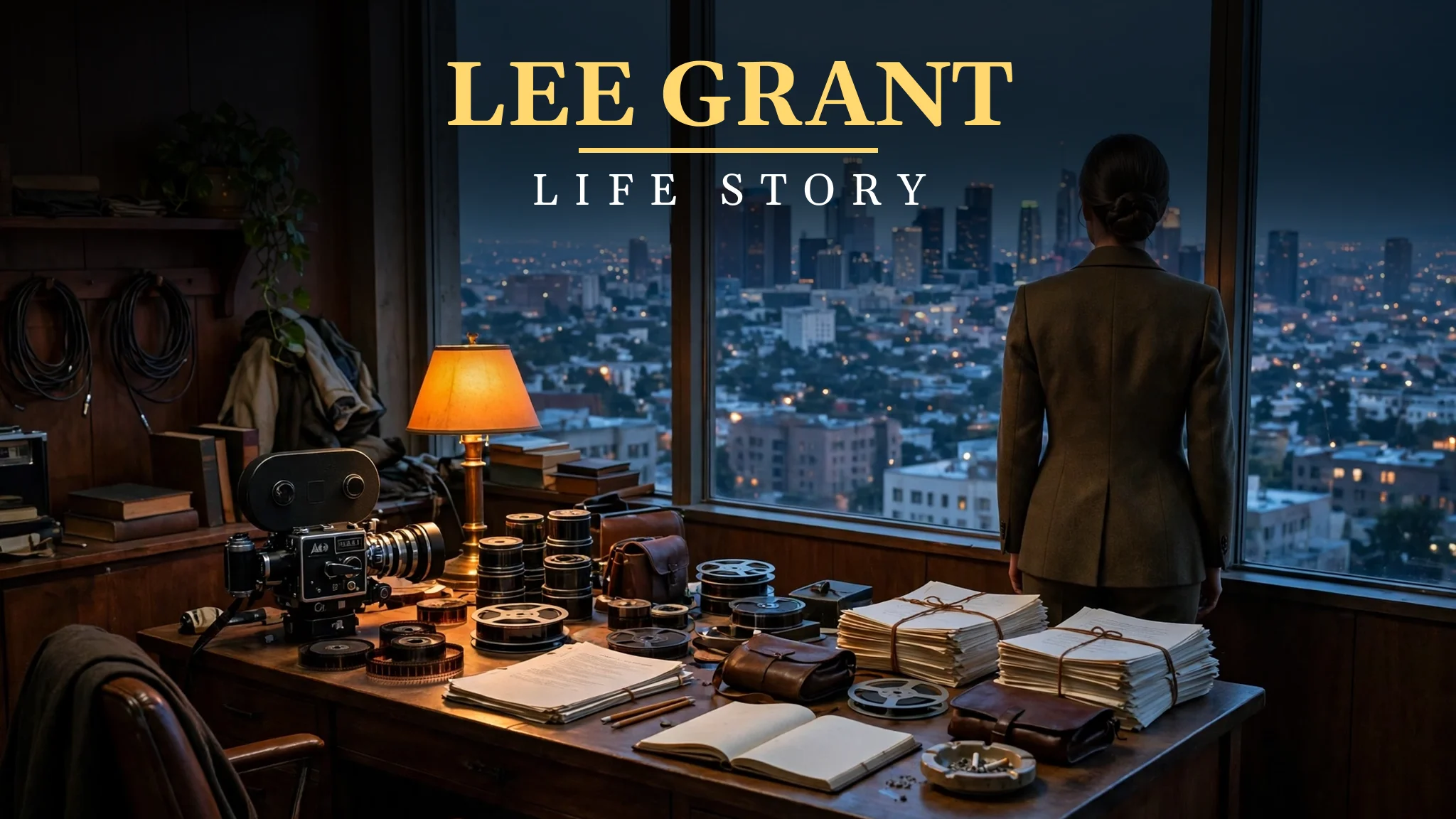
When I think of Lee Grant now, I think of a woman standing by a window in the evening, looking out at a city skyline, with a desk full of scripts and film reels behind her. She is not a young star anymore. She is a woman who has lived, who has waited, who has worked, and who has earned the right to look at the city and to know that she belongs in it. That image stays with me, because it captures both her patience and her strength. She waited, and she worked, and she came back, and she did it on her own terms.
I hope readers who find her story will watch In the Heat of the Night, and I hope they will watch her documentary about poverty, and I hope they will read her memoir. I hope they will see that she was more than a victim of the blacklist. She was a survivor, a teacher, an actress, and a director, and she was a woman who refused to let twelve years of silence be the end of her story. That is why I think her life matters, and that is why I think it will still matter many years from now, when the blacklist is only a chapter in a history book and her work is still there to be seen.
I also want to say something about her age, because reaching one hundred years old is a remarkable thing. She lived through almost a century of change, from the silent era to the age of streaming, and she worked in many of those eras. I think that long life gave her a perspective that few people have, a sense of how much can change and how much stays the same. She saw Hollywood change, she saw America change, and she changed with them, without losing herself. That is a rare achievement, and it is one more reason to admire her.
In the end, I think Lee Grant teaches us that silence is not the same as defeat. She was silenced for twelve years, but she was not defeated. She kept learning, she kept teaching, and she kept believing that her work mattered. When the silence ended, she was ready, and she did some of her best work after it. That is a lesson I will carry with me, and it is a lesson I hope others will carry too. Keep your skills alive, keep your dignity, and when the door opens again, walk through it with your head held high.
I also think about how Lee Grant’s story connects to the present, and to the way people are still punished for their opinions today. The blacklist was a specific moment in American history, but the fear behind it, the fear of being labelled, of losing work, of being shut out, is still with us in different forms. I think her life is a warning about what happens when we let fear decide who can work, and who can speak. She lost twelve years, and Hollywood lost twelve years of her talent, and that loss cannot be undone. We should remember that cost, and we should be careful not to repeat it, in any form, in any industry.
Another thought that stays with me is her daughter Dinah, and the way a mother’s career affects her children. Dinah grew up in a home where her parents were blacklisted, where money was tight, and where work was uncertain, and she became an actress herself. I think about what Dinah learned from watching her mother keep going, keep teaching, and keep believing. She learned that a career is not only about fame, but about resilience, about finding a way to work even when the doors are closed, and about using your skills to help others. That lesson, passed from mother to daughter, is a beautiful part of Lee’s legacy, and it shows that her influence goes beyond her own films.
I also wonder what she felt when she directed her first documentary, and when she realised that she could tell stories on her own terms. She had spent years waiting for someone to hire her, and suddenly she was the one hiring, the one choosing, the one deciding what story to tell. That shift from waiting to choosing must have felt powerful, and I think it gave her a sense of freedom that she had not felt since she was a young actress in New York. She used that freedom well, and she used it to shine a light on people who had no voice, on the poor, on women in prison, and on families struggling to survive. That is a use of freedom I admire deeply.
When I think of Lee now, I do not only think of the Oscar. I think of a teacher in a small classroom, helping a nervous student find their voice, and of a director on a documentary set, listening to a person tell their story, and of an actress in her eighties, still working, still learning, and still speaking honestly about her life. Those images, taken together, show a whole person, not only a star, and they show a life that was rich, difficult, and ultimately triumphant. She survived, she grew, and she gave back, and that is a life worth remembering.
I hope that people who read her story will not only watch In the Heat of the Night, but will also watch Down and Out in America, and will read her memoir, and will understand that she was more than a victim of the blacklist. She was a survivor, a teacher, a director, and a woman who refused to let twelve years of silence be the end of her story. Her life is proof that even a long silence can be followed by a strong voice, if you keep your skills alive and keep your dignity intact.
I also think about the way Lee Grant’s story is told today, and how important it is to tell it to young people who have never heard of the blacklist. Many students do not know that actors were once punished for their opinions, that they lost work for twelve years, and that a whole generation of talent was wasted because of fear. Her life is a clear and powerful example of that waste, and of the resilience needed to survive it. I think her memoir should be read in schools, and her films should be watched, so that new generations understand what happened, and so that they do not repeat it. History is not only about dates. It is about people like Lee, who lived through it and who came out the other side with their dignity intact.
I also want to remember her as a director, not only as an actress, because her directing work shows a different kind of courage. She chose to tell stories about poverty, about women in prison, and about people who were often ignored, and she did it because she believed that film should show the truth. That belief, that art should serve people, not only entertain them, is a powerful one, and it is one that I admire deeply. She used her second career to shine a light on people who had no voice, and that is a legacy that goes beyond any single award. It is a legacy of service, and it is one I will carry with me.
Frequently Asked Questions
How long was Lee Grant blacklisted in Hollywood?
Lee Grant was blacklisted for about twelve years, from the early 1950s until the early 1960s, after she refused to cooperate with the House Un-American Activities Committee in the way it wanted. During that time she could not get film or television work in Hollywood. She taught acting and worked in the theatre in New York, where the blacklist had less power, until the ban began to lift.
What film won Lee Grant her Academy Award?
She won the Academy Award for Best Supporting Actress for In the Heat of the Night in 1967, playing Mrs. Colbert, the widow of a murdered businessman. The win came sixteen years after her first Oscar nomination for Detective Story in 1951. It was a major comeback moment after her long years away from film work.
Did Lee Grant also work as a director?
Yes, she began directing in the 1980s and won an Academy Award for Best Documentary Feature for Down and Out in America in 1986, a film about poverty in the United States. She directed other documentaries and feature films as well, and her directing work became a major second career after her years as an actress.
What was Lee Grant’s first big role?
Her first big role was on Broadway in Detective Story in 1949, playing a shoplifter, and she repeated the role in the film version in 1951. Her performance earned her an Academy Award nomination for Best Supporting Actress when she was twenty-five. The role showed her ability to make a small part feel real and important.
Is Lee Grant still alive, and how old is she?
Lee Grant was born on 31 October 1925 in New York City, and she reached her hundredth birthday in October 2025. She is one of the last living links to the golden age of Hollywood and to the blacklist era. Her long life has spanned the rise of television, the fall of the studio system, and the growth of independent film.
What book did Lee Grant write about her life?
She wrote a memoir called I Said Yes to Everything, published in 2014 when she was in her late eighties. In the book she tells the story of her life in her own words, including the blacklist, her marriages, her work as an actress and director, and the choices she made. Readers praised it for its honesty and warmth.


