Leonardo da Vinci: The Life Story Behind the Renaissance Genius
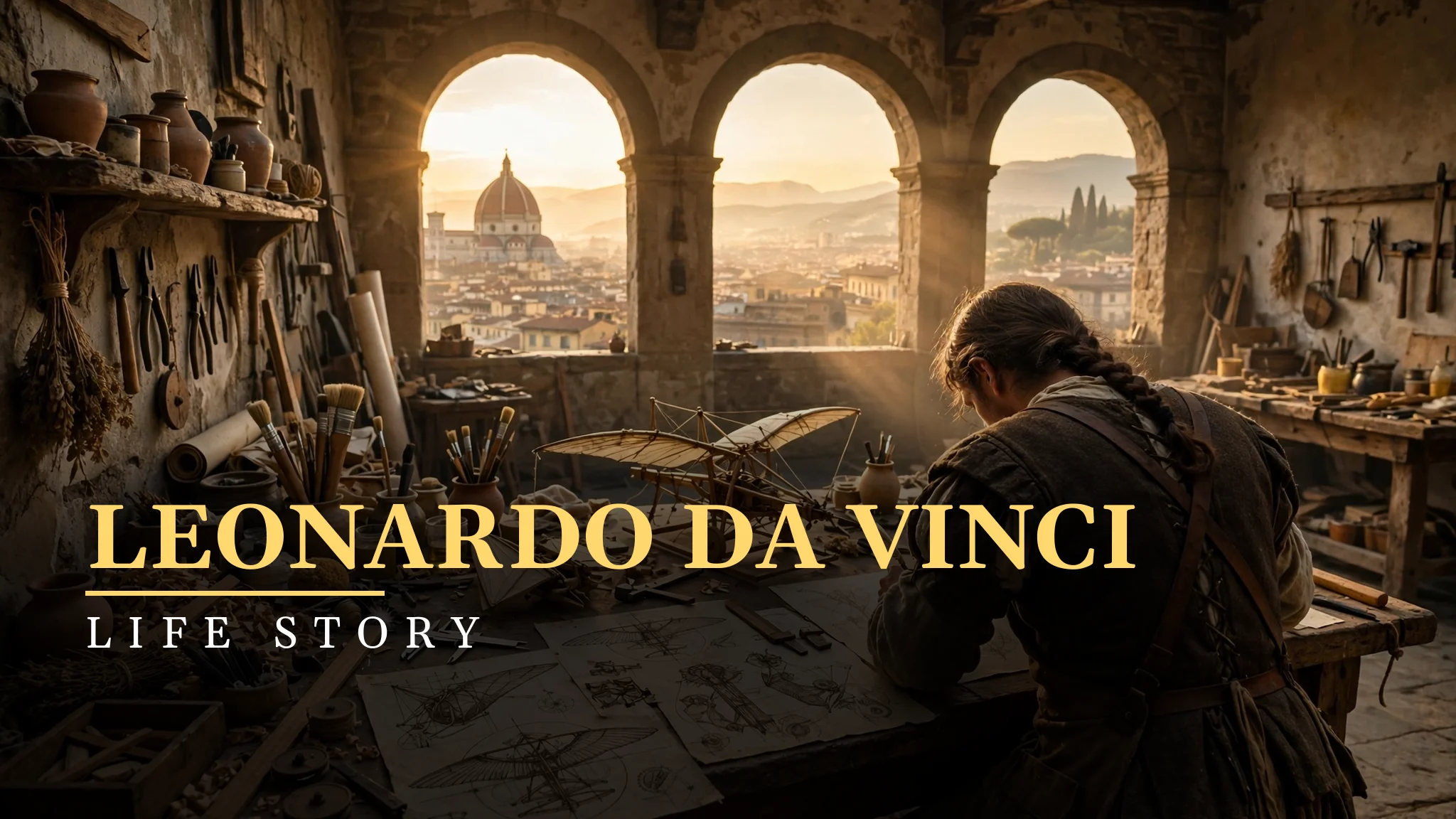
In this post
- A Boy in Vinci Who Watched the World
- Florence, Verrocchio, and the Young Artist
- Milan, The Last Supper, and the Court of Ludovico
- The Mona Lisa and the Smile No One Can Explain
- Notebooks, Flying Machines, and the Anatomy of the Body
- France, the Final Years, and a Death in the King’s Arms
- The Horse, the War Machines, and the Dreams That Were Never Built
- My Take:
Leonardo da Vinci is the closest thing history has to a universal genius, a man who was a painter, a sculptor, an engineer, an anatomist, a musician, a writer, and an inventor, all at the same time, and who was brilliant at all of them. He painted the Mona Lisa, the most famous painting in the world, and The Last Supper, one of the most reproduced images in history, and he also filled thousands of pages of notebooks with drawings of flying machines, of the human heart, of water, of plants, and of the stars. He was not a man who did one thing well. He was a man who did everything, and who did it with a curiosity that never stopped.
He was born on 15 April 1452 in Vinci, a small town in Tuscany, Italy, the illegitimate son of a notary and a peasant woman, and he grew up in the countryside, where he watched birds, water, and plants, and where he learned to draw by looking closely at the world around him. He was taken to Florence as a teenager, to work in the workshop of the artist Andrea del Verrocchio, and there he learned to paint, to sculpt, and to make things with his hands. From Florence he went to Milan, to Rome, and finally to France, where he died on 2 May 1519, at the age of sixty-seven, in the arms of the French king, or so the story goes, although the truth is less romantic and more human.
What makes Leonardo extraordinary is not only what he made, but how he thought. He believed that art and science were the same thing, that to paint a face you had to understand the muscles underneath it, and that to build a machine you had to understand nature. He wrote his notebooks in mirror writing, from right to left, so that only he could read them easily, and he filled them with questions, with drawings, and with ideas that were centuries ahead of his time. He dreamed of flying, he designed a helicopter, a tank, and a parachute, and he dissected human bodies to learn how they worked, at a time when such work was forbidden. He was a man out of time, and his notebooks are still studied today, five hundred years after his death.
A Boy in Vinci Who Watched the World
Leonardo di ser Piero da Vinci was born on 15 April 1452 in the small town of Vinci, in Tuscany, Italy, the son of Ser Piero da Vinci, a notary, and Caterina, a peasant woman whose full identity is not certainly known. He was born out of wedlock, which meant that he could not follow his father into the profession of a notary, and that he would have to make his own way in the world. He spent his early years in Vinci, living first with his mother and then with his father’s family, in a house in the countryside, where he was free to roam, to watch the birds, to study the plants, and to draw the world around him.
He was a curious child, and he was a beautiful child, with long hair and a face that people remembered, and he was also a child who asked questions that other children did not ask. Why does water flow the way it does? Why do birds fly? How does a face change when it smiles? Those questions stayed with him, and they became the questions of his life. He did not go to a formal school in the way that the sons of rich families did, and he did not learn Latin, the language of learning, which meant that he was always an outsider in the world of scholars. He learned by looking, by drawing, and by doing, and that way of learning became his greatest strength.
When he was about fourteen, his father took him to Florence, the great city of the Renaissance, and apprenticed him to Andrea del Verrocchio, one of the most famous artists in the city, whose workshop made paintings, sculptures, and objects for the churches and the rich families of Florence. Verrocchio’s workshop was a busy place, full of young artists learning their trade, and Leonardo was one of the best. He learned to paint, to mix colours, to sculpt in bronze, and to work with his hands, and he also learned that an artist was not only a maker of beautiful things, but also an engineer, a designer, and a thinker.
The story is told that Verrocchio asked Leonardo to paint an angel in one of his pictures, The Baptism of Christ, and that Leonardo’s angel was so beautiful that Verrocchio never painted again, because he knew he could not match his pupil. The story may not be true in every detail, but it captures something real: Leonardo was a prodigy, and everyone who saw his work knew it. He was not only talented. He was different, and his difference was that he saw the world more clearly than other people, and he could put what he saw onto paper and onto canvas in a way that no one else could.
Florence, Verrocchio, and the Young Artist
In Florence, Leonardo worked in Verrocchio’s workshop for many years, and he learned the craft of painting in the Renaissance style, which was based on careful drawing, on perspective, and on the study of nature. He painted, he sculpted, and he made drawings, and he began to develop his own style, which was softer, more subtle, and more interested in light and shadow than the style of his master. He was particularly interested in sfumato, a technique of painting in which colours and tones blend into each other without harsh lines, like smoke, and which gives his paintings their soft, mysterious quality.
He also began to keep notebooks, small books in which he wrote his thoughts, drew his observations, and recorded his ideas, and he kept them for the rest of his life. The notebooks are written in mirror writing, from right to left, which may have been because he was left-handed, or because he wanted to keep his ideas private, or simply because it was easier for him to write that way. Whatever the reason, the notebooks are one of the great treasures of the Renaissance, and they contain drawings of everything from the human heart to the flight of birds, from the flow of water to the design of a flying machine.
In 1472, he became a member of the painters’ guild in Florence, which meant that he was recognised as a master painter in his own right, and he began to take commissions of his own. He painted The Annunciation, a picture of the angel Gabriel telling the Virgin Mary that she will have a child, and The Adoration of the Magi, a large, unfinished painting that shows his ambition and his genius, even in its incomplete state. He was not a fast painter, and he often left works unfinished, because he was always thinking, always improving, and always dissatisfied with what he had done. That perfectionism was both his greatest strength and his greatest weakness, because it made his finished works perfect, but it also meant that many of his works were never finished at all.
He left Florence in 1482, when he was thirty, to go to Milan, where he offered his services to Ludovico Sforza, the ruler of Milan, not as a painter, but as an engineer, a maker of war machines, bridges, and fortifications. It was a strange offer for an artist, but it shows how Leonardo saw himself: not only as a painter, but as a man who could do anything, who could design a weapon, a building, or a painting, with the same mind and the same hands. Ludovico accepted, and Leonardo spent the next seventeen years in Milan, the longest period he spent in any one place, and the period in which he did some of his greatest work.
Milan, The Last Supper, and the Court of Ludovico
In Milan, Leonardo worked for Ludovico Sforza, and he painted, engineered, and designed for the court. His most famous work from this period is The Last Supper, painted between 1495 and 1498 on the wall of the refectory, the dining hall, of the monastery of Santa Maria delle Grazie in Milan. The painting shows the moment when Jesus tells his disciples that one of them will betray him, and it captures the reactions of each disciple, their shock, their anger, their disbelief, and their fear, in a way that no painting had done before. It is a large painting, fifteen feet high and twenty-nine feet wide, and it is one of the most famous images in the world, reproduced on posters, on plates, and in books, and visited by millions of people every year.
The Last Supper was painted in a new technique, using tempera on plaster, rather than true fresco, and the technique did not last, so the painting began to deteriorate soon after it was finished, and it has been restored many times. Even in its damaged state, it is a masterpiece, because of the way Leonardo composed it, with Jesus in the centre, the disciples grouped in threes, and the whole scene balanced and dramatic. It is a painting that tells a story, and that shows the inner life of its characters, and that is why it is still studied, still admired, and still loved.
In Milan, Leonardo also worked on a huge equestrian statue, a bronze horse for Ludovico, which was to be the largest statue of its kind in the world, but which was never completed, because the bronze was needed for cannons when Milan went to war, and because the model was destroyed by French soldiers when they invaded Italy. He also designed stage sets, costumes, and machines for court entertainments, and he filled his notebooks with drawings of machines, of weapons, and of the human body. He dissected corpses, in secret, to learn about anatomy, and he made drawings of the heart, the muscles, and the skeleton that were far ahead of their time, and that were not surpassed for centuries.
He left Milan in 1499, when the French invaded and Ludovico was overthrown, and he spent the next years travelling, working in Florence, in Rome, and in other cities, and always returning to his notebooks, to his painting, and to his questions. He was a man without a home, and without a patron who could keep him for long, but he was also a man who was free to go where he wanted, and to work on what interested him, and that freedom suited his restless mind.
The Mona Lisa and the Smile No One Can Explain
Leonardo began the Mona Lisa in 1503, when he was in Florence, and he worked on it for many years, carrying it with him when he travelled, and never quite finishing it, because he was never satisfied with it. The painting shows a woman, Lisa Gherardini, the wife of a Florentine merchant, sitting with her hands folded, looking out at the viewer with a small, mysterious smile, and with a landscape of winding roads and distant mountains behind her. It is a small painting, only thirty inches high, but it is the most famous painting in the world, and it is visited by millions of people every year in the Louvre in Paris, where it hangs behind glass, protected and admired.
The smile is the most famous part of the painting, and it is the part that has puzzled people for centuries. Is she smiling, or is she sad? Is she looking at you, or past you? The answer seems to change depending on where you stand, and on how you look, and that is because Leonardo used sfumato, the soft blending of light and shadow, to create a face that is not fixed, but that seems to change, like a real face. He also painted her without eyebrows, and without a clear outline, so that the face seems to emerge from the darkness, soft and alive, rather than flat and painted. It is a portrait that feels like a person, not like a picture, and that is why it has fascinated people for five hundred years.
Leonardo never delivered the Mona Lisa to the merchant who commissioned it, and he kept it with him until his death, which suggests that it meant something special to him, although no one knows exactly what. He took it to France when he went there in 1516, at the invitation of King Francis I, and after his death it became part of the French royal collection, and eventually part of the Louvre. It is now the most visited painting in the world, and it is a symbol of the Renaissance, of art, and of the mystery of a smile.
He also painted other works in his later years, including The Virgin and Child with St Anne, a large, soft painting of the Virgin, her mother, and the child Jesus, and St John the Baptist, a painting of a young man pointing upwards, with a mysterious smile, similar to the Mona Lisa. He worked slowly, he worked carefully, and he worked on many things at once, and he left many works unfinished, because his mind was always moving to the next idea, the next question, and the next drawing.
Notebooks, Flying Machines, and the Anatomy of the Body
Leonardo’s notebooks are perhaps his greatest achievement, even greater than his paintings, because they show the full range of his mind. He filled more than thirteen thousand pages with drawings and writings, on subjects that include anatomy, botany, geology, water, flight, warfare, and painting, and he did it over a period of more than forty years. The notebooks were not published in his lifetime, and they were scattered after his death, but they survive in collections in Milan, Paris, London, and other cities, and they are still studied today by scientists, artists, and historians.
He was fascinated by flight, and he studied birds for years, watching how they flapped their wings, how they soared, and how they landed, and he designed machines that could fly, including a glider, a helicopter, which he called an aerial screw, and a parachute, which he designed as a pyramid of cloth. None of his flying machines were built in his lifetime, and none of them would have worked as he designed them, because he did not understand the power needed to lift a human into the air, but his drawings show a mind that was thinking about flight centuries before the Wright brothers built the first aeroplane, and that is why he is remembered as a prophet of flight.
He was also fascinated by the human body, and he dissected more than thirty corpses, in secret, because the Church forbade the dissection of human bodies, and he made drawings of the heart, the lungs, the muscles, and the skeleton that were accurate, beautiful, and far ahead of their time. He was the first person to draw the heart correctly, with its four chambers, and the first to understand that the heart was a muscle that pumped blood, and his drawings were not surpassed for more than a century. He did this work not to become a doctor, but to become a better painter, because he believed that to paint a body you had to understand how it worked, inside and out.
He also studied water, and he drew the way water flows around rocks, the way it forms whirlpools, and the way it erodes the land, and he designed canals, bridges, and machines to control water. He studied plants, and he drew them with a botanist’s accuracy, and he studied geology, and he understood that the earth was much older than the Bible said it was, and that fossils were the remains of ancient animals, not the result of a flood. He was a scientist as well as an artist, and he was a scientist who used his eyes, his hands, and his drawings to understand the world.
France, the Final Years, and a Death in the King’s Arms
In 1516, when Leonardo was sixty-four, he accepted an invitation from King Francis I of France to come and live in France, at the Chateau du Clos Luce, near the royal palace at Amboise, in the Loire Valley. Francis was a young king who admired Leonardo, and who gave him a pension, a home, and the freedom to work on whatever he wanted. Leonardo took his notebooks, his paintings, including the Mona Lisa, and his ideas, and he spent the last three years of his life in France, in the company of the king, who visited him often, and who treated him as a friend and as a father figure.
The story is told that Leonardo died in the arms of King Francis, on 2 May 1519, at the age of sixty-seven, and that the king held his head as he died. The story may not be true, because Francis was not in Amboise on the day Leonardo died, but it captures something real: the love and the respect that the young king had for the old artist, and the sense that Leonardo’s death was the end of an era. He was buried in the chapel of Saint-Hubert at Amboise, and his grave was lost for centuries, until it was rediscovered in the nineteenth century, and his bones were reburied in the chapel where they rest today.
He left behind his notebooks, his paintings, and a reputation as the greatest genius of the Renaissance, a man who could do everything, and who did it with a curiosity that never faded. He was not a perfect man, and he was not a man who finished everything he started, but he was a man who saw the world more clearly than anyone else, and who left behind a record of that vision in his drawings and his paintings. He is still studied, still admired, and still loved, five hundred years after his death, and his notebooks are still teaching us how to look, how to draw, and how to think.
The Horse, the War Machines, and the Dreams That Were Never Built
Leonardo’s notebooks are full of machines that were never built in his lifetime, including a great bronze horse for Ludovico Sforza in Milan, which was to be twenty-four feet high, the largest equestrian statue in the world, and which Leonardo worked on for years, making models, studying horses, and designing the mould, only for the bronze to be taken for cannons when Milan went to war, and for the clay model to be destroyed by French soldiers. He also designed tanks, with cannons pointing in every direction, and a giant crossbow, and a machine gun, and other weapons of war, although he hated war, and although he wrote that he did not want his machines to be used to kill. He designed them because Ludovico paid him to, and because he was curious about how they would work, and because he believed that an engineer should be able to design anything, even a weapon, although he hoped that his designs would never be used.
He also designed a helicopter, a parachute, and a glider, and he drew them with such care, and with such understanding of the principles of flight, that modern engineers have looked at his drawings and marvelled at how close he came to the truth, centuries before the first aeroplane flew. His machines were not built, and they would not have worked as he drew them, because he did not have the materials, or the engines, or the understanding of power that modern engineers have, but his drawings show a mind that was thinking about the future, and that was willing to dream, even when the dream could not yet be built. That willingness to dream is one of the most important parts of his legacy, because it shows that a great mind does not only solve the problems of today, but also imagines the possibilities of tomorrow.
My Take:
I think Leonardo da Vinci is the most extraordinary person who ever lived, and I do not say that lightly, because there have been many extraordinary people, but none of them did what Leonardo did. He was a painter, a sculptor, an engineer, an anatomist, a musician, and an inventor, and he was brilliant at all of them, not just good, but brilliant, in a way that no one else has ever been. He painted the most famous painting in the world, he designed machines that would not be built for centuries, and he drew the human heart correctly when no one else could. That is not a normal life. That is a life that seems almost impossible, and yet it was real, and it is documented in his notebooks, in his paintings, and in the records of his time.
What I love most about Leonardo is his curiosity. He was curious about everything: about birds, about water, about the human body, about light, about shadows, and about the smile of a woman. He did not accept the answers he was given. He looked, he drew, he asked, and he kept asking until he understood for himself. That curiosity is the most important quality a person can have, in my opinion, because it is the quality that leads to learning, to discovery, and to growth. A person who is not curious will never learn anything new, and a person who is curious will never stop learning. Leonardo never stopped, and that is why his notebooks are still being studied five hundred years after his death.
I also love the fact that he was an outsider. He was born out of wedlock, he did not learn Latin, he did not go to university, and he was not part of the world of scholars. He learned by looking and by doing, and that way of learning was, in many ways, better than the way of the scholars, because it was based on observation, not on authority. He did not believe something because a book said it. He believed it because he had seen it, drawn it, and understood it. That is a lesson for all of us: do not trust authority blindly, look for yourself, draw what you see, and think for yourself. Leonardo did that, and he changed the world because of it.
The Mona Lisa is the part of his work that I think about most, because it is so small, and so famous, and so mysterious. It is a painting of a woman with a small smile, and people travel from all over the world to see it, and they stand in front of it, and they try to understand the smile, and they cannot. I think that is the point. Leonardo did not paint a smile that can be explained. He painted a smile that changes, that seems happy and sad at the same time, and that feels like a real person, not like a picture. That is the magic of his painting, and it is why it has lasted. He understood that a face is not a fixed thing, but a living thing, and he painted it that way, with soft edges, with light and shadow, and with a mystery that has never been solved.
I think about his notebooks, and how they were written in mirror writing, and how they were not published in his lifetime, and how they were scattered after his death, and I feel a kind of sadness, because if they had been published, the world might have learned from them centuries earlier. His drawings of the heart, of the flying machine, of water, and of plants were ahead of their time, and they were lost, or hidden, for hundreds of years. That is a reminder that genius is not enough. A genius also needs a world that is ready to listen, and Leonardo’s world was not ready. It took centuries for the world to catch up with him, and that is both a tragedy and a triumph, because his ideas survived, even when the world was not listening.
I want to be honest about his flaws, because he was not perfect, and because a full picture includes them. He left many works unfinished, he was slow, he was easily distracted, and he often moved on to a new idea before he had finished the old one. The Adoration of the Magi, the great horse in Milan, and many other works were never completed, and that must have frustrated the people who paid for them. I do not think that makes him less great, but I think it makes him more human, and it reminds me that even a genius has limits, and that perfectionism can be a weakness as well as a strength. He wanted everything to be perfect, and because he wanted perfection, he sometimes finished nothing. That is a lesson for all of us: sometimes it is better to finish something good than to dream of something perfect and never finish it.
I also think about his dissections, and how brave they were. He dissected human bodies in secret, at a time when the Church forbade it, and he did it to learn, to draw, and to understand. That took courage, and it took a belief that knowledge was more important than rules, and that the truth about the human body was worth the risk. I admire that courage, because it shows that he was not afraid to break the rules when the rules stood in the way of truth. He was not a rebel for the sake of being a rebel. He was a rebel for the sake of knowledge, and that is the best kind of rebellion.
I also think about The Last Supper, and about how it captures a single moment, the moment when Jesus says that one of his disciples will betray him, and how Leonardo shows the reaction of each disciple, in their faces, in their hands, and in their bodies. It is not a painting of a calm dinner. It is a painting of shock, of anger, of fear, and of disbelief, and it is a painting that tells a story in a way that words cannot, because it shows thirteen people, all reacting at once, all differently, and all truthfully. I think that is the genius of Leonardo as a storyteller: he did not paint a scene, he painted a moment, and he painted the inner life of the people in it, and that is why the painting is still studied, still admired, and still reproduced, five hundred years later.
I think about his notebooks, and about the mirror writing, and about the fact that they were not published in his lifetime, and I feel a sadness, because the world could have learned from them so much earlier. His drawings of the heart were correct, his designs for flying machines were visionary, and his studies of water were beautiful, and they were hidden, in private books, for centuries, while the world went on without them. That is a reminder that genius is not enough, and that a genius also needs to share their work, and to publish it, and to teach others, or the work can be lost. Leonardo shared his paintings, but he kept his notebooks private, and that privacy cost the world centuries of knowledge. I do not blame him, because he was a private man, and because he wrote for himself, but I wish he had shared more, and sooner.
Another thought that stays with me is about his perfectionism, and about the works he left unfinished. The Adoration of the Magi, the great horse, and many other works were never completed, because Leonardo was always thinking, always improving, and always dissatisfied. I understand that feeling, because I have felt it in my own work, the feeling that something is not good enough, and that it would be better to start again, or to leave it, than to finish it imperfectly. But I also think that perfectionism can be a trap, and that sometimes it is better to finish something good than to dream of something perfect. Leonardo’s finished works are perfect, and they are worth the wait, but his unfinished works are a reminder that even a genius can be stopped by his own high standards, and that is a lesson for all of us: do your best, and then let it go.
I think about his dissections, and about the courage it took to cut open a human body, in secret, at a time when the Church forbade it, and to draw what he saw, with accuracy and with beauty. He did it not to shock, but to learn, and to paint better, and to understand the human body, and that is a kind of courage that is rare, because it is the courage to break a rule for the sake of truth. I admire that, and I think it is a lesson for scientists, and for artists, and for anyone who wants to learn: do not accept the rules that stand in the way of truth, question them, and, if you must, break them, carefully, and for a good reason. Leonardo did that, and his drawings of the heart are still used today, as a testament to what he learned.
I also think about his time in France, and about the kindness of King Francis, who gave an old man a home, a pension, and the freedom to work, and who visited him, and treated him as a friend. It is a beautiful ending to a life that had been restless, and that had moved from Florence to Milan to Rome, and finally to France, because it shows that Leonardo, who had been an outsider for most of his life, found a home at the end, and a king who loved him, not for his usefulness, but for who he was. I find that moving, because it tells me that even a genius, who is often lonely, can find a friend, and a home, if he lives long enough, and if he is lucky enough to meet a person who understands him.
Finally, I want to say something about looking, because that is the skill that Leonardo taught me most. He looked at water, and he saw how it flowed. He looked at a bird, and he saw how it flew. He looked at a face, and he saw how it smiled. He looked, and he drew, and he thought, and he never stopped looking. I try to look a little more carefully because of him, to notice the world around me, to ask why, and to draw what I see, even if I cannot draw well. Looking is the first step to understanding, and Leonardo was the greatest looker who ever lived, and that is why his notebooks are still teaching us, five hundred years after his death, how to see.
What I take from Leonardo’s life, in the end, is a lesson about looking. He looked at the world, really looked, with his eyes, with his hands, and with his mind, and he saw things that other people missed: the way water flows, the way a bird flies, the way a face changes when it smiles, and the way the heart pumps blood. He looked, and he drew, and he thought, and he never stopped. I try to look a little more carefully because of him, to notice the world around me, to ask why, and to draw what I see, even if I cannot draw well. Looking is the first step to understanding, and Leonardo was the greatest looker who ever lived. That is why I admire him, and why I think his story will be told for as long as people paint, and draw, and wonder how the world works. I also think about the way his notebooks are kept today, in museums and libraries, in Milan, in Paris, and in London, and about the people who travel to see them, and who look at his drawings of a heart, or of a flying machine, and who feel a connection to a man who lived five hundred years ago. That connection is real, because his drawings are not old, they are alive, and they speak to anyone who looks at them carefully, in any century. I think that is the best definition of genius: work that is still alive, still teaching, and still inspiring, long after the person who made it is gone. Leonardo’s work is alive, and it will stay alive, as long as people look, and draw, and wonder.
Frequently Asked Questions
When and where was Leonardo da Vinci born?
Leonardo da Vinci was born on 15 April 1452 in Vinci, a small town in Tuscany, Italy, the son of Ser Piero da Vinci, a notary, and Caterina, a peasant woman. He grew up in the countryside, where he watched birds, water, and plants, and learned to draw by looking closely at the world.
What is the Mona Lisa and why is it famous?
The Mona Lisa, begun in 1503, is a portrait of Lisa Gherardini, the wife of a Florentine merchant, famous for her mysterious smile, which seems to change as you look at it. Leonardo used a soft technique called sfumato to create the smile, and the painting is now in the Louvre in Paris, where millions of people visit it every year.
What is The Last Supper?
The Last Supper, painted between 1495 and 1498 in Milan, shows the moment Jesus tells his disciples that one of them will betray him, capturing each disciple’s shock and disbelief. It is painted on the wall of the monastery of Santa Maria delle Grazie in Milan and is one of the most famous images in the world.
Did Leonardo da Vinci design flying machines?
Yes, Leonardo studied birds for years and designed a glider, a helicopter he called an aerial screw, and a parachute, centuries before the first aeroplane was built. None of his machines were built in his lifetime, and they would not have worked as designed, but his drawings show a mind thinking about flight long before anyone else.
Why did Leonardo write in mirror writing?
Leonardo wrote his notebooks from right to left, in mirror writing, which may have been because he was left-handed, or because he wanted to keep his ideas private, or simply because it was easier for him. His notebooks contain more than thirteen thousand pages of drawings and writings on art, anatomy, flight, water, and many other subjects.
When did Leonardo da Vinci die?
Leonardo da Vinci died on 2 May 1519 in France, at the age of sixty-seven, at the Chateau du Clos Luce near Amboise, where he had lived for the last three years of his life as a guest of King Francis I. He was buried in the chapel of Saint-Hubert at Amboise.


