Lights: The Life Story Behind the Synth-Pop Star
In this post
- A Childhood That Moved From Place to Place
- Finding a Voice Online and in Toronto
- The Listening and a Juno Award
- Siberia, Little Machines, and a Bigger Sound
- Skin and Earth, Comics, and a World of Her Own
- Pep, New Music, and Life as a Mother
- A Bright Voice That Keeps Shining
- The Light in the Songs and the Shows That Carry It
- My Take:
Lights makes music that glows. Her songs are bright, fast, and full of light, and they have made her one of Canada’s most loved pop singers. She sings over shining keyboards, she writes about hope and hard days, and she turns her feelings into melodies that stay in the mind long after the song ends. For many fans, her voice is the sound of a friend who believes that tomorrow can be better than today.
She was born Valerie Anne Poxleitner in Timmins, Ontario, and she grew up in a family that moved often. As a child she lived in different places, and she learned early how to make a new home in a new town. Music was her steady place. She sang, she played, and she wrote songs that helped her understand a world that kept changing around her. That early habit of turning change into music stayed with her for her whole career.
What makes her story special is the way she built a career from the internet and from her own hard work. She did not wait for a television show to find her. She shared her songs online, she played small shows, and she let listeners discover her one by one. She also drew comics, she told stories with pictures as well as with sound, and she created a world around her music that fans could step into. This is the story of a girl from a small Canadian town who became a synth-pop star with a light that never went out.
A Childhood That Moved From Place to Place
Lights was born on 11 April 1987 in Timmins, a mining town in northern Ontario. Her parents were missionaries, and their work took the family to different countries when she was young. She spent part of her childhood in the Philippines, and she also lived in Jamaica, before the family returned to Canada. Those years gave her a view of the world that was wider than most children get, and they taught her that home is not always one house in one town. Home can be a family, a song, or a feeling that travels with you.
Moving so often was not always easy. A child who changes schools and friends again and again has to learn how to be brave, how to start over, and how to find joy in a new place. Lights learned those lessons early, and they shaped her music. Her songs often talk about leaving, arriving, and holding on to hope when life feels uncertain. That feeling did not come from a book. It came from her own years of packing, travelling, and starting again.
Music was with her through all those moves. She learned to play instruments, she sang in church and at home, and she began to write her own songs while she was still young. Writing gave her a way to keep her thoughts in one place, even when her address kept changing. A song could travel with her in a way that a house could not, and she began to trust that feeling. The piano and the keyboard became her friends, and they stayed with her when other things changed.
When the family settled in Canada, she had a clearer base, but she kept the wide view she had gained as a child. She understood that people in different places listen to music in different ways, and she understood that a good melody can cross borders. That understanding helped her later, when her songs reached listeners in many countries. She had already lived in many worlds, and her music was ready to travel too.
Finding a Voice Online and in Toronto
As a teenager, Lights began to share her music on the internet, at a time when many singers were still waiting for a record label to find them. She used MySpace, a site where musicians could post songs and talk to fans directly, and she built a small audience that liked her bright sound. Her songs were clear, her voice was strong, and her melodies were easy to remember. People shared them with friends, and slowly her name began to spread beyond her home town.
She moved to Toronto, the biggest music city in Canada, and that move gave her new chances. Toronto had studios, clubs, and other musicians who were trying to build careers, and Lights worked hard to be part of that world. She played shows, she met people in the music business, and she learned how a song moves from a bedroom recording to a real record. It was not an easy life, and it took patience, but she kept writing and she kept performing.
Her early songs had a fresh, electronic sound. She used keyboards and synths to make music that felt like light itself, bright and full of energy. At the same time, her words were honest about fear, love, and hope. That mix of bright sound and honest feeling made her stand out. Many pop songs are bright but empty. Hers were bright and full of meaning, and listeners could feel the difference.
In Toronto she also learned to trust her own taste. She did not try to sound like every other pop singer. She kept her own voice, her own style, and her own ideas about what a song should be. That choice took courage, because the music business often asks young artists to copy what is already popular. Lights chose to be herself, and that choice became the foundation of her whole career.
The Listening and a Juno Award
In 2009 Lights released her first album, The Listening. The album had a clean, glowing sound, and it included songs that became favourites for her early fans. Drive My Soul was one of the best-known tracks, with a melody that felt hopeful and a voice that sounded clear and strong. The album showed that she could make a full record, not only a few songs online, and it gave her a real place in Canadian pop music.
The Listening was praised for its fresh sound and its honest words. Critics liked the way she mixed electronic pop with real feeling, and fans liked the way the songs made them feel brave. The album did not try to be dark or clever. It tried to be true, and that truth reached people. For a first album, it was a strong start, and it showed that Lights had more to say than a single hit.
That same year she won the Juno Award for New Artist of the Year, one of the biggest honours in Canadian music. A Juno is a sign that the music world has noticed a new voice, and it gave Lights a new level of attention. She was no longer only an internet singer. She was an award-winning artist, and people in Canada and beyond began to watch what she would do next. The award did not change her sound, but it gave her more room to grow.
After The Listening, she toured, she played festivals, and she met fans who knew her songs by heart. Touring taught her how to sing the same songs night after night and still make them feel fresh. It also taught her how to connect with a crowd, how to smile through tired days, and how to keep her voice strong. Those lessons stayed with her, and they helped her to build a career that lasted far beyond one album.
Siberia, Little Machines, and a Bigger Sound
In 2011 Lights released her second album, Siberia. The album had a colder, deeper sound than her first record, and it showed that she was growing as a writer. Songs like Toes and Everybody Breaks a Glass had more edge, and the record felt more grown up. She was still bright, but she was also willing to talk about pain, about breaking, and about the hard parts of life. That honesty made the album feel real to fans who were growing up with her.
Siberia was praised by critics and by fans, and it proved that Lights was not a one-album singer. She could change her sound, she could try new ideas, and she could still keep her core feeling. The album also showed her skill with electronic music. The synths were rich, the beats were strong, and the voice sat on top of the sound like a light in a dark room. It was a record that sounded good on headphones and on a big stage.
In 2014 she released Little Machines, an album that brought back a warmer, more open feeling. The best-known song from that record was Up We Go, a bright and hopeful track that became one of her biggest hits. Up We Go talked about rising up after a hard time, and it became an anthem for fans who needed courage. The song was played on radio, it was used in shows and ads, and it introduced Lights to many new listeners who had not heard her before.
Little Machines also showed her growth as a performer. She toured the album in many countries, she played bigger rooms, and she learned how to lead a show with confidence. She was no longer a new artist finding her feet. She was a singer with three albums, a loyal audience, and a clear voice. The record proved that she could keep making music that was both popular and personal, and that balance is hard to hold for any artist.
Skin and Earth, Comics, and a World of Her Own
In 2017 Lights released Skin and Earth, an album that was also a comic book. She wrote and drew the comic herself, and the songs told the same story as the pictures. The comic was about a young woman in a world that had lost its colour, and the music gave that story a voice. It was a bold idea, because few pop singers try to make an album and a comic at the same time, but Lights had always loved drawing and storytelling, and she wanted to bring those loves together.
Skin and Earth included the song Giants, a strong and hopeful track that became a favourite. The album had a darker, more dramatic sound than her earlier work, and it showed that she could tell a long story across many songs. Fans who read the comic could hear the story in the music, and fans who only heard the music could still feel the drama. It was a complete world, and it showed how much she had grown as an artist.
The comic also showed her skill as a visual artist. She had drawn since she was young, and she had always liked comics and science fiction. By making Skin and Earth, she proved that a singer can also be a storyteller in pictures, and that music and art can live in the same project. That project gave her a new kind of fan, people who loved comics as well as music, and it opened a new door in her career.
After Skin and Earth, she kept exploring new ideas. She released acoustic versions of her songs, she worked with other artists, and she kept touring. She did not rush her next album, and she took time to live, to think, and to write. That patience is important, because a singer who rushes can lose the feeling that made people love her. Lights chose to wait until she had something true to say, and her fans waited with her.
Pep, New Music, and Life as a Mother
In 2022 Lights released Pep, an album with a bright, playful, and honest sound. The record talked about life, love, and the ups and downs of being an adult, and it had songs that felt light and songs that felt deep. It showed that she was still writing with care, still trying new sounds, and still willing to be open about her feelings. Fans liked the way the album felt like a conversation with a friend who had grown up alongside them.
Pep also came after a big change in her personal life. Lights married Beau Bokan, the singer of the band Blessthefall, and they had a daughter named Rocket. Becoming a mother changed the way she saw time, work, and music. She had to balance touring with family life, and she had to find new ways to write when her days were full of care for a child. That balance is not easy, and many artists struggle with it, but Lights talked about it openly and with warmth.
In the years after Pep, she released more music, including the album A6 in 2025, and she kept playing shows. Her later work kept the bright sound that fans loved, but it also had a calmer, more settled feeling. She was no longer a young singer trying to prove herself. She was a mother, a wife, and an artist with a long career, and her songs reflected that fuller life. The music still glowed, but it glowed with a deeper light.
Her life as a mother also gave her new stories to tell. She wrote about love in a different way, about hope in a different way, and about the future in a different way. A child changes the way a person thinks about tomorrow, and Lights let that change into her songs. Fans who had grown up with her could hear that change, and many of them were going through the same changes in their own lives.
A Bright Voice That Keeps Shining
Lights is known for a kind, open way of dealing with fans. She talks to them online, she shares her art, and she thanks them for their support. She does not act distant or superior. She acts like a person who knows that her career exists because listeners chose to listen, and she treats that choice with respect. That kindness has helped her to keep a loyal audience for more than fifteen years.
Her influence can be seen in the way many young Canadian singers now use the internet to share their work. She was one of the early artists who proved that a singer could build a career online without waiting for a big label to find her. That example gave courage to many young musicians, and it helped to change the way Canadian pop music works. She did not only make songs. She helped to open a door for others.
Today her place in Canadian music is secure. Her early albums are still played, her later albums are still loved, and her songs are still shared by new listeners every year. She began as a girl who moved from place to place, and she became a singer whose music travels even further than she did. Her voice is bright, her stories are honest, and her light has not faded. That is the heart of her story, and it is why fans still wait for her next song.
The Light in the Songs and the Shows That Carry It
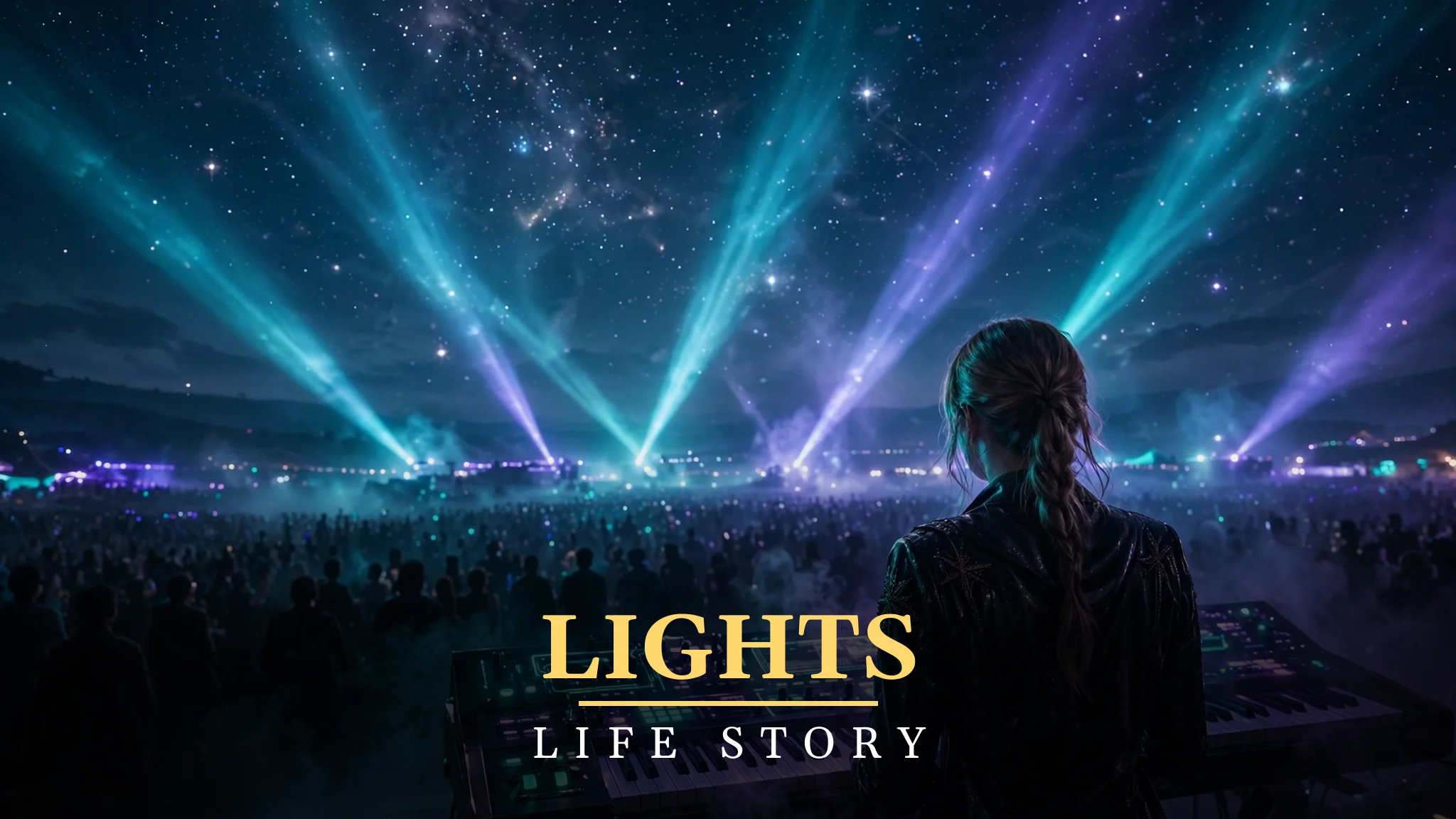
One of the clearest things about Lights is the way her live shows feel like a bright room in a dark night. She stands behind her keyboards, the lights move across the stage, and the crowd sings along to songs they have loved for years. The show is not built on big tricks or on a loud band that drowns out the singer. It is built on her voice, on the glow of the synths, and on the feeling that everyone in the room is sharing the same hope. A fan who has had a hard week can walk into that room feeling tired, and walk out feeling lighter, because the music has given them a small lift.
Her songwriting also shows a careful balance between pop and honesty. A pop song is often made to be simple, to be easy to sing, and to be easy to remember, and Lights knows how to do all of those things. But she does not stop there. She adds words about fear, about starting over, about love that is not perfect, and about the courage to keep going when life is hard. That extra layer makes her songs last longer than a normal pop hit, because a listener can return to them in a different year and find a new meaning in the same words.
She has also worked with other artists, and those collaborations show how flexible her voice is. She can sing with a rock band, she can sing over a dance beat, and she can sing a quiet acoustic song with only a piano. Each time, her voice stays clear and her feeling stays true. That flexibility has helped her to stay in music for a long time, because she is not locked into one sound or one style. She can try new things, and her fans are willing to follow her when she does.
The comic book work is another sign of how wide her talent is. Many singers can write a song, but few can also draw a whole comic, build a world in pictures, and tell a story that matches the music. Lights did that with Skin and Earth, and she did it with care. The comic was not a small extra. It was a real story, with real characters, and it showed that she thinks in pictures as well as in sound. Fans who love comics found a new reason to love her, and fans who love music found a new way to hear her songs.
Her connection with Canada also matters. She is a Canadian singer who has stayed proud of her home, and she has won Juno Awards, played Canadian festivals, and worked with Canadian artists. Canada is a country with many voices, and Lights is one of the clearest. She shows that a singer from a small town in northern Ontario can reach the world, and she shows it without losing her kindness or her sense of home. That example matters for young singers in small towns everywhere.
The way she uses the internet is also part of her story. She talks to fans, she shares her drawings, she posts about her life as a mother, and she lets people see the real person behind the songs. That openness builds trust, and trust builds a long career. A fan who feels known is a fan who stays, and Lights has built a community, not only an audience. That community has carried her through changes in music, changes in life, and changes in the world around her.
Her keyboards glow with a light that feels like hope itself, and that glow has become a symbol for her fans, who see in it a reminder that a dark night can still hold a bright song. Lights makes electronic music that feels human, not cold, and that warmth is what makes her songs different from many other pop records.
My Take:
I think Lights is a singer who proves that hope can be a serious thing. When I hear her songs, I do not hear empty happiness. I hear a person who knows that life can be hard, and who still chooses to sing about light. That choice takes courage, because it is easy to be dark and to say that nothing will get better. It is harder to say that tomorrow can be bright, and to mean it. Lights means it, and I can hear that truth in her voice.
I admire the way she started online. She did not wait for permission. She posted her songs, she talked to fans, and she built a career one listener at a time. That path is now normal for many young artists, but when Lights started, it was still new. She had to trust that her songs were good enough to find people on their own, and that trust paid off. I think that is a lesson for anyone who makes something: share your work, be patient, and let the right people find you.
What I like most about her music is the mix of bright sound and honest words. Up We Go is a good example. The melody is joyful, the beat is strong, and the words talk about rising after a fall. That song has helped many people through hard days, and I think that is a beautiful thing for a pop song to do. A song that only makes you dance is fine, but a song that makes you dance and also gives you courage is better, and Lights writes songs like that.
I also think about her childhood, and how moving so often shaped her. A child who changes homes again and again learns to carry hope inside, because the outside world keeps changing. Lights learned that lesson, and she turned it into music. Her songs often feel like a light in a new place, a small hope that travels with you. I find that moving, because it shows how a hard childhood can become a gift, if a person learns to turn it into art.
There is a part of her story that makes me think about comics and stories. Skin and Earth was a brave project, because it asked fans to read a comic and listen to an album at the same time. Many artists would not try that, because it is risky and it takes a lot of work. Lights tried it because she loved both music and drawing, and she wanted to share that love. I respect that bravery, because it shows that an artist should follow her own ideas, even when they are unusual.
I also respect the way she has balanced music and family. Becoming a mother changes a life, and it changes a career. Lights did not hide that change. She talked about it, she wrote about it, and she kept making music in a way that fit her new life. That honesty helps other mothers who are also artists, and it helps fans who are also parents. It says that a career does not have to end when a child is born. It can grow in a new way, and it can become deeper.
For a young listener, I think the lesson is to keep your light on. Life will change, homes will change, and plans will change, but a person who keeps making, keeps singing, and keeps hoping will find a way through. Lights kept her light on through many moves, through many albums, and through many years, and that light still shines. I think that is a good model for anyone who feels lost or far from home.
I do wonder sometimes if her bright sound can hide how deep her songs really are. Some listeners may hear only the synths and the melody, and they may miss the words about fear and hope. But that is also a strength. A song that sounds bright can reach people who would not listen to a sad song, and once they are listening, the words can do their work. Lights understands that, and she uses bright music to carry serious feelings. That is a clever and kind way to write.
When I think about her later albums, I feel a quiet respect for her patience. She did not rush Pep, and she did not rush her next record. She waited until she had something true to say, and then she said it with care. In a music world that asks for a new song every week, that patience is rare. It tells me that she cares more about the song than about the chart, and I think fans can hear that care in every note.
I also think about her kindness to fans. She answers, she shares, and she treats listeners like friends. That kindness is not a small thing. In a world where many famous people seem distant, a singer who is kind and open stands out. It makes fans want to stay, and it makes new listeners want to join. I would rather be remembered for kindness than for a single hit, and I think Lights will be remembered for both.
In the end, I see Lights as a singer who turned a moving childhood into a bright career. She turned change into hope, she turned the internet into a stage, and she turned a comic book into an album. She did all of that with a voice that is clear, honest, and full of light. I do not need her to be louder or darker. I need her to keep being herself, because her light is what makes her songs special, and the world needs more light like that.
One more thought stays with me. When I hear her music, I think of a night sky full of stars, with a small light moving through it. That light is hope, and it is the heart of her work. She makes music for people who are travelling, who are starting over, and who need a reason to keep going. I am glad she is still singing, and I hope she keeps shining for many years to come.
I also think about how her music helps people who are far from home. She grew up moving, and many of her fans are also moving, studying in a new city, working in a new country, or starting a new life after a hard change. Her songs speak to those people, because they talk about carrying light with you, about finding a new home, and about hoping for a better tomorrow. That message is simple, but it is also deep, and it is one that many people need to hear again and again.
Another thing I admire is her work ethic. She has made many albums, she has toured for years, she has drawn a comic, and she has raised a child, all while keeping her voice strong and her songs honest. That is a lot of work, and it takes discipline. She does not seem to complain about that work. She seems to love it, and that love can be heard in the music. A singer who loves her work makes better songs, and Lights is a good example of that truth.
When I listen to her later music, I hear a woman who is calm and sure of herself. She is not trying to prove that she is young, and she is not trying to copy a new trend. She is making music that fits her life now, music about love, family, hope, and the future. That calm is a gift, and it makes her later songs feel warm and safe. I think many listeners, especially those who have grown up with her, find comfort in that calm, because it feels like a friend who has grown up alongside them.
I also think about the future, and I hope she keeps making music for many years. The world changes fast, and pop music changes even faster, but a clear voice and an honest song will always have a place. Lights has both, and she has the skill to keep using them in new ways. Whether she makes another comic, another album, or a quiet acoustic record, I think her fans will listen, because they trust her to tell the truth in a bright and beautiful way.
In the end, I see Lights as a singer who chose hope as her main theme, and who has stayed true to that choice through every change in her life. She chose hope when she moved as a child, she chose hope when she shared her songs online, she chose hope when she made Skin and Earth, and she chooses hope now as a mother and an artist. That steady hope is rare, and it is why her music still matters. I will keep listening, because her light helps me to see my own way forward, and I think it does the same for many other people too.
I also want to say something about her voice itself, because it is easy to forget how hard it is to sing the way she does. Her voice is clear, it is strong, and it can move from a soft whisper to a bright, high note without losing its warmth. She does not hide behind loud instruments, and she does not use her voice to show off. She uses it to carry a feeling, and that feeling reaches the listener directly. When I hear her sing Up We Go, I feel the lift in the melody, and I feel the hope in the words, and those two things together make the song powerful.
There is also a lesson in the way she treats her fans like a community. She shares her art, she answers with kindness, and she remembers that her career exists because people chose to listen. That respect is not common in fame, where many artists act as if the audience owes them something. Lights acts as if she owes the audience her best work, and that attitude makes people want to stay with her for years. I think that is a good way to live, not only for a singer, but for any person who makes something for others.
I think about her daughter Rocket, and how becoming a mother must have changed the way she hears her own songs. A song about hope sounds different when you are singing it for a child, and a song about the future sounds different when that future belongs to someone you love. Lights has let that change into her music, and her later songs feel deeper because of it. They are not only about her own life. They are about a family, a home, and a tomorrow that she wants to be bright for the next generation.
Finally, I think her story shows that a small town can hold a big dream. Timmins is far from Toronto, far from Los Angeles, and far from the big stages of the world, yet a girl from Timmins became a singer whose songs are heard in many countries. That does not happen by luck alone. It happens by work, by hope, and by a voice that refuses to go quiet. Lights worked, she hoped, and she kept singing, and that is why her light still shines today, and why I believe it will keep shining for a long time.
When I think of Lights, I think of a person who never let distance or change take her light away. She moved as a child, she moved as an artist, and she moved as a mother, and in every move she carried her songs with her. That is a strong image, and it is one I will keep. A light that travels is a light that can help anyone, anywhere, and Lights has shared hers with the world for more than fifteen years, with honesty, with kindness, and with a voice that still glows.
When I hear Lights on a bright morning, I think about how her voice carries hope in a way that few singers can match, and I think about how much the world needs that hope. Her songs do not hide from hard days, they face them with light, and that is why they still help listeners who are starting over in a new place.
I will keep Lights’ records close, because they remind me that hope is a light that can travel with you, even when you move to a new place, and that a bright song can help a person to keep going.
Frequently Asked Questions
Where was Lights born and what is her real name?
Lights was born Valerie Anne Poxleitner on 11 April 1987 in Timmins, Ontario, Canada. She grew up in a missionary family and spent part of her childhood in the Philippines and Jamaica before returning to Canada.
How did Lights first become famous?
She first became known by sharing her songs on MySpace and building an audience online, then moving to Toronto and releasing her debut album The Listening in 2009. She won the Juno Award for New Artist of the Year that same year.
What are Lights’ most famous songs?
Her most famous songs include Drive My Soul, Ice, Up We Go, Giants, Toes, Second Go, and Running With the Boys. Up We Go from Little Machines is one of her biggest and most loved hits.
What is the Skin and Earth album and comic?
Skin and Earth, released in 2017, is both an album and a comic book written and drawn by Lights. The comic tells the story of a young woman in a world that has lost its colour, and the songs tell the same story in music.
Is Lights married and does she have children?
Yes, she is married to Beau Bokan, the singer of Blessthefall, and they have a daughter named Rocket. Becoming a mother has shaped her later music and the way she balances touring with family life.
Is Lights still making music today?
Yes, she is still making music. After Pep in 2022, she released more new music including A6 in 2025, and she continues to tour, write, and share her art with fans around the world.


