Liu Ye: The Life Story Behind China's Tough Star
In this post
- A Boy From Changchun in the Cold North
- Drama School in Beijing and the First Roles
- Balzac and the Little Chinese Seamstress Takes Him Abroad
- Soldiers, Fathers, and the Big Films
- The Years When the Spotlight Moved On
- A Family Between Two Worlds
- Still Standing, Still Believable
- Working With Directors Who See the World Differently
- My Take:
There is a certain kind of actor who never seems to be acting at all. Liu Ye is one of them. When he appears on screen, he does not look like a man showing off a skill. He looks like a man who has simply walked into the room and started living his life in front of us. His face is open and honest, his voice is low, and his movements are unhurried. Chinese audiences have loved him for more than twenty years, and film lovers in other countries know him from Balzac and the Little Chinese Seamstress, the gentle film that took his quiet talent around the world.
Liu Ye was born in 1978 in Changchun, a city in Jilin province in the north-east of China. He grew up in the cold winters of the north, in a place far from the film world of Beijing. He was a tall, strong-looking boy, and people who met him as a teenager often thought he would become a sportsman. Instead, he found his way to the Central Academy of Drama in Beijing, one of the best acting schools in the country, and there he discovered that his greatest strength was not his size or his looks. It was his stillness. He could stand in front of a camera and do very little, and the camera would still find him interesting.
His career has moved in a way that few actors manage. He won a major award when he was still very young, for the film Lan Yu, and then he built a long career in both art films and big commercial productions. He has played soldiers, lovers, fathers, and historical figures. He has worked with famous directors in China and abroad. He married a French photographer and built a family that lives between two cultures. Through all of it, he has kept the same quality that made him stand out at the start: he is believable, and he is calm, and he never seems to be trying too hard.
A Boy From Changchun in the Cold North
Changchun is the capital of Jilin province, a city of long winters and wide streets. Liu Ye was born there on 23 March 1978. His family was ordinary, and his childhood was the kind of childhood many Chinese boys of his generation knew: school in the morning, play in the afternoon, and long cold months when the snow stayed on the ground. He was tall for his age, and he had a strong build, and his teachers sometimes thought he might do well in sport. He was not a loud child, though. He watched more than he spoke, and he had a serious side that people noticed early.
The north-east of China has its own character. People there are known for being direct, warm, and tough. They speak plainly, and they do not hide what they feel. Liu Ye carries that character in his acting. He does not play men who hide behind clever words. He plays men who say what they mean, even when it costs them something. That honesty comes from where he grew up, from a place where people valued a straight answer more than a polite one.
As a teenager, he began to think about what he wanted to do with his life. Acting was not the obvious choice for a boy from Changchun. The film world was far away, in Beijing and Shanghai, and it seemed to belong to other kinds of people. But Liu Ye had something that drama schools look for: a face that the camera likes, a voice that carries feeling, and a natural calm that cannot be taught. He decided to try for the Central Academy of Drama, and he prepared himself for the entrance exams that thousands of young people take every year.
Getting into the Central Academy of Drama is hard. The school takes only a small number of students, and the competition is fierce. Liu Ye passed, and the move to Beijing changed his life. He arrived in the capital as a young man from the north-east, and he found himself among students from all over China, many of whom had grown up around theatre and film. He did not try to copy them. He kept his own manner, his own accent, and his own way of moving. That decision would serve him well, because the thing that made him different was also the thing that made him memorable.
Drama School in Beijing and the First Roles
At the Central Academy of Drama, Liu Ye trained in the same way that generations of Chinese actors have trained: voice classes, movement classes, and long hours of rehearsal. The school teaches its students to build a character from the inside out, to understand what a person wants before they worry about how the person looks. Liu Ye took to this training naturally. He was good at listening to other actors, good at waiting for the right moment, and good at letting a scene breathe instead of rushing through it.
His classmates included other young actors who would later become famous, and the school years were a time of friendship and competition. They watched each other’s work, they argued about films, and they dreamed about the roles they would play one day. Liu Ye was not the most talkative student, but he was one of the most watched. Teachers noticed that when he performed, the room went quiet. There was something about his stillness that made people pay attention.
His first film roles came while he was still young. He appeared in Postmen in the Mountains, a quiet film about a father and son in the countryside, and he began to build a reputation as an actor who could carry a gentle story without forcing it. The film world in China was changing at that time. New directors were making smaller, more personal films, and they needed actors who could be natural in front of the camera. Liu Ye fitted that need perfectly. He did not act like a star. He acted like a real person.
The big moment came early. In 2001, he starred in Lan Yu, a film about a love affair between a young man and an older businessman in Beijing. The film was bold for its time, and it asked a great deal of its lead actor. Liu Ye played the younger man with a mix of innocence and stubbornness that made the story feel true. His performance won him the Golden Horse Award for Best Actor, one of the most important film awards in the Chinese-speaking world. He was only twenty-three years old. It was a remarkable start, and it set a high standard for everything that followed.
Balzac and the Little Chinese Seamstress Takes Him Abroad
If Lan Yu made Liu Ye famous in China, then Balzac and the Little Chinese Seamstress made him known around the world. The film, released in 2002 and directed by Dai Sijie, told the story of two young men sent to a remote village during the Cultural Revolution, and the beautiful young woman they both loved. Liu Ye played Ma, one of the two young men, a boy from the city who discovers books, music, and love in a place where all of those things were forbidden.
The film was gentle, funny, and sad, all at the same time. It showed a China that many people outside the country had never seen: not the big cities and the grand history, but the small villages, the mountains, and the daily lives of ordinary people. Liu Ye’s performance was central to that feeling. He played Ma as a young man who is curious about the world, who reads forbidden books in secret, and who falls in love for the first time. Audiences in France, in America, and in many other countries watched him and felt that they knew him.
The film travelled to festivals around the world, and Liu Ye travelled with it. He was still a young man, and he was suddenly being interviewed by reporters in other countries, asked about China, about the Cultural Revolution, and about what it was like to be an actor from a place so far away. He answered in his usual calm way, without exaggeration and without complaint. He did not try to be a spokesman for China. He spoke about the film, about his character, and about the simple pleasure of telling a good story.
Balzac and the Little Chinese Seamstress did something important for Liu Ye’s career. It showed that he could work in films made for an international audience, and that his acting did not depend on language or on local fame. A quiet performance travels well, because it does not need translation. The way a person looks at someone they love, the way they hold a book, the way they stand in the rain: these things mean the same in every country. Liu Ye understood that, and it became a lasting part of his work.
Soldiers, Fathers, and the Big Films
After his early success, Liu Ye moved into a wider range of roles. He played soldiers in war films, fathers in family dramas, and men of history in large productions. One of his most praised later roles was in City of Life and Death, a powerful film about the Nanjing Massacre, directed by Lu Chuan. The film was dark and difficult, and it asked its actors to show the horror of war without turning it into entertainment. Liu Ye played a Chinese soldier caught in the middle of that horror, and his performance was praised for its restraint. He did not overplay the pain. He let it show in small ways, in a look, in a silence, in a hand that would not stop shaking.
He also appeared in large historical films about the founding of modern China, playing figures from the past with the same quiet dignity. These big productions need actors who can stand in a crowd of hundreds and still be seen. Liu Ye could do that without shouting or making big gestures. He had a way of holding himself that made the camera find him, even in a wide shot. Directors valued that, and they kept calling him back for more.
Television also became a large part of his work. Chinese television dramas reach audiences of hundreds of millions, and a good drama can make an actor a household name in a way that a film cannot. Liu Ye appeared in popular dramas, playing husbands, fathers, and men trying to do the right thing in difficult times. He was not afraid of television. He treated it with the same care he gave to his films, and audiences respected him for it.
In these years, he also began to be seen as a man of the family, not only as an actor. He married Anaïs Martane, a French photographer, in 2009. They had a son, Noé, and a daughter, Nina. The family became known to Chinese audiences through television shows and photographs, and people loved the mix of Chinese and French life in their home. Liu Ye spoke about his children with warmth and humour, and he showed a side of himself that his film roles rarely showed: a playful, relaxed father who was happy to be silly with his children.
The Years When the Spotlight Moved On
No actor stays at the top forever, and Liu Ye has had his share of quieter years. As new young stars arrived, the leading roles that had once come to him began to go to others. Some actors fight this change with anger. Some try to stay young by taking parts that do not suit them. Liu Ye took a different path. He accepted that his career was changing, and he looked for parts that suited the man he had become, rather than the young man he had been.
He began to play fathers more often, and men with more life behind them. He played in dramas about family, about work, and about the problems of middle age. These parts did not bring the same excitement as his early films, but they brought something else: a chance to show what a man in his forties knows about life. He played men who had made mistakes, men who were trying to repair a marriage, men who were learning how to be a father to a teenage child. Audiences who had grown up with him found these roles easy to believe, because they were growing up too.
There were also times when his work was criticised. Some dramas he appeared in were not as strong as his best films, and some viewers felt that he was wasting his talent on ordinary television. He did not answer those criticisms with anger. He kept working, and he waited for better scripts. That patience is not easy. An actor who has won a Golden Horse Award does not want to be told that his latest drama is forgettable. But Liu Ye understood that a long career has ups and downs, and that the only answer to a weak project is a stronger one next time.
The hardest part of these years may have been the change in the film world itself. Chinese cinema became bigger, louder, and more commercial. Action films and comedies filled the cinemas, and the quiet art films that had made Liu Ye famous became rarer. He adapted by taking parts in bigger films when they were good, and by keeping his own style even inside a large production. He did not become a different actor to fit the new fashion. He stayed himself, and he trusted that there would always be an audience for an honest performance.
A Family Between Two Worlds
One of the most interesting parts of Liu Ye’s life is his family. His wife, Anaïs Martane, is French, and their children have grown up speaking both Chinese and French. The family has lived in Beijing, and they have also spent time in France. That life between two cultures has given Liu Ye a view of the world that many Chinese actors do not have. He has seen how people live in another country, how they raise their children, and how they think about fame and work.
He has spoken in interviews about the differences between Chinese and French family life, and he has done so with humour. He has said that his wife is direct, and that his children are confident in a way that surprises him. He has also said that he wants his children to know both of their cultures, to speak both languages, and to feel at home in both places. That is not an easy thing to give a child, and it takes effort from both parents. Liu Ye seems to have made that effort gladly.
His children have also appeared with him on television, in family shows that are popular in China. Chinese audiences loved watching Noé and Nina, and they loved seeing Liu Ye as a father. It was a new kind of fame for him, not the fame of a film star, but the fame of a family man. He handled it with care, showing his children to the public but also protecting them from too much attention. He has said that his family is the most important part of his life, and his actions seem to match his words.
That family life has also changed his acting. A man who has raised children understands things that a young man cannot understand. He knows what it feels like to worry about a child at night, to be proud of a small achievement, and to feel helpless when a child is sad. Those feelings have found their way into his later roles, especially the fathers he has played. When he plays a father now, he is not guessing. He is drawing on his own life, and audiences can tell the difference.
Still Standing, Still Believable
Today, Liu Ye remains a respected name in Chinese acting. He is no longer the young man who won the Golden Horse Award at twenty-three, but he is still the actor directors call when they need someone believable. He appears in films and dramas, he takes part in variety shows, and he remains a familiar face to audiences who have watched him for more than two decades. His career has lasted because it was built on skill, not on a single moment of fame.
What will people remember about him? They will remember Lan Yu, and the young man who won a major award before he was ready for it. They will remember Balzac and the Little Chinese Seamstress, and the gentle boy reading forbidden books in a mountain village. They will remember City of Life and Death, and the soldier who showed the pain of war without shouting. And they will remember the father on television, laughing with his children, showing that a serious actor can also be a warm and funny man at home.
His place in Chinese cinema is secure, not because he chased every trend, but because he stayed true to a simple idea: act like a real person, and the audience will believe you. That idea has carried him from Changchun to Beijing, from a small film about a postman to the great stages of the world. It is a simple idea, but it is not an easy one, and very few actors can hold to it for as long as Liu Ye has. That is why his story matters, and why it is worth telling in full.
Working With Directors Who See the World Differently
One of the things that has shaped Liu Ye’s career is the directors he has worked with. He has worked with Dai Sijie on Balzac and the Little Chinese Seamstress, a director who tells gentle stories about China with a French eye. He has worked with Lu Chuan on City of Life and Death, a director who tells hard stories about war with great seriousness. He has worked with many other directors, in China and abroad, and each one has asked something different of him. That variety has made him a better actor, because he has had to adapt to different ways of working, different styles of storytelling, and different ideas about what a film should be.
Working with a director from another country is a special challenge. The director may not speak your language well. They may have different ideas about how a scene should be played. They may want a performance that is quieter, or louder, than what you are used to. Liu Ye has handled those challenges with the same calm he brings to his acting. He listens, he watches, and he finds a way to meet the director halfway. He does not insist on his own way. He looks for the truth of the scene, and he trusts the director to help him find it. That flexibility is one of the reasons international directors have wanted to work with him.
He has also worked with directors who make very different kinds of films in China. Some make art films, small and personal, for a small audience. Some make big commercial films, for millions of people. Liu Ye has moved between those two worlds, and he has done it without losing himself. He brings the same honesty to a big war film as he brings to a small art film. He does not change his style to fit the size of the production. He trusts that honesty works in any size of film, and he has been right. A real performance is real, whether it is seen by a hundred people or by a hundred million.
That experience has also taught him something about the film world itself. He has seen how films are made in different countries, how crews work, and how audiences react. He has seen that a good story is a good story everywhere, and that a quiet performance can travel across borders, because feelings do not need translation. A father who loves his child, a soldier who is afraid, a young man who falls in love for the first time: these things mean the same in China, in France, and in America. Liu Ye has built his career on that truth, and it is the reason his work has been seen and loved in so many places.
My Take:
When I think about Liu Ye, the first word that comes to my mind is stillness. I do not mean that he is boring, or that he does nothing on screen. I mean that he has learned something most people never learn, which is that you do not need to fill every second with noise. In real life, the most powerful moments are often quiet. A father sits beside a sick child and says nothing. A soldier stands in the rain and waits. A young man reads a book he is not supposed to read, and his hands shake a little. Liu Ye understands those moments, and he lets them last. I think that is a rare gift, and it is the reason his best work stays in my mind long after I have forgotten louder films.
I admire the way he won a major award so young and did not let it ruin him. Winning a Golden Horse Award at twenty-three could have made a young man arrogant. It could have made him think he had nothing left to learn. It could have made him lazy, because the world had already told him he was the best. Liu Ye did not go that way. He kept working, he kept taking different kinds of parts, and he kept learning. I think that takes a kind of humility that is hard to hold on to when everyone is praising you. I have seen many young people, in many kinds of work, who get one early success and then spend the rest of their lives trying to live off it. Liu Ye treated his early success as a beginning, not as an ending. That is the right way to treat success, and it is much harder than it sounds.
I also think his story says something important about being from a place that is not the centre of things. Changchun is not Beijing. It is not Shanghai. It is a city in the north-east, cold in winter, far from the film studios. A boy from Changchun has to travel further, in every sense, to become an actor. He has to leave home. He has to learn how the capital works. He has to prove himself to people who grew up closer to the centre. Liu Ye did all of that without losing the thing that made him different. He did not become a Beijing actor. He stayed a man from the north-east who happened to work in Beijing. I think that is worth noticing, because many people feel that they have to hide where they come from in order to succeed. Liu Ye shows that where you come from can be your strength, not your shame. The directness, the toughness, the honesty of the north-east are all in his acting, and they are the reason people trust him.
There is a sad part to his story as well, and I want to be honest about it. The sad part is that the film world changed around him, and the quiet films that made him famous became harder to find. Chinese cinema grew bigger and louder, and there was less room for a gentle film about two boys reading books in a village. I think that is a loss, not only for Liu Ye, but for all of us. We need loud films too, of course. We need action and laughter and spectacle. But we also need quiet films, films that let us think and feel slowly. When the market pushes those films aside, actors like Liu Ye have to work harder to find good parts, and audiences have to work harder to find good films. I do not think that is a fair trade. I think a country needs both kinds of stories, and I hope the quiet ones come back.
I am also struck by his family life, and by the choice to build a family between two cultures. That is not an easy life. A child who grows up between China and France has to learn two languages, two ways of behaving, and two ways of thinking about the world. A parent who raises such a child has to be patient, open, and willing to be wrong. Liu Ye seems to have taken that on with good humour. I admire that, because it shows a kind of courage that has nothing to do with acting. It is easy to stay inside one culture and never be challenged. It is harder to live between two cultures and to let both of them change you. I think his children will be stronger for it, and I think he is stronger for it too. It has given him a wider view of life, and that wider view shows in his acting.
I want to say something honest about his later television work, because I do not want this to be only praise. Some of the dramas he appeared in during his forties were not as good as his best films. They were ordinary, and they did not ask much of him. I understand why he took them. An actor has to work, and a family has to be supported, and not every script is a masterpiece. But I do think there is a lesson here for all of us, which is that it is easy to drift into comfortable work that does not challenge you. Comfortable work pays well, and it is safe, and it does not ask you to risk failure. But it also does not help you grow. I think Liu Ye knows this, and I think his best work in recent years has come when he has chosen parts that ask more of him, parts that let him show what a man in his forties truly knows. I hope he keeps choosing those parts, because he still has a great deal to show us.
The lesson I take from Liu Ye, more than anything else, is about the value of being believable. In a world full of noise, of people shouting for attention, of performances that try too hard, believability is a quiet superpower. When a person is believable, we trust them. We listen to them. We remember what they said. That is true for actors, and it is true for everyone else too. A teacher who is believable can change a child’s life. A doctor who is believable can calm a frightened patient. A friend who is believable can help us through a hard time. Liu Ye has built a career on being believable, and I think that is a better goal than being famous. Fame fades. Believability lasts, because it is built on truth, and truth does not go out of fashion.
Finally, I think his story is a reminder that a career is not a straight line. It goes up and down. It has bright years and quiet years. It has films that the whole world sees and dramas that only a few people remember. What matters is not the shape of the line. What matters is whether the person keeps walking it with honesty. Liu Ye has kept walking it for more than twenty years, and he is still walking it now. I respect that more than any single award. Awards are given in one night. A career is built over a lifetime, one honest performance at a time, and Liu Ye has built one of the most honest careers in Chinese acting. That is why I will keep watching his work, and why I think you should too.
I also think about the way Liu Ye’s face works on screen, because it is such a large part of his gift. His face is open, honest, and unguarded. When he is happy, you can see it. When he is sad, you can see it. He does not hide his feelings behind a mask, and he does not try to look clever or mysterious. That openness is rare, and it is powerful, because it makes the audience feel that they know him. We trust people whose faces we can read. We distrust people whose faces hide everything. Liu Ye’s face hides nothing, and that is why audiences trust him. I think that is a lesson for all of us, not only for actors. An open face, an honest expression, is worth more than a clever disguise. People can tell when you are being real, and they respond to it, even if they cannot name what they are responding to. Liu Ye’s face is real, and that reality has carried his career for more than twenty years.
I want to think, too, about what it means to be a father in two cultures. His children, Noé and Nina, are growing up with a Chinese father and a French mother, speaking two languages, living in two worlds. That is a gift, but it is also a challenge. A child who lives between two cultures must learn to belong in both, and to feel at home in neither, fully. Liu Ye seems to understand that, and he seems to have made a real effort to give his children both cultures, honestly and fully. He has not chosen one over the other. He has let both live in his home, in his family, and in his children’s lives. I admire that, because it takes patience, openness, and a willingness to be changed by another culture. Many people say they are open to other cultures, but they are not. They tolerate them, at best. Liu Ye has embraced another culture, through his marriage, through his family, and through his life, and that embrace has made him a wider, richer person. I think his acting is better for it, because he has seen the world through more than one pair of eyes.
There is another part of his story that I find moving, and it is the way he handled early success. He won a Golden Horse Award at twenty-three, which is an extraordinary thing. Many young people who win a major award that young become arrogant, or lazy, or afraid. They think they have already done the best work of their lives, and they spend the rest of their careers trying to live up to it, or trying to escape it. Liu Ye did not do that. He treated the award as a beginning, not as an ending. He kept working, kept learning, and kept taking different kinds of roles. I think that takes a kind of humility that is hard to hold on to when the whole world is praising you. It is easy to believe your own praise. It is hard to remember that praise is not the same as growth, and that the work is what matters, not the award. Liu Ye remembered that, and his career is the proof. He is still working, still learning, and still growing, more than twenty years after that first great prize.
I also want to say something honest about the films he made after his early success, because not all of them were great. Some were ordinary. Some were forgettable. That is normal for an actor with a long career, but it is worth saying, because it reminds us that a career is not a straight line of triumphs. It is a mix of great work and ordinary work, of films that matter and films that do not. The important thing is not that every film is great. The important thing is that the actor keeps trying, keeps choosing, and keeps learning from the films that do not work. Liu Ye has done that. He has not let a weak film stop him. He has moved on to the next one, and he has tried again. That resilience is one of the most valuable qualities a person can have, in any kind of work. It is easy to keep going when everything is going well. It is hard to keep going when things are not going well. Liu Ye has kept going, and that is why he is still here.
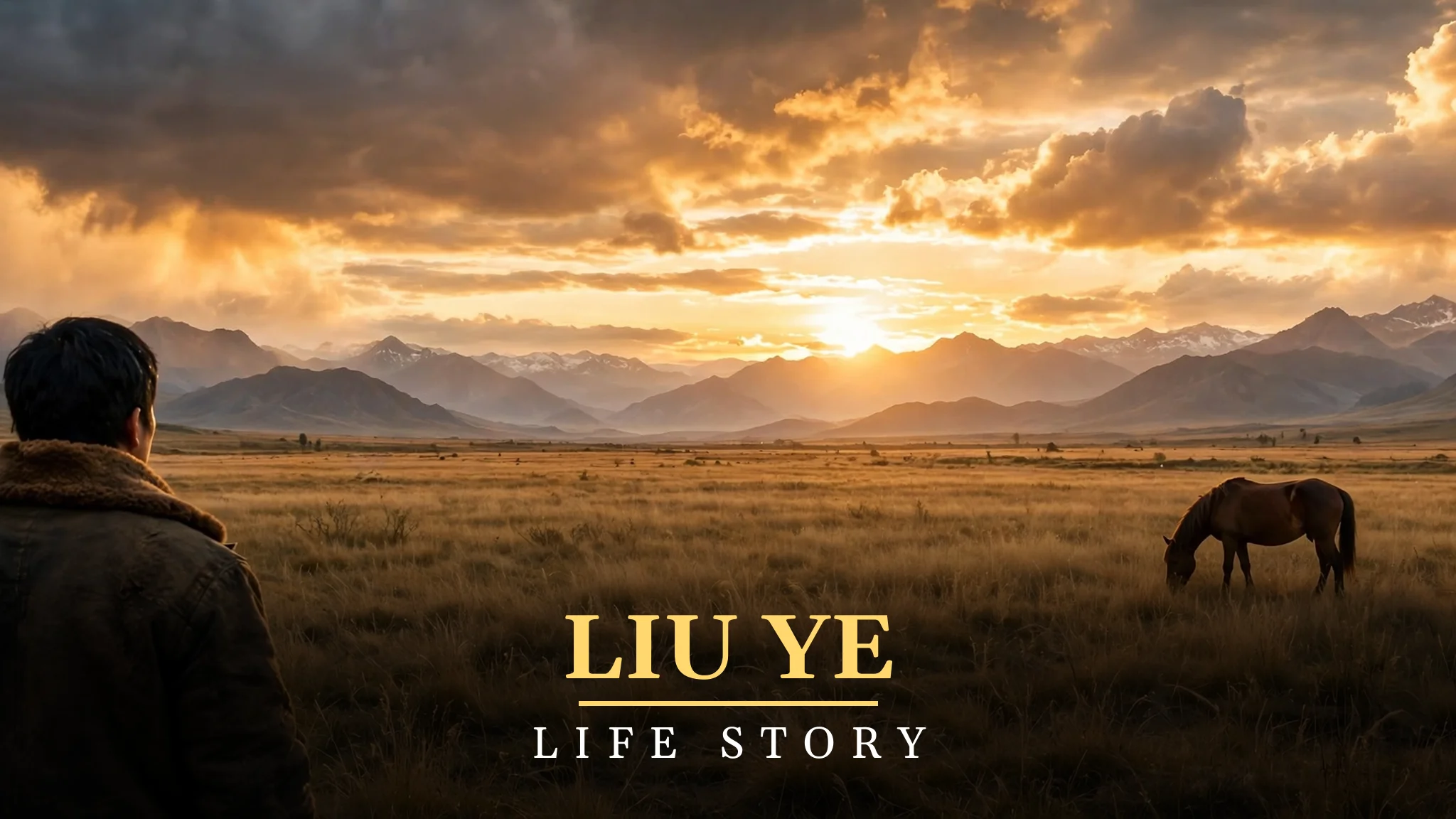
Finally, I want to return to the image of the man on the grass plain, looking at the mountains, which is the image on his cover. That image fits Liu Ye well, because it shows a man who is small in front of a large landscape, and who is comfortable with that smallness. He does not try to dominate the mountains. He stands before them, quietly, and he looks. That is how he acts. He does not try to dominate a scene. He stands in it, quietly, and he lets the scene be what it is. I think that is a beautiful way to live, as well as a beautiful way to act. We are all small in front of the mountains of life, in front of time, and in front of the world. A person who accepts that smallness, and who stands quietly before it, is wiser than a person who tries to shout the mountains down. Liu Ye has stood quietly before the mountains for more than twenty years, and he is still standing. That is why I admire him, and why I think his story is worth remembering.
Frequently Asked Questions
Who is Liu Ye and what is he best known for?
Liu Ye is a Chinese actor born in 1978 in Changchun, Jilin. He is best known for winning the Golden Horse Award for Best Actor for Lan Yu, and for starring in Balzac and the Little Chinese Seamstress, a film that made him known to audiences around the world.
Where did Liu Ye study acting?
He studied at the Central Academy of Drama in Beijing, one of China’s top acting schools. He moved there from Changchun as a young man and trained in voice, movement, and stage acting before his film career began.
What film made Liu Ye famous outside China?
Balzac and the Little Chinese Seamstress, released in 2002, made him known internationally. In the film he plays Ma, a young man sent to a remote village during the Cultural Revolution who discovers forbidden books and first love.
Who is Liu Ye married to and does he have children?
He married French photographer Anaïs Martane in 2009. They have a son, Noé, and a daughter, Nina, and the family is known in China for its mix of Chinese and French life, including appearances on family television shows.
What award did Liu Ye win for Lan Yu?
He won the Golden Horse Award for Best Actor for his performance in Lan Yu in 2001, when he was only twenty-three years old. The film told the story of a love affair in Beijing and was one of the boldest Chinese films of its time.
What other important films has Liu Ye appeared in?
He appeared in Postmen in the Mountains early in his career and later in City of Life and Death, a powerful film about the Nanjing Massacre. He has also played in large historical films and many popular Chinese television dramas.
How old is Liu Ye?
Liu Ye was born on 23 March 1978, so he was forty-eight years old in 2026. He has been acting for more than twenty-five years, moving from young leading roles to father and character roles as he has grown older.


