Lordi: The Life Story Behind Finland's Monster Band
In this post
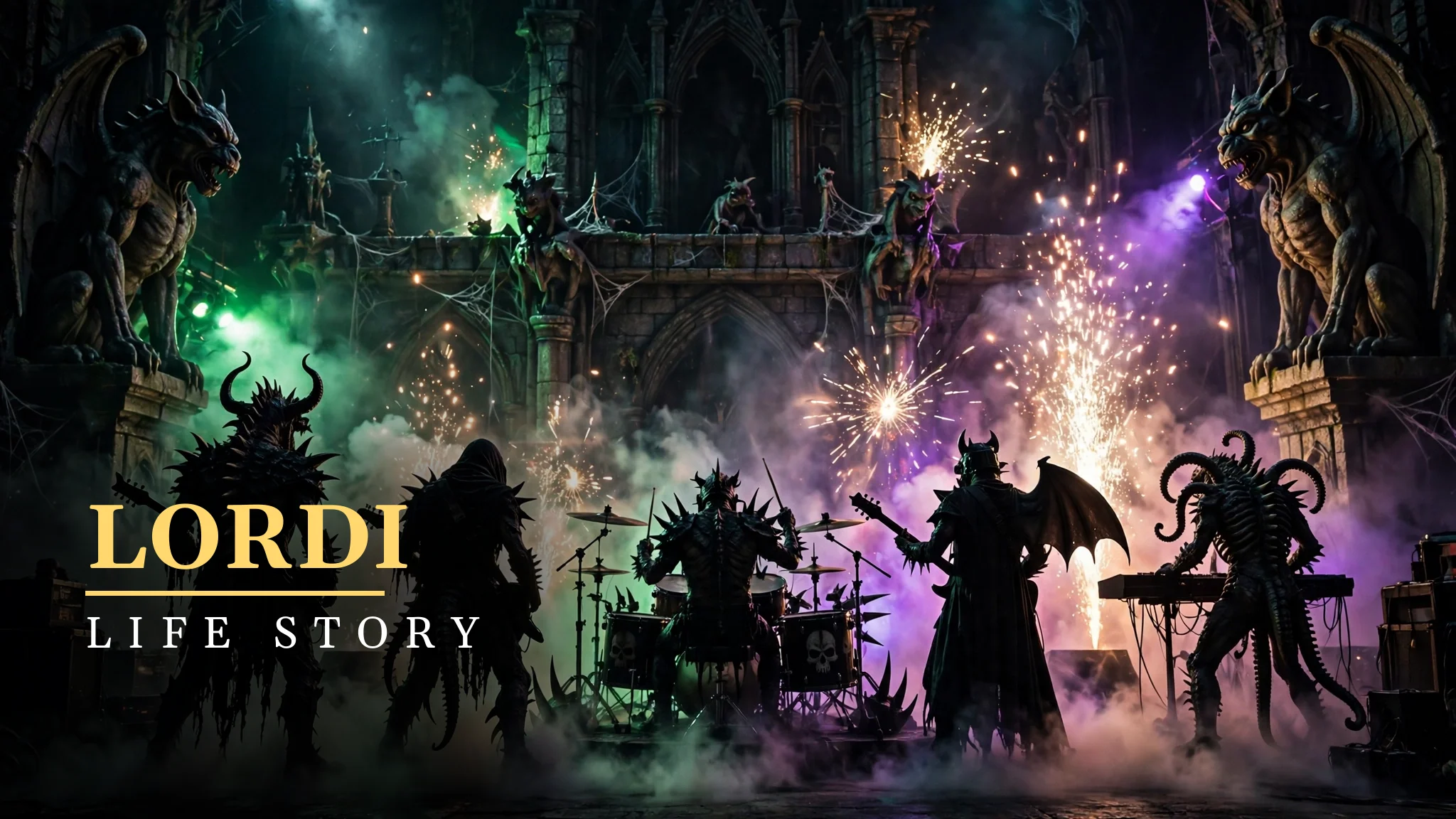
Most bands want you to see their faces. Lordi wanted you to see their monsters. When the Finnish band walked onto a stage, the audience did not see five ordinary musicians in jeans and T-shirts. They saw a horned demon singer, a pharaoh with a guitar, a bull-like monster on bass, a scary keyboard player, and a drummer who looked as if he had come from a horror film. The costumes were not a joke that lasted for one show. They were the heart of the band, and the band never broke the spell.
The band came from Rovaniemi, a small city in the north of Finland, far from the big music cities of Europe. Their leader, Tomi Putaansuu, known as Mr Lordi, loved horror films, heavy metal, and monsters, and he built a band around those loves. For many years, almost nobody outside Finland knew their name. Then, in 2006, they entered the Eurovision Song Contest, the biggest song contest in Europe, and they won it with a loud rock song called Hard Rock Hallelujah. It was one of the most surprising wins in the history of the contest, and it made Lordi famous in a single night.
This is the story of Lordi, a band that believed in monsters when the music world wanted pretty faces. It is a story about a boy from the far north who loved horror films, about friends who built costumes by hand, about years of small shows and hard work, and about a night in Athens when a monster band beat every pop star in Europe. It is also a story about staying true to a strange idea, even when people laughed at it.
What makes the story of Lordi worth telling is not only the Eurovision win. It is the fact that the band kept going after the win, making album after album, touring the world, and never taking off the masks. Many bands change their image when they become famous. Lordi did the opposite. They kept the monsters, they kept the horror, and they kept the loud guitars, and their fans loved them for it. That loyalty to one idea is the thread that runs through their whole story.
A Boy From Rovaniemi Who Loved Monsters
Tomi Putaansuu was born in 1974 in Rovaniemi, a city in Finnish Lapland, close to the Arctic Circle. Rovaniemi is known for snow, for long dark winters, and for being the home of Santa Claus in the stories told to children. It is a long way from Helsinki, and even further from London or Los Angeles. Tomi grew up in that quiet northern city, and he spent much of his childhood watching horror films, reading comics, and listening to heavy metal. Those three loves would shape his whole life.
As a boy, Tomi loved the monsters in the films he watched. He did not find them frightening in a bad way. He found them exciting, funny, and free. A monster in a film could be loud, strange, and different, and nobody expected it to behave like an ordinary person. Tomi felt a connection with that idea, and he began to draw monsters of his own, to make masks, and to dream of a band that would look like the creatures from his favourite films. For many children, such dreams fade as they grow up. For Tomi, the dream only grew stronger.
He was also a serious music fan, and he loved bands like Kiss, who wore make-up and costumes on stage, and Alice Cooper, who built horror shows around his songs. Those artists showed him that a rock band could be more than music. It could be theatre, it could be a show, and it could be a world that the audience stepped into for one night. Tomi wanted to build a world like that, but he wanted his monsters to be more real and more frightening than anything Kiss had done. He wanted the audience to believe, even for a moment, that real monsters were playing on the stage.
Tomi also learned early that making monsters took real skill, and he spent years learning how to build masks, how to paint latex, and how to make a costume that could survive a loud and sweaty rock show. He studied the creatures in his favourite films closely, looking at how their skin was made, how their teeth were shaped, and how they moved, and he used what he learned to build his own creatures. This was not a hobby he picked up in a weekend. It was a craft he worked at for years, and it gave the band a look that no other band had, because no other band had a leader who could build monsters with his own hands.
In the early 1990s, Tomi began to put his ideas into action. He formed a band, and he gave the members monster names and monster costumes. The band was called Lordi, after his own stage name, Mr Lordi. The other members took names like Amen, who dressed as an Egyptian pharaoh, and Kita, who played drums. The costumes were made by hand, with great care, and they took hours to put on before a show. The band was not trying to be fashionable. They were trying to be true to the world Tomi had imagined as a boy.
Small Shows and the First Album
For many years, Lordi played small shows in Finland, and almost nobody outside the country knew them. The band worked hard, but the music world was not ready for a monster band from Lapland. Record companies did not know how to sell them, radio stations did not know how to play them, and many people thought the costumes were a joke. The band kept going anyway, because they believed in what they were doing, and because their small but loyal fans loved the shows.
The band’s first album, Get Heavy, was released in 2002, and it included the song Would You Love a Monsterman, which became a hit in Finland. The song was loud, catchy, and funny, and it asked a simple question that fitted the band perfectly. Would you love a monster? The fans said yes, and the song gave the band their first real success. The album showed that behind the costumes there was a band that could write strong rock songs with big choruses that people could sing along to.
The success of the first album gave the band a chance to tour more widely in Finland, and to play at festivals where larger crowds could see them. The shows were a spectacle, with the monsters on stage, with fire and smoke, and with a singer who roared like a creature from a film. People who saw the band once did not forget them, and word spread slowly across Finland. The band was still far from famous, but they were building something real, one show at a time.
The band also learned how to survive as a group during those hard early years, because a band that earns little money and sleeps in cheap places can easily fall apart. Lordi stayed together because the members shared the same dream, and because they were friends as well as bandmates. They shared the driving, they shared the building of the stage, and they shared the work of putting on the costumes, and that shared work made the friendship stronger. A band that only meets on stage will break when times get hard, but a band that works together off the stage as well will last.
Their second album, The Monsterican Dream, came out in 2004, and it showed that the band was growing. The songs were stronger, the sound was bigger, and the band was more confident. The album included songs that mixed horror film ideas with classic hard rock, and it proved that Lordi was not a one-song band. They had more to say, and they were learning how to say it. The band was ready for a bigger stage, but they did not know that the biggest stage of all was about to come to them.
The Night That Changed Everything
In 2006, Lordi decided to enter the Eurovision Song Contest, and the decision surprised many people. Eurovision was known for pop songs, for pretty singers, and for bright and shiny performances. A monster band from Finland playing hard rock seemed like the wrong choice for such a contest. But the band believed in their song, Hard Rock Hallelujah, and they believed that the audience would respond to something loud and different. They were right.
The contest was held in Athens, in Greece, and Lordi first had to win the Finnish selection to get there. They did, and then they travelled to Athens with their costumes, their guitars, and their song. The performance was unforgettable. The monsters stood on the stage, the guitars roared, the fire burned, and the singer roared the chorus. The audience in the hall cheered, and the people watching at home across Europe could not look away. It was the loudest and strangest thing Eurovision had ever seen.
When the votes were counted, Lordi had won. They had scored 292 points, and they had beaten every other country in the contest. It was Finland’s first ever win at Eurovision, and the whole country celebrated. People who had never listened to hard rock were suddenly cheering for a monster band, and the band became national heroes overnight. The win was not only a victory for Lordi. It was a victory for the idea that a small country could win by being itself, and that a strange and honest idea could beat a safe and pretty one.
The win also changed how the world saw Finland. Before that night, many people outside Europe knew Finland for snow, for saunas, and for quiet people, but they did not know its music. After the win, Finland was the country of the monster band, and that gave Finnish rock a new confidence. Young bands in Finland saw that a band from their own country could win on the biggest stage in Europe, and they believed a little more in their own chances. A single song had opened a door, and many musicians walked through it in the years that followed.
The days after the win were wild. The band returned to Finland to a hero’s welcome, with crowds waiting for them at the airport and in the streets. Their song was played on radios across Europe, and their album The Arockalypse, released in 2006, sold well in many countries. The band that had played small shows in Lapland was suddenly famous in Germany, in Britain, and in many other places. The monsters had won, and the world knew their names.
Life After Eurovision
Winning Eurovision can be a curse for a band, because the fame comes fast and it can fade just as fast. Many winners are forgotten within a year, and their next songs are ignored. Lordi did not let that happen. They used the fame to tour more widely, to make more albums, and to build a lasting career. They knew that one win was not enough, and they worked hard to prove that they were a real band, not a one-night joke.
The band released the album Deadache in 2008, and it showed that they could still write strong songs after the excitement of the win had faded. The album was darker and heavier, and it pleased the fans who had followed the band before Eurovision. The band toured in Europe and in America, and they played to crowds who came to see the monsters in person. The live shows were still the heart of the band, and the band worked hard to make each show a spectacle worth remembering.
In the years that followed, the band released more albums, including Babez for Breakfast in 2010, To Beast or Not to Beast in 2013, and Scare Force One in 2014. Each album kept the same spirit, but each one had its own sound. The band did not repeat the same songs again and again. They tried new ideas, they wrote about different monsters, and they kept the music fresh. The fans stayed with them, because the band respected the fans and gave them new music to enjoy.
The band also went through changes in its members, as all long-lived bands do. The drummer Kita left the group, and a new drummer, Otus, joined, but Otus died in 2012, which was a sad and hard time for the band. The band kept going, because they believed that the music mattered more than any one member, and because they wanted to honour their friend by continuing. New members joined, including the drummer Mana and the keyboard player Hella, and the band found a new strength in the years that followed.
The new members brought new energy to the band, and they also brought new ideas, because each monster has its own character and its own story. Hella’s character, a frightening doll with a dark past, gave the band a new visual idea on stage, and Mana’s powerful drumming gave the songs a harder drive. The band did not try to copy the old members. They let the new members be themselves, and the sound grew because of it. That openness is one reason the band has lasted so long, because they treat change as a chance to grow rather than as a threat.
Monsters, Costumes, and the Secret
One of the most interesting things about Lordi is the way they protect their secret. The members never appear in public without their costumes, and they do not let photographers take pictures of their real faces. The costumes are their faces, as far as the public is concerned, and the band has kept that rule for more than thirty years. That discipline is rare in the music world, where most stars want their faces to be seen everywhere, and it shows how seriously the band takes their world.
The costumes themselves are works of art. Mr Lordi makes many of them by hand, and each one is built to fit the character it belongs to. Amen wears the robes of an ancient Egyptian pharaoh, and his costume is covered in gold and in strange symbols. The bass player, Hiisi, looks like a bull-like creature, and the keyboard player, Hella, looks like a frightening doll. The costumes take hours to put on, and they are hot and heavy under the stage lights, but the band wears them for every show, because the show would not be the same without them.
The band’s love of horror films runs through everything they do. Their songs are full of monsters, of haunted houses, of vampires, and of creatures from old films. Their album covers look like horror film posters, and their stage shows use fire, smoke, and props that could have come from a film set. The band is not trying to frighten people in a cruel way. They are trying to give the audience a fun and thrilling night, the way a good horror film gives its audience a fun and thrilling evening.
Mr Lordi is also a film director, and he directed a horror film called Dark Floors, released in 2008, in which the band appeared as monsters. The film showed that the band’s world was bigger than music. It was a whole universe of monsters, stories, and images, and the band wanted to share that universe with their fans in every way they could. That ambition is one reason the band has lasted so long. They are not only musicians. They are storytellers, and their stories happen to be told with loud guitars.
The film also showed how seriously the band took its monsters, because making a film is very different from making an album, and it needs a different kind of patience. Mr Lordi had to think about cameras, about actors, and about a story that would hold together for more than an hour, and he did it while still leading the band. That work showed his fans that the monsters were not a costume he put on for a night. They were a world he had built in his mind since childhood, and he wanted to share every part of it.
Still Roaring After Thirty Years
In the 2020s, Lordi continued to make music, releasing the album Killection in 2020 and a set of seven albums called Lordiversity in 2021. The Lordiversity project was a bold idea, because the band recorded seven albums in different styles of rock music, from disco to thrash metal, and released them all at once. It was a huge amount of work, and it showed that the band was still full of ideas after nearly thirty years. Few bands would try such a thing, and fewer still could finish it.
The band also released Screem Writers Guild in 2023, an album inspired by horror films from the 1980s, and they continued to tour in Europe and beyond. Their shows were still loud, still full of fire and smoke, and still led by monsters who never took off their masks. The fans who came to those shows included people who had followed the band since the beginning, and young people who had discovered them through Eurovision or through the internet. The band had become a family that kept growing.
The city of Rovaniemi honoured the band by naming a square after them, and the band’s story became a part of the city’s identity. A small northern city that was known for snow and for Santa Claus was now also known for a monster band that had won Eurovision. That honour meant a great deal to the band, because they had never forgotten where they came from. They were proud of Lapland, and Lapland was proud of them.
The band also gave Rovaniemi something else, a reason for visitors to come. Fans of Lordi travel to the city to see the square, to visit the places the band comes from, and to feel close to the monsters they love. That tourism helps the city, and it shows how a band can give back to its home in a real and practical way. The monsters did not only bring fame to Rovaniemi. They brought people, and those people brought life to the city.
Today, Lordi is still playing, still making albums, and still wearing the costumes. The band has lasted longer than most rock bands, and they have done it without changing who they are. They are still monsters, they are still loud, and they are still from Rovaniemi. That is a simple story, but it is a true one, and it is the reason their fans still cheer when the monsters walk onto the stage.
My Take:
When I think about Lordi, the first thing I feel is joy, because this is a story about people who refused to grow out of what they loved. Tomi Putaansuu loved monsters as a boy, and instead of putting that love away when he became an adult, he built a band around it. I admire that, because the world tells us to be serious, to be normal, and to leave childish things behind, and Lordi shows that the childish thing can be the truest thing. The monsters were not a phase. They were the point, and the band was brave enough to say so.
I think the Eurovision win is one of the most hopeful moments in the history of that contest. Eurovision is often a place for safe pop songs, for pretty singers, and for performances that offend nobody. Lordi came in with loud guitars, with fire, and with monster costumes, and they won by a large margin. That tells me that audiences are not as narrow as the music business thinks. People want something real, something different, and something with heart, and when they see it, they vote for it. The win was not only for Finland. It was for every strange band that has been told it does not fit.
I also admire the discipline of the costumes. It would be so easy to take the mask off for a photograph, or to show the real face on television, and to become famous as a person instead of as a monster. The band has never done that, and that choice shows a deep respect for the world they built. The monster is not a mask they wear for work. The monster is the band, and the person behind it stays private. In a time when everyone shares everything about themselves, that privacy is a strong and healthy choice, and I respect it a great deal.
What I love most about the band is that the songs are good. A costume can get you noticed for one night, but it cannot keep you famous for thirty years. The songs have to be good, and Lordi’s songs are good. They have big choruses, they have strong melodies, and they are fun to sing along to. Hard Rock Hallelujah is a simple song, but it is a strong one, and it does the job it was written to do. It makes people want to shout, to dance, and to feel alive. That is what a rock song should do, and Lordi does it well.
I feel sad when I think about the death of Otus, the drummer who died in 2012. A band is a family, and losing a member is like losing a brother, and the band had to keep going with that loss in their hearts. I respect the way they handled it, because they did not make a show of their grief, and they did not stop. They kept playing, and they honoured their friend by continuing the work they had shared. That is a quiet and dignified choice, and it tells me a lot about the character of the people behind the monsters.
I think about Rovaniemi, and I smile, because it is a small city in the far north, and it produced a band that won the biggest song contest in Europe. That is a reminder that great things do not only come from big cities. They can come from anywhere, from a quiet place with long winters and a lot of snow, if the people there have a strong idea and the patience to follow it. Young people in small towns should hear this story, because it tells them that where they come from is not a limit. It is a starting point, and a strange starting point can be an advantage.
The Lordiversity project is something I admire very much, because it shows a band that is still curious after thirty years. Seven albums at once, in seven different styles, is a huge amount of work, and most bands would never try it. Lordi tried it, and they finished it, and that tells me that they still love music for its own sake. They are not bored, and they are not repeating themselves. They are still playing, still learning, and still having fun. That is the best sign of a healthy band, and it is a rare one.
I also think about the fans, because Lordi’s fans are loyal in a way that is special. They do not only like the songs. They love the whole world of the band, the monsters, the costumes, the horror films, and the jokes. When you love a band like that, you are part of a family, and the band treats you like family. The shows are a place where everyone can be strange together, and nobody has to pretend to be normal. That feeling of belonging is precious, and it is one reason the band has lasted so long.
If I have one small criticism, it is that the band never became as big outside Europe as they deserved to be. In America, they are known mostly to rock fans, and many people have never heard of them. I think that is a shame, because their shows are the kind of fun that anyone can enjoy, and their songs are simple enough for anyone to sing. But maybe it does not matter. A band does not need to be famous everywhere. It needs to be loved by the people who need it, and Lordi is loved deeply by their fans.
I think the story of Lordi has a lesson for anyone who has a strange idea. The world will tell you that the idea is too weird, that it will not work, and that you should do something normal instead. Lordi heard all of that, and they kept going. They played small shows, they made their costumes by hand, and they waited for their moment. When the moment came, they were ready, and they took it. That is a lesson about patience, and it is a lesson about trusting yourself when others do not.
For a reader who has never heard the band, I would say this. Do not judge them by the costumes alone. Listen to the song, watch the show, and ask yourself if you are having fun. If you are smiling, if you are singing along, and if you feel a little braver than before, then the band has done its job. Monsters are not only for frightening people. They can also be for freeing people, for giving them permission to be loud and strange and different. That is what Lordi does, and it is a kind thing to do.
In the end, I think Lordi teaches us that being yourself is not a small thing. It is the biggest thing, and it is the hardest thing, because the world will try to change you. Tomi Putaansuu was a boy who loved monsters, and he became a man who led a monster band to victory in front of all of Europe. He did not change. He grew, he worked, and he stayed true. That is a full and honest story, and it is one I will remember with a smile.
I also want to say something about the fun of it all, because fun matters more than people admit. Music is not only about art and about meaning. It is also about joy, about a night out with friends, about shouting a chorus at the top of your voice. Lordi understands that, and their shows are built around joy. The fire, the smoke, the monsters, and the loud guitars are all there to make people happy, and they do. A band that makes people happy for thirty years has done something good, and I think that is worth celebrating.
One more thought stays with me, and it is about the name of the square in Rovaniemi. A city does not name a square after a band unless the band means something real to the people who live there. Lordi means something real to Rovaniemi, because they took the name of a small northern city to the whole of Europe, and they did it without hiding where they came from. That is a proud story, and it is a story that belongs to the whole city, not only to the band. When I think of that square, I think of a boy who loved monsters, and of a city that stood behind him.
I will finish with a simple wish. I hope the band keeps playing for many more years, and I hope young people keep discovering them. The world needs more monsters who are kind, more bands who are brave, and more stories like this one. Lordi gave the world a night in Athens that nobody will forget, and they gave their fans thirty years of loud and joyful music. That is enough for any band, and it is more than most bands ever give. I am glad they exist, and I am glad their monsters are still roaring.
There is one more thing I want to say about the night in Athens, because I think it matters for how we judge music. The experts who write about Eurovision often say that only a certain kind of song can win, a song that is safe, pretty, and easy to forget. Lordi proved them wrong in front of hundreds of millions of viewers, and that proof still matters. It tells every songwriter that the audience is wiser than the experts think, and that a bold and honest song can beat a careful one. I hope the people who run music contests remember that night, and I hope they leave room for the monsters.
I also think about the children in Rovaniemi who watch the band and dream of their own strange ideas. A child who sees a monster band from their own small city win in Athens learns something that no lesson in school can teach. They learn that their home is not too small, that their dreams are not too strange, and that hard work can carry them further than they imagined. That is a powerful lesson, and it is one of the best gifts a band can give to its hometown. The square named after Lordi is not only an honour for the band. It is a sign to every child in the city that their dreams matter.
When I compare Lordi with other bands that won Eurovision, I see a clear difference. Most winners try to repeat their winning song again and again, hoping the magic will come back, and they slowly fade away. Lordi never tried to repeat Hard Rock Hallelujah. They made new albums, they tried new styles, and they built a career that did not depend on one night. That is the difference between a band and a moment. A moment passes, but a band that works hard and stays true can last for decades, and Lordi is the proof of that.
Finally, I want to say that I admire the band’s sense of humour, because humour is easy to lose when you become famous. Lordi never lost it. Their songs are funny as well as loud, their monsters have silly names and silly stories, and their shows make people laugh as well as cheer. That humour is not a weakness. It is a strength, because it shows that the band does not take itself too seriously, even while it takes its music very seriously. A band that can laugh at itself and still play with full power is a band that understands what rock music is for, and I think that understanding is the heart of their long success.
I also think the band teaches us something about patience that is easy to miss. They waited more than ten years from their first shows to their big night in Athens, and during those years they earned very little and they were ignored by most of the music world. Many bands would have given up after two or three years of that, but Lordi kept going, because they loved the work itself. When their moment finally came, they were ready, because they had spent a decade getting ready. That is the part of the story I want young musicians to remember most of all.
Frequently Asked Questions
When did Lordi form and where is the band from?
Lordi formed in Rovaniemi, Finland, in the early 1990s, led by Tomi Putaansuu, who performs as Mr Lordi. The band built its identity around monster costumes, horror films, and hard rock, and they played small shows in Finland for many years before becoming famous.
How did Lordi win Eurovision 2006?
Lordi won the Eurovision Song Contest in Athens in 2006 with the song Hard Rock Hallelujah, scoring 292 points. It was Finland’s first ever win in the contest, and the band’s loud rock performance stood out against the pop songs of the other countries.
Which Lordi songs do fans know best?
Hard Rock Hallelujah is the band’s most famous song, because it won Eurovision 2006 and was played across Europe. Other well known songs include Would You Love a Monsterman, from their first album Get Heavy, and Devil Is a Loser.
Why does Lordi always wear monster costumes?
The band wears monster costumes because the monsters are the heart of their identity, built on Tomi Putaansuu’s love of horror films. The members never appear in public without their costumes, and they keep their real faces private, so the audience always meets the monsters, not the people behind them.
Who are the members of Lordi?
The band is led by Mr Lordi on vocals, and the current line-up includes Amen on guitar, Hiisi on bass, Hella on keyboards, and Mana on drums. Former members include the drummer Kita and the drummer Otus, who died in 2012, and the bass player OX.
Is Lordi still making music?
Yes, Lordi is still active, and they have continued to release albums and tour in the 2020s, including Killection in 2020, the seven-album Lordiversity set in 2021, and Screem Writers Guild in 2023. They still perform in their monster costumes, and their live shows remain loud and full of spectacle.


