Los Kjarkas: The Life Story Behind the Bolivian Folk Band
In this post
- Capinota, Cochabamba, and the Music of the Andes
- The Hermosa Brothers and the Birth of the Group
- Llorando se fue and the Song That Travelled the World
- Festivals, Records, and a Life on the Road
- Loss, Change, and the Brothers Who Carried On
- Still Playing: Six Decades of Andean Music
- What Los Kjarkas Mean to Bolivia and the World
- The Music Itself: Charango, Quena, and Zampoña
- My Take:
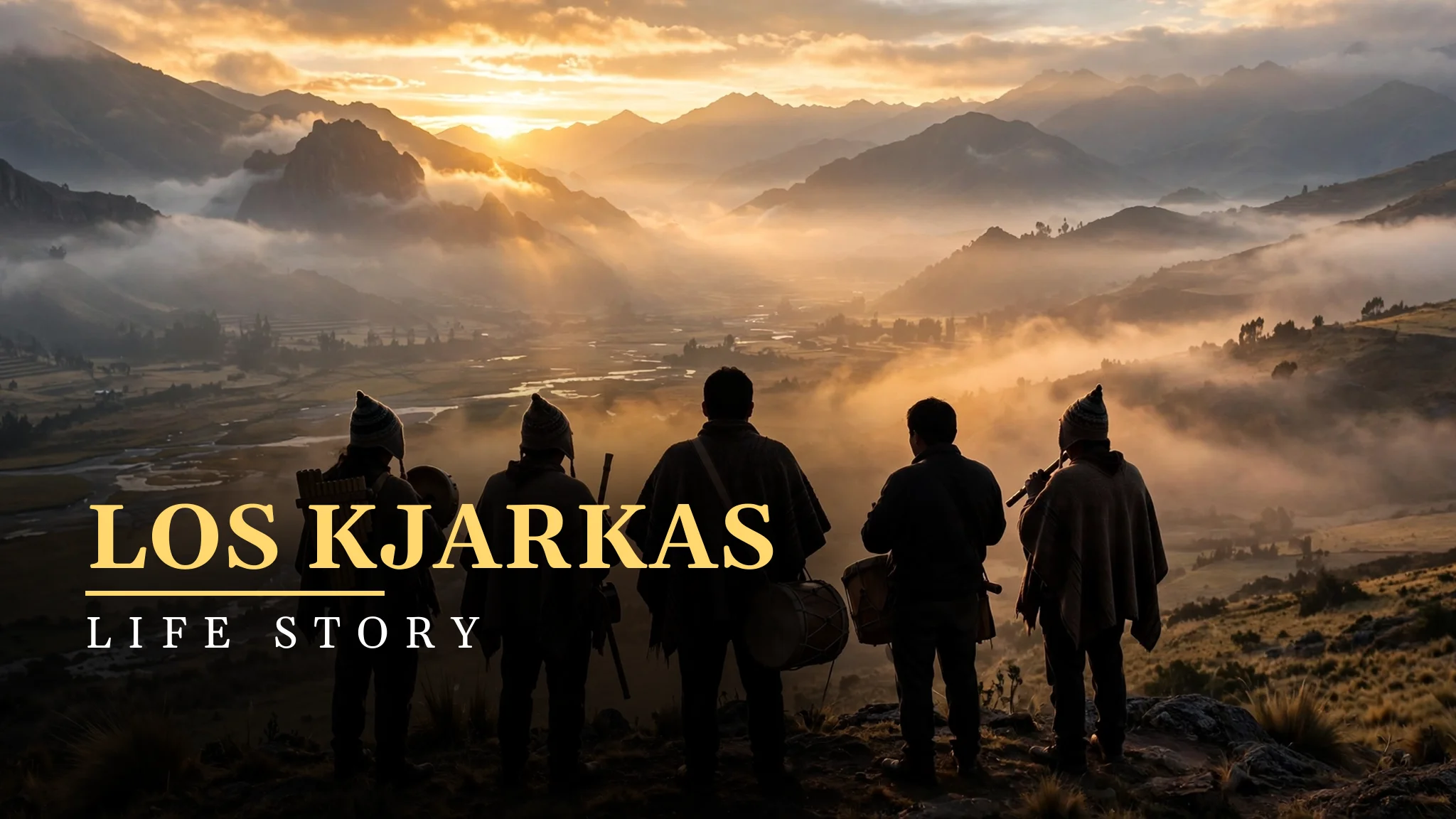
Los Kjarkas are the most famous folk group in the history of Bolivia, and one of the best-known Andean music groups in the whole world. Their story begins in a small town in the highlands of Cochabamba, where a family of brothers picked up the instruments of their ancestors and decided to play the music of their people for anyone who would listen. More than half a century later, their songs are still played at festivals, at weddings, and on the radio across Latin America, and one of their melodies became one of the most famous dance tunes on earth.
The group was founded in 1965 in Capinota, a town in the Cochabamba region of Bolivia, by the Hermosa brothers, led by Wilson Hermosa. They played the traditional instruments of the Andes: the charango, a small guitar-like instrument made from the shell of an armadillo in the old days; the quena, a wooden flute; the zampoña, the panpipes; and the bombo, a large drum. Their music was the music of the Bolivian highlands, full of the wind, the mountains, and the life of the farming communities that have lived there for centuries.
What makes their story remarkable is how far that local music travelled. A song they wrote in the early 1980s, “Llorando se fue”, was turned into the Lambada by the group Kaoma at the end of that decade, and the Lambada became a worldwide hit. The melody that had been written in Bolivia was suddenly being danced to in Paris, in Tokyo, and in New York. This is the story of how a family band from a small Bolivian town made music that the whole world ended up dancing to.
Capinota, Cochabamba, and the Music of the Andes
Capinota is a town in the department of Cochabamba, in the highlands of central Bolivia. Life there is shaped by the mountains, by farming, and by the seasons. The people of the Andes have a long musical tradition, and music is not a separate thing from life. It is played at festivals, at harvests, at weddings, and at religious celebrations, and children learn the songs and the instruments by listening and by joining in. The Hermosa brothers grew up inside that tradition.
The instruments of Andean music are simple in form but rich in sound. The charango is small and bright, and it carries the melody with a quick, dancing rhythm. The quena is a flute with a breathy, lonely sound, like wind moving through the mountains. The zampoña is a set of panpipes, and it needs two players working together, each playing half the notes, which is a beautiful image of how Andean music works: it is music made together, not alone. The bombo gives the deep heartbeat underneath it all. Together, these instruments make a sound that is unmistakably Bolivian.
The Hermosa brothers learned these instruments as children, and they learned the songs of their region as well. They did not learn music in a conservatory. They learned it at home, in their town, and at the festivals where the whole community played together. That way of learning gave them a deep understanding of the music, not only of how to play the notes but of what the notes meant to the people who heard them.
Bolivia in the 1960s was a country where folk music was loved by ordinary people but was not always respected by the music business. The Hermosa brothers wanted to change that. They believed that the music of the Andes deserved to be heard on the radio, on records, and on stages far beyond their town. That belief became the mission of Los Kjarkas, and it has guided the group for more than fifty years.
The Hermosa Brothers and the Birth of the Group
Los Kjarkas was founded in 1965 by Wilson Hermosa, together with his brothers Gonzalo, Ulises, and Elmer Hermosa. The name Kjarkas comes from a Quechua word, and it carries the sound of the Andean world the brothers came from. A family band has a special strength: the members know each other deeply, they trust each other, and they share the same roots. That strength helped Los Kjarkas survive for decades, through changes in the music business and through the loss of members over time.
In the early years, the group played wherever they could. They performed in Cochabamba, in La Paz, and in towns across Bolivia, at festivals and community events where folk music was loved. They were not yet famous, but they were building a reputation as musicians who played the traditional music with skill and with feeling. People who heard them knew that this was not a group imitating folk music. This was a group that lived it.
The brothers also began to write their own songs. They took the traditional rhythms and melodies of the Andes and shaped them into new songs that spoke about love, about the land, and about the life of the Bolivian people. Their songs were in Spanish and in Quechua, the language of the Andes, and they carried the feelings of both. Writing original songs was an important step, because it meant the group was not only keeping the old music alive. They were adding to it.
The early years were hard work, as they are for any band from a small town. The money was small, the travel was tiring, and the recognition was slow. But the brothers kept going, because they believed in the music and because the audiences who heard them kept asking for more. A folk group that plays for its own people has a foundation that no fashion can take away, and Los Kjarkas built their career on that foundation.
Llorando se fue and the Song That Travelled the World
The most famous song in the history of Los Kjarkas is “Llorando se fue”, which means “Crying, she left” in English. It is a sad song about a woman who leaves, and the pain of the person left behind. The melody is beautiful and haunting, and it carries the feeling of the Andes in every note. The group recorded it in the early 1980s, and it became one of their best-loved songs in Bolivia and across Latin America.
What happened next is one of the strangest stories in the history of popular music. At the end of the 1980s, the French-Brazilian group Kaoma released a dance song called “Lambada”, with a fast, joyful rhythm that made people all over the world want to dance. The melody of “Lambada” was the melody of “Llorando se fue”. Kaoma had taken the Bolivian song and turned it into a dance hit without properly crediting Los Kjarkas, and the song became a huge international success, selling millions of copies.
Los Kjarkas took action to protect their work, and the dispute became well known. The group showed that the melody was theirs, and they won recognition for their authorship. The story is important because it shows both the power and the danger of folk music in a global world. A melody from a small town in Bolivia could travel to every dance floor on earth, but the people who wrote it had to fight to be recognised. Los Kjarkas fought, and they won, and their victory became a symbol for folk musicians everywhere.
The Lambada episode changed the group’s life. Suddenly, people around the world wanted to know who Los Kjarkas were. The song that had been a sad Bolivian ballad was now a joyful dance tune, and the group became known far beyond Latin America. They used that attention well, continuing to play their own music in their own way, and reminding the world that the melody came from the Andes, from the charango and the quena, and from the brothers of Capinota.
Festivals, Records, and a Life on the Road
After the success of “Llorando se fue”, Los Kjarkas became one of the most in-demand folk groups in Latin America. They played at festivals across Bolivia and in neighbouring countries, and they toured in Europe, in Asia, and in the Americas. Their concerts were celebrations of Andean culture, with the traditional instruments, the colourful clothing, and the songs that audiences knew by heart. For Bolivians living far from home, a Los Kjarkas concert was a reminder of the mountains and the music of their childhood.
The group recorded many albums over the decades, and their discography became one of the largest in Bolivian folk music. Their songs covered the full range of Andean life: love songs, dance tunes, songs about the land, and songs about the history of Bolivia. Some of their best-known songs, such as “Wayayay”, became standards of Andean music, played by folk groups across the region. Each album added to their reputation as the keepers of a musical tradition.
Life on the road for a folk group is different from life on the road for a rock band. The instruments are delicate, the clothing is traditional, and the performances are often part of festivals that last for days. Los Kjarkas learned to travel well, to play in many kinds of places, and to adapt their show to the audience in front of them. Whether they were playing for a small town festival in Bolivia or for a large hall in Europe, they played with the same care and the same pride.
The group also became ambassadors for Bolivia. When they played abroad, they were not only performing music. They were showing the world a part of Bolivian culture that many people had never seen. The ponchos, the hats, the instruments, and the songs were all part of a world that was new to many listeners, and Los Kjarkas presented it with dignity and with joy. They were proud of where they came from, and they made their audiences proud of it too.
Loss, Change, and the Brothers Who Carried On
A group that lasts for more than fifty years will face loss, and Los Kjarkas has faced its share. Wilson Hermosa, the founder and leader of the group, died in 2008, and his death was a great loss for the group and for Bolivian music. He had been the heart of Los Kjarkas from the beginning, the brother who had the vision to take the music of Capinota to the world. His death left a gap that could never be filled in the same way.
Other members also passed away over the years, and the group had to find a way to continue without them. That is one of the hardest things a long-running group can do. The sound of a band is made by the people in it, and when a person leaves, the sound changes. Los Kjarkas handled this by keeping the music at the centre. The songs, the instruments, and the tradition were bigger than any one member, and the group continued to play them with the same respect.
The younger members of the Hermosa family joined the group, and the family tradition continued. A family band has a way of passing its music from one generation to the next, and Los Kjarkas became an example of that. The children and grandchildren of the founders learned the songs, the instruments, and the stories, and they carried them forward. The group became not only a band but a family legacy.
Through all these changes, the group’s purpose stayed the same. They played the music of the Andes, they honoured the tradition they came from, and they shared it with the world. The losses made the music sadder at times, but they also made it deeper, because the songs now carried the memory of the brothers who had written them and played them first.
Still Playing: Six Decades of Andean Music
Los Kjarkas are still active today, more than six decades after they were founded in Capinota. That is a remarkable achievement for any musical group, and it is especially remarkable for a folk group from a small town. They continue to perform, to record, and to appear at festivals in Bolivia and abroad, and their audiences include people of all ages, from grandparents who heard them in the 1960s to young people who discovered them through the Lambada story.
Their continued activity is a gift to Bolivia. The group is a living link to the music of the Andes, and their concerts are a chance for young Bolivians to hear the instruments and the songs of their grandparents played live. In a world where music changes quickly, Los Kjarkas offer something steady: the sound of the charango, the quena, and the zampoña, played by musicians who have spent their lives learning them.
The group has also been honoured in Bolivia and beyond for their contribution to culture. They are recognised as one of the great folk groups of Latin America, and their music is studied and played by folk musicians across the region. The honours matter, but the real honour is the audience. When a crowd sings along to “Llorando se fue” or dances to “Wayayay”, that is the group’s reward, and it is a reward they have earned many times over.
The story of Los Kjarkas is still being written. As long as the group plays, the music of the Andes will be heard, and the story of the brothers from Capinota will continue. They began as a family band in a small town, and they became a name known around the world. That journey, from the highlands of Cochabamba to the dance floors of Paris and Tokyo, is one of the great journeys in the history of folk music.
What Los Kjarkas Mean to Bolivia and the World
Los Kjarkas matter because they proved that the music of a small place can belong to the whole world. The Andes are far from the great music capitals, and the instruments of Andean music are not the instruments of pop music. But Los Kjarkas showed that a melody played on a charango can be as powerful as any song on the radio, and that a song written in a small Bolivian town can be danced to on every continent. That proof gave confidence to folk musicians everywhere.
Their legacy is also about protection. The Lambada story taught the music world that folk melodies are not free for anyone to take. They belong to the people who wrote them, and those people deserve to be recognised and paid. Los Kjarkas fought for that recognition, and their fight helped other folk musicians understand their rights. That is a legacy that goes beyond music, into the question of who owns a song and who deserves credit for it.
For Bolivia, Los Kjarkas are a national treasure. They are the sound of the country, the music that plays at its festivals and that Bolivians carry with them when they live far from home. For the world, they are a reminder that the best music does not always come from the biggest cities. Sometimes it comes from a small town in the mountains, played by brothers who learned their instruments at home and who never forgot where they came from.
The Music Itself: Charango, Quena, and Zampoña
To understand Los Kjarkas, you have to understand their instruments, because the instruments are the soul of the music. The charango is a small stringed instrument, bright and quick, and it carries the melody with a dancing rhythm that makes people want to move. It was once made from the shell of an armadillo, and today it is made from wood, but its sound has not changed: it is the sound of the Andes, high, clear, and joyful. When a charango plays, you can hear the mountains in it, and you can hear the festivals where it has been played for centuries.
The quena is a wooden flute, and its sound is very different. It is breathy, lonely, and beautiful, like wind moving through a high valley. A quena player must breathe with great control, and the sound that comes out is full of feeling. It can sound like a person singing, or like a bird calling, or like the wind itself. In the hands of Los Kjarkas, the quena carries the sadness of the Andes, the longing for home, and the memory of people who have gone away. It is the instrument that makes audiences feel the mountains, even if they have never seen them.
The zampoña is a set of panpipes, and it is played by two musicians working together, each playing half the notes. That fact is beautiful in itself, because it means the music cannot be played alone. It needs two people, listening to each other, breathing together, and trusting each other. That is the spirit of Andean music: it is made together, not alone, and it is a reminder that a community is stronger than a single person. Los Kjarkas have played the zampoña that way for decades, and their music carries that spirit of togetherness.
The bombo is a large drum, and it gives the music its heartbeat. It is deep, steady, and strong, and it holds the other instruments together. Without the bombo, the charango and the quena would float away. With it, they have a foundation, a rhythm that the audience can feel in their chest. At a festival, the bombo is the sound that makes people dance, and it is the sound that tells them the celebration has begun. Los Kjarkas have always understood that, and their bombo has been the heartbeat of their music for more than sixty years.
Together, these instruments make a sound that is unmistakably Bolivian, and unmistakably Andean. It is a sound that has been played for centuries, and Los Kjarkas have kept it alive, not by freezing it in the past but by playing it with love and with skill in the present. Their music is a living tradition, and it is alive because they have played it, night after night, for more than six decades.
The instruments also tell us something about the group itself. Los Kjarkas did not choose easy instruments. They chose instruments that take years to learn, that demand patience, and that carry the history of a people. That choice was a statement: we will play the music of our ancestors, we will play it well, and we will share it with the world. They have kept that promise, and the world is richer for it.
My Take:
I think Los Kjarkas are one of the most important groups I have ever written about, and the reason is simple: they took the music of their own small town and carried it to the whole world, without losing it along the way. That is a very hard thing to do. Many musicians who become famous change their sound to please a bigger audience. Los Kjarkas did the opposite. They kept the charango, the quena, and the zampoña, they kept singing about the Andes, and they trusted that the world would listen. The world did listen, and I think that is a lesson for every musician from a small place.
What amazes me most is the story of “Llorando se fue” and the Lambada. A sad song about a woman leaving, written in Bolivia, became a joyful dance tune that filled dance floors from Paris to Tokyo. That is a strange and wonderful journey for a melody. I think it shows that a good melody is stronger than any one version of it. The melody survived being turned into a dance song, it survived being taken without credit, and it survived the fight that followed, and it is still beautiful today. I find that deeply moving, because it means that the work of the Hermosa brothers was so strong that no one could take it away from them, even when they tried.
I also think the Lambada story is a warning, and I do not want to look away from it. The fact that Kaoma could take a Bolivian melody and make millions from it without properly crediting the writers tells us something about how the music business has treated folk musicians. Folk music is often treated as if it belongs to no one, as if it is simply there for anyone to use. But it does belong to someone. It belongs to the people who wrote it, who learned the instruments, and who kept the tradition alive. Los Kjarkas fought for their rights, and they won, and I admire that fight enormously. It was not only a fight for money. It was a fight for respect, and for the idea that a folk musician from a small town deserves the same recognition as a pop star from a big city.
I think about the Hermosa brothers a lot when I read this story, because a family band is a special thing. Brothers who play together know each other’s timing, each other’s breathing, and each other’s feelings in a way that strangers cannot. The sound of Los Kjarkas has that closeness in it. You can hear that the musicians trust each other, and that they are playing not only for the audience but for each other. I think that trust is part of why the group lasted so long. A band made of strangers can fall apart over money or fame. A band made of brothers has a bond that is harder to break, even when life is hard.
The instruments matter to me too. The charango, the quena, and the zampoña are not easy instruments to play well. They take years of practice, and they carry the sound of the Andes in a way that no other instruments can. When I think about Los Kjarkas, I think about the sound of the quena, that lonely, breathy flute that sounds like wind in the mountains. It is a sound that makes me feel the height of the Andes, the thin air, and the distance between the towns. I think it is one of the most beautiful sounds in the world, and I am grateful that Los Kjarkas kept it alive and shared it with the world.
I also feel sad when I think about the losses the group has faced, especially the death of Wilson Hermosa in 2008. He was the founder, the leader, and the brother who had the vision to take the music beyond Capinota. When a person like that dies, the group loses more than a musician. It loses its centre. I admire the way the group carried on, and the way the younger members of the family stepped forward to keep the music going. That takes courage, because it is much easier to stop than to continue when the person who started it all is gone. Los Kjarkas continued, and that continuation is a tribute to Wilson Hermosa in itself.
What I would tell a young folk musician who reads this story is to trust the music of your own place. The world is full of people who will tell you that your music is too local, too old-fashioned, or too strange for a big audience. Los Kjarkas prove that those people are wrong. The music of Capinota travelled to Paris and Tokyo, not because it was changed to suit those cities, but because it was true to where it came from. If your music is honest, and if you play it well, people will hear it, no matter where they live. That is a lesson worth carrying.
I also learn from Los Kjarkas that a career in music is not measured in years but in the songs that survive. The group has been playing for more than sixty years, which is an extraordinary length of time. But the real measure is not the number of years. It is the number of songs that people still sing. “Llorando se fue” is still sung. “Wayayay” is still played. Those songs have outlived fashions, outlived the Lambada craze, and outlived many of the musicians who first played them. They are still here, and they will still be here when the next generation discovers them. That is what a life in music is for.
There is another lesson I take from them, about patience. The Hermosa brothers did not become world famous in a year. They played for many years in Bolivia before the world noticed them, and they kept playing after the world’s attention moved on. That patience is rare, and it is the reason they are still here. A musician who only wants quick fame will stop when the fame fades. A musician who loves the music will keep playing, because the music itself is the reward. Los Kjarkas loved the music, and that love is audible in every recording they made.
I also think about what Los Kjarkas mean to Bolivians who live far from home. For a Bolivian living in Spain, in Argentina, or in the United States, a Los Kjarkas song is a piece of home. It is the sound of the mountains, the festivals, and the family gatherings they left behind. Music has that power: it can carry a person back to a place they miss, in a way that words alone cannot. I think it is a beautiful thing that the Hermosa brothers gave that gift to so many people, without ever leaving their own roots behind.
In the end, my feeling about Los Kjarkas is one of respect and gratitude. I respect them for their skill, for their patience, and for their fight to be recognised. I am grateful that they kept the music of the Andes alive, that they shared it with the world, and that they are still playing today. A group that lasts for more than sixty years is not just a band. It is a living piece of history, and it deserves to be honoured as such. I hope the brothers of Capinota know how much their music has meant, not only to Bolivia but to the world, and I hope the next generation of the family keeps the songs going for another sixty years.
I also think about the instruments, because they are the soul of this story. The charango, the quena, the zampoña, and the bombo are not easy instruments. They take years to learn, and they carry the sound of the Andes in a way that no other instruments can. When I think about Los Kjarkas, I think about the quena most of all, that lonely flute that sounds like wind in the mountains. It is a sound that makes me feel the height of the Andes, the thin air, and the distance between the towns. I think it is one of the most beautiful sounds in the world, and I am grateful that Los Kjarkas kept it alive and shared it with the world.
I keep returning to the idea of the family band, because it is so central to their story. Brothers who play together know each other’s timing, each other’s breathing, and each other’s feelings in a way that strangers cannot. The sound of Los Kjarkas has that closeness in it. You can hear that the musicians trust each other, and that they are playing not only for the audience but for each other. I think that trust is part of why the group lasted so long. A band made of strangers can fall apart over money or fame. A band made of brothers has a bond that is harder to break, even when life is hard.
I also think about what it means to be from Capinota, a small town that most of the world has never heard of. The Hermosa brothers could have left Capinota and tried to become stars in a big city. Instead they carried Capinota with them, in their music, in their instruments, and in their name. When they played in Paris or in Tokyo, they were playing the music of Capinota, and they were proud of it. I think that is a powerful lesson: you do not have to hide where you come from. You can carry it with you, and the world will respect you for it. Los Kjarkas proved that, and they proved it for sixty years.
There is something else I want to say, about the Lambada and the fight that followed. The fight was not only about money. It was about respect, and about the idea that a folk musician from a small town deserves the same recognition as a pop star from a big city. Los Kjarkas fought for that respect, and they won, and their victory helped other folk musicians understand their rights. I think that is a legacy that goes beyond music. It is a legacy about justice, about who owns a song, and about who deserves credit for their work. I admire them for fighting that fight, and I think the music world is fairer because they did.
I also think about the younger members of the Hermosa family, who joined the group and carried the music forward. That is a beautiful thing, a family passing its songs from one generation to the next, like a language or a recipe. The children learned the instruments, the songs, and the stories, and they became part of the group. That is how a tradition survives: not in books or in museums, but in families, in hands, and in voices. Los Kjarkas are a living example of that, and I hope the next generation keeps the songs going for another sixty years.
If I could speak to a young folk musician anywhere in the world, I would tell them to listen to Los Kjarkas. Listen to the way they play the charango, the way they breathe through the quena, and the way they work together on the zampoña. Then ask yourself: what is the music of my place, and am I playing it with the same love? If you can answer yes, you are on the right road. Los Kjarkas show that the music of a small place can belong to the whole world, if you play it with honesty and with skill.
I also learn from them that a song can have more than one life. “Llorando se fue” was a sad Bolivian ballad, and then it became the Lambada, a joyful dance tune, and then it became a symbol of a fight for justice. One melody, three lives, and each one true in its own way. That tells me that a good song is stronger than any one version of it. It can travel, it can change, and it can survive, as long as the melody is true. The Hermosa brothers wrote a melody that was true, and it has survived everything.
In the end, I keep coming back to gratitude. I am grateful that the brothers of Capinota picked up their instruments, that they played for their town, that they wrote “Llorando se fue”, and that they fought for their rights. I am grateful that they are still playing today, more than sixty years later, and that their music is still heard at festivals and in homes across Bolivia and beyond. A group that lasts for sixty years is not just a band. It is a living piece of history, and it deserves to be honoured as such. I hope the world keeps listening, because Los Kjarkas still have something to say.
Frequently Asked Questions
When was Los Kjarkas founded?
Los Kjarkas was founded in 1965 in Capinota, in the Cochabamba region of Bolivia, by Wilson Hermosa and his brothers Gonzalo, Ulises, and Elmer Hermosa. The group has been active for more than six decades, making it one of the longest-running folk groups in Latin America.
What is the connection between Los Kjarkas and the Lambada?
The worldwide dance hit “Lambada”, released by Kaoma in 1989, used the melody of Los Kjarkas’ song “Llorando se fue”, which the Bolivian group had recorded in the early 1980s. Los Kjarkas fought for recognition of their authorship and won, and the case became a famous example of folk musicians defending their work.
What instruments do Los Kjarkas play?
They play the traditional instruments of the Andes, including the charango, a small bright stringed instrument, the quena wooden flute, the zampoña panpipes, and the bombo drum. These instruments give their music the sound that is unmistakably Andean and unmistakably Bolivian.
Where are Los Kjarkas from?
They are from Capinota, a town in the department of Cochabamba in the highlands of central Bolivia. The Hermosa brothers grew up there, learning the folk music of the Andes at home and at local festivals before taking it to stages across Bolivia and the world.
What are some of Los Kjarkas’ best-known songs?
Their best-known songs include “Llorando se fue”, the melody behind the Lambada, and “Wayayay”, which became a standard of Andean folk music. Their large catalogue also includes many love songs, dance tunes, and songs about the land and history of Bolivia.
Are Los Kjarkas still performing?
Yes, the group is still active more than sixty years after it was founded, with younger members of the Hermosa family carrying on the tradition. They continue to perform at festivals and concerts in Bolivia and abroad, and their music remains a central part of Bolivian folk culture.


