Los Tigres del Norte: The Life Story Behind Mexico's Norteño Legends
In this post
- Growing Up in Sinaloa and Moving to California
- Contrabando y Traicion and the Song of Camelia
- La Puerta Negra, Jefe de Jefes, and a Band at the Top
- America, Immigration, and Songs for the People
- Five Decades, a Family, and a Legacy That Lasts
- What Los Tigres del Norte Means for Mexico
- Grammy Awards, MTV Unplugged, and a Band the World Knows
- La Granja, La Reina del Sur, and Songs That Tell the Truth
- My Take:
Los Tigres del Norte are the most famous norteno band in the world, a group of brothers from Sinaloa who moved to California, who started playing as teenagers, and who became legends by singing the stories of the border, stories about smugglers, about lovers, about workers, and about the people who cross from Mexico to the United States. They were formed in San Jose, California, in 1968, by the Hernandez brothers, Jorge, Hernan, Eduardo, and Luis, with Oscar Lara on drums, and they have been playing together for more than fifty five years, longer than almost any other band in Mexican music.
Their most famous songs, including Contrabando y Traicion, La Puerta Negra, Jefe de Jefes, La Reina del Sur, and La Granja, are among the best known corridos in the world, and they are played at parties, on the radio, and in homes across Mexico and the United States. They have won Grammy Awards and Latin Grammy Awards, they have sold millions of records, and they have filled stadiums, and they are loved by Mexicans on both sides of the border, who hear their own life in their songs.
What makes their story special is its length, its honesty, and its connection to the people they sing about. They are not singers who pretend to know the life of the border. They have lived it, as immigrants, as workers, and as musicians who travelled from town to town, playing for people who had little money but who loved music. This is the story of how five young men from Sinaloa became Los Tigres del Norte, the Tigers of the North, and how they have kept that name for more than fifty five years.
Growing Up in Sinaloa and Moving to California
Los Tigres del Norte began in Rosa Morada, a small town in Sinaloa, Mexico, where the Hernandez brothers were born and raised. Jorge Hernandez, the eldest brother, was born in 1945, and his brothers Hernan, Eduardo, and Luis grew up with him in a family that was poor, hard working, and full of music. Their mother sang, their father worked, and the boys learned to play instruments as children, because music was part of daily life in Sinaloa, and because it was a way to earn a living and to bring joy to their neighbours.
As teenagers, the brothers moved with their family to San Jose, California, in the United States, where many Mexicans had gone to work, and where they hoped for a better life. San Jose was a new world for them, with a different language, a different culture, and a different kind of work, but they carried their music with them, and they played in their new home, in small venues, at parties, and for other Mexican families who missed home. That move from Sinaloa to California shaped their music, because they were now singing about two places, about Mexico and about the United States, and about the border that joined them.
They began to play as a band in 1968, when Jorge was still a teenager, and they called themselves Los Tigres del Norte, the Tigers of the North, a name that suggested strength, courage, and a wild spirit. They played norteno music, with accordion, with bajo sexto, with bass, and with drums, and they sang corridos, the story songs of the north, about real people, about real events, and about the life of the border. Their early shows were in small halls, in restaurants, and at community events, and they built a reputation as a talented young band.
Their childhood in Sinaloa and their youth in California gave them a deep understanding of the people they would sing for. They knew what it was like to be poor, to move to a new country, to work hard, and to miss home. That understanding is in their songs, and it is why their audience trusts them. They are not singers who pretend to know their life. They have lived it, and they sing about it with honesty.
Contrabando y Traicion and the Song of Camelia
In the early 1970s, Los Tigres del Norte recorded Contrabando y Traicion, a corrido about Camelia la Texana, a woman who smuggles drugs across the border with her lover, and who kills him when he betrays her. The song became a huge hit in 1974, and it made the band famous in Mexico and in the United States. It was a story song, with a clear narrative, a strong melody, and a voice that made the listener believe in Camelia, and it showed that Los Tigres could tell a story as well as any singer in Mexican music.
Contrabando y Traicion was important because it was a new kind of corrido, a song about a woman who was strong, independent, and dangerous, not a victim, and because it showed that a corrido could be about a woman’s story, not only about a man’s story. Camelia became a legend, and the song became a classic, played at parties, on the radio, and in films, and it is still one of the most loved corridos in the world today. It is the song that made Los Tigres del Norte, and it is still the song that many people think of when they hear their name.
The success of Contrabando y Traicion gave the band a record deal, and it gave them the chance to record more albums, to tour, and to build a career. They recorded many albums in the 1970s, each one with new corridos, new love songs, and new stories, and they built an audience that grew with each record. They were no longer only a band from San Jose. They were a band from Mexico and the United States, with fans on both sides of the border.
The song also showed that Los Tigres were storytellers, not only singers, and that their strength was in their ability to make a listener care about a character, about Camelia, about her lover, and about the world they lived in. That storytelling is central to the corrido, and Los Tigres have mastered it for more than fifty years. They are not only musicians. They are narrators of the border, and their songs are the stories of the people who live there.
La Puerta Negra, Jefe de Jefes, and a Band at the Top
In the years that followed, Los Tigres del Norte recorded many of their most famous songs, including La Puerta Negra, a song about a black door that is closed to a lover, which became a hit in the 1990s, and Jefe de Jefes, a song about a boss of bosses, which became the title of their 1997 album, and one of their signature records. Jefe de Jefes is a corrido about power, about respect, and about a man who is the leader of leaders, and it is sung with a voice that is strong, clear, and full of authority. The song became an anthem, and it is still played at parties and on the radio today.
They also recorded La Reina del Sur, a song about a woman who becomes a queen in the world of smuggling, which later inspired a famous television series, and La Granja, a song that uses farm animals to talk about politics and about the people in power, a clever and brave song that showed that Los Tigres were not afraid to talk about difficult subjects. Their songs were not only about love and about smuggling. They were about politics, about immigration, about work, and about the life of Mexicans in the United States, and that range made them more than a corrido band. They were a voice for their people.
They won Grammy Awards and Latin Grammy Awards for their albums, and they were praised by critics and by other musicians for their longevity, their songwriting, and their live shows. Their concerts were large, with thousands of fans singing every word, dancing, and cheering, and they toured in Mexico, in the United States, and in other countries, playing for audiences who loved their music. They were at the top of norteno music, and they stayed there for decades, because their songs were honest, well written, and full of feeling.
The band’s lineup stayed stable for many years, with Jorge Hernandez as the lead singer and accordion player, Hernan Hernandez on bass, Eduardo Hernandez on accordion and saxophone, Luis Hernandez on bajo sexto, and Oscar Lara on drums. That stability is rare in a band, and it is a sign of a group that works well together, that respects each other, and that loves music. They are brothers, and they are friends, and they are a family, and that family has stayed together for more than fifty five years.
America, Immigration, and Songs for the People
Los Tigres del Norte have always sung about immigration, about the journey from Mexico to the United States, and about the life of Mexicans who work far from home. Their song America, and other songs about the border, talk about the hope, the hardship, and the courage of people who cross, who work, and who send money home to their families. Those songs are not only entertainment. They are a voice for millions of people who are often ignored, and who hear their own story in the music of Los Tigres.
They have also sung about the dangers of the border, about the coyotes who smuggle people, about the police, and about the families who are separated by a wall and by a law. Their songs are honest, and they do not pretend that life on the border is easy. They tell the truth, and that truth has made them loved by immigrants, by workers, and by families on both sides of the border. They are a band that sings for the people, not only for the rich, and that is a powerful thing.
In 2011, they recorded an MTV Unplugged album, a live acoustic record that showed a different side of their music, with softer arrangements, with guest singers, and with a warm and intimate sound. The album was a success, it won awards, and it showed that Los Tigres could make music that was both traditional and modern, and that could be loved by a new generation of listeners, including young people who had not grown up with their early records. That ability to reach new fans, decade after decade, is a sign of a band that is still relevant, and that still makes music that matters.
They have also worked for causes they believe in, including the rights of immigrants, and the need for a fair and humane immigration policy, and they have used their fame to talk about those issues. That commitment is part of who they are, and it shows that they care about more than music. They are a band that thinks, that cares, and that tries to make the world a better place, even as they make music that is fun and danceable.
Five Decades, a Family, and a Legacy That Lasts
Los Tigres del Norte have been performing for more than fifty five years, a length of career that is almost unheard of in popular music, and a sign of a band that loves its work, that respects its audience, and that has stayed together through good times and hard times. They have played in small halls, in large stadiums, and in festivals in Mexico and the United States, and they have done it with the same instruments, the same voices, and the same love for norteno music. They have seen music change, they have seen new styles come and go, and they have kept playing the music of the north, because it is the music they love, and because it is the music their audience loves.
They have also faced hard times, including the loss of friends, health problems, and the challenges of touring for so many years, but they have kept going, and they have kept singing. That persistence is part of their story, and it is one of the reasons their fans admire them. They are not a band that gives up when things get hard. They are a band that keeps playing, that keeps touring, and that keeps showing up for their audience, year after year, decade after decade.
Their family has been part of their career, and their children have grown up with the band, learning the music, and sometimes playing with them, carrying on the tradition that their fathers started. That family line, from Sinaloa to California, from father to son, is part of what makes their story special, because it shows that music is not only a job. It is a family, a tradition, and a way of life. They have passed their music to the next generation, just as their parents passed it to them, and that is a beautiful thing.
Today, Los Tigres del Norte continue to perform, to record, and to tour, and their concerts are still full of fans who sing every word, who dance, and who cheer for the Tigers of the North. They are old men now, but their voices are still strong, and their accordions are still fast, and their love for music is still clear. They are living legends, and their name will be remembered in Mexican music for as long as people play the accordion and sing about the border.
What Los Tigres del Norte Means for Mexico
Los Tigres del Norte matters to Mexican music because they are the greatest norteno band of all time, and because they have kept that music alive for more than fifty five years. They showed that the corrido, the accordion, and a warm voice could make music that was loved by millions of people, in Mexico and in the United States, and that could last for decades. They did not need to change their sound to be popular. They needed only to play well, to sing honestly, and to love their audience, and they did all of that.
They also matter because they came from a poor family in Sinaloa, moved to California, and built a career with their own hands, with instruments, and with hard work. They did not have a famous family, and they did not have a short cut. They played in small halls, they played at parties, and they worked their way up to stadiums. That is a lesson for any young musician who dreams of fame. A career is built step by step, with practice, with patience, and with love for the music.
Their songs about immigration matter too, because they give a voice to millions of people who are often ignored, and who hear their own story in the music of Los Tigres. They sing about the border, about work, about family, and about the hope of a better life, and those songs are a comfort, a celebration, and a protest, all at the same time. That is a real achievement, and it is one that will be remembered long after their songs have been played.
In the end, their story is a story about brothers from Sinaloa who became legends, not by birth, but by work, by talent, and by love for their music and for their people. They are Los Tigres del Norte, and that name will stay with them, and with their music, for as long as people listen to norteno music.
Grammy Awards, MTV Unplugged, and a Band the World Knows
Los Tigres del Norte have won Grammy Awards and Latin Grammy Awards for their albums and songs, and those honours show that the music world respects their songwriting, their longevity, and their live shows, not only their fans. In 2011, they recorded an MTV Unplugged album, a live acoustic record that showed a different side of their music, with softer arrangements, with guest singers, and with a warm and intimate sound. The album was a success, it won awards, and it showed that Los Tigres could make music that was both traditional and modern, and that could be loved by a new generation of listeners, including young people who had not grown up with their early records.
Their concerts are large, with thousands of fans singing every word, dancing, and cheering, and they have toured in Mexico, in the United States, and in other countries, playing in stadiums and in festivals that are full. Their fans come from many generations, from older listeners who remember Contrabando y Traicion, to younger listeners who discovered them through La Reina del Sur, and that mix of ages is a sign of a band that has crossed generations. Most bands belong to one decade. Los Tigres belong to several, and their music is still played on the radio, at parties, and in cars, more than fifty five years after they first became famous.
Other musicians respect them, because they know how hard it is to stay together for fifty five years, to write good corridos, and to perform live for a large crowd, and because they know that Los Tigres do all of those things with care. They have collaborated with artists from many genres, they have worked on music for television and film, and they have shown that they are willing to listen, to learn, and to share the stage. That generosity is rare in a famous band, and it is a sign of real musicians, who care about the music more than about being the star.
Their place in Mexican music is secure, because they are the greatest norteno band of all time, because they have sold millions of records, and because their songs are now part of the history of Spanish language music. They have not been overtaken by the next trend, because they have never followed a trend. They have followed their own ideas, their own home in Sinaloa, and their own voice, and their fans have followed them, because they trust them, and because they love their songs.
La Granja, La Reina del Sur, and Songs That Tell the Truth
Los Tigres del Norte have recorded many songs that go beyond love and smuggling, and that talk about politics, about power, and about the life of ordinary people. La Granja uses farm animals to talk about the people in power, a clever and brave song that shows that the band is not afraid to speak about difficult subjects, and that they trust their audience to understand a metaphor. La Reina del Sur tells the story of a woman who becomes a queen in the world of smuggling, a story that later inspired a famous television series, and that shows that a corrido can be about a woman’s strength, not only about a man’s power.
Those songs matter, because they show that Los Tigres are not only entertainers. They are storytellers who care about the world, who see what is happening around them, and who are willing to sing about it, even when it is hard. Their songs about immigration, about work, and about the border are also part of that truth telling, because they give a voice to people who are often ignored, and who hear their own life in the music. That is a powerful thing, and it is one of the reasons their audience trusts them, and has trusted them for more than fifty five years.
They have also shown that a corrido can be a work of art, with good words, a good melody, and a story that stays in the mind, and that it can be loved by millions of people, in Mexico and in the United States. Their songs are played at parties, on the radio, and in homes, and they are taught to children, who learn the words, and who sing them with their parents. That passing from one generation to the next is a sign of music that lasts, and it is a sign that Los Tigres have made songs that will be remembered for many years.
My Take:
When I think about Los Tigres del Norte, the first thing I think about is how long they have been together, and how rare that is in music. Most bands break up after a few years, because of fights, because of money, or because they get tired of each other. Los Tigres have stayed together for more than fifty five years, as brothers, as friends, and as a family, and they are still playing, still recording, and still filling stadiums. That takes more than talent. It takes love, respect, and a commitment to music that is stronger than the problems that come with fame. I admire them for that, because staying together is harder than becoming famous, and they have done both.
I admire Jorge Hernandez as a singer, because his voice is warm, clear, and full of feeling, and because he can tell a story in a song as well as any singer in Mexican music. When he sings Contrabando y Traicion, I hear the story of Camelia, a woman who is strong, independent, and dangerous, and I believe in her, because Jorge sings her story with honesty. That is a gift, and it is one that I think people should respect more. A good singer can sing notes, but a great singer can make you care about a character, and Jorge does that, song after song, year after year.
What I like most about their music is its honesty about the border. They sing about immigration, about work, about family, and about the hope of a better life, and they do it in simple words that their audience understands. When they sing about America, I hear a song about people who cross, who work hard, and who miss home, and I think about how many millions of people have lived that story. That is a powerful thing, because music can give a voice to people who are often ignored, and Los Tigres have given that voice for more than fifty years. I respect them for that, and I think it is one of the most important things they have done.
I also think about Camelia la Texana, and about how important that character is. She is a woman who is not a victim, who makes her own choices, and who pays the price for them, and that is a brave character to sing about, especially in the 1970s, when most corridos were about men. Los Tigres sang about Camelia, and they made her a legend, and that shows that they were willing to tell a different kind of story. I like that, because it shows that a corrido can be about a woman, about strength, and about independence, and that is a message that still matters today.
Their song Jefe de Jefes is one of my favourites, because it is a song about power, about respect, and about a man who is the leader of leaders, and it is sung with a voice that is strong and clear. When I hear that song, I think about a person who has earned respect through hard work, through loyalty, and through courage, and I think about how many people in the north admire that kind of person. That is a human story, and Los Tigres tell it well, with a melody that is catchy and with a voice that is full of authority. It is a song that has lasted, and it will keep lasting.
I think about the length of their career, and I feel respect, because very few singers work for fifty five years. Most singers have a few good years, and then they are forgotten. Los Tigres have worked for five decades, and they are still loved, still touring, and still playing their accordions. That is a rare achievement, and it is one that I think people should celebrate more. It shows that a band that loves its music, that respects its audience, and that keeps working can have a career that lasts a lifetime.
If I have a criticism, it is not really a criticism of their music. It is a sadness that norteno music does not always get the respect it deserves in the wider music world. Los Tigres del Norte are masters, and their music is as skilled as any classical music, but they are not always talked about in the same way as pop stars or rock stars. I think that is unfair, because their music is just as important, and just as beautiful, as any other kind of music. I hope that more people discover their music, and that they give it the respect it deserves.
I also think about their family, and about how the Hernandez brothers have stayed together as a family, and have passed their music to their children. That is a beautiful thing, because it shows that music is a family tradition, passed from father to son, just as their parents passed it to them. I like that image, of brothers playing together, and of children learning from their fathers, and of a family that has kept its music alive for more than fifty years. It is a reminder that music is not only a job. It is a family, a tradition, and a way of life.
What I learn from Los Tigres del Norte is that a career is built slowly, and that slow growth can be strong. They did not become a star in one night, and they did not chase a quick hit. They practiced, they played, they recorded, and they built their audience one show at a time. That is a slow way to build a career, and it is the right way, because it gives a band time to learn, to grow, and to make music that lasts. A fast fame can disappear fast. A slow fame, built on good music, can last for decades.
I also learn that it is possible to stay true to your own sound, even when the world around you changes. Los Tigres have played norteno music for fifty five years, and they have not changed it to chase a trend. They have kept the accordion, the bajo sexto, and the warm voice, and they have made that sound their own. That steadiness is a sign of a real band, and it is one that I admire. A band that knows what it loves, and that keeps playing it well, is more interesting than a band that changes its style every year to stay fashionable.
I think about their audience in the United States, and about how much their music means to Mexican families who live far from home. For those families, their songs are a link to Sinaloa, to the north, and to the life they left behind. When they hear Contrabando y Traicion, they think about home, about family, and about the people they love. That is a beautiful thing, and it is a sign of music that matters. Los Tigres are not only singing to a crowd in front of them. They are singing to people in kitchens and cars all over the United States, and their voices keep them close to their roots.
Another thing I notice is how much they have given to younger musicians. Many norteno groups today play in their style, and they learn from their records, and they see them as masters. That influence is part of their legacy, because a great band does not only make good records. It teaches the next generation, and it shows them how to play with feeling, with precision, and with love for the music. Los Tigres have done that for more than fifty years, and their influence is still felt today.
I also think about Sinaloa, and about how much their home has shaped them. They grew up in a small town, they moved to California, and they carry both places with them in their music. They have not tried to hide where they come from, and they have not tried to pretend that they were born somewhere else. I think that honesty makes their fans love them more, because many of their fans also come from Sinaloa, and they see themselves in the band. They see brothers from Rosa Morada who became legends, and they feel proud.
If I think about their future, I feel hopeful, because they are still playing, and they are still loved. They could keep touring, they could keep recording, and they could keep teaching their children, and their fans would follow them. They have already shown that they can do hard things, and I think they will keep doing them. I hope they also take time to rest, and to be with their families, because a band that is tired cannot play well for long, and because their families matter more than any stage.
What I learn from their story, in the end, is that a long career is built on love, on work, and on respect for your audience. Los Tigres del Norte have loved their music, they have worked hard for fifty five years, and they have respected their fans, and that is why they still love them. When I hear their accordions, I hear a band that knows who it is, and that knows what it wants to play, and that is a rare and good thing in music.
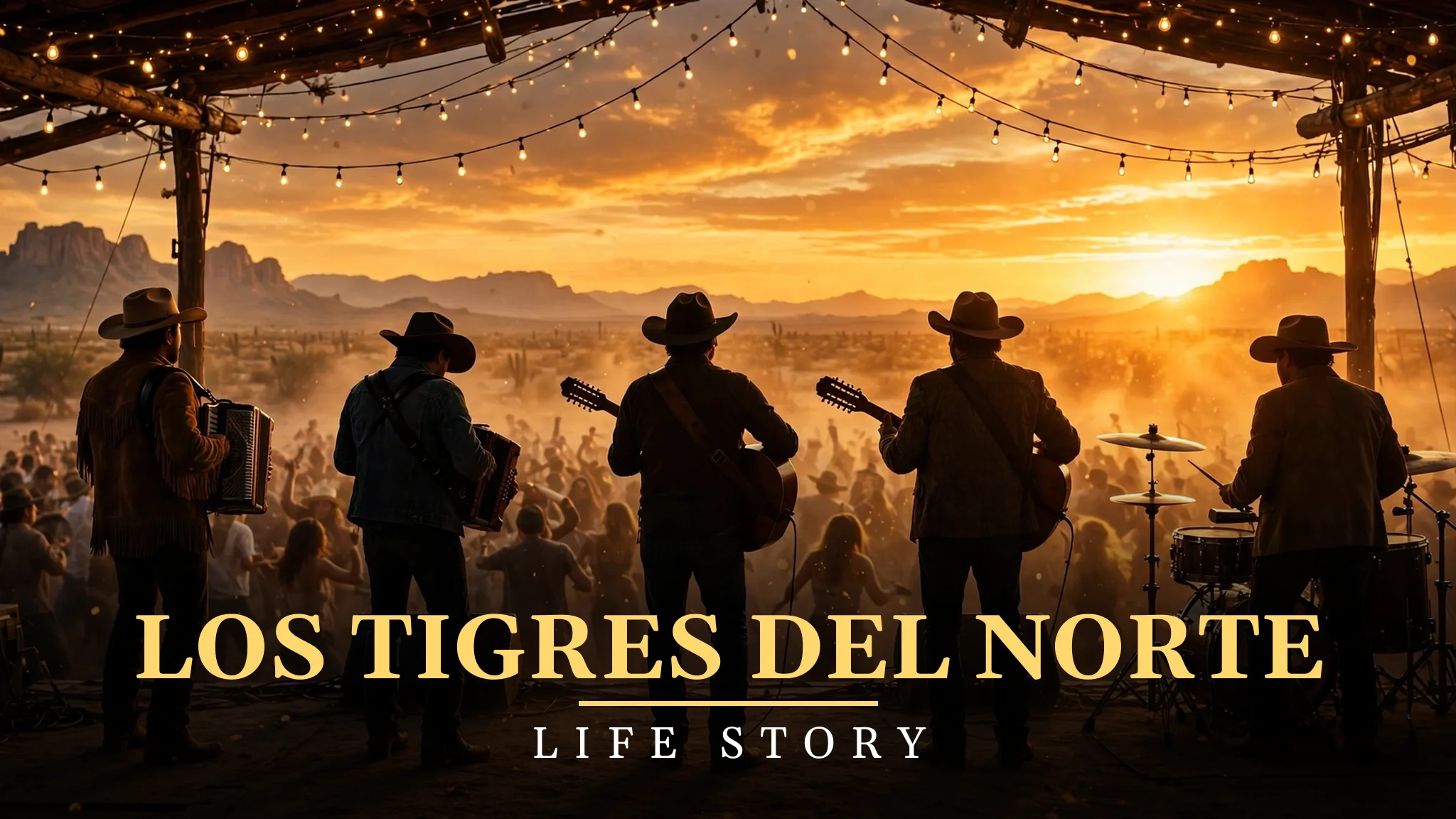
I want to add one more thought, about the desert in their cover image, because it is part of who they are. Five musicians stand on a stage in the desert at sunset, under string lights, with a crowd dancing, and that image feels warm, open, and full of life. It is an image of a band that belongs to the north, to the desert, and to the people who dance to their music. I like that image, and I think it fits Los Tigres. They are tigers of the desert, and their music is the sound of that desert.
In the end, I think Los Tigres del Norte are musicians who deserve all the respect they receive, because they have given their lives to their music, they have played for more than fifty five years, and they have kept the tradition of norteno alive. I like their music, I like their accordions, and I like the way they carry themselves. I hope they keep playing for many years, and I hope more people discover their songs, because they deserve to be heard.
I think about the MTV Unplugged album they made in 2011, and about how special it must have been. A band that has played loud norteno music for forty years, sitting down with acoustic instruments, with guest singers, and with a small audience, is a brave thing to do. It shows that they were willing to try something new, and that they trusted their songs to work in a quieter way. I like that, because it shows that a great song does not need a loud band to be beautiful. It needs only a good melody, good words, and a voice that means what it sings, and Los Tigres have all of those things, in any arrangement.
I also think about their world tours, and about how powerful they must be. A stadium full of fans, singing Jefe de Jefes, with lights, with sound, and with a band that is playing with all its heart, is a different kind of magic from a studio record. It is loud, it is joyful, and it makes the audience feel as if they are part of something large. Los Tigres’ concerts are like that, and I think that is why their fans love them so much. They do not go to hear a record. They go to be part of a celebration, and to sing with a band they love, in a room full of people who feel the same way.
I think about their song La Granja, and about how clever it is to use farm animals to talk about power. It is a funny song, and it is also a serious song, because it says something true about the people who rule, and about the people who work, and it does it in a way that makes the listener smile and think at the same time. That is a hard thing to do in a song, and Los Tigres do it well, because they are storytellers who know how to use a metaphor, and who trust their audience to understand it. I like that, because it shows that a corrido can be smart, not only loud, and that a band can sing about politics without being boring.
Frequently Asked Questions
When and where were Los Tigres del Norte formed?
Los Tigres del Norte were formed in San Jose, California, in 1968, by the Hernandez brothers from Rosa Morada, Sinaloa, with Oscar Lara on drums. They began playing norteno music as teenagers, and they have been together for more than fifty five years.
What is Los Tigres del Norte’s most famous song?
Many people would name Contrabando y Traicion, from 1974, as their most famous song, because it tells the story of Camelia la Texana and became a classic corrido. Other well known songs include La Puerta Negra, Jefe de Jefes, La Reina del Sur, and La Granja.
Who are the members of Los Tigres del Norte?
The band is made up of the Hernandez brothers, Jorge on vocals and accordion, Hernan on bass, Eduardo on accordion and saxophone, and Luis on bajo sexto, with Oscar Lara on drums. That lineup has stayed stable for many years, which is rare for a band.
Has Los Tigres del Norte won Grammy Awards?
Yes, Los Tigres del Norte have won Grammy Awards and Latin Grammy Awards for their albums and songs, including for their MTV Unplugged album in 2011. Those awards show how respected their work is in Mexican and Latin music.
What do Los Tigres del Norte sing about?
They sing corridos about life on the border, about immigration, about love, about work, and about the people who cross from Mexico to the United States. Their songs tell stories in simple words, and they give a voice to Mexicans on both sides of the border.
Are Los Tigres del Norte still performing today?
Yes, they continue to perform, record, and tour, with concerts full of fans who sing every word and dance to their music. They remain the most famous norteno band in the world, even after more than fifty five years on stage.


