Lotte Verbeek: The Life Story Behind the Dutch Screen Star
In this post
Lotte Verbeek is a Dutch actress who has built a career across Europe and America, playing characters who are elegant, intelligent, and often mysterious. She was born in Venlo, in the south of the Netherlands, and she studied acting and dance before she became known for her role as Giulia Farnese in the television series The Borgias. She went on to play Geillis Duncan in Outlander, a role that made her known to millions of viewers around the world, and she appeared in films such as The Fault in Our Stars. Her story is about a woman who combined training, talent, and a willingness to travel, and who built an international career step by step.
She was born on 24 June 1982 in Venlo, a city near the German border. She grew up in a Dutch world, but she was close to other cultures, and that closeness gave her a broad view of Europe from an early age. She studied dance and theatre, she worked on stage, and she moved to film and television with a clear sense of what she wanted to do. She wanted to play characters with depth, and she wanted to work in different countries and in different languages.
What makes her story worth telling is the range of her work. She has played a Renaissance noblewoman, a time travelling witch, a Dutch art student, and many other characters, and she has done it in Dutch, in English, and in other languages. She is an actress who is comfortable in many worlds, and that versatility has made her a valuable performer in both European and American productions.
Growing Up in Venlo
Lotte Verbeek was born on 24 June 1982 in Venlo, a city in the province of Limburg in the south of the Netherlands, close to the border with Germany. Venlo was a practical and hard working city, known for its trade and its industry, and life there was calm and orderly. She grew up in a family that valued culture and education, and she was encouraged to explore her interests and to develop her talents. It was a good place to grow up, and it gave her a sense of home that she has carried with her ever since.
As a child, she was drawn to dance and to movement. She liked to dance, to perform, and to express herself through her body as well as through words. She was a graceful child, and she had a natural sense of rhythm and of space. That love of dance would later become an important part of her acting, because it gave her a physical awareness that many actors do not have. She understood how a character moves, how they hold themselves, and how their body can tell a story.
Her school years were shaped by her interest in the arts. She was a good student, but her real passion was for dance and theatre. She took part in performances, she studied dance seriously, and she began to think about a career in the performing arts. She was not a child who wanted to be famous. She was a child who wanted to perform, to learn, and to become better at her craft.
The city of Venlo gave her a Dutch sense of practicality. Life there was not glamorous, and it did not encourage showing off. It encouraged hard work, honesty, and a respect for others. Those values stayed with her, and they appear in her acting, which is hard working, honest, and respectful of the audience. She has never tried to impress people with tricks. She has tried to tell the truth, and that is a quality that audiences recognise and respect.
Dance, Theatre, and Training
After school, Verbeek studied dance and theatre, training at schools in the Netherlands that taught her the technical side of performance. Dance training is demanding, and it teaches a performer discipline, control, and an awareness of the body. Verbeek learned all of this, and she became a strong dancer as well as a developing actress. That combination gave her a unique set of skills, because she could use her body to tell a story in a way that many actors cannot.
She also studied acting, and she learned how to build a character, how to work with a text, and how to perform in front of an audience. Her training was thorough, and it gave her a solid foundation for the career that followed. She performed on stage, she worked with different directors, and she learned how to handle the pressure of a live performance. She was a dedicated student, and her teachers noticed her talent and her work ethic.
The years of training also gave her a love of European culture. She was close to Germany, she travelled to other countries, and she learned about different traditions of theatre and dance. That breadth of experience made her a versatile performer, one who could work in many different settings and who could adapt to different styles of directing. It also gave her a sense of herself as a European actress, not just a Dutch one.
By the time she finished her training, she was ready to work as a professional. She had the skills, she had the talent, and she had the determination to build a career. She did not expect instant success. She expected to work hard, to take the roles that were offered, and to learn from every job. That attitude served her well in the years that followed.
First Films and Nothing Personal
Verbeek’s first major film role came in Nothing Personal, released in 2009, a Dutch film directed by Urszula Antoniak. The film told the story of a young Dutch woman who leaves her old life behind and travels to Ireland, where she meets an older man and begins a new relationship. Verbeek played the lead role, and her performance was praised for its honesty and its depth. She won awards for the role, and it made her known in the Netherlands and in Europe as a serious actress.
Nothing Personal was important because it showed her ability to carry a film on her own. The film was quiet and slow, and it relied on her performance to hold the audience’s attention. She did that with a combination of stillness, grace, and emotional honesty, and she proved that she could be a leading actress. The film was shown at festivals around the world, and it brought her to the attention of directors in other countries.
She went on to appear in other Dutch and European films, building her experience year by year. Each role taught her something new, and each one made her a stronger actress. She was not in a hurry to become famous. She was building a career, and she was doing it in the right way, by working steadily and by learning from every job.
The early film years were essential to her later success. Hollywood and international television did not discover her overnight. They discovered her after she had already proven herself in European cinema, and that foundation is the reason her later performances feel so assured. She had already done the hard work before she arrived on the world stage.
The Borgias and a Renaissance Star
In 2011, Verbeek joined the cast of The Borgias, a television series about the powerful Borgia family in Renaissance Italy. She played Giulia Farnese, a noblewoman who becomes the mistress of Pope Alexander VI, played by Jeremy Irons. The role was complex and demanding, because Giulia was a woman who had to survive in a world of power, politics, and danger, and who had to use her intelligence and her charm to protect herself and her family.
Verbeek played Giulia with grace and strength, and she became one of the most memorable characters in the series. She wore beautiful costumes, she spoke in English, and she worked with a large international cast in a major production that was seen around the world. The Borgias was a success, and it brought her to the attention of audiences in America and in many other countries. It was a turning point in her career, because it proved that she could work in a major international television series and hold her own opposite major stars.
The role also showed her ability to play a historical character with depth. Giulia Farnese was a real person from history, and Verbeek had to make her feel real rather than like a figure from a painting. She did that by focusing on Giulia’s feelings, her fears, and her hopes, and by showing the human being behind the historical name. That approach made the character feel alive, and it earned her praise from critics and from viewers.
The Borgias ran for three seasons, and it gave Verbeek a chance to develop a character over a long period, something that a film does not allow. She grew as an actress during those years, and she learned how to work on a large television production with a big cast and a complex story. That experience prepared her for the next major television role of her career.
Outlander and Geillis Duncan
Verbeek’s next major television role was as Geillis Duncan in Outlander, the popular series based on the novels by Diana Gabaldon. Geillis was a mysterious and dangerous character, a woman from the eighteenth century who was involved in witchcraft and in the Jacobite cause, and who later turned out to be a time traveller from the twentieth century. It was a complex role, and Verbeek played it with a mix of charm, intelligence, and menace that made Geillis one of the most memorable characters in the series.
Outlander was a huge success, with millions of viewers around the world, and Geillis became a fan favourite. Audiences loved the character’s mystery, her humour, and her unpredictability, and Verbeek’s performance was praised for its energy and its depth. She appeared in the first season and returned in later seasons, and her character’s story became an important part of the series. It was a role that showed her range, because Geillis was very different from Giulia Farnese, and Verbeek played both with conviction.
The role also brought her a new level of fame. Outlander fans are passionate and loyal, and they followed Verbeek’s work closely. She became known to a global audience, and she was invited to fan conventions and to interviews around the world. She handled that fame with grace, and she remained focused on her work as an actress rather than on celebrity.
Geillis Duncan remains one of her most loved roles, and it is a good example of her ability to play a character who is both charming and dangerous. She made Geillis feel real, even when the character was doing extraordinary things, and that is a sign of a talented actress. It is a role that will be remembered for as long as Outlander is watched.
Films, The Fault in Our Stars, and Today
In addition to her television work, Verbeek has appeared in films, including The Fault in Our Stars from 2014, in which she played Lidewij Vliegenthart, a Dutch woman who helps the film’s young heroes when they travel to Amsterdam. The role was small but memorable, and it showed her ability to bring warmth and humanity to a supporting part. The film was a major success, and it brought her to the attention of a younger audience who may not have seen her earlier work.
She has also appeared in other films and television series in Europe and America, including The Blacklist and Agent Carter, and she has continued to work in Dutch productions. Her career is a mix of film and television, of Dutch and international work, and of leading and supporting roles, and that mix has kept her work fresh and interesting. She is not limited to one kind of role, and she is not limited to one country.
Today, Lotte Verbeek is seen as one of the most versatile Dutch actresses of her generation. She has worked with major directors, she has played memorable characters in major series, and she has built a career that spans continents and languages. She is respected by her colleagues for her professionalism and her talent, and she is loved by her fans for the grace and depth of her performances.
Her story is still being written. She is still young, she is still working, and she is still choosing new roles that will challenge her. She has come a long way from Venlo, from dance school to the biggest television series in the world, and she has done it by working hard, by learning her craft, and by staying true to herself. That is a story worth telling, and it is one that will continue for many years to come.
Dance and the Body on Screen
Lotte Verbeek’s training as a dancer gives her acting a quality that is hard to describe but easy to see. She moves with a grace that other actors do not have, and she understands how a character’s body can tell a story. When she played Giulia Farnese in The Borgias, she did not just wear beautiful costumes. She moved in them as if she had lived in them all her life, with a poise that reflected Giulia’s position in the Renaissance court. When she played Geillis Duncan in Outlander, she moved with a different energy, sharp, quick, and unpredictable, reflecting Geillis’s dangerous and restless nature. That ability to change her physical presence from one role to another is a direct result of her dance training.
Dance also taught her discipline. A dancer must practise every day, must look after her body, and must learn to control her movements with precision. Verbeek brought that discipline to her acting, and it shows in the way she prepares for a role. She thinks about how the character walks, how they sit, how they hold their hands, and how they use space. Those details may seem small, but they make a character feel complete, because an audience notices them even if they do not consciously think about them. A character who moves like a real person feels real, and Verbeek’s characters always feel real.
Her dance background also gave her a sense of rhythm, and rhythm is important in acting as well as in dance. A scene has a rhythm, a conversation has a rhythm, and an actor who understands rhythm can make a scene flow naturally. Verbeek understands that, and her performances have a musical quality, a sense of timing that makes her dialogue feel natural and her pauses feel meaningful. That is a rare skill, and it is one that sets her apart from other actresses of her generation.
She has also used her dance training in roles that required physical work, such as period dramas where the costumes are heavy and the movement is restricted. A dancer knows how to move gracefully even when she is wearing a long dress or a corset, and Verbeek does that with ease. Her performances in The Borgias show this clearly, because she moves through the grand rooms of the Vatican with a confidence that makes the historical setting feel alive. That is not an accident. It is the result of years of training, and it is a testament to the value of learning dance as well as acting.
Historical Drama and the Past Made Alive
Lotte Verbeek has a special talent for historical drama, and it is worth understanding why she is so good at it. A historical role requires an actress to do two things at once: to be true to the past, and to make the character feel alive in the present. Many actresses fail at one or the other. They either play the past as if it were a museum, stiff and distant, or they play it as if it were the present, ignoring the differences of the time. Verbeek does neither. She studies the period, she understands its customs, and then she finds the human being inside the costume.
In The Borgias, she played Giulia Farnese, a real woman from Renaissance Italy, and she made her feel like a person who could have lived in any century. Giulia was a noblewoman, but she was also a sister, a mother, and a woman trying to survive in a world ruled by powerful men. Verbeek showed all of those sides, and she did it without ever making Giulia feel like a figure from a history book. The audience could see her fears, her hopes, and her intelligence, and they could understand why she made the choices she did.
Her work in Outlander required a different kind of historical acting, because Geillis Duncan lived in the eighteenth century but was also a time traveller from the twentieth. Verbeek had to play a woman who knew two centuries, and who carried the knowledge of both. She did that with a subtlety that made Geillis feel both old and modern at the same time, a woman who belonged nowhere and everywhere. That is a difficult balance, and it is a sign of an actress who thinks deeply about her characters and about the worlds they live in.
A Career Built on Versatility
Lotte Verbeek’s career is built on versatility, and that versatility is visible in the range of characters she has played. She has been a Renaissance noblewoman in The Borgias, a time travelling witch in Outlander, a young Dutch woman starting a new life in Nothing Personal, and a helpful stranger in The Fault in Our Stars. Each of those characters is different, and each one required a different kind of acting. Verbeek found the right approach for each one, and she did it without ever losing herself. That is a rare achievement, and it is one that comes from training, from hard work, and from a genuine curiosity about people.
Her versatility also extends to language. She acts in Dutch and in English, and she does both with ease, because she has learned to think in both languages and to feel the rhythm of each one. Acting in a second language is hard, but Verbeek makes it look natural, and that skill has opened doors to international productions that would otherwise have stayed closed. A young actor who wants a global career should learn from her example and take language seriously, because it is a tool that can change a career.
My Take:
When I think about Lotte Verbeek, I think about grace. Not grace in a shallow sense, but grace in the way a person moves, speaks, and carries themselves when they are under pressure. She plays characters who are elegant, but who are also strong, and that combination is rare. Giulia Farnese in The Borgias is graceful, but she is also a survivor. Geillis Duncan in Outlander is graceful, but she is also dangerous. Verbeek understands that grace is not weakness. It is a form of strength, and she brings that understanding to every role she plays. I admire that, because it shows an actress who thinks deeply about her characters.
I admire the way she trained. She did not just study acting. She studied dance, and that dance training gave her a physical awareness that many actors do not have. She knows how a character moves, how they hold themselves, and how their body can tell a story. That is a valuable skill, and it is one that makes her performances feel complete. An actor who only thinks about words will miss half the story. Verbeek thinks about the whole person, and her performances show it.
What I find most interesting about her is her versatility. She has played a Renaissance noblewoman, a time travelling witch, a Dutch art student, and many other characters, and she has done it in different languages and in different countries. That versatility is not easy to achieve, because each role requires a different kind of acting. A historical drama needs a different approach from a fantasy series, and a film needs a different approach from television. Verbeek adapts to each one, and she does it without losing herself. That is a sign of a talented and well trained actress.
I also think about her role in Nothing Personal, and I find it very moving. The film is about a young woman who leaves everything behind and starts again in a new place. Verbeek played that woman with a quiet honesty that made the film feel real. She did not try to make the character heroic or dramatic. She played her as a real person who was trying to find her way, and that honesty earned her awards and the respect of critics. It was an early role, but it showed the actress she would become.
If I have a sadness about her story, it is that she is often cast in supporting roles, and her talent deserves more leading roles. She has proven that she can carry a film, as she did in Nothing Personal, and she has proven that she can be a memorable part of a major series, as she did in Outlander. But she has not always been given the leading roles that her talent deserves. That is a shame, because audiences would love to see more of her. I hope that directors will give her more chances to lead, because she has earned them.
I also respect the way she has built an international career without losing her Dutch roots. She works in the Netherlands, in Britain, and in America, and she brings a Dutch directness and honesty to each role. She has not tried to become an American actress or a British actress. She has remained a Dutch actress who works internationally, and that gives her a distinctive place in the film world. I admire that, because it shows a person who knows who she is and who does not need to change to fit in.
Another thing I notice is her professionalism. Directors and co-stars have praised her for being prepared, for being focused, and for being easy to work with. That may sound like a small thing, but in the film and television world it matters a great deal. A set is a stressful place, and an actor who is professional makes everyone’s job easier. Verbeek has built a reputation as a professional, and that reputation will help her for the rest of her career.
When I compare Verbeek with other actresses of her generation, what stands out is her elegance. She does not play characters who are loud or crude. She plays characters who are refined, intelligent, and complex, and she does it with a grace that is uniquely hers. That elegance is her gift, and it is what makes her performances memorable. It is also what makes her a good fit for historical dramas and for fantasy series, where a character must feel both real and larger than life.
For a young actor reading this, I think the lesson is to train widely and to be willing to travel. Verbeek studied dance and acting, she worked in the Netherlands, and she travelled to other countries to work. That breadth of training and experience made her a versatile actress, and it opened doors that would have stayed closed if she had stayed in one place. A young actor who follows her example will not be limited to one kind of work. They will be able to do many things, and they will have a longer and richer career because of it.
In the end, I think Lotte Verbeek teaches us that grace and strength can go together, and that an actress who is willing to work hard, to train properly, and to travel can build a career that spans the world. She has played in some of the most popular television series of recent years, she has worked in major films, and she has earned the respect of audiences and critics alike. I admire her for it, and I look forward to seeing what she does next, because I believe that her best work may still be ahead of her.
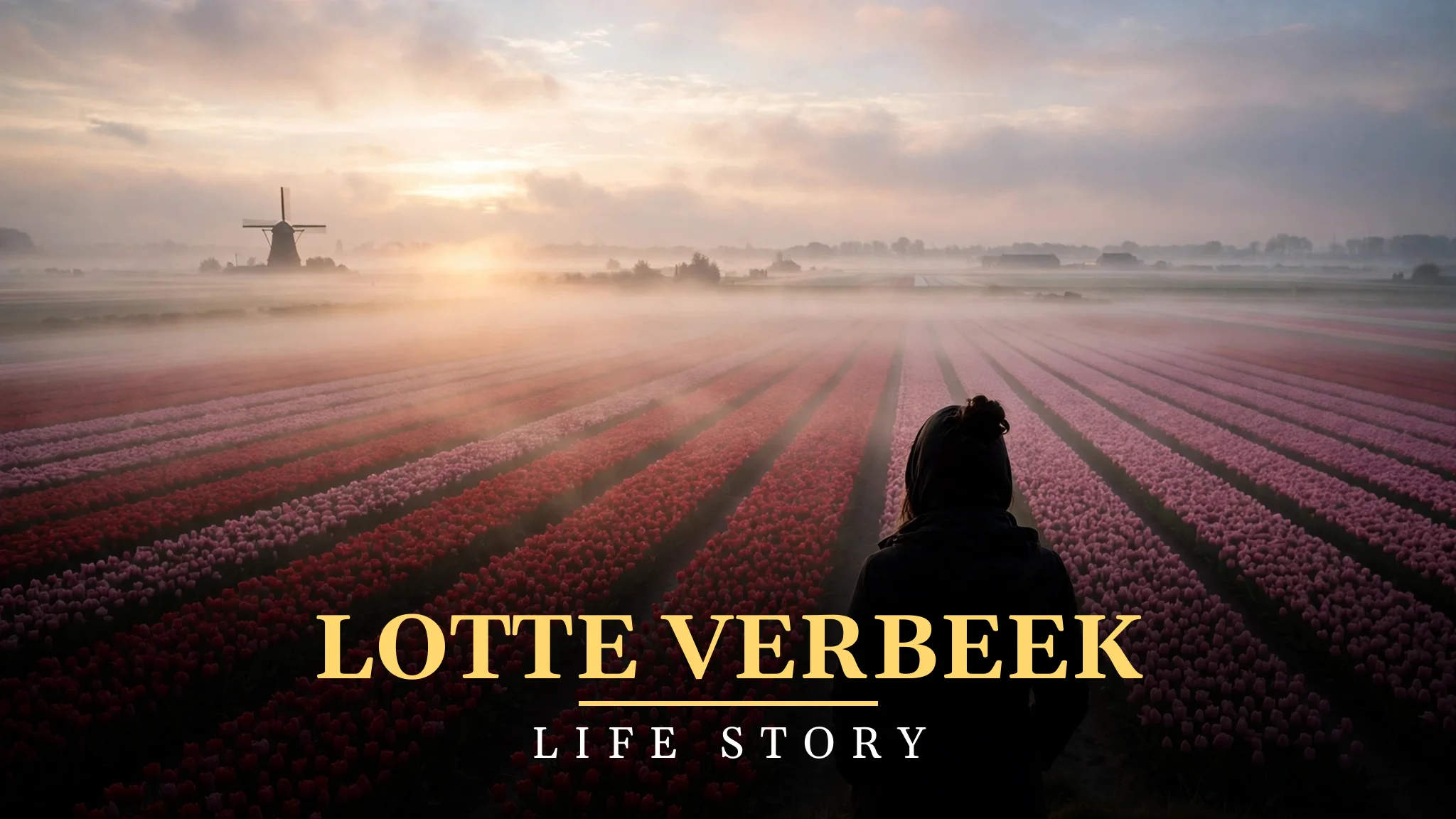
One more thought stays with me, and it is about the tulips in her image and the Dutch landscape she comes from. She grew up in a country of flowers, of windmills, and of wide skies, and she carries that Dutch sense of beauty with her wherever she goes. It is a quiet beauty, not a loud one, and it is the same kind of beauty that appears in her acting. I think that is a lovely connection, and it is one that makes her story feel complete.
I also think about the tulip field in her image, and about what it says about her career. A tulip field is a Dutch landscape, full of colour, order, and beauty, and it stretches as far as the eye can see. Verbeek’s career is like that field: it is Dutch at its roots, it is full of colour and variety, and it stretches across many countries and many kinds of roles. She has not stayed in one place. She has travelled, she has worked in different languages, and she has built a career that is as wide and as beautiful as a field of tulips in spring. I find that image very fitting, and it is one that I will remember when I think about her.
Another thing I admire is her work in The Fault in Our Stars, because it was a small role in a film that was loved by millions of young people, and she played it with great warmth. Lidewij is a Dutch woman who helps two young Americans when they visit Amsterdam, and she does it with kindness and with a sense of humour. It is a small part, but Verbeek made it memorable, because she brought a real person’s warmth to it. That is a sign of a generous actress, one who is willing to play a supporting role well, even when she is not the star of the film. Many actors would not bother. Verbeek did, and the film is better for it.
I also think about the challenge of playing a historical character like Giulia Farnese, because the audience already has an idea of what a Renaissance noblewoman should look like, and the actress must live up to that idea while also making the character feel human. Verbeek did that by focusing on Giulia’s feelings, her fears, and her hopes, rather than on the costumes or the setting. She showed a woman who was trying to survive in a dangerous world, and who used her intelligence to protect herself. That is a modern way of looking at a historical figure, and it is one that makes the past feel alive and relevant to today’s audience.
There is also a lesson here about the value of international work. Verbeek has worked in the Netherlands, in Britain, and in America, and each of those experiences has made her a better actress. She has learned different styles, she has worked with different directors, and she has played characters from different cultures. That breadth is a strength, and it is one that young actors should aim for. An actor who only works in one country will have a narrow view of the world. An actor who works in many countries will have a wide view, and their performances will show it.
I think about her future too, and about what roles she might play next. She is in her forties, and she has many years of acting ahead of her. She could play mothers, leaders, artists, and women who have lived a long life and who have learned from it. Those are rich roles, and Verbeek has the experience and the talent to play them well. I hope that directors will give her those chances, because audiences will benefit from seeing a mature actress at the height of her powers.
Finally, I want to say something about elegance, because it is a word that comes up again and again when people talk about Verbeek. She is elegant, but her elegance is not cold or distant. It is warm, it is human, and it is the elegance of a person who is comfortable in her own skin. That is a rare quality, and it is one that makes her performances feel both beautiful and real. I admire her for it, and I look forward to seeing what she does next, because I believe that her best work may still be ahead of her.
I also think about the windmill in her image, and about what it says about Dutch identity. A windmill is an old symbol, but it still works, still turns, and still has a purpose. Verbeek’s career is like that: it is rooted in Dutch tradition, in dance and theatre, but it is still moving, still working, and still finding new purposes. She has taken the old skills she learned as a dancer and as a stage actress, and she has used them in new kinds of television and film. That combination of old and new is a strength, and it is one that makes her work feel both timeless and modern.
Another thing I admire is her ability to play characters who are not easy to like. Geillis Duncan is a fascinating character, but she is also a dangerous one, and Verbeek did not try to make her sweet or simple. She played her as she was, a woman with secrets, with ambitions, and with a dark side, and she trusted the audience to find her interesting even when they did not approve of her. That is a brave choice, and it is one that shows an actress who is not afraid of complexity.
There is also a thought about the value of training, because Verbeek’s career shows what happens when an actor is properly trained. She studied dance, she studied acting, and she learned her craft thoroughly before she became famous. That training is visible in every performance, in the way she moves, in the way she speaks, and in the way she listens. A young actor who wants a long career should follow her example and take training seriously, because talent alone is not enough. Talent must be shaped by discipline, and Verbeek’s work shows what that shaping can achieve.
I also think about the way Verbeek has handled the fame that came with Outlander, because it was a new kind of fame, global and passionate, with fans who followed her work closely and who wanted to know everything about her. She handled it with grace, attending fan events, talking to viewers, and remaining focused on her work as an actress. That is not easy, because global fame can be overwhelming, but Verbeek managed it by staying grounded, by remembering where she came from, and by keeping her private life private. I respect that balance, because it shows a person who understands that fame is part of the job, not the whole of it.
Frequently Asked Questions
Where was Lotte Verbeek born and what did she study?
Lotte Verbeek was born on 24 June 1982 in Venlo, Netherlands, and she studied dance and theatre, training as a dancer and actress before moving into film and television.
What was Lotte Verbeek’s first major film role?
Her first major film role was in Nothing Personal from 2009, a Dutch film in which she played a young woman who travels to Ireland and starts a new life, winning awards for her performance.
Who did Lotte Verbeek play in The Borgias?
She played Giulia Farnese in The Borgias, a Renaissance noblewoman who becomes the mistress of Pope Alexander VI, in the television series that ran from 2011.
Who is Geillis Duncan in Outlander?
Geillis Duncan, played by Verbeek in Outlander, is a mysterious and dangerous character from the eighteenth century who is involved in witchcraft and later revealed to be a time traveller from the twentieth century.
Did Lotte Verbeek appear in The Fault in Our Stars?
Yes, she played Lidewij Vliegenthart in The Fault in Our Stars from 2014, a Dutch woman who helps the young heroes when they travel to Amsterdam.
What other television series has Lotte Verbeek appeared in?
She has appeared in series including The Blacklist and Agent Carter, as well as Dutch productions, building a career that spans European and American television.
Is Lotte Verbeek still acting today?
Yes, she continues to work in film and television in the Netherlands, Britain, and America, and she remains one of the most versatile Dutch actresses of her generation.


