Louis Armstrong: The Life Story Behind Jazz's Greatest Star
In this post
Louis Armstrong was born on 4 August 1901 in New Orleans, Louisiana, in one of the poorest neighbourhoods of the city, and he grew up without a father, raised by his mother and his grandmother in a district known as the Battlefield. As a boy he sang on street corners for pennies, and he worked at odd jobs, including delivering coal, to help the family. Music was everywhere in New Orleans, in the brass bands, in the churches and in the dance halls, and the young Armstrong absorbed it all, carrying a tin horn and dreaming of the day he would play a real one.
His chance came when he was sent to the Colored Waif’s Home for Boys after firing a pistol into the air on New Year’s Eve in 1912. At the home he learned to play the cornet in the band, and the director, Peter Davis, recognised his talent and gave him extra lessons. When he left the home in 1914 he was already a capable player, and he began working on the riverboats and in the dance bands of New Orleans. Within a few years he was the most talked-about young musician in the city.
In 1922 Joe Oliver, the leading cornet player of New Orleans, sent for Armstrong to join his band in Chicago, and the move changed American music. Armstrong’s solos, first with Oliver and then on his own records with the Hot Five and Hot Seven, introduced a new way of playing jazz, built on improvisation, swing and a tone that sounded like a human voice. By the end of the 1920s he was the most famous jazz musician in the world, and he stayed famous for the rest of his life.
Armstrong died on 6 July 1971 in New York, at the age of 69, after a career that lasted almost sixty years. He had taken jazz from the dance halls of New Orleans to concert stages around the world, and he had done it with a trumpet, a gravel voice and a smile that became one of the most recognised faces on earth. This is his life story, from the streets of New Orleans to the top of the charts.
New Orleans and the Waif’s Home
Louis Daniel Armstrong was born on 4 August 1901 in New Orleans, Louisiana, to Mary Albert, known as Mayann, and William Armstrong, a labourer who left the family soon after Louis was born. He grew up in the Battlefield, a rough neighbourhood of Storyville, living with his mother and his grandmother, Josephine, in a house without running water. As a small boy he sang in a vocal quartet on street corners, earning pennies from passers-by, and he worked jobs that a child could do, including selling newspapers and delivering coal for a local merchant.
On New Year’s Eve in 1912, when he was eleven, Armstrong fired a pistol into the air to celebrate, and he was arrested and sent to the Colored Waif’s Home for Boys, a reform school for Black children. The home turned out to be the making of him. Its band director, Peter Davis, taught him the cornet, and Armstrong practised with an intensity that surprised everyone. Davis gave him the lead cornet chair, and by the time Armstrong left the home in 1914 he could read music and play with a confidence that was unusual for a boy his age.
Back in New Orleans he found work playing in dance bands and on the riverboats that travelled the Mississippi. He played with Kid Ory’s band, one of the best in the city, and he began to develop the style that would make him famous, a big, warm tone and a way of bending notes that sounded like singing. He also married Daisy Parker, his first wife, in 1918, though the marriage did not last. By 1922 he was ready for a bigger stage, and it came in the form of a telegram from Chicago.
Chicago, Joe Oliver, and the Hot Five
Joe Oliver, known as King Oliver, was the leading cornet player in New Orleans, and in 1922 he sent for Armstrong to join his Creole Jazz Band in Chicago. Armstrong arrived in the city with his cornet wrapped in a cloth and his belongings in a small bag, and he moved into Oliver’s home, where Oliver’s wife took care of him. Playing second cornet behind Oliver, he learned how to blend with a band and how to take a solo that lifted the whole ensemble. The band recorded for Gennett Records in 1923, and the records spread Armstrong’s name beyond Chicago.
In 1924 Armstrong moved to New York to join Fletcher Henderson’s orchestra, the best Black dance band in the country. Henderson’s musicians were trained readers, and Armstrong’s arrival changed the band, pushing it toward the looser, swinging style that became the sound of the big band era. He stayed a year, then returned to Chicago, where he married the pianist Lil Hardin, who encouraged him to leave Oliver’s shadow and lead his own band. She was right, and the records he made next changed jazz for ever.
Between 1925 and 1928 Armstrong recorded with a small group called the Hot Five, later the Hot Seven, for Okeh Records. The recordings included West End Blues, Potato Head Blues and Cornet Chop Suey, and they are still studied as the foundation of modern jazz. On West End Blues, recorded in 1928, Armstrong opens with a long, unaccompanied cadenza that showed what a trumpet could do, and his scat singing on Heebie Jeebies, recorded in 1926, introduced a new vocal style. The Hot Five records made him a star, and they made the soloist, rather than the ensemble, the centre of jazz.
The Trumpet and the Voice
Armstrong’s trumpet playing was built on tone. He had a big, warm sound that could fill a hall without a microphone, and he played with a clarity that made every note count. He favoured the upper register, hitting high notes that other players avoided, and he bent notes and used vibrato in ways that made the trumpet sound like a human voice. Other trumpet players copied him, and the whole language of jazz trumpet after Armstrong is a response to what he did in the 1920s.
His singing was just as influential. Armstrong’s voice was a gravelly baritone, rough from years of playing and singing, and he used it with the same rhythmic freedom he brought to the trumpet. His scat singing, in which he improvised nonsense syllables in place of words, turned the voice into an instrument, and singers from Ella Fitzgerald to Bobby McFerrin have cited it as an influence. He sang the way he played, swinging the beat and bending the melody, and audiences loved the warmth and humour in it.
He was also one of the first jazz musicians to become a popular entertainer rather than a musician’s musician. His stage manner was open and joyful, and he smiled through his performances, a habit that some critics later held against him but that audiences adored. He understood that a performance was a communication, not just a display of skill, and he played every show as if it were his first. The smile became as famous as the sound, and it carried him through six decades of performing.
West End Blues and the Breakthrough
West End Blues, recorded on 28 June 1928 with the Hot Five, is often called the most important single recording in jazz history. Armstrong opens with a cadenza, a long unaccompanied flourish that climbs to a high note and then falls away, and the rest of the band enters behind him. The recording shows everything that made him different: the tone, the timing, the sense of drama, and the way he could make a simple melody feel like a story. Jazz musicians have been studying that opening for almost a century, and it still sounds fresh.
The record came at a moment when jazz was moving from New Orleans ensemble playing to the soloist-led style that Armstrong pioneered. Before the Hot Five, the cornet was one voice in a group. After West End Blues, the soloist was the point of the music, and every jazz musician who followed, from Charlie Parker to Miles Davis, worked in the space Armstrong opened. The recording also made Armstrong’s name known to musicians and listeners who had never seen him play, and it established him as the leading figure in jazz.
Armstrong followed West End Blues with a string of recordings that extended his influence, including Weather Bird, a duet with Earl Hines that is still regarded as one of the great jazz duets, and Tight Like This. He also began to record popular songs, including Ain’t Misbehavin’ and Stardust, bringing jazz phrasing to material that had been written for Broadway and Tin Pan Alley. The move toward popular song would define the second half of his career, and it made him a star far beyond the jazz world.
Hollywood, the All Stars, and the World
In the 1930s Armstrong moved into films and radio, appearing in movies like Pennies from Heaven in 1936, in which he sang and played with Bing Crosby, and he became a familiar figure to audiences who had never heard a jazz record. He toured Europe in 1932, where his playing caused a sensation, and he returned to a hero’s welcome. The tours made him an international star, and he spent much of the next forty years on the road, playing concerts in Europe, Africa, Asia and South America.
In 1947 he formed a small group called the All Stars, with Jack Teagarden on trombone, Barney Bigard on clarinet and Earl Hines on piano, and the group became his working band for the next two decades. The All Stars played the traditional New Orleans repertoire with a polish and swing that made it accessible to audiences everywhere, and their concerts were joyful occasions, full of Armstrong’s humour and showmanship. The band recorded and toured constantly, and it kept Armstrong at the centre of jazz even as new styles came and went.
Armstrong’s tours also had a diplomatic dimension. In the 1950s and 1960s the US State Department sent him on goodwill tours, and he was welcomed as an ambassador of American music in countries where American politics was less welcome. He played in Ghana, in the Congo and across Europe, and his concerts were treated as major cultural events. He took the role seriously, and he used his fame to speak, gently but firmly, about the civil rights struggles at home, including his public criticism of President Eisenhower during the Little Rock crisis in 1957.
Hello, Dolly! and the Number One Hit
In 1964 Armstrong recorded Hello, Dolly!, the title song from the Broadway musical, and it became the biggest hit of his career. The record reached number one on the Billboard chart in May 1964, displacing the Beatles from the top spot at the height of Beatlemania, and it made Armstrong, at 62, the oldest artist ever to have a number one single, a record he held for decades. The song’s success introduced him to a new generation, and it became his signature tune for the rest of his life.
The record was made with a small band and Armstrong’s familiar gravel voice, and its charm lay in its simplicity. He had recorded the song as a favour, and no one expected it to become a hit, but radio stations picked it up and audiences responded to the warmth in it. The success led to a Grammy Award and to a new round of television appearances, and it kept him working at a pace that would have exhausted a younger man. He was in his sixties and still the most recognisable voice in popular music.
Three years later he recorded What a Wonderful World, a gentle ballad about the beauty of ordinary life, written by Bob Thiele and George David Weiss. The record was a modest hit in America at first, but it became a huge success in Britain and, decades later, after it was used in the film Good Morning, Vietnam in 1987, it became one of the most beloved songs of the twentieth century. It is now the song most people associate with Armstrong, and it plays at weddings, funerals and memorials around the world.
The Ambassador of Jazz
Armstrong’s nickname, Satchmo, came from his wide smile and his large mouth, and it followed him everywhere. He was also called Pops by his fellow musicians, a sign of the affection and respect in which he was held. He was generous with younger players, inviting them to sit in with his band and praising their work in public, and he never stopped learning, listening to new records and new players even in his final years. The warmth that audiences saw on stage was real, and it was part of why he lasted so long.
He was also a prolific correspondent, writing letters to friends and fans throughout his life, and he kept a tape recorder running in his home, recording conversations, rehearsals and his own thoughts. The tapes, now held in archives, give a vivid picture of a man who loved music, loved people and loved to talk. He wrote an autobiography, Satchmo: My Life in New Orleans, published in 1954, which remains one of the best accounts of early jazz, written by someone who was there.
His influence on music is hard to overstate. He established the soloist as the centre of jazz, he created the swing feel that defined the music for decades, and he showed that a jazz musician could be a popular star without giving up the music. Trumpet players, singers, bandleaders and songwriters all owe him a debt, and the history of jazz is usually divided into the period before Armstrong and the period after him. There are very few musicians about whom that can be said.
His tour of Africa in 1960 and 1961 was one of the great moments of his career. In Ghana he was welcomed by President Kwame Nkrumah, and crowds of tens of thousands turned out to hear him play in Accra. He played in the Congo during a period of political turmoil, and his concerts there were treated as events of national importance. Armstrong was moved by the welcome he received, and he spoke often afterwards about the connection he felt with African audiences, a connection that went beyond music to something older and deeper.
The Later Years and the Health
Armstrong worked at a punishing pace for most of his life, playing hundreds of concerts a year and recording constantly, and by the late 1960s his health was failing. He suffered from heart and kidney problems, and his doctors warned him to slow down, but he kept performing, telling friends that music was what kept him alive. In 1968 he was hospitalised for heart trouble, and in 1969 he spent months recovering, but he returned to the stage as soon as he was able, playing concerts in New York and Las Vegas.
His final performances were in 1971, when he played at the Waldorf-Astoria in New York in March, a concert that was recorded and released after his death. He was visibly frail, but his playing was still strong, and the audience gave him a standing ovation that lasted for minutes. He returned home to Corona, Queens, where he lived with his wife Lucille, and he spent his last months resting and listening to music. He died on 6 July 1971, at the age of 69, of a heart attack, in his sleep.
His funeral in New York was attended by thousands, and jazz musicians from around the world sent tributes. He was buried at Flushing Cemetery in Queens, and his home in Corona, where he lived for almost thirty years, is now a museum, preserved as it was when he lived there. The house, with its kitchen, its record collection and its tape recorders, gives visitors a sense of the man behind the smile, a working musician who loved his home and his wife and his music in equal measure.
At home in Corona, Queens, Armstrong kept a daily routine that friends described with affection. He practised the trumpet every morning, answered fan mail in the afternoon, and recorded his thoughts on a tape recorder that ran almost constantly. The house was full of records, photographs and souvenirs from his travels, and Lucille kept it exactly as he liked it. Neighbours remember him sitting on the front steps in summer, talking to children on the street and signing autographs for anyone who asked. It was an ordinary life, lived by an extraordinary man, and it suited him.
The Legacy of Satchmo
Armstrong’s recordings remain the foundation of jazz education. Students learn West End Blues and the Hot Five records as their first lessons in improvisation, and trumpet teachers still use his solos as models of tone and phrasing. His scat singing is taught as a vocal technique, and his version of Hello, Dolly! is still played on the radio. The music has outlasted every fashion that followed it, and it sounds as fresh now as it did when it was recorded.
His influence extends far beyond jazz. Popular singers learned phrasing from him, rock musicians learned swing from him, and hip-hop producers have sampled his records. He showed that American music could be both art and entertainment, and that a musician from the poorest streets of New Orleans could become a citizen of the world. The list of musicians who cite him as an influence runs from Miles Davis to the Beatles, and it is hard to find a major figure in twentieth-century music who does not owe him something.
Today Armstrong is remembered as the man who made jazz a world music, and his face, with its wide smile and its handkerchief, is one of the most famous images in music history. His home in Queens is a museum, his recordings are in the Library of Congress, and What a Wonderful World is played every day somewhere in the world. He was born in poverty, in a city that gave him music, and he gave the world a sound that has never been equalled.
My Take:
What I admire about Louis Armstrong is that he was born in poverty, and he became a legend, through talent, through hard work, and through a smile, and that is a hopeful message, for anyone who feels poor, or disadvantaged, or forgotten. He was a boy from Storyville, New Orleans, who was sent to a reform school, and who learned to play the cornet there, and who became the father of jazz, and that is a story that inspires me, because it shows that you can come from nothing, and you can become great, if you have talent, and determination, and a smile, and Armstrong had all three, and that is why he is a legend.
West End Blues is the recording I think about most, because it is one of the greatest recordings in the history of jazz, and Armstrong’s trumpet solo is at its heart. He played a solo that is both technical and emotional, and that is still regarded as one of the greatest solos ever played, a solo that starts with a high, clear note, and that builds, with a series of phrases that are both beautiful and daring, and that shows his mastery of the trumpet, and his ability to make it sing, and to make it cry, and to make it tell a story, and that is a gift that few musicians possess, the gift of making an instrument tell a story, and Armstrong had it, and he used it, in every recording he made.
What a Wonderful World is a song I love, because it is about hope, about beauty, and about a world that is wonderful, even when it is hard, and Armstrong sang it with a voice that was gravelly, warm, and unmistakable, and with a conviction that is unforgettable. I think about the line, I see trees of green, red roses too, and I am moved, because it is a moment of pure beauty, a man who was born in poverty, singing about a world that is wonderful, and that is a powerful thing, and Armstrong sang it with a smile, and with a heart, and that is why the song is still sung today, by people who were not alive when he sang it, and who are moved by it, because it is a song about hope, and hope is something we all need.
Hello, Dolly! is a part of his story that fascinates me, because he was 62 years old, and he recorded a song that became a number one hit, knocking The Beatles off the top of the charts, a remarkable achievement, for a man who was 62, and who was, in the eyes of many, a jazz musician, not a pop star, but who proved that he was still relevant, and still popular, and still capable of making a hit, and that is a testament to his talent, and to his appeal, and to the power of a great song, sung by a great singer, with a voice that is unmistakable, and that is loved, by millions of people, around the world.
The lesson I take from Armstrong is that talent can lift you up, no matter where you come from. He was born in poverty, in one of the poorest neighbourhoods in America, and he became a legend, through a trumpet, and through a voice, and through a smile, and that is a lesson for anyone who feels poor, or disadvantaged, or forgotten. Do not give up, the way Louis Armstrong did not give up, and let your talent lift you up, because talent can change your life, and music can change your life, and Armstrong proved it, in every recording he made, and in every concert he gave.
I also think about his smile, because it was famous, and it was infectious, and it was a part of his legend, but it was not the most important thing about him. The most important thing was his talent, his trumpet, and his voice, and those are the things that made him a legend, not his smile, and that is a reminder that a smile is not enough, and that what matters is what you do with your talent, and Armstrong did a great deal with his, and that is why he is remembered, not just for his smile, but for his music, and for his genius, and that is a legacy that will never fade.
His scat singing is something I admire, because he invented it, by accident, when he forgot the words to Heebie Jeebies, and sang nonsense syllables, and turned it into a new style of singing, a style that is still used today, by jazz singers who scat, and who owe it to Armstrong, who was the first, and who did it with a humour, and a creativity, that was infectious, and that is a part of his genius, a genius that was not just about playing the trumpet, but about inventing, about creating, and about changing the way music is sung, and heard, and that is why he is the father of jazz, and why his recordings are still important today.
Finally, I believe Louis Armstrong was one of the greatest musicians who ever lived, and his recordings are classics that will be played for as long as jazz is played. He was Satchmo, he was Pops, and he was the father of jazz, and his story is one of talent, determination, and a life lived with a smile. He will always be remembered as the man who invented modern jazz, and as the man who sang What a Wonderful World, and who made us believe, for a moment, that the world is wonderful.
One more thing I want to say is that his reform school story is a reminder that sometimes, the worst thing that happens to you can be the best thing, because the Waif’s Home, which was meant to punish him, gave him music, and music gave him a life, and a legacy, that will never be forgotten. That is a hopeful message, for anyone who is in a difficult place, because it shows that even in the darkest place, there can be a gift, and Armstrong found his gift, in a reform school, and he used it, to become a legend, and that is a beautiful thing, and it is a part of his story that I am grateful to have learned about.
When I think about New Orleans, his birthplace, I think about how far he travelled, from a poor boy in Storyville to the most famous musician in the world, and how much he achieved. He was a boy who sold newspapers, and who sang on the streets, for pennies, and who became a legend, and that is a story that inspires anyone who dreams of being a musician, because it shows that dreams can come true, even if you start with nothing, and Armstrong started with nothing, and he became everything, and that is a hopeful message, and one that he embodied.
I will end by saying that listening to Louis Armstrong play was a privilege, and I am grateful to have heard his trumpet. He was a master, he was a genius, and he was a legend, and those three things together make a great musician. He is Satchmo, he is Pops, and he is Louis Armstrong, the father of jazz, and he will always be remembered as such, as a legend, and as a trumpet that will never be forgotten.
There is a final thought I want to leave with, and it is about the line from What a Wonderful World, where he sings, I see trees of green, red roses too, I see them bloom, for me and you, a line that has stayed with me, because it is a lesson about beauty, about hope, and about a world that is wonderful, even when it is hard. Armstrong sang that line with a warmth that has stayed with me, because it is a lesson about life, about love, and about being human. That is the power of his singing: it teaches us how to live, and it makes us better people, by showing us that the world is wonderful, if we look for it, and that is a lesson I will carry with me, always.
And if you have never heard What a Wonderful World, listen to it, because it is one of the great songs of all time, and Armstrong’s performance is at its heart. Listen to it for the story, for the trumpet, and for the voice, and for the man who sang it with a conviction that is unforgettable. That is the Louis Armstrong I will remember: not just the musician, but the man, who was warm, generous, and kind, and who will never be forgotten.
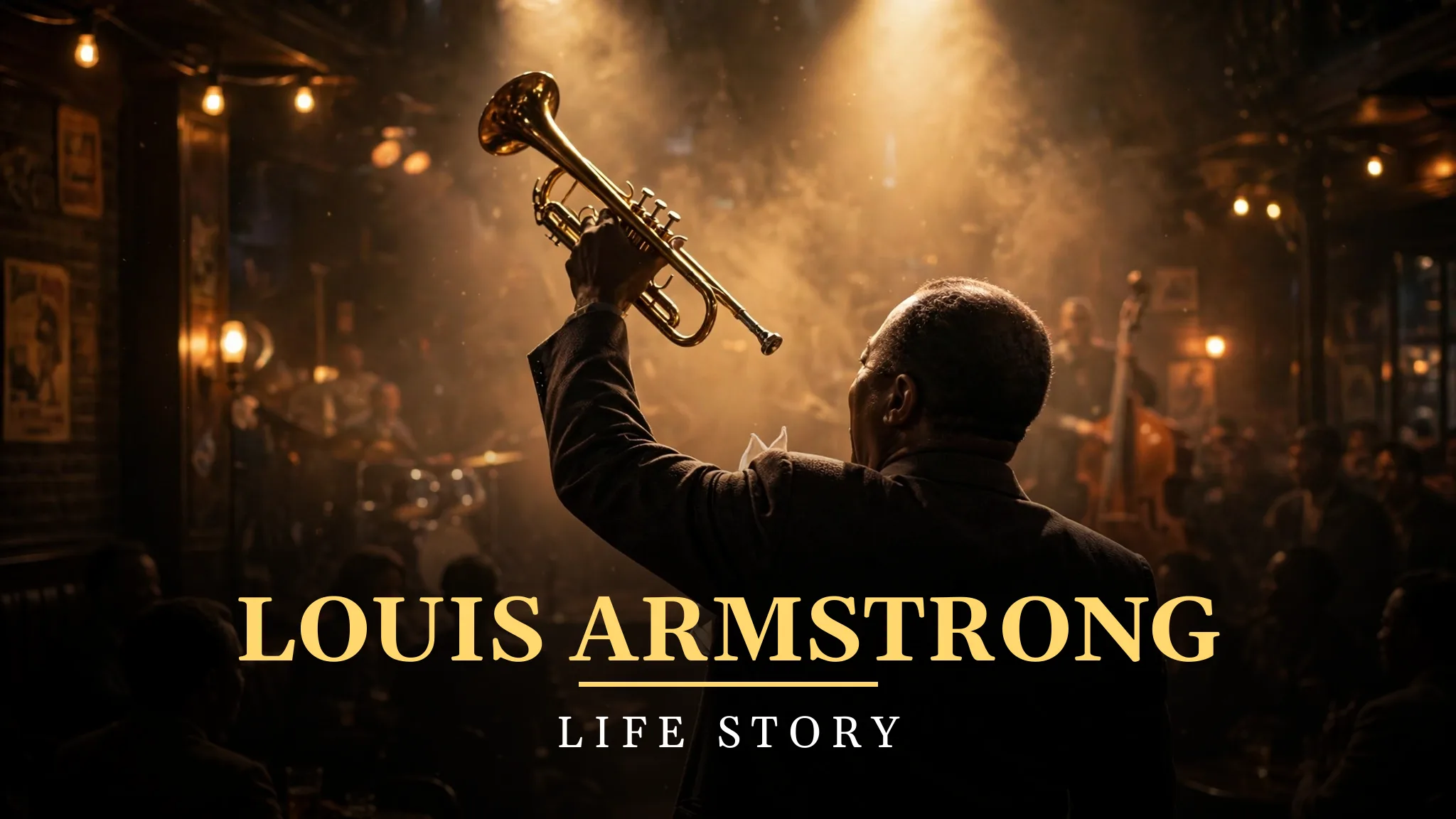
One last memory: the image of him holding a golden trumpet, with a white handkerchief in his hand, and a smile that is both warm and infectious, on a stage, in front of an audience that loves him. That image is iconic, and it is beautiful, and it is the image that will define him forever. He was Satchmo, and he was Louis Armstrong, and he was the father of jazz.
His legacy will live on through his recordings, through his trumpet, and through the generations of musicians he inspired, who heard his trumpet and wanted to play the way he played. That is a fitting legacy for a man who defined jazz, and who did it with a trumpet and a voice that will never be forgotten. He is gone, but his music remains, and his name will be remembered as one of the greats.
Finally, I want to say thank you, Louis Armstrong, for West End Blues, for Hello, Dolly!, and for a life lived with a trumpet and a smile. You were a great musician, and you were a great man, and the world is a better place because you were in it. Your music is still here, your legacy is still here, and your example is still here, and that is a life that mattered, and a life that will never be forgotten.
And one more thing: if you are a musician, play like Armstrong, because he is the musician every musician deserves to be, a musician who plays with his heart, and who makes an audience feel. Play like Armstrong, the way Louis Armstrong played, and the world will be a better place for it, because the world needs more musicians like him, who play with talent, with joy, and with humanity.
There is a last lesson in his life that I carry with me, and it is this: smile, even when it is hard, because a smile can light up a room, and Armstrong’s smile lit up the world, and that is a lesson worth remembering, and it is one I will carry with me, always, because the world needs more people like Louis Armstrong, who smile, who play, and who make the world a better place, through music, and through kindness.
One final thought: his Grammy for Hello, Dolly!, won at 62, is a testament to his longevity, because he won it for a song that became a number one hit, knocking The Beatles off the top of the charts, and that is a record that speaks for itself. He was great, at 62, and he was great at every age, and that is a rare achievement, and it is a reminder that talent does not fade with age, and that a great musician can be great for a lifetime, if he has the talent, the determination, and the smile that Armstrong possessed.
And if you ever doubt that music can change the world, remember Louis Armstrong, because he did, with a trumpet, and with a voice, and his difference is still felt today, in every jazz festival, in every trumpet player, and in every person who loves jazz, and that is a legacy that will last, long after his trumpet is heard, because his music is still here, and his influence is still here, and that is a gift that will never fade.
There is one more thing I want to say, and it is about his wife Lucille, because she was his wife for 29 years, until his death, and she loved him, and she was loyal to him, and she kept his memory alive, after his death, and that is a beautiful thing, and it is a part of his story that shows him as a husband, not just as a musician, and that is a legacy that matters, in its own way, alongside his music and his smile, because his family is his greatest legacy, and they have honoured him, by being themselves, just as he was himself.
His story also reminds me that a poor boy from New Orleans can become a legend, if he has talent, determination, and a smile, and that is a hopeful message for anyone who feels poor, or disadvantaged, or forgotten. Armstrong was poor, and he was disadvantaged, and he became one of the greatest musicians in history, because he embraced who he was, and he used his talent to become great. That is a lesson worth remembering, for every poor person out there, and for every person who dreams of being a musician.
I also want to mention his mentor, King Oliver, because he was Armstrong’s teacher, and his friend, and his father figure, and he taught him about music, and about life, and he invited him to Chicago, and that invitation changed Armstrong’s life, and it is a reminder that a mentor can change your life, and that we should be grateful to our mentors, and that Armstrong was grateful to Oliver, and he honoured him, by being great, and by carrying on his legacy, and that is a beautiful thing, and it is a part of his story that shows the power of mentorship, and of friendship, and of a teacher who believes in a student.
And finally, I think about the fact that he lived to 69, and that he played for more than fifty years, and that is a reminder that a long career, lived with joy, is a beautiful thing. He was Satchmo until the end, and he was himself until the end, and that is a life worth living, and a life worth remembering, and I am grateful to have learned about it, and to have shared it with you.
Frequently Asked Questions
When was Louis Armstrong born?
Louis Armstrong was born on 4 August 1901 in New Orleans, Louisiana, USA. He grew up in poverty in the Storyville district and learned the cornet at the Colored Waif’s Home reform school.
What is Louis Armstrong most famous for?
He is most famous for inventing modern jazz trumpet, for recordings like West End Blues, and for songs like Hello, Dolly! and What a Wonderful World, which became his signature.
What was Louis Armstrong’s nickname?
He was known as Satchmo, short for Satchelmouth, and as Pops. His gravelly voice and wide smile became as famous as his trumpet playing.
When did Louis Armstrong die?
He died on 6 July 1971 in New York, at the age of 69, of a heart attack, after a career of more than fifty years as a trumpeter and singer.
What is West End Blues?
West End Blues, recorded in 1928 with his Hot Five, is regarded as one of the greatest jazz recordings ever made, famous for Armstrong’s opening trumpet solo and his scat singing.
Why is Louis Armstrong called the father of jazz?
He transformed jazz from ensemble music into a soloist’s art, pioneered scat singing, and set the standard for swing phrasing that every jazz musician after him followed.


