Lucy Lawless: The Life Story Behind Xena
In this post
Lucy Lawless was born Lucille Frances Ryan on 29 March 1968 in Mount Albert, Auckland, New Zealand, and she grew up to become one of the most recognisable television stars of the 1990s, a woman whose face and voice defined an era of fantasy television. She is best known as Xena, the Warrior Princess, a character she played for six seasons and 134 episodes, in a show that turned a supporting role in Hercules: The Legendary Journeys into a global phenomenon. Xena was a warrior who had done terrible things and was trying to redeem herself, a woman who fought with a sword and a chakram, who travelled with a bard named Gabrielle, and who became, without anyone planning it, an icon for millions of viewers, including many who had never seen a woman lead an action show before. Her story is not just about one role, though. It is about a New Zealand actress who worked in a small industry, who was discovered almost by accident, who survived a serious on-set injury, and who spent the decades after Xena building a career as a character actress, a singer, an activist and a stage performer. She did it without ever leaving New Zealand behind, and without ever pretending that Xena was just a job.
She was the fifth of seven children born to Frank and Julie Ryan, and her childhood in Mount Albert was ordinary in the way that New Zealand childhoods of the time often were. Her father was a banker who later became the mayor of Mount Albert, her mother was a schoolteacher, and the house was full of siblings, noise and competition. Lucy was tall, athletic and funny, and she has described herself as a tomboy who preferred climbing trees to playing with dolls. She attended Marist College, a Catholic girls’ school in Auckland, where she was involved in school plays and discovered that she liked performing, even though she had no idea it could be a career. After school, she studied foreign languages at the University of Auckland, but she dropped out after a year, unsure of what she wanted to do. She travelled to Europe and Australia, working in a series of ordinary jobs, and it was during a trip to Australia that she met Garth Lawless, a man she would marry in 1988. The marriage did not last, but it gave her a surname she would keep for the rest of her professional life, and it gave her a daughter, Daisy, born in 1988.
A Miss New Zealand Crown and a Move Into Acting
Before she was Xena, Lucy Lawless was Miss New Zealand. In 1989, she won the Miss New Zealand competition, a beauty pageant that, in those days, was a genuine path into television work in a small country. The win gave her a profile, a trip to the Miss World competition in Hong Kong, and a set of contacts in the New Zealand entertainment industry. She has spoken about the pageant with a mixture of amusement and embarrassment, because the woman who would become a warrior princess started her public life in a sash and a crown, being judged on her appearance. But the pageant also taught her how to handle a camera, how to speak in public, and how to survive being looked at, all of which proved useful when the acting work began. She did not win Miss World, and she has joked that she was relieved, because the pageant world was never where she belonged. What she wanted was to act, and the pageant was a door into that world rather than a destination.
Her early acting work was in New Zealand television and film, in the small, tight-knit industry that produced a surprising number of international stars. She appeared in the comedy series Funny Business in 1989, in the film The End of the Golden Weather in 1991, and in a series of small roles that taught her the craft. The New Zealand industry of that era was tiny by Hollywood standards, with a handful of production companies, a small pool of actors who all knew each other, and a habit of shooting American-style shows on local budgets. That smallness was an advantage in one way, because an actor could learn every part of the business, from the camera work to the stunt coordination, simply by being on set. Lucy learned it all, and when the American productions arrived in the 1990s, drawn by the landscapes and the lower costs, she was ready for them in a way that actors from larger industries were not. She also worked in Australia, appearing in the television series For the Love of Mike. The work was steady but unremarkable, and she was, by her own account, a jobbing actress rather than a star. She studied at the William Davis Centre for Actors Study in Vancouver, Canada, where she learned the Meisner technique, a method of acting that emphasises listening and responding truthfully in the moment. The training mattered, because it gave her a foundation that the pageant and the small television roles had not. She returned to New Zealand with a technique, a daughter to support, and a determination to make acting work as a living, even if it never made her famous.
The Villain Who Was Supposed to Die
The role that changed her life arrived in 1995, when she was cast in Hercules: The Legendary Journeys, a New Zealand-shot fantasy series starring Kevin Sorbo. She was hired to play Xena, a villainous warlord who appeared in three episodes and was supposed to die at the end of her story. Xena was a former warlord who had led armies, burned villages and committed atrocities, and the character was written as a one-off antagonist for Hercules to defeat. Lucy played her with a ferocity and a physical presence that the producers had not expected. She was tall, she could fight, she had a voice that carried authority, and she made Xena feel dangerous in a way that the script alone did not. The audience responded immediately. Fan mail poured in, the ratings for her episodes were strong, and the producers realised they had something they had not planned for. Instead of killing Xena, they gave her a spin-off.
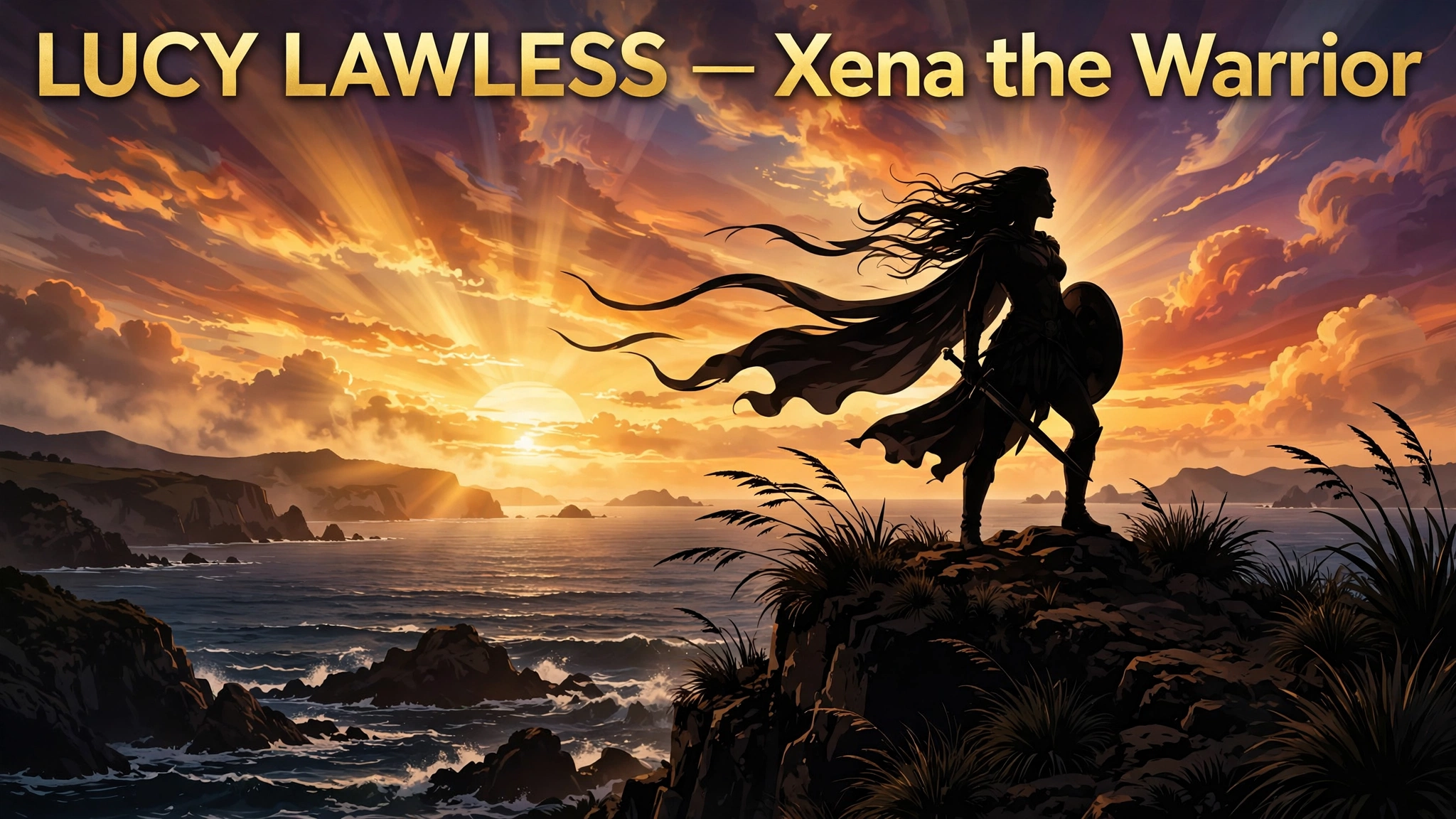
The decision to give Xena her own show was a gamble, because no one had ever built a fantasy action series around a woman before. The producers, Sam Raimi and Rob Tapert, believed the audience was there, and the first season of Xena: Warrior Princess premiered in September 1995. The show was filmed in New Zealand, on a modest budget, with sets that were reused, costumes that were made locally, and fight scenes that were choreographed by people who understood that the audience wanted to see a woman fight convincingly, not prettily. Lucy did many of her own stunts in the early seasons, learning sword fighting, horse riding and martial arts, and the physicality of the performance was a large part of its appeal. She was not a delicate heroine who needed rescuing. She was a warrior who rescued other people, and the difference mattered to viewers who had grown up watching women wait to be saved. The show’s visual language helped. Xena’s costume, a leather outfit with a breastplate, arm guards and a skirt, became instantly recognisable, and her weapon, the chakram, a circular throwing blade that returned to her hand, became one of the most famous props in television history. The chakram was a practical choice as much as a visual one, because it let the character fight at a distance as well as up close, and Lucy learned to throw it convincingly, spinning it in her hand before a fight in a gesture that fans still imitate at conventions. The costume and the weapon were designed in New Zealand, on a budget, by people who understood that a hero needs a silhouette the audience can recognise in a single frame. Xena had that silhouette, and it is why the character is still recognisable thirty years later, long after the show ended.
Six Seasons of Xena and a Horse That Changed Everything
Xena: Warrior Princess ran for six seasons, from 1995 to 2001, and it became one of the most successful syndicated television shows in the world. It was shown in more than a hundred countries, it earned a devoted fan base that organised conventions and wrote fan fiction, and it made Lucy Lawless famous in a way that no New Zealand actress had been famous before. The show’s premise was simple: Xena, a former warlord seeking redemption, travelled the ancient world with her companion Gabrielle, played by Renee O’Connor, righting wrongs and fighting monsters, gods and tyrants. The relationship between Xena and Gabrielle became the heart of the show, and it was interpreted by many viewers as a romantic relationship, a reading the producers never confirmed but never entirely denied either. The ambiguity made the show important to lesbian viewers, who saw in Xena and Gabrielle a representation they had never had on television before, and Lucy has spoken about that legacy with pride, saying that she is honoured by the connection the show’s LGBTQ audience feels to it.
The work was physically brutal. Lucy trained for hours every day, performed fight scenes in heavy leather costumes in the New Zealand heat, and rode horses at speed across rough terrain. In October 1996, during a rehearsal for a sketch on The Tonight Show with Jay Leno, she was thrown from a horse and suffered a fractured pelvis, an injury that kept her off the show for weeks and required a long recovery. The show wrote around her absence, and she returned to filming with a determination that impressed everyone who worked with her. The injury also changed how she thought about the work. She understood, in a way she had not before, that the physical demands of the role had a cost, and she began to take the stunt work more seriously, working with doubles where it made sense and saving her body for the scenes that mattered most. The show continued for four more seasons after the injury, and its final episode, in which Xena dies and Gabrielle carries on her work, was watched by millions and debated by fans for years afterwards. The fandom that grew around the show was unlike anything television had seen before. Xena conventions drew thousands of fans to cities around the world, and the fans, who called themselves Xenites, organised charities, wrote stories, and kept the show alive long after it ended. Lucy attended many of those conventions, and she has said that meeting the fans in person taught her how much the show meant to people who felt like outsiders. For many of them, Xena was the first hero who looked like them, or loved like them, or fought like them, and that connection turned a syndicated fantasy show into something closer to a community.
Battlestar Galactica, Spartacus and the Second Act
When Xena ended in 2001, Lucy Lawless faced the problem that every actor who has played an iconic role faces, which is how to be anyone else. She was in her early thirties, famous as a warrior princess, and the industry did not know what to do with her. She took the problem seriously and worked steadily, choosing roles that were as different from Xena as possible. She appeared in the television series The X-Files, playing a scientist in a two-part episode, and she took a recurring role in the science-fiction series Battlestar Galactica from 2005 to 2009, playing D’Anna Biers, a journalist who turns out to be one of the Cylons. The role was a revelation, because it showed her as a manipulative, intelligent and deeply unsettling character, with none of Xena’s heroism and all of her authority. Critics praised the performance, and it reminded the industry that she was a trained actress, not just an action star.
Her most important post-Xena role was Lucretia in Spartacus, the Starz series about the slave revolt in ancient Rome, which ran from 2010 to 2013. Lucretia was the wife of a gladiator school owner, a woman who was elegant, ruthless and sexually manipulative, and Lucy played her with a relish that made her one of the most memorable characters on television. The show was violent, explicit and operatic, and her performance was at the centre of it. Lucretia was a character who could smile at a dinner party and order a murder in the same breath, and Lucy understood that the smile was the dangerous part. She played the role in a Roman accent, with a physical stillness that made her sudden bursts of cruelty feel shocking, and the critics who had dismissed her as an action star were forced to reconsider. The production itself was demanding, filmed in New Zealand with long hours and elaborate sets, and it reunited her with the world of sword fighting and ancient costumes, but this time the fighting was psychological rather than physical. She returned for the prequel series Spartacus: Gods of the Arena in 2011, and her work on the show earned her some of the best reviews of her career. The role proved something important, which is that an actress known for playing a hero can be even more compelling as a villain, because the audience already trusts her, and the betrayal of that trust is what makes the character frightening. She also appeared in the television series Parks and Recreation, playing a love interest for Ron Swanson, a comedy role that showed a lightness she rarely got to use, and in the series Agents of S.H.I.E.L.D., Salem and Ash vs Evil Dead, in which she played Ruby Knowby, a character connected to the Evil Dead films. The pattern of these years is a working character actress taking interesting roles in interesting shows, and refusing to be defined by a single character, even one as beloved as Xena.
Music, the Stage and a Voice of Her Own
Acting was never the whole of Lucy Lawless’s career. She is also a singer, and music has been a constant thread through her life since Xena, when she performed in the musical episodes of the show and discovered that her voice could fill a concert hall. She released an album, and she has performed in concert in New Zealand, Australia and the United States, singing a mixture of jazz standards, Broadway songs and contemporary material. Her voice is deep, warm and expressive, and her live performances have a theatricality that comes from years on stage. She has also worked in musical theatre, playing the role of Betty Rizzo in a production of Grease and appearing in stage productions in New Zealand. The music career is not a hobby. It is a second profession, and it has given her a creative outlet that acting, with its dependence on casting directors and scripts, cannot always provide.
She has also directed, making her directorial debut with the New Zealand television series My Life Is Murder, in which she also stars as Alexa Crowe, a retired detective who solves crimes in Melbourne. The show, which premiered in 2019, is a light, charming detective series, and it has run for multiple seasons, giving her a steady leading role in her fifties. Alexa Crowe is the opposite of Xena in almost every way. She is funny, she cooks, she talks to her cat, and she solves murders by noticing the small details that other people miss. The role lets Lucy use the comic timing she rarely got to show as a warrior, and the audience has responded to the warmth of it. Directing was a natural step, because she had spent decades watching directors work, and she understood the craft from the inside. She has spoken about wanting to direct more, and about the satisfaction of being behind the camera, where the decisions are hers. The show is also significant because it proves that a woman in her fifties can carry a television series as a lead, a fact the industry still treats as surprising, even though it should not be.
Activism, Arrest and a Life Beyond the Screen
Lucy Lawless is as well known in New Zealand for her activism as she is for her acting, and she has taken risks for her beliefs that few celebrities would take. She is a long-standing supporter of Greenpeace, and in February 2012 she was arrested after boarding an oil drilling ship, the Noble Discoverer, in New Zealand, as part of a protest against oil exploration in the Arctic. She spent four days on the ship before being arrested, and she later pleaded guilty to trespass, was fined and sentenced to community service. She has said she has no regrets about the protest, and that the fine was worth it if it drew attention to the issue. She has also campaigned for LGBTQ rights, for the rights of sex workers in New Zealand, and for environmental causes, using her fame to draw attention to issues that the press might otherwise ignore. The activism is not a recent addition to her life. It is a thread that runs through it, from her early support for Greenpeace to her work with the Starship Foundation, a New Zealand children’s hospital charity, for which she has raised money and awareness for years.
Her personal life has been stable since her second marriage, to Robert Tapert, one of the creators of Xena, in 1998. Tapert is a film and television producer, and the couple have two sons together, Julius and Judah, in addition to her daughter Daisy from her first marriage. They live in New Zealand, and Lucy has spoken about the importance of raising her children there, away from the pressures of Hollywood. She is now in her late fifties, still working, still performing, and still using her platform for the causes she believes in. The warrior princess became a mother, a singer, a director and an activist, and the through-line is a woman who has never been content to do one thing, and who has never been afraid to take a risk for something she believes in. That is the real story of Lucy Lawless, and it is bigger than any single role.
My Take:
The thing I keep coming back to with Lucy Lawless is how much of her career was an accident, and how much of it was a choice. Xena was an accident. She was hired to play a villain in three episodes of Hercules and die at the end of them. Nobody planned a spin-off, nobody planned six seasons, and nobody planned that the character would become an icon. The choice came afterwards, in what she did with the accident. She could have spent the rest of her life playing Xena at conventions and taking whatever warrior roles the industry offered. Instead she went to work as a character actress, played a Cylon on Battlestar Galactica, played a murderous Roman wife on Spartacus, played a comedy role on Parks and Recreation, and built a second career that had nothing to do with a sword. That is not the path of someone who got lucky once. It is the path of someone who understood that luck is only useful if you do something with it.
I think Xena matters more than the television industry has ever admitted, and the reason is simple: it was the first time millions of viewers saw a woman lead an action show without apology. Before Xena, women in fantasy television were sidekicks, love interests, or damsels. Xena was the hero, the fighter, the person who saved the day, and the show never treated that as unusual or as something that needed explaining. She fought, she led, she made terrible mistakes and she tried to atone for them, and the audience accepted all of it because the character was written as a person first and a woman second. That sounds obvious now, but in 1995 it was radical, and the proof is in the audience it gathered. Young girls watched it and saw a hero who looked like them. Lesbian viewers watched it and saw a relationship between two women that was treated with respect. Viewers in more than a hundred countries watched it and saw a New Zealand actress carrying a show that Hollywood had said could not work. The industry has spent thirty years trying to replicate that success, and it still has not quite managed it, because Xena was not a formula. It was a specific actress, a specific character, and a specific moment, and the combination cannot be manufactured.
The relationship between Xena and Gabrielle is the part of the show I think about most, because it was ahead of its time in a way that is still underappreciated. The producers never said, on screen, that the two women were lovers, but they also never said they were not, and the space between those two statements became one of the most important spaces in television history. For viewers who had never seen their own lives reflected on screen, that space was everything. It meant the show belonged to them, even if the network would not say so out loud. Lucy has spoken about that legacy with a warmth that I find moving, because she did not have to embrace it. She could have distanced herself from it, the way many actors do when a role takes on a meaning they did not intend. Instead she has attended the conventions, met the fans, and said plainly that she is proud of what the show meant to its LGBTQ audience. That pride is not a marketing position. It is a moral one, and it has cost her nothing and given her audience a great deal.
Her injury in 1996 is the detail that makes the whole story human for me. She was thrown from a horse during a rehearsal for a talk show, fractured her pelvis, and was off the show for weeks. It would have been easy, and understandable, to come back cautiously, to let the stunt doubles do the work and to protect herself. She came back and kept doing the physical work, because the physical work was the character. That decision had a cost, and she has been open about the toll the role took on her body. But it also set a standard that the show lived up to, because the audience could see that the woman on screen was really fighting, really riding, really doing the things Xena did. The injury also showed something about the business that is rarely discussed, which is how little protection actors had in the 1990s when a show depended on them. There was no long hiatus, no careful return. There was a schedule, and the schedule had to be met. She met it, and the show survived because she did.
Spartacus is the performance I would show to anyone who thinks Lucy Lawless is only Xena. Lucretia is the opposite of a hero. She is elegant, cruel, manipulative and sexually predatory, and Lucy played her with a delight that made the character terrifying. The performance works because the audience already trusts her. They have spent six seasons believing she is good, and then she uses that trust against them, smiling while she destroys people. That is a sophisticated piece of acting, and it requires a performer who understands that villainy is more frightening when it is charming than when it is loud. The critics who praised her for Spartacus were not being generous. They were recognising something that had been there all along, which is that she is a trained actress with range, and that Xena, for all its fame, had only shown one part of what she could do. If she had never played Xena, she might have been known as a character actress all along. The fame delayed that recognition, but it did not prevent it.
Her activism is the part of her story that I respect most, because it is the part that carried real risk. In 2012, she boarded an oil drilling ship in New Zealand, was arrested, and was fined and sentenced to community service for protesting against Arctic oil exploration. She could have written a cheque, attended a fundraiser, and posted about it on social media, the way most celebrities do. Instead she put her body on a ship, in front of the cameras, and accepted the legal consequences. That is not a publicity stunt. It is a protest, and it is the same instinct that made her a good Xena, which is the willingness to stand in front of something dangerous and refuse to move. She has campaigned for Greenpeace, for LGBTQ rights, and for the rights of sex workers, and she has done it in New Zealand, a small country where a famous person cannot hide behind distance. Her neighbours know what she believes, and she has never seemed to mind. That is a rare kind of courage, and it is worth more than any award.
I also want to say something about the singing, because it is easy to treat it as a side project and it is not. She has a real voice, deep and warm, and she has performed in concert and in musical theatre for years. The musical episodes of Xena were not a gimmick. They were a sign that the show’s producers knew she could sing, and that the audience would accept it. Her concert performances have the same quality as her acting, which is a lack of self-consciousness. She sings standards and Broadway songs as if she has been doing it all her life, and the audience responds to the confidence. The music career matters because it shows that she is an artist, not just an actress. An actress waits for a role. An artist makes something. She has done both, and the doing is what has kept her career alive for thirty years.
The New Zealand part of her identity is inseparable from all of this. She stayed in New Zealand, raised her children there, married a New Zealand producer, and built her career from Auckland rather than from Los Angeles. That decision cost her work, because Hollywood forgets actors who are not in the room, but it gave her something more valuable, which is a life. She has said that she wanted her children to grow up in a place where fame was not the point, and where the work was judged on its merits rather than on its publicity. That is a choice many actors talk about and few actually make. She made it, and the career that followed, with its mix of American television, New Zealand theatre, music and activism, is richer for it. She is not a Hollywood star who happens to be from New Zealand. She is a New Zealand artist who happens to be famous, and the order of those two things matters.
If I have a criticism, it is that the industry never quite knew what to do with her after Xena, and that is the industry’s failure, not hers. She should have had more leading film roles. She should have had more chances to carry a show in her forties, before My Life Is Murder finally gave her one. The fact that it took until her fifties for her to get a steady leading role again says something about how television treats women who age, and it is not flattering. But she did not wait for permission. She worked, she sang, she directed, she protested, and she built a life that did not depend on the industry’s approval. My Life Is Murder is a charming show, and Alexa Crowe is a lovely character, but the real achievement is that she is still there, still working, still leading, at an age when the industry had written her off. That persistence is the story, more than any single role.
The conventions deserve a thought of their own, because they show a side of fandom that the press rarely covers fairly. The Xenites, as the fans called themselves, were not just people who liked a television show. They were a community, and they built charities, raised money for good causes, and supported each other in ways that went far beyond the show. Lucy attended those conventions for years, and she has said that the fans taught her as much as she taught them. That is an unusual thing for a star to say, and I believe her, because the conventions were where she learned what Xena meant to people who felt like outsiders. A star who only meets fans at premieres never learns that. A star who sits in a hotel ballroom for a weekend, answering questions from people who have flown across the world to be there, learns it quickly. The conventions kept the show alive, and they kept her connected to the audience in a way that a Hollywood career never would have.
Her marriage to Robert Tapert is the last piece of the picture, because it explains how the Xena years could happen at all. Tapert was one of the show’s creators, and their partnership was creative as well as personal. They have two sons together, and they have worked together on and off for nearly thirty years, including on Spartacus and on My Life Is Murder. That kind of partnership is rare in the entertainment industry, where marriages often collapse under the pressure of two careers. Theirs survived because it was built on shared work rather than on shared fame, and because both of them understood the business from the inside. She did not marry a producer to advance her career. She married a man she had made a show with, and the show came first. That order of things, work before fame, is the order that has run through her whole life, from the pageant to the protest ship, and it is why the career has lasted.
My take on Lucy Lawless is that she is the most underrated actress of her generation, not because she was not famous, but because the fame attached itself to a single character and hid everything else she could do. She was a warrior, a villain, a singer, a director, a protester and a mother, and she did all of it from New Zealand, on her own terms. Xena will always be the first thing people mention, and it should be, because it changed television. But the woman behind Xena is bigger than the character, and the career she built after it is the proof. She took an accident and turned it into a life, and she did it without leaving home, without apologising for her beliefs, and without ever pretending to be someone she was not. That is a legacy worth more than any single role, and it is why she still matters thirty years after a villain who was supposed to die refused to.
Frequently Asked Questions
How did Lucy Lawless become famous?
Her breakthrough came when she was cast as Xena in Hercules: The Legendary Journeys in 1995. The character was so popular that she was given her own series, Xena: Warrior Princess, which ran from 1995 to 2001.
What awards has Lucy Lawless won?
Lawless’s Xena is one of the great television heroines, a character who changed how women were shown on screen. She is admired as a feminist icon and as a New Zealand star who conquered the world.
Where does Lucy Lawless live now?
Lawless was married to Garth Lawless from 1988 to 1997, and they have a daughter, Daisy. She married producer Robert Tapert in 1998, and they have two sons.
Where is Lucy Lawless from?
Lucy Lawless was born in 1968 in Mount Albert, Auckland, New Zealand, the fifth of seven children. She grew up in a large, lively family and attended Marist College in Auckland.
What is Lucy Lawless’s most famous role?
Lawless’s Xena is one of the great television heroines, a character who changed how women were shown on screen. She is admired as a feminist icon and as a New Zealand star who conquered the world.


