Magic System: The Life Story Behind Ivory Coast's Beloved Band
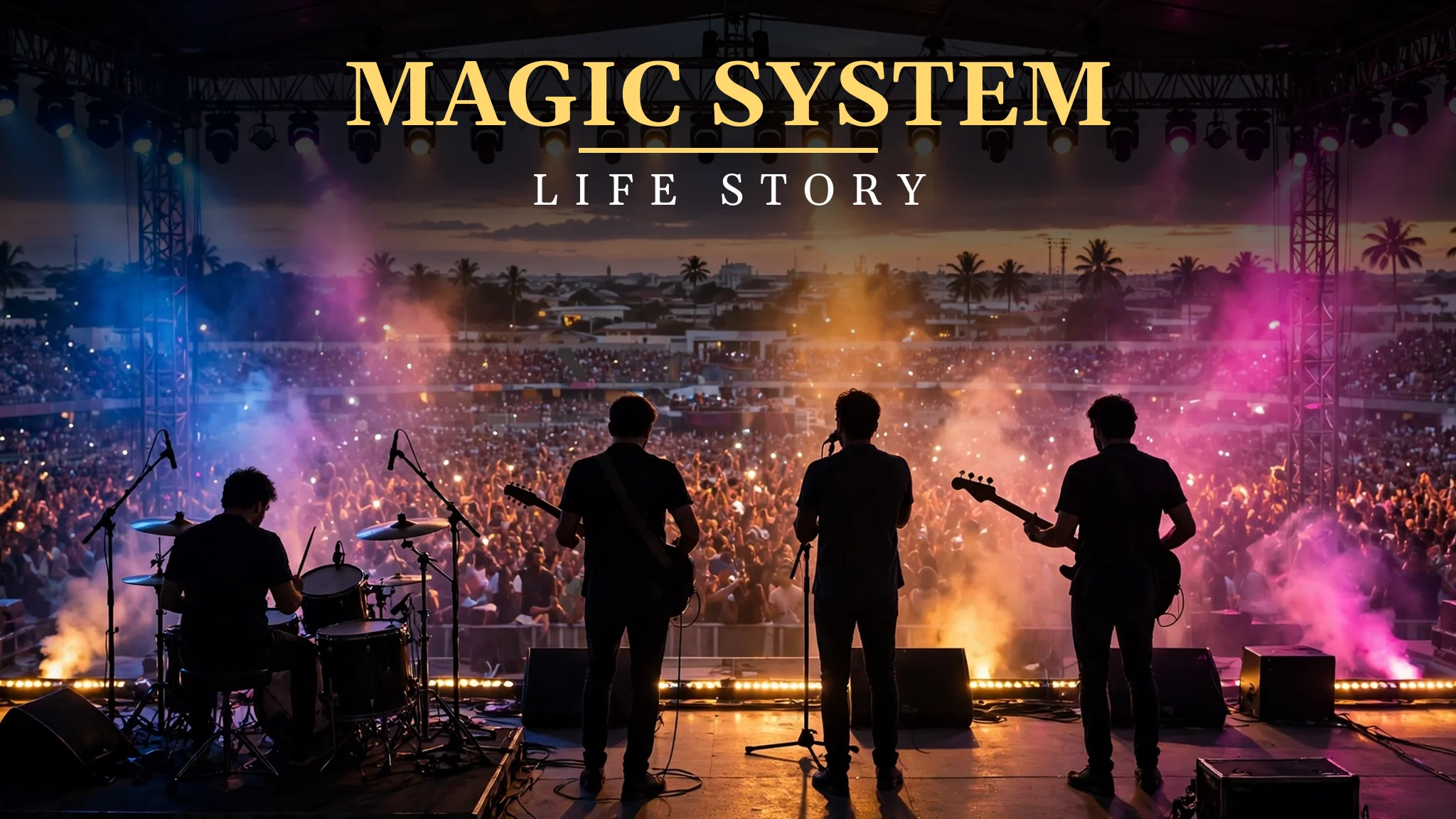
In this post
Some bands are built in a studio. Magic System was built in a neighbourhood. The four men who formed the group grew up together in Anoumabo, a district of Abidjan, and they sang together long before anyone outside their own streets knew their names. They were not put together by a record company. They were friends who shared a sound, a language, and a sense of humour, and they turned that friendship into one of the most loved bands in Africa.
The band’s story is the story of zouglou, the music of Ivorian students and young people, a style that mixes traditional rhythms with modern pop and with lyrics that speak about daily life in plain, funny, honest words. Magic System took zouglou out of the student halls and the neighbourhood parties of Abidjan and carried it to Paris, to stadiums, and to the World Cup. Their song Premier Gaou became an anthem across the French-speaking world, and their later hit Magic in the Air became a song that football fans sang in stadiums far from Ivory Coast.
This is the story of four friends, one neighbourhood, and a band that never forgot where it came from. It is a story about friendship lasting longer than fame, about a style of music that refused to stay small, and about a group that used its success to build a festival for the next generation. It is, above all, a story about joy: the joy of singing together, and the joy of making a whole crowd sing with you.
Four Friends in Anoumabo
Magic System was formed in Abidjan in 1996, by four young men from the Anoumabo neighbourhood: A’Salfo, Manadja, Tino, and Goudé. Anoumabo is a working-class district of the city, a place of crowded streets, small shops, and strong community ties. A boy growing up there learns to live close to his neighbours, to share what he has, and to make his own fun. Music was a natural part of that life. It was played at parties, at weddings, and in the street, and young people who could sing were always welcome.
The four friends were not strangers who met at an audition. They knew each other, they had sung together in informal settings, and they shared a love for the music that was popular among Ivorian students at the time: zouglou. Zouglou had grown out of the student world in Abidjan in the early 1990s, and it was music with a purpose. Its songs spoke about the difficulties of student life, about money, about love, and about the future, and they did so with humour and with a rhythm that made people dance. The four friends understood that language, because they lived it.
They began to perform together, at first in small settings, and then at larger events in Abidjan. A band of four singers, with no big instruments and no big budget, had to rely on voices, on rhythm, and on the ability to hold a crowd. Magic System learned that skill in front of audiences who were not polite. If the songs were weak, the crowd would let them know. If the songs were strong, the crowd would sing along, and the band would know it had something real. Those early performances were the band’s school, and the lessons were practical: write songs people can sing, keep the rhythm strong, and never lose the humour.
The name Magic System was a promise as well as a name. It suggested something special, something that worked like magic, and the band set out to live up to it. They were not the only zouglou group in Abidjan, and they were not the first. But they had a quality that set them apart: the four voices worked together in a way that sounded like one voice, and the friendship between them was audible in the music. A listener could hear that these men enjoyed singing together, and that enjoyment was infectious.
By the late 1990s, the band was known in Abidjan, and its songs were circulating. The members were still young, and they were still learning, but they had something that many bands never find: a shared identity, a shared sound, and a shared home. Anoumabo was not only where they came from. It was the place they would keep returning to, in their songs and in their work, for the rest of their career.
Zouglou: The Music of Students and Streets
To understand Magic System, you have to understand zouglou. The style began among students in Abidjan in the early 1990s, and it was music made by young people for young people. Its rhythms came from traditional Ivorian music, and its lyrics came from the daily life of students: the struggle to pay for school, the hope of a better future, the fun of a party, and the pain of a broken heart. Zouglou was not music for the rich. It was music for ordinary young people, and it spoke in their language.
The songs were often funny, and the humour was part of the point. A zouglou song could talk about a serious problem — money, work, or politics — and make people laugh while they thought about it. That combination made the style popular, because it did not ask listeners to choose between thinking and dancing. It let them do both, and it made the serious subjects easier to hear. Magic System understood this from the start, and their songs carried the same mix of humour and honesty.
The band’s early work was rooted in that student world. They sang about life in Abidjan, about the people they knew, and about the hopes and frustrations of young Ivorians. Their language was the language of the street, with its jokes, its slang, and its directness. A listener in Abidjan heard his own life in their songs, and that recognition was the reason the band’s audience grew. They were not singing about a distant world. They were singing about the world outside the listener’s door.
Zouglou also had a dance, and the dance was as important as the music. At a Magic System show, the audience did not stand still. They danced, they clapped, and they sang the choruses back to the band. That participation was the heart of the style. A zouglou concert was not a performance for a passive crowd. It was a shared event, and the band and the audience made it together. Magic System learned to lead that event, to read the crowd, and to keep the energy high for hours.
As the 1990s went on, zouglou spread beyond the student world and became a national music of Ivory Coast. Other groups joined the movement, and the style grew. Magic System was at the front of that growth, because the band had the songs, the voices, and the stage presence to carry the style further than anyone else had. They were ready for a song that would take zouglou out of Ivory Coast and into the wider world. That song was coming, and it would be called Premier Gaou.
Premier Gaou: The Song That Crossed the Sea
In 1999, Magic System released Premier Gaou, and the song changed everything. The title refers to a gaou, a word in Ivorian slang for a person who is not fashionable, who is behind the times, and who is laughed at by others. The song tells the story of such a person, a young man who is mocked for his old-fashioned ways, and who later becomes successful. It is a funny song, and it is also a song with a message: do not laugh at someone today, because tomorrow may be his day. That message, wrapped in a strong rhythm and a chorus that everyone could sing, made the song irresistible.
Premier Gaou became a hit in Ivory Coast, and then it travelled. In 2001, the song was released in France, and it became a huge success there as well. French radio played it, French clubs played it, and French audiences, many of whom had never heard zouglou before, learned the chorus and danced to it. The song sold in large numbers, and it made Magic System the first zouglou group to become a star in Europe. A band from Anoumabo was now famous in Paris, and the journey from a neighbourhood party to a European hit was complete.
The success of Premier Gaou was not only about sales. It was about what the song proved. It proved that Ivorian music, sung in the language of the street, could succeed in France without being changed to fit French tastes. The band did not have to sing in a different style, or hide where it came from, to be heard. It sang as itself, and the audience came to it. That is a rare achievement for an African band in Europe, and it opened doors for other Ivorian artists who followed.
The song also became an anthem in Ivory Coast and across French-speaking Africa. It was played at weddings, at parties, and at celebrations, and its chorus was known by people who did not follow music closely. A song that becomes an anthem is different from a song that is only a hit. A hit is popular for a season. An anthem is popular for years, because it speaks to something that does not change: the hope that a person who is laughed at today will be respected tomorrow. Magic System had written an anthem, and the anthem would follow them for the rest of their career.
After Premier Gaou, the band was no longer a local group. It was a continental and European star, with tours, television appearances, and a growing catalogue of songs. The four friends from Anoumabo had to learn how to live with that success, how to travel, how to record, and how to keep their friendship intact when the pressure grew. They managed it, and the band stayed together, which is itself a rare achievement in popular music.
Paris, Albums, and Life on the Road
The years after Premier Gaou were years of albums, tours, and growth. Magic System released a series of records that built on the success of the first hit, including albums that mixed zouglou with other African and international sounds. Each album added new songs to the band’s live show, and each one showed that the band could do more than repeat Premier Gaou. They could write new choruses, new jokes, and new stories, and their audience stayed with them.
Touring became a central part of the band’s life. They performed in France, in Belgium, in other parts of Europe, and across Africa, and their shows became famous for their energy and their length. A Magic System concert was not a short set. It was a long celebration, with the four singers moving across the stage, talking to the crowd, and leading the audience in songs that everyone knew. The band’s stage presence was built on friendship: the four men enjoyed each other’s company, and the audience could see it. That joy was part of the show.
Living on the road is hard for any band, and it is harder still for a band of four friends who have to make decisions together. Magic System managed it by keeping their roles clear and by keeping their roots in mind. A’Salfo, the band’s leader, became the public face of the group, speaking for the band in interviews and in public life. The other members kept their own roles, and the four of them made decisions as a group. That balance helped the band survive the pressures of fame, and it kept the friendship at the centre of the work.
The band also began to work with other artists, and those collaborations brought new listeners to their music. Working with singers from other countries and other styles showed that Magic System was not limited to zouglou alone. It could adapt, it could learn, and it could share a stage with artists from very different backgrounds. Those collaborations also showed the respect that other artists had for the band. A singer who works with Magic System gains access to the band’s large and loyal audience, and the band gains a new sound to explore.
Through all of this, the band stayed based in its identity as an Ivorian group. Its songs continued to speak about Ivory Coast, about Abidjan, and about the life of ordinary people. The band did not become a French band, or a European band. It remained a band from Anoumabo that happened to be famous in Europe, and that distinction mattered to its fans at home, who saw the band as their own, even when it was performing far away.
Magic in the Air and the World Cup Stage
In 2014, Magic System released one of its biggest international hits, Magic in the Air, a collaboration with the Moroccan singer Chawki. The song was made for the football World Cup in Brazil, and it became an anthem for fans across the French-speaking world and beyond. Its chorus was simple, its rhythm was strong, and its message was joyful: the magic was in the air, and everyone could feel it. Football fans sang it in stadiums, radio stations played it during the tournament, and the song gave the band a new generation of listeners who had not been born when Premier Gaou was released.
Magic in the Air was a different kind of success from Premier Gaou. Premier Gaou had been a song about a person, with a story and a joke. Magic in the Air was a song about a feeling, about the excitement of a big event and the joy of sharing it with others. The band showed that it could write both kinds of song, and that it could adapt to a new moment without losing its identity. The collaboration with Chawki also showed the band’s willingness to work across borders, bringing together an Ivorian group and a Moroccan singer for a song about a global event.
The song’s success brought the band back to the centre of attention in France and in Africa, and it reminded audiences that Magic System was not a band of the past. It was a band that could still make a hit, still fill a stadium, and still make people dance. The World Cup gave the song a platform, but the song’s quality gave it a life beyond the tournament. It continued to be played at parties and celebrations long after the final whistle, and it became another anthem in the band’s catalogue.
The years after Magic in the Air were years of continued touring and recording, and the band remained one of the most popular African groups in the French-speaking world. Its members had grown older, and their lives had changed, but the friendship and the music remained. A band that can still make a hit fifteen years after its first success is a band that has learned how to last, and Magic System had learned that lesson well.
The band’s story during this period is also a story about the changing world of African music. New styles were arriving from Nigeria and Ghana, and the music scene was becoming more competitive. Magic System did not try to copy those styles. It kept its own sound, and it trusted that its audience would stay. That trust was rewarded, because the band’s audience did stay, and new listeners continued to discover the old songs and the new ones.
FEMUA: A Festival Built for the Next Generation
One of the most important parts of Magic System’s story is not a song. It is a festival. In 2008, A’Salfo founded the Festival des Musiques Urbaines d’Anoumabo, known as FEMUA, in the band’s home neighbourhood of Anoumabo in Abidjan. The festival was created to bring music to the people of Anoumabo, and to give young artists a stage. It has since become one of the biggest music festivals in West Africa, drawing artists from across the continent and audiences of tens of thousands.
FEMUA was a gift to the neighbourhood that made the band. Anoumabo had given Magic System its start, its sound, and its identity, and the festival was a way of giving something back. It brought big stars to a working-class district, and it showed the young people of Anoumabo that their neighbourhood mattered. A festival in Anoumabo was a statement: great music does not only happen in the rich parts of a city. It happens where the people are, and Anoumabo was where the people were.
The festival also became a platform for young artists. New singers and groups could perform at FEMUA and be seen by a large audience, and the festival helped to launch careers. That was the point. Magic System had been young artists once, with talent and no stage, and the band knew how valuable a stage could be. FEMUA gave that stage to others, and it did so year after year. The festival’s growth, from a local event to a major international gathering, is a measure of the band’s influence beyond its own songs.
FEMUA also became a meeting place for African music. Artists from different countries performed there, and the festival’s audience included people from across West Africa and beyond. It was a place where the music of the continent could be heard in one place, and where the diversity of African music could be celebrated. The band’s role as the festival’s founder gave it a new identity: not only a group of singers, but a group of builders, who had created an institution that would outlast any single song.
The festival’s success also showed the band’s commitment to Ivory Coast. At a time when many successful African artists moved their lives to Europe, Magic System invested in its home. It built a festival in Anoumabo, it brought artists to Abidjan, and it kept its roots visible. That commitment is part of the band’s legacy, and it is one that its fans recognise and respect. A band can be famous anywhere, but a band that builds at home is a band that belongs to its home.
A Band That Stayed Together
Magic System’s greatest achievement may be the simplest one: the band stayed together. Four friends from Anoumabo formed a group in 1996, and decades later, they were still performing together. In popular music, that is rare. Bands break up over money, over fame, over creative differences, and over the pressures of life on the road. Magic System faced all of those pressures, and it survived them. The friendship that started the band became the reason the band lasted.
That longevity is not an accident. It comes from a shared history, a shared sense of humour, and a shared commitment to the music and to the neighbourhood that made them. The members of the band have grown older together, and their lives have changed, but the core of the group has remained the same. A listener who hears Magic System today hears the same four voices, the same joy, and the same connection to Abidjan that the band had in its early years. That continuity is a gift to the audience, and it is a sign of the band’s character.
The band’s legacy is now secure. It is remembered as the group that took zouglou to the world, that wrote Premier Gaou and Magic in the Air, and that built FEMUA in Anoumabo. It is also remembered as a group that showed young Ivorian artists that they could succeed without leaving their identity behind. The band’s songs are part of the soundtrack of Ivory Coast, and they are played at celebrations across the French-speaking world. That is a legacy that does not need a trophy to prove it. It is proved every time a crowd sings Premier Gaou together.
Today, Magic System remains active, performing, recording, and organising FEMUA, and its music remains a part of life in Ivory Coast and beyond. The four friends from Anoumabo are now elder statesmen of African music, and their story is told to young artists as an example of what friendship, hard work, and a good song can achieve. The magic in the band’s name was not a trick. It was a promise, and the band kept it.
My Take:
I have a soft spot for bands that start as friends, and Magic System is one of the best examples I know. Four young men from the same neighbourhood, singing together because they enjoyed it, and turning that enjoyment into a career that has lasted for decades: that is a story I find deeply moving. It is easy to form a band. It is hard to keep a band together. Magic System kept its band together, and that tells me something about the men in it. They valued each other more than they valued being right, and they valued the music more than they valued their own egos. That is a rare thing, and it is worth celebrating.
What I like most about their music is the humour. Premier Gaou is a funny song, and it is also a wise song. It tells the story of a man who is laughed at for being old-fashioned, and who later becomes successful, and it does so with a chorus that makes you smile. I think humour is underrated in music. Many singers try to be serious, and they forget that a joke can carry a message further than a lecture. Magic System understood that. Their songs make people laugh, and while people are laughing, they are also learning something about kindness, about patience, and about not judging others too quickly. That is a clever way to teach, and it is one I admire.
I also like the way the band stayed rooted in Anoumabo. It would have been easy for them, after the success of Premier Gaou in France, to move to Paris and to forget where they came from. They did not do that. They built FEMUA in Anoumabo, and they brought the world to their neighbourhood. That is a generous act, and it is also a smart one. A band that forgets its home loses its identity. A band that invests in its home keeps its identity and gives something back. I think about the young people of Anoumabo who attend FEMUA every year, and about what it means to them to see big stars perform in their own streets. That experience tells them that their neighbourhood matters, and that their dreams matter. That is a gift that goes beyond music.
Magic in the Air is another song I think about often, because it shows a different side of the band. It is not a joke, and it is not a story about a person. It is a song about a feeling, about the joy of a big event and the excitement of sharing it with others. I like that the band could write both kinds of song. It shows range, and it shows that the band was not limited to one idea. A band that can only write one kind of song will soon become boring. Magic System could write a funny story, a love song, and a stadium anthem, and all of them sounded like Magic System. That is the mark of a real band, not a one-hit group.
I will be honest about something: I do not think every Magic System album is as strong as the best ones. Some of the later records are good, but they do not have the same freshness as Premier Gaou. That is normal for a career that has lasted for more than twenty-five years. No band can be at its peak for that long. What matters is that the band kept going, and that it kept its audience. A band that can still fill a stadium decades after its first hit has earned respect, even if not every album is a classic. The career as a whole is the achievement.
What I learn from their story is that friendship is a form of talent. People often talk about talent as if it is only about a voice or an instrument. But the ability to work together, to stay together, and to make decisions together is also a talent, and it is one that many bands lack. Magic System had it, and it is the reason the band lasted. Young musicians who want a long career should study that. Find people you trust, treat them well, and keep the friendship at the centre of the work. The music will be better for it, and the career will last longer.
I also think about zouglou, and about what it means for Ivorian music. Zouglou was the music of students, of young people who had little money and big dreams. Magic System took that music and gave it to the world. That is a powerful thing. It tells young people that their music matters, even if it comes from a student hall or a neighbourhood party. It does not have to come from a big studio or a foreign country. It can come from where they are, and it can travel. I hope young Ivorian artists hear that message, because it is one of the most important lessons in African music.
The festival, FEMUA, is the part of their story that stays with me the most. Many bands talk about giving back, but few of them actually build something. Magic System built a festival, and the festival has become one of the biggest in West Africa. That is a real contribution, and it is one that will outlast the band itself. Long after the members stop performing, FEMUA will still be there, giving young artists a stage. That is a legacy that matters more than any single song, because it is a legacy that helps other people. I respect that deeply.
I think about the audiences too. A Magic System concert is not a quiet event. It is a celebration, with people dancing, singing, and laughing together. In a world that is often divided, a celebration like that is a valuable thing. It brings people together, it gives them joy, and it reminds them that they share something. The band’s music does that, and it has done it for decades. That is a serious achievement, even if it looks like fun. Fun is serious, when it brings people together.
In the end, I think Magic System’s story is a story about staying together and staying true. The four friends stayed together, they stayed true to Anoumabo, and they stayed true to zouglou. They did not change who they were to please a foreign audience. They sang as themselves, and the audience came to them. That is a lesson for any artist: be yourself, work with people you trust, and give something back to the place that made you. Magic System did all three, and their music is still being sung because of it. I hope they keep singing together for many more years, because the world needs bands that know how to make people happy, and that know how to stay friends while they do it.
I also think about the band’s name, and about how well it fits them. Magic System sounds like a promise, and the band kept that promise. Their music works like magic, in the sense that it makes people happy without them knowing quite how it happens. A good chorus, a strong rhythm, and four voices singing together: that is a simple recipe, and yet it is hard to get right. Magic System got it right, again and again, for more than twenty-five years. I think that is because the magic was not a trick. It was friendship, and friendship is the most reliable magic there is.
A’Salfo’s role as the leader is another thing I think about. A band of four friends needs someone to speak for it, to make decisions, and to carry the public responsibility, and A’Salfo took that role. He did it without overshadowing the others, and he did it while also building FEMUA, which is a huge undertaking on its own. That is a lot of work for one person, and it shows a kind of leadership that is rare in music. He did not use his position to become a solo star. He used it to serve the band, and to serve Anoumabo. I respect that, because it shows that leadership can be generous, and that a leader can be a servant as well as a star.
I think about the audiences at FEMUA, and about the young people of Anoumabo who attend the festival every year. They see big stars perform in their own streets, and they learn that their neighbourhood matters. That is a powerful lesson, and it is one that goes beyond music. A child who grows up in a working-class district is often told, in subtle ways, that his home is not important. FEMUA tells him the opposite: his home is important enough to host one of the biggest festivals in West Africa. That message is worth more than any single concert, and it is a gift that Magic System gives to Anoumabo every year.
The band’s ability to work with other artists is another strength I admire. They collaborated with Chawki on Magic in the Air, and they have worked with singers from many countries and many styles. Those collaborations show an openness that is not always present in successful bands. Some bands become closed, and they refuse to work with anyone outside their circle. Magic System stayed open, and its music became richer for it. I like that attitude. It says that music is a conversation, not a monologue, and that a band can learn from others without losing itself.
I also think about what Premier Gaou means today, more than twenty years after it was released. It is still played at weddings, at parties, and at celebrations, and its chorus is still known by people who were not born when it first came out. That is the definition of an anthem: a song that outlives its moment, and that becomes part of a culture. Magic System wrote an anthem, and they wrote it about a man who was laughed at and who later succeeded. That message — do not laugh at someone today, because tomorrow may be his day — is a message that never gets old, and it is one that every generation needs to hear. I hope the song keeps being sung, because its message is still true.
In the end, I keep coming back to the friendship. Four friends from Anoumabo, singing together since 1996, still singing together today. That is a rare thing in music, and it is a beautiful thing. Bands break up for many reasons, but Magic System did not break up, because its members valued each other more than they valued being right. That is a lesson for anyone who works with others: treat your partners well, keep the friendship at the centre, and the work will last. Magic System proved that, and their music is the proof. I hope they keep singing together for many more years.
I also think about the children of Anoumabo, and about what FEMUA means to them when they grow up. A child who attends a festival in his own neighbourhood, who sees artists from across Africa perform in his streets, learns something that no classroom can teach: that his home is a place where great things happen. That lesson stays with a child for life, and it shapes what he believes he can become. Magic System gave that lesson to the children of Anoumabo, and they give it every year the festival returns. That is a gift that goes beyond music, and it is one that the band should be proud of.
There is one more thing I want to say about their humour. In a world where so much popular music is serious, angry, or sad, Magic System’s songs make people laugh, and laughter is a serious thing. A song that makes a whole crowd laugh together is a song that brings people together, and bringing people together is one of the most valuable things music can do. Premier Gaou does that, and so do many of their other songs. I hope they keep making people laugh, because the world needs laughter, and because their laughter has always been kind. It laughs with people, not at them, and that kindness is the reason their humour lasts.
Frequently Asked Questions
Who are the members of Magic System?
Magic System was formed in Abidjan in 1996 by four friends from Anoumabo: A’Salfo, Manadja, Tino and Goudé. A’Salfo is the band’s leader and public face.
What is zouglou?
Zouglou is a music style that began among students in Abidjan in the early 1990s. It mixes traditional Ivorian rhythms with modern pop and uses humorous, honest lyrics about daily life.
What song made Magic System famous?
Premier Gaou, released in 1999 and released in France in 2001, made the band famous across Ivory Coast and Europe. Its story of a mocked man who later succeeds became an anthem.
What is Magic in the Air?
Magic in the Air is a 2014 hit by Magic System featuring Moroccan singer Chawki. It was made for the football World Cup in Brazil and became a stadium anthem for fans.
What is FEMUA?
FEMUA, the Festival des Musiques Urbaines d’Anoumabo, is a music festival founded in 2008 by A’Salfo in the band’s home neighbourhood of Anoumabo in Abidjan. It is now one of the biggest music festivals in West Africa.
Where did Magic System come from?
The band comes from Anoumabo, a working-class district of Abidjan in Ivory Coast. The neighbourhood gave the band its sound, its identity, and the site of its festival.
Is Magic System still performing today?
Yes, the band remains active, performing and recording, and it continues to organise FEMUA each year in Abidjan.


