Majida El Roumi: The Life Story Behind Lebanon's Elegant Voice
In this post
- A Daughter of Music in Kfarshima
- Studio El Fan, Ya Beirut, and the First Great Songs
- The Poet’s Singer: Kalimat, Koun Sadiqi, and Songs That Last
- Paris, the Great Halls, and a Voice the World Respected
- Family, Loss, and the Private Woman Behind the Voice
- The Olympia and the Concerts That Defined Her
- Later Years, Goodwill Work, and a Legacy of Grace
- My Take:
Majida El Roumi is the most elegant voice in Lebanese music. Her singing is not loud, and it is not made for dancing. It is made for listening, for a quiet room, for a concert hall where every word matters. She sings poetry, she sings about Beirut, about love, about loss, and about hope, and she sings it with a clarity that makes listeners feel as if they are hearing the words for the first time. For more than fifty years, she has been the singer Lebanon turns to when it wants to be reminded of its beauty.
She was born into music. Her father, Halim El Roumi, was a composer and a musician, and her home was filled with songs, with instruments, and with the great voices of the Arab world. She grew up hearing music not as entertainment but as a way of life, and she learned early that a song could carry poetry, history, and feeling all at once. She did not become famous quickly. She studied, she waited, and she chose her songs with care, and that care is why her music still sounds fresh today.
This is the story of a girl from Kfarshima who became the elegant voice of Lebanon. It follows her from her father’s house to the stage, from her first songs to her greatest works, from her concerts in Paris and Beirut to her work for her country, and to the place she holds today as one of the most respected singers in the Arab world. It is a story about grace, about patience, and about a voice that never needed to shout to be heard.
A Daughter of Music in Kfarshima
Majida El Roumi was born on 13 December 1956 in Kfarshima, a town in the mountains near Beirut, Lebanon. Her father was Halim El Roumi, a well-known composer and musician, and her mother was Marie Loutfi. Music was not a hobby in that house. It was the air the family breathed. Her father composed, he played, and he talked about music, and Majida listened. She heard the great Arab singers, she heard classical music, and she heard the songs of Lebanon, and she learned that music could be serious, beautiful, and deep.
Her childhood was shaped by her father’s work and by the town of Kfarshima, a quiet place in the hills, where life moved slowly and where people knew each other. She went to school, she studied, and she sang at home, where her voice was first heard by her family. Her father recognised that she had a special voice, but he did not push her onto a stage as a child. He wanted her to study, to learn, and to grow, and he knew that a voice like hers needed time to mature.
She studied at university, and she learned about literature and about the arts, which later helped her choose songs that were poems as much as they were music. A singer who understands poetry sings differently from one who only knows melodies, and Majida understood poetry. She read, she listened, and she learned how words and music fit together. That learning would become the heart of her career, because her best songs are poems set to music, sung with a clarity that honours the words.
The Lebanon of her youth was changing, and the civil war that began in 1975 would shape her life and her music. She was a young woman when the war began, and she saw her country suffer, and she saw its beauty threatened. That experience gave her songs a depth that a singer who has only known peace cannot fake. When she sings about Beirut, she sings about a city she loves, a city she has seen hurt, and a city she believes in still.
As a young woman, she began to sing in public, at first in small settings, and people noticed that her voice had a quality that was rare. It was clear, it was warm, and it was full of feeling, without being loud. She sang with a grace that made listeners lean in, and that grace would become her trademark. She was not a singer who demanded attention. She was a singer who earned it, note by note, word by word.
Studio El Fan, Ya Beirut, and the First Great Songs
Majida El Roumi’s first big step came in the 1970s, when she took part in Studio El Fan, the Lebanese talent show, and she won recognition for her singing. The show introduced her to audiences across Lebanon, and it gave her a start in the music world. She was young, she was elegant, and her voice was unlike the voices that were popular at the time. She did not sing for the dance floor. She sang for listeners, and that difference set her apart from the start.
Her early songs included Ya Beirut, a song about the city of Beirut, and it became one of the songs most linked with her name. Beirut in those years was a city at war, and a song about Beirut was not only a love song. It was a song about home, about loss, and about hope. Majida sang it with a tenderness that made listeners feel the city in her voice, and the song became an anthem for Lebanese who loved their capital even when it was hurting. It is still sung today, and it still moves people.
She also sang Kalimat, a song based on a poem by the great Syrian poet Nizar Qabbani, and it became one of her most famous works. The poem speaks about words, about the words a lover says, and Majida’s singing gave those words a beauty that made them unforgettable. The song showed what she did best: taking a great poem, setting it to music, and singing it with a clarity that honoured the poet. Her audience learned that a Majida El Roumi song was not only music. It was literature, and it deserved to be heard with attention.
Other songs followed, including Ibhath Anni, which means search for me, and Aatini Al Naya, a song about the flute, and each one added to her reputation as a singer of elegance and depth. Her albums sold, her concerts drew audiences who came to listen rather than to dance, and her name became a byword for quality in Lebanese music. She was building a career, song by song, and she was building it on the strongest foundation a singer can have: good words, good music, and a voice that serves both.
These early years taught her how to choose. A singer of her kind must choose songs with care, because a weak song can damage a reputation built on quality. Majida chose slowly, and she refused songs that did not meet her standard. That patience cost her some fame in the short term, because she released fewer songs than other singers, but it earned her a reputation that lasted. Her fans learned that when Majida released a song, it was worth hearing.
The Poet’s Singer: Kalimat, Koun Sadiqi, and Songs That Last
The heart of Majida El Roumi’s career is her work with poetry. She sang the words of Nizar Qabbani, one of the greatest Arab poets, and she gave his poems a musical life that made them known to people who had never read a book of poetry. Kalimat is the best example, a song that is still played today, and still studied, because it shows how a poem and a melody can become one thing. Her voice, clear and warm, carries the words without hiding them, and listeners hear the poem as the poet meant it to be heard.
Koun Sadiqi, which means be my friend, became another of her best-known songs, and it speaks about a love that begins with friendship. The song’s gentle melody and its honest words made it a favourite, and it is still played at weddings and in quiet moments. It showed a softer side of Majida, a singer who could speak about love without drama, with a warmth that felt personal. Her fans loved that softness, because it showed that elegance does not mean coldness.
She also sang Taalat Ya Mahla Nourha, a song that became a favourite in Lebanon, and her concerts became known for the way she moved between songs of love, songs of Beirut, and songs of hope. Her voice could carry a poem, a ballad, and a song of celebration, and she chose her repertoire with the care of a curator, each song in its place, each one serving the whole evening. A Majida El Roumi concert was not a collection of hits. It was a journey, and the audience travelled it with her.
Her albums continued through the 1980s, 1990s, and 2000s, and each one added new songs to her catalogue. She worked with composers who understood her style, and she chose lyrics that were poems, not only pop songs. That choice kept her music distinct, and it is why her songs are still studied and still loved. A pop song can fade in a year, but a poem set to music can last for generations, and Majida’s songs have lasted.
These were the years when her reputation grew beyond Lebanon. She performed in Paris, in Cairo, in the Gulf, and in other Arab capitals, and audiences who did not speak Arabic as their first language were drawn to the beauty of her voice. She sang at the Olympia in Paris, one of the great concert halls of Europe, and her performance there was a mark of honour. A Lebanese singer on the stage of the Olympia was a sign that her music had travelled far, and that its beauty was understood beyond its home.
Paris, the Great Halls, and a Voice the World Respected
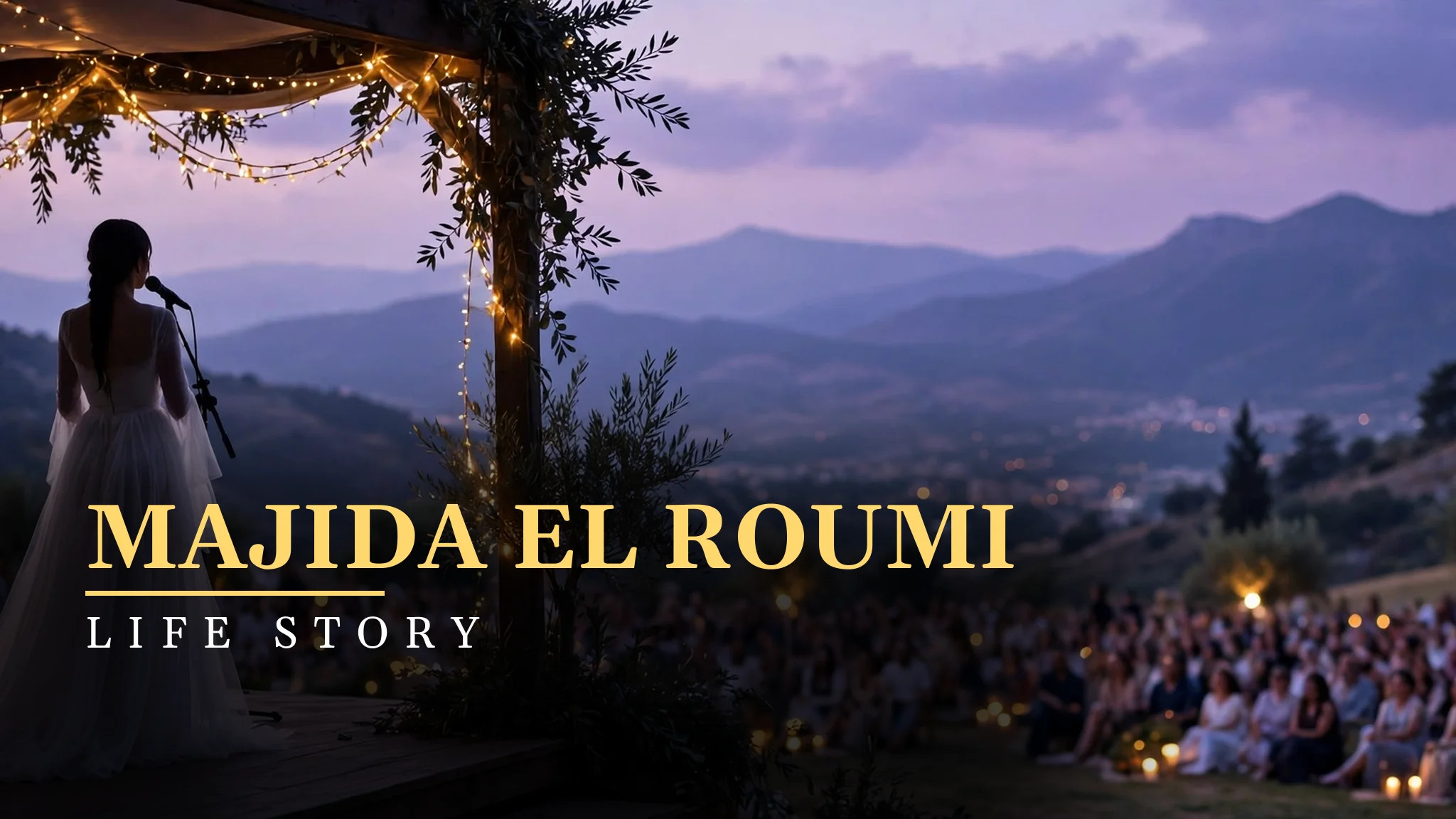
As her fame grew, Majida El Roumi became a singer whose concerts were held in the great halls of the world. She performed in Paris, where her voice filled the Olympia, and she performed in Beirut, where her concerts at the Baalbeck Festival and other venues became events that audiences waited for all year. Her shows were known for their elegance, for the orchestra that played behind her, for the way she dressed, and for the silence that fell over the hall when she began to sing. A Majida concert was not a loud night. It was a night of listening, and the audience listened with respect.
She also performed for important occasions, for national events, and for audiences that included leaders and artists. Her voice was chosen for moments that mattered, because it carried a dignity that few other voices could match. When Lebanon needed a singer to represent it, Majida was often the choice, and she carried that responsibility with grace. She did not use those occasions to promote herself. She used them to sing for her country, and that choice earned her respect.
Her music also reached the wider Arab world, where her songs were loved in Egypt, in the Gulf, in Jordan, and in Syria. She sang in Arabic, and she sang with a clarity that made her words understood across dialects. Her audience was not only Lebanese. It was Arab, and it was made up of people who loved poetry, who loved beauty, and who loved a voice that honoured the words it sang. That wide audience kept her career alive, and it showed that elegance could travel.
She became a familiar face on television, appearing on music shows and in interviews, and her calm manner made her a favourite with audiences. She spoke about her music, about her father, and about Lebanon, and she spoke with a dignity that matched her songs. She did not seek controversy, and she did not use her fame to start arguments. She spoke about what mattered, and she let her songs speak for the rest.
Her albums continued, and each one added new songs to her catalogue. She worked with composers who understood her style, and she chose songs that fitted her voice. She did not record songs that did not suit her, and she did not chase a sound that was not her own. That discipline kept her identity clear, and it is why her music still sounds like Majida El Roumi, even after many years.
Family, Loss, and the Private Woman Behind the Voice
Majida El Roumi’s private life has been marked by both joy and loss, and she has carried both with dignity. She married Antoine Dafone, and the couple had two daughters, Hala and Nour. Her daughters became an important part of her life, and she spoke of them with warmth, while keeping much of their lives away from the public eye. She tried to balance a demanding career with the quiet needs of family life, and she made choices that protected her home.
The marriage later ended in divorce, and the separation was a hard time for her. She spoke little about it in public, and she did not use it for publicity. She kept her dignity, and she focused on her work and on her daughters. That restraint earned her respect, because a public divorce can easily become a public fight, and Majida chose not to make it one. Her fans saw a woman who handled hardship with grace, and they loved her more for it.
She also faced the loss of her father, Halim El Roumi, whose music had shaped her life. His death was a deep loss, and it changed her music, giving it a new depth and a new sadness. A singer who loses a parent sings differently, and Majida’s later songs carry a feeling of memory, of a voice that remembers the man who taught her to sing. She has spoken about her father with love, and about how his lessons stayed with her long after he was gone.
She has also lived through the hard times of Lebanon, through war, through economic crisis, and through the explosion in Beirut in 2020. She spoke about her love for Lebanon, and about her pain at seeing her country suffer, and her songs took on a deeper meaning in those years. A singer who sings about her country while it is hurting must find a way to be honest without giving up hope, and Majida found that way, song after song. Her voice became a comfort to many Lebanese, a reminder of the beauty that remained even in hard times.
Through the ups and downs of her private life, her music remained her anchor. She kept recording, kept performing, and kept singing about love, about Beirut, and about hope, even when her own heart was hurting. That is a difficult thing to do, and it takes strength. A singer who sings with grace while her own life is hard must find a way to be honest without falling apart, and Majida found that way, song after song.
The Olympia and the Concerts That Defined Her
Majida El Roumi’s performance at the Olympia in Paris is one of the great moments of her career, and it deserves to be remembered on its own. The Olympia is a hall where the greatest singers in the world have performed, and to sing there is a mark of honour that few Arab singers have earned. Majida sang there, and her voice, clear and warm, filled the hall, and the audience, many of whom did not speak Arabic, was moved by the beauty of her singing. That night proved that her music did not need translation, because beauty is a language everyone understands.
Her concerts in Beirut were equally important, and they were different in kind. At home, her audience knew her words, knew her poems, and knew her father, and they listened with a respect that a foreign audience cannot give. She performed at the Baalbeck Festival, where her voice rose between ancient temples, and at other great venues in Lebanon, where her songs became part of the country’s cultural life. Those nights were not only shows. They were events, and audiences waited for them all year.
She also performed for important occasions, for national celebrations, and for audiences that included leaders, artists, and diplomats. Her voice was chosen for moments that mattered, because it carried a dignity that few other voices could match. When Lebanon needed a singer to represent it, Majida was often the choice, and she carried that responsibility with grace. She did not use those occasions to promote herself. She used them to sing for her country, and that choice earned her respect.
The orchestra behind her was a part of her sound. She performed with large orchestras, with strings, with woodwinds, and with a conductor who understood her style, and that scale gave her concerts a grandeur that a small band could never match. A Majida concert was not a pop show. It was a classical evening, a night of poetry set to music, and the audience dressed for it, listened in silence, and applauded with warmth. That formality was part of her art, and it made her concerts feel like occasions, not only entertainment.
Those concerts, in Paris, in Beirut, and in the great halls of the Arab world, are the reason her name is spoken with respect. A singer who can fill the Olympia and Baalbeck, who can sing for a foreign audience and for her own people, has a rare gift, and Majida has it. Her voice travels, and it carries Lebanon with it, wherever it goes.
Later Years, Goodwill Work, and a Legacy of Grace
In her later years, Majida El Roumi has remained one of the most respected singers in Lebanon and the Arab world. She continues to perform, to release music, and to appear at important events, and her older songs are still played in homes, on the radio, and in concert halls across the region. A song like Kalimat has become part of the shared memory of a generation, a song that people of different ages know and love. That is a rare achievement, and it is the kind of success that does not fade when a new hit arrives.
She has also been honoured for her work beyond music. She was named a Goodwill Ambassador by the United Nations food agency, a role that recognised her standing and her willingness to use her voice for others. In that role, she spoke about hunger, about children, and about the need to help those who have less. That work showed a different side of her, not only the singer on stage but a woman who cared about the world, and who used her fame to do good.
Her legacy is clear. She showed that a singer could build a career on poetry, on elegance, and on quality, and that a gentle voice could fill large halls. She showed that Lebanese music could be both beautiful and serious, and that a song could be a poem. She also showed younger Lebanese singers, especially women, that there was a path, that they could study, could choose their songs with care, and could build a career on their own terms.
She has influenced a generation of singers who grew up listening to her, and who learned from her choice of songs, her calm stage manner, and her respect for her audience. Her name is mentioned whenever people talk about the great voices of Lebanon, and her songs are taught, studied, and celebrated. That is a legacy that will last, because a voice like hers, when it is true, is heard by each new generation as if it were new.
Today, when Majida El Roumi steps on stage, the audience knows what to expect: a clear voice, a beautiful melody, and a night of poetry set to music. She gives them that, and they give her their love in return. The elegant voice of Lebanon has kept its grace, and it shows no sign of losing it.
My Take:
I think Majida El Roumi is a singer who teaches me that beauty does not need to shout. I have heard many singers who try to impress with power, with high notes, with big gestures, and I often forget their songs a day later. Majida is different. She sings clearly, she sings gently, and her songs stay with me. When I hear Kalimat, I do not think about technique. I think about the words, about the poem, and about the way a voice can make a poem feel new. That is a gift, and it is rarer than a powerful voice.
What I admire most about her is that she was born into music and still chose her path with care. Her father was a composer, and she could have ridden on his name. She did not. She studied, she waited, and she chose her songs one by one, refusing the weak ones. That patience is not common in music, where many young singers record anything they are offered. Majida refused, and her refusal is why her catalogue is so strong. Every song she made was worth making, and that is a rare thing to say about any singer with a career of fifty years.
I also think about what it means to sing poetry. A poem is not a pop song. It has its own rhythm, its own meaning, and it asks the singer to serve the words, not to hide them. Majida serves the words. When she sings Nizar Qabbani, I hear the poet, not only the singer, and I think that is the highest praise I can give her. She does not use poetry to make herself look clever. She uses her voice to make poetry live, and that is a generous act. I wish more singers did that, because the Arab world has great poetry, and it deserves to be sung.
Her song Ya Beirut makes me think about home. I have never lived in Beirut, but I know what it means to love a city that is hurting, and Majida’s song captures that feeling. She sings about Beirut with tenderness, not with anger, and she reminds listeners that a city is more than its buildings. It is its people, its music, its memory. When she sang Ya Beirut during the war, she was giving Lebanese people a way to hold on to their city, even when it was falling apart. That is a powerful thing for a song to do, and I respect her for doing it.
I want to be honest about something I find less strong in her career. Her style has stayed very close to classical Arabic song, and her albums can sound alike to a listener who hears them all at once. The tempos stay slow, the themes stay close to love and poetry, and the sound does not change much from one album to the next. I understand why she did it, because her audience loves that sound, and changing it would be a risk. But I also think a few more surprises, a few songs that stepped outside the familiar world, would have shown us another side of her. A singer who only sings in one style can become a beautiful voice in a narrow room, and I would have liked to hear her step into a wider room now and then.
That said, I do not think the repetition is a fault in the way some critics might say. Poetry is a wide world, and Majida finds different corners of it in each song. One poem is about words, another is about friendship, another is about a city. Those are different feelings, and she sings them differently, even if the style stays close. I think a listener who pays attention will hear the differences, and I think her fans do pay attention, because they listen to her songs in silence, and they know which poem is which.
Her work as a Goodwill Ambassador matters to me, because it shows that she did not keep her voice only for the stage. She used it to speak about hunger, about children, and about people who have less. That is a brave choice for a singer, because it asks her to look beyond her own career, and to care about the world. I respect her for it, and I think it is part of why she is loved, not only as a singer but as a person. A voice that sings beautifully is a gift. A voice that also speaks for others is a greater gift.
I also think about her father, Halim El Roumi, and about the loss of a parent who taught you to sing. That loss must have changed her music, and I can hear a deeper sadness in her later songs, a feeling of memory. I think that sadness makes her music more honest, because a singer who has lost someone sings with a knowledge that a young singer cannot have. I feel sympathy for her, and I admire the way she kept singing after that loss, turning grief into beauty, and giving her audience a way to remember their own loved ones.
I think about the younger women who watch her and think, if she can be elegant and strong, I can be elegant and strong too. That is a powerful message, and it is one of the best things about her career. She did not only make songs. She made a path for women who want to sing with grace, who want to study, who want to choose their songs with care, and who want to build a career on quality. I hope she knows how many young singers she has helped by being herself, and I hope she keeps being herself, because the world needs more voices like hers.
If I had to choose one song to explain Majida El Roumi to someone who had never heard Lebanese music, I would choose Kalimat, because it holds everything she does best in one place. It is a poem, it is a melody, it is sung with clarity, and it is beautiful in a way that needs no translation. I would tell that person to listen to it quietly, to hear the words, and to notice how the song makes them feel calm and moved at the same time. That feeling is the point of her music, and Majida understands it.
In the end, I think Majida El Roumi’s story teaches a simple lesson that I want to remember. You do not have to be loud to be heard. You can be clear, you can be graceful, and you can sing poetry, and the world will listen. Majida did that, and her songs are still played in homes, still sung in concert halls, and still loved across the Arab world. A career built on elegance and quality, sung with a voice like hers, is a career that earns its place, and I am glad her place is secure.
The Olympia in Paris is an image I keep thinking about when I think about Majida El Roumi. A Lebanese woman, singing Arabic poetry, in a hall where the greatest singers in the world have performed, and an audience that does not speak her language being moved to silence by the beauty of her voice. That picture tells me what her career is about. She is not a singer of one country. She is a singer of beauty itself, and beauty does not need translation. When she sang at the Olympia, she carried Lebanon onto a world stage, and the world listened.
Her father, Halim El Roumi, is another part of her story that stays with me. He was a composer, a musician, and a teacher, and he gave his daughter a home filled with music. A child who grows up in such a home learns that music is not entertainment. It is a way of life, a serious art, and a responsibility. Majida learned that, and she carried it into her career, choosing her songs with care, refusing the weak ones, and honouring the poets she sang. I think her father’s lessons are the reason her catalogue is so strong, because she learned early that a song must be worthy of the voice that sings it.
Kalimat is a song I return to often, because it shows what Majida does best. It is a poem by Nizar Qabbani, set to music, and sung with a clarity that honours the poet. When I hear it, I do not only hear a melody. I hear words, and I feel their meaning, and I understand why poetry matters. A singer who can make a poem live is a rare thing, and Majida does it. I wish more singers did that, because the Arab world has great poetry, and it deserves to be sung, not only read.
Her work as a Goodwill Ambassador is something I respect deeply. She used her fame to speak about hunger, about children, and about people who have less, and she did it without making a show of it. That is a brave choice for a singer, because it asks her to look beyond her own career, and to care about the world. I think it is part of why she is loved, not only as a singer but as a person. A voice that sings beautifully is a gift. A voice that also speaks for others is a greater gift.
Ya Beirut is a song that makes me think about home, about a city that is loved even when it is hurting. Majida sang it with tenderness, not with anger, and she reminded listeners that a city is more than its buildings. It is its people, its music, its memory. When she sang Ya Beirut during the war, she was giving Lebanese people a way to hold on to their city, even when it was falling apart. That is a powerful thing for a song to do, and I respect her for doing it.
Her daughters, Hala and Nour, are another part of her story that stays with me. She married, she had children, and she kept singing while raising them. That is hard for any mother, and harder still for a singer who performs in great halls. I admire the way she kept going, and I think her fans saw that and respected it. A mother who sings is a mother who shows her children that work and love can live together, and Majida showed that, year after year, even after her marriage ended.
The loss of her father must have changed her music, and I can hear a deeper sadness in her later songs, a feeling of memory. I think that sadness makes her music more honest, because a singer who has lost someone sings with a knowledge that a young singer cannot have. I feel sympathy for her, and I admire the way she kept singing after that loss, turning grief into beauty, and giving her audience a way to remember their own loved ones.
If a young singer asked me what to learn from Majida El Roumi, I would say three things. First, study poetry, because a singer who understands words sings better. Second, choose your songs with care, and refuse the weak ones, because your catalogue is your legacy. Third, use your voice for others, because fame is a responsibility as well as a gift. Majida did all three, and her career is the proof that they work. She is still here, still singing, still the elegant voice of Lebanon, and that is a lesson worth remembering.
In the end, I think Majida’s story teaches me that beauty does not need to shout. You can be clear, you can be graceful, and you can sing poetry, and the world will listen. She did that, and her songs are still played in homes, still sung in concert halls, and still loved across the Arab world. A career built on elegance and quality, sung with a voice like hers, is a career that earns its place, and I am glad her place is secure.
Frequently Asked Questions
Where was Majida El Roumi born?
Majida El Roumi was born on 13 December 1956 in Kfarshima, a town in the mountains near Beirut, Lebanon. Her father was the composer Halim El Roumi, and she grew up in a home filled with music.
Who was Majida El Roumi’s father?
Her father was Halim El Roumi, a well-known Lebanese composer and musician. He recognised her talent early, and his lessons about music shaped the way she later chose her songs.
What is Majida El Roumi’s most famous song?
Kalimat, based on a poem by Nizar Qabbani, is her most famous song, and it is still played today. Ya Beirut, a song about the city of Beirut, and Koun Sadiqi are also among her best-known works.
Did Majida El Roumi sing at the Olympia in Paris?
Yes, she performed at the Olympia in Paris, one of the great concert halls of Europe. Her performance there was a mark of honour and showed that her music had travelled far beyond Lebanon.
Was Majida El Roumi a Goodwill Ambassador?
Yes, she was named a Goodwill Ambassador by the United Nations food agency, where she spoke about hunger and about helping children and families who have less. The role showed her willingness to use her fame for others.
Is Majida El Roumi still performing?
Yes, she continues to perform and release music, and her older songs are still played widely in Lebanon and across the Arab world. Her concerts still draw audiences who come to listen with respect.


